
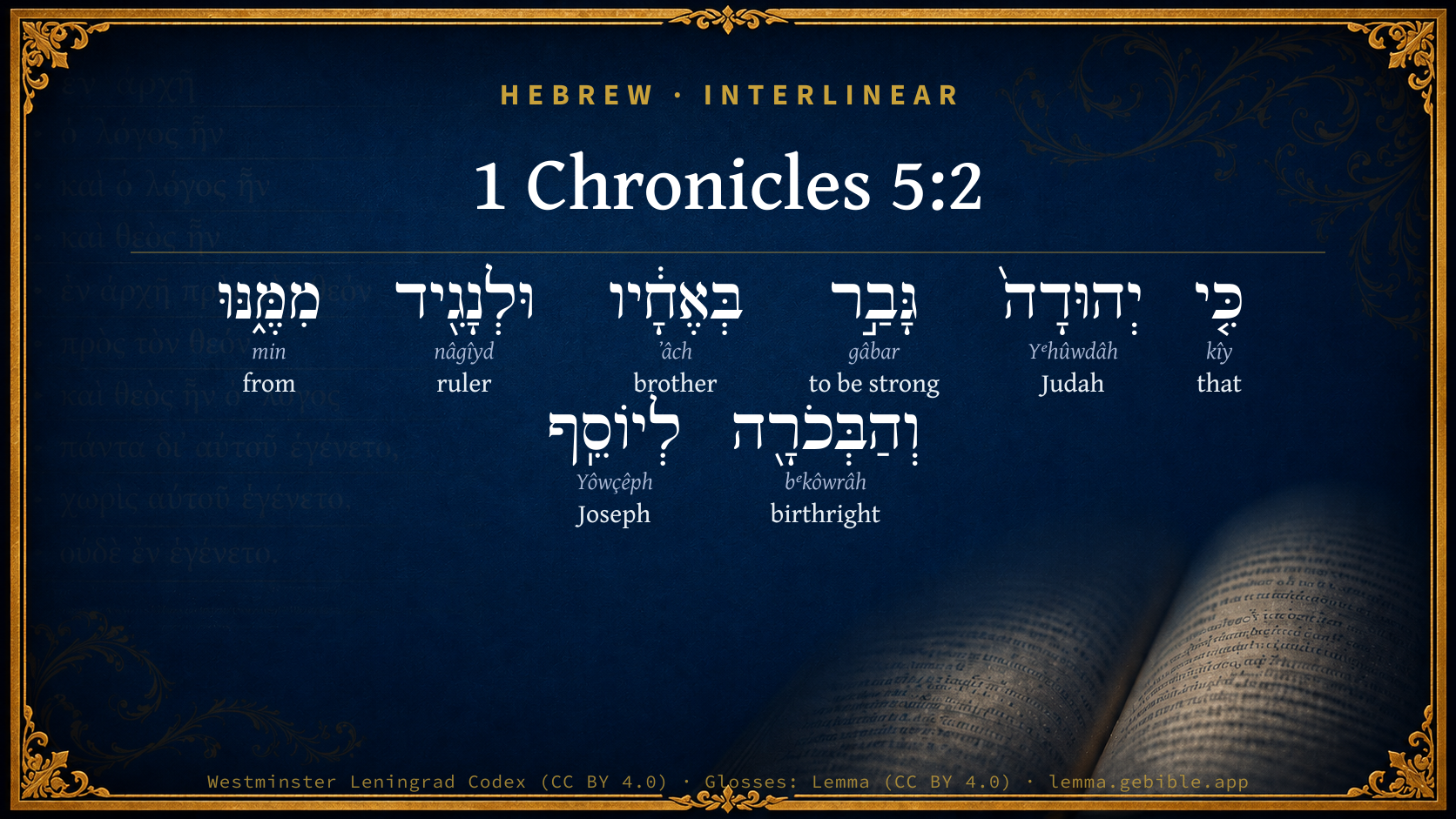
1 Chronicles 5:2

Hebrew (Westminster Leningrad Codex) 1 Chronicles 5:2 appears in the Hebrew Old Testament. The text above is from the Westminster Leningrad Codex. Each word links to its Strong’s number, a concise gloss, and parsing drawn from the Open Scriptures Hebrew Bible morphology. Click any word for its full Brown-Driver-Briggs (BDB) entry.
Download image
Cite this verse

1 Chronicles 5:2 (World English Bible). Public Domain. Lemma interlinear Bible study tool, https://lemma.gebible.app/v/1-chronicles/5/2.

Show BibTeX & RIS
BibTeX
RIS
English Translation
For Judah prevailed above his brothers, and of him came the prince; but the birthright was Joseph's:)
World English Bible · Public Domain
Download a study sheet

One document with this verse’s original text, its word-by-word gloss line, the meaning frame, cross-references with their text, attributed commentary, and full source and license credits — printable, and it pastes into notes with its structure intact.

This verse Autodidact and up

Study sheet (.html) Plain text (.txt)

A passage Seminary Student

Up to 50 verses in one chapter. A passage sheet keeps up to 6 commentary sources and 12 cross-references per verse, in the order this page ranks them, and says so on the sheet whenever that leaves anything out. Ask for a single verse and you get the Autodidact verse sheet above.

Everything on this page stays free to read, with no account — the sheet is a download of what is already on screen, not access to it.

Want to remove ads? Support Godless Engineer
Compare translations 3

The same verse in 3 English versions, stacked beneath the original-language interlinear above. Click any original word for its lexicon entry.

Each is an independent rendering of the whole verse — the interlinear is not word-aligned to these translations.

Highlighted words mark where these versions differ — a whole-verse word diff, not a word-by-word alignment.

  • World English Bible Public Domain
    For Judah prevailed above his brothers, and of him came the prince; but the birthright was Joseph's:)
  • King James Version Public Domain
    For Judah prevailed above his brethren, and of him came the chief ruler; but the birthright was Joseph's:)
  • unfoldingWord Literal Text CC BY-SA 4.0
    though Judah was great among his brothers, and a leader from him, yet the birthright to Joseph—

unfoldingWord Literal Text — © unfoldingWord, licensed CC BY-SA 4.0. Word-aligned USFM3 via Door43 (git.door43.org/unfoldingWord/en_ult).

Versions to compare (up to 4)

3 of 4 selected

Show all 18 translations

Every available English version of this verse, each an independent rendering of the whole verse.

  • World English Bible Public Domain
    For Judah prevailed above his brothers, and of him came the prince; but the birthright was Joseph's:)
  • Berean Standard Bible Public Domain
    And though Judah prevailed over his brothers and a ruler came from him, the birthright belonged to Joseph.
  • Majority Standard Bible Public Domain
    And though Judah prevailed over his brothers and a ruler came from him, the birthright belonged to Joseph.
  • King James Version Public Domain
    For Judah prevailed above his brethren, and of him came the chief ruler; but the birthright was Joseph's:)
  • American Standard Version (1901) Public Domain
    For Judah prevailed above his brethren, and of him came the prince; but the birthright was Joseph's:)
  • Revised Version (1885) Public Domain
    For Judah prevailed above his brethren, and of him came the prince; but the birthright was Joseph’s:)
  • Geneva Bible (1599) Public Domain
    For Iudah preuailed aboue his brethren, and of him came the prince, but the birthright was Iosephs)
  • Douay-Rheims (1899) Public Domain
    But of the race of Juda, who was the strongest among his brethren, came the princes: but the first birthright was accounted to Joseph.)
  • Young's Literal Translation Public Domain
    for Judah hath been mighty over his brother, and for leader above him, and the birthright `is' to Joseph.
  • Literal Standard Version CC BY-SA 4.0
    for Judah has been mighty over his brother, and for leader above him, and the birthright [is] to Joseph—
  • Unlocked Literal Bible CC BY-SA 4.0
    Judah was the strongest of his brothers, and the leader would come from him. But the birthright was Joseph's—
  • unfoldingWord Literal Text CC BY-SA 4.0
    though Judah was great among his brothers, and a leader from him, yet the birthright to Joseph—
  • Darby Bible Public Domain
    for Judah prevailed among his brethren, and of him was the prince, but the birthright was Joseph's),
  • World Messianic Bible Public Domain
    For Judah prevailed above his brothers, and from him came the prince; but the birthright was Joseph’s)—
  • Webster's Bible Public Domain
    For Judah prevailed above his brethren, and of him came the chief ruler; but the birth-right was Joseph's:)
  • Free Bible Version CC BY-SA 4.0
    and even though Judah became the strongest of his brothers and a ruler came from him, the birthright belonged to Joseph.)
  • Bible in Basic English Public Domain
    Though Judah became stronger than his brothers, and from him came the ruler, the birthright was Joseph's:)
  • JPS Tanakh (1917) Public Domain
    For Judah prevailed above his brethren, and of him came he that is the prince; but the birthright was Joseph's —

Literal Standard Version (2020), Covenant Press — licensed CC BY-SA 4.0. Text via the HelloAO Bible API (eBible.org). Unlocked Literal Bible (unfoldingWord) — licensed CC BY-SA 4.0. Text via the HelloAO Bible API (eBible.org). unfoldingWord Literal Text — © unfoldingWord, licensed CC BY-SA 4.0. Word-aligned USFM3 via Door43 (git.door43.org/unfoldingWord/en_ult). Free Bible Version, Dr. Jonathan Gallagher — licensed CC BY-SA 4.0. Text via the HelloAO Bible API (eBible.org).

Word by word

More ways to search: Search by grammar → Find every occurrence → Compare this word →

Practice this passage: Drill this verse → Learn its vocabulary →

וְהַבְּכֹרָ֖ה
bᵉkôwrâh
H1062
“and · the · birthright”
Conjunction + Particle, Definite Article + Noun, Common, Both, Singular, Absolute
Part of Speech
Conjunction + Particle + Noun
Type
Common
Gender
Both
Number
Singular
State
Absolute
Full BDB Definition

Origin: from H1060

TWOT: 244c

birthright, primogeniture, right of the first-born
  1. כִּ֤י kîy H3588 “that” Conjunction
  2. יְהוּדָה֙ Yᵉhûwdâh H3063 “Judah” Noun, Proper
  3. גָּבַ֣ר gâbar H1396 “to be strong” Verb, Qal, Perfect, 3rd Person, Masculine, Singular
  4. בְּאֶחָ֔יו ʼâch H251 “in/at · brothers · his” Preposition + Noun, Common, Masculine, Plural, Construct + Suffix, Personal, 3rd Person, Masculine, Singular
  5. וּלְנָגִ֖יד nâgîyd H5057 “and · to/for · ruler” Conjunction + Preposition + Noun, Common, Masculine, Singular, Absolute
  6. מִמֶּ֑נּוּ min H4480 “from · us” Preposition + Suffix, Personal, 1st Person, Common, Plural
  7. לְיוֹסֵֽף Yôwçêph H3130 “to/for · Joseph” Preposition + Noun, Proper

About this verse

These counts appear in no published source. They are computed here, from the morphology-tagged text and Lemma’s own curated glosses. What Lemma adds →

8
words
8
distinct lemmas
Historical
section

Notable vocabulary

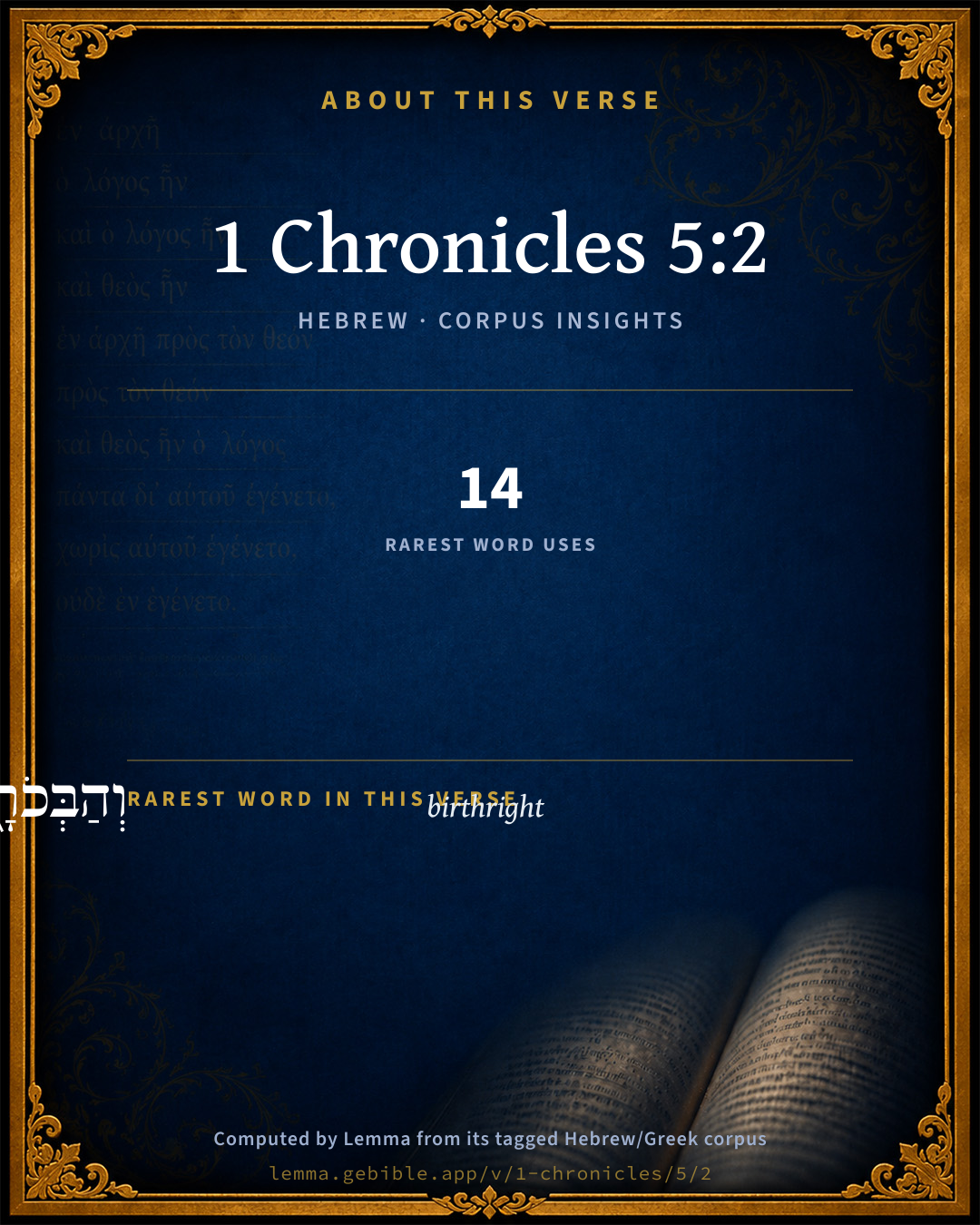
The rarest word here is וְהַבְּכֹרָ֖ה birthright H1062 — appearing just 14 times in the whole Hebrew Bible.

Shared distinctive vocabulary

וְהַבְּכֹרָ֖ה birthright H1062 occurs in 13 verses of the Hebrew Bible. Also found in:

Grammatical profile

  • 1 verb
  • 5 nouns
  • 1 preposition
  • 1 conjunction

Verb forms

  • גָּבַ֣ר Qal · Perfect

Hebrew & Septuagint length

In English translation the verse runs 17 words from the Hebrew and 24 from the Septuagint (LXX English) — the Septuagint runs noticeably longer here. See the side-by-side →

A rough comparison of the two English renderings, which tokenize alike — not a word-level alignment.

Word counts can differ between the Hebrew and the Greek without any difference in meaning — e.g. the Hebrew direct-object marker אֵת has no separate Greek word, and Greek often adds the article ὁ.

Cross-references

20

Topical passages linked to 1 Chronicles 5:2 in the Treasury of Scripture Knowledge — connected by theme and wording, ordered by reader-vote popularity; previews shown in the World English Bible.

  • Matthew 2:6 'You Bethlehem, land of Judah, Are in no way least among the princes of Judah: For out of you shall come forth a governor, Who shall shepherd my people, Israel.'"
  • Micah 5:2 But you, Bethlehem Ephrathah, Being small among the clans of Judah, Out of you one will come forth to me that is to be ruler in Israel; Whose goings forth are from of old, from everlasting.
  • Genesis 49:8–10 "Judah, your brothers will praise you: Your hand will be on the neck of your enemies; Your father's sons will bow down before you.
  • Psalms 60:7 Gilead is mine, and Manasseh is mine. Ephraim also is the defense of my head. Judah is my scepter.
  • Hebrews 7:14 For it is evident that our Lord has sprung out of Judah, about which tribe Moses spoke nothing concerning priesthood.
  • Psalms 108:8 Gilead is mine. Manasseh is mine. Ephraim also is my helmet. Judah is my scepter.
  • Psalms 78:68–71 But chose the tribe of Judah, Mount Zion which he loved.
  • Jeremiah 23:5–6 Behold, the days come, says Yahweh, that I will raise to David a righteous Branch, and he shall reign as king and deal wisely, and shall execute justice and righteousness in the land.
  • Genesis 35:23 The sons of Leah: Reuben (Jacob's firstborn), Simeon, Levi, Judah, Issachar, and Zebulun.
  • Genesis 49:26 The blessings of your father Have prevailed above the blessings of the ancient mountains, Above the bounty of the age-old hills. They will be on the head of Joseph, On the crown of the head of him who is separated from his brothers.
  • Numbers 2:3 Those who encamp on the east side toward the sunrise shall be of the standard of the camp of Judah, according to their divisions: and the prince of the children of Judah shall be Nahshon the son of Amminadab.
  • Numbers 7:12 He who offered his offering the first day was Nahshon the son of Amminadab, of the tribe of Judah,
  • Joshua 14:6 Then the children of Judah drew near to Joshua in Gilgal: and Caleb the son of Jephunneh the Kenizzite said to him, You know the thing that Yahweh spoke to Moses the man of God concerning me and concerning you in Kadesh-barnea.
  • Judges 1:2 Yahweh said, Judah shall go up: behold, I have delivered the land into his hand.
  • 1 Samuel 16:1 Yahweh said to Samuel, How long will you mourn for Saul, seeing I have rejected him from being king over Israel? fill your horn with oil, and go: I will send you to Jesse the Bethlehemite; for I have provided me a king among his sons.
  • 1 Samuel 16:10 Jesse made seven of his sons to pass before Samuel. Samuel said to Jesse, Yahweh has not chosen these.
  • 1 Samuel 16:12 He sent, and brought him in. Now he was ruddy, and withal of a beautiful face, and goodly to look on. Yahweh said, Arise, anoint him; for this is he.
  • 2 Samuel 8:15 David reigned over all Israel; and David executed justice and righteousness to all his people.
  • Romans 8:29 For whom he foreknew, he also predestined to be conformed to the image of his Son, that he might be the firstborn among many brothers.
  • Revelation 5:5 One of the elders said to me, "Don't weep. Behold, the Lion who is of the tribe of Judah, the Root of David, has overcome; he who opens the book and its seven seals."

Cross-references courtesy of OpenBible.info (CC BY 4.0).

Hebrew and Greek witnesses Masoretic Hebrew ↔ Greek Septuagint

The same verse in the two great witnesses to the Old Testament, shown verse-for-verse.

Here the Septuagint runs noticeably longer than the Hebrew — LXX2012 (modern English Septuagint) 24 words vs World English Bible 17. A rough length comparison of the two English translations, not a word-level alignment — read both below.

These are two independent witnesses, not word-aligned to each other, and the Septuagint is shown in lemma (dictionary) form.

Hebrew 1 Chronicles 5:2 Masoretic · Westminster Leningrad Codex

כִּ֤י יְהוּדָה֙ גָּבַ֣ר בְּאֶחָ֔יו וּלְנָגִ֖יד מִמֶּ֑נּוּ וְהַבְּכֹרָ֖ה לְיוֹסֵֽף

For Judah prevailed above his brothers, and of him came the prince; but the birthright was Joseph's:)

World English Bible · Public Domain

Greek LXX 1 Chronicles 5:2 Septuagint · lemma form

ὅτι ἰούδας δυνατός ἰσχύς καί ἐν ὁ ἀδελφός αὐτός καί εἰς ἡγέομαι ἐκ αὐτός καί ὁ εὐλογία ὁ ιωσηφ

for Judas was very mighty even among his brethren, and one was to be a ruler out of him: but the blessing was Joseph's).

LXX2012 (modern English Septuagint) · Public Domain

On this verse, Ellicott's Commentary for English Readers discusses the Septuagint’s reading. Read the note in Commentary ↓

Hebrew: Westminster Leningrad Codex (CC BY 4.0). Greek: Septuagint (public domain); English from LXX2012 (modern English Septuagint) (Public Domain). How the Septuagint differs from the Hebrew →

Commentary

Notes on 1 Chronicles 5:2 from classic Christian and Jewish commentators (each source and its license shown beneath its notes). The classic Christian expositions comment on the surrounding passage and are grouped to its opening verse, so a note may address several verses; the Jewish commentaries on the Tanakh (Rashi and others) are per-verse, so they appear only where the commentator wrote on this verse.

Lemma curates 59 commentaries, every one of them public domain or Creative Commons licensed, each selected and text-cleaned for this edition rather than reprinted as found. About our sources →

Trapp's Complete Commentary

John Trapp

1Ch 5:2 For Judah prevailed above his brethren, and of him [came] the chief ruler; but the birthright [was] Joseph’s:)

Ver. 2. For Judah prevailed above his brethren.] As was foretold. {Gen 49:8-10} {See Trapp on "Gen 49:8"} {See Trapp on "Gen 49:9"} {See Trapp on "Gen 49:10"}

And of him came the chief ruler.] Jesus Christ especially. {Heb 7:14}

But the birthright was Joseph’s.] Quod ad fructum attinet.

John Trapp, A Commentary or Exposition upon All the Books of the Old and New Testament (1647–1656) — public domain. Text from a community e-Sword module.

The Biblical Illustrator

Joseph S. Exell

1Ch_5:2

And of him came the Chief Ruler.

The Chief Ruler

I read of the rulers of the darkness of this world; the rulers of synagogues; the rulers that set themselves against the Lord and against His Anointed; but none of them are Chief. Christ is the Chief Ruler.

I. His appointment to office (Pro_8:22-31; Psa_2:6-9).

1. He rules in the Church.

2. He rules in the hearts of His people.

II. His essential qualifications for that office.

1. Infinite wisdom.

2. Invincible power.

3. Order.

III. The mercies unfolded in it.

1. By it is maintained the truth of God.

2. His empire is secured through it. He must rule until every enemy submits (Psa_72:11; Isa_11:7).

3. Triumphs are secured to us and repeatedly realised by our Chief Ruler.

(1) Over temptations (1Co_10:13).

(2) Over every difficulty in providence (Isa_13:16). (Joseph Irons.)

The Biblical Illustrator, edited by Joseph S. Exell (c. 1880s–1900s) — public domain. Text from a community e-Sword module.

Joseph Benson's Commentary

1Ch 5:2. For Judah — Not the person, (for in person Joseph prevailed,) but the tribe of Judah. Prevailed — Excelled the other tribes, especially in the following privilege. And of him — Rather, For of him, as the Hebrew ו, vau, is often used: this being a reason of the foregoing assertion, or declaration, showing wherein he did prevail. Came the chief ruler — The government was, by God’s promise and appointment, to be seated chiefly and most durably in that tribe, first in David and his successors, and then in the Messiah, who sprang out of Judah, (Heb 7:14,) which was a far greater privilege than the birthright. But, or although, the birthright was Joseph’s — So this prevents or removes an objection to Judah’s precedency taken from the birthright.

Joseph Benson's Commentary on the Old and New Testaments (1811–1818) — public domain. Text from a community e-Sword module.

Geneva Bible (1599)

Geneva Bible translators

That is, he was the chiefest of all the tribes according to Jacob’s prophecy, Gen. 49:8, and because Christ should come of him.

Geneva Bible (1599) marginal notes — public domain. Text via Bolls.life.

Adam Clarke's Commentary

Verse 2. And of him came the chief ruler] This is, by both the Syriac and Arabic, understood of Christ: "From Judah the King Messiah shall proceed." The Chaldee paraphrases the verse thus: "Seeing Judah prevailed over his brethren, so the kingdom was taken from Reuben and given to Judah; and because he was strong, so was his kingdom. Levi also was godly, and did not transgress in the matter of the golden calf; therefore the high priesthood was taken away from the children of Reuben, and on their account from all the first-born, and given to Aaron and his sons. The custody of the sanctuary belonged to the Levites, but the birthright to Joseph." - T.

Adam Clarke's Commentary on the Bible (1810–1826) — public domain. Text from a community e-Sword/MySword module.

Ellicott's Commentary for English Readers

(2) For Judah prevailed above his brethren.—Literally, was mighty among his brethren. Comp. Jacob’s blessing (Gen_49:8-10): “Judah, thou—thy brethren shall praise thee, Thy hand shall be on the neck of thy foes, Thy father’s sons shall bow before thee. Sceptre shall not depart from Judah, Nor doom-staff from between his feet,” &c. (See also Jdg_1:1-2, where Judah is divinely commissioned to lead the attack upon the Canaanites.) At the census of Moses, Judah greatly outnumbered any other single tribe (Num_1:27).

And of him came the chief ruler.—“And from him (one was to become) prince.” Literally, and for a prince—out of him. (Comp. Mic_5:1.) LXX., εἰς ἡγούμενον ἐξ αὐτοῦ. David is meant, as in 1Sa_13:14. We may also remember the word of the apostolic writer: “It is evident that our Lord sprang out of Judah” (Heb_7:4). The prophecy concerning the royal dignity of Judah is only thus exhausted of its meaning.

But the birthright was Joseph’s, who actually received the “double portion” in the two tribal domains of Ephraim and Manasseh.

A Bible Commentary for English Readers, edited by Charles John Ellicott (1878–1897) — public domain. Text from a community e-Sword module.

The Cambridge Bible for Schools and Colleges

gen. ed. J. J. S. Perowne

2. Judah prevailed above his brethren] Cp. Gen_49:8 (Jacob to Judah) “Thy father’s children shall bow down before thee.”

the chief ruler] R.V. the prince. The Heb. word is nâgîd, translated “captain” (1Sa_13:14, A.V.) and “ruler” (2Sa_7:8, A.V.). The prophets seem to prefer this word to melech, “king” as the title of the head of the Israelite state. The immediate reference is to David (Saul being virtually ignored by the Chronicler), but (since David is a typical character) a further reference in the words is possible. The Peshitta (a Judaeo-Christian work) translates, From him shall come forth (acc. to another reading, hath come forth) King Messiah.

The Cambridge Bible for Schools and Colleges (gen. ed. J. J. S. Perowne; Cambridge University Press, 1878–1918) — public domain. Text from a community e-Sword module.

John Gill's Exposition

For Judah prevailed above his brethren,.... That is, the tribe of Judah prevailed above the rest in number, in valour, and courage, and in dignity; wherefore the genealogy is not reckoned according to birthright, but dignity and dominion; hence this genealogical account began with Judah:

because of him came the chief ruler; David and the kings of Judah, his successors; and above all, from him the Prince Messiah was to spring, and did, according to Gen 49:10 so both the Syriac and Arabic versions read,"out of Judah should go forth the King Messiah:"

but the birthright was Joseph's or "though" (p) it was; yet Judah having the dominion and dignity, that tribe is first genealogized.

(p) Licet, ibid. (Tigurine version)

John Gill's Exposition of the Whole Bible (1746–1763) — public domain (CC PDM 1.0). Text via the HelloAO Bible API.

Haydock's Catholic Bible Commentary

Accounted to Joseph, viz., as to the double portion, which belonged to the first-born: but the princely dignity was given to Juda, and the priesthood to Levi. (Challoner) --- Yet it is not certain that the latter dignity formed a part of the birth-right, (Genesis xxv. 31.) and the author takes no notice of it. (Calmet) --- The double portion seems to have been all the privilege, Deuteronomy xxi. 17. Septuagint, "the blessing or gift was Joseph’s." Hebrew also does not specify princes, but "the leader," (Haydock) the Messias, (Syriac, &c.) and kings, from David till the captivity. (Calmet) (Genesis xlix. 4.) (Worthington)

George Leo Haydock (1774–1849), Haydock's Catholic Family Bible and Commentary, 1859 edition — public domain. Excludes Psalms (Douay-Rheims chapter numbering differs from Protestant) and Deuterocanonical books (Catholic canon only).

Matthew Poole's English Annotations

Judah; not the person, (for so Joseph prevailed,) but the tribe of Judah.

Prevailed above his brethren; excelled the other tribes in number and power, and especially in the following privilege.

And of him, or for of him, as the Hebrew vau is oft used; this being a reason of the foregoing assertion, or a declaration wherein he did prevail.

Came the chief ruler; the government was by God’s promise and appointment to be seated chiefly and most durably in that tribe, first in David and his successors, and then in the Messiah, who sprang out of Judah, Heb 7:14, which was a far greater privilege than the birthright. Or, as to the ruler, (i.e. as to the point of dominion,) he was more than he, or preferred before him, i.e. before Joseph, who is named in the very next clause, the pronoun being referred unto the following noun, which is frequent among the Hebrews, as Psa 87:1; 105:19.

But the birthright; or,

although, as vau is oft used; so this prevents or removes an objection against Judah’s precedency taken from his birthright.

Matthew Poole's English Annotations on the Holy Bible (1683–1685) — public domain. Text from a community e-Sword/MySword module.

The Pulpit Commentary

Birthrights and supremacies.

A significant fact of the early history of the patriarchs is here brought to remembrance. It is one so curious as to carry suggestions and lessons for all the ages, and so is recorded for our instruction. By providential arrangement the tribal birthright was Reuben"s; he, however, lost it through his wrongdoing, and his father shifted it from the eldest son of his first with to the eldest son of his second but really his own chosen wife from Reuben to Joseph. Man"s adjustments of the Divine order are not always sealed by God. Jacob"s were not in this case. As the years passed on, Judah came to the front, ultimately gained the sovereignty, and from this tribe came the permanent Davidic dynasty. Joseph, represented by the tribe of Ephraim, struggled, age after age, to keep the birthright place, but in vain; and in the conflict of the two tribes we may find illustration of the hopelessness of pressing mere human adjustments against the providential order. Neither the individual nor the community may ever hope to "resist God and prosper." It is ever ill work "running upon the bosses of Jehovah"s buckler.

I MAN CANNOT READJUST THE DIVINE ORDER. Yet that is exactly what we, in our self-will, are ever striving to do. Even when we know what is God"s will, we try to get it twisted about so that it may at least seem to conform to our will. This is a very common but very subtle form of Christian error and sin. We know what we wish or want, so we deceive ourselves into the idea that this is what God wishes or wants for us, and fail in that simple openness to Divine lead which is the right spirit to cherish. Scripture illustrations may be found in Rebekah, whose will was to gain the birthright and blessing for her favourite son, so she took the Divine order into her own adjustment, and won those things for him by deceptions which, very properly, brought heavy penalties on her and on him. Or in Balaam, who professed to do exactly what God wished him to do, and yet evidently did what he himself planned to do, forcing from God that fatal "Go." Or in Saul, who could not simply wait God"s time and the arrival of his prophet, but, arranging the Divine order according to his own self-will, must himself offer the sacrifice. The forms in which nowadays men take the ordering of their lives into their own hands may be illustrated, and, as a contrast, mention may be made of David, who, though tempted to slay King Saul, would not interfere with the Divine order, though he might easily have seemed to himself to have been only fulfilling the Divine promise. We must wait for God as well as on him.

II MAN FINDS HIS TRUE GOOD IN FOLLOWING THE DIVINE ORDER. Not in the helplessly passive way of poor aged Eli, but in an active and loyal way, we may say, "It is the Lord; let him do what seemeth him good." Keble expresses the right state of mind for the child of God, in his picture of the man sanctified by affliction, "wishing, no longer struggling, to be free." The Divine order for our life may differ wholly from the order of our own plannings. It may even seem to flesh and blood painful and humiliating. Still let life unfold, and it proves the way of best blessing for us and for others through us. Let eternity unfold, and we sing through all the ages of the "good way wherein the Lord our God led us." David shows us the attitude to which the Divine order is revealed. "The meek will he guide in judgment, and the meek will he teach his way.

III FOLLOWING THE DIVINE ORDER MAY LEAD A MAN TO HIGHER THINGS THAN HIS BIRTH PROMISED. Illustrate from Judah, and from cases of men born in the disabilities of poverty, or of the weakness of hereditary disease, who have been led in God"s providence to high place, powers, and usefulness. Let us find our faculty and endowment. It is the key to God"s purpose in our life; let us develop it. Life will then bring to us its best. Let us but follow on along the line of our Divine endowment, and even the "least may become the first. R.T.

The Pulpit Commentary (1880–1919), ed. H.D.M. Spence-Jones & Joseph S. Exell — public domain. Text from a community e-Sword module.

John Wesley's Explanatory Notes

Judah - Not the person, but the tribe of Judah. Prevailed - Excelled the other tribes, especially in the following privilege.

John Wesley, Explanatory Notes Upon the Whole Bible (1754–1765) — public domain. Text via the GEBible commentary corpus.

Keil & Delitzsch

C. F. Keil & F. Delitzsch

For Judah prevailed above his brethren,.... That is, the tribe of Judah prevailed above the rest in number, in valour, and courage, and in dignity; wherefore the genealogy is not reckoned according to birthright, but dignity and dominion; hence this genealogical account began with Judah:

because of him came the chief ruler; David and the kings of Judah, his successors; and above all, from him the Prince Messiah was to spring, and did, according to Gen 49:10 so both the Syriac and Arabic versions read,"out of Judah should go forth the King Messiah:"

but the birthright was Joseph's or "though" (p) it was; yet Judah having the dominion and dignity, that tribe is first genealogized.

(p) Licet, ibid. (Tigurine version)

Keil & Delitzsch — Biblical Commentary on the Old Testament (1861–1891) — public domain (CC PDM 1.0). Text via the HelloAO Bible API. (Old Testament only.)

Rashi

Rabbi Shlomo Yitzchaki (Rashi)

Because Judah prevailed over his brothers as it says (Gen. 49:9): “Judah is a lion’s cub.”

and the one appointed as prince was to be from him the kingship emanated from him, and for this reason the king was called נָגִיד, since he is the one who leads [the people] out and brings them in [the Aramaic root נגד means to pull or lead.] And the birthright and the throne were taken from Reuben, and the throne was given to Judah, as it is written: “Because Judah prevailed over his brothers”; but the share of the birthright was given to Joseph, to his two sons.

Rashi on the Tanakh — English translations: “The Judaica Press complete Tanach with Rashi, translated by A. J. Rosenberg” (CC BY 4.0); “Pentateuch with Rashi's commentary by M. Rosenbaum and A.M. Silbermann, 1929-1934” (public domain); “The Metsudah Tanach series, Lakewood, N.J” (CC BY 4.0); and “The Book of Joshua, Metsudah Publications, 1997” (CC BY 4.0). Text via Sefaria.

Lesson kit

Teaching starters — assembled from the data on this page, not authored interpretation. Every prompt links to the verse data it draws on. Edit before teaching.

1 Chronicles, in the Historical, opens this verse with 8 words (8 distinct Hebrew lemmas). Its most distinctive word is bᵉkôwrâh (“birthright”). The Greek Septuagint runs longer here. A historical commentator’s framing appears above. Read the whole chapter for the surrounding context.

Discussion questions

  1. What does “birthright” (bᵉkôwrâh) contribute to the verse as a whole?
  2. Genesis 4:4 shares the word «birthright» with this verse. How do the two illuminate each other?
  3. Compared with the Hebrew, the Septuagint runs longer here. What questions does that raise?
  4. These translations render this verse differently. What is at stake in choosing one wording over another?
  5. The verb «גָּבַ֣ר» is Qal Perfect. How does its form color the action?
  6. Reading how Trapp's Complete Commentary and The Biblical Illustrator read this verse, where do the two commentators agree and where do they part?

Things to notice

Reading settings

Reading text

Shown beneath each verse's original-language words.

Old Testament
Old Testament edition

Read the OT as the Masoretic Hebrew (MT) or the Greek Septuagint (LXX).

English shown for the Greek Septuagint (in the Hebrew ↔ Greek comparison).

Comparing translations? Open the Compare panel on any verse page to stack up to four side by side.