1 Kings 15:17

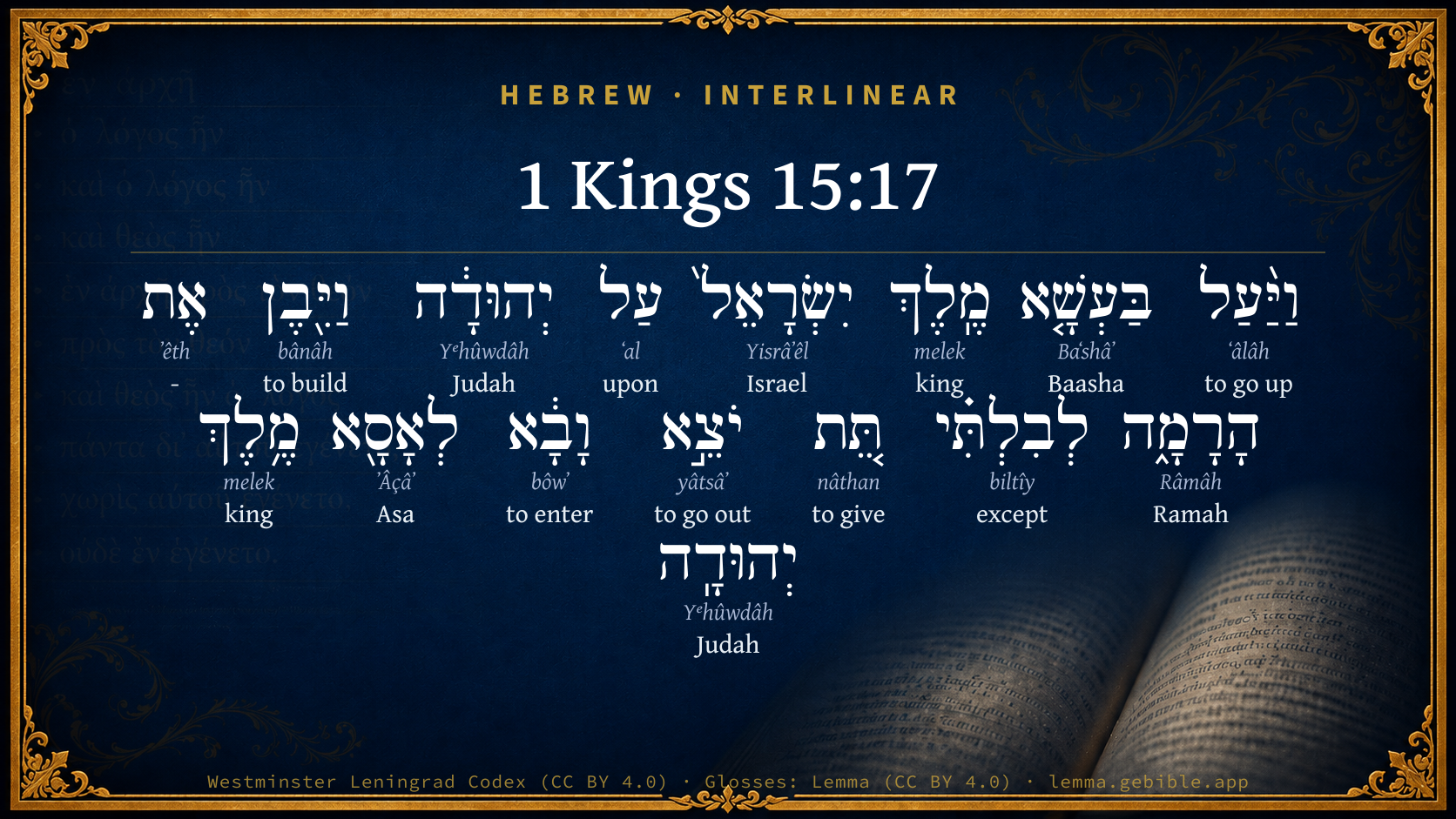
Hebrew (Westminster Leningrad Codex) 1 Kings 15:17 appears in the Hebrew Old Testament. The text above is from the Westminster Leningrad Codex. Each word links to its Strong’s number, a concise gloss, and parsing drawn from the Open Scriptures Hebrew Bible morphology. Click any word for its full Brown-Driver-Briggs (BDB) entry.
Download image
Cite this verse

1 Kings 15:17 (World English Bible). Public Domain. Lemma interlinear Bible study tool, https://lemma.gebible.app/v/1-kings/15/17.

Show BibTeX & RIS
BibTeX
RIS
English Translation
Baasha king of Israel went up against Judah, and built Ramah, that he might not allow anyone to go out or come in to Asa king of Judah.
World English Bible · Public Domain
Download a study sheet

One document with this verse’s original text, its word-by-word gloss line, the meaning frame, cross-references with their text, attributed commentary, and full source and license credits — printable, and it pastes into notes with its structure intact.

This verse Autodidact and up

Study sheet (.html) Plain text (.txt)

A passage Seminary Student

Up to 50 verses in one chapter. A passage sheet keeps up to 6 commentary sources and 12 cross-references per verse, in the order this page ranks them, and says so on the sheet whenever that leaves anything out. Ask for a single verse and you get the Autodidact verse sheet above.

Everything on this page stays free to read, with no account — the sheet is a download of what is already on screen, not access to it.

Want to remove ads? Support Godless Engineer
Compare translations 3

The same verse in 3 English versions, stacked beneath the original-language interlinear above. Click any original word for its lexicon entry.

Each is an independent rendering of the whole verse — the interlinear is not word-aligned to these translations.

Highlighted words mark where these versions differ — a whole-verse word diff, not a word-by-word alignment.

  • World English Bible Public Domain
    Baasha king of Israel went up against Judah, and built Ramah, that he might not allow anyone to go out or come in to Asa king of Judah.
  • King James Version Public Domain
    And Baasha king of Israel went up against Judah, and built Ramah, that he might not suffer any to go out or come in to Asa king of Judah.
  • unfoldingWord Literal Text CC BY-SA 4.0
    And Baasha, the king of Israel, went up against Judah, and he built Ramah so as not to give going out or coming in to Asa, the king of Judah.

unfoldingWord Literal Text — © unfoldingWord, licensed CC BY-SA 4.0. Word-aligned USFM3 via Door43 (git.door43.org/unfoldingWord/en_ult).

Versions to compare (up to 4)

3 of 4 selected

Show all 18 translations

Every available English version of this verse, each an independent rendering of the whole verse.

  • World English Bible Public Domain
    Baasha king of Israel went up against Judah, and built Ramah, that he might not allow anyone to go out or come in to Asa king of Judah.
  • Berean Standard Bible Public Domain
    Baasha king of Israel went to war against Judah and fortified Ramah to prevent anyone from leaving or entering the territory of Asa king of Judah.
  • Majority Standard Bible Public Domain
    Baasha king of Israel went to war against Judah and fortified Ramah to prevent anyone from leaving or entering the territory of Asa king of Judah.
  • King James Version Public Domain
    And Baasha king of Israel went up against Judah, and built Ramah, that he might not suffer any to go out or come in to Asa king of Judah.
  • American Standard Version (1901) Public Domain
    And Baasha king of Israel went up against Judah, and built Ramah, that he might not suffer any one to go out or come in to Asa king of Judah.
  • Revised Version (1885) Public Domain
    And Baasha king of Israel went up against Judah, and built Ramah, that he might not suffer any to go out or come in to Asa king of Judah.
  • Geneva Bible (1599) Public Domain
    Then Baasha king of Israel went vp against Iudah, and buylt Ramah, so that he woulde let none go out or in to Asa King of Iudah.
  • Douay-Rheims (1899) Public Domain
    And Baasa king of Israel went up against Juda, and built Rama, that no man might go out or come in, of the side of Asa king of Juda.
  • Young's Literal Translation Public Domain
    and Baasha king of Israel goeth up against Judah, and buildeth Ramah, not to permit any one going out and coming in to Asa king of Judah.
  • Literal Standard Version CC BY-SA 4.0
    and Baasha king of Israel goes up against Judah, and builds Ramah, not to permit anyone going out and coming in to Asa king of Judah.
  • Unlocked Literal Bible CC BY-SA 4.0
    Baasha king of Israel, acted aggressively against Judah and built up Ramah, so that he might not allow anyone to leave or enter into the land of Asa king of Judah.
  • unfoldingWord Literal Text CC BY-SA 4.0
    And Baasha, the king of Israel, went up against Judah, and he built Ramah so as not to give going out or coming in to Asa, the king of Judah.
  • Darby Bible Public Domain
    And Baasha king of Israel came up against Judah, and built Ramah, in order to let none go out or come in to Asa king of Judah.
  • World Messianic Bible Public Domain
    Baasha king of Israel went up against Judah, and built Ramah, that he might not allow anyone to go out or come in to Asa king of Judah.
  • Webster's Bible Public Domain
    And Baasha king of Israel went up against Judah, and built Ramah, that he might not suffer any to go out or come in to Asa king of Judah.
  • Free Bible Version CC BY-SA 4.0
    Baasha, king of Israel, attacked Judah and fortified Ramah to stop people coming from or going to Asa, king of Judah.
  • Bible in Basic English Public Domain
    And Baasha, king of Israel, went up against Judah, building Ramah, so that no one was able to go out or in to Asa, king of Judah.
  • JPS Tanakh (1917) Public Domain
    And Baasa king of Israel went up against Judah, and built Ramah, that he might not suffer any to go out or come in to Asa king of Judah.

Literal Standard Version (2020), Covenant Press — licensed CC BY-SA 4.0. Text via the HelloAO Bible API (eBible.org). Unlocked Literal Bible (unfoldingWord) — licensed CC BY-SA 4.0. Text via the HelloAO Bible API (eBible.org). unfoldingWord Literal Text — © unfoldingWord, licensed CC BY-SA 4.0. Word-aligned USFM3 via Door43 (git.door43.org/unfoldingWord/en_ult). Free Bible Version, Dr. Jonathan Gallagher — licensed CC BY-SA 4.0. Text via the HelloAO Bible API (eBible.org).

Word by word

More ways to search: Search by grammar → Find every occurrence → Compare this word →

Practice this passage: Drill this verse → Learn its vocabulary →

בַּעְשָׁ֤א
Baʻshâʼ
H1201
“Baasha”
Noun, Proper
Part of Speech
Noun
Type
Proper
Full BDB Definition

Origin: from an unused root meaning to stink

TWOT: None

Baasha = "wicked" - third king of the northern kingdom of Israel and the founder of its second dynasty having killed the second king, Nadab
  1. וַיַּ֨עַל ʻâlâh H5927 “and · to go up” Conjunction + Verb, Qal, Sequential Imperfect, 3rd Person, Masculine, Singular
  2. מֶֽלֶךְ melek H4428 “king of” Noun, Common, Masculine, Singular, Construct
  3. יִשְׂרָאֵל֙ Yisrâʼêl H3478 “Israel” Noun, Proper
  4. עַל ʻal H5921 “upon” Preposition
  5. יְהוּדָ֔ה Yᵉhûwdâh H3063 “Judah” Noun, Proper
  6. וַיִּ֖בֶן bânâh H1129 “and · to build” Conjunction + Verb, Qal, Sequential Imperfect, 3rd Person, Masculine, Singular
  7. אֶת ʼêth H853 “-” Particle, Direct Object
  8. הָרָמָ֑ה Râmâh H7414 “the · Ramah” Particle, Definite Article + Noun, Proper
  9. לְבִלְתִּ֗י biltîy H1115 “to/for · except” Preposition + Conjunction
  10. תֵּ֚ת nâthan H5414 “to give” Verb, Qal, Infinitive Construct
  11. יֹצֵ֣א yâtsâʼ H3318 “going out” Verb, Qal, Participle Active, Masculine, Singular, Absolute
  12. וָבָ֔א bôwʼ H935 “and · entering” Conjunction + Verb, Qal, Participle Active, Masculine, Singular, Absolute
  13. לְאָסָ֖א ʼÂçâʼ H609 “to/for · Asa” Preposition + Noun, Proper
  14. מֶ֥לֶךְ melek H4428 “king of” Noun, Common, Masculine, Singular, Construct
  15. יְהוּדָֽה Yᵉhûwdâh H3063 “Judah” Noun, Proper

About this verse

These counts appear in no published source. They are computed here, from the morphology-tagged text and Lemma’s own curated glosses. What Lemma adds →

16
words
14
distinct lemmas
Historical
section

Shared distinctive vocabulary

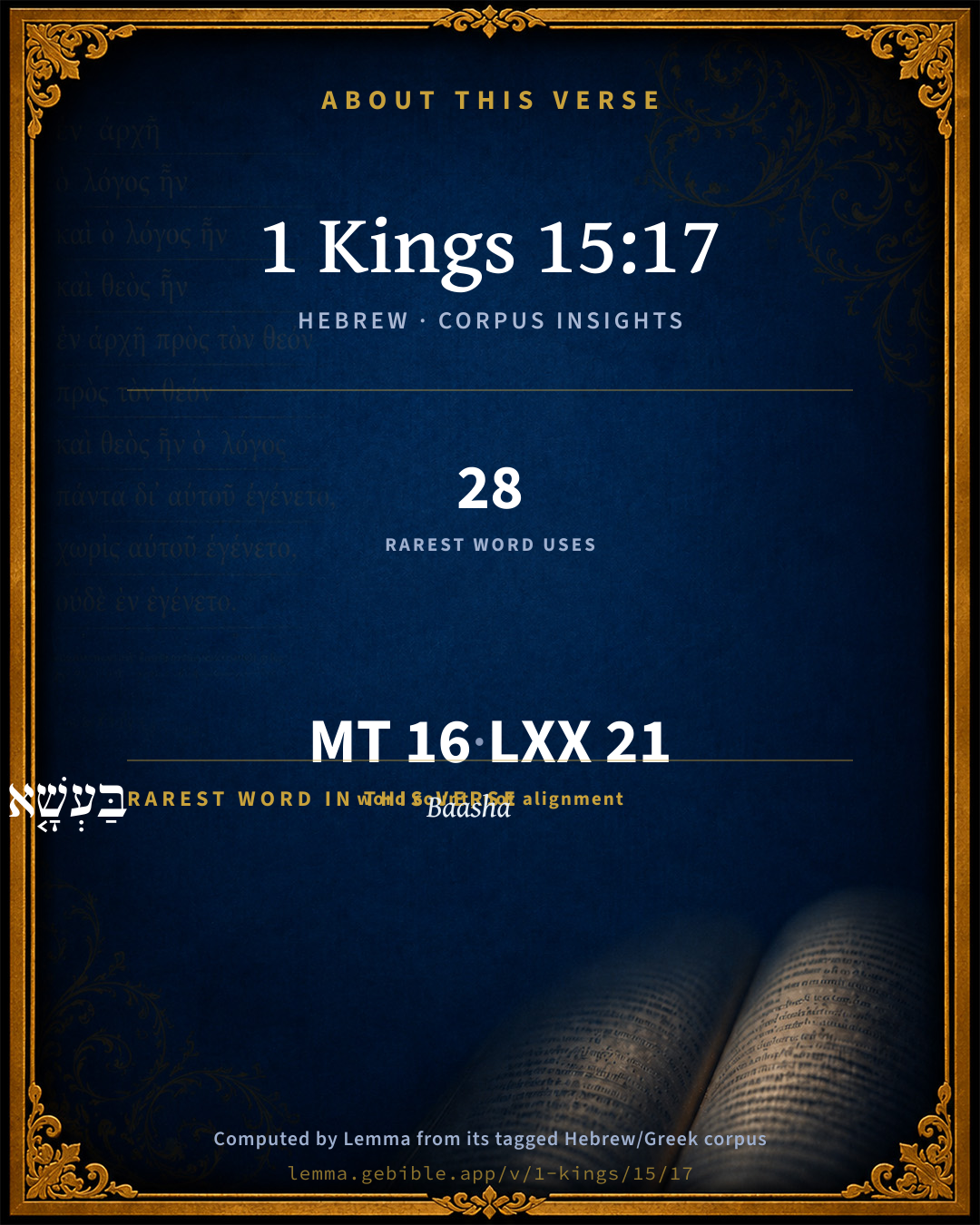
בַּעְשָׁ֤א Baasha H1201 occurs in 26 verses of the Hebrew Bible. Also found in:

Grammatical profile

  • 5 verbs
  • 8 nouns
  • 1 preposition
  • 1 conjunction
  • 1 particle

Verb forms

  • וַיַּ֨עַל Qal · Sequential Imperfect
  • וַיִּ֖בֶן Qal · Sequential Imperfect
  • תֵּ֚ת Qal · Infinitive Construct
  • יֹצֵ֣א Qal · Participle Active
  • וָבָ֔א Qal · Participle Active

Repetition

Words recur within this verse — often emphatic in Hebrew:

  • מֶֽלֶךְ king H4428 ×2
  • יְהוּדָ֔ה Judah H3063 ×2

Hebrew & Septuagint length

In English translation the verse runs 28 words from the Hebrew and 27 from the Septuagint (LXX English) — closely comparable.

A rough comparison of the two English renderings, which tokenize alike — not a word-level alignment.

Word counts can differ between the Hebrew and the Greek without any difference in meaning — e.g. the Hebrew direct-object marker אֵת has no separate Greek word, and Greek often adds the article ὁ.

In the original languages it is 16 Hebrew tokens and 21 Greek tokens — but the two are counted differently (Hebrew bundles its prefixes and suffixes into one token; the Greek is in lemma form), so that isn’t a like-for-like length.

Cross-references

8

Topical passages linked to 1 Kings 15:17 in the Treasury of Scripture Knowledge — connected by theme and wording, ordered by reader-vote popularity; previews shown in the World English Bible.

  • 1 Kings 12:27 if this people go up to offer sacrifices in the house of Yahweh at Jerusalem, then will the heart of this people turn again to their lord, even to Rehoboam king of Judah; and they will kill me, and return to Rehoboam king of Judah.
  • Joshua 18:25 Gibeon, and Ramah, and Beeroth,
  • 2 Chronicles 16:1–6 In the six and thirtieth year of the reign of Asa, Baasha king of Israel went up against Judah, and built Ramah, that he might not allow anyone to go out or come in to Asa king of Judah.
  • 1 Kings 15:21–22 It happened, when Baasha heard of it, that he left off building Ramah, and lived in Tirzah.
  • 1 Samuel 15:34 Then Samuel went to Ramah; and Saul went up to his house to Gibeah of Saul.
  • 1 Kings 15:27 Baasha the son of Ahijah, of the house of Issachar, conspired against him; and Baasha struck him at Gibbethon, which belonged to the Philistines; for Nadab and all Israel were laying siege to Gibbethon.
  • 2 Chronicles 11:13–17 The priests and the Levites who were in all Israel resorted to him out of all their border.
  • Jeremiah 31:15 Thus says Yahweh: A voice is heard in Ramah, lamentation, and bitter weeping, Rachel weeping for her children; she refuses to be comforted for her children, because they are no more.

Cross-references courtesy of OpenBible.info (CC BY 4.0).

Hebrew and Greek witnesses Masoretic Hebrew ↔ Greek Septuagint

The same verse in the two great witnesses to the Old Testament, shown verse-for-verse.

These are two independent witnesses, not word-aligned to each other, and the Septuagint is shown in lemma (dictionary) form.

Hebrew 1 Kings 15:17 Masoretic · Westminster Leningrad Codex

וַיַּ֨עַל בַּעְשָׁ֤א מֶֽלֶךְ יִשְׂרָאֵל֙ עַל יְהוּדָ֔ה וַיִּ֖בֶן אֶת הָרָמָ֑ה לְבִלְתִּ֗י תֵּ֚ת יֹצֵ֣א וָבָ֔א לְאָסָ֖א מֶ֥לֶךְ יְהוּדָֽה

Baasha king of Israel went up against Judah, and built Ramah, that he might not allow anyone to go out or come in to Asa king of Judah.

World English Bible · Public Domain

Greek LXX 1 Kings 15:17 Septuagint · lemma form

καί ἀναβαίνω βαασα βασιλεύς ἰσραήλ ἐπί ἰούδας καί οἰκοδομέω ὁ ραμα ὁ μή εἰμί ἐκπορεύομαι καί εἰςπορεύομαι ὁ ασα βασιλεύς ιουδα

And Baasa king of Israel went up against Juda, and built Rama, so that no one should go out or come in for Asa king of Juda.

LXX2012 (modern English Septuagint) · Public Domain

Hebrew: Westminster Leningrad Codex (CC BY 4.0). Greek: Septuagint (public domain); English from LXX2012 (modern English Septuagint) (Public Domain). How the Septuagint differs from the Hebrew →

Targum (Aramaic paraphrase)

1

The Targum is the ancient Jewish Aramaic paraphrase of the Hebrew Scriptures — an interpretive translation, not the Hebrew text itself. Onkelos (literal) and Pseudo-Jonathan (expansive) render the Torah, and Jonathan the Prophets. Coverage is partial: where no permissively-licensed English translation exists for a verse, only the Aramaic is shown. This is verse-level text, not a word-by-word alignment to the Hebrew.

  1. Targum Jonathan Prophets (Joshua–Malachi)
    וּסְלִיק בַּעְשָׁא מַלְכָּא דְיִשְׂרָאֵל עַל דְבֵית יְהוּדָה וּבְנָא יַת רָמָתָא בְּדִיל דְלָא לְמִשְׁבַּק לְמִתַּן נָפִיק וְעָלֵיל לְאָסָא מַלְכָּא דְבֵית יְהוּדָה:

    (no public-domain English translation for this verse)

    Targum Jonathan — Aramaic: “Mikraot Gedolot” (public domain). English: “Sefaria Community Translation” (CC0 1.0 (public-domain dedication)); “London "Chaldee Paraphrase," 1871” (public domain). Text via Sefaria.

Commentary

Notes on 1 Kings 15:17 from classic Christian and Jewish commentators (each source and its license shown beneath its notes). The classic Christian expositions comment on the surrounding passage and are grouped to its opening verse, so a note may address several verses; the Jewish commentaries on the Tanakh (Rashi and others) are per-verse, so they appear only where the commentator wrote on this verse.

Lemma curates 59 commentaries, every one of them public domain or Creative Commons licensed, each selected and text-cleaned for this edition rather than reprinted as found. About our sources →

Trapp's Complete Commentary

John Trapp

1Ki 15:17 And Baasha king of Israel went up against Judah, and built Ramah, that he might not suffer any to go out or come in to Asa king of Judah.

Ver. 17. That he might not suffer any.] He sought to block him up, and so to keep his own people - who had a mind to the sincere service of God - from flying away to him.

John Trapp, A Commentary or Exposition upon All the Books of the Old and New Testament (1647–1656) — public domain. Text from a community e-Sword module.

Joseph Benson's Commentary

1Ki 15:17. Baasha built Ramah — That is, repaired and fortified it. It was a city in the tribe of Benjamin, which either belonged to the kingdom of Israel, or he had taken it from Judah. That he might not suffer any to go out, &c. — That he might hinder all communication between his people and the people of Judah, and that his people might not go up to Jerusalem to worship. For this place lay in the confines of both kingdoms; and in such a strait, that a fortification being made there, none could pass to or fro without a license from Baasha.

Joseph Benson's Commentary on the Old and New Testaments (1811–1818) — public domain. Text from a community e-Sword module.

Tyndale Open Study Notes

Tyndale Open Resources

15:17 Baasha’s southward thrust recaptured towns previously lost to Abijam (2 Chr 13:19), as well as Ramah in Judah, about four miles north of Jerusalem. This sealed the border, preventing the Israelites from defecting to Judah and confining Asa to his own territory. Ramah commanded the important north–south and east–west routes in Canaan (Judg 4:5; Isa 10:29; Jer 31:15; 40:1).

Tyndale Open Study Notes — © Tyndale Open Resources, licensed CC BY-SA 4.0. Text via the HelloAO Bible API.

Geneva Bible (1599)

Geneva Bible translators

Of the same purpose that Jeroboam did, because the people should not go up to Jerusalem, lest they should follow Asa.

Geneva Bible (1599) marginal notes — public domain. Text via Bolls.life.

Adam Clarke's Commentary

Verse 17. And Baasha - built Ramah] As the word signifies a high place, what is here termed Ramah was probably a hill, (commanding a defile through which lay the principal road to Jerusalem,) which Baasha fortified in order to prevent all intercourse with the kingdom of Judah, lest his subjects should cleave to the house of David. Ramah was about two leagues northward of Jerusalem.

Adam Clarke's Commentary on the Bible (1810–1826) — public domain. Text from a community e-Sword/MySword module.

Ellicott's Commentary for English Readers

(17) Built Ramah.—Ramah, or properly, the Ramah—the word signifying only “elevation”—is mentioned in Jos_18:25 as a city of Benjamin, situated (see Jos. Ant. viii. 12, 3) about five miles north of Jerusalem. It is mentioned in Jdg_4:5; Jdg_19:13; Isa_10:29; Jer_40:1, and is identified with the village known as Er-Ram at the present day.

This fortification of Ramah close to the hostile capital—like the fortification of Decelea, near Athens, in the Peloponnesian war—was a standing menace to Judah. Baasha, who was a military chief, seems to have been warned by the ill-success of former attempts to invade and subjugate Judah, and to have used this easier means of keeping the enemy in check, and provoking a conflict—if a conflict there was to be—on his own ground. The text, however, implies a further design to blockade the road between the kingdoms, perhaps explained by the statement, in 2Ch_15:9-10, of the falling away of many from Israel to Asa, now in the height of his prosperity. The new fortress was, no doubt, supported by all the military force of Israel, which Asa, in spite of his increased strength, dared not attack.

A Bible Commentary for English Readers, edited by Charles John Ellicott (1878–1897) — public domain. Text from a community e-Sword module.

The Cambridge Bible for Schools and Colleges

gen. ed. J. J. S. Perowne

17. went up against Judah and built Ramah] This act of Baasha’s shews us that Israel must by this time have recovered some of the power and territory which had been taken from them in Jeroboam’s reign (2Ch_13:19). Ramah, though lying in the hill country of Ephraim, was among the places allotted to the tribe of Benjamin (Jos_18:25), so that it must have been very near to Jerusalem, and to make a fortress of it, as Baasha was now doing, was like making a blockade of Jerusalem, a condition which is described in the words which immediately follow.

The Cambridge Bible for Schools and Colleges (gen. ed. J. J. S. Perowne; Cambridge University Press, 1878–1918) — public domain. Text from a community e-Sword module.

John Gill's Exposition

Then King Asa made a proclamation throughout all Judah,.... Summoned men of all sorts, ranks, and degrees:

(none was exempted;) the Jews (z) say, not so much as a newly married man, whom the law excused from war the first year, nor the disciples of the wise men:

and they took away the stones of Ramah, and the timber thereof, wherewith Baasha had builded; or fortified the place; these; the men of Judah, whom Asa summoned, carried off:

and King Asa built with them Geba of Benjamin, and Mizpah; which were both in the tribe of Benjamin, and which he fortified, Jos 18:24.

(z) Jarchi & Kimchi in loc.

John Gill's Exposition of the Whole Bible (1746–1763) — public domain (CC PDM 1.0). Text via the HelloAO Bible API.

Albert Barnes' Notes on the Bible

Ramah (perhaps “Er-Ram;” marginal reference) was situated halfway between Bethel and Jerusalem. Its distance from Jerusalem was no more than five miles so that its occupation was a menace to that capital. Baasha’s seizure of Ramah implies a previous recovery of the towns taken by Abijam from Jeroboam, namely, Bethel, Jeshanah, and Ephrain 2Ch 13:19, and was a carrying of the war into the enemy’s country. Could his conquest have been maintained, it would have crippled Judah seriously, and have almost compelled a transfer of the capital to Hebron.

That he might not suffer any to go out or come in - Baasha, in seizing Ramah, professed to be acting on the defensive. His complaint seems to have been well founded (compare 2Ch 15:9); but it was more than a defensive measure - it was the first step toward a conquest of the southern kingdom.

Albert Barnes' Notes on the Bible (1834–1885) — public domain. Text from a community e-Sword/MySword module.

Haydock's Catholic Bible Commentary

Rama, fortifying it with a wall all round, 2 Paralipomenon xvi. (Haydock) --- Rama signifies, "a height." This fort commanded a narrow pass, between the two kingdoms, (Calmet) and cut off all communication; which Baasa dreaded, lest his subjects should return to the service of the true God, and of Juda. (Haydock) --- Josue (xviii. 25.) mentions Rama, near Gaboan, (Calmet) about five miles north of Jerusalem. (St. Jerome) --- There was another towards the south. (Menochius) --- But there the king of Israel would have no power. (Haydock)

George Leo Haydock (1774–1849), Haydock's Catholic Family Bible and Commentary, 1859 edition — public domain. Excludes Psalms (Douay-Rheims chapter numbering differs from Protestant) and Deuterocanonical books (Catholic canon only).

Matthew Poole's English Annotations

Baasha went up against Judah; perceiving Asa’s great success, of which see 2Ch 14; 2Ch 15, and the defection of many of his own subjects to him upon that occasion, 2Ch 15:9, he began to bestir himself, and commenceth a war against him.

Built, i.e. repaired and fortified, Ramah, a city of Benjamin; which either belonged to the kingdom of Israel, from the division, (as some other places of that tribe are supposed to have done; of which See Poole "1Ki 11:13",) or belonged to Judah, but was now invaded and taken by Baasha, and fortified.

That he might not suffer any to go out or come in to Asa king of Judah; therefore he chose this place, because it was in the way from his kingdom to Jerusalem, and, as some add, in or near the straits of the mountains, where they could easily discover and hinder all passengers that way.

Matthew Poole's English Annotations on the Holy Bible (1683–1685) — public domain. Text from a community e-Sword/MySword module.

Whedon's Commentary on the Bible

Daniel D. Whedon

17. Built Ramah — That is, he attempted to fortify it so as to make it a fortress for his troops; and since Ramah lay midway between Beth-el and Jerusalem, it was a choice spot to serve his purpose of checking the emigration of Israelites into the kingdom of Judah.

Not suffer any to go out or come in to Asa — The conviction that Jerusalem was the proper place to worship drew multitudes there, and Jeroboam and his successors found that the calf-worship at Beth-el and Dan would not command the respect of all his people. Compare 1Ki_12:27; 2Ch_11:13-17; Tob_1:6. Baasha thought to check this going up to Jerusalem by force of arms. He would build a stronghold at Ramah and station forces there to oppose all emigration out of his realm.

Daniel D. Whedon (gen. ed.), Commentary on the Old and New Testaments (1874–1909) — public domain. Text from a community e-Sword module.

The Pulpit Commentary

And Baasha, king of Israel, went up against Judah This statement probably refers to the reconquest of the three cities which Abijah had taken from Jeroboam, (2Ch_13:19) as Ramah could hardly have been rebuilt whilst Bethel remained in the hands of Judah, and built Ramah Heb. the Ramah, i.e., " the elevation," or "high place." Now er Ram (=the height), in Benjamin (Jos_18:25; Jud_1:19:18, 14) five miles distant from Jerusalem, near the frontier of the two territories, and also then, as now, on the great north road. It was the key, consequently, to both kingdoms. Hence the struggles to possess it, vers, 21, 22; (2Ch_16:1, etc.) that he might not suffer any to go out Heb. not to give any going out, etc. or come in to Asa, king of Judah. The object of Baasha in fortifying this place is evident. It was not merely to have an advanced post as a menace to Jerusalem (Rawlinson), but primarily, by its command of the high road, to prevent his subjects from falling away to the kingdom of Judah, or even from going up to Jerusalem to worship; in fact, to isolate Judah and to blockade its capital. That there was a great defection to Ass at this time we know from 2Ch_15:9. This was an exodus which Baasha felt must be checked. Blunt ("Coincidences," pp. 176-8) has happily shown from 2Ch_16:6, etc., how the primary object must have been to "stop the alarming drainage of all that was virtuous out of their borders." Rawlinson sees in the fortification of this place "the first step towards a conquest of the southern kingdom." But as to this the text is silent, or rather it assigns an entirely different reason.

The Pulpit Commentary (1880–1919), ed. H.D.M. Spence-Jones & Joseph S. Exell — public domain. Text from a community e-Sword module.

John Wesley's Explanatory Notes

Built - That is, repaired and fortified.

John Wesley, Explanatory Notes Upon the Whole Bible (1754–1765) — public domain. Text via the GEBible commentary corpus.

Lesson kit

Teaching starters — assembled from the data on this page, not authored interpretation. Every prompt links to the verse data it draws on. Edit before teaching.

1 Kings, in the Historical, opens this verse with 16 words (14 distinct Hebrew lemmas). Its most distinctive word is Baʻshâʼ (“Baasha”). A historical commentator’s framing appears above. Read the whole chapter for the surrounding context.

Discussion questions

  1. How does “Baasha” (Baʻshâʼ) shape what this verse is saying?
  2. How does 1 Kings 15:16, which shares the word «Baasha», read alongside this verse?
  3. What does the repetition of “king” (2× in this one verse) do in this verse?
  4. The translations on this page render this verse differently — a whole-verse word diff, not a word-by-word alignment. What might account for the different wordings?
  5. «וַיַּ֨עַל» is a Qal Sequential Imperfect verb. How does that grammatical form shape the action described?
  6. Compare how Trapp's Complete Commentary and Joseph Benson's Commentary read this verse. Where do they agree or differ?

Things to notice

Reading settings

Reading text

Shown beneath each verse's original-language words.

Old Testament
Old Testament edition

Read the OT as the Masoretic Hebrew (MT) or the Greek Septuagint (LXX).

English shown for the Greek Septuagint (in the Hebrew ↔ Greek comparison).

Comparing translations? Open the Compare panel on any verse page to stack up to four side by side.