
Judges 20:18

Hebrew (Westminster Leningrad Codex) Judges 20:18 appears in the Hebrew Old Testament. The text above is from the Westminster Leningrad Codex. Each word links to its Strong’s number, a concise gloss, and parsing drawn from the Open Scriptures Hebrew Bible morphology. Click any word for its full Brown-Driver-Briggs (BDB) entry.
Download image
Cite this verse

Judges 20:18 (World English Bible). Public Domain. Lemma interlinear Bible study tool, https://lemma.gebible.app/v/judges/20/18.

Show BibTeX & RIS
BibTeX
RIS
English Translation
The children of Israel arose, and went up to Bethel, and asked counsel of God; and they said, Who shall go up for us first to battle against the children of Benjamin? Yahweh said, Judah [shall go up] first.
World English Bible · Public Domain
Download a study sheet

One document with this verse’s original text, its word-by-word gloss line, the meaning frame, cross-references with their text, attributed commentary, and full source and license credits — printable, and it pastes into notes with its structure intact.

This verse Autodidact and up

Study sheet (.html) Plain text (.txt)

A passage Seminary Student

Up to 50 verses in one chapter. A passage sheet keeps up to 6 commentary sources and 12 cross-references per verse, in the order this page ranks them, and says so on the sheet whenever that leaves anything out. Ask for a single verse and you get the Autodidact verse sheet above.

Everything on this page stays free to read, with no account — the sheet is a download of what is already on screen, not access to it.

Want to remove ads? Support Godless Engineer
Compare translations 3

The same verse in 3 English versions, stacked beneath the original-language interlinear above. Click any original word for its lexicon entry.

Each is an independent rendering of the whole verse — the interlinear is not word-aligned to these translations.

Highlighted words mark where these versions differ — a whole-verse word diff, not a word-by-word alignment.

  • World English Bible Public Domain
    The children of Israel arose, and went up to Bethel, and asked counsel of God; and they said, Who shall go up for us first to battle against the children of Benjamin? Yahweh said, Judah [shall go up] first.
  • King James Version Public Domain
    And the children of Israel arose, and went up to the house of God, and asked counsel of God, and said, Which of us shall go up first to the battle against the children of Benjamin? And the LORD said, Judah shall go up first.
  • unfoldingWord Literal Text CC BY-SA 4.0
    And they arose and went up to Bethel. And the sons of Israel inquired of God, and they said, “Who should go up for us at the start to the battle with the sons of Benjamin?” And Yahweh said, “Judah at the start.”

unfoldingWord Literal Text — © unfoldingWord, licensed CC BY-SA 4.0. Word-aligned USFM3 via Door43 (git.door43.org/unfoldingWord/en_ult).

Versions to compare (up to 4)

3 of 4 selected

Show all 18 translations

Every available English version of this verse, each an independent rendering of the whole verse.

  • World English Bible Public Domain
    The children of Israel arose, and went up to Bethel, and asked counsel of God; and they said, Who shall go up for us first to battle against the children of Benjamin? Yahweh said, Judah [shall go up] first.
  • Berean Standard Bible Public Domain
    The Israelites set out, went up to Bethel, and inquired of God, “Who of us shall go up first to fight against the Benjamites?” “Judah will be first,” the LORD replied.
  • Majority Standard Bible Public Domain
    The Israelites set out, went up to Bethel, and inquired of God, “Who of us shall go up first to fight against the Benjamites?” “Judah will be first,” the LORD replied.
  • King James Version Public Domain
    And the children of Israel arose, and went up to the house of God, and asked counsel of God, and said, Which of us shall go up first to the battle against the children of Benjamin? And the LORD said, Judah shall go up first.
  • American Standard Version (1901) Public Domain
    And the children of Israel arose, and went up to Beth-el, and asked counsel of God; and they said, Who shall go up for us first to battle against the children of Benjamin? And Jehovah said, Judah `shall go up' first.
  • Revised Version (1885) Public Domain
    And the children of Israel arose, and went up to Beth-el, and asked counsel of God; and they said, Who shall go up for us first to battle against the children of Benjamin? And the LORD said, Judah shall go up first.
  • Geneva Bible (1599) Public Domain
    And the children of Israel arose, and went vp to the house of God, and asked of God, saying, Which of vs shall goe vp first to fight against the children of Beniamin? And the Lord said, Iudah shalbe first.
  • Douay-Rheims (1899) Public Domain
    And they arose and came to the house of God, that is, to Silo: and they consulted God, and said: Who shall be in our army the first to go to the battle against the children of Benjamin? And the Lord answered them: Let Juda be your leader.
  • Young's Literal Translation Public Domain
    And they rise and go up to Beth-El, and ask of God, and the sons of Israel say, `Who doth go up for us at the commencement to battle with the sons of Benjamin?' and Jehovah saith, `Judah -- at the commencement.'
  • Literal Standard Version CC BY-SA 4.0
    And they rise and go up to Beth-El, and ask of God, and the sons of Israel say, “Who goes up for us at the commencement to battle with the sons of Benjamin?” And YHWH says, “Judah—at the commencement.”
  • Unlocked Literal Bible CC BY-SA 4.0
    The people of Israel arose, went up to Bethel, and asked for advice from God. They asked, “Who first will attack the people of Benjamin for us?” Yahweh said, “Judah will attack first.”
  • unfoldingWord Literal Text CC BY-SA 4.0
    And they arose and went up to Bethel. And the sons of Israel inquired of God, and they said, “Who should go up for us at the start to the battle with the sons of Benjamin?” And Yahweh said, “Judah at the start.”
  • Darby Bible Public Domain
    The people of Israel arose and went up to Bethel, and inquired of God, "Which of us shall go up first to battle against the Benjaminites?" And the LORD said, "Judah shall go up first."
  • World Messianic Bible Public Domain
    The children of Israel arose, went up to Bethel, and asked counsel of God. They asked, “Who shall go up for us first to battle against the children of Benjamin?” The LORD said, “Judah first.”
  • Webster's Bible Public Domain
    And the children of Israel arose, and went up to the house of God, and asked counsel of God, and said, Which of us shall go up first to the battle against the children of Benjamin? And the LORD said, Judah shall go up first.
  • Free Bible Version CC BY-SA 4.0
    The Israelites went to Bethel and asked God, “Which ones of us should be the first to go and fight the Benjamites?” “Judah is to go first,” the Lord replied.
  • Bible in Basic English Public Domain
    And they got up and went up to Beth-el to get directions from God, and the children of Israel said, Who is to be the first to go up to the fight against the children of Benjamin? And the Lord said, Judah is to go up first.
  • JPS Tanakh (1917) Public Domain
    And the children of Israel arose, and went up to Beth-el, and asked counsel of God; and they said: 'Who shall go up for us first to battle against the children of Benjamin?' And the LORD said: 'Judah first.'

Literal Standard Version (2020), Covenant Press — licensed CC BY-SA 4.0. Text via the HelloAO Bible API (eBible.org). Unlocked Literal Bible (unfoldingWord) — licensed CC BY-SA 4.0. Text via the HelloAO Bible API (eBible.org). unfoldingWord Literal Text — © unfoldingWord, licensed CC BY-SA 4.0. Word-aligned USFM3 via Door43 (git.door43.org/unfoldingWord/en_ult). Free Bible Version, Dr. Jonathan Gallagher — licensed CC BY-SA 4.0. Text via the HelloAO Bible API (eBible.org).

Word by word

More ways to search: Search by grammar → Find every occurrence → Compare this word →

Practice this passage: Drill this verse → Learn its vocabulary →

בַתְּחִלָּ֔ה
tᵉchillâh
H8462
“in/at the · beginning”
Preposition, Determined + Noun, Common, Feminine, Singular, Absolute
Part of Speech
Preposition + Noun
Type
Common
Gender
Feminine
Number
Singular
State
Absolute
Full BDB Definition

Origin: from H2490 in the sense of opening

TWOT: 661d

beginning, first - the first time - from the beginning, in the beginning (with preposition)
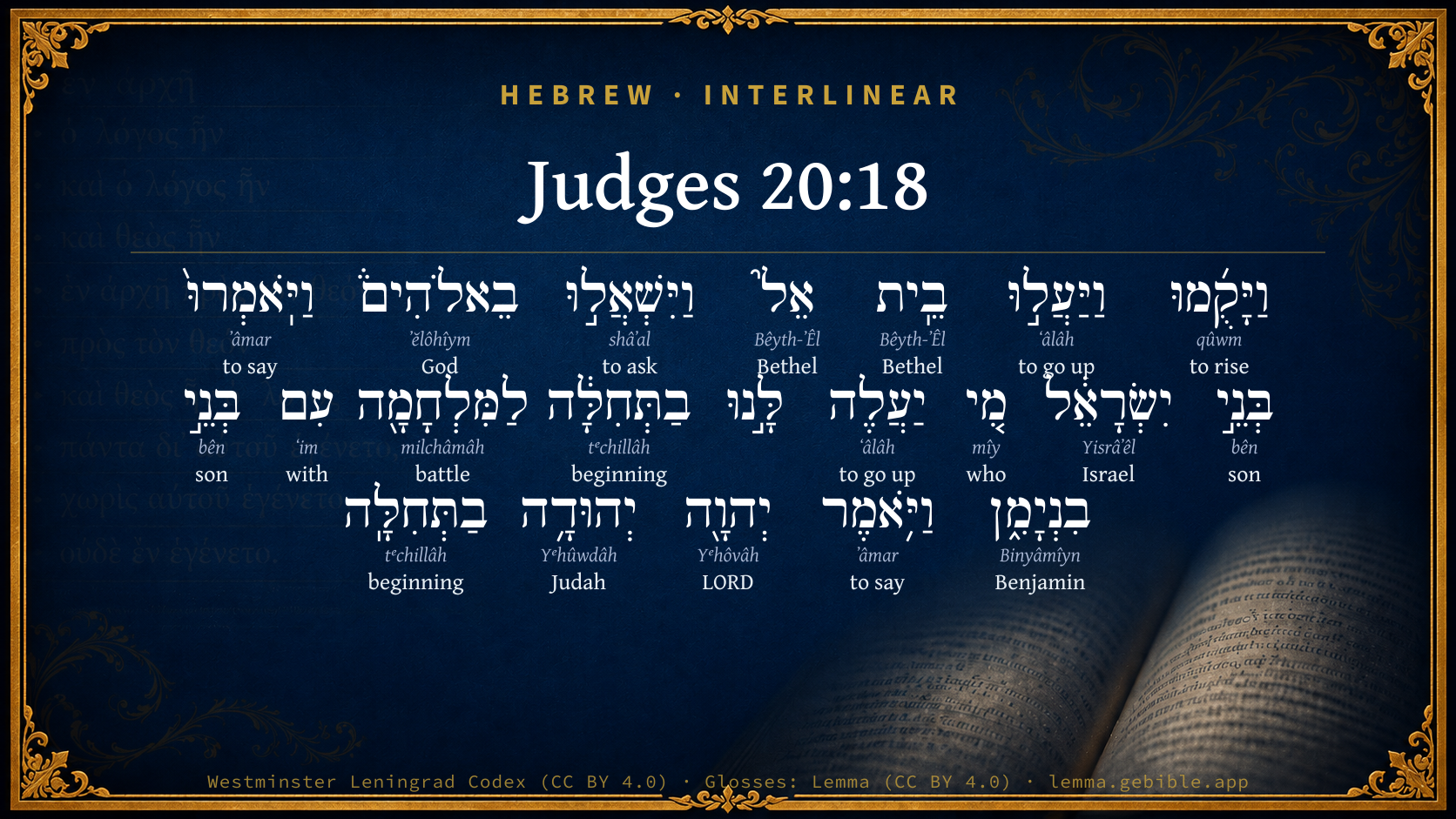
  1. וַיָּקֻ֜מוּ qûwm H6965 “and · to rise” Conjunction + Verb, Qal, Sequential Imperfect, 3rd Person, Masculine, Plural
  2. וַיַּעֲל֣וּ ʻâlâh H5927 “and · to go up” Conjunction + Verb, Qal, Sequential Imperfect, 3rd Person, Masculine, Plural
  3. בֵֽית Bêyth-ʼÊl H1008 “Bethel” Noun, Proper
  4. אֵל֮ Bêyth-ʼÊl H1008 “Bethel” Noun, Proper
  5. וַיִּשְׁאֲל֣וּ shâʼal H7592 “and · to ask” Conjunction + Verb, Qal, Sequential Imperfect, 3rd Person, Masculine, Plural
  6. בֵאלֹהִים֒ ʼĕlôhîym H430 “in/at · God(s)” Preposition + Noun, Common, Masculine, Plural, Absolute
  7. וַיֹּֽאמְרוּ֙ ʼâmar H559 “and · to say” Conjunction + Verb, Qal, Sequential Imperfect, 3rd Person, Masculine, Plural
  8. בְּנֵ֣י bên H1121 “sons of” Noun, Common, Masculine, Plural, Construct
  9. יִשְׂרָאֵ֔ל Yisrâʼêl H3478 “Israel” Noun, Proper
  10. מִ֚י mîy H4310 “who” Particle, Interrogative
  11. יַעֲלֶה ʻâlâh H5927 “to go up” Verb, Qal, Imperfect, 3rd Person, Masculine, Singular
  12. לַמִּלְחָמָ֖ה milchâmâh H4421 “to/for the · battle” Preposition, Determined + Noun, Common, Feminine, Singular, Absolute
  13. עִם ʻim H5973 “with” Preposition
  14. בְּנֵ֣י bên H1121 “sons of” Noun, Common, Masculine, Plural, Construct
  15. בִנְיָמִ֑ן Binyâmîyn H1144 “Benjamin” Noun, Proper
  16. וַיֹּ֥אמֶר ʼâmar H559 “and · to say” Conjunction + Verb, Qal, Sequential Imperfect, 3rd Person, Masculine, Singular
  17. יְהוָ֖ה Yᵉhôvâh H3068 “LORD” Noun, Proper
  18. יְהוּדָ֥ה Yᵉhûwdâh H3063 “Judah” Noun, Proper
  19. בַתְּחִלָּֽה tᵉchillâh H8462 “in/at the · beginning” Preposition, Determined + Noun, Common, Feminine, Singular, Absolute

About this verse

These counts appear in no published source. They are computed here, from the morphology-tagged text and Lemma’s own curated glosses. What Lemma adds →

21
words
15
distinct lemmas
Historical
section

Notable vocabulary

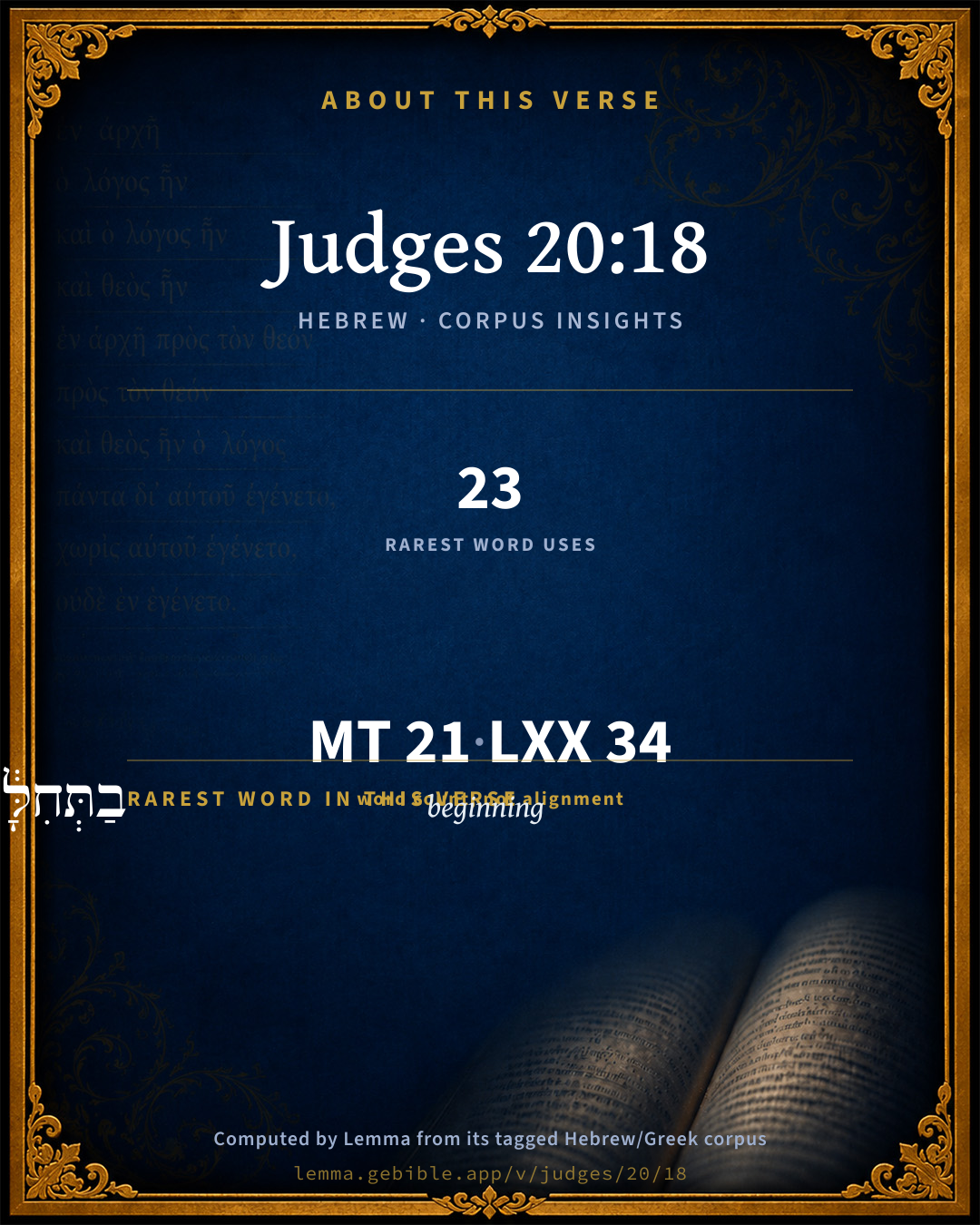
The rarest word here is בַתְּחִלָּ֔ה beginning H8462 — appearing just 23 times in the whole Hebrew Bible.

Shared distinctive vocabulary

בַתְּחִלָּ֔ה beginning H8462 occurs in 21 verses of the Hebrew Bible. Also found in:

Grammatical profile

  • 6 verbs
  • 12 nouns
  • 2 prepositions
  • 1 particle

Verb forms

  • וַיָּקֻ֜מוּ Qal · Sequential Imperfect
  • וַיַּעֲל֣וּ Qal · Sequential Imperfect
  • וַיִּשְׁאֲל֣וּ Qal · Sequential Imperfect
  • וַיֹּֽאמְרוּ֙ Qal · Sequential Imperfect
  • יַעֲלֶה Qal · Imperfect
  • וַיֹּ֥אמֶר Qal · Sequential Imperfect

Repetition

Words recur within this verse — often emphatic in Hebrew:

  • וַיַּעֲל֣וּ to go up H5927 ×2
  • בֵֽית Bethel H1008 ×2
  • וַיֹּֽאמְרוּ֙ to say H559 ×2
  • בְּנֵ֣י son H1121 ×2
  • בַתְּחִלָּ֔ה beginning H8462 ×2

Hebrew & Septuagint length

In English translation the verse runs 39 words from the Hebrew and 43 from the Septuagint (LXX English) — closely comparable.

A rough comparison of the two English renderings, which tokenize alike — not a word-level alignment.

Word counts can differ between the Hebrew and the Greek without any difference in meaning — e.g. the Hebrew direct-object marker אֵת has no separate Greek word, and Greek often adds the article ὁ.

In the original languages it is 21 Hebrew tokens and 34 Greek tokens — but the two are counted differently (Hebrew bundles its prefixes and suffixes into one token; the Greek is in lemma form), so that isn’t a like-for-like length.

Cross-references

12

Topical passages linked to Judges 20:18 in the Treasury of Scripture Knowledge — connected by theme and wording, ordered by reader-vote popularity; previews shown in the World English Bible.

  • Numbers 27:21 He shall stand before Eleazar the priest, who shall inquire for him by the judgment of the Urim before Yahweh: at his word shall they go out, and at his word they shall come in, both he, and all the children of Israel with him, even all the congregation.
  • Judges 20:23 The children of Israel went up and wept before Yahweh until even; and they asked of Yahweh, saying, Shall I again draw near to battle against the children of Benjamin my brother? Yahweh said, Go up against him.
  • Judges 20:26–27 Then all the children of Israel, and all the people, went up, and came to Bethel, and wept, and sat there before Yahweh, and fasted that day until even; and they offered burnt-offerings and peace-offerings before Yahweh.
  • Genesis 49:8–10 "Judah, your brothers will praise you: Your hand will be on the neck of your enemies; Your father's sons will bow down before you.
  • Numbers 27:5 Moses brought their cause before Yahweh.
  • Joshua 9:14 The men took of their provision, and didn't ask counsel at the mouth of Yahweh.
  • Joshua 18:1 The whole congregation of the children of Israel assembled themselves together at Shiloh, and set up the tent of meeting there: and the land was subdued before them.
  • Judges 1:1–2 It happened after the death of Joshua, the children of Israel asked of Yahweh, saying, Who shall go up for us first against the Canaanites, to fight against them?
  • Judges 18:31 So they set them up Micah's engraved image which he made, all the time that the house of God was in Shiloh.
  • Judges 19:18 He said to him, We are passing from Bethlehem Judah to the farther side of the hill-country of Ephraim; from there am I, and I went to Bethlehem Judah: and I am [now] going to the house of Yahweh; and there is no man who takes me into his house.
  • Judges 20:7 Behold, you children of Israel, all of you, give here your advice and counsel.
  • Joel 1:14 Sanctify a fast. Call a solemn assembly. Gather the elders, And all the inhabitants of the land, to the house of Yahweh, your God, And cry to Yahweh.

Cross-references courtesy of OpenBible.info (CC BY 4.0).

Hebrew and Greek witnesses Masoretic Hebrew ↔ Greek Septuagint

The same verse in the two great witnesses to the Old Testament, shown verse-for-verse.

These are two independent witnesses, not word-aligned to each other, and the Septuagint is shown in lemma (dictionary) form.

Hebrew Judges 20:18 Masoretic · Westminster Leningrad Codex

וַיָּקֻ֜מוּ וַיַּעֲל֣וּ בֵֽית אֵל֮ וַיִּשְׁאֲל֣וּ בֵאלֹהִים֒ וַיֹּֽאמְרוּ֙ בְּנֵ֣י יִשְׂרָאֵ֔ל מִ֚י יַעֲלֶה לָּ֣נוּ בַתְּחִלָּ֔ה לַמִּלְחָמָ֖ה עִם בְּנֵ֣י בִנְיָמִ֑ן וַיֹּ֥אמֶר יְהוָ֖ה יְהוּדָ֥ה בַתְּחִלָּֽה

The children of Israel arose, and went up to Bethel, and asked counsel of God; and they said, Who shall go up for us first to battle against the children of Benjamin? Yahweh said, Judah [shall go up] first.

World English Bible · Public Domain

Greek LXX Judges 20:18 Septuagint · lemma form

καί ἀναἵστημι καί ἀναβαίνω εἰς βαιθηλ καί ἐρωτάω ἐν ὁ θεός καί εἶπον ὁ υἱός ἰσραήλ τίς ἀναβαίνω ἐγώ ἐν ἀρχή εἰς παράταξις πρός υἱός βενιαμίν καί εἶπον κύριος ἰούδας ἐν ἀρχή ἀναβαίνω ἀποἡγέομαι

And they arose and went up to Baethel, and enquired of God: and the children of Israel said, Who shall go up for us first to fight with the children of Benjamin? And the Lord said, Juda shall go up first as leader.

LXX2012 (modern English Septuagint) · Public Domain

On this verse, Ellicott's Commentary for English Readers discusses the Septuagint’s reading. Read the note in Commentary ↓

Hebrew: Westminster Leningrad Codex (CC BY 4.0). Greek: Septuagint (public domain); English from LXX2012 (modern English Septuagint) (Public Domain). How the Septuagint differs from the Hebrew →

Targum (Aramaic paraphrase)

1

The Targum is the ancient Jewish Aramaic paraphrase of the Hebrew Scriptures — an interpretive translation, not the Hebrew text itself. Onkelos (literal) and Pseudo-Jonathan (expansive) render the Torah, and Jonathan the Prophets. Coverage is partial: where no permissively-licensed English translation exists for a verse, only the Aramaic is shown. This is verse-level text, not a word-by-word alignment to the Hebrew.

  1. Targum Jonathan Prophets (Joshua–Malachi)
    וְקָמוּ וּסְלִיקוּ לְבֵית אֵל וּשְׁאִילוּ בְמֵימְרָא דַייָ וַאֲמַרוּ בְּנֵי יִשְׂרָאֵל מַן יִסַק לָנָא בְּקַדְמֵיתָא לְאַגָחָא קְרָבָא עִם בְּנֵי בִּנְיָמִין וַאֲמַר יְיָ יְהוּדָה בְּקַדְמֵיתָא:

    (no public-domain English translation for this verse)

    Targum Jonathan — Aramaic: “Mikraot Gedolot” (public domain). English: “Sefaria Community Translation” (CC0 1.0 (public-domain dedication)); “London "Chaldee Paraphrase," 1871” (public domain). Text via Sefaria.

Commentary

Notes on Judges 20:18 from classic Christian and Jewish commentators (each source and its license shown beneath its notes). The classic Christian expositions comment on the surrounding passage and are grouped to its opening verse, so a note may address several verses; the Jewish commentaries on the Tanakh (Rashi and others) are per-verse, so they appear only where the commentator wrote on this verse.

Lemma curates 59 commentaries, every one of them public domain or Creative Commons licensed, each selected and text-cleaned for this edition rather than reprinted as found. About our sources →

Matthew Henry's Commentary

We have here the defeat of the men of Israel in their first and second battle with the Benjamites.

I. Before their first engagement they asked counsel of God concerning the order of their battle and were directed, and yet they were sorely beaten. They did not think it was proper to ask of God whether they should go up at all against Benjamin (the case was plain enough, the men of Gibeah must be punished for their wickedness, and Israel must inflict the punishment or it will not be done), but "Who shall go first?" (Jdg 20:18), that is, "Who shall be general of our army?" for, which soever tribe was appointed to go first, the prince of that tribe must be looked upon as commander-in-chief of the whole body. For, if they had meant it of the order of their march only, it would have been proper to ask, "Who shall go next?" and then, "Who next?" But, if they know that Judah must go first, they know they must all observe the orders of the prince of that tribe. This honour was done to Judah because our Lord Jesus was to spring from that tribe, who was in all things to have the pre-eminence. The tribe that went up first had the most honourable post, but withal the most dangerous, and probably lost most in the engagement. Who would strive for precedency that sees the peril of it? Yet though Judah, that strong and valiant tribe, goes up first, and all the tribes of Israel attend them, little Benjamin (so he is called, Psa 68:27), is too hard for them all. The whole army lays siege to Gibeah, Jdg 20:19. The Benjamites advance to raise the siege, and the army prepares to give them a warm reception (Jdg 20:20). But between the Benjamites that attacked them in the front with incredible fury, and the men of Gibeah that sallied out upon their rear, they were put into confusion and lost 22,000 men, Jdg 20:21. Here were no prisoners taken, for there was no quarter given, but all put to the sword.

II. Before their second engagement they again asked counsel of God, and more solemnly than before; for they wept before the Lord until evening (Jdg 20:23), lamenting the loss of so many brave men, especially as it was a token of God's displeasure and would give occasion to the Benjamites to triumph in the success of their wickedness. Also at this time they did not ask who should go up first, but whether they should go up at all. The intimate a reason why they should scruple to do it, especially now that Providence had frowned upon them, because Benjamin was their brother, and a readiness to lay down their arms if God should so order them. God bade them go up; he allowed the attempt, for, though Benjamin was their brother, he was a gangrened member of their body and must be cut off. Upon this they encouraged themselves, perhaps more in their own strength than in the divine commission, and made a second attempt upon the forces of the rebels, in the same place where the former battle was fought (Jdg 20:22), with the hope of retrieving their credit upon the same spot of ground where they had lost it, which they would not superstitiously change, as if there were any thing unlucky in the place. But they were this second time repulsed, with the loss of 18,000 men, Jdg 20:25. The former day's loss and this amounted to 40,000, which was just a tenth part of the whole army, and the same number that they had drawn out by lot to fetch victuals, Jdg 20:10. They decimated themselves for that service, and now God again decimated them for the slaughter. But what shall we say to these things, that so just and honourable a cause should thus be put to the worst once and again? Were they not fighting God's battle against sin? Had they not his commission? What, and yet miscarry thus! 1. God's judgments are a great deep, and his way is in the sea. Clouds and darkness are often round about him, but judgment and justice are always the habitation of his throne. We may be sure of the righteousness, when we cannot see the reasons, of God's proceedings. 2. God would hereby show them, and us in them, that the race is not to the swift nor the battle to the strong, that we are not to confide in numbers, which perhaps the Israelites did with too much assurance. We must never lay the weight on an arm of flesh, which only the Rock of ages will bear. 3. God designed hereby to correct Israel for their sins. They did well to show such a zeal against the wickedness of Gibeah: but were there not with them, even with them, sins against the Lord their God? Those must be made to know their own iniquity that are forward in condemning the iniquity of others. Some think it was a rebuke to them for not witnessing against the idolatry of Micah and the Danites, by which their religion was corrupted, as they now did against the lewdness of Gibeah and the Benjamites, by which the public peace was disturbed, though God had particularly ordered them to levy war upon idolaters, Deu 13:12, etc. 4. God would hereby teach us not to think it strange if a good cause should suffer defeat fore a while, nor to judge of the merits of it by the success of it. The interest of grace in the heart, and of religion in the world, may be foiled, and suffer great loss, and seem to be quite run down, but judgment will be brought forth to victory at last. Vincimur in praelio, sed non in bello - We are foiled in a battle, but not in the whole campaign. Right may fall, but it shall arise.

Matthew Henry's Commentary on the Whole Bible (1708–1710) — public domain (CC PDM 1.0). Text via the HelloAO Bible API.

Jamieson, Fausset & Brown

Robert Jamieson, A. R. Fausset & David Brown

THE ISRAELITES LOSE FORTY THOUSAND. (Jdg 20:18-28)

the children of Israel arose, and went up to the house of God--This consultation at Shiloh was right. But they ought to have done it at the commencement of their proceedings. Instead of this, all their plans were formed, and never doubting, it would seem, that the war was just and inevitable, the only subject of their inquiry related to the precedency of the tribes--a point which it is likely was discussed in the assembly. Had they asked counsel of God sooner, their expedition would have been conducted on a different principle--most probably by reducing the number of fighting men, as in the case of Gideon's army. As it was, the vast number of volunteers formed an excessive and unwieldy force, unfit for strenuous and united action against a small, compact, and well-directed army. A panic ensued, and the confederate tribes, in two successive engagements, sustained great losses. These repeated disasters (notwithstanding their attack on Benjamin had been divinely authorized) overwhelmed them with shame and sorrow. Led to reflection, they became sensible of their guilt in not repressing their national idolatries, as well as in too proudly relying on their superior numbers and the precipitate rashness of this expedition. Having humbled themselves by prayer and fasting, as well as observed the appointed method of expiating their sins, they were assured of acceptance as well as of victory. The presence and services of Phinehas on this occasion help us to ascertain the chronology thus far, that the date of the occurrence must be fixed shortly after the death of Joshua.

Jamieson, Fausset & Brown — Commentary Critical and Explanatory on the Whole Bible (1871) — public domain (CC PDM 1.0). Text via the HelloAO Bible API.

The Cambridge Bible for Schools and Colleges

gen. ed. J. J. S. Perowne

18. The Israelite host is mustered (Jdg_20:17), and all is ready for an advance against Gibeah (Jdg_20:19 f.), when the entire army marches off to Beth-el, 10 m. distance from Mizpah (if = Nebî Samwîl), to consult the divine oracle. Such a change of position at such a moment is almost incredible, and unnecessary, one would think, inasmuch as Mizpah itself was a sanctuary (Jdg_20:1). Although Beth-el has a place in the B narrative (Jdg_20:26 f.), this verse can hardly belong to the original form of it. And there are indications which confirm the impression that the verse is a gloss; contrast ‘asked counsel of God’ with ‘asked counsel of Jehovah’ Jdg_20:23; Jdg_20:27; the question and response of the oracle are imitated from Jdg_1:1-2; in the account which follows all Israel acts together, not under the initiative of Judah; in the Hebr. Jdg_20:18-19 begin with the same word and they arose.

went up to Beth-el] Vulgate they came to the house of God, that is to Shiloh: an interesting attempt to get over a theoretical difficulty; see on Jdg_20:27, and cf. Jdg_21:2 n.

The Cambridge Bible for Schools and Colleges (gen. ed. J. J. S. Perowne; Cambridge University Press, 1878–1918) — public domain. Text from a community e-Sword module.

Trapp's Complete Commentary

John Trapp

Jdg 20:18 And the children of Israel arose, and went up to the house of God, and asked counsel of God, and said, Which of us shall go up first to the battle against the children of Benjamin? And the LORD said, Judah [shall go up] first.

Ver. 18. Which of us shall go up?] They asked not, Shall we go up? and shall we prosper? for of that they were over confident, because of the equity of their cause and their great strength. They slighted the Benjamites also for their paucity {few in numbers} and folly, as the Spaniards were wont to do the Portuguese for pocos y locos, that is, few and foolish. Hence they miscarried.

John Trapp, A Commentary or Exposition upon All the Books of the Old and New Testament (1647–1656) — public domain. Text from a community e-Sword module.

Joseph Benson's Commentary

Jdg 20:18. The children of Israel arose — Some sent in the name of all; and went up to the house of God — To Shiloh, which was not far from Mizpeh; and asked counsel of God — By Urim and Thummim, as they did Jdg 1:1. The Targum has it, They asked counsel by the word of the Lord. Which of us shall go up first? — This was asked to prevent emulations and contentions: but they do not ask whether they should go against them or not; nor yet do they seek to God for his help by prayer, and fasting, and sacrifice, as in all reason they ought to have done; but were confident of success, because of their great numbers and righteous cause.

Joseph Benson's Commentary on the Old and New Testaments (1811–1818) — public domain. Text from a community e-Sword module.

Geneva Bible (1599)

Geneva Bible translators

That is, to the Ark, which was in Shiloh some think in Mizpah, as verse 1.

Geneva Bible (1599) marginal notes — public domain. Text via Bolls.life.

Adam Clarke's Commentary

Verse 18. Went up to the house of God] Some think that a deputation was sent from Shiloh, where Phinehas the high priest was, to inquire, not concerning the expediency of the war, nor of its success, but which of the tribes should begin the attack. Having so much right on their side, they had no doubt of the justice of their cause. Having such a superiority of numbers, they had no doubt of success. See Clarke on Jud 20:1.

And the Lord said, Judah] But he did not say that they should conquer.

Adam Clarke's Commentary on the Bible (1810–1826) — public domain. Text from a community e-Sword/MySword module.

Ellicott's Commentary for English Readers

(18) To the house of God.—Rather, to Bethel (as in the LXX., Syriac, Arabic, and Chaldee). The reason why our translators adopted their translation is shown by the Vulgate, which renders it “to the house of God that is in Shiloh.” But Beth El cannot mean “house of God,” which is always either Beth ha-Elohim or Beth Adonai (house of the Lord). Why they did not meet at the more central Shiloh we cannot say.

Asked counsel of God.—Namely, by the Urim and Thummim. Apparently the high priest was not prevented by any scruple from taking the ephod, with its jewelled breastplate and Urim and Thummim, to any place where its use was needed. The ark was similarly carried from place to place, and had been brought (Jdg_20:27) to the venerable sanctuary of Bethel with the high priest. It is not necessary to suppose that the tabernacle was itself removed. It may have been—for Shiloh was never understood to be more than its temporary resting-place. Bethel—as being a sacred place and near Gibeah—would be a convenient place of rendezvous.

Which of us . . .?—Jdg_1:1-2.

Judah . . . first.—This is remarkable as indicating that the Urim and Thummim were something more than a pair of lots, and that the questions with which God was consulted by its means were other than those which admitted a mere positive or negative answer.

A Bible Commentary for English Readers, edited by Charles John Ellicott (1878–1897) — public domain. Text from a community e-Sword module.

John Gill's Exposition

And the children of Israel arose,.... From Mizpeh, where they were assembled, having heard that the Benjaminites were gathered together to defend the men of Gibeah:

and went up to the house of God; to the tabernacle which was in Shiloh, Jdg 18:31, see Jos 18:1 though the Targum takes Bethel for the name of a place so called; and so do Ben Gersom and Josephus (p), which was near Shiloh, for Shiloh is said to be on the north side of Bethel, Jdg 21:19 but as there is no reason to believe the tabernacle was now removed from Shiloh thither, so it is not likely they would go to any other place but where the tabernacle ark, and high priest were:

and asked counsel of God; before Phinehas the high priest, according to the judgment of Urim and Thummim, Jdg 20:28.

and said which of us shall go up first to the battle against the children of Benjamin? there being no supreme magistrate, judge, or general, to lead them; they did not ask whether they should go to war or no with their brethren; they made no doubt of that, taking it for granted they had sufficient reason for so doing, and that it was according to the will of God; nor did they inquire whether they should be victorious or not, they made no doubt of being victorious, both from their superior numbers, and the justness of their cause; they only inquire who should lead them on, having no general; and this they might do, to prevent any contentions among them about being precedence:

and the Lord said, Judah shall go up first: which tribe pitched their standard first about the tabernacle, and marched first in their journeys in the wilderness, and was ordered to go up first and fight the Canaanites, being a powerful and warlike tribe.

(p) Ut supra. (Antiqu. l. 5. c. 2. sect. 10.)

John Gill's Exposition of the Whole Bible (1746–1763) — public domain (CC PDM 1.0). Text via the HelloAO Bible API.

Albert Barnes' Notes on the Bible

Went up to the house of God - It should be “to Bethel.” At this time the ark was at Bethel (compare 1Sa 10:3), and not at Shiloh. It is not unlikely that though Shiloh was the chief residence of the ark Jer 7:12, yet the tabernacle, being moveable, was, either at stated times, or as occasion required, moved to where the Judge resided, or the congregation assembled (compare 1Sa 7:16). On the present occasion the ark may have been moved to Bethel for the convenience of proximity to the great national council at Mizpeh.

Albert Barnes' Notes on the Bible (1834–1885) — public domain. Text from a community e-Sword/MySword module.

Haydock's Catholic Bible Commentary

Silo. Hebrew simply "to Bethel," which the Septuagint, Syriac, Josephus, and others, explain of the city: but others generally understand "the house of God," at Silo, for which Bethel is placed, chap. xxi. 2, 9, and 12. Phinees resided near the tabernacle, and was desired to consult. --- Juda is not the name of a man, but of the tribe; (Calmet) and probably Othoniel would have the chief command. (Salien) --- The Israelites do not ask whether they ought to make war on their brethren, &c., but only desire to know which tribe shall begin the attack, chap. i. 1., and x. 18. They manifest a degree of presumption, which God soon chastised, (Calmet) as well as the idolatry of Dan, &c., which they had neglected to punish, though they had an express command to do it, Deuteronomy xiii. 12. (Salien) --- They were full of pride, and only concerned to revenge their own wrongs. (Haydock)

George Leo Haydock (1774–1849), Haydock's Catholic Family Bible and Commentary, 1859 edition — public domain. Excludes Psalms (Douay-Rheims chapter numbering differs from Protestant) and Deuterocanonical books (Catholic canon only).

Matthew Poole's English Annotations

The children of Israel, i.e. some sent in the name of all.

To the house of God, to wit, to Shiloh, which was not far from Mizpeh, where they were.

Which of us shall go up first to the battle? this they ask to prevent emulations and contentions; but they do not ask whether they should go against them, or no, for that they knew they ought to do by the will of God already revealed. Nor yet do they seek to God for his help by prayer, and fasting, and sacrifice, as in all reason they ought to have done; but were confident of success, because of their great numbers, and righteous cause.

Matthew Poole's English Annotations on the Holy Bible (1683–1685) — public domain. Text from a community e-Sword/MySword module.

Whedon's Commentary on the Bible

Daniel D. Whedon

18. Went up to the house of God — Rather, went up to Beth-el, because, as Jdg_20:27 informs us, the ark of God was there at that time. See note on Jdg_20:27.

Asked counsel of God — By means of the urim on the ephod of Phinehas, the high priest. Compare notes on Num_27:21, and Jdg_18:5.

Which of us shall go up first — The same question that was asked when they went to battle against the Canaanites, (Jdg_1:1,) and the same answer was given. They felt that all preparations for battle were incomplete until they had received a communication from God; but it was a grievous mistake in them not to have asked counsel of the Lord before declaring war against their brother Benjamin, and for this neglect and their self-confidence they pay dearly before the war is over. “Nothing can be clearer,” says Kitto, “than that they never once thought of consulting the Divine oracle till the war had been fully resolved upon and settled beyond recall by solemn pledges and oaths.”

Daniel D. Whedon (gen. ed.), Commentary on the Old and New Testaments (1874–1909) — public domain. Text from a community e-Sword module.

The Pulpit Commentary

The house of God. In this rendering the A.V follows the Vulgate, which has in demure Dei, hoc est, in Silo. But the Septuagint has Baiyhl , and all the ancient authorities, as well as modern commentators, generally agree in rendering it Bethel. The reason, which seems a conclusive one, for so doing is that the Hebrew la tyb invariably means Bethel, and that the house of God is always expressed in Hebrew by tyb (beth-ha-elohim). The conclusion is that at this time the ark of God, with the tabernacle, was at Bethel, which was only seven or eight miles from Shiloh. Bethel would be eight or ten miles from Gibeah, i.e. about half way between Shiloh and Gibeah. Asked counsel. The same phrase as Jud_1:1, where it is rendered simply asked (see note to Jud_1:1, and vers. 23, 47). In following this precedent the Israelites put the men of Gibeah on the footing of the Canaanite inhabitants of the land. With reference to ver. 9, it is worth considering whether this is not the fulfilment of the purpose there expressed by the Israelites, to go up against Gibeah by lot; either by understanding that the answer asked was given by a Divinely-directed lot, according to which Judah"s turn came first, (Jos_7:14-18 1Sa_14:41 Act_1:24-26; etc.) or by taking the expression by lot in a wider sense, as meaning generally Divine direction.

Vers. 18-48. Pure and impure zeal.

That the indignation of Israel was justly excited by the wickedness of the men of Gibeah who can doubt? That they had a just cause of quarrel with the men of Benjamin for refusing to join them in the punishment of the offenders is no less certain. But that the merciless destruction of the whole tribe by fire and sword was a ferocious and cruel deed equally admits of no contradiction. A state of mind, therefore, was generated between the first rising of their wrath on account of the foul crime of their countrymen, and the final execution of the fierce vengeance, which calls for our notice and our reprobation. That state of mind was what the Greeks called zhlov , a burning, unreasoning passion or heat, which hurries men on to words or actions of which in their cooler moments they repent and are ashamed. Under the influence of such passion, whether it be anger, or jealousy, or envy, or any other intemperate emotion of the mind, men are no longer their own masters. As in the case of that state of feeling which we lately considered under the name of temper, (Homiletics on Jud 20:1-17) reason ceases to guide and control the actions, and the voice of conscience cannot make itself heard. The man is like a ship without a rudder, driven by the storm whither he would not. Now when we consider that under the influence of passion we are liable to say and do things that are wrong, and that are very contrary to our own real feelings and opinions, and, maybe, very hurtful to our neighbours, it is obvious how watchful every Christian man should be to keep such passion under strict control, and to set a watch upon the various movements of his heart. This is doubly necessary, because, as we have seen in the history before us, what in its beginning is right is apt in its course to become wrong. It is not merely a question of degree. But for the most part the nature of the passion changes in its onward flow. Thus, in the case of the Israelites, the first feeling of indignation at a great wrong, the shame at the pollution of the name of Israel, their common inheritance, and their grief at the dishonour done to the name of God, were righteous and commendable feelings. There was no need to water them down or to reason them away. It would have been base and wrong not to follow them out to their legitimate consequences in action. But in the course of doing so the pure stream became fouled by far baser passion. Anger at the contradiction and opposition offered to themselves, wounded pride at the success of their adversaries in the first days" battles, the fierce determination to quell and destroy their enemies, and the heat and blood-thirstiness which are the natural result of war and strife, lashed them into madness. And so it is with ourselves. In war, in politics, in private quarrels, though we may begin by being in the right, yet the original cause is often lost sight of in the progress of the strife, and new jealousies, personal enmities, selfish resentments, and unwarrantable violence of feeling, which spring up, as it were, by the way, are allowed to get possession of us, and hurry us on to injustice and wrong. But especially does this painful narrative suggest a caution to those who take upon themselves to be the champions of right as against wrong to be very careful that no mere passions mix themselves up with their championship. We would say to every Christian brother, Be very zealous for right against wrong. Be very zealous for truth against falsehood. HAVE NO RESPECT OF PERSONS; and be as firm in rebuking wrong when it is found in those nearest and dearest to you as when it is found in strangers or enemies; and when it is found in the great and honourable, as when it is found in the meanest and lowest of mankind. But be very careful to keep your zeal pure. Let it be a simple zeal for God"s honour and glory, and for his law and his truth. It will then never betray you into wrong speaking or wrong doing; and, moreover, it will effect its purpose among men. It will be a real witness for God, and it will make itself felt. While mere anger and passion are utterly feeble and worthless, and usually injure the cause they are meant to serve, the calm, steadfast opposition to wrong, by word or deed, will always have its weight. Such was the testimony of the words and life of the Lord Jesus upon earth. His zeal for his Father"s honour was as a consuming fire; but it went hand in hard with an inexhaustible patience and gentleness towards men. We always feel in reading the Gospels that his severest rebukes sprang from his hatred for sin, and were combined with infinite love for the sinner. His whole life was a protest against wrong, but as gentle as it was firm, as winning as it was decided. Such should be the rebukes of his disciples springing from principle, not from passion; severe, yet tender; unflinching, but never given without necessity; not unmixed with sympathy for the pain they cause, and anxiety to add the balm of love and forgiveness so soon as they have wrought repentance; never aggravated by personal feelings or heat of anger; never uttered in scorn, or with a sense of the rebuker"s own superiority; but the outcome of an upright mind hating evil and zealous for God"s honour, yet at the same time clothed with humility and tempered with heavenly charity.

HOMILIES BY A.F. MUIR. Ver. 18. Cf. on ch. 1. ver. 1. M.

The Pulpit Commentary (1880–1919), ed. H.D.M. Spence-Jones & Joseph S. Exell — public domain. Text from a community e-Sword module.

John Wesley's Explanatory Notes

Children of Israel - Some sent in the name of all. House of God - To Shiloh, which was not far from Mizpeh. Which - This was asked to prevent emulations and contentions: but they do not ask whether they should go against them, or no, for that they knew they ought to do by the will of God already revealed: nor yet do they seek to God for his help by prayer, and fasting, and sacrifice, as in all reason they ought to have done; but were confident of success, because of their great numbers, and righteous cause.

John Wesley, Explanatory Notes Upon the Whole Bible (1754–1765) — public domain. Text via the GEBible commentary corpus.

Rashi

Rabbi Shlomo Yitzchaki (Rashi)

Yehudah first. But they did not try to inquire whether they would be victorious or vanquished. When they ultimately tried, He replied, "Go up, for tomorrow I shall deliver them into your hand." They were consistent, and fulfilled their promise.

Rashi on the Tanakh — English translations: “The Judaica Press complete Tanach with Rashi, translated by A. J. Rosenberg” (CC BY 4.0); “Pentateuch with Rashi's commentary by M. Rosenbaum and A.M. Silbermann, 1929-1934” (public domain); “The Metsudah Tanach series, Lakewood, N.J” (CC BY 4.0); and “The Book of Joshua, Metsudah Publications, 1997” (CC BY 4.0). Text via Sefaria.

Lesson kit

Teaching starters — assembled from the data on this page, not authored interpretation. Every prompt links to the verse data it draws on. Edit before teaching.

Judges, in the Historical, opens this verse with 21 words (15 distinct Hebrew lemmas). Its most distinctive word is tᵉchillâh (“beginning”). A historical commentator’s framing appears above. Read the whole chapter for the surrounding context.

Discussion questions

  1. The word tᵉchillâh carries the sense “beginning.” How does it shape the verse?
  2. How does Genesis 13:3, which shares the word «beginning», read alongside this verse?
  3. What does the repetition of “to go up” (2× in this one verse) do in this verse?
  4. These translations render this verse differently. What is at stake in choosing one wording over another?
  5. «וַיָּקֻ֜מוּ» is a Qal Sequential Imperfect verb. How does that grammatical form shape the action described?
  6. Compare how Matthew Henry's Commentary and Jamieson, Fausset & Brown read this verse. Where do they agree or differ?

Things to notice

Reading settings

Reading text

Shown beneath each verse's original-language words.

Old Testament
Old Testament edition

Read the OT as the Masoretic Hebrew (MT) or the Greek Septuagint (LXX).

English shown for the Greek Septuagint (in the Hebrew ↔ Greek comparison).

Comparing translations? Open the Compare panel on any verse page to stack up to four side by side.