
2 Kings 9:29

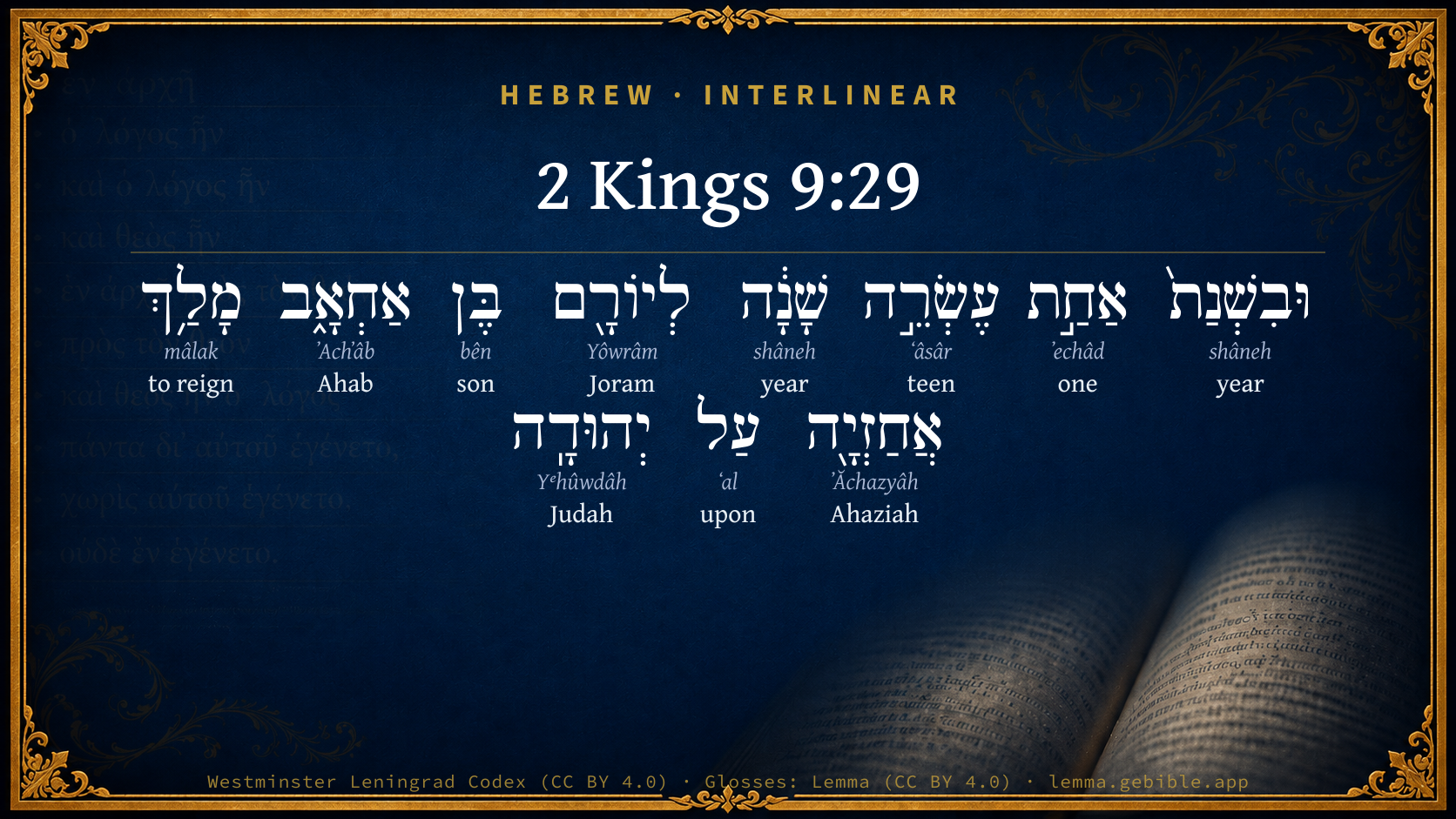
Hebrew (Westminster Leningrad Codex) 2 Kings 9:29 appears in the Hebrew Old Testament. The text above is from the Westminster Leningrad Codex. Each word links to its Strong’s number, a concise gloss, and parsing drawn from the Open Scriptures Hebrew Bible morphology. Click any word for its full Brown-Driver-Briggs (BDB) entry.
Download image
Cite this verse

2 Kings 9:29 (World English Bible). Public Domain. Lemma interlinear Bible study tool, https://lemma.gebible.app/v/2-kings/9/29.

Show BibTeX & RIS
BibTeX
RIS
English Translation
In the eleventh year of Joram the son of Ahab began Ahaziah to reign over Judah.
World English Bible · Public Domain
Download a study sheet

One document with this verse’s original text, its word-by-word gloss line, the meaning frame, cross-references with their text, attributed commentary, and full source and license credits — printable, and it pastes into notes with its structure intact.

This verse Autodidact and up

Study sheet (.html) Plain text (.txt)

A passage Seminary Student

Up to 50 verses in one chapter. A passage sheet keeps up to 6 commentary sources and 12 cross-references per verse, in the order this page ranks them, and says so on the sheet whenever that leaves anything out. Ask for a single verse and you get the Autodidact verse sheet above.

Everything on this page stays free to read, with no account — the sheet is a download of what is already on screen, not access to it.

Want to remove ads? Support Godless Engineer
Compare translations 3

The same verse in 3 English versions, stacked beneath the original-language interlinear above. Click any original word for its lexicon entry.

Each is an independent rendering of the whole verse — the interlinear is not word-aligned to these translations.

Highlighted words mark where these versions differ — a whole-verse word diff, not a word-by-word alignment.

  • World English Bible Public Domain
    In the eleventh year of Joram the son of Ahab began Ahaziah to reign over Judah.
  • King James Version Public Domain
    And in the eleventh year of Joram the son of Ahab began Ahaziah to reign over Judah.
  • unfoldingWord Literal Text CC BY-SA 4.0
    Now in the year of 11, the year to Joram, the son of Ahab, Ahaziah had reigned over Judah.

unfoldingWord Literal Text — © unfoldingWord, licensed CC BY-SA 4.0. Word-aligned USFM3 via Door43 (git.door43.org/unfoldingWord/en_ult).

Versions to compare (up to 4)

3 of 4 selected

Show all 18 translations

Every available English version of this verse, each an independent rendering of the whole verse.

  • World English Bible Public Domain
    In the eleventh year of Joram the son of Ahab began Ahaziah to reign over Judah.
  • Berean Standard Bible Public Domain
    (In the eleventh year of Joram son of Ahab, Ahaziah had become king over Judah.)
  • Majority Standard Bible Public Domain
    (In the eleventh year of Joram son of Ahab, Ahaziah had become king over Judah.)
  • King James Version Public Domain
    And in the eleventh year of Joram the son of Ahab began Ahaziah to reign over Judah.
  • American Standard Version (1901) Public Domain
    And in the eleventh year of Joram the son of Ahab began Ahaziah to reign over Judah.
  • Revised Version (1885) Public Domain
    And in the eleventh year of Joram the son of Ahab began Ahaziah to reign over Judah.
  • Geneva Bible (1599) Public Domain
    And in the eleuenth yere of Ioram the sonne of Ahab, began Ahaziah to reigne ouer Iudah.
  • Douay-Rheims (1899) Public Domain
    In the eleventh year of Joram the son of Achab, Ochozias reigned over Juda,
  • Young's Literal Translation Public Domain
    And in the eleventh year of Joram son of Ahab reign did Ahaziah over Judah.
  • Literal Standard Version CC BY-SA 4.0
    And in the eleventh year of Joram son of Ahab, Ahaziah reigned over Judah.
  • Unlocked Literal Bible CC BY-SA 4.0
    Now it was in the eleventh year of Joram son of Ahab that Ahaziah had begun to reign over Judah.
  • unfoldingWord Literal Text CC BY-SA 4.0
    Now in the year of 11, the year to Joram, the son of Ahab, Ahaziah had reigned over Judah.
  • Darby Bible Public Domain
    (And in the eleventh year of Joram the son of Ahab had Ahaziah begun to reign over Judah.)
  • World Messianic Bible Public Domain
    In the eleventh year of Joram the son of Ahab, Ahaziah began to reign over Judah.
  • Webster's Bible Public Domain
    And in the eleventh year of Joram the son of Ahab began Ahaziah to reign over Judah.
  • Free Bible Version CC BY-SA 4.0
    Ahaziah became king of Judah in the eleventh year of the reign of Joram, son of Ahab.
  • Bible in Basic English Public Domain
    (In the eleventh year of the rule of Joram, the son of Ahab, Ahaziah became king over Judah.)
  • JPS Tanakh (1917) Public Domain
    And in the eleventh year of Joram the son of Ahab began Ahaziah to reign over Judah.

Literal Standard Version (2020), Covenant Press — licensed CC BY-SA 4.0. Text via the HelloAO Bible API (eBible.org). Unlocked Literal Bible (unfoldingWord) — licensed CC BY-SA 4.0. Text via the HelloAO Bible API (eBible.org). unfoldingWord Literal Text — © unfoldingWord, licensed CC BY-SA 4.0. Word-aligned USFM3 via Door43 (git.door43.org/unfoldingWord/en_ult). Free Bible Version, Dr. Jonathan Gallagher — licensed CC BY-SA 4.0. Text via the HelloAO Bible API (eBible.org).

Word by word

More ways to search: Search by grammar → Find every occurrence → Compare this word →

Practice this passage: Drill this verse → Learn its vocabulary →

לְיוֹרָ֖ם
Yôwrâm
H3141
“to/for · Joram”
Preposition + Noun, Proper
Part of Speech
Preposition + Noun
Type
Proper
Full BDB Definition

Origin: a form of H3088

TWOT: None

Joram = "Jehovah is exalted" - son of king Jehoshaphat of Judah and himself king of Judah for 8 years; his wife was the wicked Athaliah who was probably the instigator for his returning the nation of Judah to the worship of Baal - son of king Ahab of the northern kingdom of Israel and king of Israel himself for 12 years; he was murdered by Jehu on the plot of land for which his father had murdered Naboth thus fulfilling the prophecy of Elijah to the very letter - a Levite in the time of David and an ancestor of Shelomith - son of Toi, king of Hamath
  1. וּבִשְׁנַת֙ shâneh H8141 “and · in/at · year of” Conjunction + Preposition + Noun, Common, Feminine, Singular, Construct
  2. אַחַ֣ת ʼechâd H259 “one” Adjective, Cardinal number, Feminine, Singular, Absolute
  3. עֶשְׂרֵ֣ה ʻâsâr H6240 “teen” Adjective, Cardinal number, Feminine, Singular, Absolute
  4. שָׁנָ֔ה shâneh H8141 “year” Noun, Common, Feminine, Singular, Absolute
  5. בֶּן bên H1121 “son of” Noun, Common, Masculine, Singular, Construct
  6. אַחְאָ֑ב ʼAchʼâb H256 “Ahab” Noun, Proper
  7. מָלַ֥ךְ mâlak H4427 “to reign” Verb, Qal, Perfect, 3rd Person, Masculine, Singular
  8. אֲחַזְיָ֖ה ʼĂchazyâh H274 “Ahaziah” Noun, Proper
  9. עַל ʻal H5921 “upon” Preposition
  10. יְהוּדָֽה Yᵉhûwdâh H3063 “Judah” Noun, Proper

About this verse

These counts appear in no published source. They are computed here, from the morphology-tagged text and Lemma’s own curated glosses. What Lemma adds →

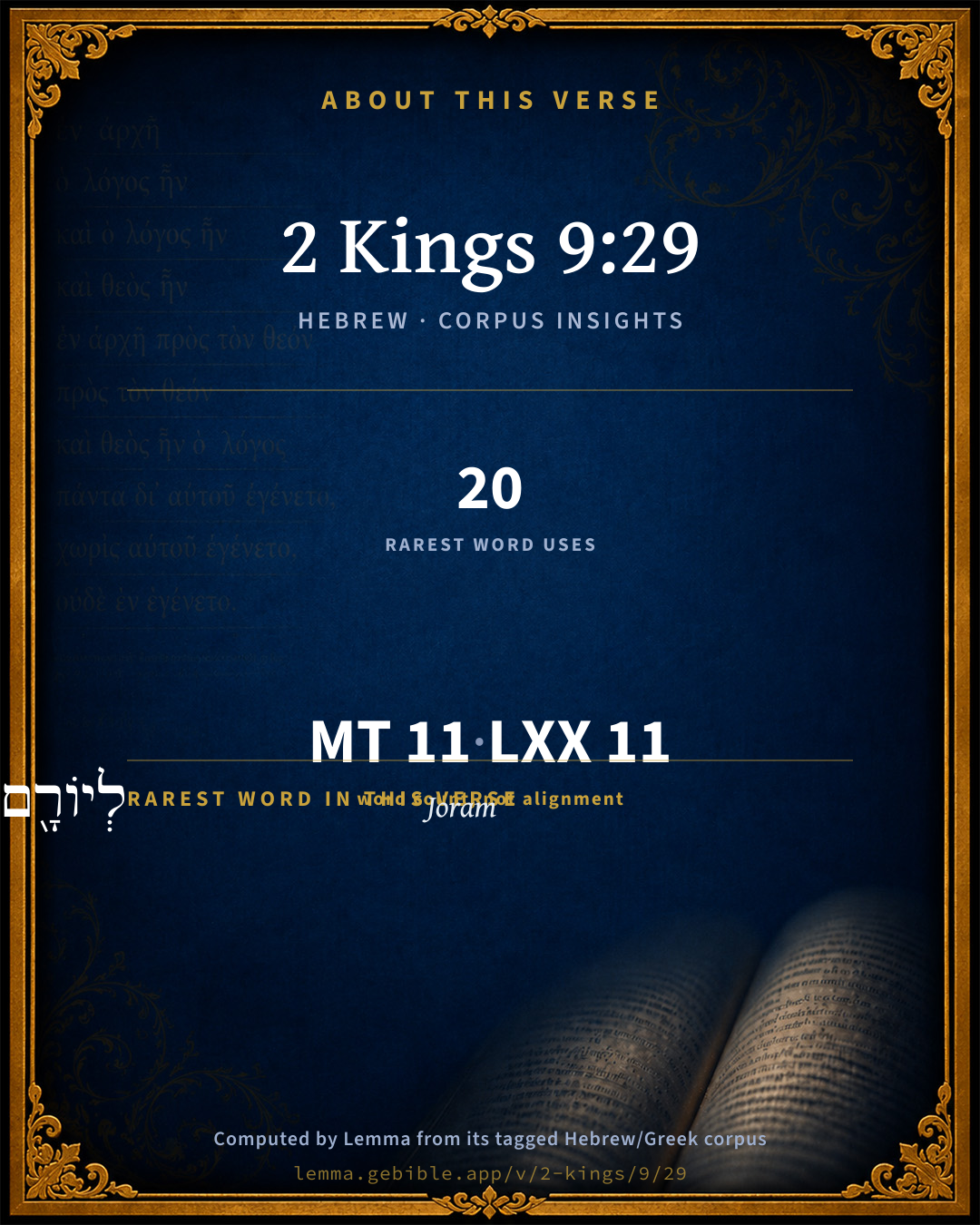
11
words
10
distinct lemmas
Historical
section

Notable vocabulary

The rarest word here is לְיוֹרָ֖ם Joram H3141 — appearing just 20 times in the whole Hebrew Bible.

Shared distinctive vocabulary

לְיוֹרָ֖ם Joram H3141 occurs in 16 verses of the Hebrew Bible. Also found in:

Grammatical profile

  • 1 verb
  • 7 nouns
  • 2 adjectives
  • 1 preposition

Verb forms

  • מָלַ֥ךְ Qal · Perfect

Repetition

A word recurs within this verse — often emphatic in Hebrew:

  • וּבִשְׁנַת֙ year H8141 ×2

Hebrew & Septuagint length

In English translation the verse runs 16 words from the Hebrew and 16 from the Septuagint (LXX English) — the same length.

A rough comparison of the two English renderings, which tokenize alike — not a word-level alignment.

Word counts can differ between the Hebrew and the Greek without any difference in meaning — e.g. the Hebrew direct-object marker אֵת has no separate Greek word, and Greek often adds the article ὁ.

In the original languages it is 11 Hebrew tokens and 11 Greek tokens — but the two are counted differently (Hebrew bundles its prefixes and suffixes into one token; the Greek is in lemma form), so that isn’t a like-for-like length.

Cross-references

4

Topical passages linked to 2 Kings 9:29 in the Treasury of Scripture Knowledge — connected by theme and wording, ordered by reader-vote popularity; previews shown in the World English Bible.

  • 2 Chronicles 21:18–19 After all this Yahweh struck him in his bowels with an incurable disease.
  • 2 Kings 8:16 In the fifth year of Joram the son of Ahab king of Israel, Jehoshaphat being then king of Judah, Jehoram the son of Jehoshaphat king of Judah began to reign.
  • 2 Kings 8:24–25 Joram slept with his fathers, and was buried with his fathers in the city of David; and Ahaziah his son reigned in his place.
  • 2 Chronicles 22:1–2 The inhabitants of Jerusalem made Ahaziah his youngest son king in his place; for the band of men who came with the Arabians to the camp had slain all the eldest. So Ahaziah the son of Jehoram king of Judah reigned.

Cross-references courtesy of OpenBible.info (CC BY 4.0).

Hebrew and Greek witnesses Masoretic Hebrew ↔ Greek Septuagint

The same verse in the two great witnesses to the Old Testament, shown verse-for-verse.

These are two independent witnesses, not word-aligned to each other, and the Septuagint is shown in lemma (dictionary) form.

Hebrew 2 Kings 9:29 Masoretic · Westminster Leningrad Codex

וּבִשְׁנַת֙ אַחַ֣ת עֶשְׂרֵ֣ה שָׁנָ֔ה לְיוֹרָ֖ם בֶּן אַחְאָ֑ב מָלַ֥ךְ אֲחַזְיָ֖ה עַל יְהוּדָֽה

In the eleventh year of Joram the son of Ahab began Ahaziah to reign over Judah.

World English Bible · Public Domain

Greek LXX 2 Kings 9:29 Septuagint · lemma form

καί ἐν ἔτος ἑνδέκατος ιωραμ βασιλεύς ἰσραήλ βασιλεύω οχοζιας ἐπί ἰούδας

And in the eleventh year of Joram king of Israel, Ochozias began to reign over Juda.

LXX2012 (modern English Septuagint) · Public Domain

On this verse, The Cambridge Bible for Schools and Colleges discusses the Septuagint’s reading. Read the note in Commentary ↓

Hebrew: Westminster Leningrad Codex (CC BY 4.0). Greek: Septuagint (public domain); English from LXX2012 (modern English Septuagint) (Public Domain). How the Septuagint differs from the Hebrew →

Targum (Aramaic paraphrase)

1

The Targum is the ancient Jewish Aramaic paraphrase of the Hebrew Scriptures — an interpretive translation, not the Hebrew text itself. Onkelos (literal) and Pseudo-Jonathan (expansive) render the Torah, and Jonathan the Prophets. Coverage is partial: where no permissively-licensed English translation exists for a verse, only the Aramaic is shown. This is verse-level text, not a word-by-word alignment to the Hebrew.

  1. Targum Jonathan Prophets (Joshua–Malachi)
    וּבִשְׁנַת חֲדָא עַשְׂרֵי שְׁנִין לְיוֹרָם בַּר אַחְאָב מְלַךְ אֲחַזְיָה עַל דְבֵית יְהוּדָה:

    (no public-domain English translation for this verse)

    Targum Jonathan — Aramaic: “Mikraot Gedolot” (public domain). English: “Sefaria Community Translation” (CC0 1.0 (public-domain dedication)); “London "Chaldee Paraphrase," 1871” (public domain). Text via Sefaria.

Commentary

Notes on 2 Kings 9:29 from classic Christian and Jewish commentators (each source and its license shown beneath its notes). The classic Christian expositions comment on the surrounding passage and are grouped to its opening verse, so a note may address several verses; the Jewish commentaries on the Tanakh (Rashi and others) are per-verse, so they appear only where the commentator wrote on this verse.

Lemma curates 59 commentaries, every one of them public domain or Creative Commons licensed, each selected and text-cleaned for this edition rather than reprinted as found. About our sources →

Trapp's Complete Commentary

John Trapp

2Ki 9:29 And in the eleventh year of Joram the son of Ahab began Ahaziah to reign over Judah.

Ver. 29. And in the eleventh year.] See 2Ki 8:25.

John Trapp, A Commentary or Exposition upon All the Books of the Old and New Testament (1647–1656) — public domain. Text from a community e-Sword module.

Geneva Bible (1599)

Geneva Bible translators

That is, eleven whole years: for 2 Kings 8:25, before, when he said that he began to reign the twelfth year of Joram, he taketh part of the year for the whole.

Geneva Bible (1599) marginal notes — public domain. Text via Bolls.life.

Adam Clarke's Commentary

Verse 29. In the eleventh year of Joram] The note in our margin contains as good an account of this chronological difficulty as can be reasonably required: Then he began to reign as viceroy to his father in his sickness; 2Ch 21:18-19. But in Joram's twelfth year he began to reign alone; 2Kg 8:26.

Adam Clarke's Commentary on the Bible (1810–1826) — public domain. Text from a community e-Sword/MySword module.

Ellicott's Commentary for English Readers

(29) In the eleventh year of Joram.—2Ki_8:25 says “in the twelfth year of Joram.” Such a difference is not remarkable, inasmuch as the synchronisms between the reigns of the two kingdoms are not based upon exact records. Moreover, different computations might make the same year the eleventh or tweftth of Joram. (The verse is a parenthesis, and perhaps spurious.)

A Bible Commentary for English Readers, edited by Charles John Ellicott (1878–1897) — public domain. Text from a community e-Sword module.

The Cambridge Bible for Schools and Colleges

gen. ed. J. J. S. Perowne

29. And in the eleventh year of Joram … began Ahaziah to reign] This verse seems out of place. It is not usual to mention the date at which a king begins to reign, after his death, but at his accession. This was done for Ahaziah in 2Ki_8:25, but there it is said that it was in the twelfth year of Joram that his reign began. So small a variation is of very little account when we consider how the Jews reckoned the regnal years of their kings, but the unusual position of the notice in this verse casts some suspicion upon it. The LXX. however represents it.

The Cambridge Bible for Schools and Colleges (gen. ed. J. J. S. Perowne; Cambridge University Press, 1878–1918) — public domain. Text from a community e-Sword module.

John Gill's Exposition

And he said, throw her down,.... Out of the window upon the ground:

so they threw her down; took her up, and cast her headlong, as they were bid:

and some of her blood was sprinkled on the wall; of the palace where she was:

and on the horses; which drew the chariot of Jehu:

and he trod her underfoot; with his horses; according to Kimchi, her sentence, and so her death, was stoning, as a retaliation of Naboth; for stoning was done two ways, both by casting down persons on stones, and by casting stones upon them; see Gill on Act 7:58.

John Gill's Exposition of the Whole Bible (1746–1763) — public domain (CC PDM 1.0). Text via the HelloAO Bible API.

Albert Barnes' Notes on the Bible

In the eleventh year - The twelfth according to 2Ki 8:25. The discrepancy may be best explained from two ways of reckoning the accession of Ahaziah, who is likely to have been regent for his father during at least one year. See 2Ch 21:19.

Albert Barnes' Notes on the Bible (1834–1885) — public domain. Text from a community e-Sword/MySword module.

Haydock's Catholic Bible Commentary

Eleventh, or rather the twelfth, (chap. viii. 25.; Houbigant) unless he had been associated with his father on the throne a year before his death. (Calmet) (Du Hamel)

George Leo Haydock (1774–1849), Haydock's Catholic Family Bible and Commentary, 1859 edition — public domain. Excludes Psalms (Douay-Rheims chapter numbering differs from Protestant) and Deuterocanonical books (Catholic canon only).

Matthew Poole's English Annotations

Of this See Poole "2Ki 8:25".

Matthew Poole's English Annotations on the Holy Bible (1683–1685) — public domain. Text from a community e-Sword/MySword module.

Whedon's Commentary on the Bible

Daniel D. Whedon

29. In the eleventh year of Joram — But 2Ki_8:25, says, the twelfth year of Joram. “This difference of dates probably arose from a different computation of the beginning of the years of his reign.” — Keil.

Daniel D. Whedon (gen. ed.), Commentary on the Old and New Testaments (1874–1909) — public domain. Text from a community e-Sword module.

The Pulpit Commentary

And in the eleventh year of Joram the son of Ahab began Ahaziah to reign over Israel. in 2Ki_8:25 the accession of Ahaziah is placed in Joram"s twelfth, instead of his eleventh, year. The slight discrepancy is sufficiently explained By the double reckoning of a king"s "first year," familiar to chronologists, either

(1) from the date of the accession to the end of the current civil year; or

(2) from the date of the accession to the same day in the ensuing year.

The Pulpit Commentary (1880–1919), ed. H.D.M. Spence-Jones & Joseph S. Exell — public domain. Text from a community e-Sword module.

unfoldingWord translationNotes

Door43 World Missions Community

in the eleventh year of Joram son of Ahab

This describes the time that Ahaziah began to reign by stating how long the current king of Israel had reigned. AT: "in the eleventh year that Joram son of Ahab was king of Israel" (See: Assumed Knowledge and Implicit Information)

eleventh year

"11th year" (See: Ordinal Numbers)

translationWords

reign

kingdom of Judah

unfoldingWord translationNotes — © Distant Shores Media and the Door43 World Missions Community, licensed CC BY-SA 4.0. Source: git.door43.org/Door43/en_tn.

Rashi

Rabbi Shlomo Yitzchaki (Rashi)

In the eleventh year of Yorom, son of Achov, Achazyoh became king. Above it states, “In the twelfth year.” And you are forced [to say] that Yehorom his father died in the twelfth year of Yorom, because he became king in the fifth year of Yorom and he reigned for eight years. Why then does it say here, “In the eleventh year”? I say that he reigned one year during his father’s lifetime because he was afflicted with severe maladies, as it is stated, “And after all this, Adonoy afflicted him [in his intestines] with incurable illness, and it was at the end of a year … his intestines came out because of his illness, etc.,” “and the inhabitants of Yerusholayim made king—Achazyohu.” Here it states, “Achazyohu was twenty-two years old when he became king,” but in Divrei Hayomim [it states], “He was forty-two years old when he reigned.” Yehorom, his father, lived for forty years, no more, as it is stated, concerning him, “He was thirty-two years old when he became king, and he reigned eight years [in Yerusholayim].” How then is it possible for a son to be two years older than his father? Rather, twenty years before he was born, which is two years before his father was born, this decree was issued. From the day that Asa took Omri’s daughter in marriage for Yehoshophot his son, a decree was issued upon the House of Dovid that it be destroyed with the House of Achov. And similarly it states, “And from God [it was decreed] for the ruination of Achazyohu, that he come to Yorom, etc.” Thus it is taught in Seder Olam and in the Tosefta of [Maseches] Sotah. However, in all of Scripture, we do not find that Yehoshophot married Omri’s daughter. However, I did find in Divrei Hayomim, “And he intermarried with Achov.” Perhaps this [refers to] his sister whom he married. He married her in the thirty-first year of Asa, as it is stated, “In the thirty-first year of the reign of Asa, [King of Yehudah], Omri reigned [over Yisroel].” And we learned in Seder Olam that he reigned over the entire kingdom, for six years before then he reigned over half the people, and when Asa took his [Imri’s] daughter in marriage to [his son] Yehoshophot, Imri gained prestige, and they assassinated Tivni. Proceed and calculate from the thirty-first year of Asa until Achazyohu’s death and you will find them to be forty-two [years].

Rashi on the Tanakh — English translations: “The Judaica Press complete Tanach with Rashi, translated by A. J. Rosenberg” (CC BY 4.0); “Pentateuch with Rashi's commentary by M. Rosenbaum and A.M. Silbermann, 1929-1934” (public domain); “The Metsudah Tanach series, Lakewood, N.J” (CC BY 4.0); and “The Book of Joshua, Metsudah Publications, 1997” (CC BY 4.0). Text via Sefaria.

Lesson kit

Teaching starters — assembled from the data on this page, not authored interpretation. Every prompt links to the verse data it draws on. Edit before teaching.

2 Kings, in the Historical, opens this verse with 11 words (10 distinct Hebrew lemmas). Its most distinctive word is Yôwrâm (“Joram”). A historical commentator’s framing appears above. Read the whole chapter for the surrounding context.

Discussion questions

  1. How does “Joram” (Yôwrâm) shape what this verse is saying?
  2. 2 Samuel 8:10 shares the word «Joram» with this verse. How do the two illuminate each other?
  3. “year” occurs 2× in this one verse. What is the effect of the repetition?
  4. The translations on this page render this verse differently — a whole-verse word diff, not a word-by-word alignment. What might account for the different wordings?
  5. The verb «מָלַ֥ךְ» is Qal Perfect. How does its form color the action?
  6. Reading how Trapp's Complete Commentary and Geneva Bible (1599) read this verse, where do the two commentators agree and where do they part?

Things to notice

Reading settings

Reading text

Shown beneath each verse's original-language words.

Old Testament
Old Testament edition

Read the OT as the Masoretic Hebrew (MT) or the Greek Septuagint (LXX).

English shown for the Greek Septuagint (in the Hebrew ↔ Greek comparison).

Comparing translations? Open the Compare panel on any verse page to stack up to four side by side.