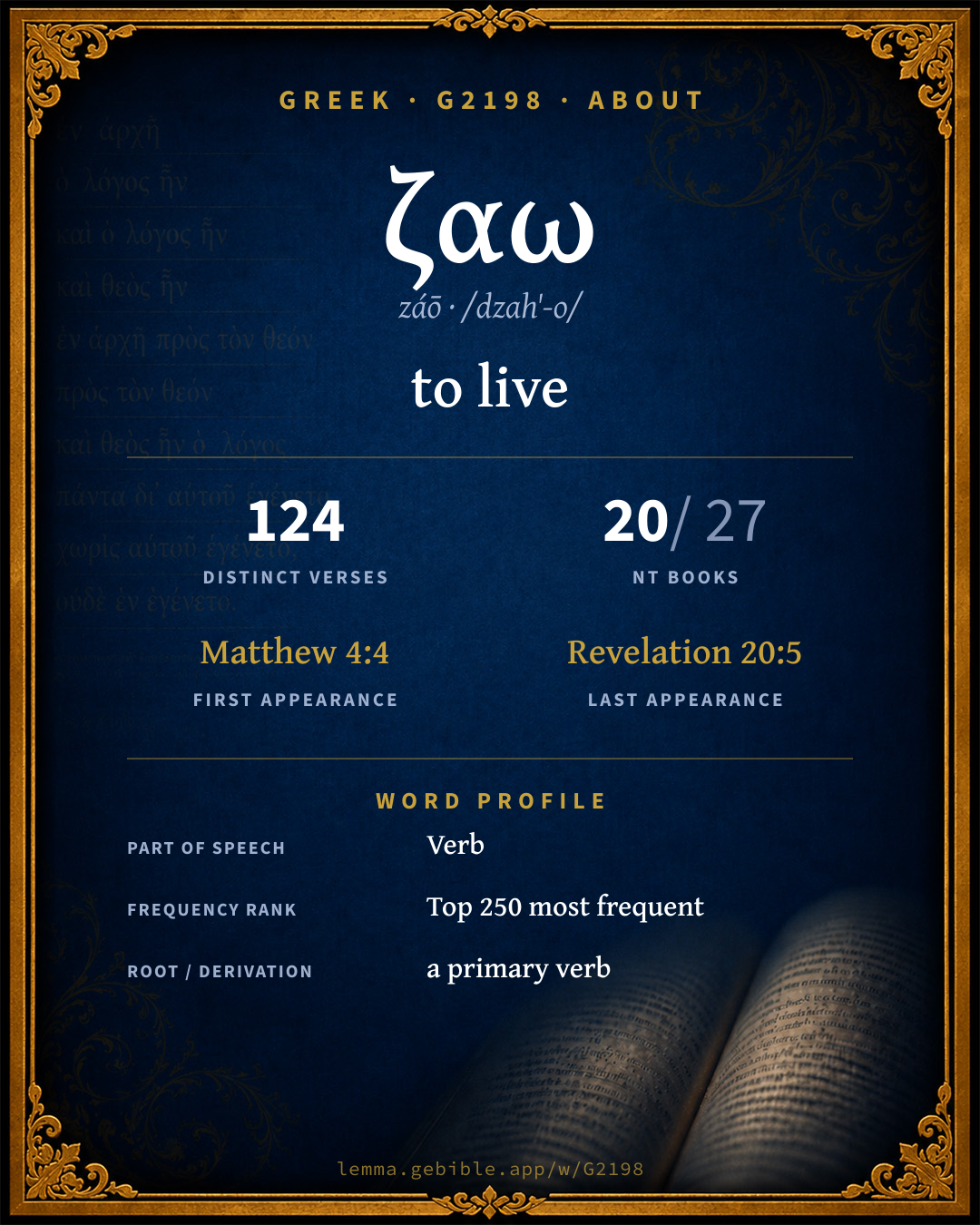
ζάω
to live
‘to live’ is one of 6 main senses fuller range ↓
Full lexicon entry — Thayer's Greek Lexicon
From Thayer's Greek Lexicon
Where this word appears
See every Present-tense verb in the Greek New Testament →
Grammar key — what these labels mean
Part of speech
- Verb
- An action or state-of-being word.
Tense
- Present
- Ongoing or general action in present time (imperfective aspect).
- Future
- Action expected in future time.
- Aorist
- Action viewed as a simple whole, without regard to duration — often past (perfective aspect).
- Imperfect
- Continuous or repeated action in past time (“was writing”).
Voice
- Active
- The subject performs the action.
- Middle deponent
- Middle in form but active in meaning.
Mood
- Indicative
- States a fact or asks a factual question (the mood of reality).
- Participle
- A verbal adjective (“writing,” “having written”).
- Infinitive
- A verbal noun (“to write”), unmarked for person or number.
- Subjunctive
- Expresses probability, purpose, or possibility (the mood of contingency).
Case
- Genitive
- The case of source, possession, or “of” — answers “whose / from what.”
- Nominative
- The case of the subject (and the predicate nominative).
- Dative
- The case of the indirect object, means, or location — “to / for / with / in.”
- Accusative
- The case of the direct object and of extent.
Person
- 3rd person
- The one spoken about (“he / she / it / they”).
- 1st person
- The speaker (“I / we”).
- 2nd person
- The one addressed (“you”).
Gender
- Masculine
- Grammatically masculine.
- Feminine
- Grammatically feminine.
- Neuter
- Grammatically neuter.
Number
- Singular
- One.
- Plural
- More than one.
1 verse where G2198 appears in the Aorist tense in the Book of 1 Peter. Filtered view — show all forms. Click any verse to open its interlinear word-by-word view. Verse text shown in the World English Bible for context — . Each verse’s Greek form is shown with its reference; the English is not keyword-highlighted, since the data carries no word-level English alignment. Use “Compare translations” on any verse to read it across multiple English versions. This concordance covers the Greek New Testament; Septuagint (Greek Old Testament) occurrences of this word are not indexed here.
1 Peter
About this entry
At a glance — auto-summarized from this page’s data, not written by a person. Every figure links to its source below. This summary describes the numbers; it doesn’t interpret them.
“to live” is the headline sense of the Greek verb ζαω (záō). “liveth” is the historic King James Version rendering; modern versions use “living.” See the renderings breakdown. It turns up in 124 verses across 20 books, a common footprint. First canonically at Matthew 4:4, it enters the text early. Catalogued under 6 senses, its meaning is not single-sense. See the sense tree, 124-verse concordance, and the renderings breakdown below.
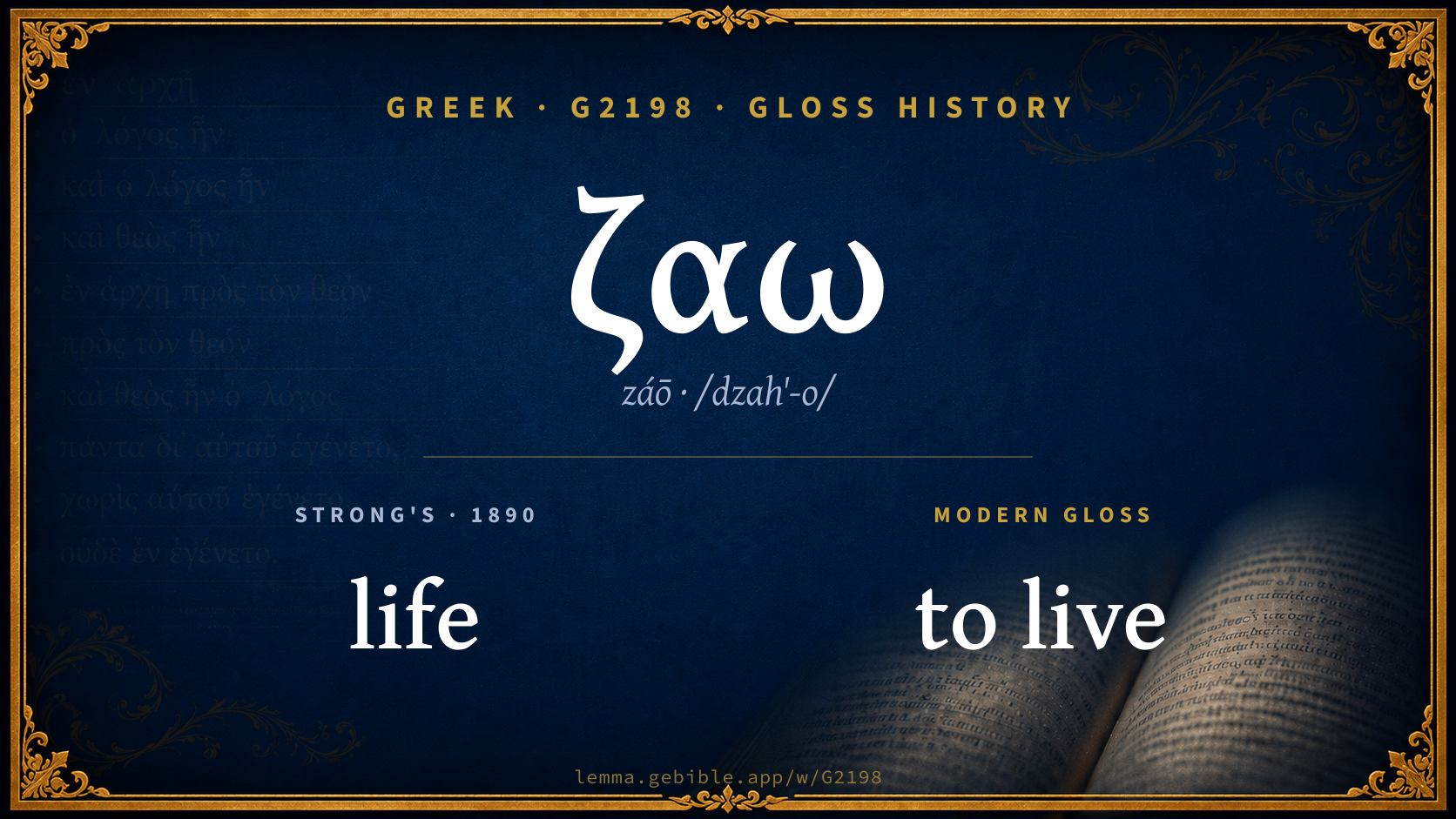
Gloss history
Strong's 1890 vs modern scholarship
About this word
Strong's G2198 catalogs a Greek word from the Greek New Testament.
These counts are not copied from any lexicon or concordance. They are computed here, from the morphology-tagged Greek New Testament. What Lemma adds →
- 124
- distinct verses
- The word appears in 124 distinct verses.
- 20 / 27
- NT books
- The word appears in 20 of 27 New Testament books.
- #120
- by frequency
- Top 250 most frequent Greek words (rank 120 of 5,347 Greek words by occurrence).
View all 124 occurrences in the concordance →
By section of the New Testament
By traditional corpus
Conventional, traditional groupings — biblical authorship is debated, so this is a traditional corpus grouping, not an authorship claim. Some books belong to more than one corpus (Luke is in both the Gospels and the Lukan corpus, and so on), so these shares overlap and need not total 100%. Each figure is a share of the word’s 124 distinct verses.
- Pauline corpus 49 verses · 40%
- Gospels 30 verses · 24%
- Johannine 26 verses · 21%
- Lukan (Luke–Acts) 20 verses · 16%
- Hebrews 12 verses · 10%
- Revelation 12 verses · 10%
- General (Catholic) Epistles 9 verses · 7%
How translations render this word
Counts come from each version’s own published word-to-Strong’s tagging or interlinear alignment — an approximate guide to how each version renders this word, not a word-level alignment the data otherwise carries. Because each total is that version’s own tagged count, the per-version totals vary from one another and need not match the appearance or distinct-verse counts above. These counts may also differ from a printed concordance because Lemma counts each distinctly tagged rendering and does not collapse phrase taggings into a single head-word total. This is a fixed set of word-tagged versions (KJV, ASV, BSB, ULT) and does not change with the reading translation you choose elsewhere. Each version’s license is shown beside its name below (and on Sources).
- King James Version: Living 34×, Live 17×, Liveth 16×
- American Standard Version: Living 37×, Live 21×, Liveth 13×
- Berean Standard Bible: Living 38×, Live 19×, Will live 12×
- unfoldingWord Literal Text: Living 51×, Live 22×, Lives 8×
King James Version Public Domain
Renders G2198 across 147 tagged occurrences — most commonly:
Plus other, less common renderings. Plus 27 renderings that appear only once — usually multi-word phrases or single function words the recovered tagging swept in, not distinct renderings. Not rendered by a distinct English word in 1 further occurrence.
American Standard Version Public Domain
Renders G2198 across 146 tagged occurrences — most commonly:
Plus other, less common renderings. Plus 31 renderings that appear only once — usually multi-word phrases or single function words the recovered tagging swept in, not distinct renderings.
Berean Standard Bible Public Domain
Renders G2198 across 140 tagged occurrences — most commonly:
Plus other, less common renderings. Plus 25 renderings that appear only once — usually multi-word phrases or single function words the recovered tagging swept in, not distinct renderings.
unfoldingWord Literal Text CC BY-SA 4.0
Renders G2198 across 150 tagged occurrences — most commonly:
Plus other, less common renderings. Plus 26 renderings that appear only once — usually multi-word phrases or single function words the recovered tagging swept in, not distinct renderings.
Senses in Thayer's
The 6 senses Thayer's distinguishes for this word, in lexicon order (not ranked by frequency or importance). The full entry — with sub-senses — is in the Lexicon Entry tab.
- to live, breathe, be among the living (not lifeless, not dead)
- to have true life and worthy of the name
- active, blessed, endless in the kingdom of God
- to live i.e. pass life, in the manner of the living and acting
- living water, having vital power in itself and exerting the same upon the soul
- metaph. to be in full vigour
Word origin
Origin: a primary verb
A primary verb; to live (literally or figuratively): - life (-time) (a-) live (-ly) quick.
— Strong’s Exhaustive Concordance (1890), public domain.
Forms in the corpus
The 32 distinct written forms G2198 takes in the Greek New Testament, most frequent first — each parse links to that tense’s occurrences in the concordance.
Same root — word family
Other Thayer's entries built from the same root as G2198, grouped by Strong’s listed origin. These share a root / origin per the lexicon — not necessarily a shared meaning. Each links to that word’s own entry.
Derived from this word
Compare all same-root words → They share a root, not necessarily a meaning.
Septuagint usage
The same Greek word ζαω appears 439 times in the Greek Old Testament (Septuagint), across 404 verses in 31 books.
- 439
- LXX occurrences
- Tagged occurrences of this Greek word in the Septuagint.
- 404
- verses
- Distinct Septuagint verses containing this word.
- 31 / 39
- OT books
- The word appears in 31 of the 39 Old Testament books.
Sample Septuagint occurrences
- Genesis 1:20 ζάω
- Exodus 4:18 ζάω
- Leviticus 11:10 ζάω
- Numbers 4:19 ζάω
- Deuteronomy 4:1 ζάω
- Joshua 3:10 ζάω
- Judges 8:19 ζάω
- Ruth 2:20 ζάω
- 1 Samuel 1:26 ζάω
- 2 Samuel 1:10 ζάω
- 1 Kings 1:25 ζάω
- 2 Kings 1:2 ζάω
Septuagint occurrences (same lexeme)
Every verse where the same Strong’s number (G2198) appears in the Greek Septuagint — showing the first 50 of 404. Verse text shown in the World English Bible for context; the Greek form is the matched word — the English is not keyword-highlighted.
- Genesis 1:20 ζάω God said, "Let the waters swarm with swarms of living creatures, and let birds fly above the earth in the open expanse of sky."
- Genesis 1:24 ζάω God said, "Let the earth bring forth living creatures after their kind, cattle, creeping things, and animals of the earth after their kind," and it was so.
- Genesis 2:7 ζάω Yahweh God formed man from the dust of the ground, and breathed into his nostrils the breath of life; and man became a living soul.
- Genesis 2:19 ζάω Out of the ground Yahweh God formed every animal of the field, and every bird of the sky, and brought them to the man to see what he would call them. Whatever the man called every living creature, that was its name.
- Genesis 3:20 ζάω The man called his wife Eve, because she was the mother of all living.
- Genesis 3:22 ζάω Yahweh God said, "Behold, the man has become like one of us, knowing good and evil. Now, lest he put forth his hand, and also take of the tree of life, and eat, and live forever..."
- Genesis 5:3 ζάω Adam lived one hundred thirty years, and became the father of a son in his own likeness, after his image, and named him Seth.
- Genesis 5:5 ζάω All the days that Adam lived were nine hundred thirty years, then he died.
- Genesis 5:6 ζάω Seth lived one hundred five years, and became the father of Enosh.
- Genesis 5:7 ζάω Seth lived after he became the father of Enosh eight hundred seven years, and became the father of sons and daughters.
- Genesis 5:9 ζάω Enosh lived ninety years, and became the father of Kenan.
- Genesis 5:10 ζάω Enosh lived after he became the father of Kenan, eight hundred fifteen years, and became the father of sons and daughters.
- Genesis 5:12 ζάω Kenan lived seventy years, and became the father of Mahalalel.
- Genesis 5:13 ζάω Kenan lived after he became the father of Mahalalel eight hundred forty years, and became the father of sons and daughters
- Genesis 5:15 ζάω Mahalalel lived sixty-five years, and became the father of Jared.
- Genesis 5:16 ζάω Mahalalel lived after he became the father of Jared eight hundred thirty years, and became the father of sons and daughters.
- Genesis 5:18 ζάω Jared lived one hundred sixty-two years, and became the father of Enoch.
- Genesis 5:19 ζάω Jared lived after he became the father of Enoch eight hundred years, and became the father of sons and daughters.
- Genesis 5:21 ζάω Enoch lived sixty-five years, and became the father of Methuselah.
- Genesis 5:25 ζάω Methuselah lived one hundred eighty-seven years, and became the father of Lamech.
- Genesis 5:26 ζάω Methuselah lived after he became the father of Lamech seven hundred eighty-two years, and became the father of sons and daughters.
- Genesis 5:27 ζάω All the days of Methuselah were nine hundred sixty-nine years, then he died.
- Genesis 5:28 ζάω Lamech lived one hundred eighty-two years, and became the father of a son,
- Genesis 5:30 ζάω Lamech lived after he became the father of Noah five hundred ninety-five years, and became the father of sons and daughters.
- Genesis 8:21 ζάω Yahweh smelled the sweet savor. Yahweh said in his heart, "I will not again curse the ground any more for man's sake, because the imagination of man's heart is evil from his youth; neither will I ever again strike everything living, as I have done.
- Genesis 9:3 ζάω Every moving thing that lives will be food for you. As the green herb, I have given everything to you.
- Genesis 9:10 ζάω and with every living creature that is with you: the birds, the cattle, and every animal of the earth with you. Of all that go out of the ark, even every animal of the earth.
- Genesis 9:12 ζάω God said, "This is the token of the covenant which I make between me and you and every living creature that is with you, for perpetual generations:
- Genesis 9:15 ζάω and I will remember my covenant, which is between me and you and every living creature of all flesh, and the waters will no more become a flood to destroy all flesh.
- Genesis 9:16 ζάω The rainbow will be in the cloud. I will look at it, that I may remember the everlasting covenant between God and every living creature of all flesh that is on the earth."
- Genesis 9:28 ζάω Noah lived three hundred fifty years after the flood.
- Genesis 11:11 ζάω Shem lived after he became the father of Arpachshad five hundred years, and became the father of sons and daughters.
- Genesis 11:12 ζάω Arpachshad lived thirty-five years, and became the father of Shelah.
- Genesis 11:13 ζάω Arpachshad lived after he became the father of Shelah four hundred three years, and became the father of sons and daughters.
- Genesis 11:14 ζάω Shelah lived thirty years, and became the father of Eber:
- Genesis 11:15 ζάω and Shelah lived after he became the father of Eber four hundred three years, and became the father of sons and daughters.
- Genesis 11:16 ζάω Eber lived thirty-four years, and became the father of Peleg.
- Genesis 11:17 ζάω Eber lived after he became the father of Peleg four hundred thirty years, and became the father of sons and daughters.
- Genesis 11:18 ζάω Peleg lived thirty years, and became the father of Reu.
- Genesis 11:19 ζάω Peleg lived after he became the father of Reu two hundred nine years, and became the father of sons and daughters.
- Genesis 11:20 ζάω Reu lived thirty-two years, and became the father of Serug.
- Genesis 11:21 ζάω Reu lived after he became the father of Serug two hundred seven years, and became the father of sons and daughters.
- Genesis 11:22 ζάω Serug lived thirty years, and became the father of Nahor.
- Genesis 11:23 ζάω Serug lived after he became the father of Nahor two hundred years, and became the father of sons and daughters.
- Genesis 11:24 ζάω Nahor lived twenty-nine years, and became the father of Terah.
- Genesis 11:25 ζάω Nahor lived after he became the father of Terah one hundred nineteen years, and became the father of sons and daughters.
- Genesis 11:26 ζάω Terah lived seventy years, and became the father of Abram, Nahor, and Haran.
- Genesis 12:13 ζάω Please say that you are my sister, that it may be well with me for your sake, and that my soul may live because of you."
- Genesis 17:18 ζάω Abraham said to God, "Oh that Ishmael might live before you!"
- Genesis 19:19 ζάω See now, your servant has found favor in your sight, and you have magnified your loving kindness, which you have shown to me in saving my life. I can't escape to the mountain, lest evil overtake me, and I die.
These are occurrences of the same Greek lexeme (G2198) in the Septuagint — not a translation of any one Hebrew word. The store carries no word-level Hebrew↔Greek alignment, so no Hebrew original is asserted here. Counts come from the recovered LXX Strong's tagging — high-frequency vocabulary is well covered, while rare or late forms may be untagged — so they reflect tagged occurrences and may slightly undercount.