
1 Timothy 5:6

Greek (Tischendorf 8th ed.) 1 Timothy 5:6 appears in the Greek New Testament. The text above is from the Tischendorf 8th edition. Each word links to its Strong’s number and a concise gloss. Click any word for its full Thayer’s Greek Lexicon entry.
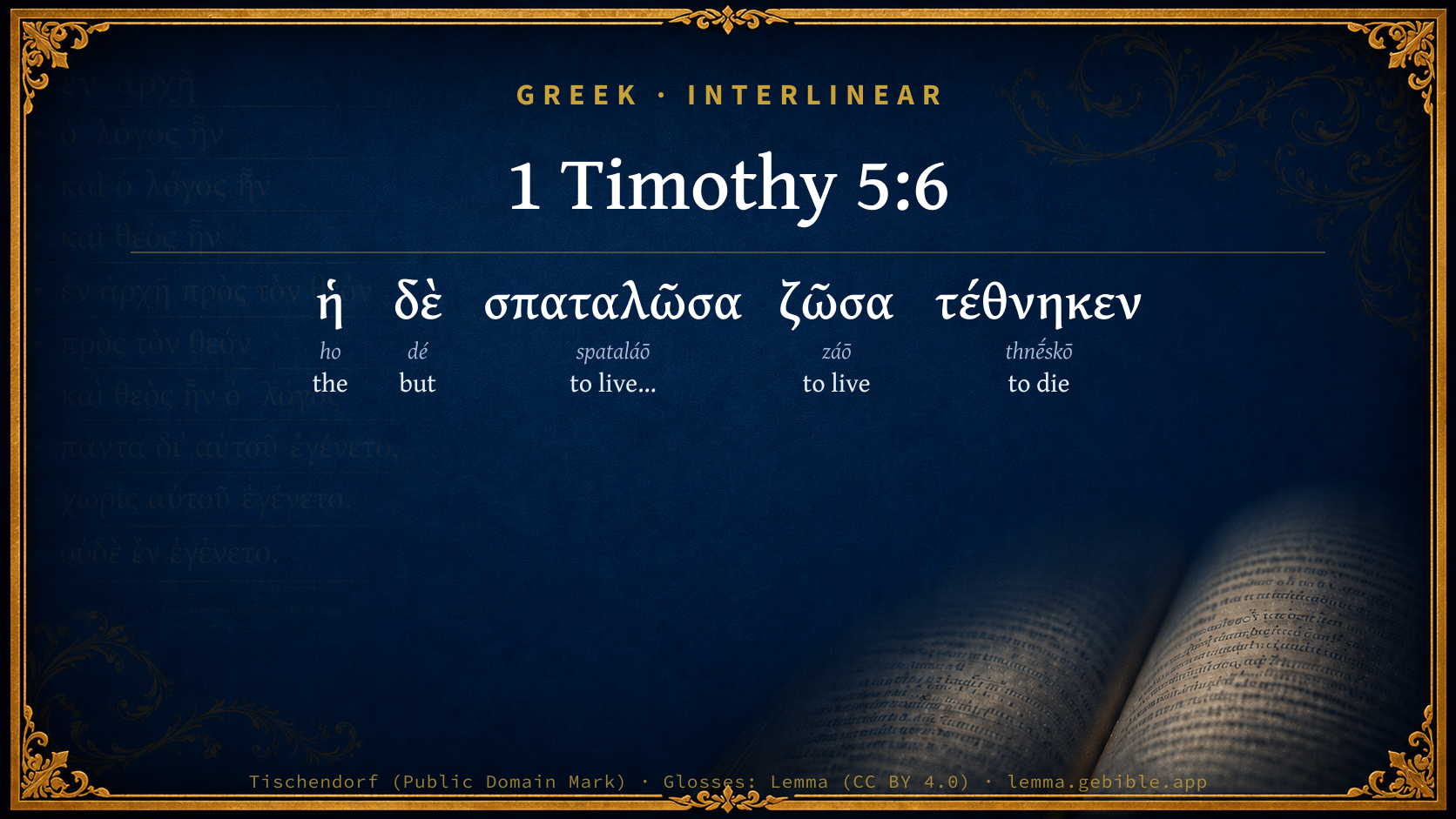
Download image
Cite this verse

1 Timothy 5:6 (World English Bible). Public Domain. Lemma interlinear Bible study tool, https://lemma.gebible.app/v/1-timothy/5/6.

Show BibTeX & RIS
BibTeX
RIS
English Translation
But she who gives herself to pleasure is dead while she lives.
World English Bible · Public Domain
Highlights
  • 1 first appearance in the Greek New Testament
Full analysis ↓
Download a study sheet

One document with this verse’s original text, its word-by-word gloss line, the meaning frame, cross-references with their text, attributed commentary, and full source and license credits — printable, and it pastes into notes with its structure intact.

This verse Autodidact and up

Study sheet (.html) Plain text (.txt)

A passage Seminary Student

Up to 50 verses in one chapter. A passage sheet keeps up to 6 commentary sources and 12 cross-references per verse, in the order this page ranks them, and says so on the sheet whenever that leaves anything out. Ask for a single verse and you get the Autodidact verse sheet above.

Everything on this page stays free to read, with no account — the sheet is a download of what is already on screen, not access to it.

Want to remove ads? Support Godless Engineer
Compare translations 3

The same verse in 3 English versions, stacked beneath the original-language interlinear above. Click any original word for its lexicon entry.

Each is an independent rendering of the whole verse — the interlinear is not word-aligned to these translations.

Highlighted words mark where these versions differ — a whole-verse word diff, not a word-by-word alignment.

  • World English Bible Public Domain
    But she who gives herself to pleasure is dead while she lives.
  • King James Version Public Domain
    But she that liveth in pleasure is dead while she liveth.
  • unfoldingWord Literal Text CC BY-SA 4.0
    But the one living self-indulgently, living, has died.

unfoldingWord Literal Text — © unfoldingWord, licensed CC BY-SA 4.0. Word-aligned USFM3 via Door43 (git.door43.org/unfoldingWord/en_ult).

Versions to compare (up to 4)

3 of 4 selected

Show all 19 translations

Every available English version of this verse, each an independent rendering of the whole verse.

  • World English Bible Public Domain
    But she who gives herself to pleasure is dead while she lives.
  • Berean Standard Bible Public Domain
    But she who lives for pleasure is dead even while she is still alive.
  • Majority Standard Bible Public Domain
    But she who lives for pleasure is dead even while she is still alive.
  • King James Version Public Domain
    But she that liveth in pleasure is dead while she liveth.
  • American Standard Version (1901) Public Domain
    But she that giveth herself to pleasure is dead while she liveth.
  • Revised Version (1885) Public Domain
    But she that giveth herself to pleasure is dead while she liveth.
  • Geneva Bible (1599) Public Domain
    But shee that liueth in pleasure, is dead, while shee liueth.
  • Douay-Rheims (1899) Public Domain
    For she that liveth in pleasures, is dead while she is living.
  • Young's Literal Translation Public Domain
    and she who is given to luxury, living -- hath died;
  • Literal Standard Version CC BY-SA 4.0
    but she given to luxury [while] living has died;
  • Unlocked Literal Bible CC BY-SA 4.0
    However, the woman who lives for pleasure is dead, even though she is still alive.
  • unfoldingWord Literal Text CC BY-SA 4.0
    But the one living self-indulgently, living, has died.
  • Darby Bible Public Domain
    But she that lives in habits of self-indulgence is dead [while] living.
  • World Messianic Bible Public Domain
    But she who gives herself to pleasure is dead while she lives.
  • Webster's Bible Public Domain
    But she that liveth in pleasure, is dead while she liveth.
  • Free Bible Version CC BY-SA 4.0
    But a widow who concentrates on pleasing herself is already dead, even though she's still physically alive.
  • Bible in Basic English Public Domain
    But she who gives herself to pleasure is dead while she is living.
  • Text-Critical English NT CC BY 4.0
    But she who lives in self-indulgence is dead even while she lives.
  • Tyndale New Testament (1534) Public Domain
    But she that liveth in pleasure is deed even yet alive.

Literal Standard Version (2020), Covenant Press — licensed CC BY-SA 4.0. Text via the HelloAO Bible API (eBible.org). Unlocked Literal Bible (unfoldingWord) — licensed CC BY-SA 4.0. Text via the HelloAO Bible API (eBible.org). unfoldingWord Literal Text — © unfoldingWord, licensed CC BY-SA 4.0. Word-aligned USFM3 via Door43 (git.door43.org/unfoldingWord/en_ult). Free Bible Version, Dr. Jonathan Gallagher — licensed CC BY-SA 4.0. Text via the HelloAO Bible API (eBible.org).

Word by word

More ways to search: Search by grammar → Find every occurrence → Compare this word →

Practice this passage: Drill this verse → Learn its vocabulary →

About this verse

These counts appear in no published source. They are computed here, from the morphology-tagged text and Lemma’s own curated glosses. What Lemma adds →

5
words
5
distinct lemmas
Pauline Epistles
section

Notable vocabulary

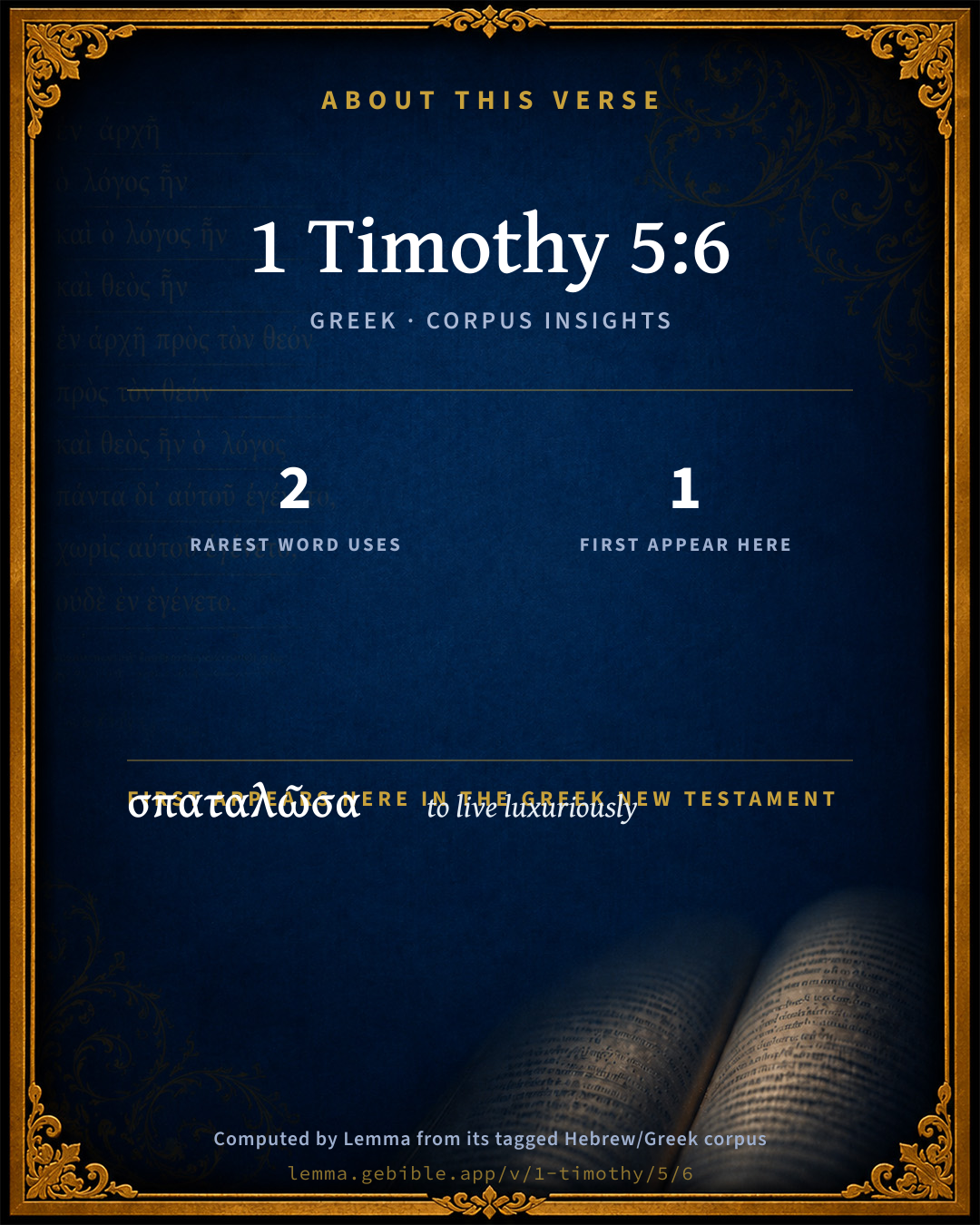
The rarest word here is σπαταλῶσα to live luxuriously G4684 — appearing just 2 times in the whole Greek New Testament.

First appearance in Scripture

This word makes its first canonical appearance in the Greek New Testament here:

  • σπαταλῶσα to live luxuriously G4684

Shared distinctive vocabulary

σπαταλῶσα to live luxuriously G4684 occurs in 2 verses of the Greek New Testament. Also found in:
Cross-references

27

Topical passages linked to 1 Timothy 5:6 in the Treasury of Scripture Knowledge — connected by theme and wording, ordered by reader-vote popularity; previews shown in the World English Bible.

  • James 5:5 You have lived delicately on the earth, and taken your pleasure. You have nourished your hearts as in a day of slaughter.
  • Luke 15:24 for this, my son, was dead, and is alive again. He was lost, and is found.' They began to celebrate.
  • Revelation 3:1 "And to the angel of the assembly in Sardis write: He who has the seven Spirits of God, and the seven stars says these things: "I know your works, that you have a reputation of being alive, but you are dead.
  • Revelation 18:7 However much she glorified herself, and grew wanton, so much give her of torment and mourning. For she says in her heart, 'I sit a queen, and am no widow, and will in no way see mourning.'
  • Luke 15:32 But it was appropriate to celebrate and be glad, for this, your brother, was dead, and is alive again. He was lost, and is found.'"
  • Ephesians 2:1 You were made alive when you were dead in transgressions and sins,
  • Psalms 73:5–7 They are free from burdens of men, Neither are they plagued like other men.
  • Matthew 8:22 But Jesus said to him, "Follow me, and leave the dead to bury their own dead."
  • Luke 15:13 Not many days after, the younger son gathered all of this together and traveled into a far country. There he wasted his property with riotous living.
  • Ephesians 5:14 Therefore he says, "Awake, you who sleep, and arise from the dead, and Christ will shine on you."
  • Deuteronomy 28:54 The man who is tender among you, and very delicate, his eye shall be evil toward his brother, and toward the wife of his bosom, and toward the remnant of his children whom he has remaining;
  • Deuteronomy 28:56 The tender and delicate woman among you, who would not adventure to set the sole of her foot on the ground for delicateness and tenderness, her eye shall be evil toward the husband of her bosom, and toward her son, and toward her daughter,
  • 1 Samuel 15:32 Then said Samuel, Bring you here to me Agag the king of the Amalekites. Agag came to him cheerfully. Agag said, Surely the bitterness of death is past.
  • 1 Samuel 25:6 and thus shall you tell him who lives [in prosperity], Peace be to you, and peace be to your house, and peace be to all that you have.
  • Job 21:11–15 They send forth their little ones like a flock. Their children dance.
  • Proverbs 29:21 He who pampers his servant from youth Will have him become a son in the end.
  • Isaiah 22:13 and behold, joy and gladness, killing oxen and killing sheep, eating flesh and drinking wine: let us eat and drink, for tomorrow we shall die.
  • Isaiah 47:1 Come down, and sit in the dust, virgin daughter of Babylon; sit on the ground without a throne, daughter of the Chaldeans: for you shall no more be called tender and delicate.
  • Jeremiah 6:2 The comely and delicate one, the daughter of Zion, will I cut off.
  • Lamentations 4:5 Those who did feed delicately are desolate in the streets: Those who were brought up in scarlet embrace dunghills.
  • Amos 6:5–6 Who strum on the strings of a harp; Who invent for themselves instruments of music, like David;
  • Luke 7:25 But what did you go out to see? A man clothed in soft clothing? Behold, those who are gorgeously dressed, and live delicately, are in kings' courts.
  • Luke 12:19 I will tell my soul, "Soul, you have many goods laid up for many years. Take your ease, eat, drink, be merry."'
  • 2 Corinthians 5:14–15 For the love of Christ constrains us; because we judge thus, that one died for all, therefore all died.
  • Ephesians 2:5 even when we were dead through our trespasses, made us alive together with Christ (by grace you have been saved),
  • Luke 16:19 "Now there was a certain rich man, and he was clothed in purple and fine linen, living in luxury every day.
  • Colossians 2:13 You were dead through your trespasses and the uncircumcision of your flesh. He made you alive together with him, having forgiven us all our trespasses,

Cross-references courtesy of OpenBible.info (CC BY 4.0).

Commentary

Notes on 1 Timothy 5:6 from classic Christian and Jewish commentators (each source and its license shown beneath its notes). The classic Christian expositions comment on the surrounding passage and are grouped to its opening verse, so a note may address several verses; the Jewish commentaries on the Tanakh (Rashi and others) are per-verse, so they appear only where the commentator wrote on this verse.

Lemma curates 59 commentaries, every one of them public domain or Creative Commons licensed, each selected and text-cleaned for this edition rather than reprinted as found. About our sources →

The Biblical Illustrator

Joseph S. Exell

1Ti_5:6

But she that liveth in pleasure.

A life of pleasure a life of death

If this be true--and, being part of the Word of God, it must be true--then the world of pleasure is a region of death, and a life of pleasure is a living death. These are strange tidings for those who live only for pleasure, and who boast that they alone, of all mankind, enjoy life.

I. Who is meant by the person that liveth in pleasure? And this point does require explanation; for the word pleasure, is one strangely abused; it has quite a different meaning in different companies, and among different men. There are pleasures in science, pleasures in sin; pleasures in holiness here, and in heaven, we know, there are pleasures for evermore. Now, she that is a widow indeed, and desolate, trusteth in God, and continueth in supplications and prayers night and day. But she that liveth in pleasure is dead while she liveth. Now this is evidently a character just the reverse; that of one who trusteth not in God, who neglects supplication and prayers. The same character is further described more at length in the eleventh and the thirteenth verses: wantonness, idleness, wandering about from house to house, tattling, the spirit of busy-bodies, speaking things which they ought not--are given as characteristics of her that liveth in pleasure. The original word, liveth in pleasure, is very peculiar, and is used in only one other place in the New Testament, namely, in Jam_5:5. Now, in that passage of St. James, he is addressing the wealthy, and the luxurious: Go to now, ye rich men, weep and howl for your miseries that; shall come upon you. Your riches are corrupted, and your garments are moth-eaten. Then, in the fifth verse, Ye have lived in pleasure on the earth, and been wanton; ye have nourished your hearts as in a day of slaughter: where the word that is translated ye have been wanton, is the very same word with that which, in our text, is rendered liveth in pleasure: and the whole passage strikingly describes what kind of character is intended. Thus it is plain already, that to live in pleasure, is to live without trust or faith in God, without constant prayer; in wantonness, idleness, trifling, the pride of wealth; in luxury, sensuality, and self-indulgence. This is the life of worldly pleasure. But there are yet many other Scriptures which describe the life of pleasure; and I am anxious you should feel the Scriptural force of the subject. Thus, in the prophet Ames, in the sixth chapter: Woe to them that are at ease in Zion, and trust in the mountain of Samaria, which are named chief of nations, to whom the house of Israel came, etc. Again you see the spirit of the child of pleasure, he makes himself at ease, he puts far away the evil day: he is self-indulgent, luxurious, gay, and jovial; he feels not for the affliction of Gods afflicted people. In the book of Job, we have another description of men living in worldly pleasure--in his twenty-first chapter: Wherefore do the wicked live, become old, yea, are mighty in power? Their seed:is established in their sight with them, and their offspring before their eyes. Their houses are safe from fear, neither is the rod of God upon them. Here, again, you see the life of pleasure to be a life of unsanctified prosperity, festivity, mirth, wealth; with the spirit of infidelity mocking at religion, asking, what good in prayer--what end to serve God? Oh, ye that have lived in pleasure, does not your conscience feel, My life is detected; my character has been described? So in our Lords parable; the rich man, who fared sumptuously every day, and was clothed in purple and fine linen, was evidently a man of pleasure--luxurious, self-indulgent, fond of dress. The city of Sodom was a city of pleasure. Then think of Babylon, once filled with the gayest of the gay; see that city of pleasure described in the prophet Isaiah: Come down and sit in the dust, O virgin daughter of Babylon, sit on the ground: there is no throne, O daughter of the Chaldeans: for thou shalt no more be called tender and delicate. Take the mill-stones, and grind meal: uncover thy locks, make bare the leg, uncover the thigh, pass over the rivers, etc. And let none think that the Scriptural description of one that liveth in pleasure applies only to the rich and the great of this world. But the temptation is common to all ranks, persons in middle life, and persons in the lowest walks of life, may be found to live continually in pleasure. This do all the intemperate. Oh, what sums the poor and labouring classes spend in the present day on needless, noxious, inflammatory drink!

II. Then this is Gods judgment of the state of such She that liveth in pleasure--whoever liveth in pleasure--is dead while alive. Now that is the sentiment, or rather the sentence, of God Himself. What does it mean? She that liveth in pleasure is dead while she liveth:--how can one be dead while alive? Think of that serious, pious Christian, once in the circle of your acquaintance, once a friend, and even a brother; but now he seems as one dead to all your pleasures, dead to the world, dead indeed unto sin. You say in scorn, that you might as well ask a dead man as ask him to join your worldly pleasure, he has become what you term a poor lifeless creature; he is buried alive. How true, how just, how striking that description! The dead neither move, nor see, nor hear, nor smell, nor feel. Your heart moves not in love to God; your minds eye sees no suitableness in the Saviour; you hear not His voice, you perceive no fragrance in His name, like that of ointment poured forth; you feel not the constraining force of His dying love. Then death is, further, a state of insensibility and helplessness. But further still, She that liveth in pleasure, is dead while she liveth, because under sentence of death. If a criminal were convicted of murder, or some capital crime, and sentenced to death, in the interval between his sentence and his execution he is considered as dead in the eye of the law. But are you afraid that you shall now lose all pleasure? You will lose the phantom, and gain the substance; you will throw away the counterfeit, and receive genuine gold; you will drop worldly pleasure, which is connected with death, which has death inseparably tied to it, and enjoy spiritual pleasure, which is connected with eternal life. But I had not meant to say much more which might seem harsh to those who will still be of the world; I was endeavouring to lead those who are desirous of coming out of the world to come into new life. Her ways are ways of pleasantness, and all her paths are peace. Then how noble, sublime, and glorious, are the objects with which religion is conversant. I add but another thought. Religious pleasures are the best, for they have the approving smile of God on them now, and they can be carried with the soul into another world, and there be ripened into perfection. (J. Hambleton, M. A.)

The woman of pleasure

It is a strong way of putting the truth, that a woman who seeks in worldly advantage her chief enjoyment, will come to disappointment and death. My friends, you all want to be happy. You have had a great many recipes by which it is proposed to give you satisfaction--solid satisfaction.

1. And, in the first place, I advise you not to build your happiness upon mere social position.

2. I go further, and advise you not to depend for enjoyment upon mere personal attractions.

3. Again, I advise you not to depend for happiness upon the flatteries of men.

4. Again, I charge you not to depend for happiness upon the discipleship of fashion. (T. De Witt Talmage.)

True living

A Persian monarch asked an aged man, How many of the suns revolutions hast thou counted? Sire, said the old man, I am but four years of age. What! interrupted the king, fearest thou not to answer me falsely, or dost thou jest on the very brink of the tomb? I speak not falsely, replied the aged man; eighty long years have I wasted in folly and sinful pleasures and in amassing wealth, none of which I can take with me when I leave this world. Four only have I spent in doing good to my fellow-men, and shall I count those years which have been utterly wasted?

A living death

Alas! many a man is dead while he liveth; yea, all are dead who live in impenitence and presumptuous sins. God is the soul of our soul, and the life of our life; and Christ must dwell in our heart by faith, and be the heart of our heart, to enable us to say with St. Paul, I live, yet not I, but Christ liveth in me. Just as the heart is the workshop of the soul, from which it distributes natural heat and vital energy into all the veins and members, even so must the Lord Jesus generate in us spiritual life, and diffuse His spirit into all our powers, senses, desires, thoughts, and motions. The ungodly man is a living corpse; the worm of sinful desire consumes his conscience; he is an abomination in the eyes of the Saviour, and offensive to God and the holy angels. (J. Gotthold.)

The Biblical Illustrator, edited by Joseph S. Exell (c. 1880s–1900s) — public domain. Text from a community e-Sword module.

Tyndale Open Study Notes

Tyndale Open Resources

5:6 Some widows in Ephesus were living only for pleasure, more interested in receiving than in giving (see also 6:17-19; Jas 5:5). They did not need support.

Tyndale Open Study Notes — © Tyndale Open Resources, licensed CC BY-SA 4.0. Text via the HelloAO Bible API.

Bengel's Gnomon

Johann Albrecht Bengel

1Ti 5:6. Σπαταλῶσα) She that liveth in pleasure (luxuriously). Jas 5:5, ἐτρυφήσατε καὶ ἐσπαταλήσατε. Hesychius explains σπαταλᾷ, as τρυφᾷ.—ζῶσα τέθνηκε, though living, she is dead) This remark may be applied to any ungodly man, although he may be actively engaged in the business of life, but especially to a widow devoted to pleasure. Although she seems to her own self still to enjoy life, yet she is dead while she lives, because she is now no longer of benefit (profitable or serviceable), either naturally or spiritually, and therefore she deserves no honour (1Ti 5:3, i.e. no share in the public maintenance).

Bengel's Gnomon of the New Testament — English translation (T&T Clark, Edinburgh, 1860) — public domain. Text from a community e-Sword module.

Meyer's Critical & Exegetical Commentary

Heinrich August Wilhelm Meyer

1Ti_5:6. Ἡ δὲ σπαταλῶσα] The opposite of the ὄντως χήρα who has dedicated her life to piety. Σπαταλᾷν, revel, be wanton, occurs elsewhere only in Jam_5:5 (Wisd. 21:15). There is nothing to show that the apostle was here thinking of the squandering of the support received.

ζῶσα τέθνηκε] These words have been taken as exhorting Timothy to consider the wanton widow as dead, and not to support her; but this takes away all point from the words. The right meaning is obtained by comparing such passages as Eph_4:18, Rev_3:1, and others similar. While the widow who conducts herself as a widow should, lives in God, the wanton widow leads a life given up to the desires of the world, a life only in appearance, the very opposite of the true life. Theophylact: κἂν δοκεῖ ζῆν κατὰ τὴν αἰσθητὴν, τέθνηκε κατὰ πνεῦμα.

Meyer — Critical and Exegetical Commentary on the New Testament — English translation by Peter Christie, edited by Frederick Crombie (T&T Clark, 1880) — public domain. Text from a community e-Sword module.

Expositor's Greek Testament

ed. W. Robertson Nicoll

1Ti 5:6 . σπαταλῶσα : The modern term fast , in which the notion of prodigality and wastefulness is more prominent than that of sensual indulgence, exactly expresses the significance of this word. The R.V., she that giveth herself to pleasure , is stronger than the A.V. A somewhat darker force is given to it here by the associated verb in 1Ti 5:11 , καταστρηνιάσωσιν . The Vulg. is felicitous, Quae in deliciis est, vivens mortua est . The expression is more terse than in Rev 3:1 , “Thou hast a name that thou livest and thou art dead”. Cf. Rom 7:10 ; Rom 7:24 , Eph 4:18 . Wetstein quotes in illustration from Stobaeus (238), as descriptive of a poor man’s life of anxiety, πένης ἀποθανὼν φροντίδων ἀπηλλάγη , ζῶν γὰρ τέθνηκε .

The Expositor's Greek Testament, edited by W. Robertson Nicoll (1897–1910) — public domain. Text from a community e-Sword module.

Geneva Bible (1599)

Geneva Bible translators

The third rule: Let widows that live in pleasure, and neglect the care of their own family, be holden and accompted as fallers away from God and his religion, and worse than very infidels.

Geneva Bible (1599) marginal notes — public domain. Text via Bolls.life.

Jamieson, Fausset & Brown

Robert Jamieson, A. R. Fausset & David Brown

she that liveth in pleasure--the opposite of such a widow as is described in Ti1 5:5, and therefore one utterly undeserving of Church charity. The Greek expresses wanton prodigality and excess [TITTMANN]. The root expresses weaving at a fast rate, and so lavish excess (see on Jam 5:5).

dead while she liveth--dead in the Spirit while alive in the flesh (Mat 8:22; Eph 5:14).

Jamieson, Fausset & Brown — Commentary Critical and Explanatory on the Whole Bible (1871) — public domain (CC PDM 1.0). Text via the HelloAO Bible API.

Adam Clarke's Commentary

Verse 6. But she that liveth in pleasure] Ἡ δε σπαταλωσα· She that liveth delicately-voluptuously indulging herself with dainties; it does not indicate grossly criminal pleasures; but simply means one who indulges herself in good eating and drinking, pampering her body at the expense of her mind. The word is used in reference to what we term petted and spoiled children; and a remarkable passage, is produced by Kypke, from an epistle of Theanus to Eubulus, found in Opusc. Myth. Galaei, page 741, where he says: "What can be done with that boy, who, if he have not food when and as he pleases, bursts out into weeping; and, if he eats, must have dainties and sweetmeats? If the weather be hot he complains of fatigue; if it be cold, he trembles; if he be reproved, he scolds; if every thing be not provided for him according to his wish, he is enraged. If he eats not, he breaks out into fits of anger. He basely indulges himself in pleasure; and in every respect acts voluptuously and effeminately. Knowing then, O friend, ὁτι τα σπαταλωντα των παιδιων, ὁταν ακμασῃ προς ανδρας, ανδραποδα γινεται, τας τοιαυτας ἡδονας αφαιρει· that boys living thus voluptuously, when they grow up are wont to become slaves; take away, therefore, such pleasures from them." I have introduced this long quotation, the better to fix the meaning of the apostle, and to show that the life of pleasure mentioned here does not mean prostitution or uncleanness of any kind, though such a life may naturally lead to dissolute manners.

Is dead while she liveth.] No purpose of life is answered by the existence of such a person. Seneca, in Epist. 60, says of pleasure-takers, and those who live a voluptuous life: Hos itaque animalium loco numeremus, non hominum: quosdam vero ne animalium quidem, sed mortuorum-mortem antecesserunt. "We rank such persons with brutes, not with men; and some of them not even with brutes, but with dead carcasses. They anticipate their own death." Such persons are, as the apostle says elsewhere, dead in trespasses, and dead in sins.

Adam Clarke's Commentary on the Bible (1810–1826) — public domain. Text from a community e-Sword/MySword module.

John Calvin's Commentaries

6. She who is in luxury. After having described the marks by which real widows may be known, he now contrasts them with others that ought not to be received. The Greek participle which he employs, σπαταλῶσα, means one who allows herself every indulgence, and leads an easy and luxurious life. Accordingly, Paul (in my opinion) censures those who abuse their widowhood for this purpose, that, being loosed from the marriage yoke, and freed from every annoyance, they may lead a life of pleasant idleness; for we see many who seek their own freedom and convenience, and give themselves up to excessive mirth.

Is dead while she liveth When Paul says that such persons “are dead while they live,” this is supposed by some to mean that they are unbelievers; an opinion with which I do not at all agree. I think it more natural to say that a woman “is dead,” when she is useless, and does no good; for to what purpose do we live, if it be not that our actions may yield some advantage? And what if we should say that the emphasis lies in the word liveth? For they who covet an indolent life, that they may live more at their ease, have constantly in their mouth the proverbial saying: —

“For life is not to live, but to be well.”

The meaning would therefore be: “If they reckon themselves happy, when they have everything to their heart’s wish, and if they think that nothing but repose and luxury can be called life, for my part, I declare that they are dead.” But as this meaning might seem liable to the charge of excessive ingenuity, I wished merely to give a passing glimpse of it, without making any positive assertion. This at least is certain, that Paul here condemns indolence, when he calls those women dead who are of no use.

John Calvin's Commentaries (1540-1563) — public domain. Text from the Calvin Translation Society English edition (1840s-50s) via the Christian Classics Ethereal Library (ccel.org). Calvin's coverage is partial (roughly two-thirds of the Bible); uncommented books and verses are honest gaps, never fabricated. The 19th-century editor's footnotes and remarks are omitted so the notes are faithfully Calvin's own voice.

Ellicott's Commentary for English Readers

(6) But she that liveth in pleasure is dead while she liveth.—This is a thoroughly Pauline thought, set forth in other language in the Roman Epistle, Rom_8:13 : “For if ye live after the flesh ye shall die.” The word in the Greek rendered “she that liveth in pleasure” is very remarkable, and in the New Testament is found only in one other place (Jas_5:5). The widow-woman who could so forget her sorrow and her duty is spoken of as a living corpse, and sharply contrasted with her far happier sister, who, dead to the pleasures of the flesh, living a life of prayer and of self-denial, in the true sense of the word, may be spoken of as living. A very different estimate of life was held by the greatest of Greek poets, who writes thus of men giving up pleasures: “I do not consider that such a one lives, but I regard him as a living corpse” (Antigone of Sophocles, 1166-7, Dindorf). Comp., too, Rev_3:1.

A Bible Commentary for English Readers, edited by Charles John Ellicott (1878–1897) — public domain. Text from a community e-Sword module.

The Cambridge Bible for Schools and Colleges

gen. ed. J. J. S. Perowne

6. liveth in pleasure] The word occurs only once besides in N.T., Jas_5:5; where it is coupled with ‘living delicately,’ and is translated by R.V. ‘have taken your pleasure,’ consistently with its rendering here ‘giveth herself to pleasure.’ But surely all the connexion and derivation of the word points to a worse meaning, the rioting of a prodigal; as e.g. its use by the LXX. (as Bp Ellicott points out) in Eze_16:49, ‘this was the iniquity of thy sister Sodom, pride, fulness of bread, and abundance of idleness was in her and in her daughters.’ It is reproduced in the cognate ‘wax wanton’ of 1Ti_5:11. Render perhaps she that liveth a prodigal’s life. Stress is laid on this being brought out, because St Paul is painting the two pictures, for contrast, in the strongest colours, one all saint, one all sinner.

is dead while she liveth] Has no ‘hold on the life which is life indeed,’ as urged 1Ti_6:19.

The Cambridge Bible for Schools and Colleges (gen. ed. J. J. S. Perowne; Cambridge University Press, 1878–1918) — public domain. Text from a community e-Sword module.

John Gill's Exposition

But she that liveth in pleasure,.... Voluptuously, and deliciously; lives a wanton, loose, and licentious life, serving divers lusts and pleasures:,

is dead while she liveth; is dead in trespasses and sins, while she lives in them; is dead morally or spiritually, while she lives a natural or corporeal life. There is a likeness between a moral and a corporeal death. In a corporeal death, the soul is separated from the body; and in a moral death, souls are separated from God, and are alienated from the life of God; and are without Christ, who is the author and giver of spiritual life; and have not the Spirit, which is the Spirit of life: death defaces and deforms the man, and a moral death lies in the defacing of the image of God, first stamped on man, and in a loss of original righteousness; for as death strips a man naked of all, as he was when he came into the world, so sin, which brings on this moral death, has stripped man of his moral righteousness, whereby he is become dead in law, as well as in sin: and as in death there is a privation of all sense, so such who are dead, morally or spiritually, have no true sense of sin, and of their state and condition; are not concerned about sin, nor troubled for it, but rejoice in it, boast of it, plead for it, and declare it: between such persons and dead men there is a great similitude; as dead men are helpless to themselves, so are they; they can do nothing of, nor for themselves, in matters of a spiritual nature; and as dead men are unprofitable unto others, so are they to God, and man; and as dead men are hurtful and infectious to others, so they by their evil communications corrupt good manners; and as dead bodies are nauseous and disagreeable, so are such persons, especially to a pure and holy Being; and as dead men are deprived of their senses, so are these: they are blind, and cannot see and discern the things of the Spirit of God; they have not ears to hear the joyful sound of the Gospel, so as to understand it, approve of it, and delight in it; they have no feeling, nor are they burdened with the weight of sin; nor have they any taste and savour of the things of God, but only of the things of men; so that in a spiritual sense they are dead, while they are alive. It is a common, saying to be met with in Jewish writers, , "the wicked while alive are said to be dead" (s). And they say (t) also, that men are called "dead", from the time they sin; and that he that sins is accounted "as a dead man" (u).

(s) T. Bab. Beracot, fol. 18. 2. & Hieros. Beracot, fol. 4. 4. Midrash Kohelet, fol. 78. 2. Tzeror Hammor, fol. 58. 3. Caphtor, fol. 79. 1, 2. & 84. 1. Jarchi in Gen. xi. 32. & Baal Hatturim in Deut. xvii. 6. (t) Tzeror Hammer, fol. 5. 9. (u) lb. fol. 6. 2. & 127. 2.

John Gill's Exposition of the Whole Bible (1746–1763) — public domain (CC PDM 1.0). Text via the HelloAO Bible API.

Trapp's Complete Commentary

John Trapp

6 But she that liveth in pleasure is dead while she liveth.

Ver. 6. Is dead while she liveth] Cum careat pura mente, cadaver agit. Pamphilius in Terence saith the like of a light housewife. Sane hercle homo voluptati obsequens fuit dum vixit. St Paul’s Greek cannot well be rendered but by Terence’s Latin, and Terence’s Latin cannot well be put into other Greek.

But she that liveth in pleasure] Gr. σπαταλωσα. The delicate dame, such as were those wanton daughters of Sion, those mincing minions mentioned Isa 3:16-26, as also those of Tyre and Sidon, those of Phoenicia, so called from the Syriac phinneck, delicate: the Greeks call them τρυφεροι, such as lie melting in sensual delights and sinful pleasures, in the froth whereof groweth that worm that never dieth, Jas 5:5. I have read of a gallant addicted to uncleanness, who at last meeting with a beautiful dame, and having enjoyed his fleshly desires of her, found her in the morning to be the dead body of one that he had formerly sinned with, which had been acted by the devil all night, and left dead again in the morning. Sure he had but ψυχρον παραγκαλισμα, a cold armful of her at length (as Lycophron saith of an evil wife), and if God had given grace, it might have brought him to better courses; but where that is wanting, no warning will serve turn. Jeroboam had as great a miracle wrought before him in the drying up of his hand, as St Paul at his conversion, yet was he not wrought upon, because the Spirit did not set it on. Besides, grace is seated in the powers of nature. Now carnal sins disable nature, and so set men in a greater distance from grace, as taking away the heart, Hos 4:11.

John Trapp, A Commentary or Exposition upon All the Books of the Old and New Testament (1647–1656) — public domain. Text from a community e-Sword module.

Albert Barnes' Notes on the Bible

But she that liveth in pleasure - Margin, “delicately.” The Greek word (σπαταλάω spatalaō) occurs nowhere else in the New Testament, except in Jam 5:5, “Ye have lived in pleasure on the earth.” It properly means to live in luxury, voluptuously; to indulge freely in eating and drinking; to yield to the indulgence of the appetites. It does not indicate grossly criminal pleasures; but the kind of pleasure connected with luxurious living, and with pampering the appetites. It is probable that in the time of the apostle, there were professedly Christian widows who lived in this manner - as there are such professing Christians of all kinds in every age of the world.

Is dead while she liveth - To all the proper purposes of life she is as if she were dead. There is great emphasis in this expression, and nothing could convey more forcibly the idea that true happiness is not to be found in the pleasure of sense. There is nothing in them that answers the purposes of life. They are not the objects for which life was given, and as to the great and proper designs of existence, such persons might as well be dead.

Albert Barnes' Notes on the Bible (1834–1885) — public domain. Text from a community e-Sword/MySword module.

Haydock's Catholic Bible Commentary

For she that liveth in pleasure, (i.e. that seeks to live in ease and plenty) is dead [3] while she is living, by the spiritual death of her soul in sin. See St. John Chrysostom with non less eloquence than piety, expounding this riddle, as he terms it, to wit, what it is to be at the same time alive and dead. (Witham)

===============================

[BIBLIOGRAPHY]

St. John Chrysostom, (Greek: log. ig. p. 301.) Greek: touto phusin ainigma, &c.

George Leo Haydock (1774–1849), Haydock's Catholic Family Bible and Commentary, 1859 edition — public domain. Excludes Psalms (Douay-Rheims chapter numbering differs from Protestant) and Deuterocanonical books (Catholic canon only).

Matthew Poole's English Annotations

Η δε σψαταλωσα, she that is wanton, Jam 5:5, she that spends her money in needless costs, as to meat, drink, or apparel, is spiritually dead, dead in sin, while she liveth a temporary voluptuous life, in vanity, and luxury, and impurity of flesh and spirit.

Matthew Poole's English Annotations on the Holy Bible (1683–1685) — public domain. Text from a community e-Sword/MySword module.

Whedon's Commentary on the Bible

Daniel D. Whedon

6. The spurious widow, that liveth in pleasure—not necessarily unchaste, but gay and prodigal—is dead to all Christian life, while she liveth a free secular life.

Daniel D. Whedon (gen. ed.), Commentary on the Old and New Testaments (1874–1909) — public domain. Text from a community e-Sword module.

The Pulpit Commentary

Giveth herself to for liveth in, A.V Giveth herself to pleasure (hJ spatalwsa); only here andsate Jam_5:5 (ejspatalh) "taken your pleasure," R.V, "been wanton," A.V) in the New Testament, but found (as well as spatalh and spatalov) in Ecc 21:15, and in Polybius (Liddell and Scott). Trench ("Synonyms of New Testament," p. 191) compares and contrasts strhniaw trufaw, and spatalaw, and says that the latter includes the idea of prodigality. The word brings into the strongest possible contrast the widow who was like Anna, and those whom St. Paul here denounces. Is dead while she liveth; or, has died (is dead) in her lifetime. She is dead to God, and, as Alford suggests, is no longer a living member of the Church of Christ. Compare St. Jude"s expression "twice dead" (ver. 12). The expression in Rev_3:1 is different, unless zwsa here can have the same meaning as onoma ecei oti zh, "though nominally alive as a Christian," etc.

Death in life.

she that liveth in pleasure is dead while she liveth." Christianity purifies and harmonizes the whole nature of man, and assimilates whatever is pure in humanity to the kingdom of God. It does not destroy pure earthly joys; nay, rather it plants many flowers by the wayside of life. But pleasure is often perverted by man, and in that age k had become so associated with what was coarse and carnal, that the very word "pleasure" became in the gospel a synonym for sin. We have here death in the midst of life liveth in pleasure is dead while she liveth or death and life side by side.

I THE IMMOBILITY WHICH CHARACTERIZES THE DEAD BODY CHARACTERIZES THE DEAD SOUL. There is no movement of thought towards God; no feet swift to do his will; no heart that beats in sympathy with his Law. Instinct is alive; but the brightness of the eye, and the music of the voice, and the activities of lift, are like flowers upon graves.

II THE INSENSIBILITY OF THE DEAD BODY CHARACTERIZES THE DEAD SOUL. All around there may be signs of outward life. As the body lies in the churchyard, the murmuring river flows by its banks, the birds make their summer music in the trees, and men, women, and children stay to rest, and to read the inscriptions on the graves; but to all these things the sleepers in the tombs are insensible. So the dead soul is insensible to the august realities of religion, to the voice of God, and to the visions of the great day.

III THE CORRUPTION OF THE DEAD BODY CHARACTERIZES THE DEAD SOUL. This is the dread thought in connection with death, that we must bury it out of sight. When decay commences, corruption begins; and he, who knows all that is in man, tells us that out of the sepulcher of the unrenewed heart of man come evil desires, murders, and adulteries. "They that sow to the flesh shall of the flesh reap corruption" These aspects of the case show us that, as there are graveyards in the crowded cities with all their busy life, so in the unrenewed heart of man there is death in the midst of life. W.M.S.

The Pulpit Commentary (1880–1919), ed. H.D.M. Spence-Jones & Joseph S. Exell — public domain. Text from a community e-Sword module.

John Wesley's Explanatory Notes

She that liveth in pleasure - Delicately, voluptuously, in elegant, regular sensuality, though not in the use of any such pleasures as are unlawful in themselves.

John Wesley, Explanatory Notes Upon the Whole Bible (1754–1765) — public domain. Text via the GEBible commentary corpus.

Fairbairn on Ezekiel, Jonah & the Pastoral Epistles

Patrick Fairbairn

Ver. 6. But she that lives deliciously (or wantonly; σπαταλῶσα occurs only again in Jas 5:5), is dead while she lives: the reverse of the true widow, who was represented as comparatively dead to the world, and alive to God, this person appears to have a relish only for the world and its pleasures, and to be dead to what is of God. The description substantially coincides with that given of the church of Sardis in Rev 3:1, “Thou hast a name that thou livest, and art dead.” Only here the living has respect not so much to a profession of godliness as to the world’s idea of life—an unreserved surrender to present objects and entertainments. Such life in the lower sphere involves death in the higher. And though the apostle does not expressly state it, yet it is plainly implied in what he says, that widows living after such a fashion were to be regarded as cut off from the sympathy and oversight extended to true Christian widows.

Patrick Fairbairn — An Exposition of Ezekiel (1851), Jonah (1849), and The Pastoral Epistles (1874) — public domain. Text from a community e-Sword module.

The People's New Testament

B. W. Johnson

6. She that liveth in pleasure. The widow that plays the wanton is dead spiritually.

B. W. Johnson's The People's New Testament with Notes (1889–1891) — public domain. Electronic text from the Christian Classics Ethereal Library (CCEL) ThML edition.

Cambridge Greek Testament for Schools and Colleges

6. ἡ δὲ σπαταλῶσα κ.τ.λ., but she (i.e. the widow) that liveth riotously is dead while she liveth. σπαταλᾷν only occurs in N.T. here and at Jas 5:5; cp. Eze 16:49 (where it is used of one of the sins of Sodom and her daughters) and Sir 21:15.

The conception of spiritual death, of death in life, is frequent in St Paul; see Rom 7:10; Rom 7:24; Eph 4:18, and cp. Rev 3:1 where it is said of the Church of Sardis … ὅτι ζῇς καὶ νεκρὸς εἶ.

Cambridge Greek Testament for Schools and Colleges (Cambridge University Press, 1896; 21 vols, various authors incl. Carr, Maclear, Plummer, Farrar, Lumby, Moule, M. R. James, Simcox) — public domain. Text from a community e-Sword module.

Alford’s Greek Testament

Henry Alford

6.] Contrast (δέ) to the character just described: and that certainly with a view to point out that this kind of widow is no object for the charity of the Church, as not being at all a partaker of the life unto God.

σπαταλῶσα] Wetst. from the glossaries, gives σπαταλᾷ, λίαν τρυφᾷ, ἀσώτως ζῇ. In the Anthol., iv. 28. 14, we have coupled πᾶν τὸ βρότων σπατάλημα κ. ἡ πολύολβος ἐδωδή. It appears to be allied to σπαθάω (σπάω),—see Aristoph., Nub. 53, and Schol. (in Wetst.); and Ellic., here.

ζῶσα τέθνηκεν] while alive in the flesh, has no real life in the Spirit: see ref.—and Mat 8:22: Eph 5:14. Wetst. quotes many such expressions from profane writers: one, as compared with this passage, remarkably illustrative of the moral difference between Christianity and heathenism: Soph. Antig. 1183,—τὰς γὰρ ἡδονὰς ὅταν | προδῶσιν ἄνδρες, οὐ τίθημʼ ἐγὼ | ζῇν τοῦτον, ἀλλʼ ἔμψυχον ἡγοῦμαι νεκρόν. The very expression is found in Stobæus; see reff. I cannot help regarding the idea as in the background,—‘and, if devoid of spiritual life, then not to be taken into account by the Church.’

Henry Alford, The Greek Testament (1849–1861) — public domain. Text from a community e-Sword module.

International Critical Commentary

6. σπαταλῶσα] probably akin to σπάω, to suck down, hence to live luxuriously, self-indulgently, often combined with τρυφᾶν: cf. Jas 5:5, Eze 16:49 ἐν πλησμονῇ ἄρτων καὶ ἐν εὐθηνίᾳ ἐσπατάλων αὐτὴ καὶ αἱ θυγατέρες αὐτῆς: Pro 29:21 κατασπαταλᾶν. Hermas, Sim. vi. 1; Barn. x. 3; Ps.-Chrys. de pœna, ix. 277 E, ὁ σπαταλίστης ἐκεῖνος of Dives in Luk 16:19. For these and other illustrations, cf. Hort on Jas. ubi sup. and Add. Note, p. 107. Vulg. “quæ in deliciis est”; Th.-Mops. “solis epulis et deliciis vacare properans.”

ζῶσα τέθνηκε] possibly suggested by Luk 15:24 νεκρὸς ἦν καὶ ἔζησε (Resch), but the thought is common; cf. Rev 3:1 ὄνομα ἔχεις ὅτι ζῇς καὶ νεκρὸς εἶ: Hermas, Sim. vi. c. 2, τῶν τοιούτων ἡ ζωὴ θανατός ἐστιν: Juv. viii. 85, “Dignus morte perit, cœnet licet ostrea centum Gaurana”; Cic. ad Att. xii. 2, “Homini non recta sed voluptaria quærenti nonne βεβίωται?” (cf. Wetstein for other illustrations). So Dante sees in hell the soul of Friar Alberigo whose body is still on earth (Inf. xxxiii.).

International Critical Commentary — older volumes (1896–1929), various authors — public domain. Text from a community e-Sword module.

Vincent's Word Studies in the New Testament

Marvin R. Vincent

Liveth in pleasure [σπαταλωσα] . Only here and Jas 5:5. See note. Twice in LXX, Sir. 21 15; Ezekiel. xvi. 49.

Is dead while she liveth [ζωσα τεθνηκεν] . Comp. Rev 3:1; Eph 4:18. "Life in worldly pleasure is only life in appearance" (Holtzmann).

Marvin R. Vincent, Word Studies in the New Testament (1887–1900) — public domain. Text from a community e-Sword/MySword module.

Lesson kit

Teaching starters — assembled from the data on this page, not authored interpretation. Every prompt links to the verse data it draws on. Edit before teaching.

1 Timothy, in the Pauline Epistles, opens this verse with 5 words (5 distinct Greek lemmas). Its most distinctive word is spataláō (“to live luxuriously”). A historical commentator’s framing appears above. Read the whole chapter for the surrounding context.

Discussion questions

  1. The word spataláō carries the sense “to live luxuriously.” How does it shape the verse?
  2. The word “to live luxuriously” first appears here in Scripture. What is being introduced at this debut?
  3. James 5:5 shares the word «to live luxuriously» with this verse. How do the two illuminate each other?
  4. These translations render this verse differently; the difference is in the English rendering, not the original. What questions does that raise?
  5. Reading how The Biblical Illustrator and Tyndale Open Study Notes read this verse, where do the two commentators agree and where do they part?

Things to notice

  • 1 word makes its first canonical appearance in Scripture here.
  • These translations choose different wording for 13 words in this verse.
  • 5 distinct Greek lemmas span 5 words in this verse.

Reading settings

Reading text

Shown beneath each verse's original-language words.

Old Testament
Old Testament edition

Read the OT as the Masoretic Hebrew (MT) or the Greek Septuagint (LXX).

English shown for the Greek Septuagint (in the Hebrew ↔ Greek comparison).

Comparing translations? Open the Compare panel on any verse page to stack up to four side by side.