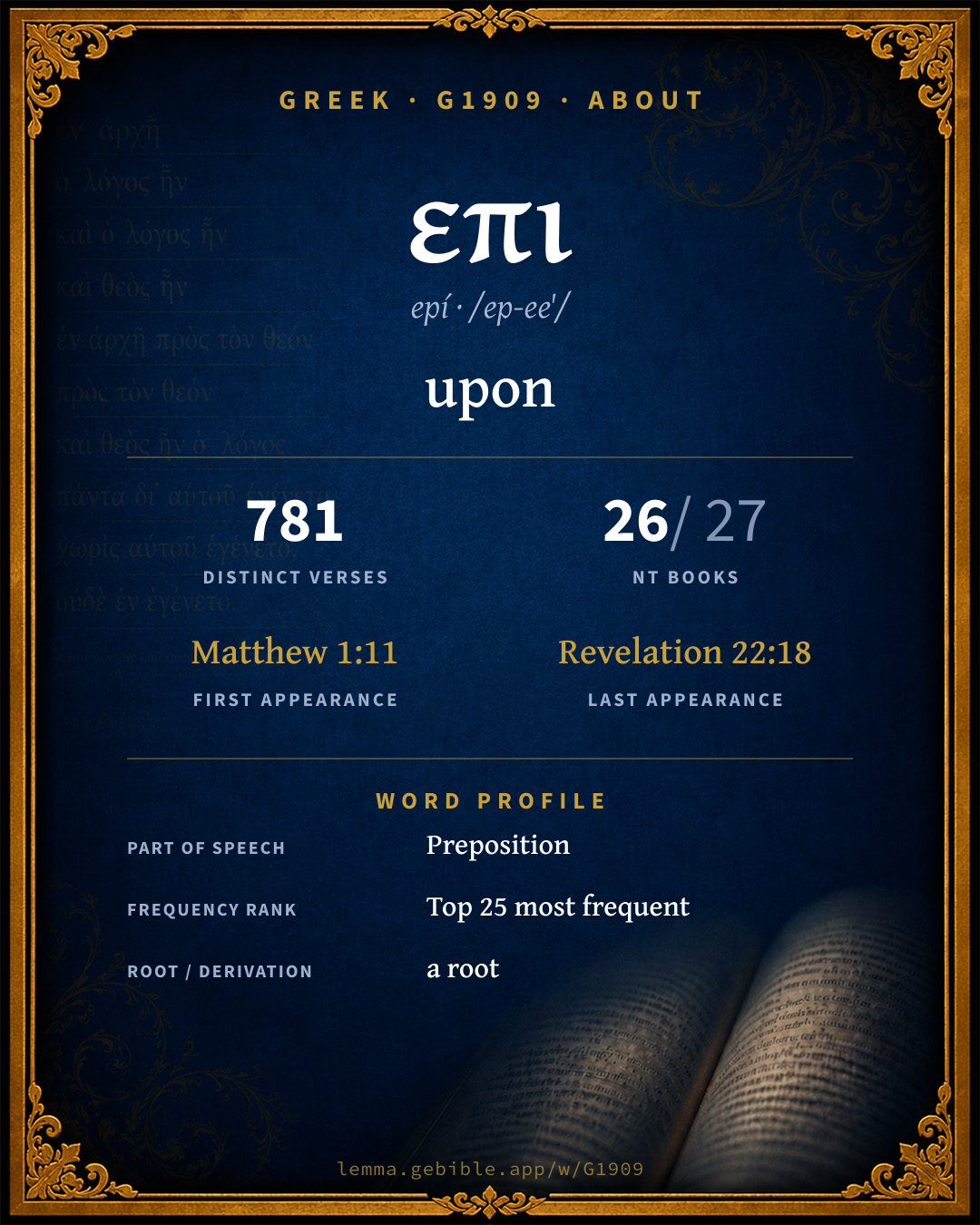
ἐπί
upon
also: on, at, by, before fuller range ↓
Full lexicon entry — Thayer's Greek Lexicon
From Thayer's Greek Lexicon
Where this word appears
Grammar key — what these labels mean
Part of speech
- Preposition
- A relational word governing a noun in a particular case.
Every verse where G1909 appears in the Book of 1 Corinthians — 17 distinct verses. Click any verse to open its interlinear word-by-word view. Verse text shown in the World English Bible for context — . Each verse’s Greek form is shown with its reference; the English is not keyword-highlighted, since the data carries no word-level English alignment. Use “Compare translations” on any verse to read it across multiple English versions. This concordance covers the Greek New Testament; Septuagint (Greek Old Testament) occurrences of this word are not indexed here.
1 Corinthians
- 1 Corinthians 1:4 ἐπὶ prep I always thank my God concerning you, for the grace of God which was given you in Christ Jesus;
- 1 Corinthians 2:9 ἐπὶ prep But as it is written, "Things which an eye didn't see, and an ear didn't hear, Which didn't enter into the heart of man, These God has prepared for those who love him."
- 1 Corinthians 3:12 ἐπὶ prep But if anyone builds on the foundation with gold, silver, costly stones, wood, hay, or stubble;
- 1 Corinthians 6:1 ἐπὶ ἐπὶ prep prep Dare any of you, having a matter against his neighbor, go to law before the unrighteous, and not before the saints?
- 1 Corinthians 6:6 ἐπὶ prep But brother goes to law with brother, and that before unbelievers!
- 1 Corinthians 7:5 ἐπὶ prep Don't deprive one another, unless it is by consent for a season, that you may give yourselves to fasting and prayer, and may be together again, that Satan doesn't tempt you because of your lack of self-control.
- 1 Corinthians 7:36 ἐπὶ prep But if any man thinks that he is behaving inappropriately toward his virgin, if she is past the flower of her age, and if need so requires, let him do what he desires. He doesn't sin. Let them marry.
- 1 Corinthians 7:39 ἐφ’ prep A wife is bound by law for as long as her husband lives; but if the husband is dead, she is free to be married to whoever she desires, only in the Lord.
- 1 Corinthians 8:5 ἐπὶ prep For though there are things that are called "gods," whether in the heavens or on earth; as there are many "gods" and many "lords;"
- 1 Corinthians 9:10 ἐπ’ ἐπ’ prep prep or does he say it assuredly for our sake? Yes, it was written for our sake, because he who plows ought to plow in hope, and he who threshes in hope should partake of his hope.
- 1 Corinthians 11:10 ἐπὶ prep For this cause the woman ought to have authority on her head, because of the angels.
- 1 Corinthians 11:20 ἐπὶ prep When therefore you assemble yourselves together, it is not possible to eat the Lord's supper.
- 1 Corinthians 13:6 ἐπὶ prep doesn't rejoice in unrighteousness, but rejoices with the truth;
- 1 Corinthians 14:16 ἐπὶ prep Otherwise if you bless with the spirit, how will he who fills the place of the unlearned say the "Amen" at your giving of thanks, seeing he doesn't know what you say?
- 1 Corinthians 14:23 ἐπὶ prep If therefore the whole assembly is assembled together and all speak with other languages, and unlearned or unbelieving people come in, won't they say that you are crazy?
- 1 Corinthians 14:25 ἐπὶ prep And thus the secrets of his heart are revealed. So he will fall down on his face and worship God, declaring that God is among you indeed.
- 1 Corinthians 16:17 ἐπὶ prep I rejoice at the coming of Stephanas, Fortunatus, and Achaicus; for that which was lacking on your part, they supplied.
About this entry
At a glance — auto-summarized from this page’s data, not written by a person. Every figure links to its source below. This summary describes the numbers; it doesn’t interpret them.
επι — transliterated epí — is a Greek preposition carrying the sense “upon.” One archaism survives in the King James Version — “unto” — where modern Bibles read “on”; see the renderings breakdown. Spanning 781 verses in 26 books, it ranks among the most common words of the Greek New Testament. Its earliest occurrence is Matthew 1:11. Thayer's distinguishes 3 senses; alongside “upon” it spans “on”, “at”, and “by”. See the sense tree, 781-verse concordance, and the renderings breakdown below.
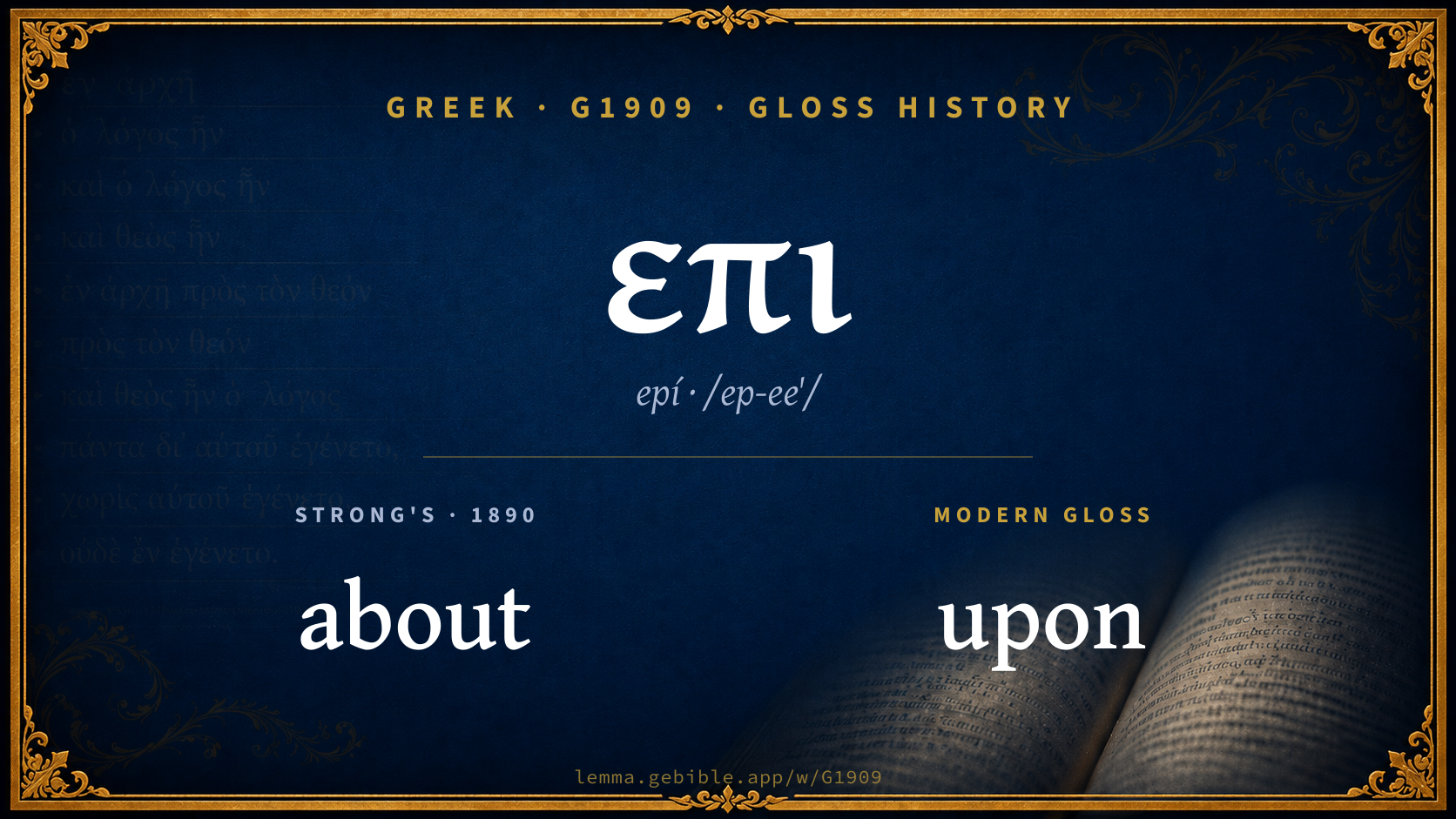
Gloss history
Strong's 1890 vs modern scholarship
About this word
Strong's G1909 catalogs a Greek word from the Greek New Testament.
These counts are not copied from any lexicon or concordance. They are computed here, from the morphology-tagged Greek New Testament. What Lemma adds →
- 781
- distinct verses
- The word appears in 781 distinct verses.
- 26 / 27
- NT books
- The word appears in 26 of 27 New Testament books.
- #22
- by frequency
- Top 25 most frequent Greek words (rank 22 of 5,347 Greek words by occurrence).
View all 781 occurrences in the concordance →
Most concentrated in
- Acts 153 verses 20%
- Luke 139 verses 18%
- Revelation 111 verses 14%
By section of the New Testament
By traditional corpus
Conventional, traditional groupings — biblical authorship is debated, so this is a traditional corpus grouping, not an authorship claim. Some books belong to more than one corpus (Luke is in both the Gospels and the Lukan corpus, and so on), so these shares overlap and need not total 100%. Each figure is a share of the word’s 781 distinct verses.
- Gospels 351 verses · 45%
- Lukan (Luke–Acts) 292 verses · 37%
- Johannine 147 verses · 19%
- Pauline corpus 118 verses · 15%
- Revelation 111 verses · 14%
- Hebrews 26 verses · 3%
- General (Catholic) Epistles 22 verses · 3%
How translations render this word
Counts come from each version’s own published word-to-Strong’s tagging or interlinear alignment — an approximate guide to how each version renders this word, not a word-level alignment the data otherwise carries. Because each total is that version’s own tagged count, the per-version totals vary from one another and need not match the appearance or distinct-verse counts above. These counts may also differ from a printed concordance because Lemma counts each distinctly tagged rendering and does not collapse phrase taggings into a single head-word total. This is a fixed set of word-tagged versions (KJV, ASV, BSB, ULT) and does not change with the reading translation you choose elsewhere. Each version’s license is shown beside its name below (and on Sources).
- King James Version: On 188×, Upon 152×, In 114×
- American Standard Version: On 196×, Upon 170×, In 62×
- Berean Standard Bible: On 287×, To 87×, In 83×
- unfoldingWord Literal Text: On 307×, To 98×, In 83×
King James Version Public Domain
Renders G1909 across 878 tagged occurrences — most commonly:
Plus other, less common renderings. Plus 50 renderings that appear only once — usually multi-word phrases or single function words the recovered tagging swept in, not distinct renderings. Not rendered by a distinct English word in 19 further occurrences.
American Standard Version Public Domain
Renders G1909 across 850 tagged occurrences — most commonly:
Plus other, less common renderings. Plus 73 renderings that appear only once — usually multi-word phrases or single function words the recovered tagging swept in, not distinct renderings. Not rendered by a distinct English word in 2 further occurrences.
Berean Standard Bible Public Domain
Renders G1909 across 784 tagged occurrences — most commonly:
Plus other, less common renderings. Plus 24 renderings that appear only once — usually multi-word phrases or single function words the recovered tagging swept in, not distinct renderings. Not rendered by a distinct English word in 74 further occurrences.
unfoldingWord Literal Text CC BY-SA 4.0
Renders G1909 across 890 tagged occurrences — most commonly:
Plus other, less common renderings. Plus 29 renderings that appear only once — usually multi-word phrases or single function words the recovered tagging swept in, not distinct renderings.
Senses in Thayer's
The 3 senses Thayer's distinguishes for this word, in lexicon order (not ranked by frequency or importance). The full entry — with sub-senses — is in the Lexicon Entry tab.
- upon, on, at, by, before
- of position, on, at, by, over, against
- to, over, on, at, across, against
Word origin
Origin: a root
A primary preposition properly meaning superimposition (of time place order etc.) as a relation of distribution [with the genitive case] that is over upon etc.; of rest (with the dative case) at on etc.; of direction (with the accusative case) towards upon etc. : - about (the times) above after against among as long as (touching) at beside X have charge of (be- [where-]) fore in (a place as much as the time of -to) (because) of (up-) on (behalf of) over (by for) the space of through (-out) (un-) to (-ward) with. In compounds it retains essentially the same import at upon etc. (literally or figuratively).
— Strong’s Exhaustive Concordance (1890), public domain.
Forms in the corpus
The 4 distinct written forms G1909 takes in the Greek New Testament, most frequent first — each parse links to that case’s occurrences in the concordance.
| Form | Parsing | Example | Uses |
|---|---|---|---|
| ἐπὶ epì | Preposition | Matthew 1:11 | 659 |
| ἐπ’ ep | Preposition | Matthew 3:16 | 143 |
| ἐφ’ eph | Preposition | Matthew 9:15 | 82 |
| ἐπί epí | Preposition | Mark 4:18 | 4 |
Same root — word family
Other Thayer's entries built from the same root as G1909, grouped by Strong’s listed origin. These share a root / origin per the lexicon — not necessarily a shared meaning. Each links to that word’s own entry.
Derived from this word
- επαγγελλω epangéllō G1861 to announce
- επαγω epágō G1863 to bring upon
- επαγωνιζομαι epagōnízomai G1864 to contend
- επαθροιζω epathroízō G1865 to gather together
- επαινεω epainéō G1867 to approve
- επαινος épainos G1868 approval
- επαιρω epaírō G1869 to lift up
- επαισχυνομαι epaischýnomai G1870 to be ashamed
- επαιτεω epaitéō G1871 to ask repeatedly
- επακουω epakoúō G1873 to give ear to
- επακροαομαι epakroáomai G1874 to listen to
- επαν epán G1875 after
- επαναγκες epánankes G1876 necessarily
- επαναγω epanágō G1877 to lead back
- επαναμιμνησκω epanamimnḗskō G1878 to remind
- επαναπαυομαι epanapaúomai G1879 to rest upon
- επανερχομαι epanérchomai G1880 to return
- επανισταμαι epanístamai G1881 to raise up against
- επανορθωσις epanórthōsis G1882 correction
- επανω epánō G1883 above
- επαρκεω eparkéō G1884 to avail
- επαρχια eparchía G1885 office of governor
- επαυλις épaulis G1886 farm
- επαυριον epaúrion G1887 the next day
+111 more words derive from G1909 (not shown).
Proper names from this root
People and places named from this root — a name, not an additional meaning of the word.
Compare all same-root words → Showing 4 of 137 — not the complete family. 1 of the same-root words is a proper name (a person or place). They share a root, not necessarily a meaning.
Septuagint usage
The same Greek word επι appears 6,033 times in the Greek Old Testament (Septuagint), across 4,556 verses in 38 books.
- 6,033
- LXX occurrences
- Tagged occurrences of this Greek word in the Septuagint.
- 4,556
- verses
- Distinct Septuagint verses containing this word.
- 38 / 39
- OT books
- The word appears in 38 of the 39 Old Testament books.
Sample Septuagint occurrences
- Genesis 1:11 ἐπί
- Exodus 1:8 ἐπί
- Leviticus 1:4 ἐπί
- Numbers 1:50 ἐπί
- Deuteronomy 1:2 ἐπί
- Joshua 1:3 ἐπί
- Judges 1:16 ἐπί
- Ruth 1:19 ἐπί
- 1 Samuel 1:9 ἐπί
- 2 Samuel 1:2 ἐπί
- 1 Kings 1:13 ἐπί
- 2 Kings 1:4 ἐπί
Septuagint occurrences (same lexeme)
Every verse where the same Strong’s number (G1909) appears in the Greek Septuagint — showing the first 50 of 4,556. Verse text shown in the World English Bible for context; the Greek form is the matched word — the English is not keyword-highlighted.
- Genesis 1:11 ἐπί God said, "Let the earth put forth grass, herbs yielding seed, and fruit trees bearing fruit after their kind, with its seed in it, on the earth," and it was so.
- Genesis 1:12 ἐπί The earth brought forth grass, herbs yielding seed after their kind, and trees bearing fruit, with its seed in it, after their kind: and God saw that it was good.
- Genesis 1:15 ἐπί and let them be for lights in the expanse of sky to give light on the earth," and it was so.
- Genesis 1:17 ἐπί God set them in the expanse of sky to give light to the earth,
- Genesis 1:20 ἐπί God said, "Let the waters swarm with swarms of living creatures, and let birds fly above the earth in the open expanse of sky."
- Genesis 1:22 ἐπί God blessed them, saying, "Be fruitful, and multiply, and fill the waters in the seas, and let birds multiply on the earth."
- Genesis 1:26 ἐπί God said, "Let us make man in our image, after our likeness: and let them have dominion over the fish of the sea, and over the birds of the sky, and over the cattle, and over all the earth, and over every creeping thing that creeps on the earth."
- Genesis 1:28 ἐπί God blessed them. God said to them, "Be fruitful, multiply, fill the earth, and subdue it. Have dominion over the fish of the sea, over the birds of the sky, and over every living thing that moves on the earth."
- Genesis 1:30 ἐπί To every animal of the earth, and to every bird of the sky, and to everything that creeps on the earth, in which there is life, I have given every green herb for food." And it was so.
- Genesis 2:5 ἐπί No plant of the field was yet in the earth, and no herb of the field had yet sprung up; for Yahweh God had not caused it to rain on the earth. There was not a man to till the ground,
- Genesis 2:21 ἐπί Yahweh God caused a deep sleep to fall on the man, and he slept; and he took one of his ribs, and closed up the flesh in its place.
- Genesis 3:1 ἐπί Now the serpent was more subtle than any animal of the field which Yahweh God had made. He said to the woman, "Yes, has God said, 'You shall not eat of any tree of the garden?'"
- Genesis 3:14 ἐπί Yahweh God said to the serpent, "Because you have done this, cursed are you above all cattle, and above every animal of the field. On your belly shall you go, and you shall eat dust all the days of your life.
- Genesis 4:4 ἐπί Abel also brought some of the firstborn of his flock and of the fat of it. Yahweh respected Abel and his offering,
- Genesis 4:5 ἐπί but he didn't respect Cain and his offering. Cain was very angry, and the expression on his face fell.
- Genesis 4:8 ἐπί Cain said to Abel, his brother, "Let's go into the field." It happened, when they were in the field, that Cain rose up against Abel, his brother, and killed him.
- Genesis 4:12 ἐπί From now on, when you till the ground, it won't yield its strength to you. You shall be a fugitive and a wanderer in the earth."
- Genesis 4:14 ἐπί Behold, you have driven me out this day from the surface of the ground. I will be hidden from your face, and I will be a fugitive and a wanderer in the earth. It will happen that whoever finds me will kill me."
- Genesis 4:17 ἐπί Cain knew his wife. She conceived, and gave birth to Enoch. He built a city, and called the name of the city, after the name of his son, Enoch.
- Genesis 6:1 ἐπί It happened, when men began to multiply on the surface of the ground, and daughters were born to them,
- Genesis 6:4 ἐπί The Nephilim were in the earth in those days, and also after that, when God's sons came to men's daughters. They bore children to them: the same were the mighty men who were of old, men of renown.
- Genesis 6:5 ἐπί Yahweh saw that the wickedness of man was great in the earth, and that every imagination of the thoughts of his heart was only evil continually.
- Genesis 6:6 ἐπί Yahweh was sorry that he had made man on the earth, and it grieved him in his heart.
- Genesis 6:12 ἐπί God saw the earth, and saw that it was corrupt, for all flesh had corrupted their way on the earth.
- Genesis 6:16 ἐπι You shall make a roof in the ark, and to a cubit shall you finish it upward. You shall set the door of the ark in the side of it. You shall make it with lower, second, and third levels.
- Genesis 6:17 ἐπί I, even, I do bring the flood of waters on this earth, to destroy all flesh having the breath of life from under the sky. Everything that is in the earth will die.
- Genesis 6:20 ἐπί Of the birds after their kind, of the cattle after their kind, of every creeping thing of the ground after its kind, two of every sort shall come to you, to keep them alive.
- Genesis 7:3 ἐπί Also of the birds of the sky, seven and seven, male and female, to keep seed alive on the surface of all the earth.
- Genesis 7:4 ἐπί In seven days, I will cause it to rain on the earth for forty days and forty nights. Every living thing that I have made, I will destroy from the surface of the ground."
- Genesis 7:6 ἐπί Noah was six hundred years old when the flood of waters came on the earth.
- Genesis 7:8 ἐπί Clean animals, animals that are not clean, birds, and everything that creeps on the ground
- Genesis 7:10 ἐπί It happened after the seven days, that the waters of the flood came on the earth.
- Genesis 7:12 ἐπί The rain was on the earth forty days and forty nights.
- Genesis 7:14 ἐπί they, and every animal after its kind, all the cattle after their kind, every creeping thing that creeps on the earth after its kind, and every bird after its kind, every bird of every sort.
- Genesis 7:17 ἐπί The flood was forty days on the earth. The waters increased, and lifted up the ark, and it was lifted up above the earth.
- Genesis 7:18 ἐπί The waters prevailed, and increased greatly on the earth; and the ark floated on the surface of the waters.
- Genesis 7:19 ἐπί The waters prevailed exceedingly on the earth. All the high mountains that were under the whole sky were covered.
- Genesis 7:21 ἐπί All flesh died that moved on the earth, including birds, cattle, animals, every creeping thing that creeps on the earth, and every man.
- Genesis 7:22 ἐπί All in whose nostrils was the breath of the spirit of life, of all that was on the dry land, died.
- Genesis 7:23 ἐπί Every living thing was destroyed that was on the surface of the ground, including man, cattle, creeping things, and birds of the sky. They were destroyed from the earth. Only Noah was left, and those who were with him in the ark.
- Genesis 7:24 ἐπί The waters prevailed on the earth one hundred fifty days.
- Genesis 8:1 ἐπί God remembered Noah, all the animals, and all the cattle that were with him in the ark; and God made a wind to pass over the earth. The waters subsided.
- Genesis 8:4 ἐπί The ark rested in the seventh month, on the seventeenth day of the month, on Ararat's mountains.
- Genesis 8:9 ἐπί but the dove found no place to rest her foot, and she returned to him into the ark; for the waters were on the surface of the whole earth. He put forth his hand, and took her, and brought her to him into the ark.
- Genesis 8:17 ἐπί Bring forth with you every living thing that is with you of all flesh, including birds, cattle, and every creeping thing that creeps on the earth; that they may breed abundantly in the earth, and be fruitful, and multiply on the earth."
- Genesis 8:19 ἐπί Every animal, every creeping thing, and every bird, whatever moves on the earth, after their families, went forth out of the ark.
- Genesis 8:20 ἐπί Noah built an altar to Yahweh, and took of every clean animal, and of every clean bird, and offered burnt offerings on the altar.
- Genesis 8:21 ἐπί Yahweh smelled the sweet savor. Yahweh said in his heart, "I will not again curse the ground any more for man's sake, because the imagination of man's heart is evil from his youth; neither will I ever again strike everything living, as I have done.
- Genesis 9:2 ἐπί The fear of you and the dread of you will be on every animal of the earth, and on every bird of the sky. Everything that the ground teems with, and all the fish of the sea are delivered into your hand.
- Genesis 9:7 ἐπί Be fruitful, and multiply. Bring forth abundantly in the earth, and multiply in it."
These are occurrences of the same Greek lexeme (G1909) in the Septuagint — not a translation of any one Hebrew word. The store carries no word-level Hebrew↔Greek alignment, so no Hebrew original is asserted here. Counts come from the recovered LXX Strong's tagging — high-frequency vocabulary is well covered, while rare or late forms may be untagged — so they reflect tagged occurrences and may slightly undercount.