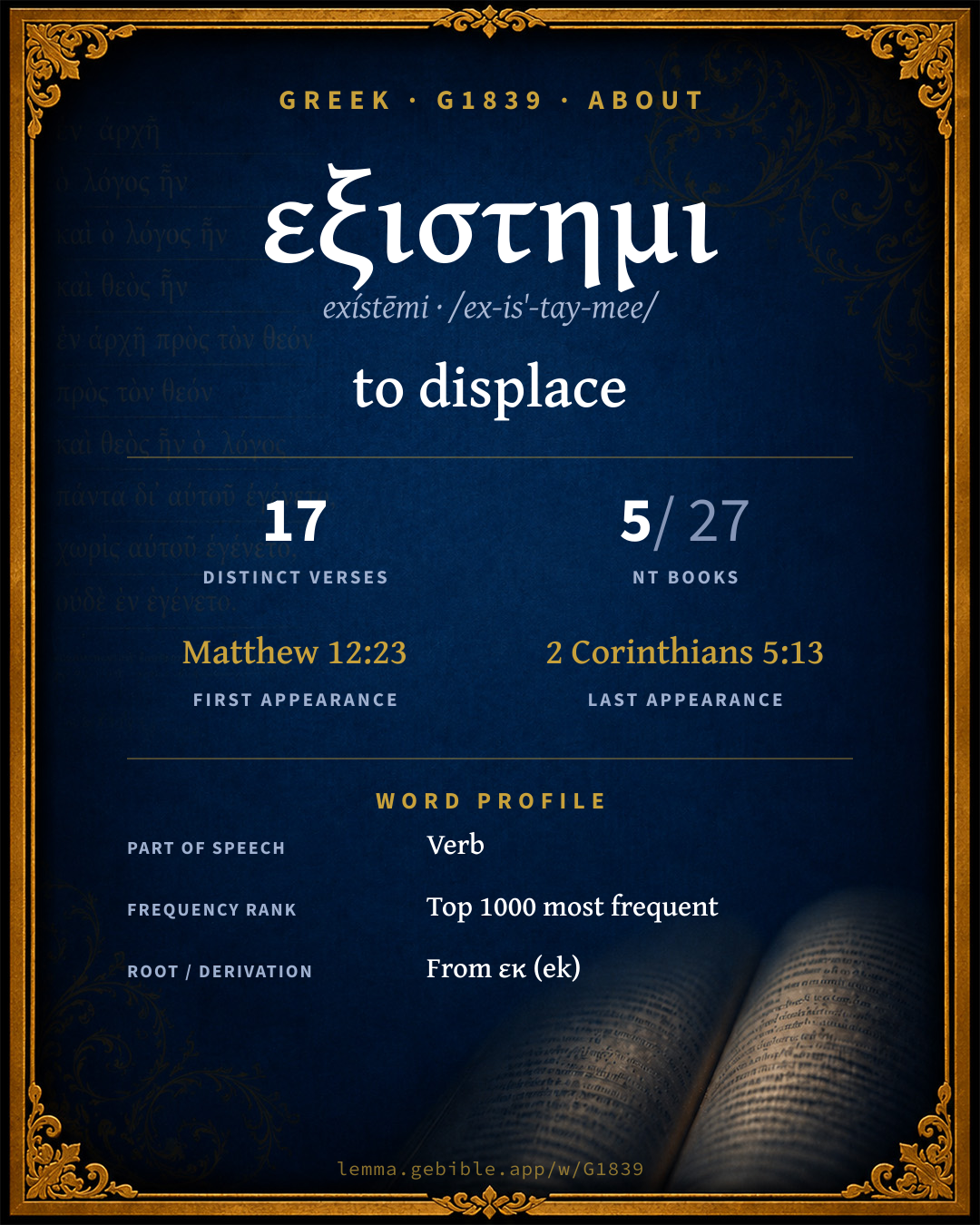
ἐξίστημι
to displace
Full lexicon entry — Thayer's Greek Lexicon
From Thayer's Greek Lexicon
Where this word appears
See every Aorist-tense verb in the Greek New Testament →
Grammar key — what these labels mean
Part of speech
- Verb
- An action or state-of-being word.
Tense
- Imperfect
- Continuous or repeated action in past time (“was writing”).
- Aorist
- Action viewed as a simple whole, without regard to duration — often past (perfective aspect).
- Present
- Ongoing or general action in present time (imperfective aspect).
- Perfect
- A completed past action with continuing present results.
Voice
- Middle
- The subject acts on or for itself, or with special interest in the action.
- Active
- The subject performs the action.
Mood
- Indicative
- States a fact or asks a factual question (the mood of reality).
- Participle
- A verbal adjective (“writing,” “having written”).
- Infinitive
- A verbal noun (“to write”), unmarked for person or number.
Case
- Nominative
- The case of the subject (and the predicate nominative).
Person
- 3rd person
- The one spoken about (“he / she / it / they”).
- 1st person
- The speaker (“I / we”).
Gender
- Masculine
- Grammatically masculine.
Number
- Plural
- More than one.
- Singular
- One.
Grammatical forms
- Verb, Imperfect, Middle, Indicative, 3rd person, Plural 6 times (35%)
- Verb, Aorist, Active, Indicative, 3rd person, Plural 5 times (29%)
- Verb, Aorist, Active, Indicative, 1st person, Plural 1 time (6%)
- Verb, Aorist, Active, Indicative, 3rd person, Singular 1 time (6%)
- Verb, Imperfect, Middle, Indicative, 3rd person, Singular 1 time (6%)
- Verb, Present, Active, Participle, Nominative, Singular, Masculine 1 time (6%)
- Verb, Present, Middle, Infinitive 1 time (6%)
- Verb, Perfect, Active, Infinitive 1 time (6%)
Parsed forms decoded from the imported morphology (Robinson–Tischendorf, public domain), counted across 17 parsed occurrences — not distinct verses.
Every verse where G1839 appears — 17 distinct verses across 5 books. Click any verse to open its interlinear word-by-word view. Verse text shown in the World English Bible for context — . Each verse’s Greek form is shown with its reference; the English is not keyword-highlighted, since the data carries no word-level English alignment. Use “Compare translations” on any verse to read it across multiple English versions. This concordance covers the Greek New Testament; Septuagint (Greek Old Testament) occurrences of this word are not indexed here.
Matthew 1 verse
Mark 4 verses
- Mark 2:12 ἐξίστασθαι pres mid inf He arose, and immediately took up the mat, and went out in front of them all; so that they were all amazed, and glorified God, saying, "We never saw anything like this!"
- Mark 3:21 ἐξέστη aor act ind 3sg When his friends heard it, they went out to seize him: for they said, "He is insane."
- Mark 5:42 ἐξέστησαν aor act ind 3pl Immediately the girl rose up, and walked, for she was twelve years old. They were amazed with great amazement.
- Mark 6:51 ἐξίσταντο impf mid ind 3pl He got into the boat with them; and the wind ceased, and they were very amazed among themselves, and marveled;
Luke 3 verses
- Luke 2:47 ἐξίσταντο impf mid ind 3pl All who heard him were amazed at his understanding and his answers.
- Luke 8:56 ἐξέστησαν aor act ind 3pl Her parents were amazed, but he charged them to tell no one what had been done.
- Luke 24:22 ἐξέστησαν aor act ind 3pl Also, certain women of our company amazed us, having arrived early at the tomb;
Acts 8 verses
- Acts 2:7 ἐξίσταντο impf mid ind 3pl They were all amazed and marveled, saying to one another, "Behold, aren't all these who speak Galileans?
- Acts 2:12 ἐξίσταντο impf mid ind 3pl They were all amazed, and were perplexed, saying one to another, "What does this mean?"
- Acts 8:9 ἐξιστάνων pres act ptcp nom sg masc But there was a certain man, Simon by name, who used to practice sorcery in the city, and amazed the people of Samaria, making himself out to be some great one,
- Acts 8:11 ἐξεστακέναι perf act inf They listened to him, because for a long time he had amazed them with his sorceries.
- Acts 8:13 ἐξίστατο impf mid ind 3sg Simon himself also believed. Being baptized, he continued with Philip. Seeing signs and great miracles occuring, he was amazed.
- Acts 9:21 ἐξίσταντο impf mid ind 3pl All who heard him were amazed, and said, "Isn't this he who in Jerusalem made havoc of those who called on this name? And he had come here intending to bring them bound before the chief priests!"
- Acts 10:45 ἐξέστησαν aor act ind 3pl They of the circumcision who believed were amazed, as many as came with Peter, because the gift of the Holy Spirit was also poured out on the Gentiles.
- Acts 12:16 ἐξέστησαν aor act ind 3pl But Peter continued knocking. When they had opened, they saw him, and were amazed.
2 Corinthians 1 verse
About this entry
At a glance — auto-summarized from this page’s data, not written by a person. Every figure links to its source below. This summary describes the numbers; it doesn’t interpret them.
εξιστημι (exístēmi) is a Greek verb most often rendered “to displace.” Debuting at Matthew 12:23, it then recurs through the corpus. With 17 verses in 5 books, it is an uncommon word in the Greek New Testament. It concentrates in Acts, which alone accounts for 47% of its uses. From the same root come εκ, εκβαλλω and εκβασις. For the data behind this summary, explore the sense tree and the renderings breakdown below.
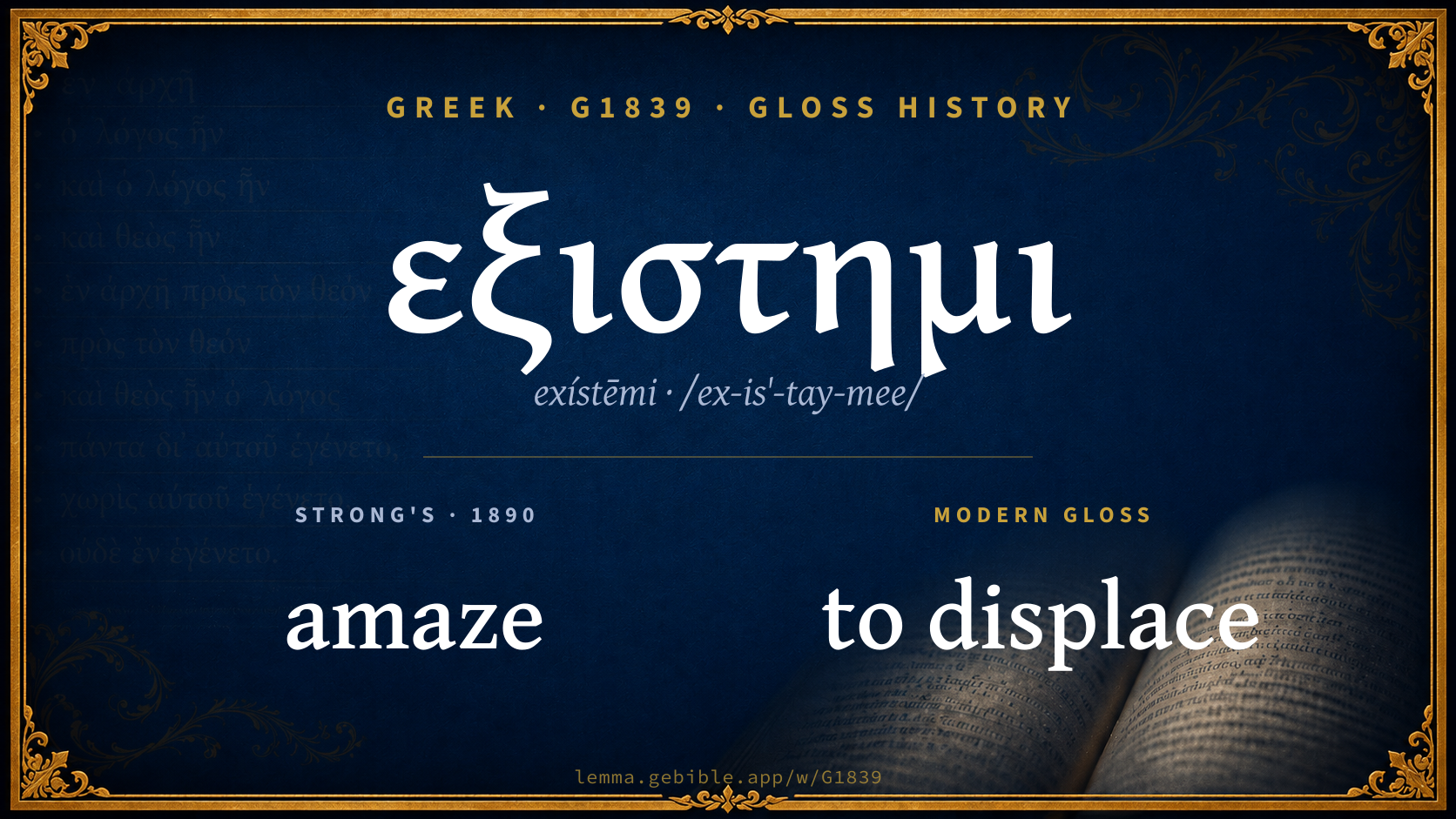
Gloss history
Strong's 1890 vs modern scholarship
About this word
Strong's G1839 catalogs a Greek word from the Greek New Testament.
These counts are not copied from any lexicon or concordance. They are computed here, from the morphology-tagged Greek New Testament. What Lemma adds →
- 17
- distinct verses
- The word appears in 17 distinct verses.
- 5 / 27
- NT books
- The word appears in 5 of 27 New Testament books.
- #697
- by frequency
- Top 1000 most frequent Greek words (rank 697 of 5,347 Greek words by occurrence).
View all 17 occurrences in the concordance →
By section of the New Testament
By traditional corpus
Conventional, traditional groupings — biblical authorship is debated, so this is a traditional corpus grouping, not an authorship claim. Some books belong to more than one corpus (Luke is in both the Gospels and the Lukan corpus, and so on), so these shares overlap and need not total 100%. Each figure is a share of the word’s 17 distinct verses.
- Lukan (Luke–Acts) 11 verses · 65%
- Gospels 8 verses · 47%
- Pauline corpus 1 verse · 6%
How translations render this word
Counts come from each version’s own published word-to-Strong’s tagging or interlinear alignment — an approximate guide to how each version renders this word, not a word-level alignment the data otherwise carries. Because each total is that version’s own tagged count, the per-version totals vary from one another and need not match the appearance or distinct-verse counts above. These counts may also differ from a printed concordance because Lemma counts each distinctly tagged rendering and does not collapse phrase taggings into a single head-word total. This is a fixed set of word-tagged versions (KJV, ASV, BSB, ULT) and does not change with the reading translation you choose elsewhere. Each version’s license is shown beside its name below (and on Sources).
- King James Version: Amazed 4×, They were 3×, Were astonished 3×
- American Standard Version: Were amazed 6×, Amazed 5×, They were 2×
- Berean Standard Bible: Astounded 6×, Were astounded 5×
- unfoldingWord Literal Text: They were 4×, Amazed 3×, Were amazed 3×
King James Version Public Domain
Renders G1839 across 21 tagged occurrences — most commonly:
Plus 7 renderings that appear only once — usually multi-word phrases or single function words the recovered tagging swept in, not distinct renderings.
American Standard Version Public Domain
Renders G1839 across 19 tagged occurrences — most commonly:
Plus 6 renderings that appear only once — usually multi-word phrases or single function words the recovered tagging swept in, not distinct renderings.
Berean Standard Bible Public Domain
Renders G1839 across 17 tagged occurrences — most commonly:
Plus 6 renderings that appear only once — usually multi-word phrases or single function words the recovered tagging swept in, not distinct renderings.
unfoldingWord Literal Text CC BY-SA 4.0
Renders G1839 across 21 tagged occurrences — most commonly:
Plus 7 renderings that appear only once — usually multi-word phrases or single function words the recovered tagging swept in, not distinct renderings.
Senses in Thayer's
The 1 sense Thayer's distinguishes for this word, in lexicon order (not ranked by frequency or importance). The full entry — with sub-senses — is in the Lexicon Entry tab.
- to throw out of position, displace
Word origin
Derived from εκ (ek) (G1537) — from.
Forms in the corpus
The 8 distinct written forms G1839 takes in the Greek New Testament, most frequent first — each parse links to that tense’s occurrences in the concordance.
| Form | Parsing | Example | Uses |
|---|---|---|---|
| ἐξίσταντο exístanto | Verb, Imperfect, Middle, Indicative, 3rd person, Plural | Matthew 12:23 | 6 |
| ἐξέστησαν exéstēsan | Verb, Aorist, Active, Indicative, 3rd person, Plural | Mark 5:42 | 5 |
| ἐξέστη exéstē | Verb, Aorist, Active, Indicative, 3rd person, Singular | Mark 3:21 | 1 |
| ἐξέστημεν exéstēmen | Verb, Aorist, Active, Indicative, 1st person, Plural | 2 Corinthians 5:13 | 1 |
| ἐξίστασθαι exístasthai | Verb, Present, Middle, Infinitive | Mark 2:12 | 1 |
| ἐξίστατο exístato | Verb, Imperfect, Middle, Indicative, 3rd person, Singular | Acts 8:13 | 1 |
| ἐξεστακέναι exestakénai | Verb, Perfect, Active, Infinitive | Acts 8:11 | 1 |
| ἐξιστάνων existánōn | Verb, Present, Active, Participle, Nominative, Singular, Masculine | Acts 8:9 | 1 |
Same root — word family
Other Thayer's entries built from the same root as G1839, grouped by Strong’s listed origin. These share a root / origin per the lexicon — not necessarily a shared meaning. Each links to that word’s own entry.
Derives from
Shares the same root
- εκβαλλω ekbállō G1544 to cast out
- εκβασις ékbasis G1545 exit
- εκγαμιζω ekgamízō G1547 to give in marriage
- εκγαμισκω ekgamískō G1548 to give in marriage
- εκγονον ékgonon G1549 offspring
- εκδαπαναω ekdapanáō G1550 to spend
- εκδεχομαι ekdéchomai G1551 to receive
- εκδηλος ékdēlos G1552 evident
- εκδημεω ekdēméō G1553 to depart
- εκδιδωμι ekdídōmi G1554 to give out
- εκδιηγεομαι ekdiēgéomai G1555 to relate
- εκδικος ékdikos G1558 without justice
- εκδιωκω ekdiṓkō G1559 to banish
- εκδοτος ékdotos G1560 delivered up
- εκδυω ekdýō G1562 to put off
- εκζητεω ekzētéō G1567 to seek out
- εκθαμβος ékthambos G1569 astonished
- εκθετος ékthetos G1570 exposed
- εκκαθαιρω ekkathaírō G1571 to cleanse
- εκκαιω ekkaíō G1572 to burn
- εκκακεω ekkakéō G1573 to be exhausted
- εκκεντεω ekkentéō G1574 to pierce
- εκκλαω ekkláō G1575 to cut off
- εκκλειω ekkleíō G1576 to shut out
+88 more words share this root (not shown).
Derived from this word
Compare all same-root words → Showing 4 of 115 — not the complete family. They share a root, not necessarily a meaning.
Septuagint usage
The same Greek word εξιστημι appears 62 times in the Greek Old Testament (Septuagint), across 61 verses in 18 books.
- 62
- LXX occurrences
- Tagged occurrences of this Greek word in the Septuagint.
- 61
- verses
- Distinct Septuagint verses containing this word.
- 18 / 39
- OT books
- The word appears in 18 of the 39 Old Testament books.
Sample Septuagint occurrences
- Genesis 27:33 ἐκἵστημι
- Exodus 18:9 ἐκἵστημι
- Leviticus 9:24 ἐκἵστημι
- Joshua 2:11 ἐκἵστημι
- Judges 4:15 ἐκἵστημι
- Ruth 3:8 ἐκἵστημι
- 1 Samuel 4:13 ἐκἵστημι
- 2 Samuel 17:2 ἐκἵστημι
- 1 Kings 1:49 ἐκἵστημι
- 2 Kings 4:13 ἐκἵστημι
- 2 Chronicles 7:21 ἐκἵστημι
- Job 5:13 ἐκἵστημι
Septuagint occurrences (same lexeme)
Every verse where the same Strong’s number (G1839) appears in the Greek Septuagint — showing the first 50 of 61. Verse text shown in the World English Bible for context; the Greek form is the matched word — the English is not keyword-highlighted.
- Genesis 27:33 ἐκἵστημι Isaac trembled violently, and said, "Who, then, is he who has taken venison, and brought it me, and I have eaten of all before you came, and have blessed him? Yes, he will be blessed."
- Genesis 42:28 ἐκἵστημι He said to his brothers, "My money is restored! Behold, it is even in my sack." Their hearts failed them, and they turned trembling one to another, saying, "What is this that God has done to us?"
- Genesis 43:33 ἐκἵστημι They sat before him, the firstborn according to his birthright, and the youngest according to his youth, and the men marveled one with another.
- Genesis 45:26 ἐκἵστημι They told him, saying, "Joseph is still alive, and he is ruler over all the land of Egypt." His heart fainted, for he didn't believe them.
- Exodus 18:9 ἐκἵστημι Jethro rejoiced for all the goodness which Yahweh had done to Israel, in that he had delivered them out of the hand of the Egyptians.
- Exodus 19:18 ἐκἵστημι Mount Sinai, the whole of it, smoked, because Yahweh descended on it in fire; and its smoke ascended like the smoke of a furnace, and the whole mountain quaked greatly.
- Exodus 23:27 ἐκἵστημι I will send my terror before you, and will confuse all the people to whom you come, and I will make all your enemies turn their backs to you.
- Leviticus 9:24 ἐκἵστημι There came forth fire from before Yahweh, and consumed the burnt offering and the fat upon the altar: and when all the people saw it, they shouted, and fell on their faces.
- Joshua 2:11 ἐκἵστημι As soon as we had heard it, our hearts did melt, neither did there remain any more spirit in any man, because of you: for Yahweh your God, he is God in heaven above, and on earth beneath.
- Joshua 10:10 ἐκἵστημι Yahweh confused them before Israel, and he killed them with a great slaughter at Gibeon, and chased them by the way of the ascent of Beth Horon, and struck them to Azekah, and to Makkedah.
- Judges 4:15 ἐκἵστημι Yahweh confused Sisera, and all his chariots, and all his host, with the edge of the sword before Barak; and Sisera alighted from his chariot, and fled away on his feet.
- Judges 4:21 ἐκἵστημι Then Jael Heber's wife took a tent-pin, and took a hammer in her hand, and went softly to him, and struck the pin into his temples, and it pierced through into the ground; for he was in a deep sleep; so he swooned and died.
- Judges 8:12 ἐκἵστημι Zebah and Zalmunna fled; and he pursued after them; and he took the two kings of Midian, Zebah and Zalmunna, and confused all the host.
- Ruth 3:8 ἐκἵστημι It happened at midnight, that the man was afraid, and turned himself; and, behold, a woman lay at his feet.
- 1 Samuel 4:13 ἐκἵστημι When he came, behold, Eli was sitting on his seat by the road watching; for his heart trembled for the ark of God. When the man came into the city, and told it, all the city cried out.
- 1 Samuel 13:7 ἐκἵστημι Now some of the Hebrews had gone over the Jordan to the land of Gad and Gilead; but as for Saul, he was yet in Gilgal, and all the people followed him trembling.
- 1 Samuel 14:15 ἐκἵστημι There was a trembling in the camp, in the field, and among all the people; the garrison, and the spoilers, they also trembled; and the earth quaked: so there was an exceeding great trembling.
- 1 Samuel 16:4 ἐκἵστημι Samuel did that which Yahweh spoke, and came to Bethlehem. The elders of the city came to meet him trembling, and said, Come you peaceably?
- 1 Samuel 17:11 ἐκἵστημι When Saul and all Israel heard those words of the Philistine, they were dismayed, and greatly afraid.
- 1 Samuel 21:2 ἐκἵστημι David said to Ahimelech the priest, The king has commanded me a business, and has said to me, Let no man know anything of the business about which I send you, and what I have commanded you: and I have appointed the young men to such and such a place.
- 1 Samuel 28:5 ἐκἵστημι When Saul saw the host of the Philistines, he was afraid, and his heart trembled greatly.
- 2 Samuel 17:2 ἐκἵστημι and I will come on him while he is weary and weak-handed, and will make him afraid; and all the people who are with him shall flee; and I will strike the king only;
- 2 Samuel 22:15 ἐκἵστημι He sent out arrows, and scattered them; Lightning, and confused them.
- 1 Kings 1:49 ἐκἵστημι All the guests of Adonijah were afraid, and rose up, and went every man his way.
- 1 Kings 9:8 ἐκἵστημι Though this house is so high, yet shall everyone who passes by it be astonished, and shall hiss; and they shall say, Why has Yahweh done thus to this land, and to this house?
- 2 Kings 4:13 ἐκἵστημι He said to him, Say now to her, Behold, you have been careful for us with all this care; what is to be done for you? would you be spoken for to the king, or to the captain of the host? She answered, I dwell among my own people.
- 2 Chronicles 7:21 ἐκἵστημι This house, which is so high, everyone who passes by it shall be astonished, and shall say, Why has Yahweh done thus to this land, and to this house?
- 2 Chronicles 15:6 ἐκἵστημι They were broken in pieces, nation against nation, and city against city; for God did vex them with all adversity.
- Job 5:13 ἐκἵστημι He takes the wise in their own craftiness; The counsel of the cunning is carried headlong.
- Job 12:17 ἐκἵστημι He leads counselors away stripped. He makes judges fools.
- Job 26:11 ἐκἵστημι The pillars of heaven tremble And are astonished at his rebuke.
- Job 36:28 ἐκἵστημι Which the skies pour down And drop on man abundantly.
- Isaiah 7:2 ἐκἵστημι It was told the house of David, saying, "Syria is allied with Ephraim." His heart trembled, and the heart of his people, as the trees of the forest tremble with the wind.
- Isaiah 10:31 ἐκἵστημι Madmenah is a fugitive; the inhabitants of Gebim flee for safety.
- Isaiah 13:8 ἐκἵστημι and they shall be dismayed; pangs and sorrows shall take hold [of them]; they shall be in pain as a woman in travail: they shall look in amazement one at another; their faces [shall be] faces of flame.
- Isaiah 16:3 ἐκἵστημι Give counsel, execute justice; make your shade as the night in the midst of the noonday; hide the outcasts; don't betray the fugitive.
- Isaiah 28:7 ἐκἵστημι Even these reel with wine, and stagger with strong drink; the priest and the prophet reel with strong drink, they are swallowed up of wine, they stagger with strong drink; they err in vision, they stumble in judgment.
- Isaiah 29:9 ἐκἵστημι Stay you and wonder; take your pleasure and be blind: they are drunken, but not with wine; they stagger, but not with strong drink.
- Isaiah 32:11 ἐκἵστημι Tremble, you women who are at ease; be troubled, you careless ones; strip yourselves, and make yourselves naked, and gird [sackcloth] on your loins.
- Isaiah 33:3 ἐκἵστημι At the noise of the thunder the peoples are fled; at the lifting up of yourself the nations are scattered.
- Isaiah 41:2 ἐκἵστημι Who has raised up one from the east, whom he calls in righteousness to his foot? he gives nations before him, and makes him rule over kings; he gives them as the dust to his sword, as the driven stubble to his bow.
- Isaiah 42:14 ἐκἵστημι I have long time held my peace; I have been still, and refrained myself: [now] will I cry out like a travailing woman; I will gasp and pant together.
- Isaiah 52:14 ἐκἵστημι Like as many were astonished at you (his visage was so marred more than any man, and his form more than the sons of men),
- Isaiah 60:5 ἐκἵστημι Then you shall see and be radiant, and your heart shall thrill and be enlarged; because the abundance of the sea shall be turned to you, the wealth of the nations shall come to you.
- Jeremiah 2:12 ἐκἵστημι Be astonished, you heavens, at this, and be horribly afraid, be you very desolate, says Yahweh.
- Jeremiah 4:9 ἐκἵστημι It shall happen at that day, says Yahweh, that the heart of the king shall perish, and the heart of the princes; and the priests shall be astonished, and the prophets shall wonder.
- Jeremiah 9:9 ἐκἵστημι Shall I not visit them for these things? says Yahweh; shall not my soul be avenged on such a nation as this?
- Jeremiah 18:16 ἐκἵστημι to make their land an astonishment, and a perpetual hissing; everyone who passes thereby shall be astonished, and shake his head.
- Jeremiah 30:29 ἐκἵστημι
- Ezekiel 2:6 ἐκἵστημι You, son of man, don't be afraid of them, neither be afraid of their words, though briers and thorns are with you, and you do dwell among scorpions: don't be afraid of their words, nor be dismayed at their looks, though they are a rebellious house.
These are occurrences of the same Greek lexeme (G1839) in the Septuagint — not a translation of any one Hebrew word. The store carries no word-level Hebrew↔Greek alignment, so no Hebrew original is asserted here. Counts come from the recovered LXX Strong's tagging — high-frequency vocabulary is well covered, while rare or late forms may be untagged — so they reflect tagged occurrences and may slightly undercount.