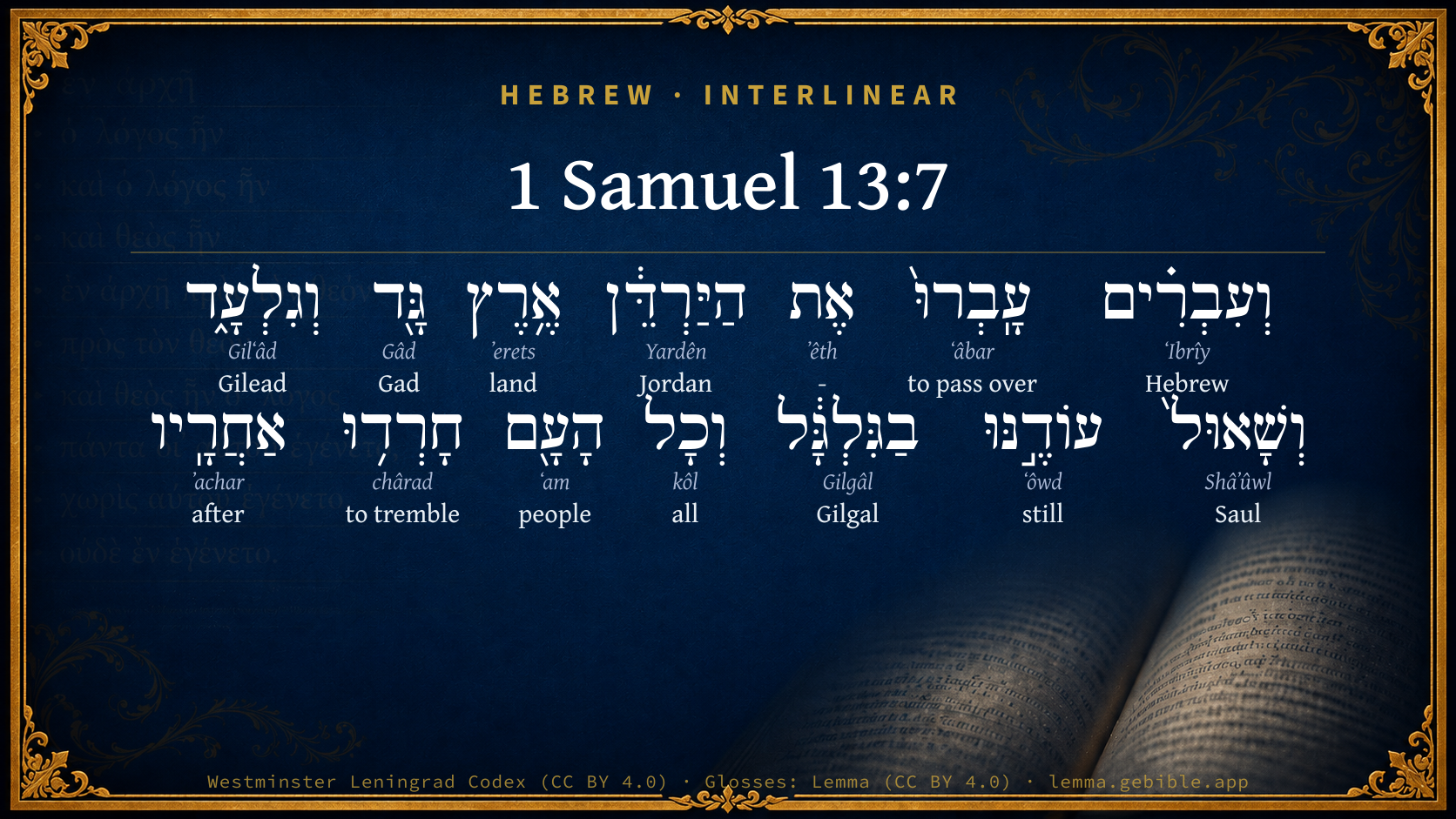
1 Samuel 13:7

Hebrew (Westminster Leningrad Codex) 1 Samuel 13:7 appears in the Hebrew Old Testament. The text above is from the Westminster Leningrad Codex. Each word links to its Strong’s number, a concise gloss, and parsing drawn from the Open Scriptures Hebrew Bible morphology. Click any word for its full Brown-Driver-Briggs (BDB) entry.
Download image
Cite this verse

1 Samuel 13:7 (World English Bible). Public Domain. Lemma interlinear Bible study tool, https://lemma.gebible.app/v/1-samuel/13/7.

Show BibTeX & RIS
BibTeX
RIS
English Translation
Now some of the Hebrews had gone over the Jordan to the land of Gad and Gilead; but as for Saul, he was yet in Gilgal, and all the people followed him trembling.
World English Bible · Public Domain
Download a study sheet

One document with this verse’s original text, its word-by-word gloss line, the meaning frame, cross-references with their text, attributed commentary, and full source and license credits — printable, and it pastes into notes with its structure intact.

This verse Autodidact and up

Study sheet (.html) Plain text (.txt)

A passage Seminary Student

Up to 50 verses in one chapter. A passage sheet keeps up to 6 commentary sources and 12 cross-references per verse, in the order this page ranks them, and says so on the sheet whenever that leaves anything out. Ask for a single verse and you get the Autodidact verse sheet above.

Everything on this page stays free to read, with no account — the sheet is a download of what is already on screen, not access to it.

Want to remove ads? Support Godless Engineer
Compare translations 3

The same verse in 3 English versions, stacked beneath the original-language interlinear above. Click any original word for its lexicon entry.

Each is an independent rendering of the whole verse — the interlinear is not word-aligned to these translations.

Highlighted words mark where these versions differ — a whole-verse word diff, not a word-by-word alignment.

  • World English Bible Public Domain
    Now some of the Hebrews had gone over the Jordan to the land of Gad and Gilead; but as for Saul, he was yet in Gilgal, and all the people followed him trembling.
  • King James Version Public Domain
    And some of the Hebrews went over Jordan to the land of Gad and Gilead. As for Saul, he was yet in Gilgal, and all the people followed him trembling.
  • unfoldingWord Literal Text CC BY-SA 4.0
    And Hebrews crossed the Jordan the land of Gad and Gilead. But Saul, he still at Gilgal, and all of the people trembled after him.

unfoldingWord Literal Text — © unfoldingWord, licensed CC BY-SA 4.0. Word-aligned USFM3 via Door43 (git.door43.org/unfoldingWord/en_ult).

Versions to compare (up to 4)

3 of 4 selected

Show all 18 translations

Every available English version of this verse, each an independent rendering of the whole verse.

  • World English Bible Public Domain
    Now some of the Hebrews had gone over the Jordan to the land of Gad and Gilead; but as for Saul, he was yet in Gilgal, and all the people followed him trembling.
  • Berean Standard Bible Public Domain
    Some Hebrews even crossed the Jordan into the land of Gad and Gilead. Saul, however, remained at Gilgal, and all his troops were quaking in fear.
  • Majority Standard Bible Public Domain
    Some Hebrews even crossed the Jordan into the land of Gad and Gilead. Saul, however, remained at Gilgal, and all his troops were quaking in fear.
  • King James Version Public Domain
    And some of the Hebrews went over Jordan to the land of Gad and Gilead. As for Saul, he was yet in Gilgal, and all the people followed him trembling.
  • American Standard Version (1901) Public Domain
    Now some of the Hebrews had gone over the Jordan to the land of Gad and Gilead; but as for Saul, he was yet in Gilgal, and all the people followed him trembling.
  • Revised Version (1885) Public Domain
    Now some of the Hebrews had gone over Jordan to the land of Gad and Gilead; but as for Saul, he was yet in Gilgal, and all the people followed him trembling.
  • Geneva Bible (1599) Public Domain
    And some of the Ebrewes went ouer Iorden vnto the lande of Gad and Gilead: and Saul was yet in Gilgal, and al the people for feare followed him.
  • Douay-Rheims (1899) Public Domain
    And some of the Hebrews passed over the Jordan into the land of Gad and Galaad. And when Saul was yet in Galgal, all the people that followed him were greatly afraid.
  • Young's Literal Translation Public Domain
    And Hebrews have passed over the Jordan to the land of Gad and Gilead; and Saul `is' yet in Gilgal, and all the people have trembled after him.
  • Literal Standard Version CC BY-SA 4.0
    And Hebrews have passed over the Jordan to the land of Gad and Gilead; and Saul [is] yet in Gilgal, and all the people have trembled after him.
  • Unlocked Literal Bible CC BY-SA 4.0
    Some of the Hebrews went over the Jordan to the land of Gad and Gilead. But Saul was still at Gilgal, and all the people followed him trembling.
  • unfoldingWord Literal Text CC BY-SA 4.0
    And Hebrews crossed the Jordan the land of Gad and Gilead. But Saul, he still at Gilgal, and all of the people trembled after him.
  • Darby Bible Public Domain
    And the Hebrews went over the Jordan into the land of Gad and Gilead. And Saul was yet in Gilgal, and all the people followed him trembling.
  • World Messianic Bible Public Domain
    Now some of the Hebrews had gone over the Jordan to the land of Gad and Gilead; but as for Saul, he was yet in Gilgal, and all the people followed him trembling.
  • Webster's Bible Public Domain
    And some of the Hebrews went over Jordan to the land of Gad and Gilead. As for Saul, he was yet in Gilgal, and all the people followed him trembling.
  • Free Bible Version CC BY-SA 4.0
    Some of the Hebrews even crossed the Jordan into the territory of Gad and Gilead, but Saul stayed at Gilgal, and all the men with him were trembling with fear.
  • Bible in Basic English Public Domain
    And a great number of the people had gone over Jordan to the land of Gad and Gilead; but Saul was still in Gilgal, and all the people went after him shaking in fear.
  • JPS Tanakh (1917) Public Domain
    Now some of the Hebrews had gone over the Jordan to the land of Gad and Gilead; but as for Saul, he was yet in Gilgal, and all the people followed him trembling.

Literal Standard Version (2020), Covenant Press — licensed CC BY-SA 4.0. Text via the HelloAO Bible API (eBible.org). Unlocked Literal Bible (unfoldingWord) — licensed CC BY-SA 4.0. Text via the HelloAO Bible API (eBible.org). unfoldingWord Literal Text — © unfoldingWord, licensed CC BY-SA 4.0. Word-aligned USFM3 via Door43 (git.door43.org/unfoldingWord/en_ult). Free Bible Version, Dr. Jonathan Gallagher — licensed CC BY-SA 4.0. Text via the HelloAO Bible API (eBible.org).

Word by word

More ways to search: Search by grammar → Find every occurrence → Compare this word →

Practice this passage: Drill this verse → Learn its vocabulary →

וְעִבְרִ֗ים
ʻIbrîy
H5680
“and · Hebrews”
Conjunction + Noun, Gentilic, Masculine, Plural, Absolute
Part of Speech
Conjunction + Noun
Type
Gentilic
Gender
Masculine
Number
Plural
State
Absolute
Full BDB Definition

Origin: patronymic from H5677

TWOT: None

Hebrew = "one from beyond" - a designation of the patriarchs and the Israelites (noun proper) - a designation of the patriarchs and the Israelites (adjective)
  1. עָֽבְרוּ֙ ʻâbar H5674 “to pass over” Verb, Qal, Perfect, 3rd Person, Common, Plural
  2. אֶת ʼêth H853 “-” Particle, Direct Object
  3. הַיַּרְדֵּ֔ן Yardên H3383 “the · Jordan” Particle, Definite Article + Noun, Proper
  4. אֶ֥רֶץ ʼerets H776 “land of” Noun, Common, Both, Singular, Construct
  5. גָּ֖ד Gâd H1410 “Gad” Noun, Proper
  6. וְגִלְעָ֑ד Gilʻâd H1568 “and · Gilead” Conjunction + Noun, Proper
  7. וְשָׁאוּל֙ Shâʼûwl H7586 “and · Saul” Conjunction + Noun, Proper
  8. עוֹדֶ֣נּוּ ʻôwd H5750 “still · his” Adverb + Suffix, Personal, 3rd Person, Masculine, Singular
  9. בַגִּלְגָּ֔ל Gilgâl H1537 “in/at the · Gilgal” Preposition, Determined + Noun, Proper
  10. וְכָל kôl H3605 “and · all of” Conjunction + Noun, Common, Masculine, Singular, Construct
  11. הָעָ֖ם ʻam H5971 “the · people” Particle, Definite Article + Noun, Common, Masculine, Singular, Absolute
  12. חָרְד֥וּ chârad H2729 “to tremble” Verb, Qal, Perfect, 3rd Person, Common, Plural
  13. אַחֲרָֽיו ʼachar H310 “after · him” Preposition + Suffix, Personal, 3rd Person, Masculine, Singular

About this verse

These counts appear in no published source. They are computed here, from the morphology-tagged text and Lemma’s own curated glosses. What Lemma adds →

14
words
14
distinct lemmas
Historical
section

Shared distinctive vocabulary

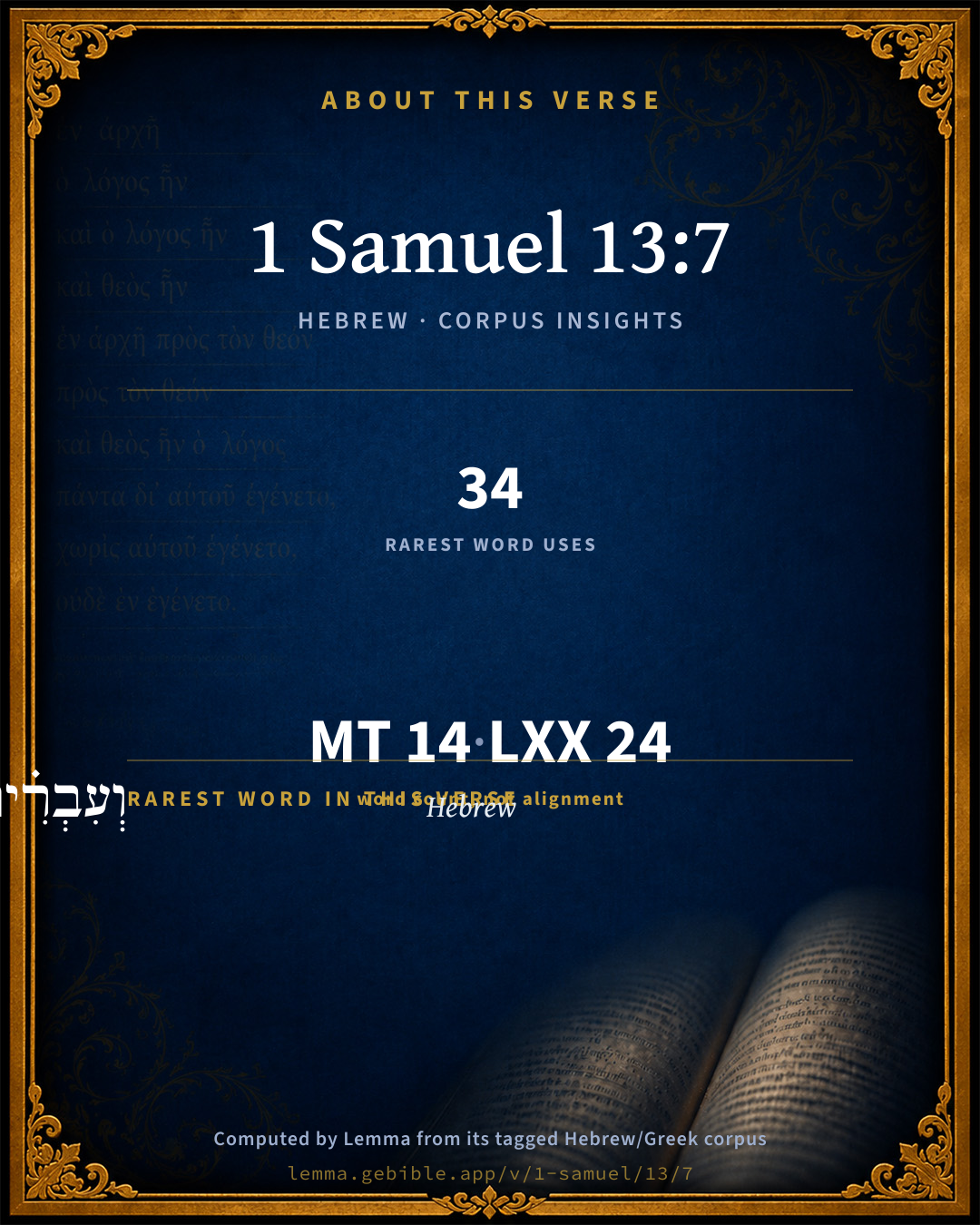
וְעִבְרִ֗ים Hebrew H5680 occurs in 32 verses of the Hebrew Bible. Also found in:

Grammatical profile

  • 2 verbs
  • 9 nouns
  • 1 preposition
  • 1 adverb
  • 1 particle

Verb forms

  • עָֽבְרוּ֙ Qal · Perfect
  • חָרְד֥וּ Qal · Perfect

Hebrew & Septuagint length

In English translation the verse runs 33 words from the Hebrew and 30 from the Septuagint (LXX English) — closely comparable.

A rough comparison of the two English renderings, which tokenize alike — not a word-level alignment.

Word counts can differ between the Hebrew and the Greek without any difference in meaning — e.g. the Hebrew direct-object marker אֵת has no separate Greek word, and Greek often adds the article ὁ.

In the original languages it is 14 Hebrew tokens and 24 Greek tokens — but the two are counted differently (Hebrew bundles its prefixes and suffixes into one token; the Greek is in lemma form), so that isn’t a like-for-like length.

Cross-references

10

Topical passages linked to 1 Samuel 13:7 in the Treasury of Scripture Knowledge — connected by theme and wording, ordered by reader-vote popularity; previews shown in the World English Bible.

  • Leviticus 26:17 I will set my face against you, and you will be struck before your enemies. Those who hate you will rule over you; and you will flee when no one pursues you.
  • Leviticus 26:36–37 "'As for those of you who are left, I will send a faintness into their hearts in the lands of their enemies: and the sound of a driven leaf will put them to flight; and they shall flee, as one flees from the sword; and they will fall when no one pursues.
  • Numbers 32:1–5 Now the children of Reuben and the children of Gad had a very great multitude of cattle: and when they saw the land of Jazer, and the land of Gilead, that behold, the place was a place for cattle;
  • Numbers 32:33–42 Moses gave to them, even to the children of Gad, and to the children of Reuben, and to the half-tribe of Manasseh the son of Joseph, the kingdom of Sihon king of the Amorites, and the kingdom of Og king of Bashan, the land, according to the cities of it with [their] borders, even the cities of the land round about.
  • Deuteronomy 3:12 This land we took in possession at that time: from Aroer, which is by the valley of the Arnon, and half the hill-country of Gilead, and the cities of it, gave I to the Reubenites and to the Gadites:
  • Deuteronomy 20:8 The officers shall speak further to the people, and they shall say, What man is there who is fearful and faint-hearted? let him go and return to his house, lest his brother's heart melt as his heart.
  • Deuteronomy 28:25 Yahweh will cause you to be struck before your enemies; you shall go out one way against them, and shall flee seven ways before them: and you shall be tossed back and forth among all the kingdoms of the earth.
  • Joshua 13:24–31 Moses gave to the tribe of Gad, to the children of Gad, according to their families.
  • Judges 7:3 Now therefore proclaim in the ears of the people, saying, Whoever is fearful and trembling, let him return and depart from Mount Gilead. There returned of the people twenty-two thousand; and there remained ten thousand.
  • Hosea 11:10–11 They will walk after Yahweh, Who will roar like a lion; For he will roar, and the children will come trembling from the west.

Cross-references courtesy of OpenBible.info (CC BY 4.0).

Hebrew and Greek witnesses Masoretic Hebrew ↔ Greek Septuagint

The same verse in the two great witnesses to the Old Testament, shown verse-for-verse.

These are two independent witnesses, not word-aligned to each other, and the Septuagint is shown in lemma (dictionary) form.

Hebrew 1 Samuel 13:7 Masoretic · Westminster Leningrad Codex

וְעִבְרִ֗ים עָֽבְרוּ֙ אֶת הַיַּרְדֵּ֔ן אֶ֥רֶץ גָּ֖ד וְגִלְעָ֑ד וְשָׁאוּל֙ עוֹדֶ֣נּוּ בַגִּלְגָּ֔ל וְכָל הָעָ֖ם חָרְד֥וּ אַחֲרָֽיו

Now some of the Hebrews had gone over the Jordan to the land of Gad and Gilead; but as for Saul, he was yet in Gilgal, and all the people followed him trembling.

World English Bible · Public Domain

Greek LXX 1 Samuel 13:7 Septuagint · lemma form

καί ὁ διαβαίνω διαβαίνω ὁ ἰορδάνης εἰς γῆ γαδ καί γαλαάδ καί σαούλ ἔτι εἰμί ἐν γάλγαλα καί πᾶς ὁ λαός ἐκἵστημι ὀπίσω αὐτός

And they that went over went over Jordan to the land of Gad and Galaad: and Saul was yet in Galgala, and all the people followed after him in amazement.

LXX2012 (modern English Septuagint) · Public Domain

On this verse, Haydock's Catholic Bible Commentary discusses the Septuagint’s reading. Read the note in Commentary ↓

Hebrew: Westminster Leningrad Codex (CC BY 4.0). Greek: Septuagint (public domain); English from LXX2012 (modern English Septuagint) (Public Domain). How the Septuagint differs from the Hebrew →

Targum (Aramaic paraphrase)

1

The Targum is the ancient Jewish Aramaic paraphrase of the Hebrew Scriptures — an interpretive translation, not the Hebrew text itself. Onkelos (literal) and Pseudo-Jonathan (expansive) render the Torah, and Jonathan the Prophets. Coverage is partial: where no permissively-licensed English translation exists for a verse, only the Aramaic is shown. This is verse-level text, not a word-by-word alignment to the Hebrew.

  1. Targum Jonathan Prophets (Joshua–Malachi)
    וִיהוֹדָאֵי עֲבָרוּ יַת יַרְדְנָא לְאַרַע גָד וְגִלְעָד וְשָׁאוּל עַד כְּעַן בְּגִלְגָלָא וְכָל עַמָא אִיתְכְּנִישׁוּ בַתְרוֹהִי:

    (no public-domain English translation for this verse)

    Targum Jonathan — Aramaic: “Mikraot Gedolot” (public domain). English: “Sefaria Community Translation” (CC0 1.0 (public-domain dedication)); “London "Chaldee Paraphrase," 1871” (public domain). Text via Sefaria.

Commentary

Notes on 1 Samuel 13:7 from classic Christian and Jewish commentators (each source and its license shown beneath its notes). The classic Christian expositions comment on the surrounding passage and are grouped to its opening verse, so a note may address several verses; the Jewish commentaries on the Tanakh (Rashi and others) are per-verse, so they appear only where the commentator wrote on this verse.

Lemma curates 59 commentaries, every one of them public domain or Creative Commons licensed, each selected and text-cleaned for this edition rather than reprinted as found. About our sources →

Trapp's Complete Commentary

John Trapp

1Sa 13:7 And [some of] the Hebrews went over Jordan to the land of Gad and Gilead. As for Saul, he [was] yet in Gilgal, and all the people followed him trembling.

Ver. 7. And all the people followed him trembling.] Mικροψυχοι; they were quite dispirited; and now that all seemed to be on fire, they rang their bells backwards as it were. Such as whose hearts are not ballasted with grace, no marvel though they ride uncertainly, and sometimes dash fearfully.

John Trapp, A Commentary or Exposition upon All the Books of the Old and New Testament (1647–1656) — public domain. Text from a community e-Sword module.

Joseph Benson's Commentary

1Sa 13:7-8. Some of the Hebrews went over Jordan — They fled as far as they could from the present danger, even into the country of the two tribes and a half. All the people followed him trembling — That is, all that were left, who, it appears, were not many. He tarried seven days — Not seven complete days, for the last day was not finished. According to the set time that Samuel had appointed — This seems to refer to the command given two years before, and recorded 1Sa 10:8 : see the note on that verse. But Samuel came not to Gilgal — So soon as Saul expected him.

Joseph Benson's Commentary on the Old and New Testaments (1811–1818) — public domain. Text from a community e-Sword module.

Tyndale Open Study Notes

Tyndale Open Resources

13:7 The land of Gad and Gilead ran the length of Transjordan (the region just east of the Jordan River).

Tyndale Open Study Notes — © Tyndale Open Resources, licensed CC BY-SA 4.0. Text via the HelloAO Bible API.

Geneva Bible (1599)

Geneva Bible translators

Where the two tribes and the half remained.

Geneva Bible (1599) marginal notes — public domain. Text via Bolls.life.

The Cambridge Bible for Schools and Colleges

gen. ed. J. J. S. Perowne

7. some of the Hebrews] The soundness of the text is rendered doubtful by the peculiarity of the construction, and the use of the term “Hebrews” without apparent reason. The Sept., changing the vowels of the word Hebrews, renders, “And they who went over went over Jordan, &c.;” but this can hardly be right either.

all the people followed him trembling] The nation obeyed his summons, but in the greatest alarm at the proximity of the Philistine host.

The Cambridge Bible for Schools and Colleges (gen. ed. J. J. S. Perowne; Cambridge University Press, 1878–1918) — public domain. Text from a community e-Sword module.

John Gill's Exposition

And some of the Hebrews went over Jordan to the land of Gad and Gilead,.... As far off as they could from the Philistines, who lay on the west of the land of Israel, and these countries were to the east. Kimchi observes, that the land of Reuben is not mentioned, which was on the other side Jordan also; because that was nearer to it than what was inhabited by Gad, and the half tribe of Manasseh; and therefore they chose to go further, thinking themselves there safer:

as for Saul, he was yet in Gilgal; where he stayed till Samuel should come to him, as directed, Sa1 10:8 to have his advice and counsel:

and all the people followed him trembling; all that were with him, the army as distinct from the common people; they abode by him, and were at his command, and were ready to go where he should direct them; but with trembling hearts when they saw the pain of the people, fleeing into holes and corners, and considered what a huge host the Philistines were coming upon them with, and Samuel their prophet not with them to encourage and counsel them.

John Gill's Exposition of the Whole Bible (1746–1763) — public domain (CC PDM 1.0). Text via the HelloAO Bible API.

Albert Barnes' Notes on the Bible

The words “some of,” which are the emphatic words in the King James Version, as distinguishing those who crossed the Jordan from those who hid themselves, are not in the Hebrew at all. The “Hebrews” seem to be distinguished from the “men of Israel” in 1Sa 13:6. (Compare 1Sa 14:21.)

Albert Barnes' Notes on the Bible (1834–1885) — public domain. Text from a community e-Sword/MySword module.

Haydock's Catholic Bible Commentary

Hebrews. Septuagint, "the people, who came over, (the river) crossed the Jordan." (Haydock) --- The title of Hebrews, "passengers," seems to be applied to those who lived on the east side of the river, (Calmet) though probably some others would seek for a retreat in that country, or even hide themselves in the regions of the Ammonites, out of which they had lately driven the inhabitants. (Haydock) --- Hebrew, "the Hebrews passed over the Jordan, the land of," &c. (Calmet) --- Afraid. Septuagint in a sort of "ecstasy" of fear.

George Leo Haydock (1774–1849), Haydock's Catholic Family Bible and Commentary, 1859 edition — public domain. Excludes Psalms (Douay-Rheims chapter numbering differs from Protestant) and Deuterocanonical books (Catholic canon only).

Matthew Poole's English Annotations

All the people, to wit, his whole army, opposed to the common people, 1Sa 13:6.

Matthew Poole's English Annotations on the Holy Bible (1683–1685) — public domain. Text from a community e-Sword/MySword module.

Whedon's Commentary on the Bible

Daniel D. Whedon

7. Hebrews went over Jordan — Which shows that the Gilgal where Saul tarried all this time was in the plains of Jericho, (see on 1Sa_13:4,) whence numbers might easily steal away to the land of Gad and Gilead, which lay across the Jordan immediately opposite Jericho.

Followed him trembling — Those that did follow him, over and above the many that deserted to the caves and deserts, trembled through fear of soon falling into the hands of an enraged and cruel enemy.

Daniel D. Whedon (gen. ed.), Commentary on the Old and New Testaments (1874–1909) — public domain. Text from a community e-Sword module.

The Pulpit Commentary

Some of the Hebrews. A contemptuous name for Israel (see ver. 3). If the reading is correct, it must be used here of a cowardly portion of the people, (as in 1Sa_14:21) for the insertion of some of in the A.V is unjustifiable. But by a very slight change, simply lengthening thestalk of one letter, we get a very good sense: "And they went over the fords of the Jordan to the land of Gad and Gilead," i.e. to the mountainous district in which the Jordan rises.

The Pulpit Commentary (1880–1919), ed. H.D.M. Spence-Jones & Joseph S. Exell — public domain. Text from a community e-Sword module.

John Wesley's Explanatory Notes

All the people - That is, all that were left.

John Wesley, Explanatory Notes Upon the Whole Bible (1754–1765) — public domain. Text via the GEBible commentary corpus.

Rashi

Rabbi Shlomo Yitzchaki (Rashi)

Crossed the Yardein to the land of Gad. To escape from the Philistines, because the Philistines were in the land of Canaan on the west side of the Yardein.

Hurried after him. They hurried to go after him.

Rashi on the Tanakh — English translations: “The Judaica Press complete Tanach with Rashi, translated by A. J. Rosenberg” (CC BY 4.0); “Pentateuch with Rashi's commentary by M. Rosenbaum and A.M. Silbermann, 1929-1934” (public domain); “The Metsudah Tanach series, Lakewood, N.J” (CC BY 4.0); and “The Book of Joshua, Metsudah Publications, 1997” (CC BY 4.0). Text via Sefaria.

Lesson kit

Teaching starters — assembled from the data on this page, not authored interpretation. Every prompt links to the verse data it draws on. Edit before teaching.

1 Samuel, in the Historical, opens this verse with 14 words (14 distinct Hebrew lemmas). Its most distinctive word is ʻIbrîy (“Hebrew”). A historical commentator’s framing appears above. Read the whole chapter for the surrounding context.

Discussion questions

  1. What does “Hebrew” (ʻIbrîy) contribute to the verse as a whole?
  2. How does Genesis 14:13, which shares the word «Hebrew», read alongside this verse?
  3. These translations render this verse differently. What is at stake in choosing one wording over another?
  4. «עָֽבְרוּ֙» is a Qal Perfect verb. How does that grammatical form shape the action described?
  5. Compare how Trapp's Complete Commentary and Joseph Benson's Commentary read this verse. Where do they agree or differ?

Things to notice

Reading settings

Reading text

Shown beneath each verse's original-language words.

Old Testament
Old Testament edition

Read the OT as the Masoretic Hebrew (MT) or the Greek Septuagint (LXX).

English shown for the Greek Septuagint (in the Hebrew ↔ Greek comparison).

Comparing translations? Open the Compare panel on any verse page to stack up to four side by side.