Isaiah 29:9

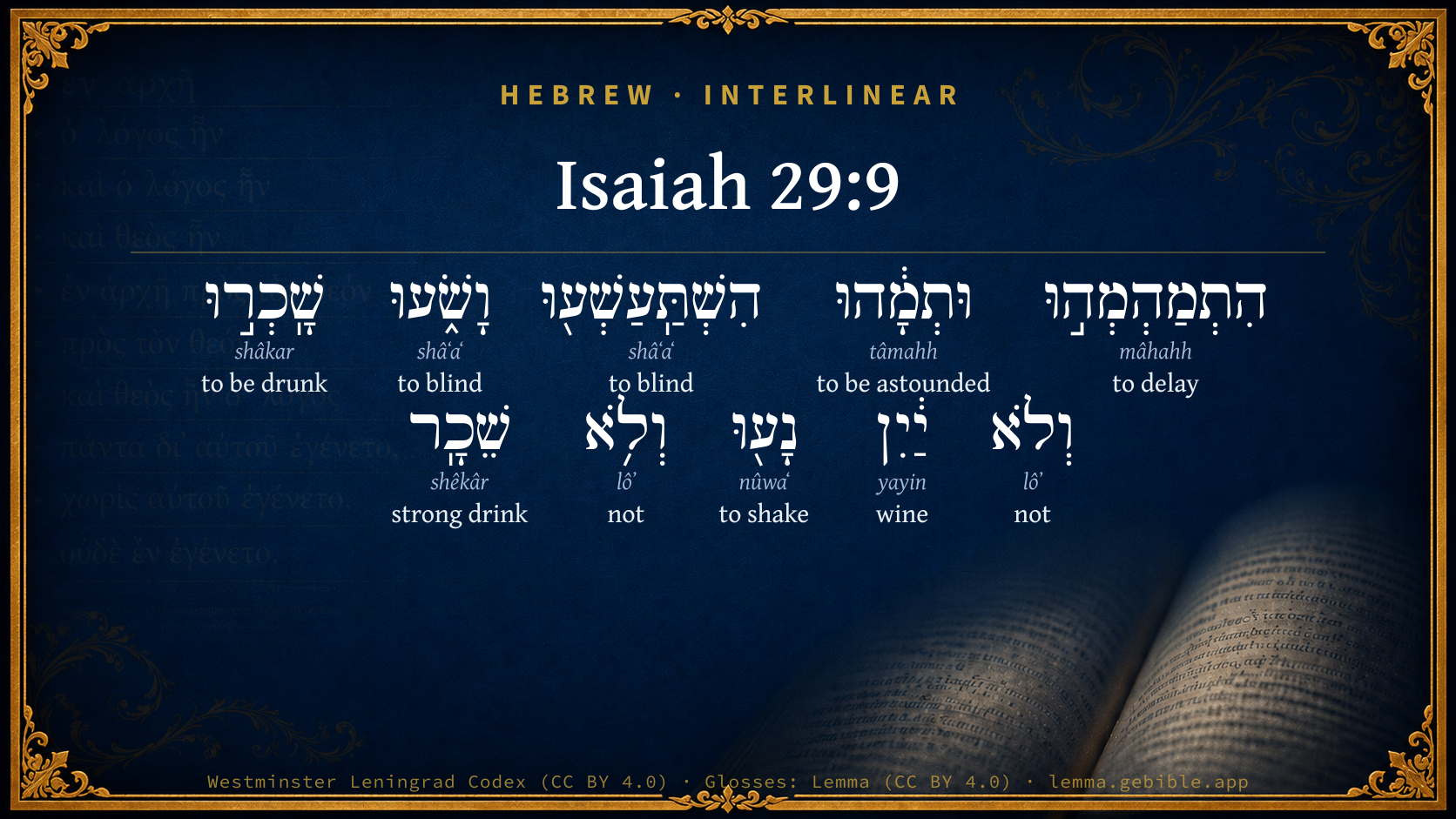
Hebrew (Westminster Leningrad Codex) Isaiah 29:9 appears in the Hebrew Old Testament. The text above is from the Westminster Leningrad Codex. Each word links to its Strong’s number, a concise gloss, and parsing drawn from the Open Scriptures Hebrew Bible morphology. Click any word for its full Brown-Driver-Briggs (BDB) entry.
Download image
Cite this verse

Isaiah 29:9 (World English Bible). Public Domain. Lemma interlinear Bible study tool, https://lemma.gebible.app/v/isaiah/29/9.

Show BibTeX & RIS
BibTeX
RIS
English Translation
Stay you and wonder; take your pleasure and be blind: they are drunken, but not with wine; they stagger, but not with strong drink.
World English Bible · Public Domain
Download a study sheet

One document with this verse’s original text, its word-by-word gloss line, the meaning frame, cross-references with their text, attributed commentary, and full source and license credits — printable, and it pastes into notes with its structure intact.

This verse Autodidact and up

Study sheet (.html) Plain text (.txt)

A passage Seminary Student

Up to 50 verses in one chapter. A passage sheet keeps up to 6 commentary sources and 12 cross-references per verse, in the order this page ranks them, and says so on the sheet whenever that leaves anything out. Ask for a single verse and you get the Autodidact verse sheet above.

Everything on this page stays free to read, with no account — the sheet is a download of what is already on screen, not access to it.

Want to remove ads? Support Godless Engineer
Compare translations 3

The same verse in 3 English versions, stacked beneath the original-language interlinear above. Click any original word for its lexicon entry.

Each is an independent rendering of the whole verse — the interlinear is not word-aligned to these translations.

Highlighted words mark where these versions differ — a whole-verse word diff, not a word-by-word alignment.

  • World English Bible Public Domain
    Stay you and wonder; take your pleasure and be blind: they are drunken, but not with wine; they stagger, but not with strong drink.
  • King James Version Public Domain
    Stay yourselves, and wonder; cry ye out, and cry: they are drunken, but not with wine; they stagger, but not with strong drink.
  • unfoldingWord Literal Text CC BY-SA 4.0
    Make yourselves wait and have amazement; blind yourselves and be blind! They are drunk, but not wine; they stagger, but not beer.

unfoldingWord Literal Text — © unfoldingWord, licensed CC BY-SA 4.0. Word-aligned USFM3 via Door43 (git.door43.org/unfoldingWord/en_ult).

Versions to compare (up to 4)

3 of 4 selected

Show all 18 translations

Every available English version of this verse, each an independent rendering of the whole verse.

  • World English Bible Public Domain
    Stay you and wonder; take your pleasure and be blind: they are drunken, but not with wine; they stagger, but not with strong drink.
  • Berean Standard Bible Public Domain
    Stop and be astonished; blind yourselves and be sightless; be drunk, but not with wine; stagger, but not from strong drink.
  • Majority Standard Bible Public Domain
    Stop and be astonished; blind yourselves and be sightless; be drunk, but not with wine; stagger, but not from strong drink.
  • King James Version Public Domain
    Stay yourselves, and wonder; cry ye out, and cry: they are drunken, but not with wine; they stagger, but not with strong drink.
  • American Standard Version (1901) Public Domain
    Tarry ye and wonder; take your pleasure and be blind: they are drunken, but not with wine; they stagger, but not with strong drink.
  • Revised Version (1885) Public Domain
    Tarry ye and wonder, take your pleasure and be blind: they are drunken, but not with wine; they stagger, but not with strong drink.
  • Geneva Bible (1599) Public Domain
    Stay your selues, and wonder: they are blinde, and make you blinde: they are drunken but not with wine: they stagger, but not by strong drinke.
  • Douay-Rheims (1899) Public Domain
    Be astonished, and wander, waver, and stagger: be drunk, and not with wine: stagger, and not with drunkenness.
  • Young's Literal Translation Public Domain
    Tarry and wonder, look ye, yea, look, Be drunk, and not with wine, Stagger, and not with strong drink.
  • Literal Standard Version CC BY-SA 4.0
    Linger and wonder, look, indeed, look, || Be drunk, and not with wine, || Stagger, and not with strong drink.
  • Unlocked Literal Bible CC BY-SA 4.0
    Astonish yourselves and be astonished; blind yourselves and be blind! Be drunk, but not with wine; stagger, but not with beer.
  • unfoldingWord Literal Text CC BY-SA 4.0
    Make yourselves wait and have amazement; blind yourselves and be blind! They are drunk, but not wine; they stagger, but not beer.
  • Darby Bible Public Domain
    Be astounded and astonished, blind yourselves and be blind! They are drunken, but not with wine; they stagger, but not with strong drink.
  • World Messianic Bible Public Domain
    Pause and wonder! Blind yourselves and be blind! They are drunken, but not with wine; they stagger, but not with strong drink.
  • Webster's Bible Public Domain
    Stay yourselves, and wonder; cry ye out, and cry: they are drunken, but not with wine; they stagger, but not with strong drink.
  • Free Bible Version CC BY-SA 4.0
    Be shocked and amazed! Make yourselves blind so you can't see! Get drunk, but not from wine! Stagger around, but not from beer!
  • Bible in Basic English Public Domain
    Be surprised and full of wonder; let your eyes be covered and be blind: be overcome, but not with wine; go with uncertain steps, but not because of strong drink.
  • JPS Tanakh (1917) Public Domain
    Stupefy yourselves, and be stupid! Blind yourselves, and be blind! ye that are drunken, but not with wine, that stagger, but not with strong drink.

Literal Standard Version (2020), Covenant Press — licensed CC BY-SA 4.0. Text via the HelloAO Bible API (eBible.org). Unlocked Literal Bible (unfoldingWord) — licensed CC BY-SA 4.0. Text via the HelloAO Bible API (eBible.org). unfoldingWord Literal Text — © unfoldingWord, licensed CC BY-SA 4.0. Word-aligned USFM3 via Door43 (git.door43.org/unfoldingWord/en_ult). Free Bible Version, Dr. Jonathan Gallagher — licensed CC BY-SA 4.0. Text via the HelloAO Bible API (eBible.org).

Word by word

More ways to search: Search by grammar → Find every occurrence → Compare this word →

Practice this passage: Drill this verse → Learn its vocabulary →

הִתְמַהְמְה֣וּ
mâhahh
H4102
“delay”
Verb, Hithpalpel, Imperative, 2nd Person, Masculine, Plural
Part of Speech
Verb
Stem
Hithpalpel
Form
Imperative
Person
2nd Person
Gender
Masculine
Number
Plural
Full BDB Definition

Origin: apparently a denominative from H4100

TWOT: 1150

(Hithpalpel) to linger, tarry, wait, delay
  1. וּתְמָ֔הוּ tâmahh H8539 “and · be astounded” Conjunction + Verb, Qal, Imperative, 2nd Person, Masculine, Plural
  2. הִשְׁתַּֽעַשְׁע֖וּ shâʻaʻ H8173 “blind” Verb, Hithpalpel, Imperative, 2nd Person, Masculine, Plural
  3. וָשֹׁ֑עוּ shâʻaʻ H8173 “and · blind” Conjunction + Verb, Qal, Imperative, 2nd Person, Masculine, Plural
  4. שָֽׁכְר֣וּ shâkar H7937 “to be drunk” Verb, Qal, Perfect, 3rd Person, Common, Plural
  5. וְלֹא lôʼ H3808 “and · not” Conjunction + Particle, Negative
  6. יַ֔יִן yayin H3196 “wine” Noun, Common, Masculine, Singular, Absolute
  7. נָע֖וּ nûwaʻ H5128 “to shake” Verb, Qal, Perfect, 3rd Person, Common, Plural
  8. וְלֹ֥א lôʼ H3808 “and · not” Conjunction + Particle, Negative
  9. שֵׁכָֽר shêkâr H7941 “strong drink” Noun, Common, Masculine, Singular, Absolute

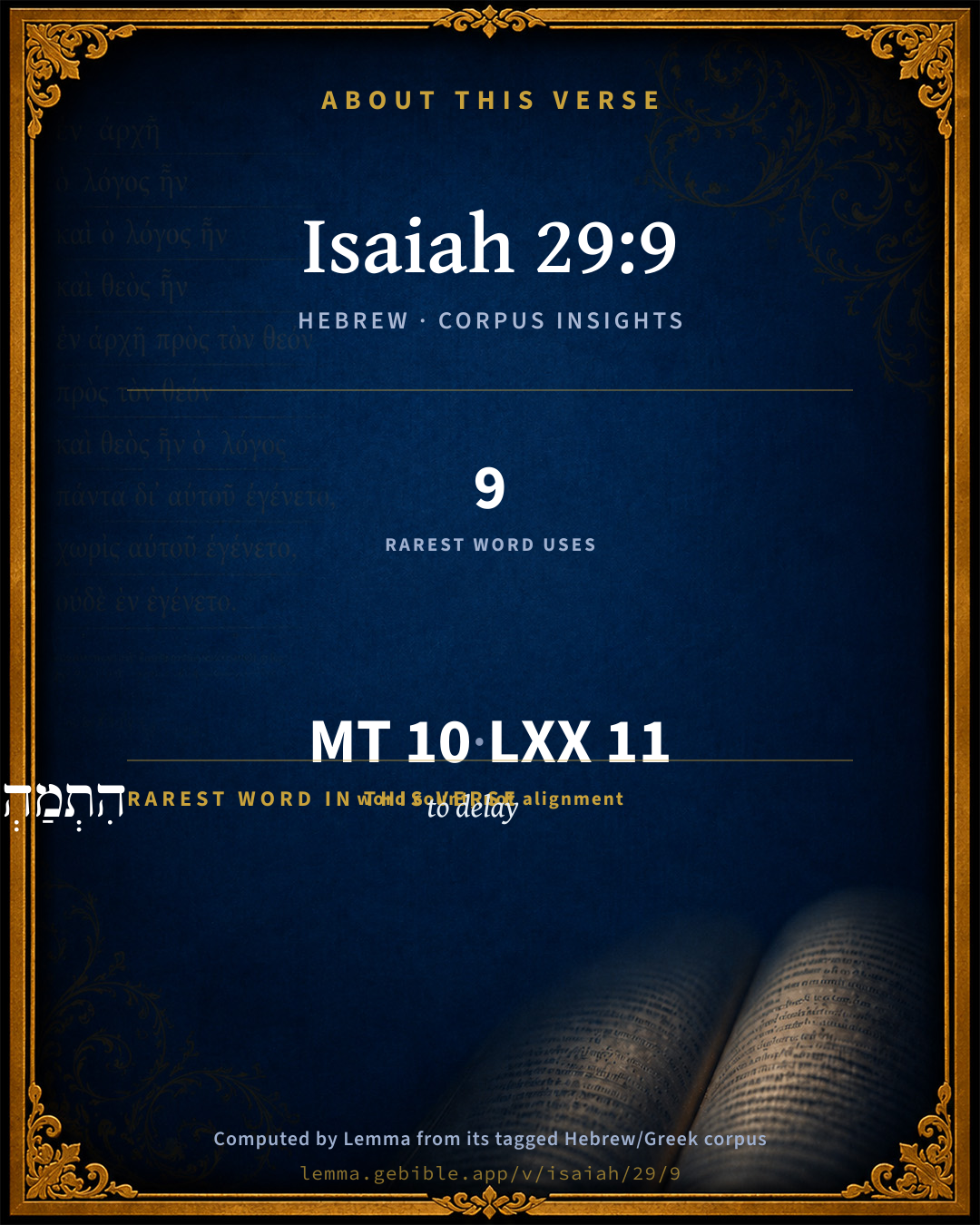
About this verse

These counts appear in no published source. They are computed here, from the morphology-tagged text and Lemma’s own curated glosses. What Lemma adds →

10
words
8
distinct lemmas
Prophets
section

Notable vocabulary

The rarest word here is הִתְמַהְמְה֣וּ to delay H4102 — appearing just 9 times in the whole Hebrew Bible.

Shared distinctive vocabulary

הִתְמַהְמְה֣וּ to delay H4102 occurs in 9 verses of the Hebrew Bible. Also found in:

Grammatical profile

  • 6 verbs
  • 2 nouns
  • 2 particles

Verb forms

  • הִתְמַהְמְה֣וּ Hithpalpel · Imperative
  • וּתְמָ֔הוּ Qal · Imperative
  • הִשְׁתַּֽעַשְׁע֖וּ Hithpalpel · Imperative
  • וָשֹׁ֑עוּ Qal · Imperative
  • שָֽׁכְר֣וּ Qal · Perfect
  • נָע֖וּ Qal · Perfect

Repetition

Words recur within this verse — often emphatic in Hebrew:

  • הִשְׁתַּֽעַשְׁע֖וּ to blind H8173 ×2
  • וְלֹא not H3808 ×2

Hebrew & Septuagint length

In English translation the verse runs 24 words from the Hebrew and 15 from the Septuagint (LXX English) — the Septuagint runs noticeably shorter here. See the side-by-side →

A rough comparison of the two English renderings, which tokenize alike — not a word-level alignment.

Word counts can differ between the Hebrew and the Greek without any difference in meaning — e.g. the Hebrew direct-object marker אֵת has no separate Greek word, and Greek often adds the article ὁ.

In the original languages it is 10 Hebrew tokens and 11 Greek tokens — but the two are counted differently (Hebrew bundles its prefixes and suffixes into one token; the Greek is in lemma form), so that isn’t a like-for-like length.

Cross-references

19

Topical passages linked to Isaiah 29:9 in the Treasury of Scripture Knowledge — connected by theme and wording, ordered by reader-vote popularity; previews shown in the World English Bible.

  • Isaiah 51:21–22 Therefore hear now this, you afflicted, and drunken, but now with wine:
  • Isaiah 19:14 Yahweh has mixed a spirit of perverseness in the midst of her; and they have caused Egypt to go astray in every work of it, as a drunken man staggers in his vomit.
  • Isaiah 33:13–14 Hear, you who are far off, what I have done; and, you who are near, acknowledge my might.
  • Isaiah 49:26 I will feed those who oppress you with their own flesh; and they shall be drunken with their own blood, as with sweet wine: and all flesh shall know that I, Yahweh, am your Savior, and your Redeemer, the Mighty One of Jacob.
  • Revelation 17:6 I saw the woman drunken with the blood of the saints, and with the blood of the martyrs of Jesus. When I saw her, I wondered with great amazement.
  • Isaiah 1:2 Hear, heavens, And listen, earth; for Yahweh has spoken: I have nourished and brought up children, And they have rebelled against me.
  • Isaiah 22:12–13 In that day did the Lord, Yahweh of Hosts, call to weeping, and to mourning, and to baldness, and to girding with sackcloth:
  • Isaiah 28:7–8 Even these reel with wine, and stagger with strong drink; the priest and the prophet reel with strong drink, they are swallowed up of wine, they stagger with strong drink; they err in vision, they stumble in judgment.
  • Isaiah 29:10 For Yahweh has poured out on you the spirit of deep sleep, and has closed your eyes, the prophets; and your heads, the seers, has he covered.
  • Isaiah 51:17 Awake, awake, stand up, Jerusalem, that have drunk at the hand of Yahweh the cup of his wrath; you have drunken the bowl of the cup of staggering, and drained it.
  • Jeremiah 2:12 Be astonished, you heavens, at this, and be horribly afraid, be you very desolate, says Yahweh.
  • Jeremiah 23:9 Concerning the prophets. My heart within me is broken, all my bones shake; I am like a drunken man, and like a man whom wine has overcome, because of Yahweh, and because of his holy words.
  • Jeremiah 25:27 You shall tell them, Thus says Yahweh of Hosts, the God of Israel: Drink you, and be drunken, and spew, and fall, and rise no more, because of the sword which I will send among you.
  • Jeremiah 51:7 Babylon has been a golden cup in Yahweh's hand, who made all the earth drunken: the nations have drunk of her wine; therefore the nations are mad.
  • Lamentations 4:21 Rejoice and be glad, daughter of Edom, that dwell in the land of Uz: The cup shall pass through to you also; you shall be drunken, and shall make yourself naked.
  • Habakkuk 1:5 "Look among the nations, watch, and wonder marvelously; for I am working a work in your days, which you will not believe though it is told you.
  • Matthew 26:45 Then he came to his disciples, and said to them, "Sleep on now, and take your rest. Behold, the hour is at hand, and the Son of Man is betrayed into the hands of sinners.
  • Mark 14:41 He came the third time, and said to them, "Sleep on now, and take your rest. It is enough. The hour has come. Behold, the Son of Man is betrayed into the hands of sinners.
  • Acts 13:40–41 Beware therefore, lest that come on you which is spoken in the prophets:

Cross-references courtesy of OpenBible.info (CC BY 4.0).

Hebrew and Greek witnesses Masoretic Hebrew ↔ Greek Septuagint

The same verse in the two great witnesses to the Old Testament, shown verse-for-verse.

Here the Septuagint runs noticeably shorter than the Hebrew — LXX2012 (modern English Septuagint) 15 words vs World English Bible 24. A rough length comparison of the two English translations, not a word-level alignment — read both below.

These are two independent witnesses, not word-aligned to each other, and the Septuagint is shown in lemma (dictionary) form.

Hebrew Isaiah 29:9 Masoretic · Westminster Leningrad Codex

הִתְמַהְמְה֣וּ וּתְמָ֔הוּ הִשְׁתַּֽעַשְׁע֖וּ וָשֹׁ֑עוּ שָֽׁכְר֣וּ וְלֹא יַ֔יִן נָע֖וּ וְלֹ֥א שֵׁכָֽר

Stay you and wonder; take your pleasure and be blind: they are drunken, but not with wine; they stagger, but not with strong drink.

World English Bible · Public Domain

Greek LXX Isaiah 29:9 Septuagint · lemma form

ἐκλύω καί ἐκἵστημι καί κραιπαλάω οὐ ἀπό σίκερα οὐδέ ἀπό οἶνος

Faint you⌃, and be amazed, and be overpowered, not with strong drink nor with wine.

LXX2012 (modern English Septuagint) · Public Domain

On this verse, The Cambridge Bible for Schools and Colleges discusses the Septuagint’s reading. Read the note in Commentary ↓

Hebrew: Westminster Leningrad Codex (CC BY 4.0). Greek: Septuagint (public domain); English from LXX2012 (modern English Septuagint) (Public Domain). How the Septuagint differs from the Hebrew →

Targum (Aramaic paraphrase)

1

The Targum is the ancient Jewish Aramaic paraphrase of the Hebrew Scriptures — an interpretive translation, not the Hebrew text itself. Onkelos (literal) and Pseudo-Jonathan (expansive) render the Torah, and Jonathan the Prophets. Coverage is partial: where no permissively-licensed English translation exists for a verse, only the Aramaic is shown. This is verse-level text, not a word-by-word alignment to the Hebrew.

  1. Targum Jonathan Prophets (Joshua–Malachi)
    אִתְרְפוּ וּשְׁחוֹ אִשְׁתְּגִישׁוּ אִיזְדַמִימוּ וְאִשְׁתְּמָמוּ רְווֹ וְלָא מִן חֲמַר טְעוֹ וְלָא מִן עַתִּיק:

    Be astounded, wonder, be ye terrified, and muse, and marvel. They are drunk, but not with wine; they stagger, but not with old wine.

    Targum Jonathan — Aramaic: “Mikraot Gedolot” (public domain). English: “Sefaria Community Translation” (CC0 1.0 (public-domain dedication)); “London "Chaldee Paraphrase," 1871” (public domain). Text via Sefaria.

Commentary

Notes on Isaiah 29:9 from classic Christian and Jewish commentators (each source and its license shown beneath its notes). The classic Christian expositions comment on the surrounding passage and are grouped to its opening verse, so a note may address several verses; the Jewish commentaries on the Tanakh (Rashi and others) are per-verse, so they appear only where the commentator wrote on this verse.

Lemma curates 59 commentaries, every one of them public domain or Creative Commons licensed, each selected and text-cleaned for this edition rather than reprinted as found. About our sources →

Matthew Henry's Commentary

Here, I. The prophet stands amazed at the stupidity of the greatest part of the Jewish nation. They had Levites, who taught the good knowledge of the Lord and had encouragement from Hezekiah in doing so, Ch2 30:22. They had prophets, who brought them messages immediately from God, and signified to them what were the causes and what would be the effects of God's displeasure against them. Now, one would think, surely this great nation, that has all the advantages of divine revelation, is a wise and understanding people, Deu 4:6. But, alas! it was quite otherwise, Isa 29:9. The prophet addresses himself to the sober thinking part of them, calling upon them to be affected with the general carelessness of their neighbours. It may be read, "They delay, they put off, their repentance, but wonder you that they should be so sottish. They sport themselves with their own deceivings; they riot and revel; but do you cry out, lament their folly, cry to God by prayer for them. The more insensible they are of the hand of God gone out against them the more do you lay to heart these things." Note, The security of sinners in their sinful way is just matter of lamentation and wonder to all serious people, who should think themselves concerned to pray for those that do not pray for themselves. But what is the matter? What are we thus to wonder at? 1. We may well wonder that the generality of the people should be so sottish and brutish, and so infatuated, as if they were intoxicated: They are drunken, but not with wine (not with wine only, though with that they were often drunk), and they erred through wine, Isa 28:7. They were drunk with the love of pleasures, with prejudices against religion, and with the corrupt principles they had imbibed. Like drunken men, they know not what they do or say, nor whither they go. They are not sensible of the divine rebukes they are under. They have beaten me, and I felt it not, says the drunkard, Pro 23:35. God speaks to them once, yea, twice; but, like men drunk, they perceive it not, they understand it not, but forget the law. They stagger in their counsels, are unstable and unsteady, and stumble at every thing that lies in their way. There is such a thing as spiritual drunkenness. 2. It is yet more strange that God himself should have poured out upon them a spirit of deep sleep, and closed their eyes (Isa 29:10), that he who bids them awake and open their eyes should yet lay them to sleep and shut their eyes; but it is in a way of righteous judgment, to punish them for their loving darkness rather than light, their loving sleep. When God by his prophets called them they said, Yet a little sleep, a little slumber; and therefore he gave them up to strong delusions, and said, Sleep on now. This is applied to the unbelieving Jews, who rejected the gospel of Christ, and were justly hardened in their infidelity, till wrath came upon them to the uttermost. Rom 11:8, God has given them the spirit of slumber. And we have reason to fear it is the woeful case of many who live in the midst of gospel light. 3. It is very sad that this should be the case with those who were their prophets, and rulers, and seers, that those who should have been their guides were themselves blindfolded; and it is easy to tell what the fatal consequences will be when the blind lead the blind. This was fulfilled when, in the latter days of the Jewish church, the chief priests, and the scribes, and the elders of the people, were the great opposers of Christ and his gospel, and brought themselves under a judicial infatuation. 4. The sad effect of this was that all the means of conviction, knowledge, and grace, which they enjoyed, were ineffectual, and did not answer the end (Isa 29:11, Isa 29:12): "The vision of all the prophets, true and false, has become to you as the words of a book, or letter, that is sealed up; you cannot discern the truth of the real visions and the falsehood of the pretended ones." Or, every vision particularly that this prophet had seen for them, and published to them, had become unintelligible; they had it among them, but were never the wiser for it, any more than a man (though a good scholar) is for a book delivered to him sealed up, and which he must not open the seals of. He sees it is a book, and that is all; he knows nothing of what is in it. So they knew that what Isaiah said was a vision and prophecy, but the meaning of it was hidden from them; it was only a sound of words to them, which they were not at all alarmed by, nor affected with; it answered not the intention, for it made no impression at all upon them. Neither the learned nor the unlearned were the better for all the messages God sent them by his servants the prophets, nor desired to be so. The ordinary sort of people excused themselves from regarding what the prophets said with their want of learning and a liberal education, as if they were not concerned to know and do the will of God because they were not bred scholars: It is nothing to me, I am not learned. Those of better rank pretended that the prophet had a peculiar way of speaking, which was obscure to them, and which, though they were men of letters, they had not been used to; and, Si non vis intelligi, debes negligi - If you wish not to be understood, you deserve to be neglected. Both these are groundless pretences; for God's prophets have been no unfaithful debtors either to the wise or to the unwise, Rom 1:14. Or we may take it thus: - The book of prophecy was given to them sealed, so that they could not read it, as a just judgment upon them; because it had often been delivered to them unsealed, and they would not take pains to learn the language of it, and then made excuse for their not reading it because they were not learned. But observe, "The vision has become thus to you whose minds the god of this world has blinded; but it is not so in itself, it is not so to all; the same vision which to you is a savour of death unto death to others is and shall be a savour of life unto life." Knowledge is easy to him that understands.

II. The prophet, in God's name, threatens those that were formal and hypocritical in their exercises of devotion, Isa 29:13, Isa 29:14. Observe here,

1. The sin that is here charged upon them - dissembling with God in their religious performances, Isa 29:13. He that knows the heart, and cannot be imposed upon with shows and pretences, charges it upon them, whether their hearts condemn them for it or no. He that is greater than the heart, and knows all things, knows that though they draw nigh to him with their mouth, and honour him with their lips, yet they are not sincere worshippers. To worship God is to make our approaches to him, and to present our adorations of him; it is to draw nigh to him as those that have business with him, with an intention therein to honour him. This we are to do with our mouth and our lips, in speaking of him and in speaking to him; we must render to him the calves of our lips, Hos 14:2. And, if the heart be full of his love and fear, out of the abundance of that the mouth will speak. But there are many whose religion is lip-labour only. They say that which expresses an approach to God and an adoration of him, but it is only from the teeth outward. For, (1.) They do not apply their minds to the service. When they pretend to be speaking to God they are thinking of a thousand impertinences: The have removed their hearts far from me, that they might not be employed in prayer, nor come within reach of the word. When work was to be done for God, which required the heart, that was sent out of the way on purpose, with the fool's eyes, into the ends of the earth. (2.) They do not make the word of God the rule of their worship, nor his will their reason: Their fear towards me is taught by the precept of men. They worshipped the God of Israel, not according to his appointment, but their own inventions, the directions of their false prophets or their idolatrous kings, or the usages of the nations that were round about them. The tradition of the elders was of more value and validity with them than the laws which God commanded Moses. Or, if they did worship God in a way conformable to his institution in the days of Hezekiah, a great reformer, they had more an eye to the precept of the king than to God's command. This our Saviour applies to the Jews in his time, who were formal in their devotions and wedded to their own inventions, and pronounces concerning them that in vain they did worship God, Mat 15:8, Mat 15:9.

2. It is a spiritual judgment with which God threatens to punish them for their spiritual wickedness (Isa 29:14): I will proceed to do a marvellous work. They did one strange thing; they removed all sincerity from their hearts. Now God will go on and do another; he will remove all sagacity from their heads. The wisdom of their wise men shall perish. They played the hypocrite, and thought to put a cheat upon God, and now they are left to themselves to play the fool, and not only to put a cheat upon themselves, but to be easily cheated by all about them. Those that make religion no more than a pretence, to serve a turn, are out in their politics; and it is just with God to deprive those of their understanding who part with their uprightness. This was fulfilled in the wretched infatuation which the Jewish nation were manifestly under, after they had rejected the gospel of Christ; they removed their hearts far from God, and therefore God justly removed wisdom far from them, and hid from their eyes the things that belonged even to their temporal peace. This is a marvelous work; it is surprising, it is astonishing, that wise men should of a sudden lose their wisdom and be given up to strong delusions. Judgments on the mind, though least taken notice of, are to be most wondered at.

III. He shows the folly of those that though to act separately and secretly from God, and were carrying on designs independent upon God and which they projected to conceal from his all-seeing eye. Here we have, 1. Their politics described (Isa 29:15): They seek deep to hide their counsel from the Lord, that he may not know either what they do or what they design; they say, "Who sees us? No man, and therefore not God himself." The consultations they had about their own safety they kept to themselves, and never asked God's advice concerning them; nay, they knew they were displeasing to him, but thought they could conceal them from him; and, if he did not know them, he could not baffle and defeat them. See what foolish fruitless pains sinners take in their sinful ways; they seek deep, they sink deep, to hide their counsel from the Lord, who sits in heaven and laughs at them. Note, A practical disbelief of God's omniscience is at the bottom both of the carnal worships and of the carnal confidences of hypocrites; Psa 94:7; Eze 8:12; Eze 9:9. 2. The absurdity of their politics demonstrated (Isa 29:16): "Surely your turning of things upside down thus, your various projects, turning your affairs this and that way to make them shape as you would have them - or rather your inverting the order of things, and thinking to make God's providence give attendance to your projects, and that God must know no more than you think fit, which is perfectly turning things upside down and beginning at the wrong end - shall be esteemed as the potter's clay. God will turn and manage you, and all your counsels, with as much ease and as absolute a power as the potter forms and fashions his clay." See how God despises, and therefore what little reason we have to dread, those contrivances of men that are carried on without God, particularly those against him. (1.) Those that think to hide their counsels from God do in effect deny him to be their Creator. It is as if the work should say of him that made it, "He made me not; I made myself." If God made us, he certainly knows us as the Psalmist shows, (Psa 139:1, Psa 139:13-16); so that those who say that he does not see them might as well say that he did not make them. Much of the wickedness of the wicked arises from this, they forget that God formed them, Deu 32:18. Or, (2.) Which comes to the same thing, they deny him to be a wise Creator: The thing framed saith of him that framed it, He had no understanding; for if he had understanding to make us so curiously, especially to make us intelligent beings and to put understanding into the inward part (Job 38:36), no doubt he has understanding to know us and all we say and do. As those that quarrel with God, so those that think to conceal themselves from him, do in effect charge him with folly; but he that formed the eye, shall he not see? Psa 94:9.

Matthew Henry's Commentary on the Whole Bible (1708–1710) — public domain (CC PDM 1.0). Text via the HelloAO Bible API.

Trapp's Complete Commentary

John Trapp

Isa 29:9 Stay yourselves, and wonder; cry ye out, and cry: they are drunken, but not with wine; they stagger, but not with strong drink.

Ver. 9. Stay yourselves, and wonder.] Sistite gradum, stand still, and stand amazed at this people’s stupendous stupidity and desperate security. Piscator rendereth the text thus: Cunctantur, itaque admiramini; deliciantur, itaque vociferamini. They delay (to return), therefore wonder ye at it; they sport at it, but cry ye out, as lamenting their folly. {Eze 9:4, where the original is very elegant} Some translate the words thus: Obstupefacite vos ipsi, et sitis stupidi, et excaecate vos ipsi et sitis caeci, stupify yourselves and be stupid; blind yourselves and be blind; do so, I say, for you will do so undoubtedly. And here begin their spiritual miseries. See Isa 29:1; Isa 6:9-10.

They are drunk, but not with wine.] But yet with that which is much worse, viz., with a spirit of stupidity; {Isa 29:10} they are not only drunk with a dry drunkenness, but deadly sick of a lethargy, being dulled in their understandings, lulled asleep in their sinful practices, ready to fly in the face of one that shall offer to awake them. Other drunkenness a man may sleep out, sleep himself sober, as Noah did; not so here, as Nazianzen {a} well observeth upon this text.

{a} Homil. de plaga grandinis.

John Trapp, A Commentary or Exposition upon All the Books of the Old and New Testament (1647–1656) — public domain. Text from a community e-Sword module.

The Biblical Illustrator

Joseph S. Exell

Isa_29:9-12

Stay yourselves, and wonder, they are drunken, but not with wine

Spiritual drunkenness

By spiritual drunkenness (Isa_29:9) we are probably to understand unsteadiness of conduct and a want of spiritual discernment.

(J. A. Alexander.)

Spiritual drunkenness worse than bodily, and more prevalent

Drunkenness in itself is a horrible vice, and it is the mother of innumerable more. But besides this there is a spiritual drunkenness.

I. This worse drunkenness, says the text, is SPIRITUAL BLINDNESS, SPIRITUAL INSENSIBILITY, OR INSANITY. In this respect it resembles the other drunkenness. The man who is drunk has eyes, but he cannot see; ears, but he cannot hear; a heart that has not ceased to beat, but he cannot understand. He mistakes one person and thing fur another. So it is with the spiritual sort in regard to the spiritual world. Look at a few of the varieties. Drunkenness--

1. From ignorance of the truth.

2. From perversion or profanation of the truth.

3. From rejection of the truth.

II. WHAT IS THE QUALITY OR CURSE OF THIS SPIRITUAL DRUNKENNESS, compared with the other? Compare it--

1. In regard to the drunkards intelligence or powers of perception.

2. In regard to the drunkards life, affections, passions, habits.

3. In regard to the drunkards state before God, the salvation of soul and body. What shall we say, if we discover the terrific truth?

(1) That the spiritual is more besotting and blinding to the spirit.

(2) That it is more maddening and brutalising to the drunkards life. What crime will the drunkard not perpetrate? But what is the life of the spiritual drunkard who goes on in his wickedness? One lifelong defiance of God.

(3) That it is a drunkenness still more infernal, more devilish, and more deadly to both soul and body. (R. Paisley.)

Judicial blindness

The Jews are represented as given over by God to a judicial blindness. Now, we regard it as a fixed principle in the interpretation of Scripture that God never does more than leave men to themselves; doing nothing directly to harden them in wickedness, or to place them out of the reach of forgiveness. (H. Melvill, B. D.)

Drunken, but not with wine

Are there, then, other forms of insobriety and resultant demoralisation distinct from that of the familiar cup? The phrases which suggest this abnormal state are continually in our mouths. Thus, we speak of people being intoxicated with delight, with fanaticism, with political excitement, or with the spirit of gambling. Wendell Holmes speaks of people who become intoxicated with music, with poetry, with love, with religious enthusiasm. He remarks how convalescents are sometimes made tipsy by a beef steak. It is said of one that he was too intoxicated with certain good news to be able to imbibe anything else. Indeed, it is told of certain company that it was so intoxicating that some of the circle were compelled to drink to keep themselves sober. (J. J.Ingram.)

Intoxication

What are the main characteristics of intoxication? The drunken man is one who has lost his power of self-control, one to whose eye and thought the proportions and relationships of life have become disordered, one whose vigour, both physically and mentally, has become enfeebled and inefficient. He is a man who for the time being loses his true relation to the things of outer life. He is abnormal. His appetites are deranged, his engrossments disproportionate, his views beclouded or oblique. (J. J. Ingram.)

For the Lord hath poured out upon you the spirit of deep sleep

The spirit of a deep sleep

The Lord hath poured out, etc. That is an appalling judgment. What have been the steps which have led up to so terrible a consummation? Men do not lose their moral sensitiveness by a stroke; it is the ultimate issue of a process. Drowsiness precedes sleep; the twilight ushers in the night. We do not reach moral abysses by a precipice; we reach them by a gradient. We do not drop into bondage; we walk into it.

1. Here are the men of my text; what was the first step in the degradation? We have it clearly indicated in the thirteenth verse. If we take the thirteenth verse, and place it before Isa_29:9, we have unfolded before us the process of degeneracy, which is re-enacted in multitudes of lives in every succeeding age. The first step towards moral benumbment is the evisceration of religious worship. Take the heart out of worship, and you will take the life out of morals. And their fear of Me is a commandment of men which has been taught them. What does that mean? The man-made has supplanted the God-born. And what does that further mean but the intrusion of the casuist into religion? The casuist is he who turns a shining principle into a dull maxim, who makes breaches and loopholes of escape in the great moral law, who changes the searching inwardness of religion into an easy external ordinance, who removes the fearful sense of the eternal, and makes us feel perilously at home in the small demands of his own commandments.

2. Now let us mark the progress of the degeneracy. Religious formalism issues in moral laxity. Note the analysis of the process which is given in the ninth verse. First there is dimness of moral vision. Tarry ye and wonder. The figure is that of a man who pulls himself up in bewilderment. He does not remember quite clearly whether this is the way, or whether he should take the next turning. Moral law does not stand out in clear bold relief. His conscience does not act readily. There is hesitancy. He tarries! There is confusion He wonders! Take your pleasure and be blind. With dimness there comes wilfulness. The little truth they saw they resented. The people liked the restfulness of the dulness. There was nothing searching or self-revealing in the adulterated light. They preferred the twilight in which they can partially hide. Let us go on with the analysis. Moral dimness; moral wilfulness; what is the next step in the degeneracy? Moral stupor. They are drunk, but not with wine. They stagger, but not with strong drink.

3. Now let us proceed to the third step in the appalling gradient. When a man has eviscerated his religion, changing its inwardness to a thin superficialness, and from this proceeds to moral laxity, I am told by the words of my text that by a judicial act of God his stupor becomes fixed. If a man will not, he shall not! Ye have taken the cup of wilfulness, and drugged yourselves into sin, and the Lord hath poured out upon you the spirit of deep sleep.

4. What is the next step in the awful gradient? And all vision is become to you as a book that is sealed. The great writings of the great books have no illuminating message. The books are sealed! What books? There is the book of conscience. Thine ears shall hear a word behind thee, saying, This is the way, walk ye in it. That book is sealed. There is the book of experience, the teachings of yesterday, the witness of history. Ask now of the days that are past. That book is sealed. There is the book of nature. The book of nature began to be read by William Wordsworth when the atmosphere of English life had been warmed by the evangelical revival. When the evangelical is dead natures inner significance is concealed. Let us therefore watch, with intensest vigilance, against the intrusion of all insincerity into our worship. (J. H. Jowett, M. A.)

The Biblical Illustrator, edited by Joseph S. Exell (c. 1880s–1900s) — public domain. Text from a community e-Sword module.

Joseph Benson's Commentary

Isa 29:9-10. Stay yourselves and wonder — The prophet, having described the temporal judgment coming on the Jews, (see the contents of the chapter,) proceeds now to predict the spiritual one, the first gradation of which is contained in these and the two following verses, which both describe the judgment and the consequence of it. It is the same with that predicted Isa 6:9-12; and Isa 8:14-15. On which see the notes. Hebrew, התמהמהו ותמהו, Pause and be astonished. Stop and consider the stupidity of this people, and you cannot but wonder at it. Cry ye out, and cry — Through amazement and horror. They are drunken, but not with wine — But with stupidity and folly, which makes them, like drunken men, insensible of their danger, and not knowing what to do. For the Lord hath poured out upon you — Hath suffered to come upon you, in a way of righteous judgment, and as a punishment for your loving, darkness rather than light; the spirit of deep sleep — Hardness of heart, and insensibility of your danger and misery. The prophets and your rulers — Your magistrates and ministers, whose blindness and stupidity are a great curse to the people; hath he covered — Permitted to be covered with the veil of ignorance and stupidity; that is, he hath withdrawn his abused light and grace from them, so that they no more see things in a true light than if a thick veil were spread over them. The prophets and seers here mean the same persons.

Joseph Benson's Commentary on the Old and New Testaments (1811–1818) — public domain. Text from a community e-Sword module.

Keil & Delitzsch

C. F. Keil & F. Delitzsch

This enigma of the future the prophet holds out before the eyes of his contemporaries. The prophet received it by revelation of Jehovah; and without the illumination of Jehovah it could not possibly be understood. The deep degradation of Ariel, the wonderful deliverance, the sudden elevation from the abyss to this lofty height - all this was a matter of faith. But this faith was just what the nation wanted, and therefore the understanding depending upon it was wanting also. The shemu‛âh was there, but the bı̄nâh was absent; and all שׁמועה הבין was wrecked on the obtuseness of the mass. The prophet, therefore, who had received the unhappy calling to harden his people, could not help exclaiming (Isa 29:9), "Stop, and stare; blind yourselves, and grow blind!" התמהמהּ, to show one's self delaying (from מההּ, according to Luzzatto the reflective of תּמהמהּ, an emphatic form which is never met with), is connected with the synonymous verb תּמהּ, to be stiff with astonishment; but to שׁעע, to be plastered up, i.e., incapable of seeing (cf., Isa 6:10), there is attached the hithpalpel of the same verb, signifying "to place one's self in such circumstances," se oblinere (differently, however, in Psa 119:16, Psa 119:47, compare Isa 11:8, se permulcere). They could not understand the word of God, but they were confused, and their eyes were, so to speak, festered up: therefore this self-induced condition would become to them a God-appointed punishment. The imperatives are judicial words of command.

This growth of the self-hardening into a judicial sentence of obduracy, is proclaimed still more fully by the prophet. "They are drunken, and not with wine; they reel, and not with meth. For Jehovah hath poured upon you a spirit of deep sleep, and bound up your eyes; the prophets and your heads, the seers, He has veiled. And the revelation of all this will be to you like words of a sealed writing, which they give to him who understands writing, saying, Pray, read this; but he says, I cannot, it is sealed. And they give the writing to one who does not understand writing, saying, Pray, read this; but he says, I do not understand writing." They were drunken and stupid; not, however, merely because they gave themselves up to sensual intoxication (יין, dependent upon שׁכרוּ, ebrii vino), but because Jehovah had given them up to spiritual confusion and self-destruction. All the punishments of God are inflicted through the medium of His no less world-destroying than world-sustaining Spirit, which, although not willing what is evil, does make the evil called into existence by the creature the means of punishing evil. Tardēmâh is used here to signify the powerless, passive state of utter spiritual insensibility. This judgment had fallen upon the nation in all its members, even upon the eyes and heads of the nation, i.e., the prophets. Even they whose duty is was to see to the good of the nation, and lead it, were blind leaders of the blind; their eyes were fast shut (עצּם, the intensive form of the kal, Isa 33:15; Aram. עצּם; Talmud also עמּץ: to shut the eyes, or press them close), and over their heads a cover was drawn, as over sleepers in the night. Since the time of Koppe and Eichhorn it has become a usual thing to regard את־הנּביאים and החזים as a gloss, and indeed as a false one (compare Isa 9:13-14); but the reason assigned - namely, that Isaiah's polemics are directed not against the prophets, but against the stupid staring people - is utterly groundless (compare Isa 28:7, and the polemics of his contemporary Micah, e.g., Isa 3:5-8). Moreover, the author of a gloss would have been more likely to interpret ראשׁיכם by השּׂרים or הכּהנים (compare Job 9:24). And Isa 29:11, Isa 29:12 are also opposed to this assumption of a gloss. For by those who understood what was written (sēpher), it is evident that the prophets and rulers of the nation are intended; and by those who did not understand it, the great mass of the people. To both of them, "the vision of all," i.e., of all and everything that God had shown to His true prophets, was by the judgment of God completely sealed. Some of them might have an outward knowledge; but the inward understanding of the revelation was sealed to them. Some had not even this, but stared at the word of the prophet, just as a man who cannot read stares at what is written. The chethib has הסּפר; the keri ספר, though without any ground, since the article is merely generic. Instead of נא־זה קרא, we should write זה קרא־נא in both cases, as certain codices and old editions do.

Keil & Delitzsch — Biblical Commentary on the Old Testament (1861–1891) — public domain (CC PDM 1.0). Text via the HelloAO Bible API. (Old Testament only.)

Geneva Bible (1599)

Geneva Bible translators

Muse hereon as long as ye list, yet shall ye find nothing but occasion to be astonied: for your Prophets are blind, and therefore cannot direct you.

Geneva Bible (1599) marginal notes — public domain. Text via Bolls.life.

Jamieson, Fausset & Brown

Robert Jamieson, A. R. Fausset & David Brown

Stay--rather, "Be astounded"; expressing the stupid and amazed incredulity with which the Jews received Isaiah's announcement.

wonder--The second imperative, as often (Isa 8:9), is a threat; the first is a simple declaration of a fact, "Be astounded, since you choose to be so, at the prophecy, soon you will be amazed at the sight of the actual event" [MAURER].

cry . . . out . . . cry--rather, "Be ye blinded (since you choose to be so, though the light shines all round you), and soon ye shall be blinded" in good earnest to your sorrow [MAURER], (Isa 6:9-10).

not with wine--but with spiritual paralysis (Isa 51:17, Isa 51:21).

ye . . . they--The change from speaking to, to speaking of them, intimates that the prophet turns away from them to a greater distance, because of their stupid unbelief.

Jamieson, Fausset & Brown — Commentary Critical and Explanatory on the Whole Bible (1871) — public domain (CC PDM 1.0). Text via the HelloAO Bible API.

Adam Clarke's Commentary

Verse 9. Stay yourselves, and wonder] התמהמהו hithmahmehu, go on what-what-whatting, in a state of mental indetermination, till the overflowing scourge take you away. See Clarke on Ps 119:60.

They are drunken, but not with wine] See Clarke on Isa 51:21.

Adam Clarke's Commentary on the Bible (1810–1826) — public domain. Text from a community e-Sword/MySword module.

Ellicott's Commentary for English Readers

(9) Stay yourselves . . .—Better, Astonish yourselves. We can perhaps best understand the words by picturing to ourselves the prophet as preaching or reciting the previous prediction to his disciples and to the people. They are staggered, startled, incredulous, and he bursts into words of vehement reproof. The form of the verb implies that their astonished unbelief was self-caused. The change from the second person to the third implies that the prophet paused for a moment in his address to describe their state as an observer. Outwardly, they were as men too drunk to understand, but their drunkenness was not that of the “wine” or the “strong drink” of the fermented palm-juice, in which, as in Isa_28:7, the prophet implies that they habitually indulged. Now their drunkenness was of another type.

A Bible Commentary for English Readers, edited by Charles John Ellicott (1878–1897) — public domain. Text from a community e-Sword module.

The Cambridge Bible for Schools and Colleges

gen. ed. J. J. S. Perowne

9. Stay yourselves, and wonder] Rather (as R.V. marg.), Be ye amazed and wonder. The first verb is of uncertain derivation. Probably both express the idea of astonishment. Cheyne (Comm.) rendered: “astonish yourselves and be astonished.”

cry ye out, and cry] Render: Blind yourselves and be blind. The root of both verbs is that used in ch. Isa_6:10 of “smearing” the eyes: the doom then threatened is now being fulfilled.

they are drunken … they stagger] These perfects should probably be pointed and translated as imperatives; “be drunken” (so the LXX.).

9–12. The people meet their doom in a state of spiritual stupor, unobservant of Jehovah’s work, and heedless of the warnings given to them.

The Cambridge Bible for Schools and Colleges (gen. ed. J. J. S. Perowne; Cambridge University Press, 1878–1918) — public domain. Text from a community e-Sword module.

John Gill's Exposition

Stay yourselves, and wonder,.... Stop a while, pause a little, consider within yourselves the case and circumstances of these people, and wonder at their stupidity. Kimchi thinks these words were spoken in the times of Ahaz, with respect to the men of Judah; and so Aben Ezra says, they are directed to the men of Zion; and it is generally thought that they are spoken to the more religious and sober part of them; though, by the following verse Isa 29:10, it appears that the case was general, and that the people to whom this address is made were as stupid as others:

cry ye out, and cry; or, "delight yourselves" (s), as in the margin; take your pleasure, indulge yourselves in carnal mirth, gratify your sensual appetite in rioting and wantonness, and then "cry" and lament, as you will have reason to do. Kimchi says, his father rendered the words, "awake yourselves, and awake others"; that is, from that deep sleep they were fallen into, afterwards mentioned:

they are drunken, but not with wine; not with that only, for otherwise many of them were given to drunkenness in a literal sense, Isa 28:7 but they were like drunken men, as stupid, senseless, and secure, though in the utmost danger:

they stagger, but not with strong drink; unsteady in their counsels and resolutions, in their principles and practices, and stumble in their goings.

(s) "oblectate vos", Cocceius; "delicias agunt", Junius & Tremellius; "deliciantur", Piscator.

John Gill's Exposition of the Whole Bible (1746–1763) — public domain (CC PDM 1.0). Text via the HelloAO Bible API.

Albert Barnes' Notes on the Bible

Stay yourselves - Thus far the prophet had given a description of the siege of Jerusalem by Sennacherib, and of his sudden overthrow. He now turns to the Jews, and reproves their stupidity, formality, and hypocrisy; and the remainder of the chapter is occupied with a statement of the prevalence of these sins, of the judgments that must follow, and of the fact that there should yet be an extensive reformation, and turning to the Lord. The word rendered ‘stay yourselves’ (התמהמהוּ hı̂temahemehû) means properly “to linger,” tarry, delay Gen 19:16; Gen 43:10; 2Sa 15:28. Here it seems to denote that state of mind in which anyone is “fixed in astonishment;” in which one stops, and stares at some strange and unexpected occurrence. The object of amazement which the prophet supposes would excite astonishment, was the stupidity, dulness, and hypocrisy of a people who had been so signally favored (compare Hab 1:5).

Cry ye out, and cry - There is in the original here a paronomasia which cannot be conveyed in a translation. The word which is used (השׁתעשׁעוּ hı̂sheta‛ashe‛û) is one form of the verb שׁעע shâ‛a‛, which means, usually, to make smooth, rub, spread over; hence, in the Hithpael form which is used here, to be spread over; and hence, is applied to the eyes Isa 6:10, to denote blindness, as if they were overspread with something by reason of which they could not see. Here it probably means, ‘be ye dazzled and blinded,’ that is, ye be astonished, as in the former part of the verse. The idea seems to be that of some object of sudden astonishment that dims the sights and takes away all the powers of vision. The word is used in the same sense in Isa 32:3; compare Isa 35:5; Isa 42:19. Probably the idea here would be well expressed by our word “stare,” ‘stare and look with a stupid surprise;’ denoting the attitude and condition of a man who is amazed at some remarkable and unlooked for spectacle.

They are drunken, but not with wine - The people of Jerusalem. They reel and stagger, but the cause is not that they are drunken with wine. It is a moral and spiritual intoxication and reeling. They err in their doctrines and practice; and it is with them as it is with a drunken man that sees nothing clearly or correctly, and cannot walk steadily. They have perverted all doctrines; they err in their views of God and his truth, and they are irregular and corrupt in their conduct.

Albert Barnes' Notes on the Bible (1834–1885) — public domain. Text from a community e-Sword/MySword module.

Haydock's Catholic Bible Commentary

Be, &c. Though God spared the city, for the sake of the good, He will not fail to punish scoffers, in due time, as He now declares. (Haydock) --- Drunkenness. You shall suffer for your crimes, (chap. xxviii. 7.) or be affrighted.

George Leo Haydock (1774–1849), Haydock's Catholic Family Bible and Commentary, 1859 edition — public domain. Excludes Psalms (Douay-Rheims chapter numbering differs from Protestant) and Deuterocanonical books (Catholic canon only).

Matthew Poole's English Annotations

Stay yourselves, and wonder; pause upon it, and you will see cause to wonder at the stupidity of this people, of which he is now about to speak. He directeth his speech, either to the religious part of the people, or to those particular persons who heard him when he delivered this prophecy.

Cry ye out, and cry; cry out again and again, either in way of supplication for them; or rather through astonishment and horror. Or, they take pleasure or sport themselves, (as this word most commonly signifies,) and riot; in the midst of all these threatenings and dangers, they are secure, and give up themselves to sensuality; which is matter of just wonder.

They are drunken, but not with wine; but either,

1. With drinking the cup of God’s fury, wherewith they are said to be made drunk, Isa 51:17,20. And then, they are drunk, is put for, they shall be drunk, after the manner of the prophets. Or,

2. With the spirit of giddiness or stupidity, which makes them like drunken men, insensible of their danger, and not knowing what to do.

Matthew Poole's English Annotations on the Holy Bible (1683–1685) — public domain. Text from a community e-Sword/MySword module.

Whedon's Commentary on the Bible

Daniel D. Whedon

9-12. Stay… wonder; cry — The original, and our version from it, in this verse are obscure. Credibly the meaning is: “Stare with amazed look at the prophecy just given, if you will. [Isaiah is addressing the nobles and priests and prophets of Jerusalem.] Revel in sensual pleasures if you will. Deeper blindness will be the certain result. Cling still to your policy of rejecting Jehovah’s aid and seeking Egypt’s.” They stagger, etc. — Here the prophet apparently soliloquizes: “Here they stagger and are stupefied by something quite different from the usual wine.” Isa_28:7. What this something is he now states to them. Jehovah hath poured… deep sleep, etc. — God creates not moral evil; but when projected from the creature, he causes it to react upon and punish itself. Sin stupefies the moral nature. It works “a deep sleep.” It makes dull, or even blind, the intellectual and the spiritual eye. Since, therefore, ye will blind yourselves to divine prophecy, Jehovah allows you all the results of your wilful blindness.

The prophets — They are not God’s prophets. Pretending to be prophets they are not true men. They pander to popular vices for popular favour and applause.

Your rulers — Your head men, men who have wickedly attained to leadership, claiming to be seers, that is, statesmen.

Hath he covered — Covered as to the eyes. They see not the plain truths of God. (It is the same over again in all ages, down to Christ’s time, down to these times.) God leaves them in their blindness. “Like priest, like people.”

The vision of all is become… as… a book that is sealed — Parabolic words, these, which teach that what God reveals avails the people nothing. Prophecy by God’s true men is thrown away through the corrupting influence of such leaders.

Daniel D. Whedon (gen. ed.), Commentary on the Old and New Testaments (1874–1909) — public domain. Text from a community e-Sword module.

The Pulpit Commentary

Vers. 9-12. NEITHER WARNING NOR PROMISE COMPREHENDED BY THOSE TO WHOM THEY HAVE BEEN ADDRESSED, "Who hath believed our report?" says the prophet in another place, (Isa_53:1) "and to whom is the arm of the Lord revealed?" It was among the most painful circumstances attaching to the prophetical office, that scarcely ever was the prophet held in any esteem among his own people, or in his own lifetime. Isaiah knows that his warning will fall dead that the people and their rulers have neither "eyes to see" nor "ears to hear." He places on record this knowledge, while at the same time striving if by any means he may arouse some from their condition of dull apathy.

Stay yourselves, and wonder; rather, stand stupefied and be astonished. The prophet bids them act as he knows that they will act. They will simply "stare with astonishment" at a prophecy which will seem to them "out of all relation to facts" (Cheyne). They will not yield it the slightest credence. They will only marvel how a sane man could have uttered such egregious folly. Cry ye out, and cry. Delitzsch and Mr. Cheyne translate, "Blind yourselves, and be blind," which certainly gives a much better sense, and is justified by the use of the same verb in Isa_6:10. As Pharaoh began by hardening his own heart, and then God hardened it ("Pulpit Commentary" on Exodus, pp. 103, 166, 203, etc.), so those who blind their own eyes, and will not see when they have the power, are, in the end, if they persist, judicially blinded by God. They are drunken, but not with wine. "The drunkards of Ephraim" (Isa_28:3) were such literally. They "erred through strong drink"; (Isa_28:7) they "were swallowed up of wine;" but the case was different with the infatuated ones of Judah. They were morally, not physically, intoxicated. Their pride and self-trust rendered them as irrational and as.

Vers. 9, 10. Two kinds of spiritual blindness.

Spiritual blindness is not the natural condition of man. God has given to all men a certain power of spiritual discernment. He is "the Light which lighteth every man that cometh into the world". (Joh_1:9) Children are invariably found to be teachable at an early age to have a power of receiving and appreciating spiritual verities. The spiritually blind have become such, and in their condition we may trace two stages.

I THE INITIAL STAGE. The commencement of spiritual blindness is a willful shutting of the eyes. Instead of seeking to see, striving to see, looking out for the spiritual in life and action, men turn away from it, "wink with their eyes," put veils over them, refuse to let the light of truth shine in upon their understandings. They "love darkness rather than light". (Joh_3:19) The whole of life should be a continual exercise of the spiritual discerning power. Men give the power as little exercise as possible. They weaken it by disuse. After a while they deprave it, so that its judgments become uncertain even false.

II THE FINAL STAGE. In Scripture the final stage is called a reprobate mind," literally, "an undistinguishing mind (adokimo )." By the law of God"s providence, the willful shutting of the eyes leads on to an inability to see. The moral vision becomes actually distorted. The "light that is within a man becomes "darkness;" and then, "how great is that darkness!" "Bitter is put for sweet, and sweet for bitter", (Isa_5:20) "good for evil, and evil for good." The state is hopeless, irremediable. It results naturally from the repeated sins against light of the first stage; but it is none the less God"s judgment upon the sinner. Hence it has been called "judicial blindness an expressive name.

Vers. 9-12. Spiritual incapacity.

Our powers, as men and women, are limited enough; and it may well be that those of God"s children who move in wider spheres and are endowed with greater capacities look down in wonder, if not with amusement, on our large pretensions. Yet we talk freely of the incapable, the feeble, the helpless, as if we ourselves were strong. There are various degrees of

I ITS DOMAIN. The prophet treats of spiritual helplessness. We see and lament physical incapacity in the shape of blindness, deafness, paralysis, etc. We also have to treat mental incapacity in the form of intellectual feebleness, decline, imbecility, insanity. But by far the saddest sight in the view of God is spiritual incapacity that moral condition in which the soul has lost its native powers, is destitute of those acquirements which would enable it to stand side by side with the holiest of the heavenly world, lacks the wisdom by which it might defend itself against its adversaries, and is therefore the prey of the worst evils, forfeits its birthright, and moves towards its doom. This incapacity affects the soul in all its higher and more serious relations in its relation to God, to those to whom it is under obligation, to its own character.

II ITS TWO PRINCIPAL MANIFESTATIONS.

1. Blindness. "The spirit of deep sloop" the closing or covering of the eyes (ver. 10). The last, or nearly the last, effect of sin is to take away the faculty of spiritual insight; so that a man cannot see those things which a human soul ought to recognize at once, the recognition of which is indispensable to its very life; viz. the presence, the claims, the power of God; the excellency of his service; the unworthiness and insufficiency of sensual gratifications and worldly ambitions; the deathfulness of sin, etc. But to the spiritually incapable these things are as if they were not. Such souls are as unconscious of these realities as is a man in a deep sleep, or as is one whose eyes are covered, of the objects which are before him.

2. Error. "They stagger, but not with strong drink" (ver. 9). As a man under the influence of stimulants cannot "walk straight," but staggers from side to side or wanders out of his way altogether, so men who are robbed of their rightful powers by sin fail to walk straight on in the path of rectitude: they deviate into

(1) false notions about God and man, about life and destiny; and into

(2) evil habits, into sad departures from purity, from uprightness, from truth, from wisdom.

III ITS COMPLETENESS.

1. It extends to the highest, he has covered the eyes of "your rulers" (ver. 10); to those who lead and who, being blind themselves, will certainly mislead; (Mat_15:14) to those whose social influence is strong and, in ibis ease, most pernicious.

2. It includes the specialists the privileged, those who profess to have peculiar access to truth: "The seers hath he covered." Woe to the land, to the Church, whose religious teachers are unable to see the directing finger of God, and are giving way to dreams of their own imagination!

3. It embraces those instructed in oilier thin, is. It is not only the unlearned that cannot read at all, but the learned men also, who are blind to the truths of God (vers. 11, 12). Here, in nature, in providence, in Scripture is a glorious, three-volumed work, the full work of God; here are sacred truths which enlarge the mind and elevate the soul, which beautify and ennoble life, prepare for death, and fit for immortal blessedness. But, with powers diminished, depraved, or destroyed by sin, they who can learn other lessons and read other secrets are as undiscerning as the most illiterate boor in presence of a language of which he does not know the alphabet, as helpless as the finished scholar in presence of a roll the seal of which he cannot break!

IV ITS EXPLANATION. How can we account for this depravation of man"s spiritual powers? It is the fitting penalty of sin; it comes in the righteous judgments of God: "The Lord hath poured out upon you," etc. (ver. 10). It is the retribution attached to a guilty non-use or misuse of spiritual faculty; it is a "woe" that is always working: "From him that hath not does not use, or abuses his talents be taken away even that which he hath". C. (Mat_25:29)

The Pulpit Commentary (1880–1919), ed. H.D.M. Spence-Jones & Joseph S. Exell — public domain. Text from a community e-Sword module.

John Wesley's Explanatory Notes

Wonder - At the stupidity of this people. Cry - Cry out again and again through astonishment. They stagger - With giddiness or stupidity, which makes them like drunken men, insensible of their danger.

John Wesley, Explanatory Notes Upon the Whole Bible (1754–1765) — public domain. Text via the GEBible commentary corpus.

J. A. Alexander on Isaiah

Joseph Addison Alexander

“Waver and wonder! be merry and blind! They are drunk, but not with wine; they reel, but not with strong drink.” Here begins the description of the moral and spiritual evils which were the occasion of the judgments previously threatened. In the first clause, the Prophet describes the condition of the people by exhorting them ironically to continue in it; in the second, he seems to turn away from them and address the spectators. The terms of the first clause are very obscure. The second imperative may be understood as indicating the effect or consequence of that before it: refuse to believe, but you will only be the more astonished; continue to enjoy yourselves, but it will only be the means of blinding you. The express description of the drunkenness as spiritual shows that where no such explanation is added (as in Isa 28:1; Isa 28:7), the terms are to be literally understood. By spiritual drunkenness we are probably to understand unsteadiness of conduct and a want of spiritual discernment.

Joseph Addison Alexander, The Prophecies of Isaiah (1846–1847; New York: Scribner, 1870–1878) — public domain. Text from a community e-Sword module.

unfoldingWord translationNotes

Door43 World Missions Community

Astonish yourselves and be astonished

The word "yourselves" refers to the people of Jerusalem. Why they are astonished can be made explicit. AT: "Be astonished at what I am telling you" (See: Assumed Knowledge and Implicit Information and Doublet)

blind yourselves and be blind

The people ignoring what Yahweh says is spoken of as if they would make themselves blind. AT: "keep being ignorant and spiritually blind to what I am showing you" (See: Metaphor)

Be drunk, but not with wine; stagger, but not with beer

The people being senseless and not understanding what Yahweh is doing is spoken of as if they were drunk. AT: "Be senseless like a drunk person, but it is not because you have drank too much wine or beer" (See: Metaphor)

For Yahweh has poured out on you the spirit of deep sleep

Here "the spirit of" means "to have the characteristic of" being asleep. Yahweh causing the people to be asleep is spoken of as if "the spirit" were a liquid that he poured out on the people. Also "deep sleep" is a metaphor that means the people are senseless and cannot understand what Yahweh is doing. AT: "The reason you are senseless is because Yahweh has caused you to be spiritually asleep" (See: Metaphor)

He has closed your eyes, the prophets, and has covered your heads, the seers

Yahweh causing the people to be senseless and not to understand what he is doing is spoken of as if he closed their eyes and covered their heads so they could not see. AT: "It is as though Yahweh has closed the eyes of the prophets and covered the heads of the seers" (See: Metaphor)

translationWords

amazed

wine

Yahweh

spirit

prophet

unfoldingWord translationNotes — © Distant Shores Media and the Door43 World Missions Community, licensed CC BY-SA 4.0. Source: git.door43.org/Door43/en_tn.

Rashi

Rabbi Shlomo Yitzchaki (Rashi)

stop Be patient to reflect [to think] about your deeds.

and wonder And wonder about your corruption.

they became blind (הִשְׁתַּעַשְׁעוּ) an expression related to (supra 6:10) “And his eyes are becoming sealed (הָשַׁע),” they were blind, not being able to see [lit., from seeing].

They were intoxicated yourselves (sic) but not from wine. Why? ([Parshandatha claims that this reading is erroneous. The correct reading, according to all manuscripts is:] their wise men, but not from wine.)

Rashi on the Tanakh — English translations: “The Judaica Press complete Tanach with Rashi, translated by A. J. Rosenberg” (CC BY 4.0); “Pentateuch with Rashi's commentary by M. Rosenbaum and A.M. Silbermann, 1929-1934” (public domain); “The Metsudah Tanach series, Lakewood, N.J” (CC BY 4.0); and “The Book of Joshua, Metsudah Publications, 1997” (CC BY 4.0). Text via Sefaria.

Ibn Ezra

Rabbi Abraham ibn Ezra

Stay yourselves. The prophet addresses the men of Zion who will be curious to know how this will happen, and what the meaning of this prophecy is.—The prophet speaks in the same manner as people use to speak one to another; and why do they still not understand him? because they are drunken, but not with wine.

Ibn Ezra on the Tanakh — English translations: “Sefaria Community Translation” (CC0 1.0 (public-domain dedication)); “Yalkut, Sifsei Chachomim Chumash, Metsudah Publications, 2009” (CC BY 4.0); and “Commentary of Ibn Ezra on Isaiah - trans. by M. Friedlander, 1873” (public domain). Text via Sefaria.

Lesson kit

Teaching starters — assembled from the data on this page, not authored interpretation. Every prompt links to the verse data it draws on. Edit before teaching.

Isaiah, in the Prophets, opens this verse with 10 words (8 distinct Hebrew lemmas). Its most distinctive word is mâhahh (“to delay”). The Greek Septuagint runs shorter here. A historical commentator’s framing appears above. Read the whole chapter for the surrounding context.

Discussion questions

  1. How does “to delay” (mâhahh) shape what this verse is saying?
  2. How does Genesis 19:16, which shares the word «to delay», read alongside this verse?
  3. What does the repetition of “to blind” (2× in this one verse) do in this verse?
  4. The Septuagint runs shorter here than the Hebrew. What might account for the difference?
  5. These translations render this verse differently. What is at stake in choosing one wording over another?
  6. «הִתְמַהְמְה֣וּ» is a Hithpalpel Imperative verb. How does that grammatical form shape the action described?
  7. Compare how Matthew Henry's Commentary and Trapp's Complete Commentary read this verse. Where do they agree or differ?

Things to notice

Reading settings

Reading text

Shown beneath each verse's original-language words.

Old Testament
Old Testament edition

Read the OT as the Masoretic Hebrew (MT) or the Greek Septuagint (LXX).

English shown for the Greek Septuagint (in the Hebrew ↔ Greek comparison).

Comparing translations? Open the Compare panel on any verse page to stack up to four side by side.