
Job 26:11

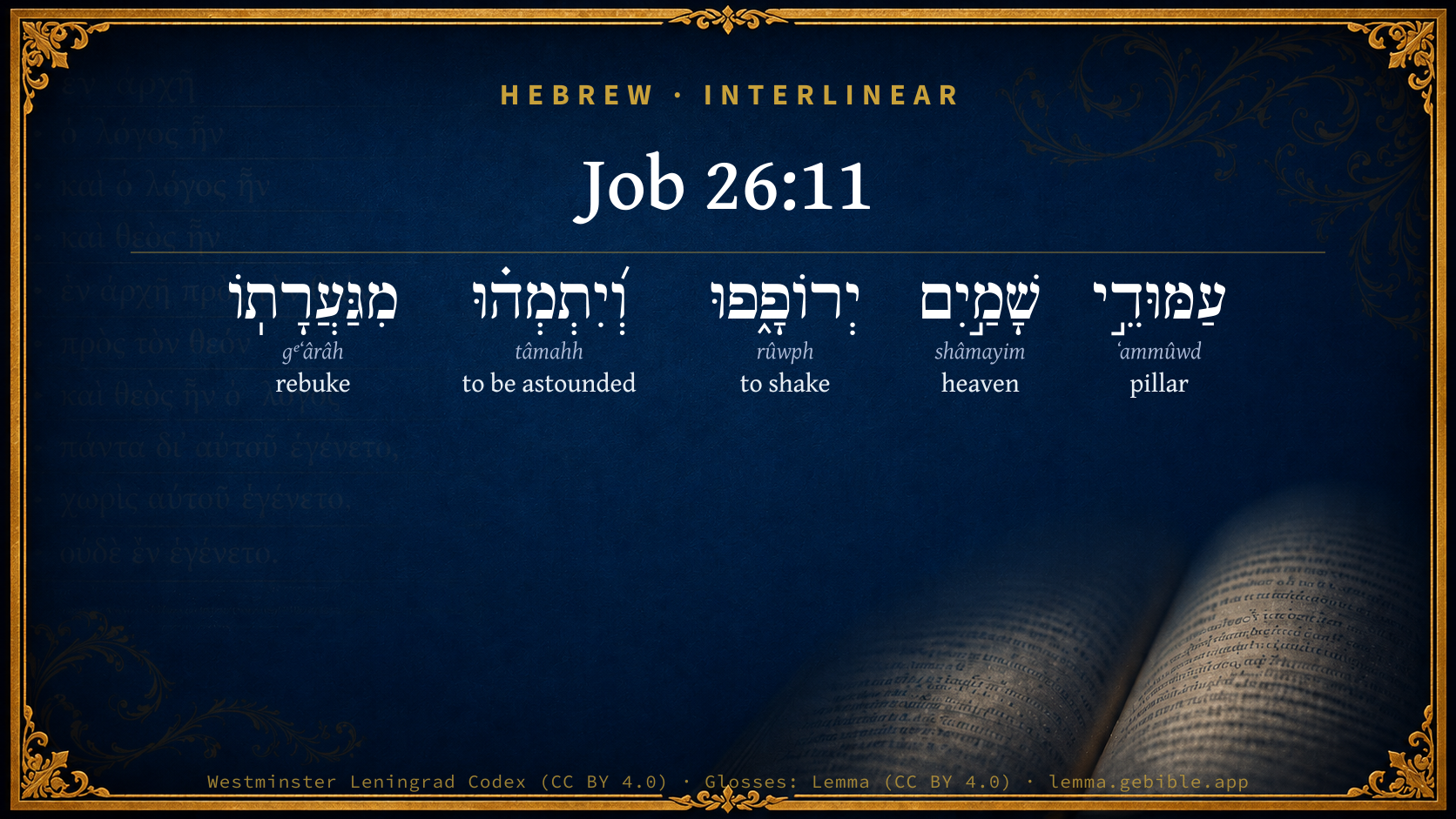
Hebrew (Westminster Leningrad Codex) Job 26:11 appears in the Hebrew Old Testament. The text above is from the Westminster Leningrad Codex. Each word links to its Strong’s number, a concise gloss, and parsing drawn from the Open Scriptures Hebrew Bible morphology. Click any word for its full Brown-Driver-Briggs (BDB) entry.
Download image
Cite this verse

Job 26:11 (World English Bible). Public Domain. Lemma interlinear Bible study tool, https://lemma.gebible.app/v/job/26/11.

Show BibTeX & RIS
BibTeX
RIS
English Translation
The pillars of heaven tremble And are astonished at his rebuke.
World English Bible · Public Domain
Highlights
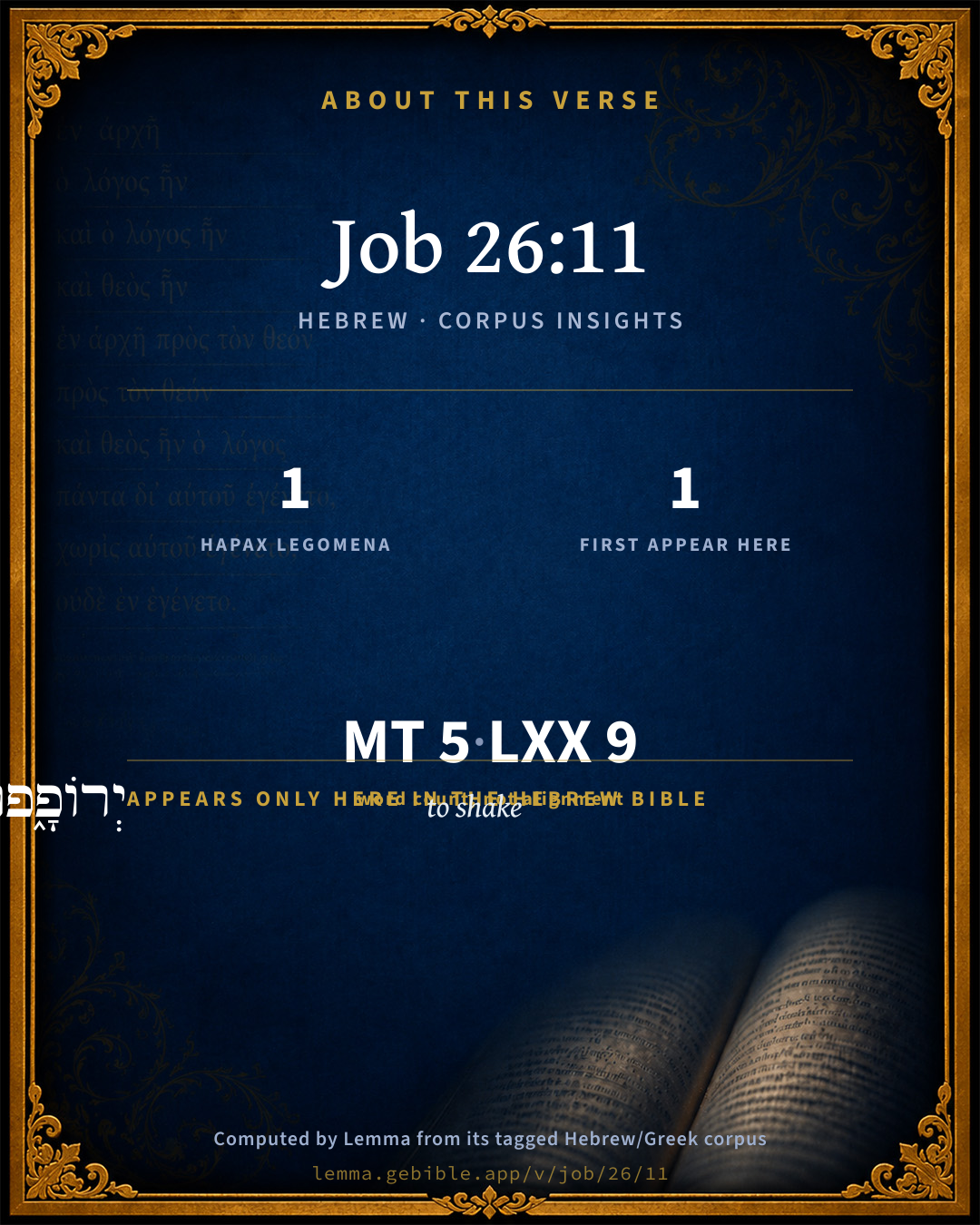
  • 1 hapax legomenon — only here in the Hebrew Bible
  • 1 first appearance in the Hebrew Bible
Full analysis ↓
Download a study sheet

One document with this verse’s original text, its word-by-word gloss line, the meaning frame, cross-references with their text, attributed commentary, and full source and license credits — printable, and it pastes into notes with its structure intact.

This verse Autodidact and up

Study sheet (.html) Plain text (.txt)

A passage Seminary Student

Up to 50 verses in one chapter. A passage sheet keeps up to 6 commentary sources and 12 cross-references per verse, in the order this page ranks them, and says so on the sheet whenever that leaves anything out. Ask for a single verse and you get the Autodidact verse sheet above.

Everything on this page stays free to read, with no account — the sheet is a download of what is already on screen, not access to it.

Want to remove ads? Support Godless Engineer
Compare translations 3

The same verse in 3 English versions, stacked beneath the original-language interlinear above. Click any original word for its lexicon entry.

Each is an independent rendering of the whole verse — the interlinear is not word-aligned to these translations.

Highlighted words mark where these versions differ — a whole-verse word diff, not a word-by-word alignment.

  • World English Bible Public Domain
    The pillars of heaven tremble And are astonished at his rebuke.
  • King James Version Public Domain
    The pillars of heaven tremble and are astonished at his reproof.
  • unfoldingWord Literal Text CC BY-SA 4.0
    The pillars of the heavens tremble and marvel at his rebuke.

unfoldingWord Literal Text — © unfoldingWord, licensed CC BY-SA 4.0. Word-aligned USFM3 via Door43 (git.door43.org/unfoldingWord/en_ult).

Versions to compare (up to 4)

3 of 4 selected

Show all 18 translations

Every available English version of this verse, each an independent rendering of the whole verse.

  • World English Bible Public Domain
    The pillars of heaven tremble And are astonished at his rebuke.
  • Berean Standard Bible Public Domain
    The foundations of heaven quake, astounded at His rebuke.
  • Majority Standard Bible Public Domain
    The foundations of heaven quake, astounded at His rebuke.
  • King James Version Public Domain
    The pillars of heaven tremble and are astonished at his reproof.
  • American Standard Version (1901) Public Domain
    The pillars of heaven tremble And are astonished at his rebuke.
  • Revised Version (1885) Public Domain
    The pillars of heaven tremble and are astonished at his rebuke.
  • Geneva Bible (1599) Public Domain
    The pillars of heauen tremble and quake at his reproofe.
  • Douay-Rheims (1899) Public Domain
    The pillars of heaven tremble, and dread at his beck.
  • Young's Literal Translation Public Domain
    Pillars of the heavens do tremble, And they wonder because of His rebuke.
  • Literal Standard Version CC BY-SA 4.0
    Pillars of the heavens tremble, || And they wonder because of His rebuke.
  • Unlocked Literal Bible CC BY-SA 4.0
    The pillars of heaven tremble and are astonished at his rebuke.
  • unfoldingWord Literal Text CC BY-SA 4.0
    The pillars of the heavens tremble and marvel at his rebuke.
  • Darby Bible Public Domain
    The pillars of the heavens tremble and are astonished at his rebuke.
  • World Messianic Bible Public Domain
    The pillars of heaven tremble and are astonished at his rebuke.
  • Webster's Bible Public Domain
    The pillars of heaven tremble and are astonished at his reproof.
  • Free Bible Version CC BY-SA 4.0
    The pillars of heaven tremble; they shake with fear at his rebuke.
  • Bible in Basic English Public Domain
    The pillars of heaven are shaking, and are overcome by his sharp words.
  • JPS Tanakh (1917) Public Domain
    The pillars of heaven tremble and are astonished at His rebuke.

Literal Standard Version (2020), Covenant Press — licensed CC BY-SA 4.0. Text via the HelloAO Bible API (eBible.org). Unlocked Literal Bible (unfoldingWord) — licensed CC BY-SA 4.0. Text via the HelloAO Bible API (eBible.org). unfoldingWord Literal Text — © unfoldingWord, licensed CC BY-SA 4.0. Word-aligned USFM3 via Door43 (git.door43.org/unfoldingWord/en_ult). Free Bible Version, Dr. Jonathan Gallagher — licensed CC BY-SA 4.0. Text via the HelloAO Bible API (eBible.org).

Word by word

More ways to search: Search by grammar → Find every occurrence → Compare this word →

Practice this passage: Drill this verse → Learn its vocabulary →

About this verse

These counts appear in no published source. They are computed here, from the morphology-tagged text and Lemma’s own curated glosses. What Lemma adds →

5
words
5
distinct lemmas
Wisdom
section

Notable vocabulary

1 hapax legomenon — a word that appears only here in the entire Hebrew Bible:

  • יְרוֹפָ֑פוּ to shake H7322

First appearance in Scripture

This word makes its first canonical appearance in the Hebrew Bible here:

  • יְרוֹפָ֑פוּ to shake H7322

Shared distinctive vocabulary

וְ֝יִתְמְה֗וּ to be astounded H8539 occurs in 8 verses of the Hebrew Bible. Also found in:

Grammatical profile

  • 2 verbs
  • 3 nouns

Verb forms

  • יְרוֹפָ֑פוּ Poal · Imperfect
  • וְ֝יִתְמְה֗וּ Qal · Imperfect

Hebrew & Septuagint length

In English translation the verse runs 11 words from the Hebrew and 11 from the Septuagint (LXX English) — the same length.

A rough comparison of the two English renderings, which tokenize alike — not a word-level alignment.

Word counts can differ between the Hebrew and the Greek without any difference in meaning — e.g. the Hebrew direct-object marker אֵת has no separate Greek word, and Greek often adds the article ὁ.

In the original languages it is 5 Hebrew tokens and 9 Greek tokens — but the two are counted differently (Hebrew bundles its prefixes and suffixes into one token; the Greek is in lemma form), so that isn’t a like-for-like length.

Cross-references

7

Topical passages linked to Job 26:11 in the Treasury of Scripture Knowledge — connected by theme and wording, ordered by reader-vote popularity; previews shown in the World English Bible.

  • 1 Samuel 2:8 He raises up the poor out of the dust, He lifts up the needy from the dunghill, To make them sit with princes, Inherit the throne of glory: For the pillars of the earth are Yahweh's, He has set the world on them.
  • Job 15:15 Behold, he puts no trust in his holy ones; Yes, the heavens are not clean in his sight:
  • Psalms 18:7 Then the earth shook and trembled. The foundations also of the mountains quaked and were shaken, Because he was angry.
  • Haggai 2:21 "Speak to Zerubbabel, governor of Judah, saying, 'I will shake the heavens and the earth.
  • Hebrews 12:26–27 whose voice shook the earth, then, but now he has promised, saying, "Yet once more I will shake not only the earth, but also the heavens."
  • 2 Peter 3:10 But the day of the Lord will come as a thief in the night; in which the heavens will pass away with a great noise, and the elements will be dissolved with fervent heat, and the earth and the works that are in it will be burned up.
  • Revelation 20:11 I saw a great white throne, and him who sat on it, from whose face the earth and the heaven fled away. There was found no place for them.

Cross-references courtesy of OpenBible.info (CC BY 4.0).

Hebrew and Greek witnesses Masoretic Hebrew ↔ Greek Septuagint

The same verse in the two great witnesses to the Old Testament, shown verse-for-verse.

These are two independent witnesses, not word-aligned to each other, and the Septuagint is shown in lemma (dictionary) form.

Hebrew Job 26:11 Masoretic · Westminster Leningrad Codex

עַמּוּדֵ֣י שָׁמַ֣יִם יְרוֹפָ֑פוּ וְ֝יִתְמְה֗וּ מִגַּעֲרָתֽוֹ

The pillars of heaven tremble And are astonished at his rebuke.

World English Bible · Public Domain

Greek LXX Job 26:11 Septuagint · lemma form

στῦλος οὐρανός πετάννυμι καί ἐκἵστημι ἀπό ὁ ἐπιτίμησις αὐτός

The pillars of heaven are prostrate and astonished at his rebuke.

LXX2012 (modern English Septuagint) · Public Domain

On this verse, Keil & Delitzsch discusses the Septuagint’s reading. Read the note in Commentary ↓

Hebrew: Westminster Leningrad Codex (CC BY 4.0). Greek: Septuagint (public domain); English from LXX2012 (modern English Septuagint) (Public Domain). How the Septuagint differs from the Hebrew →

Commentary

Notes on Job 26:11 from classic Christian and Jewish commentators (each source and its license shown beneath its notes). The classic Christian expositions comment on the surrounding passage and are grouped to its opening verse, so a note may address several verses; the Jewish commentaries on the Tanakh (Rashi and others) are per-verse, so they appear only where the commentator wrote on this verse.

Lemma curates 59 commentaries, every one of them public domain or Creative Commons licensed, each selected and text-cleaned for this edition rather than reprinted as found. About our sources →

Trapp's Complete Commentary

John Trapp

Job 26:11 The pillars of heaven tremble and are astonished at his reproof.

Ver. 11. The pillars of heaven tremble] i.e. The angels, say some, who tremble out of conscience of their own comparative imperfections. The best of saints on earth, say others (according to Gal 2:9 Rev 3:12 Pro 9:1-2), who tremble at God’s word, Isa 66:2, and have many concussions by afflictions. But better understand the firmament of heaven, Hag 2:6-7 Mat 24:29. The powers of heaven shall be shaken, they shall quake with the loud check of his thunderclaps. Or the high and mighty mountains, whereon the heavens seem to rest, as on so many pillars, shaken by earth, quakes, and sometimes with great astonishment removed out of their places.

And are astonished at his reproof] As all the beasts of the field are at the roaring of the lion; Ut quis a gravi et magnae potestatis vire, obiurgatus, tremit et vehementer solicitus est, as a slave chided by a prince trembleth, and is aghast.

John Trapp, A Commentary or Exposition upon All the Books of the Old and New Testament (1647–1656) — public domain. Text from a community e-Sword module.

Joseph Benson's Commentary

Job 26:11. The pillars of heaven tremble — Perhaps the mountains, which by their height and strength seem to reach and support the heavens. And are astonished at his reproof — When God reproveth not them, but men by them, manifesting his displeasure by thunders or earthquakes.

Joseph Benson's Commentary on the Old and New Testaments (1811–1818) — public domain. Text from a community e-Sword module.

Whedon's Commentary on the Bible

Daniel D. Whedon

Third strophe — The mightiest forces of nature are simply the agencies of the divine will, a will which subdues to itself the most discordant elements of the physical and moral world. All that we can know, and all that we can think, of God, is but a zephyr of his presence as he walks in the visible garden of the universe, (Gen_3:8,) Job_26:11-14.

11. Pillars of heaven — See note on Job_26:7 and Job_9:6. That the reference of Job to the popular belief that the mountains, as “pillars,” upheld the heavens, must be figurative, is evident from Job_26:7, where the power of God is said to uphold the north (the heaven) over the empty place.

Tremble — The Hebrew yerophaphou, occurring only here, may be fancied to oscillate like the earth-quivering it is intended to convey.

Reproof — The thunder, which is often called “the voice of God,” was regarded as his rebuke of the world. Psa_104:7. By a powerful personification, the mountain heights (pillars of heaven) are represented as being astonished with terror! Psa_114:6.

Daniel D. Whedon (gen. ed.), Commentary on the Old and New Testaments (1874–1909) — public domain. Text from a community e-Sword module.

Tyndale Open Study Notes

Tyndale Open Resources

26:11 Mountains at the edge of the horizon might be the foundations (or “pillars,” Judg 16:25-26) of heaven or the earth (Job 9:6). They were thought to reach from below the waters of the sea (Jon 2:6) and up to the clouds to support the vaults of heaven.

Tyndale Open Study Notes — © Tyndale Open Resources, licensed CC BY-SA 4.0. Text via the HelloAO Bible API.

Geneva Bible (1599)

Geneva Bible translators

Not that heaven hath pillars to uphold it, but he speaketh by a similitude, as though he would say, The heaven itself is not able to abide his reproach.

Geneva Bible (1599) marginal notes — public domain. Text via Bolls.life.

Jamieson, Fausset & Brown

Robert Jamieson, A. R. Fausset & David Brown

pillars--poetically for the mountains which seem to bear up the sky (Psa 104:32).

astonished--namely, from terror. Personification.

his reproof-- (Psa 104:7). The thunder, reverberating from cliff to cliff (Hab 3:10; Nah 1:5).

Jamieson, Fausset & Brown — Commentary Critical and Explanatory on the Whole Bible (1871) — public domain (CC PDM 1.0). Text via the HelloAO Bible API.

Adam Clarke's Commentary

Verse 11. The pillars of heaven tremble] This is probably a poetical description either of thunder, or of an earthquake: -

"He shakes creation with his nod;

Earth, sea, and heaven, confess him God."

But there may be an allusion to the high mountains, which were anciently esteemed by the common people as the pillars on which the heavens rested; and when these were shaken with earthquakes, it might be said the pillars of heaven tremble. Mount Atlas was supposed to be one of those pillars, and this gave rise to the fable of Atlas being a man who bore the heavens on his shoulders. The Greek and Roman poets frequently use this image. Thus SILIUS ITALICUS, lib. i., ver. 202: -

Atlas subducto tracturus vertice coelum:

Sidera nubiferum fulcit caput, aethereasque

Erigit aeternum compages ardua cervix:

Canet barba gelu, frontemque immanibus umbris

Pinea silva premit; vastant cava tempora venti

Nimbosoque ruunt spumantia flumina rictu.

"Atlas' broad shoulders prop th' incumbent skies:

Around his cloud-girt head the stars arise.

His towering neck supports th' ethereal way;

And o'er his brow black woods their gloom display.

Hoar is his beard; winds round his temples roar;

And from his jaws the rushing torrents pour."

J. B. C.

Adam Clarke's Commentary on the Bible (1810–1826) — public domain. Text from a community e-Sword/MySword module.

Ellicott's Commentary for English Readers

(11) The pillars of heaven tremble.—The phenomenon of storm and tempest is alluded to.

A Bible Commentary for English Readers, edited by Charles John Ellicott (1878–1897) — public domain. Text from a community e-Sword module.

The Cambridge Bible for Schools and Colleges

gen. ed. J. J. S. Perowne

11. The “pillars” of the heavens, if the conception be not wholly ideal, may be the lofty mountains on which the heavens seem to rest, and which, as they are lost in the clouds, are spoken of as belonging to heaven. At God’s rebuke, when His voice of thunder rolls, or when earthquakes shake the earth, they tremble with terror of His majesty,

The Cambridge Bible for Schools and Colleges (gen. ed. J. J. S. Perowne; Cambridge University Press, 1878–1918) — public domain. Text from a community e-Sword module.

John Gill's Exposition

The pillars of heaven tremble,.... Which may be understood either of the air, the lower part of the heavens, which may be thought to be the foundation, prop, and support of them, and is sometimes called the firmament, and "the firmament of his power", Psa 150:1; and which seems to tremble when there are thunder and lightnings, and coruscations in it; or else the mountains, which, reaching up to the heavens, look as if they were the pillars and support of them; and are indeed said to be the foundations of heaven, which move and shake and tremble at the presence and power of God, and at any expressions of his wrath and anger, and particularly through earthquakes and storms, and tempests of thunder and lightning; see Sa2 22:8, which are meant by what follows:

and are astonished at his reproof; his voice of thunder, which is sometimes awful and terrible, astonishing and surprising; and, to set forth the greatness of it, inanimate creatures are represented as trembling, and astonished at it; see Psa 104:7; some interpret this figuratively of angels, who they suppose are employed in the direction of the heavens, and the motion of the heavenly bodies; and who they think are the same which in the New Testament are called "the powers of heaven said to be shaken", Mat 24:29; and to be the seraphim that covered their faces upon a glorious display of the majesty of God, and when the posts of the door of the temple moved at the voice of him that cried, Isa 6:1; but if a figurative sense may be admitted of, the principal persons in the church, sometimes signified by heaven in Scripture, may be thought of; as ministers of the word, who are pillars in the house of God; yea, every true member of the church of God is made a pillar in it; and these tremble, and are astonished oftentimes when the Lord rebukes them by afflictions, though it is in love and kindness to them, Pro 9:1.

John Gill's Exposition of the Whole Bible (1746–1763) — public domain (CC PDM 1.0). Text via the HelloAO Bible API.

Albert Barnes' Notes on the Bible

The pillars of Heaven tremble - That is, the mountains, which seem to bear up the heavens. So, among the ancients. Mount Atlas was represented as one of the pillars of heaven. Virgil speaks of “Atlas whose brawny back supports the skies.” And Hesiod, ver. 785, advances the same notion:

“Atlas, so hard necessity ordains,

Great, the ponderous vault of stars sustains

Not far from the Hesperides he stands,

Nor from the load retracts his head or hands.”

The word “reproof” in this verse refers to the language of God, as if spoken in anger to rebuke the mountains or the earth. Perhaps the reference is to thunder, to storms, and to winds, which seem to be the voice of God; compare Psa 29:3-8. Similar descriptions of the majesty and glory of God abound in the Scriptures, where he speaks to the earth, the mountains, the hills, and they tremble. Thus, in Psa 104:32;

He looketh on the earth, and it trembleth;

He toucheth the hills, and they smoke.

So in Hab 3:10 :

The mountains saw thee, and they trembled;

The overflowing of the water passed by;

The deep uttered his voice, and lift up his hands on high.

So in Nah 1:5, “The mountains quake at him, and the hills melt, and the earth is burnt at his presence.”

Albert Barnes' Notes on the Bible (1834–1885) — public domain. Text from a community e-Sword/MySword module.

Haydock's Catholic Bible Commentary

Heaven. The mountains are so styled by Pindar; and the poets represent them supporting the heavens. Totum ferre potest humeris minitantibus orbem. (Petronius) --- Yet others understand that power which keeps all things together, (Calmet) or the angels, to whose rule the ancients attributed the celestial bodies. (St. Gregory; Ven. Bede, &c.)

George Leo Haydock (1774–1849), Haydock's Catholic Family Bible and Commentary, 1859 edition — public domain. Excludes Psalms (Douay-Rheims chapter numbering differs from Protestant) and Deuterocanonical books (Catholic canon only).

Matthew Poole's English Annotations

The pillars of heaven; either,

1. Those mountains which by their height and strength may seem to reach and support the heavens, as the poets said of Atlas; for this is a poetical book, and there are many poetical expressions in it. These tremble sometimes by force of earthquakes, or by God’s glorious appearance in them, as Sinai did. Or,

2. Holy angels; but they are not subject either to trembling, or to God’s rebuke. Or,

3. The heavenly bodies, as the sun, and moon, and stars, which as they may seem in some sort to support, so they do certainly adorn the heavens; and we know pillars are oft made, not to support, but only for ornament; as the two famous pillars of the temple, Jachin and Boaz, 1Ki 7:21. And these ofttimes seem to tremble and be astonished, as in eclipses or tempests, and terrible works of God in the air, by which they are frequently said to be affected and changed, because they seem so to us; and many things are spoken in Scripture according to appearance: see Isa 13:10; 24:23; Joe 2:10,31; Mt 24:29, &c.

At his reproof; either,

1. When God rebuketh them: for God is sometimes said in Scripture to rebuke the lifeless creatures; which is to be understood figuratively of the tokens of God’s anger in them. Or,

2. When God reproveth not them, but men by them, manifesting his displeasure against sinful men by thunders, or earthquakes, or prodigious works.

Matthew Poole's English Annotations on the Holy Bible (1683–1685) — public domain. Text from a community e-Sword/MySword module.

The Pulpit Commentary

The pillars of heaven tremble. The "pillars of heaven" are the mountains, on which the sky seems to rest. These "tremble," or seem to tremble, at the presence of God (Psa_18:7 Psa_114:4 Isa_5:25) when he visits the earth in storm and tempest, either because the whole atmosphere is full of disturbance, and the outline of the mountains shifts and changes as rain and storm sweep over them, or because the reverberations of the thunder, which shake the air, seem to shake the earth also. And are astonished at his reproof. To the mind of the poet this "trembling" is expressive of astonishment and consternation. He regards the mountains as hearing the voice of God in the storm, recognizing it as raised in anger, and so trembling and cowering before him.

The Pulpit Commentary (1880–1919), ed. H.D.M. Spence-Jones & Joseph S. Exell — public domain. Text from a community e-Sword module.

John Wesley's Explanatory Notes

Pillars - Perhaps the mountains which by their height and strength seem to reach and support the heavens. Astonished - When God reproveth not them, but men by them, manifesting his displeasure by thunders, or earthquakes.

John Wesley, Explanatory Notes Upon the Whole Bible (1754–1765) — public domain. Text via the GEBible commentary corpus.

Keil & Delitzsch

C. F. Keil & F. Delitzsch

11 The pillars of heaven tremble

And are astonished at His threatening.

12 By His power He rouseth up the sea,

And by His understanding He breaketh Rahab in pieces.

13 By His breath the heavens become cheerful;

His hand hath formed the fugitive dragon.

The mountains towering up to the sky, which seem to support the vault of the sky, are called poetically "the pillars of heaven." ירופפוּ is Pulal, like יחוללוּ, Job 26:5; the signification of violent and quick motion backwards and forwards is secured to the verb רוּף by the Targ. אתרופף = התפּלּץ, Job 9:6, and the Talm. רפרף of churned milk, blinding eyes (comp. הרף עין, the twinkling of the eye, and Arab. rff, fut. i. o. nictare), flapping wings (comp. Arab. rff and rfrf, movere, motitare alas), of wavering thinking. גּערה is the divine command which looses or binds the powers of nature; the astonishment of the supports of heaven is, according to the radical signification of תּמהּ (cogn. שׁמם), to be conceived of as a torpidity which follows the divine impulse, without offering any resistance whatever. That רגע, Job 26:12, is to be understood transitively, not like Job 7:5, intransitively, is proved by the dependent (borrowed) passages, Isa 51:15; Jer 31:35, from which it is also evident that רגע cannot with the lxx be translated κατέπαυσεν. The verb combines in itself the opposite significations of starting up, i.e., entering into an excited state, and of being startled, from which the significations of stilling (Niph., Hiph.), and of standing back or retreat (Arab. rj‛), branch off. The conjecture גּער after the Syriac version (which translates, go‛ar bejamo) is superfluous. רהב, which here also is translated by the lxx τὸ κῆτος, has been discussed already on Job 9:13. It is not meant of the turbulence of the sea, to which מחץ is not appropriate, but of a sea monster, which, like the crocodile and the dragon, are become an emblem of Pharaoh and his power, as Isa 51:9. has applied this primary passage: the writer of the book of Job purposely abstains from such references to the history of Israel. Without doubt, רהב denotes a demoniacal monster, like the demons that shall be destroyed at the end of the world, one of which is called by the Persians akomano, evil thought, another taromaiti, pride. This view is supported by Job 26:13, where one is not at liberty to determine the meaning by Isa 51:9, and to understand נחשׁ בּרח, like תּנּין in that passage, of Egypt. But this dependent passage is an important indication for the correct rendering of חללה. One thing is certain at the outset, that שׁפרה is not perf. Piel = שׁפרה, and for this reason, that the Dagesh which characterizes Piel cannot be omitted from any of the six mutae; the translation of Jerome, spiritus ejus ornavit coelos, and all similar ones, are therefore false. But it is possible to translate: "by His spirit (creative spirit) the heavens are beauty, His hand has formed the flying dragon." Thus, in the signification to bring forth (as Pro 25:23; Pro 8:24.), חללה is rendered by Rosenm., Arnh., Vaih., Welte, Renan, and others, of whom Vaih. and Renan, however, do not understand Job 26:13 of the creation of the heavens, but of their illumination. By this rendering Job 26:13 and Job 26:13 are severed, as being without connection; in general, however, the course of thought in the description does not favour the reference of the whole of half of Job 26:13 to the creation. Accordingly, חללה is not to be taken as Pilel from חול (ליל), but after Isa 57:9, as Poel from חלל, according to which the idea of Job 26:13 is determined, since both lines of the verse are most closely connected.

(בּריח) נחשׁ בּרח is, to wit, the constellation of the Dragon,

(Note: Ralbag, without any ground for it, understands it of the milky way (העגול החלבי), which, according to Rapoport, Pref. to Slonimski's Toledoth ha-schamajim (1838), was already known to the Talmud b. Berachoth, 58 b, under the name of נהר דנוד.)

one of the most straggling constellations, which winds itself between the Greater and Lesser Bears almost half through the polar circle.

"Maximus hic plexu sinuoso elabitur Anguis

Circum perque duas in morem fluminis Arctos."

(Virgil, Georg. i. 244f.)

Aratus in Cicero, de nat. Deorum, ii. 42, describes it more graphically, both in general, and in regard to the many stars of different magnitudes which form its body from head to tail. Among the Arabs it is called el-hajje, the serpent, e.g., in Firuzabdi: the hajje is a constellation between the Lesser Bear (farqadân, the two calves) and the Greater Bear (benât en-na‛sch, the daughters of the bier), "or et-tanı̂n, the dragon, e.g., in one of the authors quoted by Hyde on Ulugh Beigh's Tables of the Stars, p. 18: the tann lies round about the north pole in the form of a long serpent, with many bends and windings." Thus far the testimony of the old expositors is found in Rosenmller. The Hebrew name תּלי (the quiver) is perhaps to be distinguished from טלי and דּלי, the Zodiac constellations Aries and Aquarius.

(Note: Vid., Wissenschaft, Kunst, Judenthum (1838), S. 220f.)

It is questionable how בּרח is to be understood. The lxx translates δράκοντα ἀποστάτην in this passage, which is certainly incorrect, since בריח beside נחשׁ may naturally be assumed to be an attributive word referring to the motion or form of the serpent. Accordingly, Isa 27:1, ὄφιν φείγοντα is more correct, where the Syr. version is חויא חרמנא, the fierce serpent, which is devoid of support in the language; in the passage before us the Syr. also has חויא דערק, the fleeing serpent, but this translation does not satisfy the more neuter signification of the adjective. Aquila in Isaiah translates ὄφιν μόχλον, as Jerome translates the same passage serpentem vectem (whereas he translates coluber tortuosus in our passage), as though it were בּריח; Symm. is better, and without doubt a substantially similar thought, ὄφιν συγκλείοντα, the serpent that joins by a bolt, which agrees with the traditional Jewish explanation, for the dragon in Aben-Ezra and Kimchi (in Lex.) - after the example of the learned Babylonian teacher of astronomy, Mar-Samuel (died 257), who says of himself that the paths of the heavens are as familiar to him as the places of Nehardea

(Note: Vid., Grtz, Geschichte der Juden, iv. 324. On Isa 27:1 Kimchi interprets the מבריח differently: he scares (pushes away).)

- is called נחשׁ עקלתון, because it is as though it were wounded, and בריח, because it forms a bar (מבריח) from one end of the sky to the other; or as Sabbatai Donolo (about 94), the Italian astronomer,

(Note: Vid., extracts from his המזלות ספר in Joseph Kara's Comm. on Job, contributed by S. D. Luzzatto in Kerem Chemed, 7th year, S. 57ff.)

expresses it: "When God created the two lights (the sun and moon) and the five stars (planets) and the twelve מזלור (the constellations of the Zodiac), He also created the תלי (dragon), to unite these heavenly bodies as by a weaver's beam (מנור אורגים), and made it stretch itself on the firmament from one end to another as a bar (כבריח), like a wounded serpent furnished with the head and tail." By this explanation בּריח is either taken directly as בּריח, vectis, in which signification it does not, however, occur elsewhere, or the signification transversus (transversarius) is assigned to the בּריח (= barrı̂ah) with an unchangeable Kametz, - a signification which it might have, for brch Arab. brḥ signifies properly to go through, to go slanting across, of which the meanings to unite slanting and to slip away are only variations. בּריח, notwithstanding, has in the language, so far as it is preserved to us, everywhere the signification fugitivus, and we will also keep to this: the dragon in the heavens is so called, as having the appearance of fleeing and hastening away. But in what sense is it said of God, that He pierces or slays it? In Isa 51:9, where the תנין is the emblem of Egypt (Pharaoh), and Isa 27:1, where נחשׁ בריח is the emblem of Assyria, the empire of the Tigris, the idea of destruction by the sword of Jehovah is clear. The present passage is to be explained according to Job 3:8, where לויתן is only another name for נחש בריח (comp. Isa 27:1). It is the dragon in the heavens which produces the eclipse of the sun, by winding itself round about the sun; and God must continually wound it anew, and thus weaken it, if the sun is to be set free again. That it is God who disperses the clouds of heaven by the breath of His spirit, the representative of which in the elements is the wind, so that the azure becomes visible again; and that it is He who causes the darkening of the sun to cease, so that the earth can again rejoice in the full brightness of that great light, - these two contemplations of the almighty working of God in nature are so expressed by the poet, that he clothes the second in the mythological garb of the popular conception.

In the closing words which now follow, Job concludes his illustrative description: it must indeed, notwithstanding, come infinitely short of the reality.

Keil & Delitzsch — Biblical Commentary on the Old Testament (1861–1891) — public domain (CC PDM 1.0). Text via the HelloAO Bible API. (Old Testament only.)

unfoldingWord translationNotes

Door43 World Missions Community

The pillars of heaven tremble and are astonished at his rebuke

People thought of heaven or the sky as resting on pillars. Job speaks as though the pillars are humans that shake in fear when God is angry. AT: "The pillars that hold up heaven shake in fear when God rebukes them" or "The pillars that hold up the sky shake like people who are afraid when God rebukes them" (See: Personification)

he shattered Rahab

"he destroyed Rahab"

Rahab

This is the name of a frightening monster that lived in the sea. See how you translated this in Job 9:13. (See: How to Translate Names)

translationWords

column

heaven

tremble

amazed

rebuke

power

understand

unfoldingWord translationNotes — © Distant Shores Media and the Door43 World Missions Community, licensed CC BY-SA 4.0. Source: git.door43.org/Door43/en_tn.

Rashi

Rabbi Shlomo Yitzchaki (Rashi)

trembled when He created them, and He caused them to congeal. They were trembling, and He rebuked them, and they stood dry and strong.

astonished (wondering and ascending. Other editions: wondering and standing) in one place.

Rashi on the Tanakh — English translations: “The Judaica Press complete Tanach with Rashi, translated by A. J. Rosenberg” (CC BY 4.0); “Pentateuch with Rashi's commentary by M. Rosenbaum and A.M. Silbermann, 1929-1934” (public domain); “The Metsudah Tanach series, Lakewood, N.J” (CC BY 4.0); and “The Book of Joshua, Metsudah Publications, 1997” (CC BY 4.0). Text via Sefaria.

Lesson kit

Teaching starters — assembled from the data on this page, not authored interpretation. Every prompt links to the verse data it draws on. Edit before teaching.

Job, in the Wisdom, opens this verse with 5 words (5 distinct Hebrew lemmas). Its most distinctive word is rûwph (“to shake”). A historical commentator’s framing appears above. Read the whole chapter for the surrounding context.

Discussion questions

  1. How does “to shake” (rûwph) shape what this verse is saying?
  2. 1 word here appears nowhere else in the Hebrew Bible. Why might the author reach for such rare wording?
  3. This is the first place “to shake” appears in Scripture (first appears here). What does its debut here establish?
  4. How does Genesis 43:33, which shares the word «to be astounded», read alongside this verse?
  5. These translations render this verse differently; the difference is in the English rendering, not the original. What questions does that raise?
  6. «יְרוֹפָ֑פוּ» is a Poal Imperfect verb. How does that grammatical form shape the action described?
  7. Compare how Trapp's Complete Commentary and Joseph Benson's Commentary read this verse. Where do they agree or differ?

Things to notice

Reading settings

Reading text

Shown beneath each verse's original-language words.

Old Testament
Old Testament edition

Read the OT as the Masoretic Hebrew (MT) or the Greek Septuagint (LXX).

English shown for the Greek Septuagint (in the Hebrew ↔ Greek comparison).

Comparing translations? Open the Compare panel on any verse page to stack up to four side by side.