
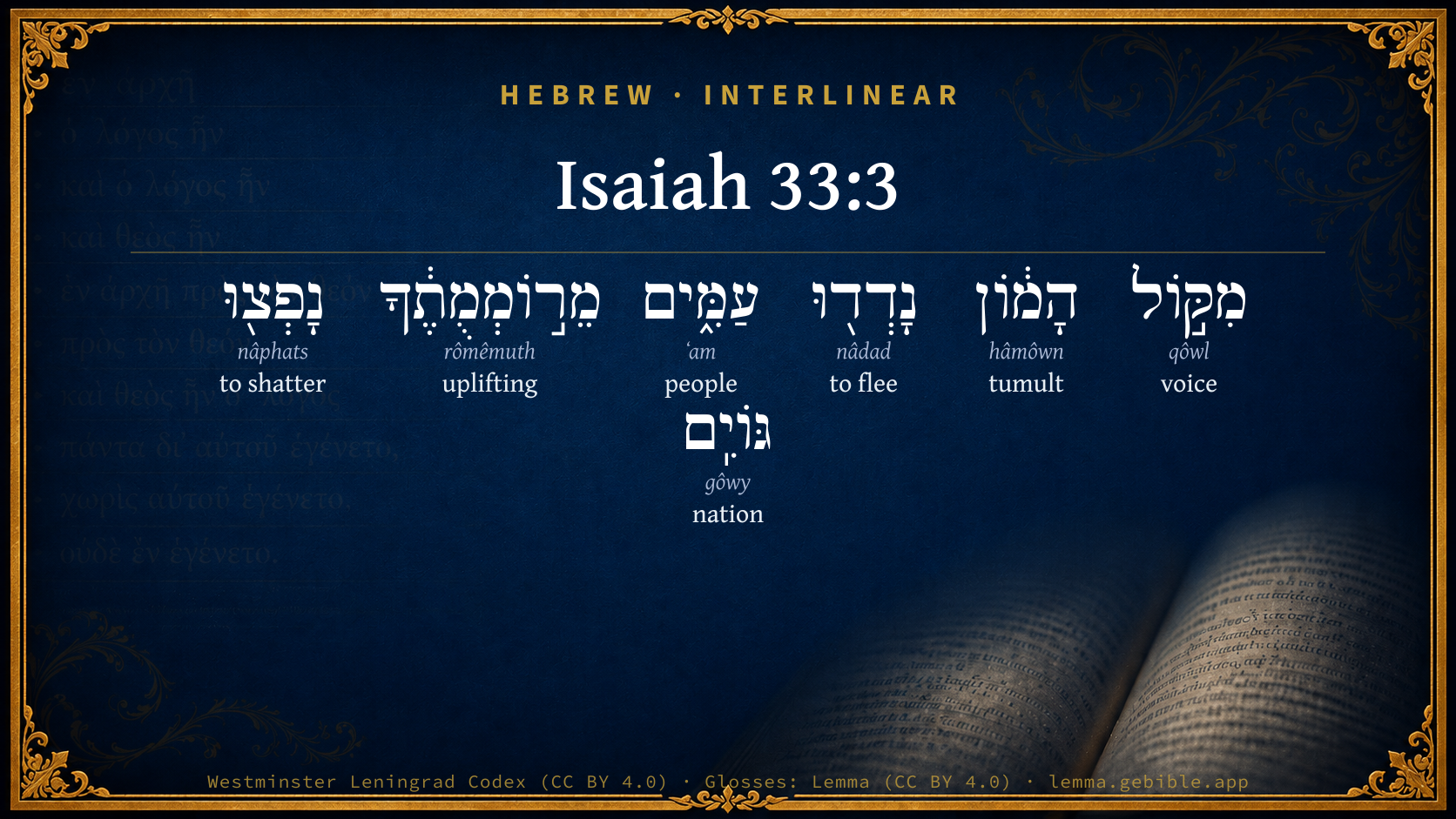
Isaiah 33:3

Hebrew (Westminster Leningrad Codex) Isaiah 33:3 appears in the Hebrew Old Testament. The text above is from the Westminster Leningrad Codex. Each word links to its Strong’s number, a concise gloss, and parsing drawn from the Open Scriptures Hebrew Bible morphology. Click any word for its full Brown-Driver-Briggs (BDB) entry.
Download image
Cite this verse

Isaiah 33:3 (World English Bible). Public Domain. Lemma interlinear Bible study tool, https://lemma.gebible.app/v/isaiah/33/3.

Show BibTeX & RIS
BibTeX
RIS
English Translation
At the noise of the thunder the peoples are fled; at the lifting up of yourself the nations are scattered.
World English Bible · Public Domain
Highlights
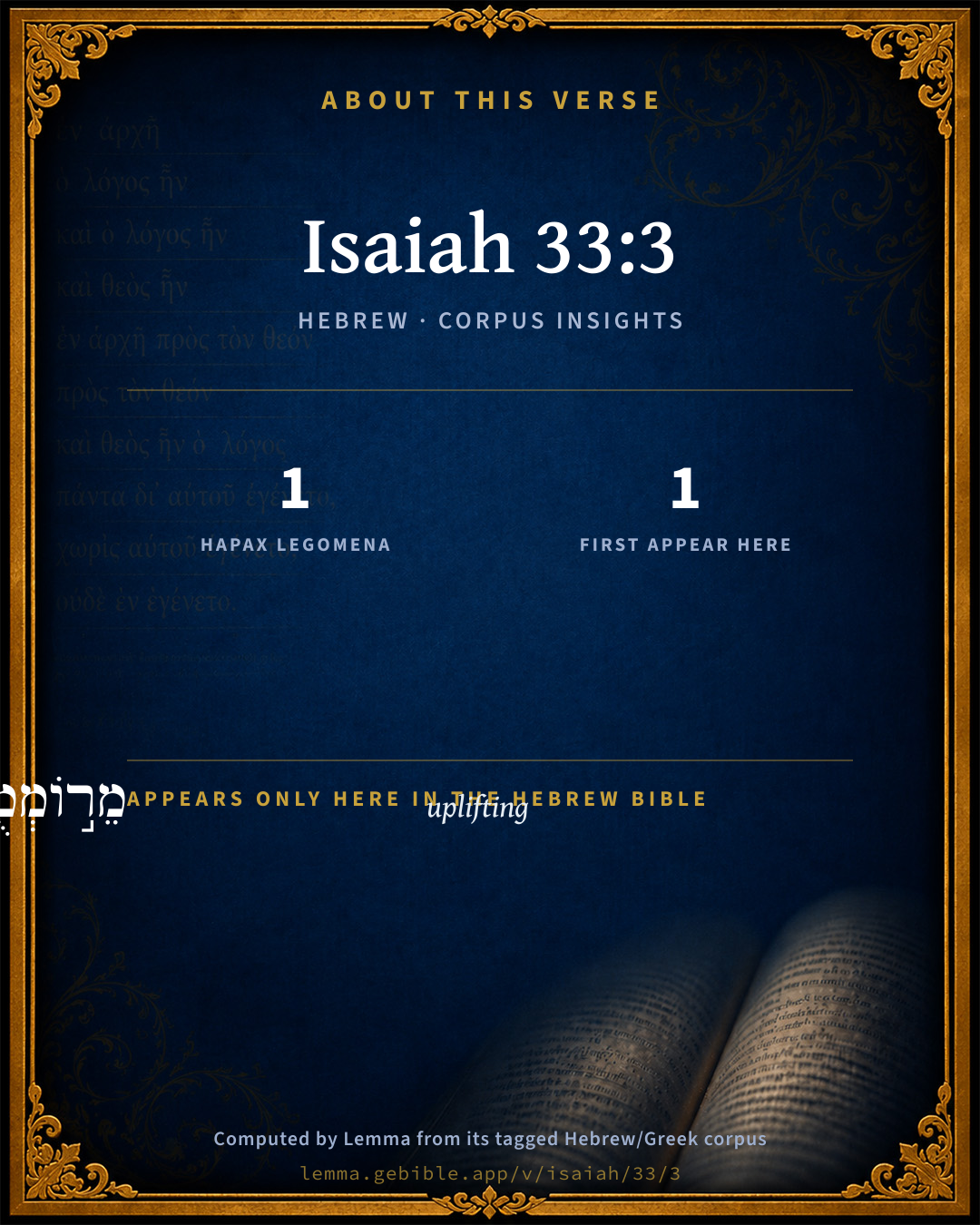
  • 1 hapax legomenon — only here in the Hebrew Bible
  • 1 first appearance in the Hebrew Bible
Full analysis ↓
Download a study sheet

One document with this verse’s original text, its word-by-word gloss line, the meaning frame, cross-references with their text, attributed commentary, and full source and license credits — printable, and it pastes into notes with its structure intact.

This verse Autodidact and up

Study sheet (.html) Plain text (.txt)

A passage Seminary Student

Up to 50 verses in one chapter. A passage sheet keeps up to 6 commentary sources and 12 cross-references per verse, in the order this page ranks them, and says so on the sheet whenever that leaves anything out. Ask for a single verse and you get the Autodidact verse sheet above.

Everything on this page stays free to read, with no account — the sheet is a download of what is already on screen, not access to it.

Want to remove ads? Support Godless Engineer
Compare translations 3

The same verse in 3 English versions, stacked beneath the original-language interlinear above. Click any original word for its lexicon entry.

Each is an independent rendering of the whole verse — the interlinear is not word-aligned to these translations.

Highlighted words mark where these versions differ — a whole-verse word diff, not a word-by-word alignment.

  • World English Bible Public Domain
    At the noise of the thunder the peoples are fled; at the lifting up of yourself the nations are scattered.
  • King James Version Public Domain
    At the noise of the tumult the people fled; at the lifting up of thyself the nations were scattered.
  • unfoldingWord Literal Text CC BY-SA 4.0
    At the sound of a tumult, peoples flee; at your exaltation, nations scatter.

unfoldingWord Literal Text — © unfoldingWord, licensed CC BY-SA 4.0. Word-aligned USFM3 via Door43 (git.door43.org/unfoldingWord/en_ult).

Versions to compare (up to 4)

3 of 4 selected

Show all 18 translations

Every available English version of this verse, each an independent rendering of the whole verse.

  • World English Bible Public Domain
    At the noise of the thunder the peoples are fled; at the lifting up of yourself the nations are scattered.
  • Berean Standard Bible Public Domain
    The peoples flee the thunder of Your voice; the nations scatter when You rise.
  • Majority Standard Bible Public Domain
    The peoples flee the thunder of Your voice; the nations scatter when You rise.
  • King James Version Public Domain
    At the noise of the tumult the people fled; at the lifting up of thyself the nations were scattered.
  • American Standard Version (1901) Public Domain
    At the noise of the tumult the peoples are fled; at the lifting up of thyself the nations are scattered.
  • Revised Version (1885) Public Domain
    At the noise of the tumult the peoples are fled; at the lifting up of thyself the nations are scattered.
  • Geneva Bible (1599) Public Domain
    At the noise of the tumult, the people fled: at thine exalting the nations were scattered.
  • Douay-Rheims (1899) Public Domain
    At the voice of the angel the people fled, and at the lifting up thyself the nations are scattered.
  • Young's Literal Translation Public Domain
    From the voice of a multitude fled have peoples, From thine exaltation scattered have been nations.
  • Literal Standard Version CC BY-SA 4.0
    From the voice of a multitude peoples have fled, || From Your exaltation nations have been scattered.
  • Unlocked Literal Bible CC BY-SA 4.0
    At the loud noise the peoples flee; when you arise, the nations are scattered.
  • unfoldingWord Literal Text CC BY-SA 4.0
    At the sound of a tumult, peoples flee; at your exaltation, nations scatter.
  • Darby Bible Public Domain
    At the noise of the tumult the peoples fled; at the lifting up of thyself the nations were scattered.
  • World Messianic Bible Public Domain
    At the noise of the thunder, the peoples have fled. When you lift yourself up, the nations are scattered.
  • Webster's Bible Public Domain
    At the noise of the tumult the people fled; at the lifting up of thyself the nations were scattered.
  • Free Bible Version CC BY-SA 4.0
    When you roar, the peoples run away; when you prepare for action, the nations scatter!
  • Bible in Basic English Public Domain
    At the loud noise the peoples have gone in flight; at your coming up the nations have gone in all directions.
  • JPS Tanakh (1917) Public Domain
    At the noise of the tumult the peoples are fled; at the lifting up of Thyself the nations are scattered.

Literal Standard Version (2020), Covenant Press — licensed CC BY-SA 4.0. Text via the HelloAO Bible API (eBible.org). Unlocked Literal Bible (unfoldingWord) — licensed CC BY-SA 4.0. Text via the HelloAO Bible API (eBible.org). unfoldingWord Literal Text — © unfoldingWord, licensed CC BY-SA 4.0. Word-aligned USFM3 via Door43 (git.door43.org/unfoldingWord/en_ult). Free Bible Version, Dr. Jonathan Gallagher — licensed CC BY-SA 4.0. Text via the HelloAO Bible API (eBible.org).

Word by word

More ways to search: Search by grammar → Find every occurrence → Compare this word →

Practice this passage: Drill this verse → Learn its vocabulary →

About this verse

These counts appear in no published source. They are computed here, from the morphology-tagged text and Lemma’s own curated glosses. What Lemma adds →

7
words
7
distinct lemmas
Prophets
section

Notable vocabulary

1 hapax legomenon — a word that appears only here in the entire Hebrew Bible:

  • מֵר֣וֹמְמֻתֶ֔ךָ uplifting H7427

First appearance in Scripture

This word makes its first canonical appearance in the Hebrew Bible here:

  • מֵר֣וֹמְמֻתֶ֔ךָ uplifting H7427

Shared distinctive vocabulary

נָפְצ֖וּ to shatter H5310 occurs in 17 verses of the Hebrew Bible. Also found in:

Grammatical profile

  • 2 verbs
  • 5 nouns

Verb forms

  • נָדְד֖וּ Qal · Perfect
  • נָפְצ֖וּ Qal · Perfect

Hebrew & Septuagint length

In English translation the verse runs 20 words from the Hebrew and 19 from the Septuagint (LXX English) — closely comparable.

A rough comparison of the two English renderings, which tokenize alike — not a word-level alignment.

Word counts can differ between the Hebrew and the Greek without any difference in meaning — e.g. the Hebrew direct-object marker אֵת has no separate Greek word, and Greek often adds the article ὁ.

Cross-references

7

Topical passages linked to Isaiah 33:3 in the Treasury of Scripture Knowledge — connected by theme and wording, ordered by reader-vote popularity; previews shown in the World English Bible.

  • Isaiah 10:13–14 For he has said, By the strength of my hand I have done it, and by my wisdom; for I have understanding: and I have removed the bounds of the peoples, and have robbed their treasures, and like a valiant man I have brought down those who sit [on thrones]:
  • Psalms 46:6 The nations raged. The kingdoms were moved. He lifted his voice, and the earth melted.
  • Isaiah 10:32–34 This very day shall he halt at Nob: he shakes his hand at the mountain of the daughter of Zion, the hill of Jerusalem.
  • Isaiah 17:12–14 Ah, the uproar of many peoples, who roar like the roaring of the seas; and the rushing of nations, that rush like the rushing of mighty waters!
  • Isaiah 37:11–18 Behold, you have heard what the kings of Assyria have done to all lands, by destroying them utterly: and shall you be delivered?
  • Isaiah 59:16–18 He saw that there was no man, and wondered that there was no intercessor: therefore his own arm brought salvation to him; and his righteousness, it upheld him.
  • Isaiah 37:29–36 Because of your raging against me, and because your arrogance is come up into my ears, therefore will I put my hook in your nose, and my bridle in your lips, and I will turn you back by the way by which you came.

Cross-references courtesy of OpenBible.info (CC BY 4.0).

Hebrew and Greek witnesses Masoretic Hebrew ↔ Greek Septuagint

The same verse in the two great witnesses to the Old Testament, shown verse-for-verse.

These are two independent witnesses, not word-aligned to each other, and the Septuagint is shown in lemma (dictionary) form.

Hebrew Isaiah 33:3 Masoretic · Westminster Leningrad Codex

מִקּ֣וֹל הָמ֔וֹן נָדְד֖וּ עַמִּ֑ים מֵר֣וֹמְמֻתֶ֔ךָ נָפְצ֖וּ גּוֹיִֽם

At the noise of the thunder the peoples are fled; at the lifting up of yourself the nations are scattered.

World English Bible · Public Domain

Greek LXX Isaiah 33:3 Septuagint · lemma form

διά φωνή ὁ φόβος σύ ἐκἵστημι λαός ἀπό ὁ φόβος σύ καί διασπείρω ὁ ἔθνος

By reason of the terrible sound the nations were dismayed for fear of you, and the heathen were scattered.

LXX2012 (modern English Septuagint) · Public Domain

On this verse, Adam Clarke's Commentary discusses the Septuagint’s reading. Read the note in Commentary ↓

Hebrew: Westminster Leningrad Codex (CC BY 4.0). Greek: Septuagint (public domain); English from LXX2012 (modern English Septuagint) (Public Domain). How the Septuagint differs from the Hebrew →

Targum (Aramaic paraphrase)

1

The Targum is the ancient Jewish Aramaic paraphrase of the Hebrew Scriptures — an interpretive translation, not the Hebrew text itself. Onkelos (literal) and Pseudo-Jonathan (expansive) render the Torah, and Jonathan the Prophets. Coverage is partial: where no permissively-licensed English translation exists for a verse, only the Aramaic is shown. This is verse-level text, not a word-by-word alignment to the Hebrew.

  1. Targum Jonathan Prophets (Joshua–Malachi)
    מִקַל הֲמוֹן אִתְבְּרוּ עַמְמַיָא מִסְגֵי גְבוּרָן אִתְבַּדָרוּ מַלְכְוָתָא:

    At the voice of a tumultuous noise the people are afraid, on account of the multitude of mighty actions kingdoms are scattered.

    Targum Jonathan — Aramaic: “Mikraot Gedolot” (public domain). English: “Sefaria Community Translation” (CC0 1.0 (public-domain dedication)); “London "Chaldee Paraphrase," 1871” (public domain). Text via Sefaria.

Commentary

Notes on Isaiah 33:3 from classic Christian and Jewish commentators (each source and its license shown beneath its notes). The classic Christian expositions comment on the surrounding passage and are grouped to its opening verse, so a note may address several verses; the Jewish commentaries on the Tanakh (Rashi and others) are per-verse, so they appear only where the commentator wrote on this verse.

Lemma curates 59 commentaries, every one of them public domain or Creative Commons licensed, each selected and text-cleaned for this edition rather than reprinted as found. About our sources →

The Cambridge Bible for Schools and Colleges

gen. ed. J. J. S. Perowne

3. At the noise of the tumult] the convulsions which attend the manifestation of Jehovah. The phrase is found in 1Ki_18:41 of a rain storm, and in Isa_13:4 of a multitudinous host.

3, 4. Assurance of Jehovah’s victory, founded on the great deliverances of the past. The perfects in Isa_33:3 may be either those of experience, expressing a general truth often verified in history, or of prophetic assurance. Isa_33:4 seems to apply this truth to the present crisis.

The Cambridge Bible for Schools and Colleges (gen. ed. J. J. S. Perowne; Cambridge University Press, 1878–1918) — public domain. Text from a community e-Sword module.

Trapp's Complete Commentary

John Trapp

Isa 33:3 At the noise of the tumult the people fled; at the lifting up of thyself the nations were scattered.

Ver. 3. At the noise of the tumult the people fled,] i.e., The Assyrian soldiers shall flee at the coming of the angel, with a hurry noise in the air for greater terror; {a} but he shall give them their passport. This their confidence was the fruit of prayer.

At the lifting up of thyself.] If God do but "arise" only, "his enemies shall be scattered; and all that hate him shall flee before him." {Psa 68:1} {See Trapp on "Psa 68:1"}

{a} A voce angeli. - Vulg.

John Trapp, A Commentary or Exposition upon All the Books of the Old and New Testament (1647–1656) — public domain. Text from a community e-Sword module.

Joseph Benson's Commentary

Isa 33:3-4. At the noise of the tumult — Which shall be made upon the angel’s destroying the army; the people fled — Namely, those of the army who escaped that stroke. At the lifting up of thyself — To execute judgment; the nations were scattered — The people of divers nations which made up Sennacherib’s army. And your spoil — That treasure which you have raked together by spoiling divers people; shall be gathered — By the Jews at Jerusalem, when you shall be forced to flee away with all possible speed, leaving your spoils behind you; like the gathering of the caterpillar — As caterpillars gather and devour all the fruits of the earth, which was a common plague in those countries; as the running to and fro of locusts, &c. — As locusts, especially when they are armed by commission from God, come with great force, and run hither and thither devouring every thing before them; shall he run upon them — Namely, Hezekiah, with his people, shall thus eagerly run to the spoil of the Assyrian camp, and shall take it.

Joseph Benson's Commentary on the Old and New Testaments (1811–1818) — public domain. Text from a community e-Sword module.

Geneva Bible (1599)

Geneva Bible translators

When thou, O Lord, didst lift up thine arm to punish thine enemies.

That is, the Assyrians fled before the army of the Chaldeans, or the Chaldeans for fear of the Medes and Persians.

Geneva Bible (1599) marginal notes — public domain. Text via Bolls.life.

Jamieson, Fausset & Brown

Robert Jamieson, A. R. Fausset & David Brown

the tumult--the approach of Jehovah is likened to an advancing thunderstorm (Isa 29:6; Isa 30:27), which is His voice (Rev 1:15), causing the people to "flee."

nation--the Assyrian levies.

Jamieson, Fausset & Brown — Commentary Critical and Explanatory on the Whole Bible (1871) — public domain (CC PDM 1.0). Text via the HelloAO Bible API.

Adam Clarke's Commentary

Verse 3. At the noise of the tumult - "From thy terrible voice"] For המון hamon, "multitude," the Septuagint and Syriac read amica, "terrible," whom I follow.

Adam Clarke's Commentary on the Bible (1810–1826) — public domain. Text from a community e-Sword/MySword module.

Ellicott's Commentary for English Readers

(3) At the noise of the tumult . . .—The “people” are the mingled nations of the Assyrian armies; the “tumult” is that of the rush and crash, as of a mighty tempest, when Jehovah should at last up lift Himself for the deliverance of His chosen ones.

A Bible Commentary for English Readers, edited by Charles John Ellicott (1878–1897) — public domain. Text from a community e-Sword module.

John Gill's Exposition

At the noise of the tumult the people fled,.... The Vulgate Latin Version renders it, "at the voice of the angel"; and Jerom reports it as the opinion of the Jews, that it was Gabriel; and many interpret the words either of the noise the angel made in the air, or was made in the Assyrian camp, when the angel descended, and smote such a vast number of them, at which the remnant, being frightened, fled, Kg2 19:35 but either this is to be understood as expressing what had been done in time past, and therefore the church took encouragement that it might and would be so again; or as a continuance of her prayer, thus, "at the noise of the tumult", or multitude (t), "let the people flee" (u); or as a prediction, "they shall flee" (w); that is, at the noise of the multitude of saints, the faithful, called, and chosen armies of heaven, that follow Christ on white horses, and clothed in white; when he shall go forth to battle with the kings of the earth, beast, and false prophet, let the people under them flee, or they shall flee, and not be able to stand before so puissant a General, and so powerful an army; see Rev 17:14,

at the lifting up of thyself, the nations were scattered; so it has been in times past, when the Lord has lifted up himself, and appeared on behalf of his people, and has exerted himself, and displayed his power; and so it will be again; or so let it be: "let the nations be scattered"; the antichristian nations, as they will be, when the Lord shall lift up his hand, and pour out the vials of his wrath upon them.

(t) "a voce multitudinis", Pagninus; "a voce turbae", Montanus, Cocceius. (u) Fugiant, so some in Gataker. (w) Profugient, Piscator.

John Gill's Exposition of the Whole Bible (1746–1763) — public domain (CC PDM 1.0). Text via the HelloAO Bible API.

Albert Barnes' Notes on the Bible

At the noise of the tumult - Lowth supposes that this is addressed by the prophet in the name of God, or rather by God himself to the Assyrian, and that it means that notwithstanding the terror which he had caused the invaded countries, he would himself fall and become an easy prey to those whom he intended to subdue. But probably it should be regarded as a part of the address which the Jews made to Yahweh Isa 33:2, and the word ‘tumult’ - המון hâmôn, sound, noise, as of rain 1Ki 18:41, or of music Eze 26:13; Amo 5:23, or the bustle or tumult of a people 1Sa 4:11; 1Sa 14:19; Job 39:7 - refers here to the voice of God by which the army was overthrown. Yahweh is often represented as speaking to people in a voice suited to produce consternation and alarm. Thus it is said of the vision which Daniel saw of a man by the side of the river Hiddekel, ‘his words’ were ‘like the voice of a multitude’ (המון hâmôn), Dan 10:6. And thus, in Rev 1:10, the voice of Christ is said to have been ‘like the voice of a trulupet;’ and in Isa 33:15, ‘like the sound of many waters.’ It wilt be recollected also that it was said that God would send upon the Assyrian army ‘thunder, and an earthquake, and a great noise, with storm and tempest, and a flame of devouring fire’ (Isa 29:6; compare Isa 30:30); and it is doubtless to this prediction that the prophet refers here. God would come forth with the voice of indignation, and would scatter the combined armies of the Assyrian.

The people fled - The people in the army of the Assyrian. A large part of them Were slain by the angel of the Lord in a single night, but a portion of them with Sennacherib escaped and fled to their own land (Isa 37:36-37.

At the lifting up of thyself - Of Yahweh; as when one rouses himself to strike.

The nations - The army of Sennacherib was doubtless made up of levies from the nations that had been subdued, and that composed the Assyrian empire.

Albert Barnes' Notes on the Bible (1834–1885) — public domain. Text from a community e-Sword/MySword module.

Matthew Poole's English Annotations

At the noise of the tumult, which the angel shall make in destroying the army.

The people; those of the army who escaped that stroke.

The nations; the people of divers nations, which made up his army.

Matthew Poole's English Annotations on the Holy Bible (1683–1685) — public domain. Text from a community e-Sword/MySword module.

Whedon's Commentary on the Bible

Daniel D. Whedon

3, 4. The prophet is not left in doubt. He sees the answer. The deliverance is yet future, but he sees it as if it were past, or now transpiring.

At the noise of the tumult the people (Assyrian) fled; at the lifting up of thyself — Words figuratively expressing the silent power of Jehovah in destroying the enemy. See Isa_37:36-37. A demonstration of thunder and great noise from the heavens is unnecessarily assumed by some.

Your spoil — That of the destroyed and routed armies.

Shall be gathered — By the inhabitants of Jerusalem going to the evening’s abandoned camps, and, like hungry locusts and caterpillars, (as they sweep clean every thing on which they light,) hastily seizing every thing they find.

Daniel D. Whedon (gen. ed.), Commentary on the Old and New Testaments (1874–1909) — public domain. Text from a community e-Sword module.

The Pulpit Commentary

At the noise of the tumult the people fled; rather, the peoples; i.e. the contingents from many nations which made up the huge army of Sennacherib. The "noise" is that caused by God "lifting up himself". (comp. Psa_29:3-9)

The Pulpit Commentary (1880–1919), ed. H.D.M. Spence-Jones & Joseph S. Exell — public domain. Text from a community e-Sword module.

John Wesley's Explanatory Notes

The noise - Which the angel shall make in destroying the army. The people - Those of the army, who escaped that stroke. The nations - The people of divers nations, which made up this army.

John Wesley, Explanatory Notes Upon the Whole Bible (1754–1765) — public domain. Text via the GEBible commentary corpus.

Keil & Delitzsch

C. F. Keil & F. Delitzsch

While the prophet is praying thus, he already sees the answer. "At the sound of a noise peoples pass away; at Thy rising nations are scattered. And your booty is swept away as a swarm of locusts sweeps away; as beetles run, they run upon it." The indeterminate hâmōn, which produces for that very reason the impression of something mysterious and terrible, is at once explained. The noise comes from Jehovah, who is raising Himself judicially above Assyria, and thunders as a judge. Then the hostile army runs away (נפצוּ = נפצּוּ, from the niphal נפץ, Sa1 13:11, from פּץ = נפוץ, from פּוּץ); and your booty (the address returns to Assyria) is swept away, just as when a swarm of locusts settles on a field, it soon eats it utterly away. Jerome, Cappellus, and others follow the Septuagint rendering, ὃν τρόπον ἐάν τις συναγάγη ἀκρίδας. The figure is quite as appropriate, but the article in hechâsı̄l makes the other view the more natural one; and Isa 33:4 places this beyond all doubt. Shâqaq, from which the participle shōqēq and the substantive masshâq are derived, is sued here, as in Joe 2:9, to signify a busy running hither and thither (discursitare). The syntactic use of shōqēq is the same as that of קרא (they call) in Isa 21:11, and sōphedı̄m (they smite) in Isa 32:12. The inhabitants of Jerusalem swarm in the enemy's camp like beetles; they are all in motion, and carry off what they can.

Keil & Delitzsch — Biblical Commentary on the Old Testament (1861–1891) — public domain (CC PDM 1.0). Text via the HelloAO Bible API. (Old Testament only.)

J. A. Alexander on Isaiah

Joseph Addison Alexander

“At a noise of tumult (or tumultuous noise) the peoples flee; at Thy rising the nations are scattered.” The rising meant is the act of rising from a state of seeming inaction, or as when one rouses himself to strike. These words are commonly applied to the divine interposition in the case of Sennacherib’s attack upon Jerusalem.

Joseph Addison Alexander, The Prophecies of Isaiah (1846–1847; New York: Scribner, 1870–1878) — public domain. Text from a community e-Sword module.

unfoldingWord translationNotes

Door43 World Missions Community

At the loud noise the peoples flee

Possible meanings of "the loud noise" are 1) it refers to Yahweh's voice. AT: "The peoples flee at the sound of your loud voice" or 2) it refers the loud sounds of Yahweh's army. AT: "The people flee at the sound of your army" (See: Assumed Knowledge and Implicit Information)

arise

This means to begin doing something. AT: "begin acting" (See: Idiom)

the nations are scattered

This can be written in active form. AT: "the nations scatter" (See: Active or Passive)

Your spoil is gathered as the locusts gather; as locusts leap, men leap on it

This compares how quick and eager Yahweh's people are when they gather the spoils from their enemies to the eagerness of locusts when they gather food. This can be stated in active form. AT: "Your people gather spoils from your enemies with the same fierceness as the locusts have who devour green plants" (See: Simile and Active or Passive)

translationWords

nation

unfoldingWord translationNotes — © Distant Shores Media and the Door43 World Missions Community, licensed CC BY-SA 4.0. Source: git.door43.org/Door43/en_tn.

Rashi

Rabbi Shlomo Yitzchaki (Rashi)

From the sound of roaring that emanated from before You, peoples wandered until here when You performed wondrous miracles for us.

Rashi on the Tanakh — English translations: “The Judaica Press complete Tanach with Rashi, translated by A. J. Rosenberg” (CC BY 4.0); “Pentateuch with Rashi's commentary by M. Rosenbaum and A.M. Silbermann, 1929-1934” (public domain); “The Metsudah Tanach series, Lakewood, N.J” (CC BY 4.0); and “The Book of Joshua, Metsudah Publications, 1997” (CC BY 4.0). Text via Sefaria.

Ibn Ezra

Rabbi Abraham ibn Ezra

The tumult of Assyria.

מרממתך By Thy honour. The honour which Thou hast given him.

Ibn Ezra on the Tanakh — English translations: “Sefaria Community Translation” (CC0 1.0 (public-domain dedication)); “Yalkut, Sifsei Chachomim Chumash, Metsudah Publications, 2009” (CC BY 4.0); and “Commentary of Ibn Ezra on Isaiah - trans. by M. Friedlander, 1873” (public domain). Text via Sefaria.

Lesson kit

Teaching starters — assembled from the data on this page, not authored interpretation. Every prompt links to the verse data it draws on. Edit before teaching.

Isaiah, in the Prophets, opens this verse with 7 words (7 distinct Hebrew lemmas). Its most distinctive word is rômêmuth (“uplifting”). A historical commentator’s framing appears above. Read the whole chapter for the surrounding context.

Discussion questions

  1. How does “uplifting” (rômêmuth) shape what this verse is saying?
  2. This verse holds 1 word here found nowhere else in the Hebrew Bible. What might the rare word draw attention to?
  3. The word “uplifting” first appears here in Scripture. What is being introduced at this debut?
  4. Genesis 9:19 shares the word «to shatter» with this verse. How do the two illuminate each other?
  5. These translations render this verse differently. What is at stake in choosing one wording over another?
  6. The verb «נָדְד֖וּ» is Qal Perfect. How does its form color the action?
  7. Reading how The Cambridge Bible for Schools and Colleges and Trapp's Complete Commentary read this verse, where do the two commentators agree and where do they part?

Things to notice

  • 1 word in this verse appears nowhere else in the Hebrew Bible.
  • 1 word makes its first canonical appearance in Scripture here.
  • These translations choose different wording for 15 words in this verse.
  • 7 distinct Hebrew lemmas span 7 words in this verse.

Reading settings

Reading text

Shown beneath each verse's original-language words.

Old Testament
Old Testament edition

Read the OT as the Masoretic Hebrew (MT) or the Greek Septuagint (LXX).

English shown for the Greek Septuagint (in the Hebrew ↔ Greek comparison).

Comparing translations? Open the Compare panel on any verse page to stack up to four side by side.