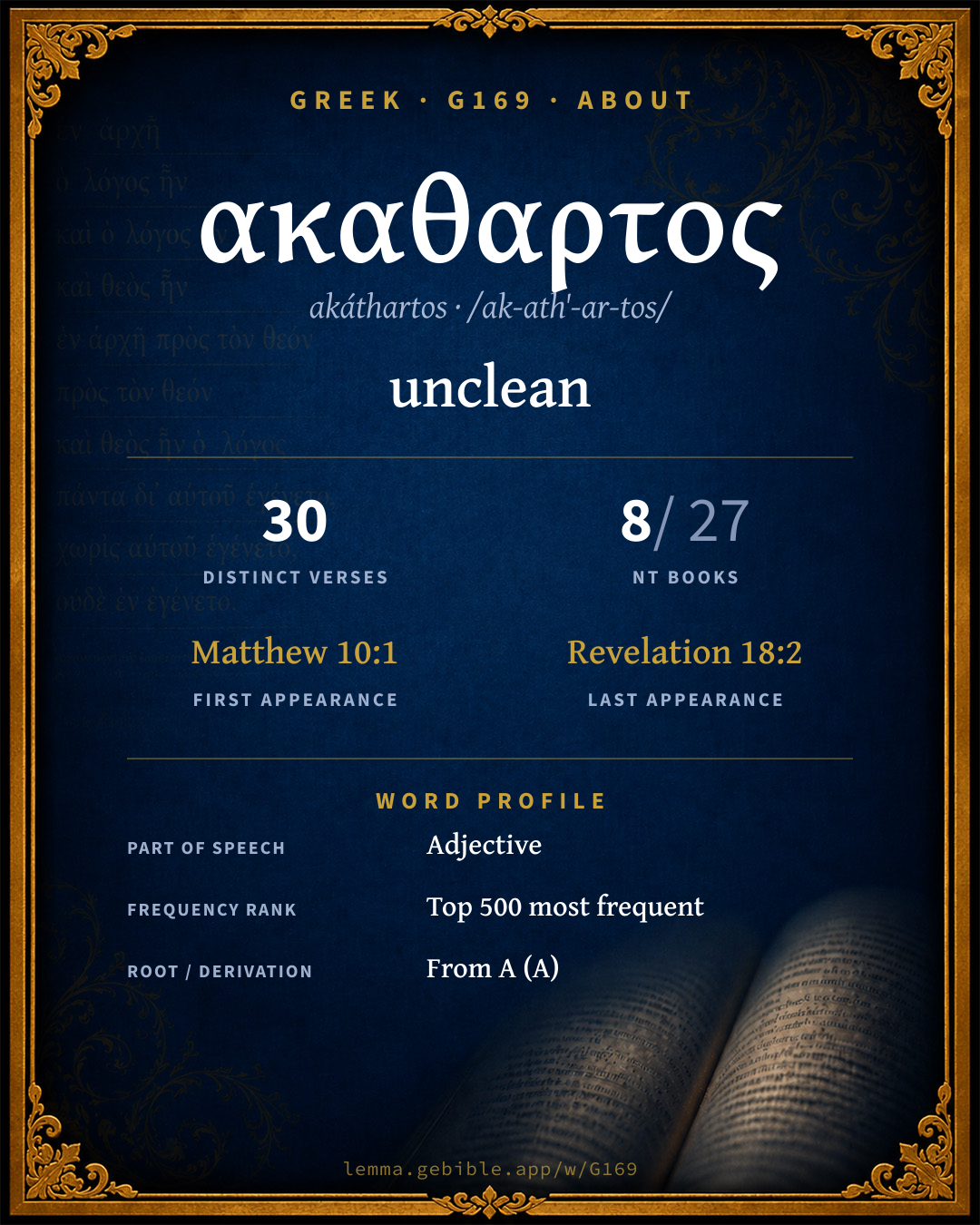
ἀκάθαρτος
unclean
Full lexicon entry — Thayer's Greek Lexicon
From Thayer's Greek Lexicon
Where this word appears
See every Accusative-case word in the Greek New Testament →
Grammar key — what these labels mean
Part of speech
- Adjective
- A word that describes or qualifies a noun.
Case
- Dative
- The case of the indirect object, means, or location — “to / for / with / in.”
- Accusative
- The case of the direct object and of extent.
- Genitive
- The case of source, possession, or “of” — answers “whose / from what.”
- Nominative
- The case of the subject (and the predicate nominative).
Gender
- Neuter
- Grammatically neuter.
- Masculine
- Grammatically masculine.
Number
- Singular
- One.
- Plural
- More than one.
Every verse where G169 appears in the Book of Acts — 5 distinct verses. Click any verse to open its interlinear word-by-word view. Verse text shown in the World English Bible for context — . Each verse’s Greek form is shown with its reference; the English is not keyword-highlighted, since the data carries no word-level English alignment. Use “Compare translations” on any verse to read it across multiple English versions. This concordance covers the Greek New Testament; Septuagint (Greek Old Testament) occurrences of this word are not indexed here.
Acts
- Acts 5:16 ἀκαθάρτων adj gen pl neut Multitudes also came together from the cities around Jerusalem, bringing sick people, and those who were tormented by unclean spirits: and they were all healed.
- Acts 8:7 ἀκάθαρτα adj acc pl neut For unclean spirits came out of many of those who had them. They came out, crying with a loud voice. Many who had been paralyzed and lame were healed.
- Acts 10:14 ἀκάθαρτον adj acc sg neut But Peter said, "Not so, Lord; for I have never eaten anything that is common or unclean."
- Acts 10:28 ἀκάθαρτον adj acc sg masc He said to them, "You yourselves know how it is an unlawful thing for a man who is a Jew to join himself or come to one of another nation, but God has shown me that I shouldn't call any man unholy or unclean.
- Acts 11:8 ἀκάθαρτον adj acc sg neut But I said, 'Not so, Lord, for nothing unholy or unclean has ever entered into my mouth.'
About this entry
At a glance — auto-summarized from this page’s data, not written by a person. Every figure links to its source below. This summary describes the numbers; it doesn’t interpret them.
ακαθαρτος (akáthartos) is a Greek adjective most often rendered “unclean.” Its earliest occurrence is Matthew 10:1. It turns up in 30 verses across 8 books, a moderately common footprint. It concentrates in Mark, which alone accounts for 37% of its uses. Related forms include Α, αβαρης and αβυσσος. Dig into 30-verse concordance and the renderings breakdown below.
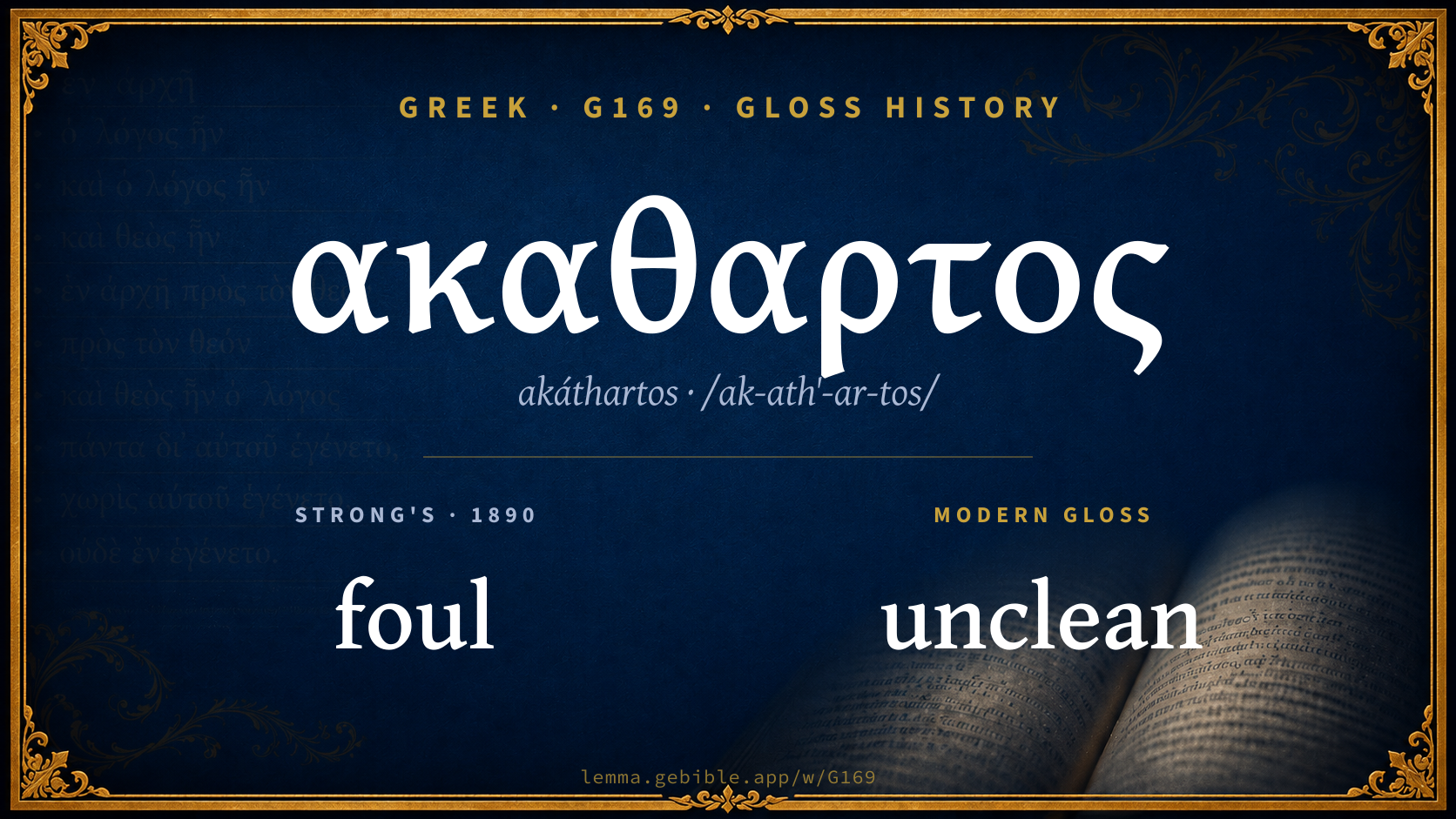
Gloss history
Strong's 1890 vs modern scholarship
About this word
Strong's G169 catalogs a Greek word from the Greek New Testament.
These counts are not copied from any lexicon or concordance. They are computed here, from the morphology-tagged Greek New Testament. What Lemma adds →
- 30
- distinct verses
- The word appears in 30 distinct verses.
- 8 / 27
- NT books
- The word appears in 8 of 27 New Testament books.
- #448
- by frequency
- Top 500 most frequent Greek words (rank 448 of 5,347 Greek words by occurrence).
View all 30 occurrences in the concordance →
By section of the New Testament
By traditional corpus
Conventional, traditional groupings — biblical authorship is debated, so this is a traditional corpus grouping, not an authorship claim. Some books belong to more than one corpus (Luke is in both the Gospels and the Lukan corpus, and so on), so these shares overlap and need not total 100%. Each figure is a share of the word’s 30 distinct verses.
- Gospels 19 verses · 63%
- Lukan (Luke–Acts) 11 verses · 37%
- Johannine 3 verses · 10%
- Pauline corpus 3 verses · 10%
- Revelation 3 verses · 10%
How translations render this word
Counts come from each version’s own published word-to-Strong’s tagging or interlinear alignment — an approximate guide to how each version renders this word, not a word-level alignment the data otherwise carries. Because each total is that version’s own tagged count, the per-version totals vary from one another and need not match the appearance or distinct-verse counts above. These counts may also differ from a printed concordance because Lemma counts each distinctly tagged rendering and does not collapse phrase taggings into a single head-word total. This is a fixed set of word-tagged versions (KJV, ASV, BSB, ULT) and does not change with the reading translation you choose elsewhere. Each version’s license is shown beside its name below (and on Sources).
- King James Version: Unclean 25×, Foul 2×
- American Standard Version: Unclean 26×
- Berean Standard Bible: Unclean 27×
- unfoldingWord Literal Text: Unclean 29×
King James Version Public Domain
Renders G169 across 30 tagged occurrences — most commonly:
Plus 3 renderings that appear only once — usually multi-word phrases or single function words the recovered tagging swept in, not distinct renderings.
American Standard Version Public Domain
Renders G169 across 30 tagged occurrences — most commonly:
Plus 4 renderings that appear only once — usually multi-word phrases or single function words the recovered tagging swept in, not distinct renderings.
Berean Standard Bible Public Domain
Renders G169 across 31 tagged occurrences — most commonly:
Plus 4 renderings that appear only once — usually multi-word phrases or single function words the recovered tagging swept in, not distinct renderings. Not rendered by a distinct English word in 1 further occurrence.
unfoldingWord Literal Text CC BY-SA 4.0
Renders G169 across 31 tagged occurrences — most commonly:
Plus 2 renderings that appear only once — usually multi-word phrases or single function words the recovered tagging swept in, not distinct renderings.
Senses in Thayer's
The 1 sense Thayer's distinguishes for this word, in lexicon order (not ranked by frequency or importance). The full entry — with sub-senses — is in the Lexicon Entry tab.
- not cleansed, unclean
Word origin
Derived from Α (A) (G1) — alpha.
Forms in the corpus
The 8 distinct written forms G169 takes in the Greek New Testament, most frequent first — each parse links to that case’s occurrences in the concordance.
| Form | Parsing | Example | Uses |
|---|---|---|---|
| ἀκάθαρτον akátharton | Adjective, Accusative, Singular, Neuter | Mark 3:30 | 9 |
| ἀκάθαρτα akátharta | Adjective, Accusative, Plural, Neuter | Acts 8:7 | 5 |
| ἀκαθάρτῳ akathártō | Adjective, Dative, Singular, Neuter | Mark 1:23 | 5 |
| ἀκαθάρτου akathártou | Adjective, Genitive, Singular, Neuter | Luke 4:33 | 4 |
| ἀκαθάρτων akathártōn | Adjective, Genitive, Plural, Neuter | Matthew 10:1 | 4 |
| ἀκαθάρτοις akathártois | Adjective, Dative, Plural, Neuter | Mark 1:27 | 2 |
| ἀκάθαρτά akáthartá | Adjective, Nominative, Plural, Neuter | 1 Corinthians 7:14 | 1 |
| ἀκάθαρτος akáthartos | Adjective, Nominative, Singular, Masculine | Ephesians 5:5 | 1 |
Same root — word family
Other Thayer's entries built from the same root as G169, grouped by Strong’s listed origin. These share a root / origin per the lexicon — not necessarily a shared meaning. Each links to that word’s own entry.
Derives from
Shares the same root
- αβαρης abarḗs G4 light
- αβυσσος ábyssos G12 abyss
- αγαμος ágamos G22 unmarried
- αγενεαλογητος agenealógētos G35 without genealogy
- αγενης agenḗs G36 ignoble
- αγναφος ágnaphos G46 unprocessed
- αγνοεω agnoéō G50 to be ignorant
- αγνωσια agnōsía G56 ignorance
- αγνωστος ágnōstos G57 unknown
- αγραμματος agrámmatos G62 unlearned
- αγρυπνεω agrypnéō G69 to watch
- αδαπανος adápanos G77 free
- αδελφος adelphós G80 brother
- αδηλος ádēlos G82 obscure
- αδης háidēs G86 hell
- αδιακριτος adiákritos G87 clear
- αδιαλειπτος adiáleiptos G88 continual
- αδικος ádikos G94 unjust
- αδοκιμος adókimos G96 unapproved
- αδολος ádolos G97 guileless
- αδυνατος adýnatos G102 weak
- αζυμος ázymos G106 unleavened
- αθανασια athanasía G110 immortal
- αθεμιτος athémitos G111 unlawful
+149 more words share this root (not shown).
Derived from this word
Proper names from this root
People and places named from this root — a name, not an additional meaning of the word.
Compare all same-root words → Showing 4 of 178 — not the complete family. 1 of the same-root words is a proper name (a person or place). They share a root, not necessarily a meaning.
Septuagint usage
The same Greek word ακαθαρτος appears 153 times in the Greek Old Testament (Septuagint), across 124 verses in 14 books.
- 153
- LXX occurrences
- Tagged occurrences of this Greek word in the Septuagint.
- 124
- verses
- Distinct Septuagint verses containing this word.
- 14 / 39
- OT books
- The word appears in 14 of the 39 Old Testament books.
Sample Septuagint occurrences
- Leviticus 5:2 ἀκάθαρτος
- Numbers 5:2 ἀκάθαρτος
- Deuteronomy 12:15 ἀκάθαρτος
- Judges 13:4 ἀκάθαρτος
- 2 Chronicles 23:19 ἀκάθαρτος
- Job 15:16 ἀκάθαρτος
- Proverbs 3:32 ἀκάθαρτος
- Ecclesiastes 9:2 ἀκάθαρτος
- Isaiah 6:5 ἀκάθαρτος
- Lamentations 4:15 ἀκάθαρτος
- Ezekiel 4:13 ἀκάθαρτος
- Hosea 8:13 ἀκάθαρτος
Septuagint occurrences (same lexeme)
Every verse where the same Strong’s number (G169) appears in the Greek Septuagint — showing the first 50 of 124. Verse text shown in the World English Bible for context; the Greek form is the matched word — the English is not keyword-highlighted.
- Leviticus 5:2 ἀκάθαρτος "'Or if anyone touches any unclean thing, whether it is the carcass of an unclean animal, or the carcass of unclean cattle, or the carcass of unclean creeping things, and it is hidden from him, and he is unclean, then he shall be guilty.
- Leviticus 7:19 ἀκάθαρτος "'The flesh that touches any unclean thing shall not be eaten. It shall be burned with fire. As for the flesh, everyone who is clean may eat it;
- Leviticus 7:21 ἀκάθαρτος When anyone touches any unclean thing, the uncleanness of man, or an unclean animal, or any unclean abomination, and eats some of the flesh of the sacrifice of peace offerings, which belong to Yahweh, that soul shall be cut off from his people.'"
- Leviticus 10:10 ἀκάθαρτος and that you are to make a distinction between the holy and the common, and between the unclean and the clean;
- Leviticus 11:4 ἀκάθαρτος "'Nevertheless these you shall not eat of those that chew the cud, or of those who part the hoof: the camel, because he chews the cud but doesn't have a parted hoof, he is unclean to you.
- Leviticus 11:5 ἀκάθαρτος The coney, because he chews the cud but doesn't have a parted hoof, he is unclean to you.
- Leviticus 11:6 ἀκάθαρτος The hare, because she chews the cud but doesn't part the hoof, she is unclean to you.
- Leviticus 11:7 ἀκάθαρτος The pig, because he has a split hoof, and is cloven-footed, but doesn't chew the cud, he is unclean to you.
- Leviticus 11:8 ἀκάθαρτος Of their flesh you shall not eat, and their carcasses you shall not touch; they are unclean to you.
- Leviticus 11:24 ἀκάθαρτος "'By these you will become unclean: whoever touches the carcass of them shall be unclean until the evening.
- Leviticus 11:25 ἀκάθαρτος Whoever carries any part of their carcass shall wash his clothes, and be unclean until the evening.
- Leviticus 11:26 ἀκάθαρτος "'Every animal which parts the hoof, and is not cloven-footed, nor chews the cud, is unclean to you. Everyone who touches them shall be unclean.
- Leviticus 11:27 ἀκάθαρτος Whatever goes on its paws, among all animals that go on all fours, they are unclean to you. Whoever touches their carcass shall be unclean until the evening.
- Leviticus 11:28 ἀκάθαρτος He who carries their carcass shall wash his clothes, and be unclean until the evening. They are unclean to you.
- Leviticus 11:29 ἀκάθαρτος "'These are they which are unclean to you among the creeping things that creep on the earth: the weasel, the rat, any kind of great lizard,
- Leviticus 11:31 ἀκάθαρτος These are they which are unclean to you among all that creep. Whoever touches them when they are dead, shall be unclean until the evening.
- Leviticus 11:32 ἀκάθαρτος On whatever any of them falls when they are dead, it shall be unclean; whether it is any vessel of wood, or clothing, or skin, or sack, whatever vessel it is, with which any work is done, it must be put into water, and it shall be unclean until the evening; then it will be clean.
- Leviticus 11:33 ἀκάθαρτος Every earthen vessel, into which any of them falls, all that is in it shall be unclean, and you shall break it.
- Leviticus 11:34 ἀκάθαρτος All food which may be eaten, that on which water comes, shall be unclean; and all drink that may be drunk in every such vessel shall be unclean.
- Leviticus 11:35 ἀκάθαρτος Everything whereupon part of their carcass falls shall be unclean; whether oven, or range for pots, it shall be broken in pieces: they are unclean, and shall be unclean to you.
- Leviticus 11:36 ἀκάθαρτος Nevertheless a spring or a cistern in which water is a gathered shall be clean: but that which touches their carcass shall be unclean.
- Leviticus 11:38 ἀκάθαρτος But if water is put on the seed, and part of their carcass falls on it, it is unclean to you.
- Leviticus 11:39 ἀκάθαρτος "'If any animal, of which you may eat, dies; he who touches its carcass shall be unclean until the evening.
- Leviticus 11:40 ἀκάθαρτος He who eats of its carcass shall wash his clothes, and be unclean until the evening. He also who carries its carcass shall wash his clothes, and be unclean until the evening.
- Leviticus 11:43 ἀκάθαρτος You shall not make yourselves abominable with any creeping thing that creeps, neither shall you make yourselves unclean with them, that you should be defiled thereby.
- Leviticus 11:47 ἀκάθαρτος to make a distinction between the unclean and the clean, and between the living thing that may be eaten and the living thing that may not be eaten.'"
- Leviticus 12:2 ἀκάθαρτος "Speak to the children of Israel, saying, 'If a woman conceives, and bears a male child, then she shall be unclean seven days; as in the days of her monthly period she shall be unclean.
- Leviticus 12:4 ἀκάθαρτος She shall continue in the blood of purification thirty-three days. She shall not touch any holy thing, nor come into the sanctuary, until the days of her purifying are completed.
- Leviticus 12:5 ἀκάθαρτος But if she bears a female child, then she shall be unclean two weeks, as in her period; and she shall continue in the blood of purification sixty-six days.
- Leviticus 13:11 ἀκάθαρτος it is a chronic leprosy in the skin of his body, and the priest shall pronounce him unclean. He shall not isolate him, for he is unclean.
- Leviticus 13:15 ἀκάθαρτος The priest shall examine the raw flesh, and pronounce him unclean: the raw flesh is unclean. It is leprosy.
- Leviticus 13:36 ἀκάθαρτος then the priest shall examine him; and, behold, if the itch has spread in the skin, the priest shall not look for the yellow hair; he is unclean.
- Leviticus 13:45 ἀκάθαρτος "The leper in whom the plague is shall wear torn clothes, and the hair of his head shall hang loose. He shall cover his upper lip, and shall cry, 'Unclean! Unclean!'
- Leviticus 13:46 ἀκάθαρτος All the days in which the plague is in him he shall be unclean. He is unclean. He shall dwell alone. Outside of the camp shall be his dwelling.
- Leviticus 13:51 ἀκάθαρτος He shall examine the plague on the seventh day. If the plague has spread in the garment, either in the warp, or in the woof, or in the skin, whatever use the skin is used for, the plague is a destructive mildew. It is unclean.
- Leviticus 13:55 ἀκάθαρτος Then the priest shall examine it, after the plague is washed; and, behold, if the plague hasn't changed its color, and the plague hasn't spread, it is unclean; you shall burn it in the fire. It is a mildewed spot, whether the bareness is inside or outside.
- Leviticus 14:19 ἀκάθαρτος "The priest shall offer the sin offering, and make atonement for him who is to be cleansed because of his uncleanness: and afterward he shall kill the burnt offering;
- Leviticus 14:36 ἀκάθαρτος The priest shall command that they empty the house, before the priest goes in to examine the plague, that all that is in the house not be made unclean: and afterward the priest shall go in to inspect the house.
- Leviticus 14:40 ἀκάθαρτος then the priest shall command that they take out the stones in which is the plague, and cast them into an unclean place outside of the city:
- Leviticus 14:41 ἀκάθαρτος and he shall cause the inside of the house to be scraped round about, and they shall pour out the mortar, that they scraped off, outside of the city into an unclean place.
- Leviticus 14:44 ἀκάθαρτος then the priest shall come in and look; and, behold, if the plague has spread in the house, it is a destructive mildew in the house. It is unclean.
- Leviticus 14:45 ἀκάθαρτος He shall break down the house, its stones, and its timber, and all the house's mortar. He shall carry them out of the city into an unclean place.
- Leviticus 14:46 ἀκάθαρτος "Moreover he who goes into the house while it is shut up shall be unclean until the evening.
- Leviticus 14:47 ἀκάθαρτος He who lies down in the house shall wash his clothes; and he who eats in the house shall wash his clothes.
- Leviticus 14:57 ἀκάθαρτος to teach when it is unclean, and when it is clean. This is the law of leprosy.
- Leviticus 15:2 ἀκάθαρτος "Speak to the children of Israel, and tell them, 'When any man has a discharge from his body, because of his discharge he is unclean.
- Leviticus 15:4 ἀκάθαρτος "'Every bed whereon he who has the discharge lies shall be unclean; and everything he sits on shall be unclean.
- Leviticus 15:5 ἀκάθαρτος Whoever touches his bed shall wash his clothes, and bathe himself in water, and be unclean until the evening.
- Leviticus 15:6 ἀκάθαρτος He who sits on anything whereon the man who has the discharge sat shall wash his clothes, and bathe himself in water, and be unclean until the evening.
- Leviticus 15:7 ἀκάθαρτος "'He who touches the body of him who has the discharge shall wash his clothes, and bathe himself in water, and be unclean until the evening.
These are occurrences of the same Greek lexeme (G169) in the Septuagint — not a translation of any one Hebrew word. The store carries no word-level Hebrew↔Greek alignment, so no Hebrew original is asserted here. Counts come from the recovered LXX Strong's tagging — high-frequency vocabulary is well covered, while rare or late forms may be untagged — so they reflect tagged occurrences and may slightly undercount.