Leviticus 11:29

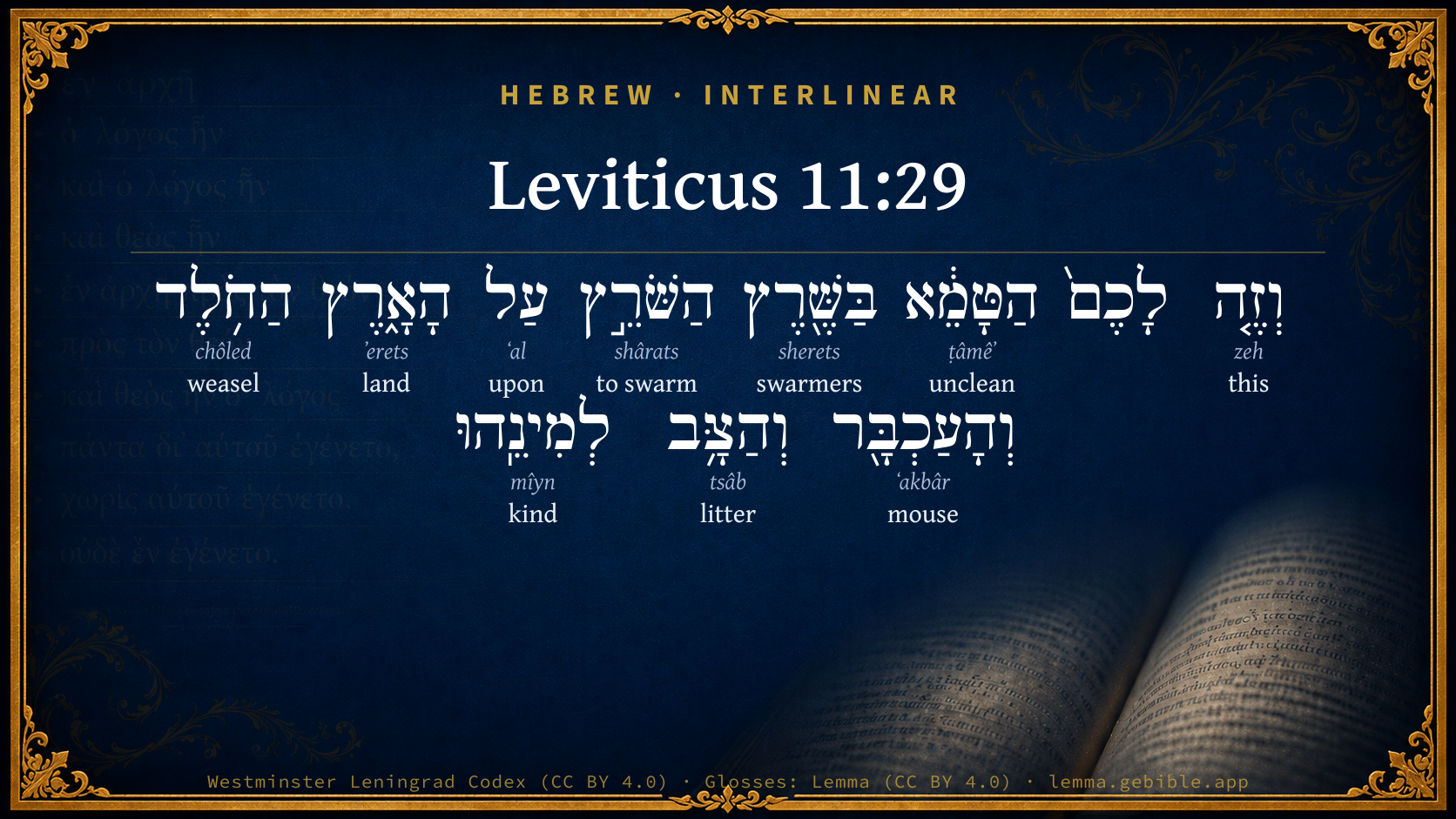
Hebrew (Westminster Leningrad Codex) Leviticus 11:29 appears in the Hebrew Old Testament. The text above is from the Westminster Leningrad Codex. Each word links to its Strong’s number, a concise gloss, and parsing drawn from the Open Scriptures Hebrew Bible morphology. Click any word for its full Brown-Driver-Briggs (BDB) entry.
Download image
Cite this verse

Leviticus 11:29 (World English Bible). Public Domain. Lemma interlinear Bible study tool, https://lemma.gebible.app/v/leviticus/11/29.

Show BibTeX & RIS
BibTeX
RIS
English Translation
"'These are they which are unclean to you among the creeping things that creep on the earth: the weasel, the rat, any kind of great lizard,
World English Bible · Public Domain
Highlights
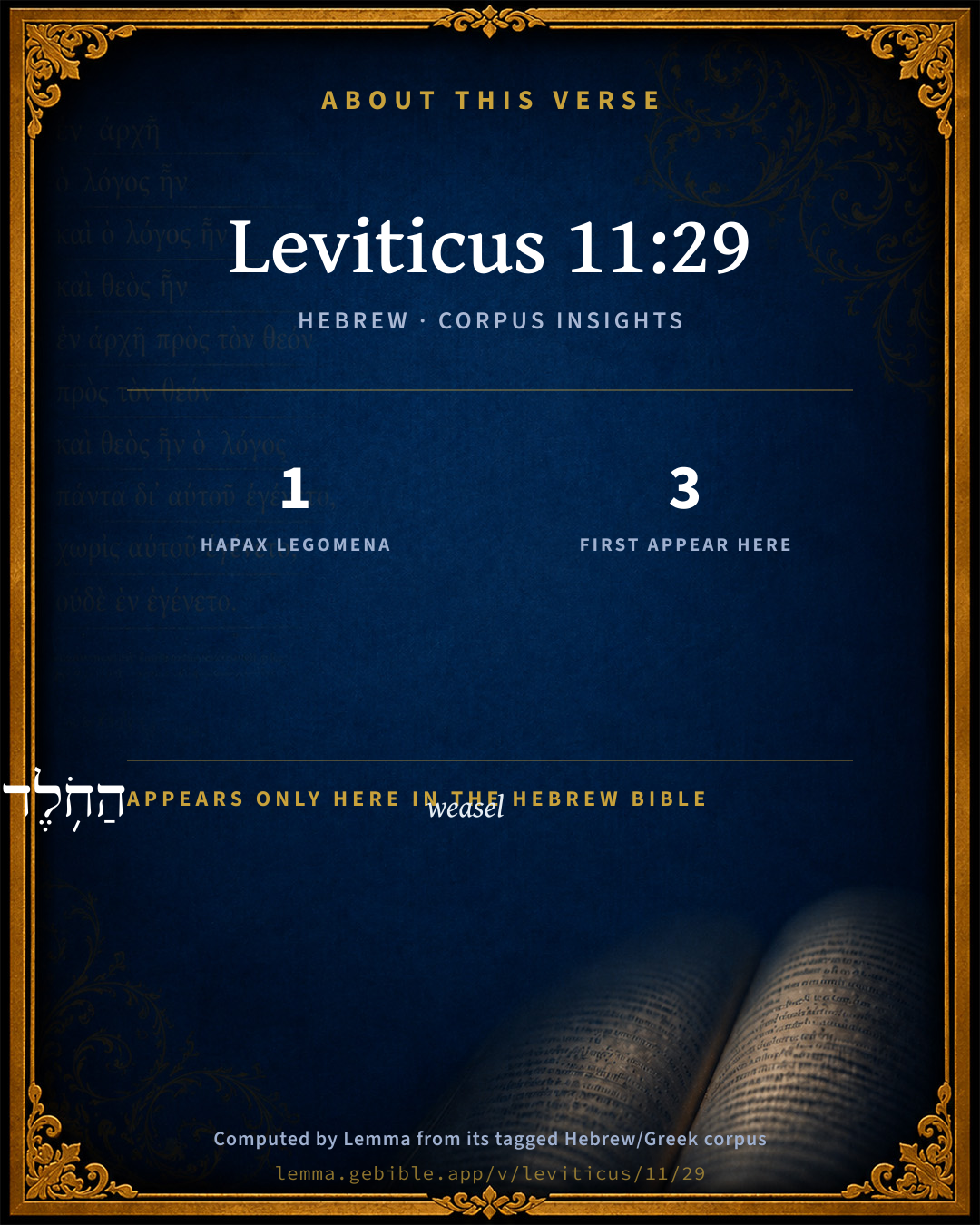
  • 1 hapax legomenon — only here in the Hebrew Bible
  • 3 first appearances in the Hebrew Bible
Full analysis ↓
Download a study sheet

One document with this verse’s original text, its word-by-word gloss line, the meaning frame, cross-references with their text, attributed commentary, and full source and license credits — printable, and it pastes into notes with its structure intact.

This verse Autodidact and up

Study sheet (.html) Plain text (.txt)

A passage Seminary Student

Up to 50 verses in one chapter. A passage sheet keeps up to 6 commentary sources and 12 cross-references per verse, in the order this page ranks them, and says so on the sheet whenever that leaves anything out. Ask for a single verse and you get the Autodidact verse sheet above.

Everything on this page stays free to read, with no account — the sheet is a download of what is already on screen, not access to it.

Want to remove ads? Support Godless Engineer
Compare translations 3

The same verse in 3 English versions, stacked beneath the original-language interlinear above. Click any original word for its lexicon entry.

Each is an independent rendering of the whole verse — the interlinear is not word-aligned to these translations.

Highlighted words mark where these versions differ — a whole-verse word diff, not a word-by-word alignment.

  • World English Bible Public Domain
    "'These are they which are unclean to you among the creeping things that creep on the earth: the weasel, the rat, any kind of great lizard,
  • King James Version Public Domain
    These also shall be unclean unto you among the creeping things that creep upon the earth; the weasel, and the mouse, and the tortoise after his kind,
  • unfoldingWord Literal Text CC BY-SA 4.0
    And these unclean to you among the swarming things, the ones that swarm on the earth: the rat and the mouse and the large lizard of its kind

unfoldingWord Literal Text — © unfoldingWord, licensed CC BY-SA 4.0. Word-aligned USFM3 via Door43 (git.door43.org/unfoldingWord/en_ult).

Versions to compare (up to 4)

3 of 4 selected

Show all 18 translations

Every available English version of this verse, each an independent rendering of the whole verse.

  • World English Bible Public Domain
    "'These are they which are unclean to you among the creeping things that creep on the earth: the weasel, the rat, any kind of great lizard,
  • Berean Standard Bible Public Domain
    The following creatures that move along the ground are unclean for you: the mole, the mouse, any kind of great lizard,
  • Majority Standard Bible Public Domain
    The following creatures that move along the ground are unclean for you: the mole, the mouse, any kind of great lizard,
  • King James Version Public Domain
    These also shall be unclean unto you among the creeping things that creep upon the earth; the weasel, and the mouse, and the tortoise after his kind,
  • American Standard Version (1901) Public Domain
    And these are they which are unclean unto you among the creeping things that creep upon the earth: the weasel, and the mouse, and the great lizard after its kind,
  • Revised Version (1885) Public Domain
    And these are they which are unclean unto you among the creeping things that creep upon the earth; the weasel, and the mouse, and the great lizard after its kind,
  • Geneva Bible (1599) Public Domain
    Also these shalbe vncleane to you amog the things that creepe and moue vpon the earth, the weasell, and the mouse, and the frog, after his kinde:
  • Douay-Rheims (1899) Public Domain
    These also shall be reckoned among unclean things, of all that move upon the earth, the weasel, and the mouse, and the crocodile, every one according to their kind:
  • Young's Literal Translation Public Domain
    `And this `is' to you the unclean among the teeming things which are teeming on the earth: the weasel, and the mouse, and the tortoise after its kind,
  • Literal Standard Version CC BY-SA 4.0
    And this [is] the unclean to you among the teeming things which are teeming on the earth: the weasel, and the muroid, and the tortoise [[or large lizard]] after its kind,
  • Unlocked Literal Bible CC BY-SA 4.0
    Of the animals that creep on the ground, these are the animals that will be unclean to you: the weasel, the rat, every kind of large lizard,
  • unfoldingWord Literal Text CC BY-SA 4.0
    And these unclean to you among the swarming things, the ones that swarm on the earth: the rat and the mouse and the large lizard of its kind
  • Darby Bible Public Domain
    And these shall be unclean unto you among the crawling things which crawl on the earth: the mole, and the field-mouse, and the lizard, after its kind;
  • World Messianic Bible Public Domain
    “‘These are they which are unclean to you among the creeping things that creep on the earth: the weasel, the rat, any kind of great lizard,
  • Webster's Bible Public Domain
    These also shall be unclean to you among the creeping animals that creep upon the earth; the weasel, and the mouse, and the tortoise, after its kind,
  • Free Bible Version CC BY-SA 4.0
    The following animals that run along the ground are unclean for you: rats, mice, any kind of large lizards,
  • Bible in Basic English Public Domain
    And these are unclean to you among things which go low down on the earth; the weasel and the mouse and the great lizard, and animals of that sort;
  • JPS Tanakh (1917) Public Domain
    And these are they which are unclean unto you among the swarming things that swarm upon the earth: the weasel, and the mouse, and the great lizard after its kinds,

Literal Standard Version (2020), Covenant Press — licensed CC BY-SA 4.0. Text via the HelloAO Bible API (eBible.org). Unlocked Literal Bible (unfoldingWord) — licensed CC BY-SA 4.0. Text via the HelloAO Bible API (eBible.org). unfoldingWord Literal Text — © unfoldingWord, licensed CC BY-SA 4.0. Word-aligned USFM3 via Door43 (git.door43.org/unfoldingWord/en_ult). Free Bible Version, Dr. Jonathan Gallagher — licensed CC BY-SA 4.0. Text via the HelloAO Bible API (eBible.org).

Word by word

More ways to search: Search by grammar → Find every occurrence → Compare this word →

Practice this passage: Drill this verse → Learn its vocabulary →

הַחֹ֥לֶד
chôled
H2467
“the · weasel”
Particle, Definite Article + Noun, Common, Masculine, Singular, Absolute
Part of Speech
Particle + Noun
Type
Common
Gender
Masculine
Number
Singular
State
Absolute
Full BDB Definition

Origin: from the same as H2465

TWOT: 654a

weasel, mole - perhaps an extinct animal, exact meaning unknown
  1. וְזֶ֤ה zeh H2088 “and · this” Conjunction + Pronoun, Demonstrative, Masculine, Singular
  2. הַטָּמֵ֔א ṭâmêʼ H2931 “the · unclean” Particle, Definite Article + Adjective, Adjective, Masculine, Singular, Absolute
  3. בַּשֶּׁ֖רֶץ sherets H8318 “in/at the · swarmers” Preposition, Determined + Noun, Common, Masculine, Singular, Absolute
  4. הַשֹּׁרֵ֣ץ shârats H8317 “the · swarming” Particle, Definite Article + Verb, Qal, Participle Active, Masculine, Singular, Absolute
  5. עַל ʻal H5921 “upon” Preposition
  6. הָאָ֑רֶץ ʼerets H776 “the · land” Particle, Definite Article + Noun, Common, Both, Singular, Absolute
  7. וְהָעַכְבָּ֖ר ʻakbâr H5909 “and · the · mouse” Conjunction + Particle, Definite Article + Noun, Common, Masculine, Singular, Absolute
  8. וְהַצָּ֥ב tsâb H6632 “and · the · litter” Conjunction + Particle, Definite Article + Noun, Common, Masculine, Singular, Absolute
  9. לְמִינֵֽהוּ mîyn H4327 “to/for · kind · his” Preposition + Noun, Common, Masculine, Singular, Construct + Suffix, Personal, 3rd Person, Masculine, Singular

About this verse

These counts appear in no published source. They are computed here, from the morphology-tagged text and Lemma’s own curated glosses. What Lemma adds →

11
words
10
distinct lemmas
Pentateuch
section

Notable vocabulary

1 hapax legomenon — a word that appears only here in the entire Hebrew Bible:

  • הַחֹ֥לֶד weasel H2467

First appearance in Scripture

These words make their first canonical appearance in the Hebrew Bible here:

  • הַחֹ֥לֶד weasel H2467
  • וְהָעַכְבָּ֖ר mouse H5909
  • וְהַצָּ֥ב litter H6632

Shared distinctive vocabulary

וְהַצָּ֥ב litter H6632 occurs in 3 verses of the Hebrew Bible. Also found in:

Grammatical profile

  • 1 verb
  • 6 nouns
  • 1 adjective
  • 1 pronoun
  • 2 prepositions

Verb forms

  • הַשֹּׁרֵ֣ץ Qal · Participle Active

Hebrew & Septuagint length

In English translation the verse runs 26 words from the Hebrew and 19 from the Septuagint (LXX English) — closely comparable.

A rough comparison of the two English renderings, which tokenize alike — not a word-level alignment.

Word counts can differ between the Hebrew and the Greek without any difference in meaning — e.g. the Hebrew direct-object marker אֵת has no separate Greek word, and Greek often adds the article ὁ.

Cross-references

15

Topical passages linked to Leviticus 11:29 in the Treasury of Scripture Knowledge — connected by theme and wording, ordered by reader-vote popularity; previews shown in the World English Bible.

  • Leviticus 11:41–42 "'Every creeping thing that creeps on the earth is an abomination. It shall not be eaten.
  • Leviticus 11:20–21 "'All flying insects that walk on all fours are an abomination to you.
  • Psalms 10:3 For the wicked boasts of his heart's cravings, He blesses the greedy, and condemns Yahweh.
  • Psalms 17:13–14 Arise, Yahweh, Confront him, cast him down. Deliver my soul from the wicked by your sword;
  • Isaiah 66:17 Those who sanctify themselves and purify themselves [to go] to the gardens, behind one in the midst, eating pig's flesh, and the abomination, and the mouse, they shall come to an end together, says Yahweh.
  • Haggai 2:6 For this is what Yahweh of Hosts says: 'Yet once, it is a little while, and I will shake the heavens, the earth, the sea, and the dry land;
  • Luke 12:15 He said to them, "Beware! Keep yourselves from covetousness, for a man's life doesn't consist of the abundance of the things which he possesses."
  • Luke 16:14 The Pharisees, who were lovers of money, also heard all these things, and they scoffed at him.
  • John 6:26 Jesus answered them, "Most assuredly I tell you, you seek me, not because you saw signs, but because you ate of the loaves, and were filled.
  • John 6:66 At this, many of his disciples went back, and walked no more with him.
  • Ephesians 4:14 that we may no longer be children, tossed back and forth and carried about with every wind of doctrine, by the trickery of men, in craftiness, after the wiles of error;
  • Philippians 3:19 whose end is destruction, whose god is the belly, and whose glory is in their shame, who think about earthly things.
  • Colossians 3:5 Put to death therefore your members which are on the earth: sexual immorality, uncleanness, depraved passion, evil desire, and covetousness, which is idolatry;
  • 2 Timothy 3:2–5 For men will be lovers of self, lovers of money, boastful, arrogant, blasphemers, disobedient to parents, unthankful, unholy,
  • Hebrews 13:5 Be free from the love of money, content with such things as you have, for he has said, "I will in no way leave you, neither will I in any way forsake you."

Cross-references courtesy of OpenBible.info (CC BY 4.0).

Hebrew and Greek witnesses Masoretic Hebrew ↔ Greek Septuagint

The same verse in the two great witnesses to the Old Testament, shown verse-for-verse.

These are two independent witnesses, not word-aligned to each other, and the Septuagint is shown in lemma (dictionary) form.

Hebrew Leviticus 11:29 Masoretic · Westminster Leningrad Codex

וְזֶ֤ה לָכֶם֙ הַטָּמֵ֔א בַּשֶּׁ֖רֶץ הַשֹּׁרֵ֣ץ עַל הָאָ֑רֶץ הַחֹ֥לֶד וְהָעַכְבָּ֖ר וְהַצָּ֥ב לְמִינֵֽהוּ

"'These are they which are unclean to you among the creeping things that creep on the earth: the weasel, the rat, any kind of great lizard,

World English Bible · Public Domain

Greek LXX Leviticus 11:29 Septuagint · lemma form

καί οὗτος σύ ἀκάθαρτος ἀπό ὁ ἑρπετόν ὁ ἕρπω ἐπί ὁ γῆ ὁ γαλῆ καί ὁ μῦς καί ὁ κροκόδειλος ὁ χερσαῖος

And these are unclean to you of reptiles upon the earth, the weasel, and the mouse, and the lizard,

LXX2012 (modern English Septuagint) · Public Domain

On this verse, John Gill's Exposition discusses the Septuagint’s reading. Read the note in Commentary ↓

Hebrew: Westminster Leningrad Codex (CC BY 4.0). Greek: Septuagint (public domain); English from LXX2012 (modern English Septuagint) (Public Domain). How the Septuagint differs from the Hebrew →

Targum (Aramaic paraphrase)

2

The Targum is the ancient Jewish Aramaic paraphrase of the Hebrew Scriptures — an interpretive translation, not the Hebrew text itself. Onkelos (literal) and Pseudo-Jonathan (expansive) render the Torah, and Jonathan the Prophets. Coverage is partial: where no permissively-licensed English translation exists for a verse, only the Aramaic is shown. This is verse-level text, not a word-by-word alignment to the Hebrew.

  1. Targum Onkelos Torah (Genesis–Deuteronomy)
    וְדֵין לְכוֹן מְסַאָבָא דְּרִחֲשָׁא דְרָחֵשׁ עַל אַרְעָא חֻלְדָא וְעַכְבָּרָא וְצָבָא לִזְנוֹהִי

    (no public-domain English translation for this verse)

    Targum Onkelos — Aramaic: “Onkelos Genesis” (public domain); “Onkelos Exodus” (public domain); “Onkelos Leviticus” (public domain); “Onkelos Numbers” (public domain); “Onkelos Deuteronomy” (public domain). English: “Sefaria Community Translation” (CC0 1.0 (public-domain dedication)); “J.W. Etheridge. The Targums of Onkelos and Jonathan Ben Uzziel on the Pentateuch. London: Longmans, Green, 1862” (public domain). Text via Sefaria.

  2. Targum Pseudo-Jonathan Torah (Genesis–Deuteronomy)
    וְדֵין לְכוֹן דִמְסָאַב דְמֵיהּ וּמַשְׁכֵיהּ וּבִישְרֵיהּ בְּרִיחֲשָׁא דְרָחִישׁ עַל אַרְעָא כִּרְכּוּשְׁתָּא וְעַכְבְּרָא אוּכְמָא וּסְמוֹקָא וְחִיוְרָא וְחַדְרוֹנָא לִזְנוֹי

    And these also to you are such as defile; the blood, the skin, and the flesh of every reptile that creepeth upon the ground: the weasel, the mouse, black, red, and white, and the toad, after his kind;

    Targum Pseudo-Jonathan — Aramaic: “Targum Jonathan on Genesis” (public domain); “Targum Jonathan on Exodus” (public domain); “Targum Jonathan on Leviticus” (public domain); “Targum Jonathan on Numbers” (public domain); “Targum Jonathan on Deuteronomy” (public domain). English: “The Targum of Jonathan ben Uzziel, trans. J. W. Etheridge, London, 1862” (public domain). Text via Sefaria.

Commentary

Notes on Leviticus 11:29 from classic Christian and Jewish commentators (each source and its license shown beneath its notes). The classic Christian expositions comment on the surrounding passage and are grouped to its opening verse, so a note may address several verses; the Jewish commentaries on the Tanakh (Rashi and others) are per-verse, so they appear only where the commentator wrote on this verse.

Lemma curates 59 commentaries, every one of them public domain or Creative Commons licensed, each selected and text-cleaned for this edition rather than reprinted as found. About our sources →

Ellicott's Commentary for English Readers

(29) These also shall be unclean.—Better, And these shall be the most unclean. As Lev_11:24-28 have been occupied with the discussion of the defilement caused by the carcases of unclean quadrupeds, which, as we have seen, belong to the first class of the animal kingdom, the Lawgiver now enumerates those “creeping things” of the fourth class, which likewise cause defilement by touching them. The eight animals here adduced (Lev_11:29-30) are therefore a continuation of the things that go on their belly, mentioned in Lev_11:20-23. They only differ in this respect, that in Lev_11:20-23 the creeping things have also wings, whilst those described here are creeping things without wings. In a stricter sense, however, Lev_11:29, &c, is a resumption of Lev_11:20.

The weasel.—Though the Hebrew name (choled), which literally denotes “the gliding” or “slipping in” animal, does not occur again in the Bible, yet the ancient versions and the description given of it by the administrators of the law in the time of Christ place it beyond a doubt that it is meant for weasel. According to these authorities the animal in question lodges in the holes of walls and in ditches, is inordinately voracious, kills other animals of prey much bigger than itself, and carries them off in its mouth. It is especially obnoxious to poultry, for which reason the ventilating holes in hen roosts are made so small that it should not be able to get through them, it has pointed and crooked teeth, with which it pierces through the skull and brain of the hens; it attacks sleeping children and human corpses, and laps water from a vessel. It delights in pilfering bright objects, which it hides in holes. It will be seen that this description given by the administrators of the law during the second Temple, of the animal meant by choled can only apply to the weasel, and not to the mole. This is fully supported by the ancient versions, though the word denotes “mole” in Arabic, and is sometimes also used in this sense in the Talmud.

And the mouse.—Besides this passage, this word (achbar), which is taken to denote “the field,” or ‘corn-destroyer,” also occurs four times in Samuel (1Sa_6:4-5; 1Sa_6:11; 1Sa_6:18), and once in Isaiah (Isa_66:17) and is uniformly translated “mouse.” That this is the true rendering is fully confirmed by the ancient versions and the administrators of the law during the second Temple. Their insatiable voracity and great fecundity make mice destroy the entire produce of a harvest in an incredibly short time. For this reason they became the symbol of destruction in the Egyptian hieroglyphics, and obtained the appellation, “the scourge of the field” in the Bible (1Sa_6:5). So great was the injury which they inflicted upon the fields in Palestine, that during the second Temple the administrators of the law permitted the Jews to destroy them by any means, even on the middle days of the two great pilgrimage festivals, the Feasts of Passover and of Tabernacles. The mischievous instinct which they have of gnawing at things which they cannot eat, and of penetrating into the sanctuary, and destroying the sacred food and scriptures, made mice peculiarly repulsive to the Jews, who gave them the appellation of “wicked mice,” a name with which they brand any malicious and wicked person to this day.

And the tortoise.—This creature (tzâb), which literally denotes “the swollen,” “the inflated” (see Num_5:27), occurs nowhere else in the Bible. That it is not the tortoise is perfectly certain, since this animal, according to the highest legal authority, was not unclean. Thus Maimonides tells us “only those animals mentioned in the Law (Lev_11:29-30) are defiling, but not the serpent, the frog, and the tortoise.” It is certain that the authorities in the time of Christ took it to denote the toad. This is evident from the discussion as to the condition of the man who has touched an animal, and cannot decide whether it is a frog, which is not defiling, or a tzâb, which is defiling. As it is the toad, and not the tortoise or lizard, which has such a misleading resemblance to the frog, there can hardly be any doubt that the administrators of the law understood the reptile here to denote the toad. This agrees with the meaning of the name, which, as we have seen, denotes the “swollen one,” and which is one of the peculiar characteristics distinguishing it from the frog, by its having a thick, squat, and more swollen body. The reason why the toad and not the frog is put into the defiling list of reptiles is probably owing to the fact that its shorter legs impart to it more the appearance of a creeping thing, and that it was believed that the limpid fluid which this reptile suddenly discharges when touched is poisonous. Some ancient versions, however, translate it “the land crocodile.”

A Bible Commentary for English Readers, edited by Charles John Ellicott (1878–1897) — public domain. Text from a community e-Sword module.

John Gill's Exposition

These also shall be unclean unto you among the creeping things that creep upon the earth,.... As distinguished from those creeping things that fly, these having no wings as they; and which were equally unclean, neither to be eaten nor touched, neither their blood, their skin, nor their flesh, as the Targum of Jonathan paraphrases it: and the Misnic doctors say (d) that the blood of a creeping thing and its flesh are joined together: and Maimonides (e) observes, that this is a fundamental thing with them, that the blood of a creeping thing is like its flesh; which in Siphre (an ancient book of theirs) is gathered from what is said in Lev 11:29 "these shall be unclean", &c. hence the wise men say, the blood of a creeping thing pollutes as its flesh: the creeping things intended are as follow:

the weasel, and the mouse, and the tortoise after his kind; the first of these, "the weasel", a creature well known; there are two sorts of it, as Pliny (f) says, the field weasel, and the house weasel; the former are called by the Jewish writers the weasel of the bushes (g), and the latter the weasel that dwells in the foundations of houses (h); and of the former there was a doubt among some of them whether it was a species of the eight reptiles in Lev 11:29 or whether it was a species of animals (i); and which, Maimonides says, is a species of foxes like to weasels: Bochart (k) thinks the mole is intended; but the generality of interpreters understand it of the weasel; and so Jarchi and Kimchi, and Philip Aquinas (l), interpret it by "mustela", the weasel: however, all agree the second is rightly interpreted "the mouse"; which has its name in Hebrew from its being a waster and destroyer of fields; an instance of which we have in Sa1 6:5; see Gill on Sa1 6:5; so that this sort may be chiefly intended, though it includes all others, who are distinguished by their colours, the black, the red, and the white, which are all mentioned by Jonathan in his paraphrase of the text: this animal, as a learned physician (m) expresses it, eats almost everything, gnaws whatever it meets with, and, among other things, is a great lover of swine's flesh, which was an abomination to the Jews; nor does it abstain from dung, and therefore it is no wonder it should be reckoned among impure creatures; and yet we find they were eaten by some people, see Isa 66:17 especially the dormouse; for which the old Romans made conveniences to keep them in, and feed them, and breed them for the table (n): so rats in the West Indies are brought to market and sold for food, as a learned author (o) of undoubted credit assures us, who was an eyewitness of it: the last in this text, "the tortoise", means the land tortoise; it has its name from the shell with which it is covered, this word being sometimes used for a covered wagon, Num 7:3 there are various kinds of them, as Pliny (p) and other writers observe, and who, as Strabo (q) and Mela (r) also, speak of a people they call Chelonophagi, or tortoise eaters: a tortoise of the land kind is esteemed a very delicate dish: Dr. Shaw (s), speaking of the land and water tortoises in Barbary, says, the former, which hides itself during the winter months, is very palatable food, but the latter is very unwholesome: the Septuagint version renders it, the "land crocodile", which, is approved of by Bochart (t): and Leo Africanus says (u), that many in Egypt eat the flesh of the crocodile, and affirm it to be of good savour; and so Benzon (w) says, its flesh is white and tender, and tastes like veal; though some among them, as Strabo (x) asserts, have a great antipathy and hatred to them; and others worship them as gods, and neither can be supposed to eat them; the land crocodiles are eaten by the Syrians, as Jerom (y) affirms, for those feeding on the sweetest flowers, as is said, their entrails are highly valued for their agreeable odour: Jarchi says, it is a creature like a frog; he means a toad; so Philip Aquinas and many render the word: Dr. Shaw takes the creature designed to be the sharp-scaled tailed lizard (z).

(d) Misn. Meilah, c. 4. sect. 3. (e) Pirush. in ib. (f) Nat. Hist. l. 29. c. 4. (g) Misn. Celaim, c. 8. sect. 5. (h) T. Bab. Cholin, fol. 20. 2. (i) Maimon. in Misn. ib. (k) Hierozoic. par. 1. l. 3. c. 95. col. 1022. (l) Sepher Shorash. & Aquinas in rad. (m) Scheuchzer. Physic. Sacr. vol. 2. p. 307. (n) Varro de re Rustic. l. 3. c. 14. apud Sir Hans Sloane's History of Jamaica, vol. 1. Introduct. p. 24. (o) Sir Hans Sloane, ib. p. 25. (p) Nat. Hist. l. 9. c. 10. & l. 32. c. 4. (q) Geograph. l. 16. p. 532. (r) De Situ Orbis, l. 3. c. 8. (s) Travels, p. 178. (t) Ut supra, (Hierozoic. par. 1.) l. 4. c. 1. (u) Descriptio Africae, l. 9. p. 762. (w) Nov. Orb. Hist. c. 3. (x) Geograph. l. 17. p. 558, 560, 561, 563. (y) Adv. Jovin. l. 2. (z) Ut supra. Travels, p. 178

John Gill's Exposition of the Whole Bible (1746–1763) — public domain (CC PDM 1.0). Text via the HelloAO Bible API.

Trapp's Complete Commentary

John Trapp

Lev 11:29 These also [shall be] unclean unto you among the creeping things that creep upon the earth; the weasel, and the mouse, and the tortoise after his kind,

Ver. 29. And the tortoise.] Which hath its name in Hebrew of a coach or wagon. The thick shell wherewith it is covered is said to be so hard, that a loaded wagon may go over it and not break it. And such is a hard heart, that cannot repent, or relent never so little.

John Trapp, A Commentary or Exposition upon All the Books of the Old and New Testament (1647–1656) — public domain. Text from a community e-Sword module.

Whedon's Commentary on the Bible

Daniel D. Whedon

CONCERNING CREEPERS, Lev_11:29-47.

This section includes not only reptiles, but some of the small mammals. Reptiles are not mentioned as a collective group in the Bible, but are divided into the moving creatures of the sea, (classed with the fishes, Gen_1:20,) and the creeping things of the land mentioned with mammalian quadrupeds, but distinct from them.

29. The weasel — The choledh is found only in this catalogue, and seems to include the weasel, ichneumon, and the mole. They are all remarkably abundant in Palestine, especially the last two.

The mouse — The akbar — field ravager — comprehends any destructive rodent. Tristram found twenty-three species of this group in Palestine. Field mice sometimes become multitudinous in Syria, and cause great destruction to the grain lands. They were eaten by idolaters, and probably used in their sacrifices or incantations. They were regarded as a great delicacy by the Romans, and were carefully kept and fattened for food. See Isa_66:17.

The tortoise — R.V. (“great lizard.”) The Hebrew tsafh occurs in Num_7:3, where it is translated covered, (wagons,) and in Isa_66:20, litters. As the name of an animal it occurs only here, and, from a similar word in Arabic, signifies a large kind of lizard, doubtless the land-waron or the land crocodile of Herodotus, (iv, 192.) “It sometimes attains the length of two feet. I kept one tame for some months, and it was very docile, coming at my call, and sleeping in the sun. It is eaten by the Bedouin.” — Tristram.

Daniel D. Whedon (gen. ed.), Commentary on the Old and New Testaments (1874–1909) — public domain. Text from a community e-Sword module.

Tyndale Open Study Notes

Tyndale Open Resources

11:29-31 This list of unclean creatures that crawl contains both warm-blooded and cold-blooded animals that scurry along the ground. Snakes are also included in this category (11:42).

Tyndale Open Study Notes — © Tyndale Open Resources, licensed CC BY-SA 4.0. Text via the HelloAO Bible API.

Geneva Bible (1599)

Geneva Bible translators

Or, crocodile.

The green frog that sitteth on the bushes.

Geneva Bible (1599) marginal notes — public domain. Text via Bolls.life.

Jamieson, Fausset & Brown

Robert Jamieson, A. R. Fausset & David Brown

the weasel--rather, the mole.

the mouse--From its diminutive size it is placed among the reptiles instead of the quadrupeds.

the tortoise--a lizard, resembling very nearly in shape, and in the hard pointed scales of the tail, the shaketail.

Jamieson, Fausset & Brown — Commentary Critical and Explanatory on the Whole Bible (1871) — public domain (CC PDM 1.0). Text via the HelloAO Bible API.

Adam Clarke's Commentary

Verse 29. The weasel] חלד choled, from chalad, Syr., to creep in. Bochart conjectures, with great propriety, that the mole, not the weasel, is intended by the Hebrew word: its property of digging into the earth, and creeping or burrowing under the surface, is well known.

The mouse] עחבר achbar. Probably the large field rat, or what is called by the Germans the hamster, though every species of the mus genus may be here prohibited.

The tortoise] צב tsab. Most critics allow that the tortoise is not intended here, but rather the crocodile, the frog, or the toad. The frog is most probably the animal meant, and all other creatures of its kind.

Adam Clarke's Commentary on the Bible (1810–1826) — public domain. Text from a community e-Sword/MySword module.

The Cambridge Bible for Schools and Colleges

gen. ed. J. J. S. Perowne

29–38. Uncleanness caused by Creeping Things

29. the weasel†] According to early Versions, and the Mishna the Heb. word should be thus translated; but some prefer the rendering ‘mole.’

the great lizard†] tortoise A.V. The cognate words in Arab. and Syr. support the rendering of R.V.

The Cambridge Bible for Schools and Colleges (gen. ed. J. J. S. Perowne; Cambridge University Press, 1878–1918) — public domain. Text from a community e-Sword module.

Albert Barnes' Notes on the Bible

The identification of “the creeping things” here named is not always certain. They are most likely those which were occasionally eaten. For the “Tortoise” read “the great lizard,” for the “ferret” the “gecko” (one of the lizard tribe), for the “chameleon” read the “frog” or the Nile lizard: by the word rendered “snail” is probably meant another kind of lizard, and by the “mole” the “chameleon.”

Albert Barnes' Notes on the Bible (1834–1885) — public domain. Text from a community e-Sword/MySword module.

Haydock's Catholic Bible Commentary

Weasel. Bochart understands the mole, in opposition to all the versions: choled, means indeed "to root up the earth." (Calmet)

George Leo Haydock (1774–1849), Haydock's Catholic Family Bible and Commentary, 1859 edition — public domain. Excludes Psalms (Douay-Rheims chapter numbering differs from Protestant) and Deuterocanonical books (Catholic canon only).

The Pulpit Commentary

Vers. 29, 30. The creeping things that creep upon the earth. This class contains things that go on their belly, but have not wings, like the previous class of creeping things (verses 20-23). By the words translated tortoise, ferret, chameleon, lizard, snail, mole, different varieties of the lizard are probably meant. The mouse is joined by Isaiah with "eating swine"s flesh and the abomination". (Isa_66:17)

The Pulpit Commentary (1880–1919), ed. H.D.M. Spence-Jones & Joseph S. Exell — public domain. Text from a community e-Sword module.

Keil & Delitzsch

C. F. Keil & F. Delitzsch

To these there are attached analogous instructions concerning defilement through contact with the smaller creeping animals (Sherez), which formed the fourth class of the animal kingdom; though the prohibition against eating these animals is not introduced till Lev 11:41, Lev 11:42, as none of these were usually eaten. Sherez, the swarm, refers to animals which swarm together in great numbers (see at Gen 1:21), and is synonymous with remes (cf. Gen 7:14 and Gen 7:21), "the creeping;" it denotes the smaller land animals which move without feet, or with feet that are hardly perceptible (see at Gen 1:24). Eight of the creeping animals are named, as defiling not only the men with whom they might come in contact, but any domestic utensils and food upon which they might fall; they were generally found in houses, therefore, or in the abodes of men. חלד is not the mole (according to Saad. Ar. Abys., etc.), although the Arabs still call this chuld, but the weasel (lxx, Onk., etc.), which is common in Syria and Palestine, and is frequently mentioned by the Talmudists in the feminine form חוּלדה, as an animal which caught birds (Mishn. Cholin iii. 4), which would run over the wave-loaves with a sherez in its mouth (Mishn. Tohor. iv. 2), and which could drink water out of a vessel (Mishn. Para ix. 3). עכבּר is the mouse (according to the ancient versions and the Talmud), and in Sa1 6:5 the field-mouse, the scourge of the fields, not the jerboa, as Knobel supposes; for this animal lives in holes in the ground, is very shy, and does not frequent houses as is assumed to be the case with the animals mentioned here. צב is a kind of lizard, but whether the thav or dsabb, a harmless yellow lizard of 18 inches in length, which is described by Seetzen, iii. pp. 436ff., also by Hasselquist under the name of lacerta Aegyptia, or the waral, as Knobel supposes, a large land lizard reaching as much as four feet in length, which is also met with in Palestine (Robinson, ii. 160) and is called el worran by Seetzen, cannot be determined.

Lev 11:30

The early translators tell us nothing certain as to the three following names, and it is still undecided how they should be rendered. אנקה is translated μυγάλη by the lxx, i.e., shrew-mouse; but the oriental versions render it by various names for a lizard. Bochart supposes it to be a species of lizard with a sharp groaning voice, because אנק signifies to breathe deeply, or groan. Rosenmller refers it to the lacerta Gecko, which is common in Egypt, and utters a peculiar cry resembling the croaking of frogs, especially in the night. Leyrer imagines it to denote the whole family of monitores; and Knobel, the large and powerful river lizard, the water-waral of the Arabs, called lacerta Nilotica in Hasselquist, pp. 361ff., though he has failed to observe, that Moses could hardly have supposed it possible that an animal four feet long, resembling a crocodile, could drop down dead into either pots or dishes. כּוח is not the chameleon (lxx), for this is called tinshemeth, but the chardaun (Arab.), a lizard which is found in old walls in Natolia, Syria, and Palestine, lacerta stellio, or lacerta coslordilos (Hasselquist, pp. 351-2). Knobel supposes it to be the frog, because coach seems to point to the crying or croaking of frogs, to which the Arabs apply the termkuk, the Greeks κοάξ, the Romans coaxare. But this is very improbable, and the frog would be quite out of place in the midst of simple lizards. לטאה, according to the ancient versions, is also a lizard. Leyrer supposes it to be the nocturnal, salamander-like family of beckons; Knobel, on the contrary, imagines it to be the tortoise, which creeps upon the earth (terrae adhaeret), because the Arabic verb signifies terrae adhaesit. This is very improbable, however. חמט (lxx), σαῦρα, Vulg. lacerta, probably the true lizard, or, as Leyrer conjectures, the anguis (Luth. Blindschleiche, blind-worm), or zygnis, which forms the link between lizards and snakes. The rendering "snail" (Sam. Rashi, etc.) is not so probable, as this is called שׁבלוּל in Psa 58:9; although the purple snail and all the marine species are eaten in Egypt and Palestine. Lastly, תּנשׁמת, the self-inflating animal (see at Lev 11:18), is no doubt the chameleon, which frequently inflates its belly, for example, when enraged, and remains in this state for several hours, when it gradually empties itself and becomes quite thin again. Its flesh was either cooked, or dried and reduced to powder, and used as a specific for corpulence, or a cure for fevers, or as a general medicine for sick children (Plin. h. n. 28, 29). The flesh of many of the lizards is also eaten by the Arabs (Leyrer, pp. 603, 604).

Lev 11:31

The words, "these are unclean to you among all swarming creatures," are neither to be understood as meaning, that the eight species mentioned were the only swarming animals that were unclean and not allowed to be eaten, nor that they possessed and communicated a larger amount of uncleanness; but when taken in connection with the instructions which follow, they can only mean, that such animals would even defile domestic utensils, clothes, etc., if they fell down dead upon them. Not that they were more unclean than others, since all the unclean animals would defile not only persons, but even the clothes of those who carried their dead bodies (Lev 11:25, Lev 11:28); but there was more fear in their case than in that of others, of their falling dead upon objects in common use, and therefore domestic utensils, clothes, and so forth, could be much more easily defiled by them than by the larger quadrupeds, by water animals, or by birds. "When they be dead," lit., "in their dying;" i.e., not only if they were already dead, but if they died at the time when they fell upon any object.

Lev 11:32

In either case, anything upon which one of these animals fell became unclean, "whether a vessel of wood, or raiment, or skin." Every vessel (כּלי in the widest sense, as in Exo 22:6), "wherein any work is done," i.e., that was an article of common use, was to be unclean till the evening, and then placed in water, that it might become clean again.

Lev 11:33

Every earthen vessel, into which (lit., into the midst of which) one of them fell, became unclean, together with the whole of its contents, and was to be broken, i.e., destroyed, because the uncleanness as absorbed by the vessel, and could not be entirely removed by washing (see at Lev 6:21). Of course the contents of such a vessel, supposing there were any, were not to be used.

Lev 11:34

"Every edible food (מן before כּל partitive, as in Lev 4:2) upon which water comes," - that is to say, which was prepared with water, - and "every drink that is drunk...becomes unclean in every vessel," sc., if such an animal should fall dead upon the food, or into the drink. The traditional rendering of Lev 11:34, "every food upon which water out of such a vessel comes," is untenable; because מים without an article cannot mean such water, or this water.

Lev 11:35

Every vessel also became unclean, upon which the body of such an animal fell: such as תּנּוּר, the earthen baking-pot (see Lev 2:4), and כּירים, the covered pan or pot. כּיר, a boiling or roasting vessel (Sa1 2:14), can only signify, when used in the dual, a vessel consisting of two parts, i.e., a pan or pot with a lid.

Lev 11:36

Springs and wells were not defiled, because the uncleanness would be removed at once by the fresh supply of water. But whoever touched the body of the animal, to remove it, became unclean.

Lev 11:37-38

All seed-corn that was intended to be sown remained clean, namely, because the uncleanness attaching to it externally would be absorbed by the earth. But if water had been put upon the seed, i.e., if the grain had been softened by water, it was to be unclean, because in that case the uncleanness would penetrate the softened grains and defile the substance of the seed, which would therefore produce uncleanness in the fruit.

Keil & Delitzsch — Biblical Commentary on the Old Testament (1861–1891) — public domain (CC PDM 1.0). Text via the HelloAO Bible API. (Old Testament only.)

Kretzmann's Popular Commentary

Paul E. Kretzmann

Of the Smaller Animals. General Precepts.

v. 29. These also shall be unclean unto you among the creeping things that creep upon the earth: the weasel, which often entered houses and defiled foods, and the mouse, that is, the field-mouse, and the tortoise after his kind, the great lizard of the Orient,

v. 30. and the ferret, or rather a lizard with a sharp cry, and the chameleon, a salamander-like lizard living in old walls, and the lizard, and the snail, either the true lizard or one similar to the blind-worm of Europe, and the mole, the word here used seeming to point definitely to the chameleon. Note that the equivalent of the Hebrew names can be given only approximately in the English language, since we have no means of knowing to which of the species now occurring in the Orient the various words apply, or whether perhaps certain species are not extinct.

v. 31. These are unclean to you among all that creep; whosoever doth touch them when they be dead shall be unclean until the even. The ordinance concerning them was so strict, not because these animals in themselves were unusually filthy, but because there was greater likelihood of their coming in contact with clothes and with vessels in the houses.

v. 32. And upon whatsoever any of them, when they are dead, doth fall, it shall be unclean, for it might easily happen that one of them would fall out of a wall or from the open ceiling; whether it be any vessel of wood, or raiment, garments of every kind, or skin, used for churning, for holding wine and other liquids, and for a variety of purposes, or sack, whatsoever vessel it be, wherein any work is done, that is, put to any use in the household or shop, it must be put in to water, and it shall be unclean until the even; so it shall be cleansed.

v. 33. And every earthen vessel whereinto any of them falleth, whatsoever is in it shall be unclean; and ye shall break it, since the porous nature of it would cause it to absorb some of the filthiness.

v. 34. of all meat which may be eaten, that on which such water cometh, which has been in contact with the carcass of such a creature, shall be unclean; and all drink that may be drunk in every such vessel shall be unclean, it was defiled by the touch of the dead animal.

v. 35. And everything whereupon any part of their carcass falleth shall be unclean, whether it be oven, the larger bake-oven, or ranges for pots, small, portable ovens of earthenware, they shall be broken down; for they are unclean and shall be unclean unto you.

v. 36. Nevertheless a fountain or pit, wherein there is plenty of water, a spring or cistern with an abundance of fresh water or with the only water supply for an entire neighborhood, shall be clean; but that, or rather, he, which toucheth their carcass, in order to carry it away, shall be unclean.

v. 37. And if any part of their carcass fall upon any sowing seed which is to be sown, it shall be clean, the external filthiness on the dry grains being absorbed by the earth.

v. 38. But if any water be put upon the seed, and any part of their carcass fall thereon, it shall be unclean unto you, for in this case the uncleanness would be absorbed by the moisture in the kernels.

v. 39. And if any beast of which ye may eat, die, if an animal belonging to the category of clean animals die a natural death or be torn by wild beasts, he that toucheth the carcass thereof shall be unclean until the even.

v. 40. And he that eateth of the carcass of it shall wash his clothes and be unclean until the even; he also that beareth the carcass of it shall wash his clothes and be unclean until the even. In either case contact of the clothes with the dead animal was practically unavoidable.

v. 41. And every creeping thing that creepeth upon the earth, all crawling and four-footed vermin, shall be an abomination; it shall not be eaten.

v. 42. Whatsoever goeth upon the belly, as serpents and worms, and whatsoever goeth upon all four, as mice, rats, weasels, moles, or whatsoever hath more feet among all creeping things that creep upon the earth, as centipedes, spiders, and other arthropods, them ye shall not eat; for they are an abomination.

v. 43. Ye shall not make yourselves abominable, literally, "ye shall not make your souls an abomination," with any creeping thing that creepeth, neither shall ye make yourselves unclean with them, that ye should be defiled thereby. The children of Israel, as the people of the Lord, must keep away from every form of defilement.

Paul E. Kretzmann, Popular Commentary of the Bible (1921–1924) — public domain. Text from a community e-Sword module.

unfoldingWord translationNotes

Door43 World Missions Community

General Information:

Yahweh continues telling Moses and Aaron which animals the people are to consider unclean.

these are the animals that will be unclean to you

These animals that God declared to be unfit for people to touch or eat are spoken of as if they were physically unclean. (See: Metaphor)

weasel

a small animal with brown fur that eats birds and small animals (See: Translate Unknowns)

large lizard, the gecko, the monitor lizard, the lizard, the skink, and the chameleon

These are different kinds of reptiles with four legs. (See: Translate Unknowns)

skink

"sand lizard"

translationWords

clean

unfoldingWord translationNotes — © Distant Shores Media and the Door43 World Missions Community, licensed CC BY-SA 4.0. Source: git.door43.org/Door43/en_tn.

Rashi

Rabbi Shlomo Yitzchaki (Rashi)

וזה לכם הטמא THESE ALSO SHALL BE UNCLEAN TO YOU — All these statements regarding uncleanness that follow are not intended as a prohibition against eating them (not as טמאה,טמא in vv. 4—7 in the beginning of this section which is the result of eating the animals mentioned) but refers to actual uncleanness, — that one becomes unclean by contact with them and is thereby forbidden to eat the heave-offering and the holy sacrifices, and to enter the Sanctuary.

החלד — moustille in O. F.; (English = weasel).

והצב — bot in old French; (English = toad), which is like a frog.

Rashi on the Tanakh — English translations: “The Judaica Press complete Tanach with Rashi, translated by A. J. Rosenberg” (CC BY 4.0); “Pentateuch with Rashi's commentary by M. Rosenbaum and A.M. Silbermann, 1929-1934” (public domain); “The Metsudah Tanach series, Lakewood, N.J” (CC BY 4.0); and “The Book of Joshua, Metsudah Publications, 1997” (CC BY 4.0). Text via Sefaria.

Lesson kit

Teaching starters — assembled from the data on this page, not authored interpretation. Every prompt links to the verse data it draws on. Edit before teaching.

Leviticus, in the Pentateuch, opens this verse with 11 words (10 distinct Hebrew lemmas). Its most distinctive word is chôled (“weasel”). A historical commentator’s framing appears above. Read the whole chapter for the surrounding context.

Discussion questions

  1. What does “weasel” (chôled) contribute to the verse as a whole?
  2. 1 word here appears nowhere else in the Hebrew Bible. Why might the author reach for such rare wording?
  3. 3 words make their first appearance in Scripture here. What does this debut establish?
  4. How does Numbers 7:3, which shares the word «litter», read alongside this verse?
  5. The translations on this page render this verse differently — a whole-verse word diff, not a word-by-word alignment. What might account for the different wordings?
  6. «הַשֹּׁרֵ֣ץ» is a Qal Participle Active verb. How does that grammatical form shape the action described?
  7. Compare how Ellicott's Commentary for English Readers and John Gill's Exposition read this verse. Where do they agree or differ?

Things to notice

  • 1 word in this verse appears nowhere else in the Hebrew Bible.
  • 3 words make their first canonical appearance in Scripture here.
  • These translations choose different wording for 18 words in this verse.
  • 10 distinct Hebrew lemmas span 11 words in this verse.

Reading settings

Reading text

Shown beneath each verse's original-language words.

Old Testament
Old Testament edition

Read the OT as the Masoretic Hebrew (MT) or the Greek Septuagint (LXX).

English shown for the Greek Septuagint (in the Hebrew ↔ Greek comparison).

Comparing translations? Open the Compare panel on any verse page to stack up to four side by side.