Ezekiel 4:13

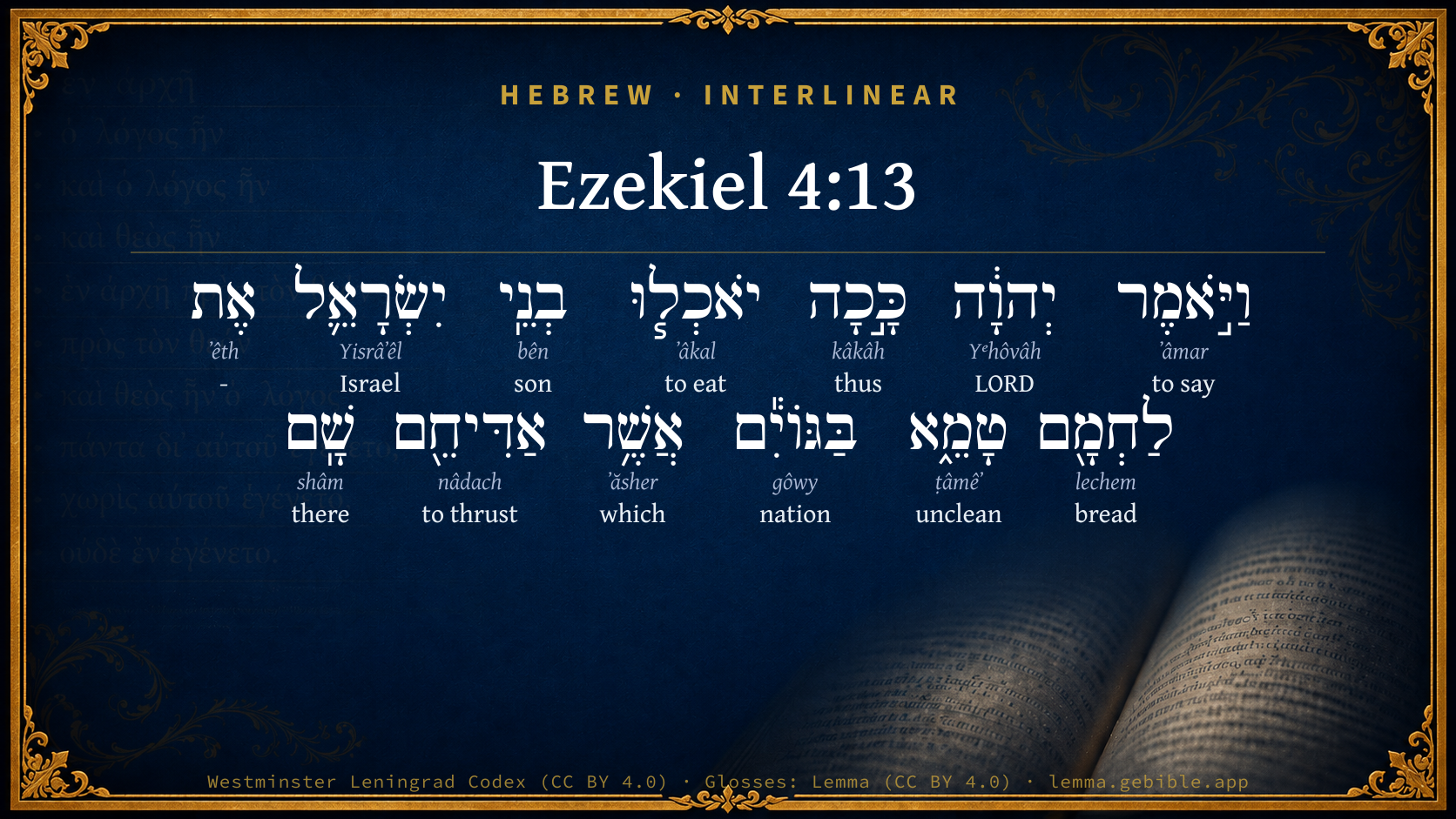
Hebrew (Westminster Leningrad Codex) Ezekiel 4:13 appears in the Hebrew Old Testament. The text above is from the Westminster Leningrad Codex. Each word links to its Strong’s number, a concise gloss, and parsing drawn from the Open Scriptures Hebrew Bible morphology. Click any word for its full Brown-Driver-Briggs (BDB) entry.
Download image
Cite this verse

Ezekiel 4:13 (World English Bible). Public Domain. Lemma interlinear Bible study tool, https://lemma.gebible.app/v/ezekiel/4/13.

Show BibTeX & RIS
BibTeX
RIS
English Translation
Yahweh said, Even thus shall the children of Israel eat their bread unclean, among the nations where I will drive them.
World English Bible · Public Domain
Download a study sheet

One document with this verse’s original text, its word-by-word gloss line, the meaning frame, cross-references with their text, attributed commentary, and full source and license credits — printable, and it pastes into notes with its structure intact.

This verse Autodidact and up

Study sheet (.html) Plain text (.txt)

A passage Seminary Student

Up to 50 verses in one chapter. A passage sheet keeps up to 6 commentary sources and 12 cross-references per verse, in the order this page ranks them, and says so on the sheet whenever that leaves anything out. Ask for a single verse and you get the Autodidact verse sheet above.

Everything on this page stays free to read, with no account — the sheet is a download of what is already on screen, not access to it.

Want to remove ads? Support Godless Engineer
Compare translations 3

The same verse in 3 English versions, stacked beneath the original-language interlinear above. Click any original word for its lexicon entry.

Each is an independent rendering of the whole verse — the interlinear is not word-aligned to these translations.

Highlighted words mark where these versions differ — a whole-verse word diff, not a word-by-word alignment.

  • World English Bible Public Domain
    Yahweh said, Even thus shall the children of Israel eat their bread unclean, among the nations where I will drive them.
  • King James Version Public Domain
    And the LORD said, Even thus shall the children of Israel eat their defiled bread among the Gentiles, whither I will drive them.
  • unfoldingWord Literal Text CC BY-SA 4.0
    For Yahweh says, “This means that the bread that the people of Israel will eat will be unclean, there among the nations where I will banish them.”

unfoldingWord Literal Text — © unfoldingWord, licensed CC BY-SA 4.0. Word-aligned USFM3 via Door43 (git.door43.org/unfoldingWord/en_ult).

Versions to compare (up to 4)

3 of 4 selected

Show all 18 translations

Every available English version of this verse, each an independent rendering of the whole verse.

  • World English Bible Public Domain
    Yahweh said, Even thus shall the children of Israel eat their bread unclean, among the nations where I will drive them.
  • Berean Standard Bible Public Domain
    Then the LORD said, “This is how the Israelites will eat their defiled bread among the nations to which I will banish them.”
  • Majority Standard Bible Public Domain
    Then the LORD said, “This is how the Israelites will eat their defiled bread among the nations to which I will banish them.”
  • King James Version Public Domain
    And the LORD said, Even thus shall the children of Israel eat their defiled bread among the Gentiles, whither I will drive them.
  • American Standard Version (1901) Public Domain
    And Jehovah said, Even thus shall the children of Israel eat their bread unclean, among the nations whither I will drive them.
  • Revised Version (1885) Public Domain
    And the LORD said, Even thus shall the children of Israel eat their bread unclean, among the nations whither I will drive them.
  • Geneva Bible (1599) Public Domain
    And the Lord said, So shall the children of Israel eate their defiled bread among the Gentiles, whither I will cast them.
  • Douay-Rheims (1899) Public Domain
    And the Lord said: So shall the children of Israel Beat their bread all filthy among the nations whither I will cast them out.
  • Young's Literal Translation Public Domain
    And Jehovah saith, `Thus do the sons of Israel eat their defiled bread among the nations whither I drive them.'
  • Literal Standard Version CC BY-SA 4.0
    And YHWH says, “Thus the sons of Israel eat their defiled bread among the nations to where I drive them.”
  • Unlocked Literal Bible CC BY-SA 4.0
    For Yahweh says, “This means that the bread that the people of Israel will eat will be unclean, there among the nations where I will banish them.”
  • unfoldingWord Literal Text CC BY-SA 4.0
    For Yahweh says, “This means that the bread that the people of Israel will eat will be unclean, there among the nations where I will banish them.”
  • Darby Bible Public Domain
    And Jehovah said, So shall the children of Israel eat their bread unclean among the nations whither I will drive them.
  • World Messianic Bible Public Domain
    The LORD said, “Even thus will the children of Israel eat their bread unclean, among the nations where I will drive them.”
  • Webster's Bible Public Domain
    And the LORD said, Even thus shall the children of Israel eat their defiled bread among the Gentiles, whither I will drive them.
  • Free Bible Version CC BY-SA 4.0
    Then the Lord said, “This is the way the Israelites will eat their unclean bread among the nations where I'll exile them.”
  • Bible in Basic English Public Domain
    And the Lord said, Even so the children of Israel will have unclean bread for their food among the nations where I am driving them.
  • JPS Tanakh (1917) Public Domain
    And the LORD said: 'Even thus shall the children of Israel eat their bread unclean, among the nations whither I will drive them.'

Literal Standard Version (2020), Covenant Press — licensed CC BY-SA 4.0. Text via the HelloAO Bible API (eBible.org). Unlocked Literal Bible (unfoldingWord) — licensed CC BY-SA 4.0. Text via the HelloAO Bible API (eBible.org). unfoldingWord Literal Text — © unfoldingWord, licensed CC BY-SA 4.0. Word-aligned USFM3 via Door43 (git.door43.org/unfoldingWord/en_ult). Free Bible Version, Dr. Jonathan Gallagher — licensed CC BY-SA 4.0. Text via the HelloAO Bible API (eBible.org).

Word by word

More ways to search: Search by grammar → Find every occurrence → Compare this word →

Practice this passage: Drill this verse → Learn its vocabulary →

כָּ֣כָה
kâkâh
  1. וַיֹּ֣אמֶר ʼâmar H559 “and · to say” Conjunction + Verb, Qal, Sequential Imperfect, 3rd Person, Masculine, Singular
  2. יְהוָ֔ה Yᵉhôvâh H3068 “LORD” Noun, Proper
  3. יֹאכְל֧וּ ʼâkal H398 “to eat” Verb, Qal, Imperfect, 3rd Person, Masculine, Plural
  4. בְנֵֽי bên H1121 “sons of” Noun, Common, Masculine, Plural, Construct
  5. יִשְׂרָאֵ֛ל Yisrâʼêl H3478 “Israel” Noun, Proper
  6. אֶת ʼêth H853 “-” Particle, Direct Object
  7. לַחְמָ֖ם lechem H3899 “bread · their” Noun, Common, Both, Singular, Construct + Suffix, Personal, 3rd Person, Masculine, Plural
  8. טָמֵ֑א ṭâmêʼ H2931 “unclean” Adjective, Adjective, Masculine, Singular, Absolute
  9. בַּגּוֹיִ֕ם gôwy H1471 “in/at the · nations” Preposition, Determined + Noun, Common, Masculine, Plural, Absolute
  10. אֲשֶׁ֥ר ʼăsher H834 “which” Particle, Relative
  11. אַדִּיחֵ֖ם nâdach H5080 “to thrust · them” Verb, Hiphil, Imperfect, 1st Person, Common, Singular + Suffix, Personal, 3rd Person, Masculine, Plural
  12. שָֽׁם shâm H8033 “there” Adverb

About this verse

These counts appear in no published source. They are computed here, from the morphology-tagged text and Lemma’s own curated glosses. What Lemma adds →

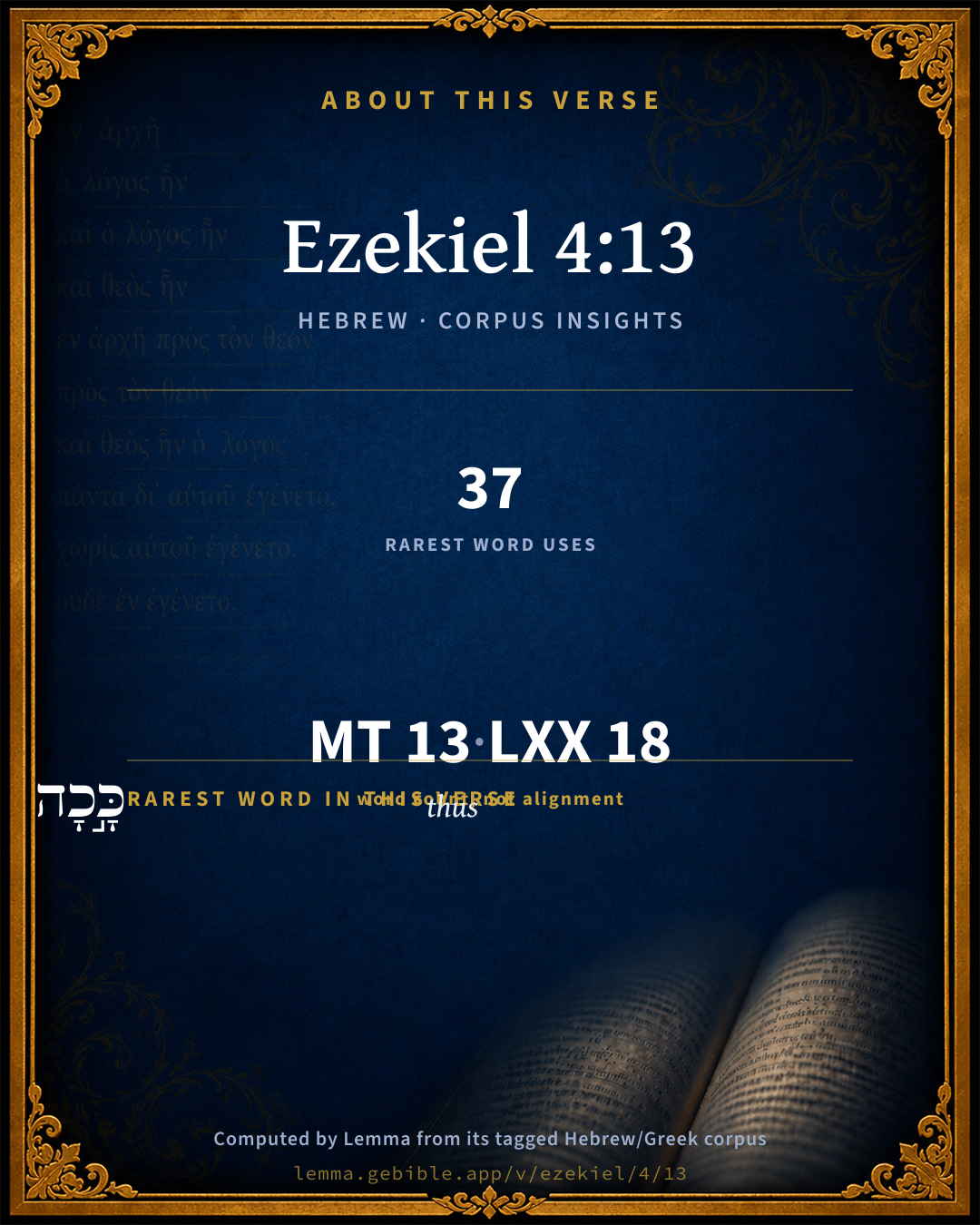
13
words
13
distinct lemmas
Prophets
section

Shared distinctive vocabulary

כָּ֣כָה thus H3602 occurs in 35 verses of the Hebrew Bible. Also found in:

Grammatical profile

  • 3 verbs
  • 5 nouns
  • 1 adjective
  • 2 adverbs
  • 2 particles

Verb forms

  • וַיֹּ֣אמֶר Qal · Sequential Imperfect
  • יֹאכְל֧וּ Qal · Imperfect
  • אַדִּיחֵ֖ם Hiphil · Imperfect

Hebrew & Septuagint length

In English translation the verse runs 21 words from the Hebrew and 23 from the Septuagint (LXX English) — closely comparable.

A rough comparison of the two English renderings, which tokenize alike — not a word-level alignment.

Word counts can differ between the Hebrew and the Greek without any difference in meaning — e.g. the Hebrew direct-object marker אֵת has no separate Greek word, and Greek often adds the article ὁ.

In the original languages it is 13 Hebrew tokens and 18 Greek tokens — but the two are counted differently (Hebrew bundles its prefixes and suffixes into one token; the Greek is in lemma form), so that isn’t a like-for-like length.

Cross-references

2

Topical passages linked to Ezekiel 4:13 in the Treasury of Scripture Knowledge — connected by theme and wording, ordered by reader-vote popularity; previews shown in the World English Bible.

  • Daniel 1:8 But Daniel purposed in his heart that he would not defile himself with the king's dainties, nor with the wine which he drank: therefore he requested of the prince of the eunuchs that he might not defile himself.
  • Hosea 9:3–4 They won't dwell in Yahweh's land; But Ephraim will return to Egypt, And they will eat unclean food in Assyria.

Cross-references courtesy of OpenBible.info (CC BY 4.0).

Hebrew and Greek witnesses Masoretic Hebrew ↔ Greek Septuagint

The same verse in the two great witnesses to the Old Testament, shown verse-for-verse.

These are two independent witnesses, not word-aligned to each other, and the Septuagint is shown in lemma (dictionary) form.

Hebrew Ezekiel 4:13 Masoretic · Westminster Leningrad Codex

וַיֹּ֣אמֶר יְהוָ֔ה כָּ֣כָה יֹאכְל֧וּ בְנֵֽי יִשְׂרָאֵ֛ל אֶת לַחְמָ֖ם טָמֵ֑א בַּגּוֹיִ֕ם אֲשֶׁ֥ר אַדִּיחֵ֖ם שָֽׁם

Yahweh said, Even thus shall the children of Israel eat their bread unclean, among the nations where I will drive them.

World English Bible · Public Domain

Greek LXX Ezekiel 4:13 Septuagint · lemma form

καί εἶπον ὅδε λέγω κύριος ὁ θεός ὁ ἰσραήλ οὕτως ἐσθίω ὁ υἱός ἰσραήλ ἀκάθαρτος ἐν ὁ ἔθνος

And you shall say, Thus says the Lord God of Israel; Thus shall the children of Israel eat unclean things among the Gentiles.

LXX2012 (modern English Septuagint) · Public Domain

On this verse, The Cambridge Bible for Schools and Colleges discusses the Septuagint’s reading. Read the note in Commentary ↓

Hebrew: Westminster Leningrad Codex (CC BY 4.0). Greek: Septuagint (public domain); English from LXX2012 (modern English Septuagint) (Public Domain). How the Septuagint differs from the Hebrew →

Targum (Aramaic paraphrase)

1

The Targum is the ancient Jewish Aramaic paraphrase of the Hebrew Scriptures — an interpretive translation, not the Hebrew text itself. Onkelos (literal) and Pseudo-Jonathan (expansive) render the Torah, and Jonathan the Prophets. Coverage is partial: where no permissively-licensed English translation exists for a verse, only the Aramaic is shown. This is verse-level text, not a word-by-word alignment to the Hebrew.

  1. Targum Jonathan Prophets (Joshua–Malachi)
    וַאֲמַר יְיָ כְּדֵין יֵיכְלוּן בְּנֵי יִשְׂרָאֵל יַת מֵיכַלְהוֹן מְסָאַב בֵּינֵי עַמְמַיָא דְאַגְלִינוּן לְתַמָן:

    (no public-domain English translation for this verse)

    Targum Jonathan — Aramaic: “Mikraot Gedolot” (public domain). English: “Sefaria Community Translation” (CC0 1.0 (public-domain dedication)); “London "Chaldee Paraphrase," 1871” (public domain). Text via Sefaria.

Commentary

Notes on Ezekiel 4:13 from classic Christian and Jewish commentators (each source and its license shown beneath its notes). The classic Christian expositions comment on the surrounding passage and are grouped to its opening verse, so a note may address several verses; the Jewish commentaries on the Tanakh (Rashi and others) are per-verse, so they appear only where the commentator wrote on this verse.

Lemma curates 59 commentaries, every one of them public domain or Creative Commons licensed, each selected and text-cleaned for this edition rather than reprinted as found. About our sources →

The Cambridge Bible for Schools and Colleges

gen. ed. J. J. S. Perowne

13. eat their defiled bread] Rather: eat their bread unclean. This is the meaning of the symbol: the food which the people shall eat among the nations will be unclean. In a pathetic passage of Hosea it is said: “they shall not dwell in the Lord’s land; but Ephraim shall eat unclean food in Assyria. They shall not pour out wine offerings to the Lord, neither shall their sacrifices be pleasing unto him; their bread shall be unto them as the bread of mourners, all that eat thereof shall be polluted; for their bread shall be for their appetite; it shall not come into the house of the Lord” (ch. Eze_9:3-4 R.V. marg.). A foreign land was in itself unclean (Amo_7:17), no presence of Jehovah sanctified it; all food eaten in it was also common for it was not hallowed by part of it being brought into the house of the Lord and offered to him. Food eaten among the heathen was as the bread of mourners in Israel, all who partook of it were polluted. But as the words of the prophet suggest (Eze_4:14) in addition to this general uncleanness the people were forced in their straits or induced to eat many things actually prohibited by the Law, such as that which died of itself or was torn by wild beasts (ch. Eze_44:31; Lev_17:15; Deu_14:21. Comp. Isa_65:4). And it is natural that in the sore famine during the siege such unclean food was eaten, as indeed more terrible practices prevailed (ch. Eze_5:10). Eze_4:13 appears in a shorter form in LXX., but there is no reason to regard the whole verse as a gloss.

The Cambridge Bible for Schools and Colleges (gen. ed. J. J. S. Perowne; Cambridge University Press, 1878–1918) — public domain. Text from a community e-Sword module.

Trapp's Complete Commentary

John Trapp

Eze 4:13 And the LORD said, Even thus shall the children of Israel eat their defiled bread among the Gentiles, whither I will drive them.

Ver. 13. Eat their defiled bread.] Not able now to observe that ceremonial purity in their meats which God had commanded. This was just upon them for their worshipping those their dungy deities.

John Trapp, A Commentary or Exposition upon All the Books of the Old and New Testament (1647–1656) — public domain. Text from a community e-Sword module.

Joseph Benson's Commentary

Eze 4:13. Even thus shall the children of Israel eat their defiled bread among the Gentiles — The prophet, speaking above of eating and drinking by weight and measure, foretels the famine in Jerusalem; now in the bread baked with dung is also pre-signified the unclean bread which the children of Israel were to eat among the Gentiles. For their circumstances in their captivity would not permit them to observe the rules of their law relating to unclean meats; and they would be constrained to partake of meats, part of which had been offered to idols. Compare Hos 9:1-3; Dan 1:8. Bread is often used in the Hebrew for all sorts of food.

Joseph Benson's Commentary on the Old and New Testaments (1811–1818) — public domain. Text from a community e-Sword module.

Jamieson, Fausset & Brown

Robert Jamieson, A. R. Fausset & David Brown

Implying that Israel's peculiar distinction was to be abolished and that they were to be outwardly blended with the idolatrous heathen (Deu 28:68; Hos 9:3).

Jamieson, Fausset & Brown — Commentary Critical and Explanatory on the Whole Bible (1871) — public domain (CC PDM 1.0). Text via the HelloAO Bible API.

Ellicott's Commentary for English Readers

(13) Eat their defiled bread among the Gentiles.—The Mosaic law purposely so hedged the people about with detailed precepts in regard to their food and its preparation, that it was impossible for them to share the food of the Gentiles without contracting ceremonial defilement; and the declared object of this symbolism is to teach that the Israelites should thus be forced to contract defilement. Their sins had brought them to that pass, which is so often the result of continued and obdurate sin, that it should be impossible for them to avoid further transgression. Ezekiel shows by his reply, in Eze_4:14, that like St. Peter, in Act_10:14, he had ever been a scrupulous observer of the law. To St. Peter, however, it was made known that in the breadth of the Christian dispensation this ceremonial law was now done away, while to Ezekiel it still remained in full force.

A Bible Commentary for English Readers, edited by Charles John Ellicott (1878–1897) — public domain. Text from a community e-Sword module.

John Gill's Exposition

And the Lord said, even thus shall the children of Israel,.... Not the ten tribes only, or those who were among the other two, but all the Jews in captivity:

eat the defiled bread among the Gentiles, whither I will drive them; so called, not because mixed, but baked in the above manner; which was a symbol of the defilements which they should contract upon various accounts, by dwelling among the Gentiles; so that this foretells their captivity; their pollution among the nations of the world; and that they should not be the holy people to the Lord they had been, and had boasted of. The Jews (k) cite this passage to prove that he that eats bread without drying his hands is as if he ate defiled bread.

(k) T. Bab. Sota, fol, 4. 2.

John Gill's Exposition of the Whole Bible (1746–1763) — public domain (CC PDM 1.0). Text via the HelloAO Bible API.

Albert Barnes' Notes on the Bible

The ceremonial ordinances in relation to food were intended to keep the nation free from idolatrous usages; everywhere among the pagan idol feasts formed a leading part in their religious services, and idol meats were partaken of in common life. Dispersion among the Gentiles must have exposed the Jews to much which they regarded as common and unclean. In Ezekiel’s case there was a mitigation Eze 4:15 of the defilement, but still legal defilement remained, and the chosen people in exile were subjected to it as to a degradation.

Albert Barnes' Notes on the Bible (1834–1885) — public domain. Text from a community e-Sword/MySword module.

Haydock's Catholic Bible Commentary

Filthy. Israel was less careful to avoid uncleannesses than Juda. Hence the prophet eats only during 390 days, Osee ix. 3. (Calmet) --- While the city was pillage for forty days, the prisoners would procure better food, ver. 7. (Haydock)

George Leo Haydock (1774–1849), Haydock's Catholic Family Bible and Commentary, 1859 edition — public domain. Excludes Psalms (Douay-Rheims chapter numbering differs from Protestant) and Deuterocanonical books (Catholic canon only).

Matthew Poole's English Annotations

This verse is a key to the former.

Even thus; scanty, mean, ill-dressed, and polluted in the very dressing, loathsome to any but starved bellies.

The children of Israel; not only the house of Judah, but all the rest of the children of Israel; not in the siege only, but this misery should pursue them.

Among the Gentiles; who would be ready enough to upbraid them, and twit them, as breaking the rules of their religion to fill their bellies: thus their sins would bring them to extremest want and shame.

Matthew Poole's English Annotations on the Holy Bible (1683–1685) — public domain. Text from a community e-Sword/MySword module.

The Pulpit Commentary

Even thus shall the children of Israel, etc. The strange command takes a wider range. It symbolizes, not the literal horrors of the siege, but the "defiled bread" which even the exiles would be reduced to eat. So taken, the words remind us of the risk of eating unclean, food, which almost inevitably attended the position of the exiles (Hos_9:3; Dan_1:8) and which, it may be, Ezekiel had already tell keenly. There is obviously something more than can be explained by a reference to "the bitter bread of banishment," or to Dante"s "Come sa di sale" ("Par.," 17:58).

Defiled bread.

Among the many inconveniences of the exile this was to be included, that the Jews would not be able to secure that their food should be cooked in their own manner, and so kept free from ceremonial defilement. But is there not a latent irony in the suggestion of such a thing as a serious calamity? Does it not show that the spirit of the Pharisees, who would strain out a gnat and swallow a camel, had already appeared? These Jews, who would be so alarmed at the prospect of external defilement, had already corrupted and befound their souls with the vilest sin. Nevertheless, if they did feel the shame of the external defilement, it would come to them as a fitting retribution. Outward shame is the just penalty of inward sin.

I BREAD IS DEFILED WHEN IT IS TAKEN BY A SINNER. All that a bad man touches turns to corruption. The sweetest food becomes foul in the mouth of the wicked. A morally bad musician desecrates the good music which he tries to interpret by breathing into it a corrupt feeling. The best book will be degraded by an evil minded reader. Such a person will contrive to extract sinful suggestions from the Bible; and then perhaps he will even denounce the sacred volume as immoral in its tendency.

II BREAD IS DEFILED WHEN IT IS GOT BY EVIL MEANS. The finest wheaten loaf is a corrupt thing when it has been stolen. A dishonest style of business degrades all its proceeds. When a man grows fat on the gains which he has extorted from the helpless by cunning or force, he has brought moral degradation into his home and corruption to his table. The very bread with which he feeds his innocent children is a vile thing, and the hungry poor whom his wicked practices are starving may have the consolation of knowing that the crusts they gnaw in reeking cellars are cleaner in the sight of God than the dainties of his sumptuous banquets.

III BREAD IS DEFILED WHEN IT IS EATEN IN AN UNWORTHY SPIRIT. If the hand of the Giver is ignored, the bread is at once degraded. It becomes but a dead mass of earth. The heavenly hand that gave it makes its highest value. Taken in faith and gratitude, the common bread of a daily meal has something of a sacramental nature in it. But ingratitude spoils all. The Israelites, loathing the manna in the wilderness and murmuring against their God, did their worst to corrupt the heavenly gift.

IV BREAD IS DEFILED WHEN IT IS EATEN FOR AN UNWORTHY PURPOSE.

1. It may be devoured in low animal greed and lust of food. Then the Divine sanctity of it vanishes, and it becomes a degraded thing. The glutton who lives to eat defiles the best bread. So, too, the man who accepts the other gifts of Providence which are bestowed upon him, solely for self indulgence, lowers and vitiates all he consumes.

2. It may be converted into energy for sin. The bad man goes forth and does wickedly in the strength of the bread which the holy God has given to fit him for the service of goodness. Can any act of defilement be worse than that? To preserve our bread from corruption let us recollect the apostolic direction, "Whether therefore ye eat or drink, or whatsoever ye do, do all to the glory of God."

The Pulpit Commentary (1880–1919), ed. H.D.M. Spence-Jones & Joseph S. Exell — public domain. Text from a community e-Sword module.

Rashi

Rabbi Shlomo Yitzchaki (Rashi)

unclean An expression of repugnance.

Rashi on the Tanakh — English translations: “The Judaica Press complete Tanach with Rashi, translated by A. J. Rosenberg” (CC BY 4.0); “Pentateuch with Rashi's commentary by M. Rosenbaum and A.M. Silbermann, 1929-1934” (public domain); “The Metsudah Tanach series, Lakewood, N.J” (CC BY 4.0); and “The Book of Joshua, Metsudah Publications, 1997” (CC BY 4.0). Text via Sefaria.

Lesson kit

Teaching starters — assembled from the data on this page, not authored interpretation. Every prompt links to the verse data it draws on. Edit before teaching.

Ezekiel, in the Prophets, opens this verse with 13 words (13 distinct Hebrew lemmas). Its most distinctive word is kâkâh (“thus”). A historical commentator’s framing appears above. Read the whole chapter for the surrounding context.

Discussion questions

  1. How does “thus” (kâkâh) shape what this verse is saying?
  2. How does Exodus 12:11, which shares the word «thus», read alongside this verse?
  3. The translations on this page render this verse differently — a whole-verse word diff, not a word-by-word alignment. What might account for the different wordings?
  4. «וַיֹּ֣אמֶר» is a Qal Sequential Imperfect verb. How does that grammatical form shape the action described?
  5. Compare how The Cambridge Bible for Schools and Colleges and Trapp's Complete Commentary read this verse. Where do they agree or differ?

Things to notice

Reading settings

Reading text

Shown beneath each verse's original-language words.

Old Testament
Old Testament edition

Read the OT as the Masoretic Hebrew (MT) or the Greek Septuagint (LXX).

English shown for the Greek Septuagint (in the Hebrew ↔ Greek comparison).

Comparing translations? Open the Compare panel on any verse page to stack up to four side by side.