Leviticus 11:7

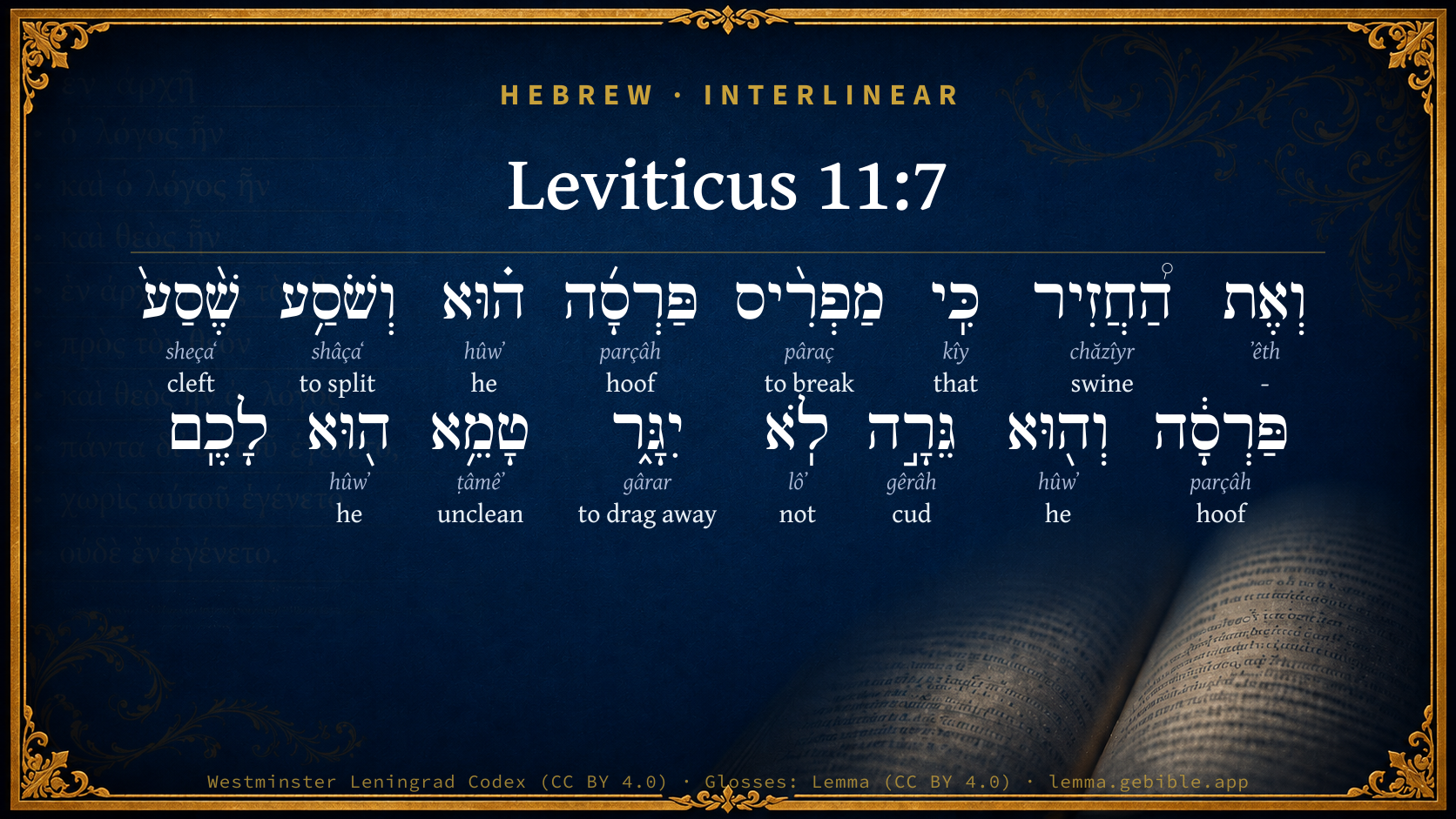
Hebrew (Westminster Leningrad Codex) Leviticus 11:7 appears in the Hebrew Old Testament. The text above is from the Westminster Leningrad Codex. Each word links to its Strong’s number, a concise gloss, and parsing drawn from the Open Scriptures Hebrew Bible morphology. Click any word for its full Brown-Driver-Briggs (BDB) entry.
Download image
Cite this verse

Leviticus 11:7 (World English Bible). Public Domain. Lemma interlinear Bible study tool, https://lemma.gebible.app/v/leviticus/11/7.

Show BibTeX & RIS
BibTeX
RIS
English Translation
The pig, because he has a split hoof, and is cloven-footed, but doesn't chew the cud, he is unclean to you.
World English Bible · Public Domain
Highlights
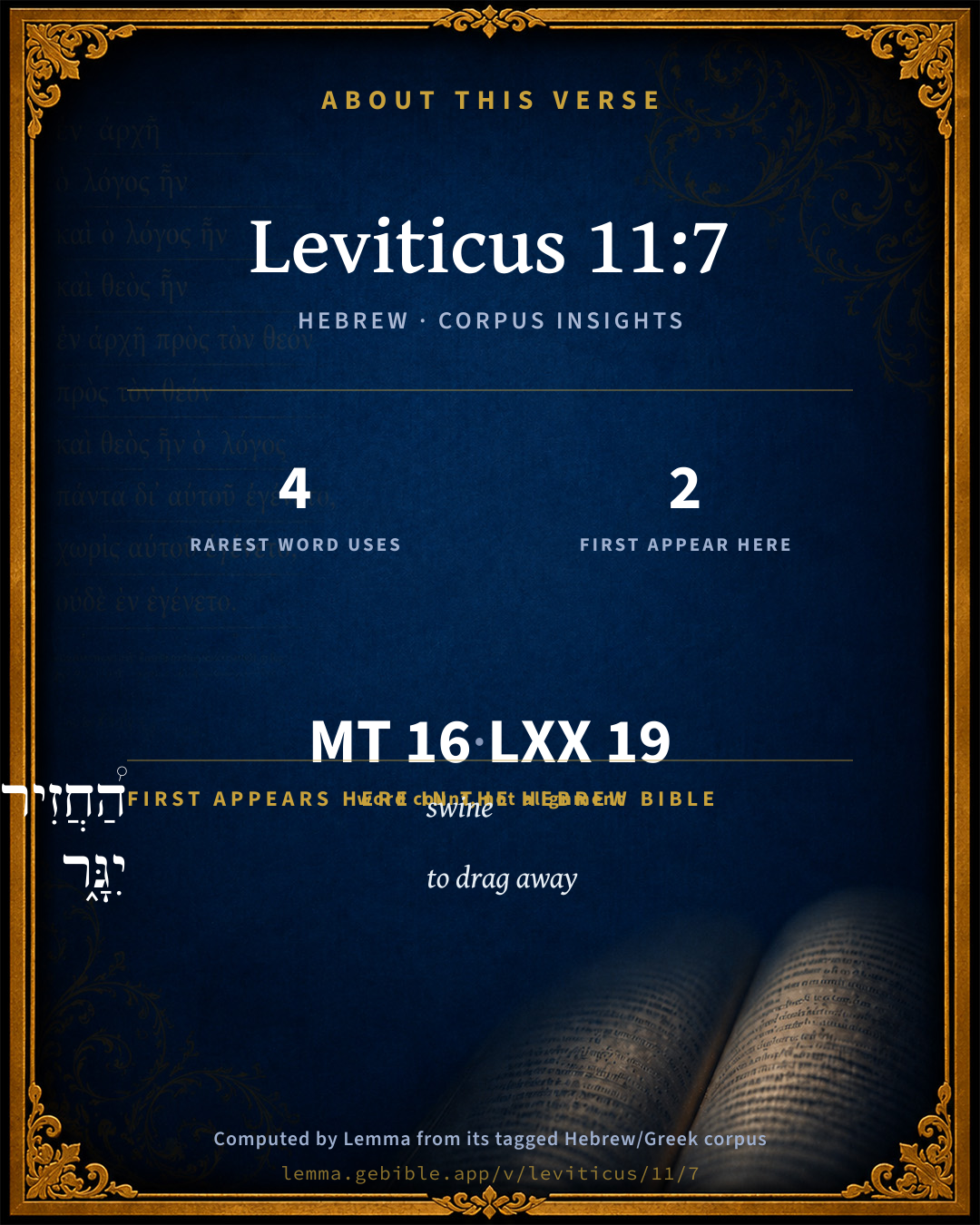
  • 2 first appearances in the Hebrew Bible
Full analysis ↓
Download a study sheet

One document with this verse’s original text, its word-by-word gloss line, the meaning frame, cross-references with their text, attributed commentary, and full source and license credits — printable, and it pastes into notes with its structure intact.

This verse Autodidact and up

Study sheet (.html) Plain text (.txt)

A passage Seminary Student

Up to 50 verses in one chapter. A passage sheet keeps up to 6 commentary sources and 12 cross-references per verse, in the order this page ranks them, and says so on the sheet whenever that leaves anything out. Ask for a single verse and you get the Autodidact verse sheet above.

Everything on this page stays free to read, with no account — the sheet is a download of what is already on screen, not access to it.

Want to remove ads? Support Godless Engineer
Compare translations 3

The same verse in 3 English versions, stacked beneath the original-language interlinear above. Click any original word for its lexicon entry.

Each is an independent rendering of the whole verse — the interlinear is not word-aligned to these translations.

Highlighted words mark where these versions differ — a whole-verse word diff, not a word-by-word alignment.

  • World English Bible Public Domain
    The pig, because he has a split hoof, and is cloven-footed, but doesn't chew the cud, he is unclean to you.
  • King James Version Public Domain
    And the swine, though he divide the hoof, and be cloven-footed, yet he cheweth not the cud; he is unclean to you.
  • unfoldingWord Literal Text CC BY-SA 4.0
    And the pig, because it is dividing a hoof and splitting the cleft of a hoof, but it itself does not ruminate the cud, it unclean to you.

unfoldingWord Literal Text — © unfoldingWord, licensed CC BY-SA 4.0. Word-aligned USFM3 via Door43 (git.door43.org/unfoldingWord/en_ult).

Versions to compare (up to 4)

3 of 4 selected

Show all 18 translations

Every available English version of this verse, each an independent rendering of the whole verse.

  • World English Bible Public Domain
    The pig, because he has a split hoof, and is cloven-footed, but doesn't chew the cud, he is unclean to you.
  • Berean Standard Bible Public Domain
    And the pig, though it has a split hoof completely divided, does not chew the cud; it is unclean for you.
  • Majority Standard Bible Public Domain
    And the pig, though it has a split hoof completely divided, does not chew the cud; it is unclean for you.
  • King James Version Public Domain
    And the swine, though he divide the hoof, and be cloven-footed, yet he cheweth not the cud; he is unclean to you.
  • American Standard Version (1901) Public Domain
    And the swine, because he parteth the hoof, and is clovenfooted, but cheweth not the cud, he is unclean unto you.
  • Revised Version (1885) Public Domain
    And the swine, because he parteth the hoof, and is clovenfooted, but cheweth not the cud, he is unclean unto you.
  • Geneva Bible (1599) Public Domain
    And the swine, because he parteth ye hoofe and is clouen footed, but cheweth not the cud, he shalbe vncleane to you.
  • Douay-Rheims (1899) Public Domain
    And the swine, which, though it divideth the hoof, cheweth not the cud.
  • Young's Literal Translation Public Domain
    and the sow, though it is dividing the hoof, and cleaving the cleft of the hoof, yet the cud it bringeth not up -- unclean it `is' to you.
  • Literal Standard Version CC BY-SA 4.0
    and the sow, though it is dividing the hoof, and cleaving the cleft of the hoof, yet it does not bring up the cud—it [is] unclean to you.
  • Unlocked Literal Bible CC BY-SA 4.0
    The pig, although it has a split hoof, does not chew the cud, is unclean to you.
  • unfoldingWord Literal Text CC BY-SA 4.0
    And the pig, because it is dividing a hoof and splitting the cleft of a hoof, but it itself does not ruminate the cud, it unclean to you.
  • Darby Bible Public Domain
    and the swine, for it hath cloven hoofs, and feet quite split open, but it cheweth not the cud -- it shall be unclean unto you.
  • World Messianic Bible Public Domain
    The pig, because it has a split hoof, and is cloven-footed, but doesn’t chew the cud, is unclean to you.
  • Webster's Bible Public Domain
    And the swine, though he divideth the hoof, and is cloven-footed, yet he cheweth not the cud; he is unclean to you.
  • Free Bible Version CC BY-SA 4.0
    The pig, which though it has a divided hoof doesn't chew the cud, so it is unclean for you.
  • Bible in Basic English Public Domain
    And the pig is unclean to you, because though the horn of its foot is parted, its food does not come back.
  • JPS Tanakh (1917) Public Domain
    And the swine, because he parteth the hoof, and is cloven-footed, but cheweth not the cud, he is unclean unto you.

Literal Standard Version (2020), Covenant Press — licensed CC BY-SA 4.0. Text via the HelloAO Bible API (eBible.org). Unlocked Literal Bible (unfoldingWord) — licensed CC BY-SA 4.0. Text via the HelloAO Bible API (eBible.org). unfoldingWord Literal Text — © unfoldingWord, licensed CC BY-SA 4.0. Word-aligned USFM3 via Door43 (git.door43.org/unfoldingWord/en_ult). Free Bible Version, Dr. Jonathan Gallagher — licensed CC BY-SA 4.0. Text via the HelloAO Bible API (eBible.org).

Word by word

More ways to search: Search by grammar → Find every occurrence → Compare this word →

Practice this passage: Drill this verse → Learn its vocabulary →

שֶׁ֨סַע֙
sheçaʻ
H8157
“cleft of”
Noun, Common, Masculine, Singular, Construct
Part of Speech
Noun
Type
Common
Gender
Masculine
Number
Singular
State
Construct
Full BDB Definition

Origin: from H8156

TWOT: 2427a

cleft, cloven, split
  1. וְאֶת ʼêth H853 “and · -” Conjunction + Particle, Direct Object
  2. הַ֠חֲזִיר chăzîyr H2386 “the · swine” Particle, Definite Article + Noun, Common, Masculine, Singular, Absolute
  3. כִּֽי kîy H3588 “that” Conjunction
  4. מַפְרִ֨יס pâraç H6536 “breaking” Verb, Hiphil, Participle Active, Masculine, Singular, Absolute
  5. פַּרְסָ֜ה parçâh H6541 “hoof” Noun, Common, Feminine, Singular, Absolute
  6. ה֗וּא hûwʼ H1931 “he” Pronoun, Personal, 3rd Person, Masculine, Singular
  7. וְשֹׁסַ֥ע shâçaʻ H8156 “and · splitting” Conjunction + Verb, Qal, Participle Active, Masculine, Singular, Absolute
  8. פַּרְסָ֔ה parçâh H6541 “hoof” Noun, Common, Feminine, Singular, Absolute
  9. וְה֖וּא hûwʼ H1931 “and · he” Conjunction + Pronoun, Personal, 3rd Person, Masculine, Singular
  10. גֵּרָ֣ה gêrâh H1625 “cud” Noun, Common, Feminine, Singular, Absolute
  11. לֹֽא lôʼ H3808 “not” Particle, Negative
  12. יִגָּ֑ר gârar H1641 “to drag away” Verb, Niphal, Imperfect, 3rd Person, Masculine, Singular
  13. טָמֵ֥א ṭâmêʼ H2931 “unclean” Adjective, Adjective, Masculine, Singular, Absolute
  14. ה֖וּא hûwʼ H1931 “he” Pronoun, Personal, 3rd Person, Masculine, Singular

About this verse

These counts appear in no published source. They are computed here, from the morphology-tagged text and Lemma’s own curated glosses. What Lemma adds →

16
words
12
distinct lemmas
Pentateuch
section

Notable vocabulary

The rarest word here is שֶׁ֨סַע֙ cleft H8157 — appearing just 4 times in the whole Hebrew Bible.

First appearance in Scripture

These words make their first canonical appearance in the Hebrew Bible here:

  • הַ֠חֲזִיר swine H2386
  • יִגָּ֑ר to drag away H1641

Shared distinctive vocabulary

שֶׁ֨סַע֙ cleft H8157 occurs in 4 verses of the Hebrew Bible. Also found in:

Grammatical profile

  • 3 verbs
  • 5 nouns
  • 1 adjective
  • 3 pronouns
  • 1 preposition
  • 1 conjunction
  • 2 particles

Verb forms

  • מַפְרִ֨יס Hiphil · Participle Active
  • וְשֹׁסַ֥ע Qal · Participle Active
  • יִגָּ֑ר Niphal · Imperfect

Repetition

Words recur within this verse — often emphatic in Hebrew:

  • פַּרְסָ֜ה hoof H6541 ×2
  • ה֗וּא he H1931 ×3

Hebrew & Septuagint length

In English translation the verse runs 21 words from the Hebrew and 26 from the Septuagint (LXX English) — closely comparable.

A rough comparison of the two English renderings, which tokenize alike — not a word-level alignment.

Word counts can differ between the Hebrew and the Greek without any difference in meaning — e.g. the Hebrew direct-object marker אֵת has no separate Greek word, and Greek often adds the article ὁ.

In the original languages it is 16 Hebrew tokens and 19 Greek tokens — but the two are counted differently (Hebrew bundles its prefixes and suffixes into one token; the Greek is in lemma form), so that isn’t a like-for-like length.

Cross-references

8

Topical passages linked to Leviticus 11:7 in the Treasury of Scripture Knowledge — connected by theme and wording, ordered by reader-vote popularity; previews shown in the World English Bible.

  • Deuteronomy 14:8 The pig, because it has a split hoof but doesn't chew the cud, is unclean to you: of their flesh you shall not eat, and their carcasses you shall not touch.
  • Isaiah 65:4 who sit among the graves, and lodge in the secret places; who eat pig's flesh, and broth of abominable things is in their vessels;
  • Isaiah 66:3 He who kills an ox is as he who kills a man; he who sacrifices a lamb, as he who breaks a dog's neck; he who offers an offering, [as he who offers] pig's blood; he who burns frankincense, as he who blesses an idol. Yes, they have chosen their own ways, and their soul delights in their abominations:
  • Isaiah 66:17 Those who sanctify themselves and purify themselves [to go] to the gardens, behind one in the midst, eating pig's flesh, and the abomination, and the mouse, they shall come to an end together, says Yahweh.
  • Matthew 7:6 "Don't give that which is holy to the dogs, neither throw your pearls before the pigs, lest perhaps they trample them under their feet, and turn and tear you to pieces.
  • Luke 8:33 The demons came out from the man, and entered into the pigs, and the herd rushed down the steep bank into the lake, and were drowned.
  • Luke 15:15 He went and joined himself to one of the citizens of that country, and he sent him into his fields to feed pigs.
  • 2 Peter 2:18–22 For, uttering great swelling words of emptiness, they entice in the lusts of the flesh, by licentiousness, those who are indeed escaping from those who live in error;

Cross-references courtesy of OpenBible.info (CC BY 4.0).

Hebrew and Greek witnesses Masoretic Hebrew ↔ Greek Septuagint

The same verse in the two great witnesses to the Old Testament, shown verse-for-verse.

These are two independent witnesses, not word-aligned to each other, and the Septuagint is shown in lemma (dictionary) form.

Hebrew Leviticus 11:7 Masoretic · Westminster Leningrad Codex

וְאֶת הַ֠חֲזִיר כִּֽי מַפְרִ֨יס פַּרְסָ֜ה ה֗וּא וְשֹׁסַ֥ע שֶׁ֨סַע֙ פַּרְסָ֔ה וְה֖וּא גֵּרָ֣ה לֹֽא יִגָּ֑ר טָמֵ֥א ה֖וּא לָכֶֽם

The pig, because he has a split hoof, and is cloven-footed, but doesn't chew the cud, he is unclean to you.

World English Bible · Public Domain

Greek LXX Leviticus 11:7 Septuagint · lemma form

καί ὁ ὗς ὅτι διχηλέω ὁπλή οὗτος καί ὀνυχίζω ὄνυξ ὁπλή καί οὗτος οὐ ἀναἄγω μηρυκισμός ἀκάθαρτος οὗτος σύ

And the swine, because this animal divides the hoof, and makes claws of the hoof, and it does not chew the cud, is unclean to you.

LXX2012 (modern English Septuagint) · Public Domain

Hebrew: Westminster Leningrad Codex (CC BY 4.0). Greek: Septuagint (public domain); English from LXX2012 (modern English Septuagint) (Public Domain). How the Septuagint differs from the Hebrew →

Targum (Aramaic paraphrase)

2

The Targum is the ancient Jewish Aramaic paraphrase of the Hebrew Scriptures — an interpretive translation, not the Hebrew text itself. Onkelos (literal) and Pseudo-Jonathan (expansive) render the Torah, and Jonathan the Prophets. Coverage is partial: where no permissively-licensed English translation exists for a verse, only the Aramaic is shown. This is verse-level text, not a word-by-word alignment to the Hebrew.

  1. Targum Onkelos Torah (Genesis–Deuteronomy)
    וְיָת חֲזִירָא אֲרֵי סְדִיק פַּרְסָתָא הוּא וּמַטִּלְפָן טִּלְפִין פַרְסָתֵהּ וְהוּא פִּשְׁרָא לָא פָשָׁר מְסָאָב הוּא לְכוֹן

    (no public-domain English translation for this verse)

    Targum Onkelos — Aramaic: “Onkelos Genesis” (public domain); “Onkelos Exodus” (public domain); “Onkelos Leviticus” (public domain); “Onkelos Numbers” (public domain); “Onkelos Deuteronomy” (public domain). English: “Sefaria Community Translation” (CC0 1.0 (public-domain dedication)); “J.W. Etheridge. The Targums of Onkelos and Jonathan Ben Uzziel on the Pentateuch. London: Longmans, Green, 1862” (public domain). Text via Sefaria.

  2. Targum Pseudo-Jonathan Torah (Genesis–Deuteronomy)
    וְיַת חֲזֵירָא אֲרוּם סָדִיק פַּרְסָתָא הוּא וּמְטַלֵיף טִילְפִין פַּרְסָתָא וְהוּא פִישְׁרָא לָא פָשָׁר מְסָאָב הוּא לְכוֹן

    And the swine, because he divideth the hoof, and is cloven, footed, but cheweth not the cud, is unclean to you.

    Targum Pseudo-Jonathan — Aramaic: “Targum Jonathan on Genesis” (public domain); “Targum Jonathan on Exodus” (public domain); “Targum Jonathan on Leviticus” (public domain); “Targum Jonathan on Numbers” (public domain); “Targum Jonathan on Deuteronomy” (public domain). English: “The Targum of Jonathan ben Uzziel, trans. J. W. Etheridge, London, 1862” (public domain). Text via Sefaria.

Commentary

Notes on Leviticus 11:7 from classic Christian and Jewish commentators (each source and its license shown beneath its notes). The classic Christian expositions comment on the surrounding passage and are grouped to its opening verse, so a note may address several verses; the Jewish commentaries on the Tanakh (Rashi and others) are per-verse, so they appear only where the commentator wrote on this verse.

Lemma curates 59 commentaries, every one of them public domain or Creative Commons licensed, each selected and text-cleaned for this edition rather than reprinted as found. About our sources →

Trapp's Complete Commentary

John Trapp

Lev 11:7 And the swine, though he divide the hoof, and be clovenfooted, yet he cheweth not the cud; he [is] unclean to you.

Ver. 7. And the swine.] Anima sui data pro sale, ne carnes putrescant, said Cleanthes. The swine hath his soul for salt only; so hath the drunkard.

John Trapp, A Commentary or Exposition upon All the Books of the Old and New Testament (1647–1656) — public domain. Text from a community e-Sword module.

Joseph Benson's Commentary

Lev 11:7. And the swine — This animal is remarkable for filthiness, and for feeding on all manner of ordure, even carrion if it falls in its way, and therefore a sow wallowing in the mire is set forth as an emblem of impurity, by writers sacred and profane. And Maimonides alleges its filthiness as the chief reason of its flesh being prohibited. Vossius, however, adds another, namely, that it had a tendency to breed the leprosy, a disease incident to those countries. And, according to the author of the Medicinal Dictionary, it is the only animal in the creation subject to the leprosy, and to something very like the king’s evil, called in Latin scrofula, from scrofa, a sow. The flesh, therefore, of this animal could not but be highly improper, as an aliment, for a people subject to leprosies, as the Jews appear to have been, and who were inhabitants of a warm climate, which renders every thing more inclinable to putrefaction.

Joseph Benson's Commentary on the Old and New Testaments (1811–1818) — public domain. Text from a community e-Sword module.

Jamieson, Fausset & Brown

Robert Jamieson, A. R. Fausset & David Brown

the swine--It is a filthy, foul-feeding animal, and it lacks one of the natural provisions for purifying the system, "it cheweth not the cud"; in hot climates indulgence in swine's flesh is particularly liable to produce leprosy, scurvy, and various cutaneous eruptions. It was therefore strictly avoided by the Israelites. Its prohibition was further necessary to prevent their adopting many of the grossest idolatries practised by neighboring nations.

Jamieson, Fausset & Brown — Commentary Critical and Explanatory on the Whole Bible (1871) — public domain (CC PDM 1.0). Text via the HelloAO Bible API.

Adam Clarke's Commentary

Verse 7. And the swine] חזיר chazir, one of the most gluttonous, libidinous, and filthy quadrupeds in the universe; and, because of these qualities, sacred to the Venus of the Greeks and Romans, and the Friga of our Saxon ancestors; and perhaps on these accounts forbidden, as well as on account of its flesh being strong and difficult to digest, affording a very gross kind of aliment, apt to produce cutaneous, scorbutic, and scrofulous disorders, especially in hot climates.

Adam Clarke's Commentary on the Bible (1810–1826) — public domain. Text from a community e-Sword/MySword module.

Ellicott's Commentary for English Readers

(7) And the swine, though he divide the hoof, and be clovenfooted.—Better, And the swine, though he is clovenfooted, and entirely separateth the hoofs. (See Lev_11:3.) Having given these illustrations of animals which comply with the first condition only—i.e., which are ruminant but not bisulcous—and hence must not be eaten, the lawgiver now concludes the list of prohibited quadrupeds with an illustration of a contrary nature—viz., the swine, which comply with the second condition only, but not with the first. Here, too, the description is according to appearance. The feet of the pig tribe generally have four toes enclosed in separate hoofs. The two middle hoofs, however, are much larger, and are divided by a deep cleft, and hence to all appearances the swine is bisulcous. Though the law before us simply describes the swine as wanting in one of the two criteria, like the camel, the coney, and the hare, yet the abhorrence which the Jews, as a nation, have always had of this animal, and the impurity which they have ascribed to it infinitely surpass their repulsion of any other unclean beast. For this reason it became the symbol of defilement and the badge of insult (Psa_65:4; Psa_66:3; Psa_66:17; Pro_11:22). The eating of pork was regarded as renouncing the Law, and as a sign of apostasy. Hence Antiochus Epiphanes adopted it as a test that those Jews who ate it had forsaken their religion and submitted to his rule. Hence we read that when swine’s flesh was forced into the mouth of Eleazar, the aged scribe, he “spit it forth, choosing rather to die gloriously than to live stained with such an abomination” (2Ma_6:18-19). During the time of the commonwealth there were no swine in Judea. Hence it was in a “far country” that the prodigal son was sent into the field to feed the swine (Luk_15:13-15). The swine in Galilee in our Lord’s time (Mat_8:30) were undoubtedly kept by Gentiles for the Roman legion. The very name of swine (chazir) was discarded, and the animal was designated by the euphemistic expression, “the other thing.” This “brutish of all animals” was, moreover, regarded as propagating cutaneous and many other disorders. The Talmud declares that “ten measures of pestilential diseases were spread over the earth, and nine of them fell to the share of pigs.” On the other hand, many of the Pagan nations regarded the swine as an emblem of the productive power of nature. Hence they sacrificed them to those deities to whom they ascribed the fertility of the soil, and the fruitfulness of cattle. Thus, the Egyptians offered them in honour of Isis and Osiris once a year at the festival of the full moon. The Athenians, too, offered the swine in their mysteries; so did the Boetians and the early Romans.

A Bible Commentary for English Readers, edited by Charles John Ellicott (1878–1897) — public domain. Text from a community e-Sword module.

The Cambridge Bible for Schools and Colleges

gen. ed. J. J. S. Perowne

7. The flesh of the pig is forbidden because it is not a ruminant. Of the four animals here mentioned, the swine was specially obnoxious to the Jews, either owing to its being an object of heathen worship (cp. Isa_65:4; Isa_66:3; Isa_66:17), or for sanitary reasons. To eat pork was by them regarded as abjuring their religion, and it is recorded as one of the abominations that were forced upon the Jews by Antiochus Epiphanes in the Maccabaean persecution, 2Ma_6:18-19.

The Cambridge Bible for Schools and Colleges (gen. ed. J. J. S. Perowne; Cambridge University Press, 1878–1918) — public domain. Text from a community e-Sword module.

John Gill's Exposition

And the swine, though he divide the hoof, and be cloven footed,.... Not only its hoofs are parted, but cloven quite through, and so in this respect answers Moses's first descriptive character of clean creatures; though Aristotle (u) and Pliny (w) speak of some kind of swine in Illyricum, Paeonia, and other places, which have solid hoofs; but perhaps these were not properly swine, though so called:

yet he cheweth not the cud; and a learned physician observes (x), that such creatures that chew not the cud, so perfect a chyle cannot be elaborated by them as is by those that chew the cud, and therefore their flesh must be less wholesome; and of the swine, he says (y), they have but one belly, and so there is no rumination or chewing the cud by them; wherefore they are to be placed, and are in a lower degree than the camel, the coney, and the hare; and as they cannot digest the chyle so well as those that chew the cud, and also live upon most sordid and filthy food, the eating of swine's flesh, he observes, must produce many inconveniences to the body, as especially scorbutic, arthritic, scabious, and leprous disorders: so Manetho the Egyptian says (z), that he that eats swine's milk is liable to be filled with the leprosy; and Maimonides (a) gives it as the principal reason of its being forbid the Jews, because it is such a filthy creature, and eats such filthy things:

he is unclean to you: and so it has always been accounted by the Jews, and nothing is more abominable to them, as is even testified by Heathen (b) writers; and in this they have been imitated by many nations, particularly the Egyptians, who, as Herodotus says (c), reckon swine a very filthy creature; so that if anyone does but touch it passing by, he is obliged to plunge himself into a river with his clothes on; and keepers of them may not go into any of their temples, nor do the rest of the Egyptians intermarry with them, but they marry among themselves; the reason of this their abhorrence of swine, Aelianus says (d), is because they are so gluttonous that they will not spare their own young, nor abstain from human flesh; and this, says he, is the reason why the Egyptians hate it as an impure and voracious animal: likewise the Arabians entirely abstain from swine's flesh, as Solinus says (e), who adds, that if any of this sort of creatures is carried into Arabia, it immediately dies; and the same Pliny (f) attests: and so the Phoenicians, the near neighbours of the Jews, would not eat the flesh of them; hence Antoninus is said to abstain from it after the manner of the Phoenicians (g), unless the historian should mean the Jews; also the Gallo-Grecians or Galatians (h); nay, even the Indians have such an abhorrence of it, that they would as soon taste of human flesh as taste of that (i), and it is well known that the Mahometans abstain from it; and they have such an aversion to it, that if any chance to kill a wild pig, for tame they have none, they look on the merit of it to be almost equivalent to the killing a Christian in fight (k): now these creatures may be an emblem of filthy and impure sinners, especially apostates, who return to their former impurities and wallow in them, Pe2 2:22.

(u) Hist. Animal. l. 2. c. 1. (w) Nat. Hist. l. 11. c. 46. (x) Scheuchzer. ut supra, (Physic. Sacr. vol. 2.) p. 282. (y) Ib. p. 284. (z) Apud Aelian. de Animal. l. 10. c. 16. (a) Moreh Nevochim, par. 3. c. 48. (b) "Et vetus indulget", &c. Juvenal. Satyr. 6. "nec distare putant", &c. Ib. Satyr. 14. Vid. Porphyr. de Abstinentia, l. 4. sect. 11, 12. (c) Euterpe, sive, l. 2. c. 47. (d) Ut supra. (Apud Aelian. de Animal. l. 10. c. 16.) (e) Polyhistor. c. 46. (f) Nat. Hist. l. 8. c. 52. (g) Herodian. Hist. l. 5. c. 16. (h) Pausan. Achaica, sive, l. 7. p. 430. (i) Ctesias apud Aelian. de Animal. l. 16. c. 37. (k) Pitts's Account of the Mahometans, p. 163.

John Gill's Exposition of the Whole Bible (1746–1763) — public domain (CC PDM 1.0). Text via the HelloAO Bible API.

Albert Barnes' Notes on the Bible

He divide the hoof ... - It is cloven-footed and completely, etc. See Lev 11:3 note. Of all the quadrupeds of which the Law forbids the flesh to be eaten, the pig seems to have been regarded as the most unclean. Compare the marginal references. Several other nations have agreed with the Hebrews in this respect: the reason being that its flesh is unwholesome, especially in warm climates.

Albert Barnes' Notes on the Bible (1834–1885) — public domain. Text from a community e-Sword/MySword module.

Haydock's Catholic Bible Commentary

Swine. This animal was abhorred by many other nations. If an Egyptian happened to touch one, he plunged into the Nile. (Herod., ii. 47.) Few are to be seen in the East. Yet the people of Crete and of Samos held swine in veneration; and they were offered in sacrifice to Venus, by the Cyprians. They seem designed for slaughter, as they are good for nothing alive. They are very subject to leprosy. (Calmet) --- The Jews would hardly name them, but called them "the beast." Old Eleazer was strongly instigated to pretend at least to eat swine’s flesh, but preferred a painful death before the transgression of God’s law, 2 Machabees vi. 18. (Haydock)

George Leo Haydock (1774–1849), Haydock's Catholic Family Bible and Commentary, 1859 edition — public domain. Excludes Psalms (Douay-Rheims chapter numbering differs from Protestant) and Deuterocanonical books (Catholic canon only).

Matthew Poole's English Annotations

The Jews would not so much as name

the swine, but called it another or a strange thing, lest the naming of it should tempt them to eat this meat, which was so commonly used and so much esteemed by others.

Matthew Poole's English Annotations on the Holy Bible (1683–1685) — public domain. Text from a community e-Sword/MySword module.

Whedon's Commentary on the Bible

Daniel D. Whedon

7. The swine — The Jews are not alone in their abhorrence of swine’s flesh. It was forbidden to the Egyptian priests, disallowed by the Koran, and rejected by the Phenicians, Ethiopians and other Eastern nations. At the present day a hog is scarcely ever seen in Palestine. Native Christians abstain from pork out of a prudential regard for the scruples of their Moslem and Jewish neighbours. Besides being a non-ruminant it is probable that the swine was excluded from the diet of the Hebrew on hygienic grounds, as liable to induce cutaneous diseases, especially the leprosy. The intimate connexion between disorders of the skin and the eating of pork is found in the derivation of the word scrofula, from the Latin scrofa, a breeding-sow.

Daniel D. Whedon (gen. ed.), Commentary on the Old and New Testaments (1874–1909) — public domain. Text from a community e-Sword module.

The Pulpit Commentary

The swine, though he divide the hoof, and be clovenfooted. Here, again, the description is not according to anatomical analysis, but to ordinary appearance. The pig appears to be cloven-footed, and it would be misleading to give any other account of his foot in ordinary speech, but scientifically speaking, he has four toes. The prohibition of the use of swine"s flesh does not arise from the fear of trichinosis or other disease, but from the disgust caused by the carnivorous and filthy habits of the Eastern pig. The repulsion originally felt for swine"s flesh was natural, and, where the animal is carnivorous, is still natural, but where its habits are changed, and it has become simply graminivorous, the feeling has ceased to exist.

The Pulpit Commentary (1880–1919), ed. H.D.M. Spence-Jones & Joseph S. Exell — public domain. Text from a community e-Sword module.

Lesson kit

Teaching starters — assembled from the data on this page, not authored interpretation. Every prompt links to the verse data it draws on. Edit before teaching.

Leviticus, in the Pentateuch, opens this verse with 16 words (12 distinct Hebrew lemmas). Its most distinctive word is sheçaʻ (“cleft”). A historical commentator’s framing appears above. Read the whole chapter for the surrounding context.

Discussion questions

  1. The word sheçaʻ carries the sense “cleft.” How does it shape the verse?
  2. 2 words make their first appearance in Scripture here. What does this debut establish?
  3. How does Leviticus 11:3, which shares the word «cleft», read alongside this verse?
  4. What does the repetition of “hoof” (2× in this one verse) do in this verse?
  5. The translations on this page render this verse differently — a whole-verse word diff, not a word-by-word alignment. What might account for the different wordings?
  6. «מַפְרִ֨יס» is a Hiphil Participle Active verb. How does that grammatical form shape the action described?
  7. Compare how Trapp's Complete Commentary and Joseph Benson's Commentary read this verse. Where do they agree or differ?

Things to notice

Reading settings

Reading text

Shown beneath each verse's original-language words.

Old Testament
Old Testament edition

Read the OT as the Masoretic Hebrew (MT) or the Greek Septuagint (LXX).

English shown for the Greek Septuagint (in the Hebrew ↔ Greek comparison).

Comparing translations? Open the Compare panel on any verse page to stack up to four side by side.