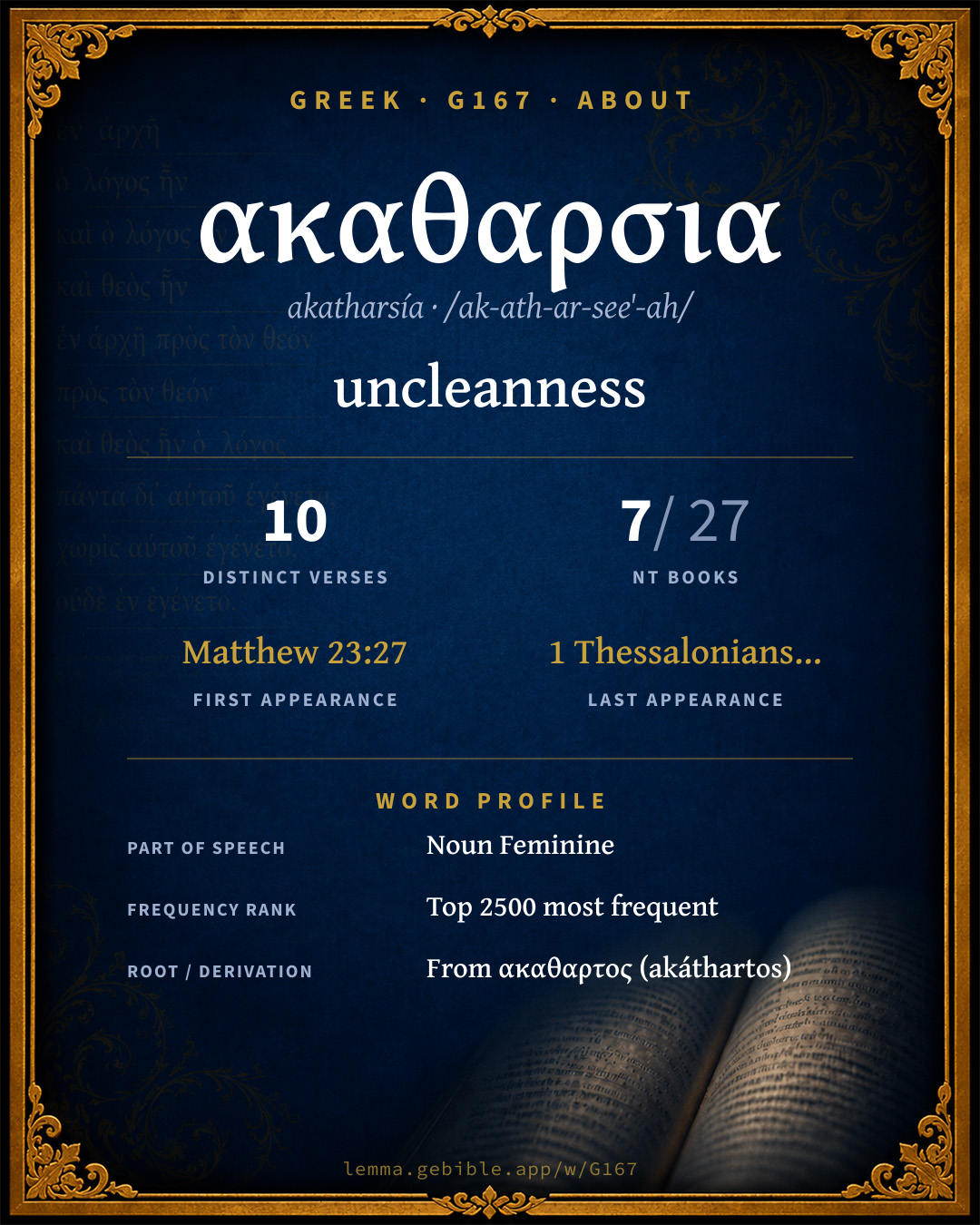
ἀκαθαρσία
uncleanness
Full lexicon entry — Thayer's Greek Lexicon
From Thayer's Greek Lexicon
Where this word appears
See every Dative-case word in the Greek New Testament →
Grammar key — what these labels mean
Part of speech
- Noun
- A naming word — a person, place, thing, or idea.
Case
- Dative
- The case of the indirect object, means, or location — “to / for / with / in.”
- Genitive
- The case of source, possession, or “of” — answers “whose / from what.”
- Accusative
- The case of the direct object and of extent.
- Nominative
- The case of the subject (and the predicate nominative).
Gender
- Feminine
- Grammatically feminine.
Number
- Singular
- One.
Grammatical forms
- Noun, Dative, Singular, Feminine 3 times (30%)
- Noun, Genitive, Singular, Feminine 3 times (30%)
- Noun, Accusative, Singular, Feminine 2 times (20%)
- Noun, Nominative, Singular, Feminine 2 times (20%)
Parsed forms decoded from the imported morphology (Robinson–Tischendorf, public domain), counted across 10 parsed occurrences — not distinct verses.
Every verse where G167 appears — 10 distinct verses across 7 books. Click any verse to open its interlinear word-by-word view. Verse text shown in the World English Bible for context — . Each verse’s Greek form is shown with its reference; the English is not keyword-highlighted, since the data carries no word-level English alignment. Use “Compare translations” on any verse to read it across multiple English versions. This concordance covers the Greek New Testament; Septuagint (Greek Old Testament) occurrences of this word are not indexed here.
Matthew 1 verse
Romans 2 verses
- Romans 1:24 ἀκαθαρσίαν n acc sg fem Therefore God also gave them up in the lusts of their hearts to uncleanness, that their bodies should be dishonored among themselves,
- Romans 6:19 ἀκαθαρσίᾳ n dat sg fem I speak in human terms because of the weakness of your flesh, for as you presented your members as servants to uncleanness and to wickedness upon wickedness, even so now present your members as servants to righteousness for sanctification.
2 Corinthians 1 verse
Galatians 1 verse
Ephesians 2 verses
Colossians 1 verse
1 Thessalonians 2 verses
About this entry
At a glance — auto-summarized from this page’s data, not written by a person. Every figure links to its source below. This summary describes the numbers; it doesn’t interpret them.
The Greek noun ακαθαρσια centers on the idea of “uncleanness.” The King James Version usually renders it “uncleanness,” while modern versions prefer “impurity” (Berean Standard Bible) — see the renderings breakdown. It appears 10 verses across 7 books of the Greek New Testament, among its uncommon vocabulary. Scripture first uses it in Matthew 23:27. Sharing its root, it stands alongside ακαθαρτος and ακαθαρτης. The sections below give every sense, occurrence, and version rendering.
Gloss history
Strong's 1890 vs modern scholarship
About this word
Strong's G167 catalogs a Greek word from the Greek New Testament.
These counts are not copied from any lexicon or concordance. They are computed here, from the morphology-tagged Greek New Testament. What Lemma adds →
- 10
- distinct verses
- The word appears in 10 distinct verses.
- 7 / 27
- NT books
- The word appears in 7 of 27 New Testament books.
- #1,056
- by frequency
- Top 2500 most frequent Greek words (rank 1,056 of 5,347 Greek words by occurrence).
View all 10 occurrences in the concordance →
Most concentrated in
- Romans 2 verses 20%
- Ephesians 2 verses 20%
- 1 Thessalonians 2 verses 20%
By section of the New Testament
By traditional corpus
Conventional, traditional groupings — biblical authorship is debated, so this is a traditional corpus grouping, not an authorship claim. Some books belong to more than one corpus (Luke is in both the Gospels and the Lukan corpus, and so on), so these shares overlap and need not total 100%. Each figure is a share of the word’s 10 distinct verses.
- Pauline corpus 9 verses · 90%
- Gospels 1 verse · 10%
How translations render this word
Counts come from each version’s own published word-to-Strong’s tagging or interlinear alignment — an approximate guide to how each version renders this word, not a word-level alignment the data otherwise carries. Because each total is that version’s own tagged count, the per-version totals vary from one another and need not match the appearance or distinct-verse counts above. These counts may also differ from a printed concordance because Lemma counts each distinctly tagged rendering and does not collapse phrase taggings into a single head-word total. This is a fixed set of word-tagged versions (KJV, ASV, BSB, ULT) and does not change with the reading translation you choose elsewhere. Each version’s license is shown beside its name below (and on Sources).
- King James Version: Uncleanness 10×
- American Standard Version: Uncleanness 10×
- Berean Standard Bible: Impurity 9×
- unfoldingWord Literal Text: Impurity 5×, Uncleanness 5×
King James Version Public Domain
Renders G167 across 10 tagged occurrences — most commonly:
American Standard Version Public Domain
Renders G167 across 10 tagged occurrences — most commonly:
Berean Standard Bible Public Domain
Renders G167 across 10 tagged occurrences — most commonly:
Plus 1 rendering that appears only once — usually multi-word phrases or single function words the recovered tagging swept in, not distinct renderings.
unfoldingWord Literal Text CC BY-SA 4.0
Renders G167 across 10 tagged occurrences — most commonly:
Senses in Thayer's
The 1 sense Thayer's distinguishes for this word, in lexicon order (not ranked by frequency or importance). The full entry — with sub-senses — is in the Lexicon Entry tab.
- uncleanness
Word origin
Derived from ακαθαρτος (akáthartos) (G169) — unclean.
From G169 ; impurity (the quality) physically or morally : - uncleanness.
— Strong’s Exhaustive Concordance (1890), public domain.
Forms in the corpus
The 4 distinct written forms G167 takes in the Greek New Testament, most frequent first — each parse links to that case’s occurrences in the concordance.
| Form | Parsing | Example | Uses |
|---|---|---|---|
| ἀκαθαρσίας akatharsías | Noun, Genitive, Singular, Feminine | Matthew 23:27 | 3 |
| ἀκαθαρσίᾳ akatharsía | Noun, Dative, Singular, Feminine | Romans 6:19 | 3 |
| ἀκαθαρσία akatharsía | Noun, Nominative, Singular, Feminine | Galatians 5:19 | 2 |
| ἀκαθαρσίαν akatharsían | Noun, Accusative, Singular, Feminine | Romans 1:24 | 2 |
Same root — word family
Other Thayer's entries built from the same root as G167, grouped by Strong’s listed origin. These share a root / origin per the lexicon — not necessarily a shared meaning. Each links to that word’s own entry.
Derives from
Shares the same root
Compare all same-root words → They share a root, not necessarily a meaning.
Septuagint usage
The same Greek word ακαθαρσια appears 48 times in the Greek Old Testament (Septuagint), across 42 verses in 12 books.
- 48
- LXX occurrences
- Tagged occurrences of this Greek word in the Septuagint.
- 42
- verses
- Distinct Septuagint verses containing this word.
- 12 / 39
- OT books
- The word appears in 12 of the 39 Old Testament books.
Sample Septuagint occurrences
- Leviticus 5:3 ἀκαθαρσία
- Numbers 19:13 ἀκαθαρσία
- 2 Samuel 11:4 ἀκαθαρσία
- 2 Chronicles 29:5 ἀκαθαρσία
- Ezra 6:21 ἀκαθαρσία
- Proverbs 6:16 ἀκαθαρσία
- Jeremiah 19:13 ἀκαθαρσία
- Lamentations 1:9 ἀκαθαρσία
- Ezekiel 4:14 ἀκαθαρσία
- Hosea 2:12 ἀκαθαρσία
- Micah 2:10 ἀκαθαρσία
- Nahum 3:6 ἀκαθαρσία
Septuagint occurrences (same lexeme)
Every verse where the same Strong’s number (G167) appears in the Greek Septuagint. Verse text shown in the World English Bible for context; the Greek form is the matched word — the English is not keyword-highlighted.
- Leviticus 5:3 ἀκαθαρσία "'Or if he touches the uncleanness of man, whatever his uncleanness is with which he is unclean, and it is hidden from him; when he knows of it, then he shall be guilty.
- Leviticus 7:20 ἀκαθαρσία but the soul who eats of the flesh of the sacrifice of peace offerings, that belongs to Yahweh, having his uncleanness on him, that soul shall be cut off from his people.
- Leviticus 7:21 ἀκαθαρσία When anyone touches any unclean thing, the uncleanness of man, or an unclean animal, or any unclean abomination, and eats some of the flesh of the sacrifice of peace offerings, which belong to Yahweh, that soul shall be cut off from his people.'"
- Leviticus 15:3 ἀκαθαρσία This shall be his uncleanness in his discharge: whether his body runs with his discharge, or his body has stopped from his discharge, it is his uncleanness.
- Leviticus 15:24 ἀκαθαρσία "'If any man lies with her, and her monthly flow is on him, he shall be unclean seven days; and every bed whereon he lies shall be unclean.
- Leviticus 15:25 ἀκαθαρσία "'If a woman has a discharge of her blood many days not in the time of her period, or if she has a discharge beyond the time of her period; all the days of the discharge of her uncleanness shall be as in the days of her period: she is unclean.
- Leviticus 15:26 ἀκαθαρσία Every bed whereon she lies all the days of her discharge shall be to her as the bed of her period: and everything whereon she sits shall be unclean, as the uncleanness of her period.
- Leviticus 15:30 ἀκαθαρσία The priest shall offer the one for a sin offering, and the other for a burnt offering; and the priest shall make atonement for her before Yahweh for the uncleanness of her discharge.
- Leviticus 15:31 ἀκαθαρσία "'Thus you shall separate the children of Israel from their uncleanness, so they will not die in their uncleanness, when they defile my tabernacle that is in their midst.'"
- Leviticus 16:16 ἀκαθαρσία and he shall make atonement for the Holy Place, because of the uncleanness of the children of Israel, and because of their transgressions, even all their sins; and so he shall do for the Tent of Meeting, that dwells with them in the midst of their uncleanness.
- Leviticus 16:19 ἀκαθαρσία He shall sprinkle some of the blood on it with his finger seven times, and cleanse it, and make it holy from the uncleanness of the children of Israel.
- Leviticus 18:19 ἀκαθαρσία "'You shall not approach a woman to uncover her nakedness, as long as she is impure by her uncleanness.
- Leviticus 19:23 ἀκαθαρσία "'When you come into the land, and have planted all kinds of trees for food, then you shall count their fruit as forbidden. Three years shall they be forbidden to you. It shall not be eaten.
- Leviticus 20:21 ἀκαθαρσία "'If a man takes his brother's wife, it is an impurity: he has uncovered his brother's nakedness; they shall be childless.
- Leviticus 20:25 ἀκαθαρσία "'You shall therefore make a distinction between the clean animal and the unclean, and between the unclean fowl and the clean: and you shall not make yourselves abominable by animal, or by bird, or by anything with which the ground teems, which I have separated from you as unclean for you.
- Leviticus 22:3 ἀκαθαρσία Tell them, 'If anyone of all your seed throughout your generations approaches the holy things, which the children of Israel make holy to Yahweh, having his uncleanness on him, that soul shall be cut off from before me. I am Yahweh.
- Leviticus 22:4 ἀκαθαρσία "'Whoever of the seed of Aaron is a leper or has an issue; he shall not eat of the holy things, until he is clean. Whoever touches anything that is unclean by the dead, or a man whose seed goes from him;
- Leviticus 22:5 ἀκαθαρσία or whoever touches any creeping thing, whereby he may be made unclean, or a man of whom he may take uncleanness, whatever uncleanness he has;
- Numbers 19:13 ἀκαθαρσία Whoever touches a dead person, the body of a man who has died, and doesn't purifies himself, defiles the tent of Yahweh; and that soul shall be cut off from Israel: because the water for impurity was not sprinkled on him, he shall be unclean; his uncleanness is yet on him.
- 2 Samuel 11:4 ἀκαθαρσία David sent messengers, and took her; and she came in to him, and he lay with her (for she was purified from her uncleanness); and she returned to her house.
- 2 Chronicles 29:5 ἀκαθαρσία and said to them, Hear me, you Levites; now sanctify yourselves, and sanctify the house of Yahweh, the God of your fathers, and carry forth the filthiness out of the holy place.
- 2 Chronicles 29:16 ἀκαθαρσία The priests went in to the inner part of the house of Yahweh, to cleanse it, and brought out all the uncleanness that they found in the temple of Yahweh into the court of the house of Yahweh. The Levites took it, to carry it out abroad to the brook Kidron.
- Ezra 6:21 ἀκαθαρσία The children of Israel who had come again out of the captivity, and all such as had separated themselves to them from the filthiness of the nations of the land, to seek Yahweh, the God of Israel, ate,
- Ezra 9:11 ἀκαθαρσία which you have commanded by your servants the prophets, saying, The land, to which you go to possess it, is an unclean land through the uncleanness of the peoples of the lands, through their abominations, which have filled it from one end to another with their filthiness:
- Proverbs 6:16 ἀκαθαρσία There are six things which Yahweh hates; Yes, seven which are an abomination to him:
- Proverbs 24:9 ἀκαθαρσία The schemes of folly are sin. The mocker is detested by men.
- Jeremiah 19:13 ἀκαθαρσία and the houses of Jerusalem, and the houses of the kings of Judah, which are defiled, shall be as the place of Topheth, even all the houses on whose roofs they have burned incense to all the host of the sky, and have poured out drink-offerings to other gods.
- Jeremiah 39:34 ἀκαθαρσία
- Lamentations 1:9 ἀκαθαρσία Her filthiness was in her skirts; she didn't remember her latter end; Therefore is she come down wonderfully; she has no comforter: See, Yahweh, my affliction; for the enemy has magnified himself.
- Ezekiel 4:14 ἀκαθαρσία Then said I, Ah Lord Yahweh! behold, my soul has not been polluted; for from my youth up even until now have I not eaten of that which dies of itself, or is torn of animals; neither came there abominable flesh into my mouth.
- Ezekiel 7:20 ἀκαθαρσία As for the beauty of his ornament, he set it in majesty; but they made the images of their abominations [and] their detestable things therein: therefore have I made it to them as an unclean thing.
- Ezekiel 9:9 ἀκαθαρσία Then said he to me, The iniquity of the house of Israel and Judah is exceeding great, and the land is full of blood, and the city full of wrestling [of judgment]: for they say, Yahweh has forsaken the land, and Yahweh doesn't see.
- Ezekiel 22:10 ἀκαθαρσία In you have they uncovered their fathers' nakedness; in you have they humbled her who was unclean in her impurity.
- Ezekiel 22:15 ἀκαθαρσία I will scatter you among the nations, and disperse you through the countries; and I will consume your filthiness out of you.
- Ezekiel 24:11 ἀκαθαρσία Then set it empty on the coals of it, that it may be hot, and the brass of it may burn, and that the filthiness of it may be molten in it, that the rust of it may be consumed.
- Ezekiel 36:17 ἀκαθαρσία Son of man, when the house of Israel lived in their own land, they defiled it by their way and by their doings: their way before me was as the uncleanness of a woman in her impurity.
- Ezekiel 36:25 ἀκαθαρσία I will sprinkle clean water on you, and you shall be clean: from all your filthiness, and from all your idols, will I cleanse you.
- Ezekiel 36:29 ἀκαθαρσία I will save you from all your uncleanness: and I will call for the grain, and will multiply it, and lay no famine on you.
- Ezekiel 39:24 ἀκαθαρσία According to their uncleanness and according to their transgressions did I to them; and I hid my face from them.
- Hosea 2:12 ἀκαθαρσία I will lay waste her vines and her fig trees, About which she has said, 'These are my wages that my lovers have given me; And I will make them a forest,' And the animals of the field shall eat them.
- Micah 2:10 ἀκαθαρσία Arise, and depart! For this is not your resting place, Because of uncleanness that destroys, Even with a grievous destruction.
- Nahum 3:6 ἀκαθαρσία I will throw abominable filth on you, and make you vile, and will set you a spectacle.
These are occurrences of the same Greek lexeme (G167) in the Septuagint — not a translation of any one Hebrew word. The store carries no word-level Hebrew↔Greek alignment, so no Hebrew original is asserted here. Counts come from the recovered LXX Strong's tagging — high-frequency vocabulary is well covered, while rare or late forms may be untagged — so they reflect tagged occurrences and may slightly undercount.