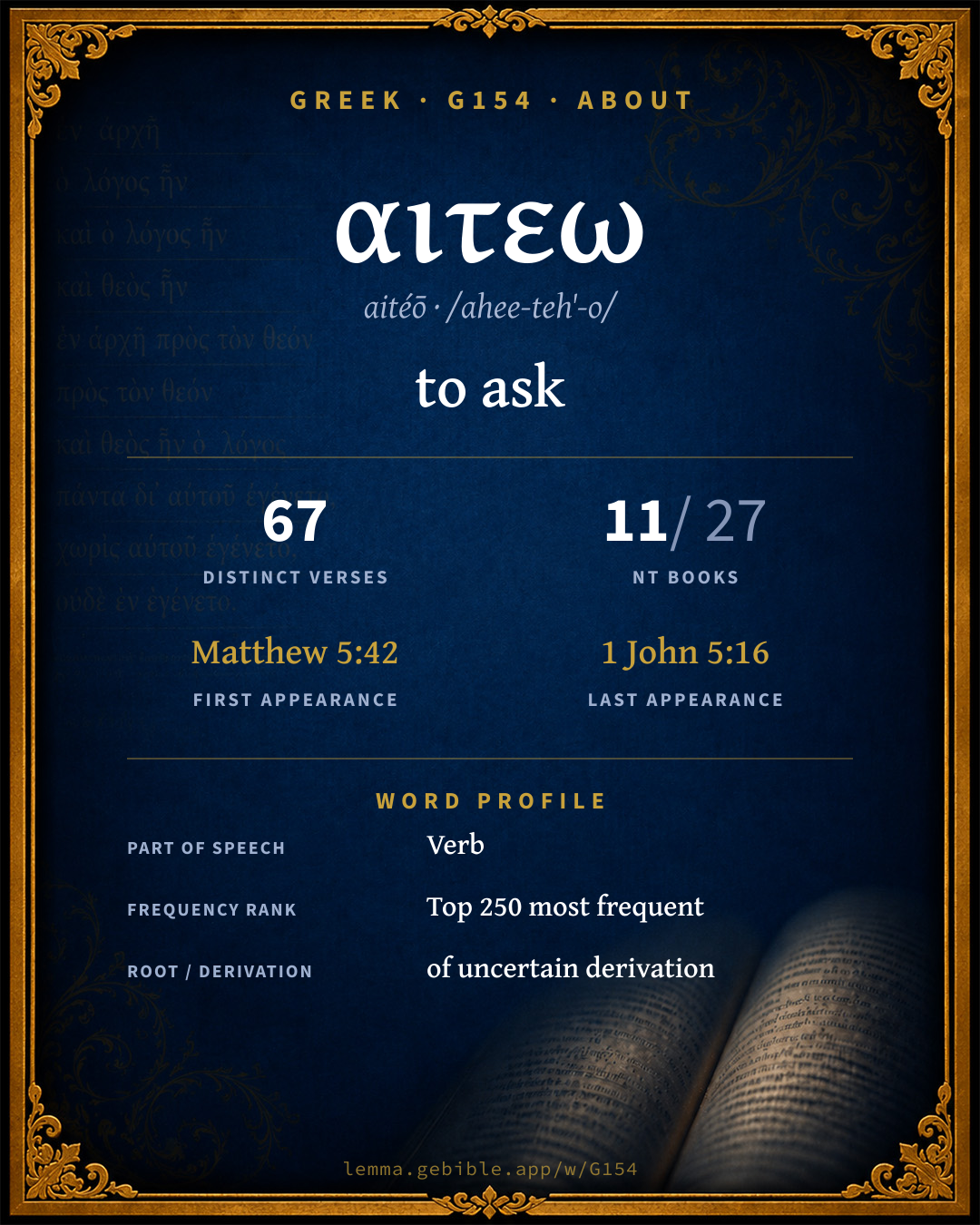
αἰτέω
to ask
Full lexicon entry — Thayer's Greek Lexicon
From Thayer's Greek Lexicon
Where this word appears
See every Aorist-tense verb in the Greek New Testament →
Grammar key — what these labels mean
Part of speech
- Verb
- An action or state-of-being word.
Tense
- Aorist
- Action viewed as a simple whole, without regard to duration — often past (perfective aspect).
- Future
- Action expected in future time.
- Present
- Ongoing or general action in present time (imperfective aspect).
- Imperfect
- Continuous or repeated action in past time (“was writing”).
- Perfect
- A completed past action with continuing present results.
Voice
- Middle
- The subject acts on or for itself, or with special interest in the action.
- Active
- The subject performs the action.
Mood
- Indicative
- States a fact or asks a factual question (the mood of reality).
- Subjunctive
- Expresses probability, purpose, or possibility (the mood of contingency).
- Participle
- A verbal adjective (“writing,” “having written”).
- Imperative
- Expresses a command or request.
- Infinitive
- A verbal noun (“to write”), unmarked for person or number.
Case
- Nominative
- The case of the subject (and the predicate nominative).
- Dative
- The case of the indirect object, means, or location — “to / for / with / in.”
Person
- 3rd person
- The one spoken about (“he / she / it / they”).
- 2nd person
- The one addressed (“you”).
- 1st person
- The speaker (“I / we”).
Gender
- Masculine
- Grammatically masculine.
- Feminine
- Grammatically feminine.
Number
- Singular
- One.
- Plural
- More than one.
Every verse where G154 appears in the Book of John — 10 distinct verses. Click any verse to open its interlinear word-by-word view. Verse text shown in the World English Bible for context — . Each verse’s Greek form is shown with its reference; the English is not keyword-highlighted, since the data carries no word-level English alignment. Use “Compare translations” on any verse to read it across multiple English versions. This concordance covers the Greek New Testament; Septuagint (Greek Old Testament) occurrences of this word are not indexed here.
John
- John 4:9 αἰτεῖς pres act ind 2sg The Samaritan woman therefore said to him, "How is it that you, being a Jew, ask for a drink from me, a Samaritan woman?" (For Jews have no dealings with Samaritans.)
- John 4:10 ᾔτησας aor act ind 2sg Jesus answered her, "If you knew the gift of God, and who it is who says to you, 'Give me a drink,' you would have asked him, and he would have given you living water."
- John 11:22 αἰτήσῃ aor mid subj 2sg Even now I know that, whatever you ask of God, God will give you."
- John 14:13 αἰτήσητε aor act subj 2pl Whatever you will ask in my name, that will I do, that the Father may be glorified in the Son.
- John 14:14 αἰτήσητέ aor act subj 2pl If you will ask anything in my name, I will do it.
- John 15:7 αἰτήσασθε aor mid impv 2pl If you remain in me, and my words remain in you, you will ask whatever you desire, and it will be done for you.
- John 15:16 αἰτήσητε aor act subj 2pl You didn't choose me, but I chose you, and appointed you, that you should go and bear fruit, and that your fruit should remain; that whatever you will ask of the Father in my name, he may give it to you.
- John 16:23 αἰτήσητε aor act subj 2pl "In that day you will ask me no questions. Most assuredly I tell you, whatever you may ask of the Father in my name, he will give it to you.
- John 16:24 ᾐτήσατε αἰτεῖτε aor act ind 2pl pres act impv 2pl Until now, you have asked nothing in my name. Ask, and you will receive, that your joy may be made full.
- John 16:26 αἰτήσεσθε fut mid ind 2pl In that day you will ask in my name; and I don't say to you, that I will pray to the Father for you,
About this entry
At a glance — auto-summarized from this page’s data, not written by a person. Every figure links to its source below. This summary describes the numbers; it doesn’t interpret them.
“to ask” is the headline sense of the Greek verb αιτεω (aitéō). Its earliest occurrence is Matthew 5:42. The Greek New Testament uses it across 67 verses — moderately common. Related forms include αιτημα, αιτια and αιτιος. See the sense tree, 67-verse concordance, and the renderings breakdown below.
Gloss history
Strong's 1890 vs modern scholarship
About this word
Strong's G154 catalogs a Greek word from the Greek New Testament.
These counts are not copied from any lexicon or concordance. They are computed here, from the morphology-tagged Greek New Testament. What Lemma adds →
- 67
- distinct verses
- The word appears in 67 distinct verses.
- 11 / 27
- NT books
- The word appears in 11 of 27 New Testament books.
- #239
- by frequency
- Top 250 most frequent Greek words (rank 239 of 5,347 Greek words by occurrence).
View all 67 occurrences in the concordance →
By section of the New Testament
By traditional corpus
Conventional, traditional groupings — biblical authorship is debated, so this is a traditional corpus grouping, not an authorship claim. Some books belong to more than one corpus (Luke is in both the Gospels and the Lukan corpus, and so on), so these shares overlap and need not total 100%. Each figure is a share of the word’s 67 distinct verses.
- Gospels 44 verses · 66%
- Lukan (Luke–Acts) 21 verses · 31%
- Johannine 14 verses · 21%
- General (Catholic) Epistles 9 verses · 13%
- Pauline corpus 4 verses · 6%
How translations render this word
Counts come from each version’s own published word-to-Strong’s tagging or interlinear alignment — an approximate guide to how each version renders this word, not a word-level alignment the data otherwise carries. Because each total is that version’s own tagged count, the per-version totals vary from one another and need not match the appearance or distinct-verse counts above. These counts may also differ from a printed concordance because Lemma counts each distinctly tagged rendering and does not collapse phrase taggings into a single head-word total. This is a fixed set of word-tagged versions (KJV, ASV, BSB, ULT) and does not change with the reading translation you choose elsewhere. Each version’s license is shown beside its name below (and on Sources).
- King James Version: Ask 10×, Ye shall ask 7×, Asketh 5×
- American Standard Version: Ask 13×, Asked 8×, Ye shall ask 5×
- Berean Standard Bible: Ask 10×, You ask 6×, Ask for 5×
- unfoldingWord Literal Text: Ask 8×, Asking 7×, You ask 6×
King James Version Public Domain
Renders G154 across 71 tagged occurrences — most commonly:
Plus 24 renderings that appear only once — usually multi-word phrases or single function words the recovered tagging swept in, not distinct renderings.
American Standard Version Public Domain
Renders G154 across 69 tagged occurrences — most commonly:
Plus other, less common renderings. Plus 17 renderings that appear only once — usually multi-word phrases or single function words the recovered tagging swept in, not distinct renderings.
Berean Standard Bible Public Domain
Renders G154 across 70 tagged occurrences — most commonly:
Plus other, less common renderings. Plus 23 renderings that appear only once — usually multi-word phrases or single function words the recovered tagging swept in, not distinct renderings.
unfoldingWord Literal Text CC BY-SA 4.0
Renders G154 across 74 tagged occurrences — most commonly:
Plus other, less common renderings. Plus 26 renderings that appear only once — usually multi-word phrases or single function words the recovered tagging swept in, not distinct renderings.
Senses in Thayer's
The 1 sense Thayer's distinguishes for this word, in lexicon order (not ranked by frequency or importance). The full entry — with sub-senses — is in the Lexicon Entry tab.
- to ask, beg, call for, crave, desire, require
Word origin
Origin: of uncertain derivation
Of uncertain derivation; to ask (in generally): - ask beg call for crave desire require. Compare G4441 .
— Strong’s Exhaustive Concordance (1890), public domain.
Forms in the corpus
The 39 distinct written forms G154 takes in the Greek New Testament, most frequent first — each parse links to that tense’s occurrences in the concordance.
Same root — word family
Other Thayer's entries built from the same root as G154, grouped by Strong’s listed origin. These share a root / origin per the lexicon — not necessarily a shared meaning. Each links to that word’s own entry.
Derived from this word
Compare all same-root words → They share a root, not necessarily a meaning.
Septuagint usage
The same Greek word αιτεω appears 69 times in the Greek Old Testament (Septuagint), across 61 verses in 19 books.
- 69
- LXX occurrences
- Tagged occurrences of this Greek word in the Septuagint.
- 61
- verses
- Distinct Septuagint verses containing this word.
- 19 / 39
- OT books
- The word appears in 19 of the 39 Old Testament books.
Sample Septuagint occurrences
- Exodus 3:22 αἰτέω
- Deuteronomy 10:12 αἰτέω
- Joshua 14:12 αἰτέω
- Judges 1:14 αἰτέω
- 1 Samuel 1:17 αἰτέω
- 2 Samuel 3:13 αἰτέω
- 1 Kings 2:16 αἰτέω
- 2 Kings 2:9 αἰτέω
- 1 Chronicles 4:10 αἰτέω
- 2 Chronicles 1:7 αἰτέω
- Ezra 6:9 αἰτέω
- Job 6:22 αἰτέω
Septuagint occurrences (same lexeme)
Every verse where the same Strong’s number (G154) appears in the Greek Septuagint — showing the first 50 of 61. Verse text shown in the World English Bible for context; the Greek form is the matched word — the English is not keyword-highlighted.
- Exodus 3:22 αἰτέω But every woman shall ask of her neighbor, and of her who visits her house, jewels of silver, jewels of gold, and clothing; and you shall put them on your sons, and on your daughters. You shall despoil the Egyptians.
- Exodus 11:2 αἰτέω Speak now in the ears of the people, and let them ask every man of his neighbor, and every woman of her neighbor, jewels of silver, and jewels of gold."
- Exodus 12:35 αἰτέω The children of Israel did according to the word of Moses; and they asked of the Egyptians jewels of silver, and jewels of gold, and clothing.
- Exodus 22:13 αἰτέω If it is torn in pieces, let him bring it for evidence. He shall not make good that which was torn.
- Deuteronomy 10:12 αἰτέω Now, Israel, what does Yahweh your God require of you, but to fear Yahweh your God, to walk in all his ways, and to love him, and to serve Yahweh your God with all your heart and with all your soul,
- Deuteronomy 18:16 αἰτέω according to all that you desired of Yahweh your God in Horeb in the day of the assembly, saying, Let me not hear again the voice of Yahweh my God, neither let me see this great fire any more, that I not die.
- Joshua 14:12 αἰτέω Now therefore give me this hill-country, of which Yahweh spoke in that day; for you heard in that day how the Anakim were there, and cities great and fortified: it may be that Yahweh will be with me, and I shall drive them out, as Yahweh spoke.
- Joshua 15:18 αἰτέω It happened, when she came [to him], that she moved him to ask of her father a field: and she alighted from off her donkey; and Caleb said, What would you?
- Joshua 19:50 αἰτέω according to the commandment of Yahweh they gave him the city which he asked, even Timnathserah in the hill-country of Ephraim; and he built the city, and lived therein.
- Joshua 21:42 αἰτέω These cities were every one with their suburbs round about them: thus it was with all these cities.
- Judges 1:14 αἰτέω It happened, when she came [to him], that she moved him to ask of her father a field: and she alighted from off her donkey; and Caleb said to her, What would you?
- Judges 5:25 αἰτέω He asked water, [and] she gave him milk; She brought him butter in a lordly dish.
- Judges 8:24 αἰτέω Gideon said to them, I would make a request of you, that you would give me every man the ear-rings of his spoil. (For they had golden ear-rings, because they were Ishmaelites.)
- Judges 8:26 αἰτέω The weight of the golden ear-rings that he requested was one thousand and seven hundred [shekels] of gold, besides the crescents, and the pendants, and the purple clothing that was on the kings of Midian, and besides the chains that were about their camels' necks.
- 1 Samuel 1:17 αἰτέω Then Eli answered, Go in peace; and the God of Israel grant your petition that you have asked of him.
- 1 Samuel 1:20 αἰτέω It happened, when the time was come about, that Hannah conceived, and bore a son; and she named him Samuel, [saying], Because I have asked him of Yahweh.
- 1 Samuel 1:27 αἰτέω For this child I prayed; and Yahweh has given me my petition which I asked of him:
- 1 Samuel 8:10 αἰτέω Samuel told all the words of Yahweh to the people who asked of him a king.
- 1 Samuel 12:17 αἰτέω Isn't it wheat harvest today? I will call to Yahweh, that he may send thunder and rain; and you shall know and see that your wickedness is great, which you have done in the sight of Yahweh, in asking you a king.
- 1 Samuel 12:19 αἰτέω All the people said to Samuel, Pray for your servants to Yahweh your God, that we not die; for we have added to all our sins [this] evil, to ask us a king.
- 2 Samuel 3:13 αἰτέω He said, Well; I will make a league with you; but one thing I require of you: that is, you shall not see my face, except you first bring Michal, Saul's daughter, when you come to see my face.
- 2 Samuel 12:20 αἰτέω Then David arose from the earth, and washed, and anointed himself, and changed his clothing; and he came into the house of Yahweh, and worshiped: then he came to his own house; and when he required, they set bread before him, and he ate.
- 1 Kings 2:16 αἰτέω Now I ask one petition of you; don't deny me. She said to him, Say on.
- 1 Kings 2:20 αἰτέω Then she said, I ask one small petition of you; don't deny me. The king said to her, Ask on, my mother; for I will not deny you.
- 1 Kings 2:22 αἰτέω King Solomon answered his mother, Why do you ask Abishag the Shunammite for Adonijah? ask for him the kingdom also; for he is my elder brother; even for him, and for Abiathar the priest, and for Joab the son of Zeruiah.
- 1 Kings 3:5 αἰτέω In Gibeon Yahweh appeared to Solomon in a dream by night; and God said, Ask what I shall give you.
- 1 Kings 3:10 αἰτέω The speech pleased the Lord, that Solomon had asked this thing.
- 1 Kings 3:11 αἰτέω God said to him, Because you have asked this thing, and have not asked for yourself long life, neither have asked riches for yourself, nor have asked the life of your enemies, but have asked for yourself understanding to discern justice;
- 1 Kings 3:13 αἰτέω I have also given you that which you have not asked, both riches and honor, so that there shall not be any among the kings like you, all your days.
- 1 Kings 10:13 αἰτέω King Solomon gave to the queen of Sheba all her desire, whatever she asked, besides that which Solomon gave her of his royal bounty. So she turned, and went to her own land, she and her servants.
- 1 Kings 12:24 αἰτέω Thus says Yahweh, You shall not go up, nor fight against your brothers the children of Israel: return every man to his house; for this thing is of me. So they listened to the word of Yahweh, and returned and went their way, according to the word of Yahweh.
- 1 Kings 19:4 αἰτέω But he himself went a day's journey into the wilderness, and came and sat down under a juniper tree: and he requested for himself that he might die, and said, It is enough; now, O Yahweh, take away my life; for I am not better than my fathers.
- 2 Kings 2:9 αἰτέω It happened, when they had gone over, that Elijah said to Elisha, Ask what I shall do for you, before I am taken from you. Elisha said, please let a double portion of your spirit be on me.
- 2 Kings 2:10 αἰτέω He said, You have asked a hard thing: [nevertheless], if you see me when I am taken from you, it shall be so to you; but if not, it shall not be so.
- 2 Kings 4:3 αἰτέω Then he said, Go, borrow you vessels abroad of all your neighbors, even empty vessels; borrow not a few.
- 2 Kings 4:28 αἰτέω Then she said, Did I desire a son of my lord? Didn't I say, Do not deceive me?
- 1 Chronicles 4:10 αἰτέω Jabez called on the God of Israel, saying, Oh that you would bless me indeed, and enlarge my border, and that your hand might be with me, and that you would keep me from evil, that it not be to my sorrow! God granted him that which he requested.
- 2 Chronicles 1:7 αἰτέω In that night did God appear to Solomon, and said to him, Ask what I shall give you.
- 2 Chronicles 1:11 αἰτέω God said to Solomon, Because this was in your heart, and you have not asked riches, wealth, or honor, nor the life of those who hate you, neither yet have asked long life; but have asked wisdom and knowledge for yourself, that you may judge my people, over whom I have made you king:
- 2 Chronicles 9:12 αἰτέω King Solomon gave to the queen of Sheba all her desire, whatever she asked, besides that which she had brought to the king. So she turned, and went to her own land, she and her servants.
- 2 Chronicles 11:23 αἰτέω He dealt wisely, and dispersed of all his sons throughout all the lands of Judah and Benjamin, to every fortified city: and he gave them food in abundance. He sought [for them] many wives.
- Ezra 6:9 αἰτέω That which they have need of, both young bulls, and rams, and lambs, for burnt offerings to the God of heaven; [also] wheat, salt, wine, and oil, according to the word of the priests who are at Jerusalem, let it be given them day by day without fail;
- Ezra 7:21 αἰτέω I, even I Artaxerxes the king, do make a decree to all the treasurers who are beyond the River, that whatever Ezra the priest, the scribe of the law of the God of heaven, shall require of you, it be done with all diligence,
- Ezra 8:22 αἰτέω For I was ashamed to ask of the king a band of soldiers and horsemen to help us against the enemy in the way, because we had spoken to the king, saying, The hand of our God is on all those who seek him, for good; but his power and his wrath is against all those who forsake him.
- Ezra 23:6 αἰτέω
- Job 6:22 αἰτέω Did I say, 'Give to me?' Or, 'Offer a present for me from your substance?'
- Job 6:25 αἰτέω How forcible are words of uprightness! But your reproof, what does it reprove?
- Psalms 2:8 αἰτέω Ask of me, and I will give the nations for your inheritance, The uttermost parts of the earth for your possession.
- Psalms 20:5 αἰτέω We will triumph in your salvation. In the name of our God we will set up our banners: May Yahweh grant all your requests.
- Psalms 26:4 αἰτέω I have not sat with deceitful men, Neither will I go in with hypocrites.
These are occurrences of the same Greek lexeme (G154) in the Septuagint — not a translation of any one Hebrew word. The store carries no word-level Hebrew↔Greek alignment, so no Hebrew original is asserted here. Counts come from the recovered LXX Strong's tagging — high-frequency vocabulary is well covered, while rare or late forms may be untagged — so they reflect tagged occurrences and may slightly undercount.