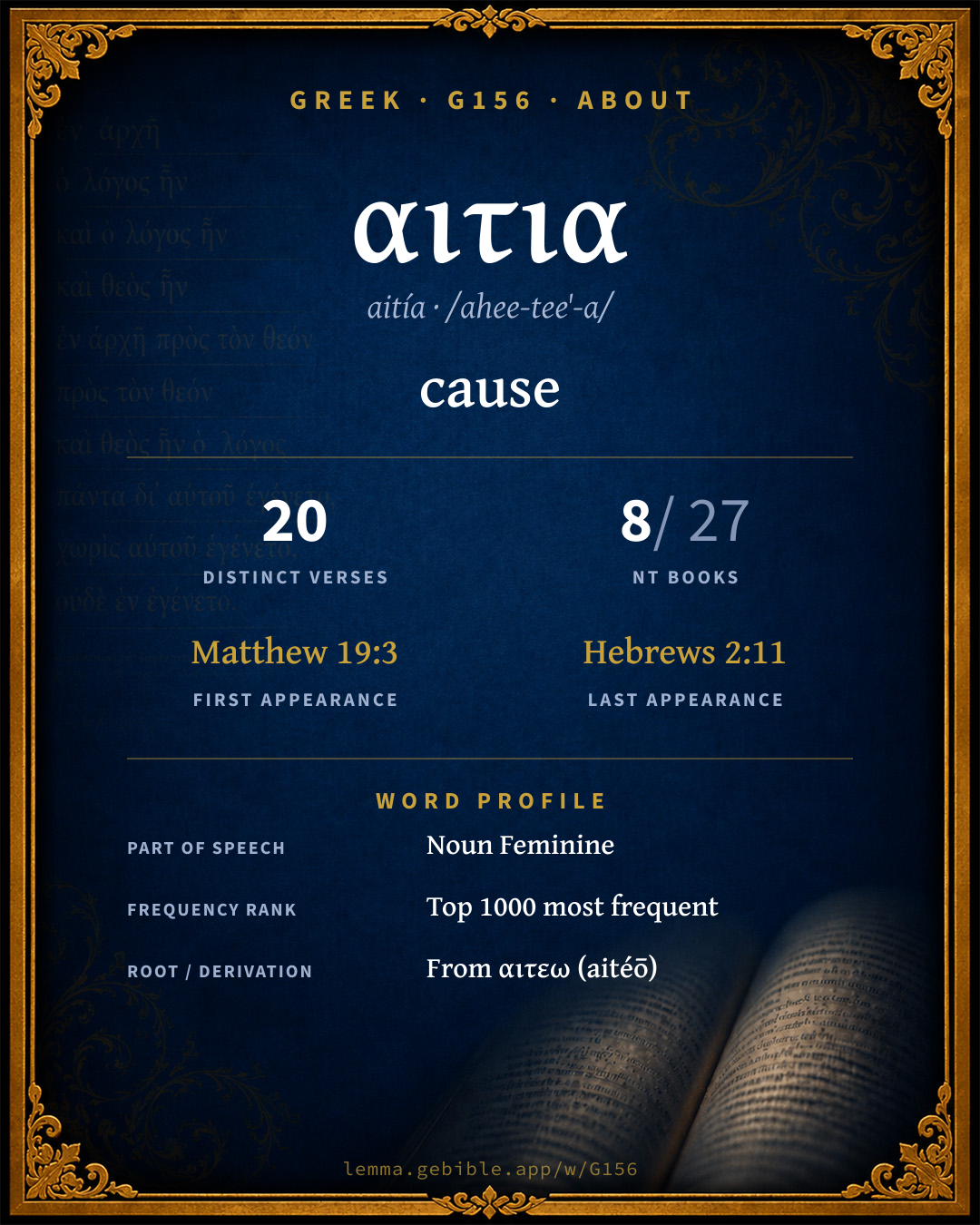
αἰτία
cause
‘cause’ is one of 3 main senses fuller range ↓
Full lexicon entry — Thayer's Greek Lexicon
From Thayer's Greek Lexicon
Where this word appears
See every Accusative-case word in the Greek New Testament →
Grammar key — what these labels mean
Part of speech
- Noun
- A naming word — a person, place, thing, or idea.
Case
- Accusative
- The case of the direct object and of extent.
- Genitive
- The case of source, possession, or “of” — answers “whose / from what.”
- Nominative
- The case of the subject (and the predicate nominative).
Gender
- Feminine
- Grammatically feminine.
Number
- Singular
- One.
Grammatical forms
- Noun, Accusative, Singular, Feminine 16 times (80%)
- Noun, Genitive, Singular, Feminine 2 times (10%)
- Noun, Nominative, Singular, Feminine 2 times (10%)
Parsed forms decoded from the imported morphology (Robinson–Tischendorf, public domain), counted across 20 parsed occurrences — not distinct verses.
Every verse where G156 appears — 20 distinct verses across 8 books. Click any verse to open its interlinear word-by-word view. Verse text shown in the World English Bible for context — . Each verse’s Greek form is shown with its reference; the English is not keyword-highlighted, since the data carries no word-level English alignment. Use “Compare translations” on any verse to read it across multiple English versions. This concordance covers the Greek New Testament; Septuagint (Greek Old Testament) occurrences of this word are not indexed here.
Matthew 3 verses
- Matthew 19:3 αἰτίαν n acc sg fem Pharisees came to him, testing him, and saying, "Is it lawful for a man to divorce his wife for any reason?"
- Matthew 19:10 αἰτία n nom sg fem His disciples said to him, "If this is the case of the man with his wife, it is not expedient to marry."
- Matthew 27:37 αἰτίαν n acc sg fem They set up over his head the accusation against him written, "THIS IS JESUS, THE KING OF THE JEWS."
Mark 1 verse
Luke 1 verse
John 3 verses
- John 18:38 αἰτίαν n acc sg fem Pilate said to him, "What is truth?" When he had said this, he went out again to the Jews, and said to them, "I find no basis for a charge against him.
- John 19:4 αἰτίαν n acc sg fem Then Pilate went out again, and said to them, "Behold, I bring him out to you, that you may know that I find no basis for a charge against him."
- John 19:6 αἰτίαν n acc sg fem When therefore the chief priests and the officers saw him, they shouted, saying, "Crucify! Crucify!" Pilate said to them, "Take him yourselves, and crucify him, for I find no basis for a charge against him."
Acts 8 verses
- Acts 10:21 αἰτία n nom sg fem Peter went down to the men, and said, "Behold, I am he whom you seek. Why have you come?"
- Acts 13:28 αἰτίαν n acc sg fem Though they found no cause for death, they still asked Pilate to have him killed.
- Acts 22:24 αἰτίαν n acc sg fem the commanding officer commanded him to be brought into the barracks, ordering him to be examined by scourging, that he might know for what crime they shouted against him like that.
- Acts 23:28 αἰτίαν n acc sg fem Desiring to know the cause why they accused him, I brought him down to their council.
- Acts 25:18 αἰτίαν n acc sg fem Concerning whom, when the accusers stood up, they brought no charge of such things as I supposed;
- Acts 25:27 αἰτίας n gen sg fem For it seems to me unreasonable, in sending a prisoner, not to also specify the charges against him."
- Acts 28:18 αἰτίαν n acc sg fem who, when they had examined me, desired to set me free, because there was no cause of death in me.
- Acts 28:20 αἰτίαν n acc sg fem For this cause therefore I asked to see you and to speak with you. For because of the hope of Israel I am bound with this chain."
2 Timothy 2 verses
- 2 Timothy 1:6 αἰτίαν n acc sg fem For this cause, I remind you that you should stir up the gift of God which is in you through the laying on of my hands.
- 2 Timothy 1:12 αἰτίαν n acc sg fem For this cause I suffer also these things. Yet I am not ashamed, for I know him whom I have believed, and I am persuaded that he is able to guard that which I have committed to him against that day.
Titus 1 verse
Hebrews 1 verse
About this entry
At a glance — auto-summarized from this page’s data, not written by a person. Every figure links to its source below. This summary describes the numbers; it doesn’t interpret them.
At its core, αιτια (aitía) means “cause.” Translators differ — “cause” in the King James Version, then “reason” (Berean Standard Bible), as the renderings breakdown shows. With 20 verses in 8 books, it is an uncommon word in the Greek New Testament. Its uses concentrate in Acts (40% of all occurrences). Catalogued under 3 senses, its meaning is not single-sense. Each statement above links to its evidence; the full detail follows below.
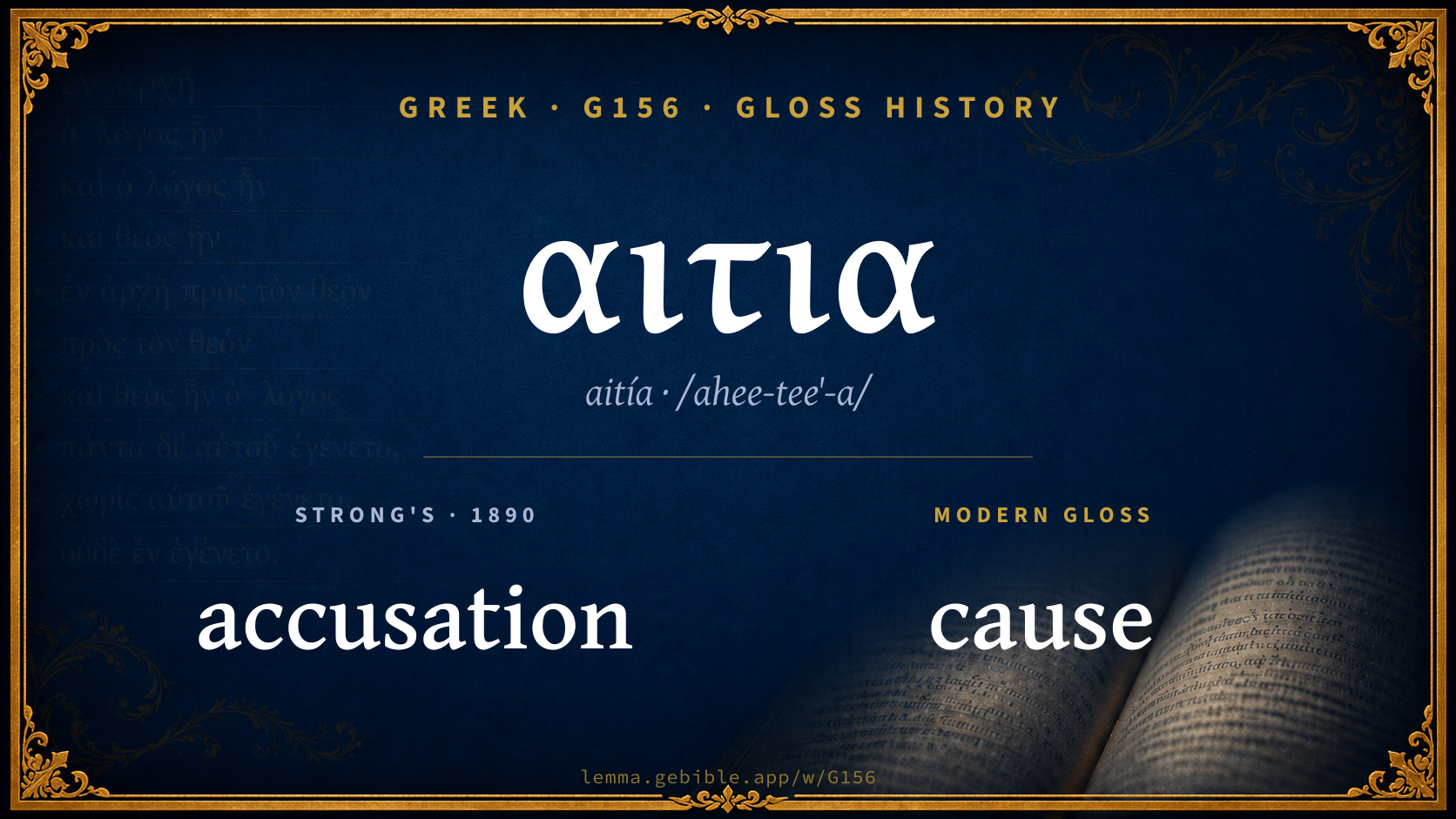
Gloss history
Strong's 1890 vs modern scholarship
About this word
Strong's G156 catalogs a Greek word from the Greek New Testament.
These counts are not copied from any lexicon or concordance. They are computed here, from the morphology-tagged Greek New Testament. What Lemma adds →
- 20
- distinct verses
- The word appears in 20 distinct verses.
- 8 / 27
- NT books
- The word appears in 8 of 27 New Testament books.
- #622
- by frequency
- Top 1000 most frequent Greek words (rank 622 of 5,347 Greek words by occurrence).
View all 20 occurrences in the concordance →
By section of the New Testament
By traditional corpus
Conventional, traditional groupings — biblical authorship is debated, so this is a traditional corpus grouping, not an authorship claim. Some books belong to more than one corpus (Luke is in both the Gospels and the Lukan corpus, and so on), so these shares overlap and need not total 100%. Each figure is a share of the word’s 20 distinct verses.
- Lukan (Luke–Acts) 9 verses · 45%
- Gospels 8 verses · 40%
- Johannine 3 verses · 15%
- Pauline corpus 3 verses · 15%
- Hebrews 1 verse · 5%
How translations render this word
Counts come from each version’s own published word-to-Strong’s tagging or interlinear alignment — an approximate guide to how each version renders this word, not a word-level alignment the data otherwise carries. Because each total is that version’s own tagged count, the per-version totals vary from one another and need not match the appearance or distinct-verse counts above. These counts may also differ from a printed concordance because Lemma counts each distinctly tagged rendering and does not collapse phrase taggings into a single head-word total. This is a fixed set of word-tagged versions (KJV, ASV, BSB, ULT) and does not change with the reading translation you choose elsewhere. Each version’s license is shown beside its name below (and on Sources).
- King James Version: Cause 8×, Accusation 3×, Fault 3×
- American Standard Version: Cause 7×, Crime 3×, Accusation 2×
- Berean Standard Bible: Reason 5×, Basis for a charge 3×, Charge 2×
- unfoldingWord Literal Text: Reason 12×, Charge 4×, Guilt 3×
King James Version Public Domain
Renders G156 across 17 tagged occurrences — most commonly:
Plus 3 renderings that appear only once — usually multi-word phrases or single function words the recovered tagging swept in, not distinct renderings. Not rendered by a distinct English word in 3 further occurrences.
American Standard Version Public Domain
Renders G156 across 19 tagged occurrences — most commonly:
Plus 7 renderings that appear only once — usually multi-word phrases or single function words the recovered tagging swept in, not distinct renderings.
Berean Standard Bible Public Domain
Renders G156 across 18 tagged occurrences — most commonly:
Plus 6 renderings that appear only once — usually multi-word phrases or single function words the recovered tagging swept in, not distinct renderings. Not rendered by a distinct English word in 2 further occurrences.
unfoldingWord Literal Text CC BY-SA 4.0
Renders G156 across 21 tagged occurrences — most commonly:
Plus 2 renderings that appear only once — usually multi-word phrases or single function words the recovered tagging swept in, not distinct renderings.
Senses in Thayer's
The 3 senses Thayer's distinguishes for this word, in lexicon order (not ranked by frequency or importance). The full entry — with sub-senses — is in the Lexicon Entry tab.
- cause, reason
- cause for which one is worthy of punishment, crime
- charge of crime, accusation
Word origin
Derived from αιτεω (aitéō) (G154) — to ask.
From the same as G154 ; a cause (as if asked for) that is (logical) reason (motive matter) (legal) crime (alleged or proved): - accusation case cause crime fault [wh-] ere[-fore].
— Strong’s Exhaustive Concordance (1890), public domain.
Forms in the corpus
The 3 distinct written forms G156 takes in the Greek New Testament, most frequent first — each parse links to that case’s occurrences in the concordance.
| Form | Parsing | Example | Uses |
|---|---|---|---|
| αἰτίαν aitían | Noun, Accusative, Singular, Feminine | Matthew 19:3 | 16 |
| αἰτία aitía | Noun, Nominative, Singular, Feminine | Matthew 19:10 | 2 |
| αἰτίας aitías | Noun, Genitive, Singular, Feminine | Mark 15:26 | 2 |
Same root — word family
Other Thayer's entries built from the same root as G156, grouped by Strong’s listed origin. These share a root / origin per the lexicon — not necessarily a shared meaning. Each links to that word’s own entry.
Derives from
Shares the same root
Derived from this word
Compare all same-root words → Showing 4 of 5 — not the complete family. They share a root, not necessarily a meaning.
Septuagint usage
The same Greek word αιτια appears 3 times in the Greek Old Testament (Septuagint), across 3 verses in 3 books.
- 3
- LXX occurrences
- Tagged occurrences of this Greek word in the Septuagint.
- 3
- verses
- Distinct Septuagint verses containing this word.
- 3 / 39
- OT books
- The word appears in 3 of the 39 Old Testament books.
Sample Septuagint occurrences
- Genesis 4:13 αἰτία
- Job 18:14 αἰτία
- Proverbs 28:17 αἰτία
Septuagint occurrences (same lexeme)
Every verse where the same Strong’s number (G156) appears in the Greek Septuagint. Verse text shown in the World English Bible for context; the Greek form is the matched word — the English is not keyword-highlighted.
- Genesis 4:13 αἰτία Cain said to Yahweh, "My punishment is greater than I can bear.
- Job 18:14 αἰτία He shall be rooted out of his tent where he trusts. He shall be brought to the king of terrors.
- Proverbs 28:17 αἰτία A man who is tormented by life blood will be a fugitive until death; No one will support him.
These are occurrences of the same Greek lexeme (G156) in the Septuagint — not a translation of any one Hebrew word. The store carries no word-level Hebrew↔Greek alignment, so no Hebrew original is asserted here. Counts come from the recovered LXX Strong's tagging — high-frequency vocabulary is well covered, while rare or late forms may be untagged — so they reflect tagged occurrences and may slightly undercount.