
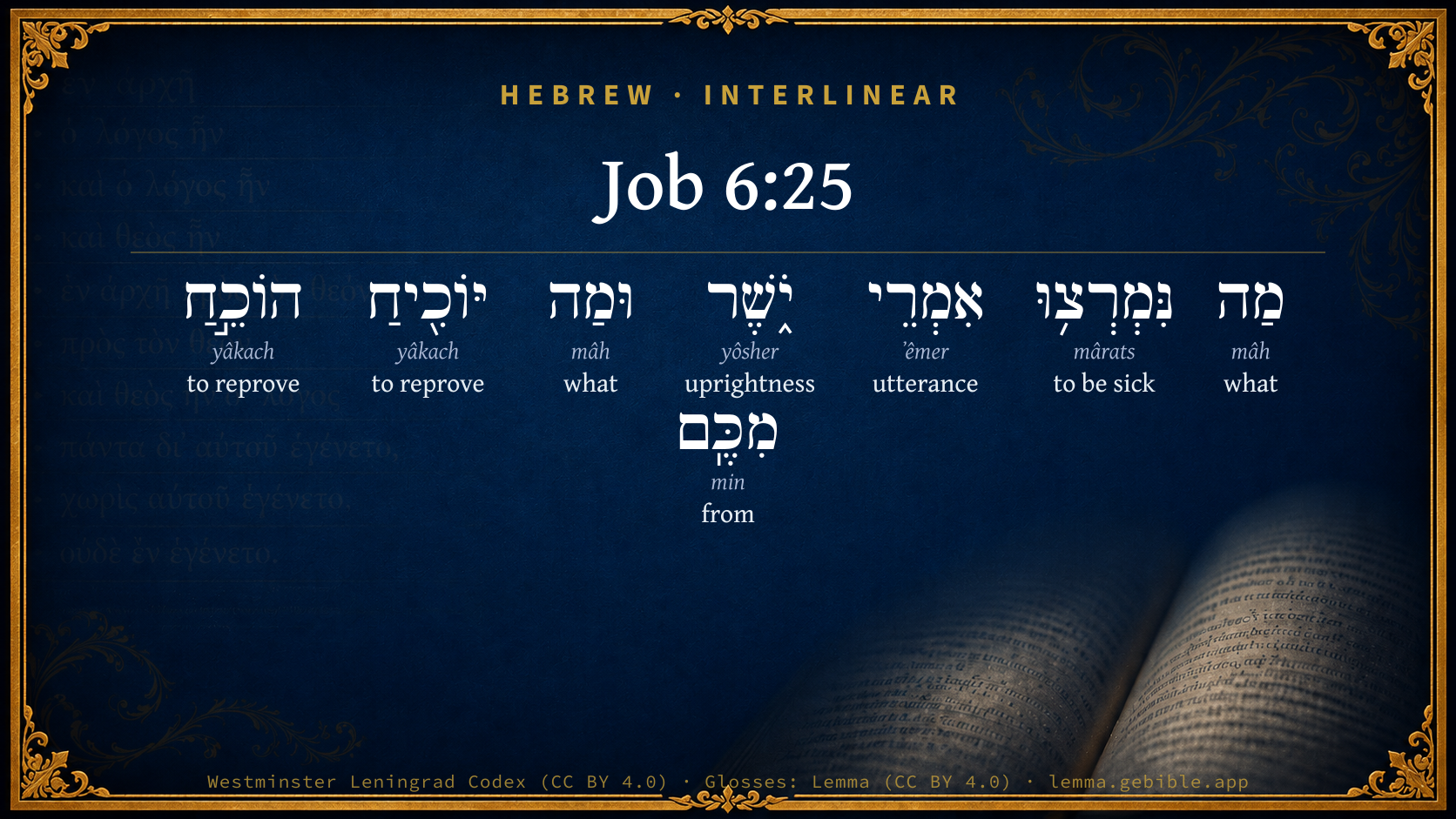
Job 6:25

Hebrew (Westminster Leningrad Codex) Job 6:25 appears in the Hebrew Old Testament. The text above is from the Westminster Leningrad Codex. Each word links to its Strong’s number, a concise gloss, and parsing drawn from the Open Scriptures Hebrew Bible morphology. Click any word for its full Brown-Driver-Briggs (BDB) entry.
Download image
Cite this verse

Job 6:25 (World English Bible). Public Domain. Lemma interlinear Bible study tool, https://lemma.gebible.app/v/job/6/25.

Show BibTeX & RIS
BibTeX
RIS
English Translation
How forcible are words of uprightness! But your reproof, what does it reprove?
World English Bible · Public Domain
Download a study sheet

One document with this verse’s original text, its word-by-word gloss line, the meaning frame, cross-references with their text, attributed commentary, and full source and license credits — printable, and it pastes into notes with its structure intact.

This verse Autodidact and up

Study sheet (.html) Plain text (.txt)

A passage Seminary Student

Up to 50 verses in one chapter. A passage sheet keeps up to 6 commentary sources and 12 cross-references per verse, in the order this page ranks them, and says so on the sheet whenever that leaves anything out. Ask for a single verse and you get the Autodidact verse sheet above.

Everything on this page stays free to read, with no account — the sheet is a download of what is already on screen, not access to it.

Want to remove ads? Support Godless Engineer
Compare translations 3

The same verse in 3 English versions, stacked beneath the original-language interlinear above. Click any original word for its lexicon entry.

Each is an independent rendering of the whole verse — the interlinear is not word-aligned to these translations.

Highlighted words mark where these versions differ — a whole-verse word diff, not a word-by-word alignment.

  • World English Bible Public Domain
    How forcible are words of uprightness! But your reproof, what does it reprove?
  • King James Version Public Domain
    How forcible are right words! but what doth your arguing reprove?
  • unfoldingWord Literal Text CC BY-SA 4.0
    How words of uprightness are forceful! But what does correcting from you correct?

unfoldingWord Literal Text — © unfoldingWord, licensed CC BY-SA 4.0. Word-aligned USFM3 via Door43 (git.door43.org/unfoldingWord/en_ult).

Versions to compare (up to 4)

3 of 4 selected

Show all 18 translations

Every available English version of this verse, each an independent rendering of the whole verse.

  • World English Bible Public Domain
    How forcible are words of uprightness! But your reproof, what does it reprove?
  • Berean Standard Bible Public Domain
    How painful are honest words! But what does your argument prove?
  • Majority Standard Bible Public Domain
    How painful are honest words! But what does your argument prove?
  • King James Version Public Domain
    How forcible are right words! but what doth your arguing reprove?
  • American Standard Version (1901) Public Domain
    How forcible are words of uprightness! But your reproof, what doth it reprove?
  • Revised Version (1885) Public Domain
    How forcible are words of uprightness! but what doth your arguing reprove?
  • Geneva Bible (1599) Public Domain
    Howe stedfast are the wordes of righteousnes? and what can any of you iustly reproue?
  • Douay-Rheims (1899) Public Domain
    Why have you detracted the words of truth, whereas there is none of you that can reprove me?
  • Young's Literal Translation Public Domain
    How powerful have been upright sayings, And what doth reproof from you reprove?
  • Literal Standard Version CC BY-SA 4.0
    How powerful have been upright sayings, || And what reproof from you reproves?
  • Unlocked Literal Bible CC BY-SA 4.0
    How painful are truthful words! But your arguments, how do they actually rebuke me?
  • unfoldingWord Literal Text CC BY-SA 4.0
    How words of uprightness are forceful! But what does correcting from you correct?
  • Darby Bible Public Domain
    How forcible are right words! but what doth your upbraiding reprove?
  • World Messianic Bible Public Domain
    How forcible are words of uprightness! But your reproof, what does it reprove?
  • Webster's Bible Public Domain
    How forcible are right words! but what doth your arguing reprove?
  • Free Bible Version CC BY-SA 4.0
    Honest words are painful, but what do your arguments prove?
  • Bible in Basic English Public Domain
    How pleasing are upright words! but what force is there in your arguments?
  • JPS Tanakh (1917) Public Domain
    How forcible are words of uprightness! But what doth your arguing argue?

Literal Standard Version (2020), Covenant Press — licensed CC BY-SA 4.0. Text via the HelloAO Bible API (eBible.org). Unlocked Literal Bible (unfoldingWord) — licensed CC BY-SA 4.0. Text via the HelloAO Bible API (eBible.org). unfoldingWord Literal Text — © unfoldingWord, licensed CC BY-SA 4.0. Word-aligned USFM3 via Door43 (git.door43.org/unfoldingWord/en_ult). Free Bible Version, Dr. Jonathan Gallagher — licensed CC BY-SA 4.0. Text via the HelloAO Bible API (eBible.org).

Word by word

More ways to search: Search by grammar → Find every occurrence → Compare this word →

Practice this passage: Drill this verse → Learn its vocabulary →

About this verse

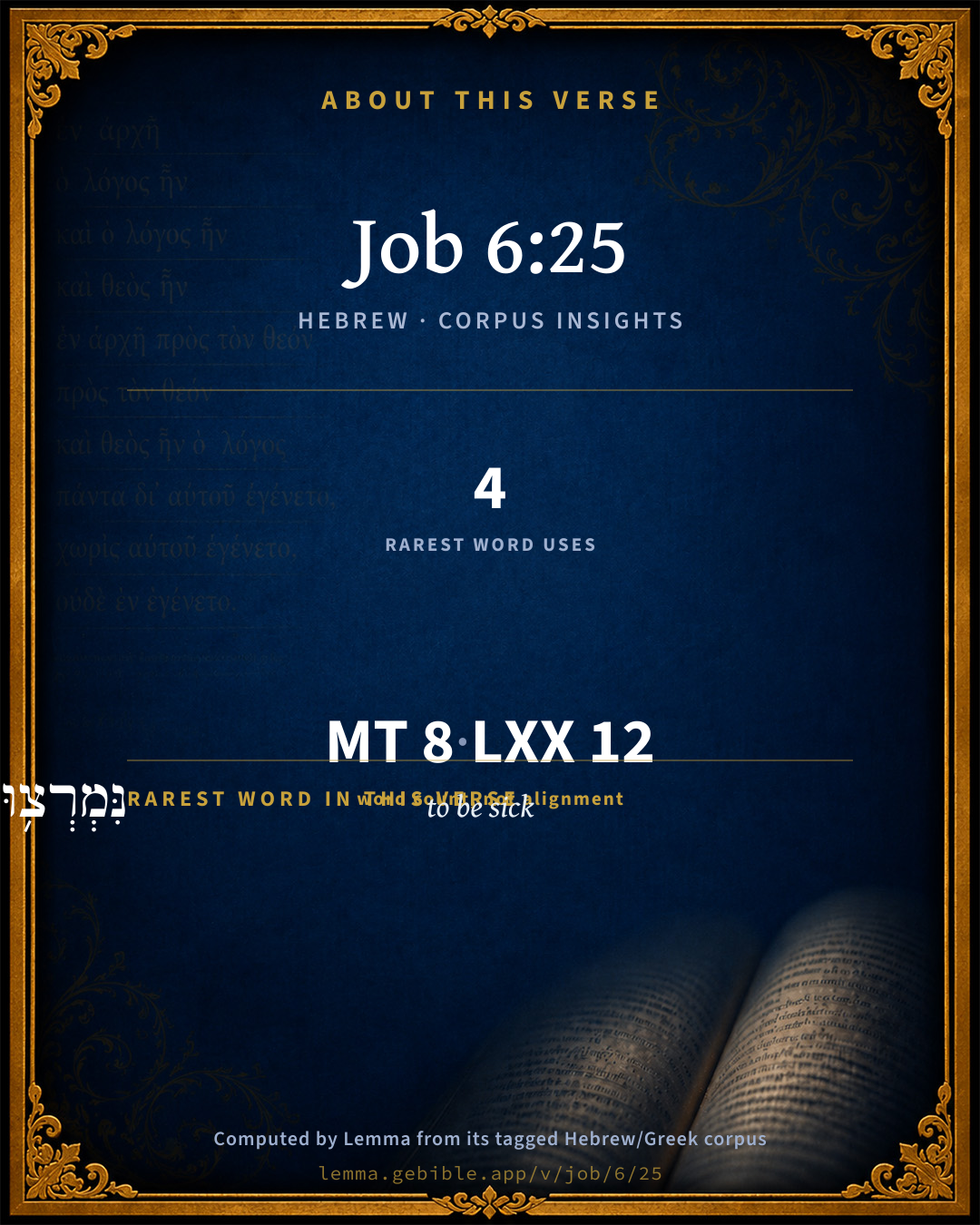
These counts appear in no published source. They are computed here, from the morphology-tagged text and Lemma’s own curated glosses. What Lemma adds →

8
words
6
distinct lemmas
Wisdom
section

Notable vocabulary

The rarest word here is נִּמְרְצ֥וּ to be sick H4834 — appearing just 4 times in the whole Hebrew Bible.

Shared distinctive vocabulary

נִּמְרְצ֥וּ to be sick H4834 occurs in 4 verses of the Hebrew Bible. Also found in:

Grammatical profile

  • 3 verbs
  • 2 nouns
  • 1 preposition
  • 2 particles

Verb forms

  • נִּמְרְצ֥וּ Niphal · Perfect
  • יּוֹכִ֖יחַ Hiphil · Imperfect
  • הוֹכֵ֣חַ Hiphil · Infinitive Absolute

Repetition

Words recur within this verse — often emphatic in Hebrew:

  • יּוֹכִ֖יחַ to reprove H3198 ×2
  • מַה what H4100 ×2

Hebrew & Septuagint length

In English translation the verse runs 13 words from the Hebrew and 20 from the Septuagint (LXX English) — the Septuagint runs noticeably longer here. See the side-by-side →

A rough comparison of the two English renderings, which tokenize alike — not a word-level alignment.

Word counts can differ between the Hebrew and the Greek without any difference in meaning — e.g. the Hebrew direct-object marker אֵת has no separate Greek word, and Greek often adds the article ὁ.

In the original languages it is 8 Hebrew tokens and 12 Greek tokens — but the two are counted differently (Hebrew bundles its prefixes and suffixes into one token; the Greek is in lemma form), so that isn’t a like-for-like length.

Cross-references

11

Topical passages linked to Job 6:25 in the Treasury of Scripture Knowledge — connected by theme and wording, ordered by reader-vote popularity; previews shown in the World English Bible.

  • Job 4:4 Your words have supported him who was falling, You have made firm the feeble knees.
  • Job 13:5 Oh that you would be completely silent! Then you would be wise.
  • Job 16:3–5 Shall vain words have an end? Or what provokes you that you answer?
  • Job 21:34 So how can you comfort me with nonsense, Seeing that in your answers there remains only falsehood?"
  • Job 24:25 If it isn't so now, who will prove me a liar, And make my speech worth nothing?"
  • Job 32:3 Also his wrath was kindled against his three friends, because they had found no answer, and yet had condemned Job.
  • Proverbs 12:18 There is one who speaks rashly like the piercing of a sword, But the tongue of the wise heals.
  • Proverbs 16:21–24 The wise in heart shall be called prudent. Pleasantness of the lips promotes instruction.
  • Proverbs 18:21 Death and life are in the power of the tongue; Those who love it will eat its fruit.
  • Proverbs 25:11 A word fitly spoken Is like apples of gold in settings of silver.
  • Ecclesiastes 12:10–11 The Preacher sought to find out acceptable words, and that which was written blamelessly, words of truth.

Cross-references courtesy of OpenBible.info (CC BY 4.0).

Hebrew and Greek witnesses Masoretic Hebrew ↔ Greek Septuagint

The same verse in the two great witnesses to the Old Testament, shown verse-for-verse.

Here the Septuagint runs noticeably longer than the Hebrew — LXX2012 (modern English Septuagint) 20 words vs World English Bible 13. A rough length comparison of the two English translations, not a word-level alignment — read both below.

These are two independent witnesses, not word-aligned to each other, and the Septuagint is shown in lemma (dictionary) form.

Hebrew Job 6:25 Masoretic · Westminster Leningrad Codex

מַה נִּמְרְצ֥וּ אִמְרֵי יֹ֑שֶׁר וּמַה יּוֹכִ֖יחַ הוֹכֵ֣חַ מִכֶּֽם

How forcible are words of uprightness! But your reproof, what does it reprove?

World English Bible · Public Domain

Greek LXX Job 6:25 Septuagint · lemma form

ἀλλά ὡς ἔοικα φαῦλος ἀληθινός ῥῆμα οὐ γάρ παρά σύ ἰσχύς αἰτέω

But as it seems, the words of a true man are vain, because I do not ask strength of you.

LXX2012 (modern English Septuagint) · Public Domain

On this verse, Haydock's Catholic Bible Commentary discusses the Septuagint’s reading. Read the note in Commentary ↓

Hebrew: Westminster Leningrad Codex (CC BY 4.0). Greek: Septuagint (public domain); English from LXX2012 (modern English Septuagint) (Public Domain). How the Septuagint differs from the Hebrew →

Commentary

Notes on Job 6:25 from classic Christian and Jewish commentators (each source and its license shown beneath its notes). The classic Christian expositions comment on the surrounding passage and are grouped to its opening verse, so a note may address several verses; the Jewish commentaries on the Tanakh (Rashi and others) are per-verse, so they appear only where the commentator wrote on this verse.

Lemma curates 59 commentaries, every one of them public domain or Creative Commons licensed, each selected and text-cleaned for this edition rather than reprinted as found. About our sources →

Trapp's Complete Commentary

John Trapp

Job 6:25 How forcible are right words! but what doth your arguing reprove?

Ver. 25. How forcible are right words] How sweet, saith the Chaldee, interpreting it by Psa 119:103. It may be read Nimletsu for Nimretsu; but the word is well rendered forcible, potent, valid. It noteth also, saith Mr Caryl, acrimony, sharpness, or smartness, because right words have a pleasing acrimony upon the palate of the soul, and a power upon the judgment to sway and carry it. Ille regit dictis animos, &c. Audite senem iuvenes quem iuvenem senes audierunt: these few words from Augustus, falling right, quieted the rebels in his army; and the like is reported of Alexander the Great, of Menenius, Agrippa, &c. But we have better instances, as that of Abigail treating with David; the woman of Abel with Joab; Nicodemus, by a few seasonable words, dissolving the council gathered together against Christ, Joh 7:50; Joh 7:53; Paphnutius stickling for the married clergy at the Nicene council, &c. One seasonable truth failing on a prepared heart hath often a strong and sweet operation. Luther having heard Staupicius say that that is kind repentance which begins from the love of God, ever after that time the practice of repentance was sweeter to him. This speech also of his took well with Luther, The doctrine of predestination beginneth at the wounds of Christ; but before any of this he was much wrought upon by conferrence with an old priest about justification by faith. So was that Italian marquis, Galecius Caracciolus, by a similitude used by Peter Martyr reading upon the First to the Corinthians. Nescio quid divinum in auscultatione est, saith one, there is a kind of divine force and efficacy in hearing more than in reading the word. We may say of it, as David once did of Goliath’s sword, There is none to that. And yet it cannot be denied that the word read also hath a mighty force and powerful influence upon the conscience Hence those many praises of it, Psa 19:7-8, "The statutes of the Lord are right," &c. Right for every man’s state and purpose; so penned, that every man may think they speak de se in re sua, of himself in this particular case, as Athanasius hath it; so right the good word of God is and suitable; how then can it be but forcible. {see Heb 4:12 2Co 10:4-5} And how forcible it is none can tell but those that have felt it; nor those neither; hence this expression by way of admiration, Oh how effectual are right words!

But what doth your arguing reprove?] Heb. What doth your disputation dispute? What force, what energy, is in your arguments? how flat and sinewless are they! what dull stuff appear they! and how little to the purpose! Tam facile diluuntur argumenta vestra, quam vulpes comest pyrum. I can blow them off as easily as I could a feather off my hand. Strong is the truth (I grant), and easily evinceth the things that are true; but to conclude truths from falsities (as that I am a hypocrite because afflicted), that ye can never do.

John Trapp, A Commentary or Exposition upon All the Books of the Old and New Testament (1647–1656) — public domain. Text from a community e-Sword module.

The Biblical Illustrator

Joseph S. Exell

Job_6:25

How forcible are right words!

The force of right words

Who has not felt the superiority of the power of Jobs words compared with those of the words of his friends?

How is this? Job suffered, struggled, and sorrowed, and therefore he learned something of the human heart. Irritating to him were the words of his friends. Those words were as nothing; they reproved nothing; they appealed to nothing in the sorrow-stricken man. Righteous words would have been precious to him; hence his bitter disappointment after listening to the effusion of Eliphaz. Who has not felt the feebleness of mere platitudes when the soul has longed for sympathy?

I. That words may possess a righteous or unrighteous character. Right words. God declared to Jobs friends, Ye have not spoken of Me the thing that is right, as My servant Job hath.

1. The power of speech is a Divine gift. Whether words were originally given, or were elaborated by the faculty of speech, does not alter the question of the Divine origin of the gift. Without speech, where would have been the outcome of mans spiritual energies? How the soul speaks in the voice! Burning words proclaim the power of the spirit that is in man.

2. The Divine gift of words is intended to be a righteous power. By perversion of words sin was introduced; by the righteousness of words error and evil shall be destroyed. The words of God are spirit and life.

3. In proportion to the excellence of the gift will be the responsibility of the speaker. By thy words shalt thou be justified, etc.

II. The power of words for good or evil is in proportion to their righteousness or unrighteousness. Doth not the ear try words? Righteous words reprove.

1. The words of God are instruments of righteousness. Do not My words do good? (Mic_2:7.)

2. The words of man are only righteous as they harmonise with the words of God. Let your speech be always with grace (Col_4:6).

3. In the war of words the righteous words shall be victorious. Great is truth, and must prevail.

4. Divine power operates through the words of the good. I will be to thee a mouth and wisdom. Therefore how forcible are right words!

5. Evil words are destructive. Whose word doth eat as doth a canker. The unrighteous words of Jobs friends possessed a power that forced him to exclaim, How forcible are right words! (Bishop Percival.)

Right words

Words are right three ways.

I. In the matter, when they are true.

II. In the manner, when they are plain, direct, and perspicuous.

III. In their use, when they are duly and properly applied; when the arrow is carried home to the white, then they are right words, or words of righteousness. When this threefold rightness meets in words, how forcible, how strong are such words! (J. Caryl.)

The potency of language

Language is more than the expression of ideas. It sustains a more vital relation. Thought is a remote abstraction until it becomes visible, tangible, concrete, in words. Hence Wordsworth, with profound philosophy, wrote, Language is the incarnation of thought. But more than this, a man knows not what he thinks until he tries to put it into words. The tongue or pen sometimes like a whetstone sharpens thought, giving it edge and point; sometimes like a painters pencil, it communicates definiteness, precision, and exquisite colouring to the outlines of thought; again, like a prism, it seems to analyse and separate blended ideas; again, like a crystal, it imparts clearness, symmetry, brilliance; or like a mirror, it reflects and multiplies the rays of light. Verily, how forcible are right words! (A. T. Pierson, D. D.)

.

The Biblical Illustrator, edited by Joseph S. Exell (c. 1880s–1900s) — public domain. Text from a community e-Sword module.

Geneva Bible (1599)

Geneva Bible translators

He that hath a good conscience doth not shrink at the sharp words or reasonings of others, except they be able to persuade him by reason.

Geneva Bible (1599) marginal notes — public domain. Text via Bolls.life.

Jamieson, Fausset & Brown

Robert Jamieson, A. R. Fausset & David Brown

And what will your arguings reprove?--literally, "the reproofs which proceed from you"; the emphasis is on you; you may find fault, who are not in my situation [UMBREIT].

Jamieson, Fausset & Brown — Commentary Critical and Explanatory on the Whole Bible (1871) — public domain (CC PDM 1.0). Text via the HelloAO Bible API.

Adam Clarke's Commentary

Verse 25. How forcible are right words] A well-constructed argument, that has truth for its basis, is irresistible.

But what doth your arguing reprove?] Your reasoning is defective, because your premises are false; and your conclusions prove nothing, because of the falsity of the premises whence they are drawn. The last clause, literally rendered, is, What reproof, in a reproof from you? As you have proved no fault you have consequently reproved no vice. Instead of מה נמרצו mah nimretsu, "how forcible," מה נמלצו mah nimletsu, "how savoury or pleasant," is the reading of two MSS., the Chaldee, and some of the rabbins. Both senses are good, but the common reading is to be preferred.

Adam Clarke's Commentary on the Bible (1810–1826) — public domain. Text from a community e-Sword/MySword module.

Ellicott's Commentary for English Readers

(25) How forcible are right words !—“How forcible are words of uprightness! But what doth your reproof reprove? Open rebuke is better than secret love; better to be honestly and openly rebuked by you than be subject to the secret insinuations which are intended to pass for friendship.”

A Bible Commentary for English Readers, edited by Charles John Ellicott (1878–1897) — public domain. Text from a community e-Sword module.

The Cambridge Bible for Schools and Colleges

gen. ed. J. J. S. Perowne

25. how forcible are right words] Or, words of uprightness, that is honest, straightforward, close dealing with a man about himself, or his offences, sign of true friendship, Psa_141:5; cf. ch. Job_33:3, where Elihu claims to speak out of this rectitude of mind. The word rendered forcible is of rather uncertain meaning. It occurs again 1Ki_2:8, a grievous curse, Mic_2:10, a sore destruction, and in Job_16:3, what emboldeneth thee that thou answerest? The fundamental sense of the word is assumed to be to be sharp, hence, to be strong, vehement. This is conjectural. What may be but another form of the word occurs in Psa_119:103, how sweet are thy words unto my taste! And many prefer that meaning here: how sweet are words of uprightness.

your arguing reprove] lit. what doth reproving from you, the kind of reproving that comes from you, insinuations and captious laying hold of more excited language, reprove? In Job_6:24 Job demanded to know from his friends directly what sins they laid to his charge. He would welcome straightforward dealing that went into his circumstances.

The Cambridge Bible for Schools and Colleges (gen. ed. J. J. S. Perowne; Cambridge University Press, 1878–1918) — public domain. Text from a community e-Sword module.

John Gill's Exposition

Do ye imagine to reprove words,.... Or with words; with bare words, without any force of reasoning and argument in them? put a parcel of words together without any sense or meaning, or however without any cogency in them, and think to run me down with them? or is your scheme and device only, and which you pursue, to catch at and lay hold on some words of mine uttered in my distress, and make me an offender for a word, or for a few words, supposing they have been rashly and passionately spoken? have ye no facts to charge me with, before or since these calamities befell me? is the charge of hypocrisy and want of the fear of God to be supported by producing some hasty expressions, without pointing at one single action in my life and conversation?

and the speeches of one that is desperate, which are as wind? that is, do ye imagine to reprove them? or, are; your thoughts wholly and solely intent on them? are these only the strong reasons you have to produce to fix the sin of hypocrisy upon me? for by him that is "desperate" he means himself; not that he despaired of his everlasting salvation; he was far from despair; he was a strong believer, and determined that, though he was slain, he would trust in the Lord; he was well assured he should be justified, both here and hereafter; and full well knew that his Redeemer lived, and that though he died, he should rise again and be happy in the vision of God for ever: but he despaired of a restoration to outward happiness, which Eliphaz had suggested, should he behave well; but, alas! his condition was forlorn and miserable, and there was no hope with him of being better; his children were dead, his substance in the hands of robbers, his health so extremely bad that he had no expectation of a recovery to his former state; and therefore it was very unkind and ungenerous to lay hold upon and aggravate the speeches of such an one, and improve them against him; and especially as they were only "for refreshment" (c), as some choose to render the words, see Job 32:20; they were uttered to give vent to his sorrow and grief, and not with any ill design against God or men; or the sense of the whole is, that they imagined that their words were right and fit to reprove with, and that there were force and strength in them, and had a tendency to work conviction and bring to confession; but as for the words of Job, they treated them "as wind"; as idle, vain, and empty, and useless and fruitless as the wind.

(c) "ad respirium", Schultens.

John Gill's Exposition of the Whole Bible (1746–1763) — public domain (CC PDM 1.0). Text via the HelloAO Bible API.

Albert Barnes' Notes on the Bible

How forcible are right words! - How weighty and impressive are words of truth! Job means that he was accustomed to feel their power, and to admit it on his soul. If their words were such, he would listen to them with profound attention, and in silence. The expression has a proverbial cast.

But what doth your arguing reprove? - Or rather, what doth the reproof from you reprove? or what do your reproaches prove? Job professes a readiness to listen to words of truth and wisdom; he complains that the language of reproach used by them was not adapted to instruct his understanding or to benefit his heart. As it was, he did not feel himself convinced, and was likely to derive no advantage from what they said.

Albert Barnes' Notes on the Bible (1834–1885) — public domain. Text from a community e-Sword/MySword module.

Haydock's Catholic Bible Commentary

Why. Hebrew, "How strong are the words of truth!" (Calmet) --- Whereas. Protestants, "But what doth your arguing reprove?" What part of my discourse do you find erroneous? Septuagint, "But it seems the words of the man of truth are deceitful. Yet I do not beg from you (a word or) strength." (Haydock)

George Leo Haydock (1774–1849), Haydock's Catholic Family Bible and Commentary, 1859 edition — public domain. Excludes Psalms (Douay-Rheims chapter numbering differs from Protestant) and Deuterocanonical books (Catholic canon only).

Matthew Poole's English Annotations

Right words, i.e. the words of truth or solid arguments, have a marvellous power to convince and persuade a man; and if yours were such, I should readily yield to them.

Your arguing reprove; or, your arguing argue. There is no truth in your assertions, nor weight in your arguments, and therefore are they of no account or power with me.

Matthew Poole's English Annotations on the Holy Bible (1683–1685) — public domain. Text from a community e-Sword/MySword module.

Whedon's Commentary on the Bible

Daniel D. Whedon

25. How forcible — How sweet, etc. Thus Furst, Ewald, and Zockler. Many others of equal authority, however, (for instance, Gesenius, Thes., p. 820,) favour the version of the text — How forcible are right words — words of “uprightness,” or “truth,” ישׁד. The parallelism, which ever helps to the meaning of a verse, will properly appear from a literal translation of the second member of the verse: “But what doth reproof from you reprove.” The feebleness of their reproof (from you) is set forth by contrast with the forcibleness of right words. “Words which keep the straight way of truth go to the heart.”

Daniel D. Whedon (gen. ed.), Commentary on the Old and New Testaments (1874–1909) — public domain. Text from a community e-Sword module.

The Pulpit Commentary

How forcible are right words! literally, words of uprightness. Such words have a force that none can resist. If the charges made by Eliphaz had been right and true, and his arguments sound and just, then Job must have yielded to them, have confessed himself guilty, and bowed down with shame before his judges. But they had had no such constraining power. Therefore they were not "words of uprightness." But what doth your arguing reprove? literally, What doth your reproving reprove? That is What exactly is it that ye think to be wrong in me? At what is your invective aimed?

The power of right words; or, complaining stayed by instruction.

Job has hitherto met with no comfort from those who came "to mourn with him, and to comfort him." From the inutility of their powerless words he turns aside with the bitter reflection on his lips, "How forcible are right words!" Words charged with truth, with great views of things, with tender sympathy, heal and guide and comfort the perplexed and saddened soul; while the words of false friends pierce as goads. Truth at all times is worthy of trust. The spirit, worn and weary, may rest in it and find peace. Consider the power of truth the force of right Words

I IN RESOLVING THE ENTANGLEMENTS OF ERROR. Truth is the right, the straight, line which reveals and thereby condemns the crooked departures. Its own clear, calm utterance resolves the confusion of tortuous commingled error. It is by the simple statement of truth that the wrong of error is discovered and rebuked. Loudness of denunciation cannot contradict error, or unravel it, or expose it. Nor will mere logical demonstration; noise will not destroy darkness; nor will the gloom be illuminated by proving it to be darkness. But the quiet shining of the lamp will scatter the shades of black night. So truth in its own simplicity and realness effectually and alone disperses the gloom and guides the feet of the wanderer through the tangled path of error. Such words Job had not yet found. But the good Teacher was not far away; and finally Job was led to the open plain and the clear light and the straight way.

II RIGHT WORDS ARE FORCIBLE IN THE PRESENCE OF DEEP SORROW. So Job thought. It was for such words he pined. He longed for the teaching that would bring him comfort, and not for the accusations that would make his burden heavier and his heart sadder. There is a deep truth relating to all human affliction. Looked at only as a derangement of human happiness, it is devoid of that completeness of view that would constitute it a truthful one. But looked at as a Divine correction, a discipline, a sharp warning or departure from law, and a just punishment for such departure; and looked at as under the control of the Almighty Father, it is seen to be invested with a momentous character, and to be. inflicted for the wisest and best purposes. Right words on it bring the mind to peace. They are forcible to counsel and to comfort; to warn of danger, to guide to safety, to console in suffering. Happy the sufferer who has an interpreter at band, who with right words can unveil the mystery, and make clear the ways of God to man!

III RIGHT WORDS ARE FORCIBLE IN THE ADJUSTMENT OF DISTURBED RELATIONS OF LIFE. They are wise words and kind. Even enemies are overcome by them. The right word is a word in harmony with the truth. Spoken with lips that speak truth habitually, and from a heart where truth finds its home, they carry conviction. They win the ear and the confidence of the listener. They have a force peculiar to themselves. They command. They are strong and cannot be shaken. They pierce, as doth an arrow, when they are words of condemnation founded on truth; and they comfort, and heal, and restore, and readjust, when they are spoken in kindness. The wise man searches for right words, and, having found them, speaks them in all simplicity. And the seeker after truth, or rest, or comfort welcomes them. They bear help on their wings, and are as reviving as the beams of the morning. R.G.

The force of right words.

Job is not so unreasonable as he appears to his friends. He will admit the force of truth and reason. Only he considers the arguments he has heard false and fallacious.

I REASONABLE MEN RECOGNIZE THE FORCE OF RIGHT WORDS. Words may be like arrows that pierce, like swords that divide, like hammers that crush; or they may be like seeds that grow and bear fruit, like loaves of bread to feed the hungry, and streams of living water flowing by the dusty highway, from which all thirsty souls may drink. Thus they are more than mere sounds. They are expressions of thought. God"s words come with power. All right Words are forcible. But there are empty words that fall without any weight, and vapid words that are dissipated in the air without effect. It is not the number, the volume, or the noise, of the words that gives them force, but the rightness of them. We must, therefore, inquire wherein this rightness resides.

1. In truth. False words may seem to carry great weight. But in the end all lies fail. The truth, simply told, has a force which no rhetoric can equal.

2. In adaptability. There are truths which are not suitable for the occasion on which they are spoken. This was the case with many of the remarks which Eliphaz had made, which were right enough in themselves, but which did not apply to Job. They lost force by being irrelevant.

3. In moral weight. The justice of what we say adds weight to it. The most forcible words are those that find their way to our conscience. Others may be luminous; these words flame out with startling vividness.

4. In sympathy. Truth spoken in love comes with double force.

II IT IS FOOLISH TO DISREGARD THE FORCE OF RIGHT WORDS.

1. In the speaker. This was the Temanite"s mistake. He was not sufficiently considerate of the rightness of what he said. He meant well, but he spoilt all by this grievous error. We need to weigh our words. They may have many excellent qualities clearness, grace, apparent vigour yet if they are not right words they will fail. The Christian teacher needs to test and correct his words by standing close to the fountain of truth and right in the Holy Scriptures, and by keeping his heart pure and sympathetic. Otherwise all his eloquence will be barren, or even poisonous as mephitic vapours.

2. In the hearer. It is excessively foolish to disregard words as though they were merely "sound and fury, signifying nothing." They are the chariots in which thoughts ride; and if we would but open our gates to receive them, we might find those thoughts most welcome guests. Even if the words are unpopular or painful, we should be foolish to disregard them when we know them to be right. For truth does not cease to be truth by being rejected. Many unpalatable ideas are most medicinal. And many words, rejected at first, when once they are received, prove to be as the very bread of life. The words of the everlasting gospel are right words, which we may reject at our peril; which we may receive for our salvation. W.F.A.

The Pulpit Commentary (1880–1919), ed. H.D.M. Spence-Jones & Joseph S. Exell — public domain. Text from a community e-Sword module.

John Wesley's Explanatory Notes

Forcible - The words of truth have a marvelous power. Reprove - But there is no truth in your assertions or weight in your arguments.

John Wesley, Explanatory Notes Upon the Whole Bible (1754–1765) — public domain. Text via the GEBible commentary corpus.

Rashi

Rabbi Shlomo Yitzchaki (Rashi)

How clear Heb. נמרצו, like (I Kings 2:8), “a clear curse (נמרצת),” an expression of (Prov. 25:11) “a word spoken with proper basis.” and similarly (Ps. 119:103), “How clear (נמלצו) are Your words to my palate.” All of them are expressions of clarification (מליצה), and the “lammed” is converted to a “resh.”

words of uprightness If you were saying words of uprightness, they would be accepted, but now, what does your proof prove? Every expression of תוֹכָחָה in Job means the clarification and verification of matters.

Rashi on the Tanakh — English translations: “The Judaica Press complete Tanach with Rashi, translated by A. J. Rosenberg” (CC BY 4.0); “Pentateuch with Rashi's commentary by M. Rosenbaum and A.M. Silbermann, 1929-1934” (public domain); “The Metsudah Tanach series, Lakewood, N.J” (CC BY 4.0); and “The Book of Joshua, Metsudah Publications, 1997” (CC BY 4.0). Text via Sefaria.

Lesson kit

Teaching starters — assembled from the data on this page, not authored interpretation. Every prompt links to the verse data it draws on. Edit before teaching.

Job, in the Wisdom, opens this verse with 8 words (6 distinct Hebrew lemmas). Its most distinctive word is mârats (“to be sick”). The Greek Septuagint runs longer here. A historical commentator’s framing appears above. Read the whole chapter for the surrounding context.

Discussion questions

  1. What does “to be sick” (mârats) contribute to the verse as a whole?
  2. 1 Kings 2:8 shares the word «to be sick» with this verse. How do the two illuminate each other?
  3. “to reprove” occurs 2× in this one verse. What is the effect of the repetition?
  4. Compared with the Hebrew, the Septuagint runs longer here. What questions does that raise?
  5. These translations render this verse differently; the difference is in the English rendering, not the original. What questions does that raise?
  6. The verb «נִּמְרְצ֥וּ» is Niphal Perfect. How does its form color the action?
  7. Reading how Trapp's Complete Commentary and The Biblical Illustrator read this verse, where do the two commentators agree and where do they part?

Things to notice

Reading settings

Reading text

Shown beneath each verse's original-language words.

Old Testament
Old Testament edition

Read the OT as the Masoretic Hebrew (MT) or the Greek Septuagint (LXX).

English shown for the Greek Septuagint (in the Hebrew ↔ Greek comparison).

Comparing translations? Open the Compare panel on any verse page to stack up to four side by side.