
1 Kings 2:22

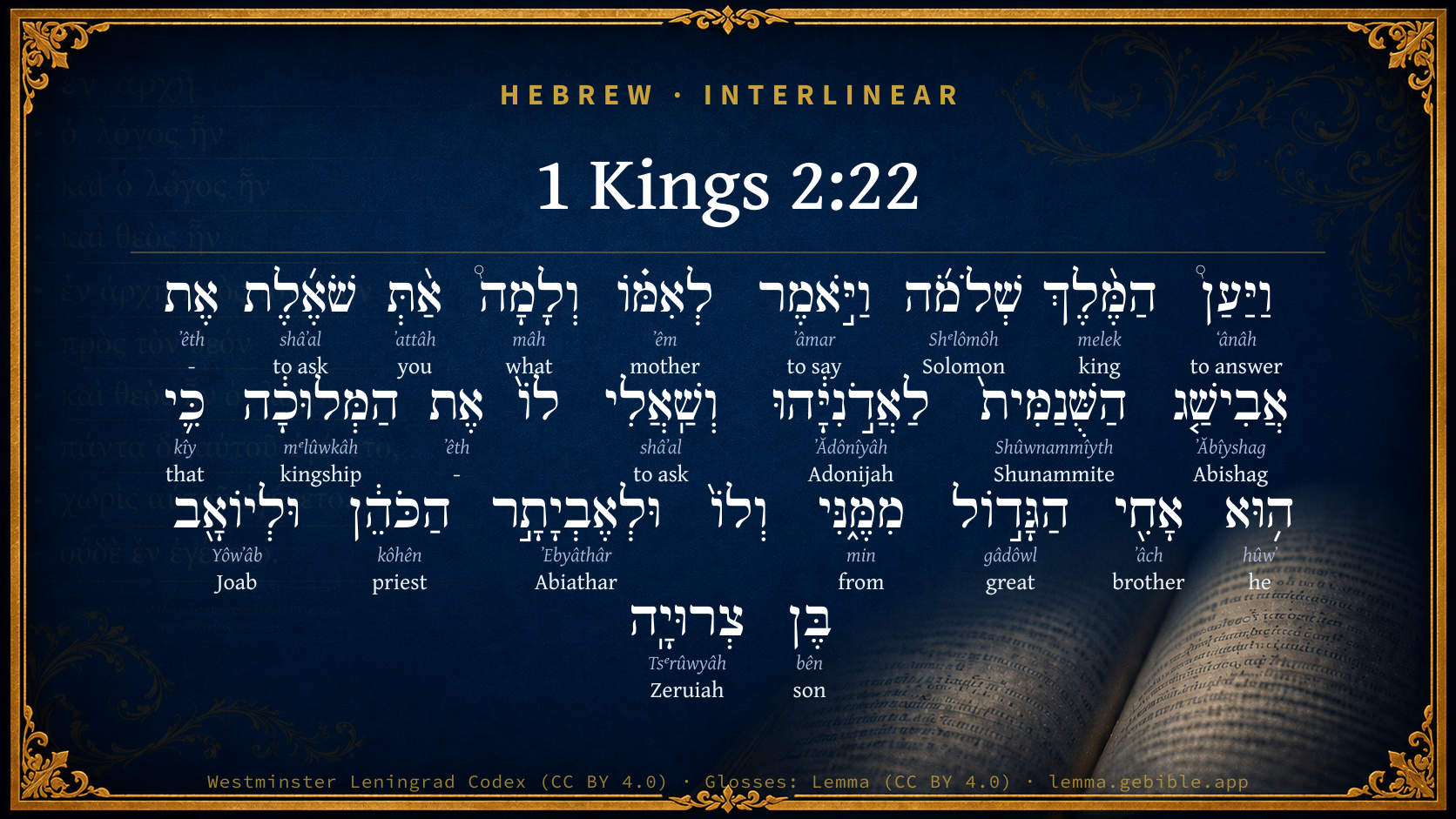
Hebrew (Westminster Leningrad Codex) 1 Kings 2:22 appears in the Hebrew Old Testament. The text above is from the Westminster Leningrad Codex. Each word links to its Strong’s number, a concise gloss, and parsing drawn from the Open Scriptures Hebrew Bible morphology. Click any word for its full Brown-Driver-Briggs (BDB) entry.
Download image
Cite this verse

1 Kings 2:22 (World English Bible). Public Domain. Lemma interlinear Bible study tool, https://lemma.gebible.app/v/1-kings/2/22.

Show BibTeX & RIS
BibTeX
RIS
English Translation
King Solomon answered his mother, Why do you ask Abishag the Shunammite for Adonijah? ask for him the kingdom also; for he is my elder brother; even for him, and for Abiathar the priest, and for Joab the son of Zeruiah.
World English Bible · Public Domain
Download a study sheet

One document with this verse’s original text, its word-by-word gloss line, the meaning frame, cross-references with their text, attributed commentary, and full source and license credits — printable, and it pastes into notes with its structure intact.

This verse Autodidact and up

Study sheet (.html) Plain text (.txt)

A passage Seminary Student

Up to 50 verses in one chapter. A passage sheet keeps up to 6 commentary sources and 12 cross-references per verse, in the order this page ranks them, and says so on the sheet whenever that leaves anything out. Ask for a single verse and you get the Autodidact verse sheet above.

Everything on this page stays free to read, with no account — the sheet is a download of what is already on screen, not access to it.

Want to remove ads? Support Godless Engineer
Compare translations 3

The same verse in 3 English versions, stacked beneath the original-language interlinear above. Click any original word for its lexicon entry.

Each is an independent rendering of the whole verse — the interlinear is not word-aligned to these translations.

Highlighted words mark where these versions differ — a whole-verse word diff, not a word-by-word alignment.

  • World English Bible Public Domain
    King Solomon answered his mother, Why do you ask Abishag the Shunammite for Adonijah? ask for him the kingdom also; for he is my elder brother; even for him, and for Abiathar the priest, and for Joab the son of Zeruiah.
  • King James Version Public Domain
    And king Solomon answered and said unto his mother, And why dost thou ask Abishag the Shunammite for Adonijah? ask for him the kingdom also; for he is mine elder brother; even for him, and for Abiathar the priest, and for Joab the son of Zeruiah.
  • unfoldingWord Literal Text CC BY-SA 4.0
    And King Solomon answered and said to his mother, “And why are you requesting Abishag the Shunammitess for Adonijah? Then request for him the kingdom, for he is my brother, older than me, and for him and for Abiathar the priest and for Joab, the son of Zeruiah!”

unfoldingWord Literal Text — © unfoldingWord, licensed CC BY-SA 4.0. Word-aligned USFM3 via Door43 (git.door43.org/unfoldingWord/en_ult).

Versions to compare (up to 4)

3 of 4 selected

Show all 18 translations

Every available English version of this verse, each an independent rendering of the whole verse.

  • World English Bible Public Domain
    King Solomon answered his mother, Why do you ask Abishag the Shunammite for Adonijah? ask for him the kingdom also; for he is my elder brother; even for him, and for Abiathar the priest, and for Joab the son of Zeruiah.
  • Berean Standard Bible Public Domain
    King Solomon answered his mother, “Why do you request Abishag the Shunammite for Adonijah? Since he is my older brother, you might as well request the kingdom for him and for Abiathar the priest and for Joab son of Zeruiah!”
  • Majority Standard Bible Public Domain
    King Solomon answered his mother, “Why do you request Abishag the Shunammite for Adonijah? Since he is my older brother, you might as well request the kingdom for him and for Abiathar the priest and for Joab son of Zeruiah!”
  • King James Version Public Domain
    And king Solomon answered and said unto his mother, And why dost thou ask Abishag the Shunammite for Adonijah? ask for him the kingdom also; for he is mine elder brother; even for him, and for Abiathar the priest, and for Joab the son of Zeruiah.
  • American Standard Version (1901) Public Domain
    And king Solomon answered and said unto his mother, And why dost thou ask Abishag the Shunammite for Adonijah? ask for him the kingdom also; for he is mine elder brother; even for him, and for Abiathar the priest, and for Joab the son of Zeruiah.
  • Revised Version (1885) Public Domain
    And king Solomon answered and said unto his mother, And why dost thou ask Abishag the Shunammite for Adonijah? ask for him the kingdom also; for he is mine elder brother; even for him, and for Abiathar the priest, and for Joab the son of Zeruiah.
  • Geneva Bible (1599) Public Domain
    But King Salomon answered and sayd vnto his mother, And why doest thou aske Abishag the Shunammite for Adonijah? aske for him the kingdome also: for he is mine elder brother, and hath for him both Abiathar the Priest, and Ioab the sonne of Zeruiah.
  • Douay-Rheims (1899) Public Domain
    And king Solomon answered, and said to his mother: Why dost thou ask Abisag the Sunamitess for Adonias? ask for him also the kingdom: for he is my elder brother, and hath Abiathar the priest, and Joab the son of Sarvia.
  • Young's Literal Translation Public Domain
    And king Solomon answereth and saith to his mother, `And why art thou asking Abishag the Shunammite for Adonijah? also ask for him the kingdom -- for he `is' mine elder brother -- even for him, and for Abiathar the priest, and for Joab son of Zeruiah.'
  • Literal Standard Version CC BY-SA 4.0
    And King Solomon answers and says to his mother, “And why are you asking [for] Abishag the Shunammite for Adonijah? Also ask [for] the kingdom for him—for he [is] my elder brother—even for him, and for Abiathar the priest, and for Joab son of Zeruiah.”
  • Unlocked Literal Bible CC BY-SA 4.0
    King Solomon answered and said to his mother, “Why do you ask Abishag the Shunammite for Adonijah? Why do you not ask the kingdom for him also, for he is my elder brother—for him, for Abiathar the priest, and for Joab son of Zeruiah?”
  • unfoldingWord Literal Text CC BY-SA 4.0
    And King Solomon answered and said to his mother, “And why are you requesting Abishag the Shunammitess for Adonijah? Then request for him the kingdom, for he is my brother, older than me, and for him and for Abiathar the priest and for Joab, the son of Zeruiah!”
  • Darby Bible Public Domain
    And king Solomon answered and said to his mother, And why dost thou ask Abishag the Shunammite for Adonijah? ask for him the kingdom also; for he is mine elder brother; even for him, and for Abiathar the priest, and for Joab the son of Zeruiah.
  • World Messianic Bible Public Domain
    King Solomon answered his mother, “Why do you ask Abishag the Shunammite for Adonijah? Ask for him the kingdom also, for he is my elder brother; even for him, and for Abiathar the priest, and for Joab the son of Zeruiah.”
  • Webster's Bible Public Domain
    And king Solomon answered and said to his mother, And why dost thou ask Abishag the Shunamite for Adonijah? ask for him the kingdom also; for he is my elder brother; even for him, and for Abiathar the priest, and for Joab the son of Zeruiah.
  • Free Bible Version CC BY-SA 4.0
    King Solomon answered his mother, “Why on earth are you asking me to give Abishag to Adonijah? You might as well ask me to give my brother the kingdom! He is my older brother, and Abiathar the priest and Joab, son of Zeruiah, are on his side!”
  • Bible in Basic English Public Domain
    Then King Solomon made answer and said to his mother, Why are you requesting me to give Abishag the Shunammite to Adonijah? Take the kingdom for him in addition, for he is my older brother, and Abiathar the priest and Joab, the son of Zeruiah, are on his side.
  • JPS Tanakh (1917) Public Domain
    And king Solomon answered and said unto his mother: 'And why dost thou ask Abishag the Shunammite for Adonijah? ask for him the kingdom also; for he is mine elder brother; even for him, and for Abiathar the priest, and for Joab the son of Zeruiah.'

Literal Standard Version (2020), Covenant Press — licensed CC BY-SA 4.0. Text via the HelloAO Bible API (eBible.org). Unlocked Literal Bible (unfoldingWord) — licensed CC BY-SA 4.0. Text via the HelloAO Bible API (eBible.org). unfoldingWord Literal Text — © unfoldingWord, licensed CC BY-SA 4.0. Word-aligned USFM3 via Door43 (git.door43.org/unfoldingWord/en_ult). Free Bible Version, Dr. Jonathan Gallagher — licensed CC BY-SA 4.0. Text via the HelloAO Bible API (eBible.org).

Word by word

More ways to search: Search by grammar → Find every occurrence → Compare this word →

Practice this passage: Drill this verse → Learn its vocabulary →

אֲבִישַׁ֤ג
ʼĂbîyshag
H49
“Abishag”
Noun, Proper
Part of Speech
Noun
Type
Proper
Full BDB Definition

Origin: from H1 and H7686

TWOT: None

Abishag = "my father is a wanderer" - David's beautiful young nurse
  1. וַיַּעַן֩ ʻânâh H6030 “and · to answer” Conjunction + Verb, Qal, Sequential Imperfect, 3rd Person, Masculine, Singular
  2. הַמֶּ֨לֶךְ melek H4428 “the · king” Particle, Definite Article + Noun, Common, Masculine, Singular, Absolute
  3. שְׁלֹמֹ֜ה Shᵉlômôh H8010 “Solomon” Noun, Proper
  4. וַיֹּ֣אמֶר ʼâmar H559 “and · to say” Conjunction + Verb, Qal, Sequential Imperfect, 3rd Person, Masculine, Singular
  5. לְאִמּ֗וֹ ʼêm H517 “to/for · mother · his” Preposition + Noun, Common, Feminine, Singular, Construct + Suffix, Personal, 3rd Person, Masculine, Singular
  6. וְלָמָה֩ mâh H4100 “and · to/for · what” Conjunction + Preposition + Particle, Interrogative
  7. אַ֨תְּ ʼattâh H859 “you” Pronoun, Personal, 2nd Person, Feminine, Singular
  8. שֹׁאֶ֜לֶת shâʼal H7592 “asking” Verb, Qal, Participle Active, Feminine, Singular, Absolute
  9. אֶת ʼêth H853 “-” Particle, Direct Object
  10. הַשֻּׁנַמִּית֙ Shûwnammîyth H7767 “the · Shunammite” Particle, Definite Article + Noun, Gentilic, Feminine, Singular, Absolute
  11. לַאֲדֹ֣נִיָּ֔הוּ ʼĂdônîyâh H138 “to/for · Adonijah” Preposition + Noun, Proper
  12. וְשַֽׁאֲלִי shâʼal H7592 “and · ask” Conjunction + Verb, Qal, Imperative, 2nd Person, Feminine, Singular
  13. אֶת ʼêth H853 “-” Particle, Direct Object
  14. הַמְּלוּכָ֔ה mᵉlûwkâh H4410 “the · kingship” Particle, Definite Article + Noun, Common, Feminine, Singular, Absolute
  15. כִּ֛י kîy H3588 “that” Conjunction
  16. ה֥וּא hûwʼ H1931 “he” Pronoun, Personal, 3rd Person, Masculine, Singular
  17. אָחִ֖י ʼâch H251 “brother · my” Noun, Common, Masculine, Singular, Construct + Suffix, Personal, 1st Person, Common, Singular
  18. הַגָּד֣וֹל gâdôwl H1419 “the · great” Particle, Definite Article + Adjective, Adjective, Masculine, Singular, Absolute
  19. מִמֶּ֑נִּי min H4480 “from · me” Preposition + Suffix, Personal, 1st Person, Common, Singular
  20. וּלְאֶבְיָתָ֣ר ʼEbyâthâr H54 “and · to/for · Abiathar” Conjunction + Preposition + Noun, Proper
  21. הַכֹּהֵ֔ן kôhên H3548 “the · priest” Particle, Definite Article + Noun, Common, Masculine, Singular, Absolute
  22. וּלְיוֹאָ֖ב Yôwʼâb H3097 “and · to/for · Joab” Conjunction + Preposition + Noun, Proper
  23. בֶּן bên H1121 “son of” Noun, Common, Masculine, Singular, Construct
  24. צְרוּיָֽה Tsᵉrûwyâh H6870 “Zeruiah” Noun, Proper

About this verse

These counts appear in no published source. They are computed here, from the morphology-tagged text and Lemma’s own curated glosses. What Lemma adds →

27
words
23
distinct lemmas
Historical
section

Notable vocabulary

The rarest word here is אֲבִישַׁ֤ג Abishag H49 — appearing just 5 times in the whole Hebrew Bible.

Shared distinctive vocabulary

אֲבִישַׁ֤ג Abishag H49 occurs in 5 verses of the Hebrew Bible. Also found in:

Grammatical profile

  • 4 verbs
  • 13 nouns
  • 1 adjective
  • 2 pronouns
  • 3 prepositions
  • 1 conjunction
  • 3 particles

Verb forms

  • וַיַּעַן֩ Qal · Sequential Imperfect
  • וַיֹּ֣אמֶר Qal · Sequential Imperfect
  • שֹׁאֶ֜לֶת Qal · Participle Active
  • וְשַֽׁאֲלִי Qal · Imperative

Repetition

A word recurs within this verse — often emphatic in Hebrew:

  • שֹׁאֶ֜לֶת to ask H7592 ×2

Hebrew & Septuagint length

In English translation the verse runs 41 words from the Hebrew and 46 from the Septuagint (LXX English) — closely comparable.

A rough comparison of the two English renderings, which tokenize alike — not a word-level alignment.

Word counts can differ between the Hebrew and the Greek without any difference in meaning — e.g. the Hebrew direct-object marker אֵת has no separate Greek word, and Greek often adds the article ὁ.

In the original languages it is 27 Hebrew tokens and 46 Greek tokens — but the two are counted differently (Hebrew bundles its prefixes and suffixes into one token; the Greek is in lemma form), so that isn’t a like-for-like length.

Cross-references

9

Topical passages linked to 1 Kings 2:22 in the Treasury of Scripture Knowledge — connected by theme and wording, ordered by reader-vote popularity; previews shown in the World English Bible.

  • 1 Chronicles 3:2 the third, Absalom the son of Maacah the daughter of Talmai king of Geshur; the fourth, Adonijah the son of Haggith;
  • 2 Samuel 12:8 I gave you your master's house, and your master's wives into your bosom, and gave you the house of Israel and of Judah; and if that would have been too little, I would have added to you many more such things.
  • 1 Kings 1:5–7 Then Adonijah the son of Haggith exalted himself, saying, I will be king: and he prepared him chariots and horsemen, and fifty men to run before him.
  • 1 Kings 1:11 Then Nathan spoke to Bathsheba the mother of Solomon, saying, Haven't you heard that Adonijah the son of Haggith reigns, and David our lord doesn't know it?
  • 1 Kings 1:24–25 Nathan said, My lord, king, have you said, Adonijah shall reign after me, and he shall sit on my throne?
  • 1 Chronicles 3:5 and these were born to him in Jerusalem: Shimea, and Shobab, and Nathan, and Solomon, four, of Bathshua the daughter of Ammiel;
  • Matthew 20:22 But Jesus answered, "You don't know what you are asking. Are you able to drink the cup that I am about to drink, and be baptized with the baptism that I am baptized with?" They said to him, "We are able."
  • Mark 10:38 But Jesus said to them, "You don't know what you are asking. Are you able to drink the cup that I drink, and to be baptized with the baptism that I am baptized with?"
  • James 4:3 You ask, and don't receive, because you ask with wrong motives, so that you may spend it for your pleasures.

Cross-references courtesy of OpenBible.info (CC BY 4.0).

Hebrew and Greek witnesses Masoretic Hebrew ↔ Greek Septuagint

The same verse in the two great witnesses to the Old Testament, shown verse-for-verse.

These are two independent witnesses, not word-aligned to each other, and the Septuagint is shown in lemma (dictionary) form.

Hebrew 1 Kings 2:22 Masoretic · Westminster Leningrad Codex

וַיַּעַן֩ הַמֶּ֨לֶךְ שְׁלֹמֹ֜ה וַיֹּ֣אמֶר לְאִמּ֗וֹ וְלָמָה֩ אַ֨תְּ שֹׁאֶ֜לֶת אֶת אֲבִישַׁ֤ג הַשֻּׁנַמִּית֙ לַאֲדֹ֣נִיָּ֔הוּ וְשַֽׁאֲלִי לוֹ֙ אֶת הַמְּלוּכָ֔ה כִּ֛י ה֥וּא אָחִ֖י הַגָּד֣וֹל מִמֶּ֑נִּי וְלוֹ֙ וּלְאֶבְיָתָ֣ר הַכֹּהֵ֔ן וּלְיוֹאָ֖ב בֶּן צְרוּיָֽה

King Solomon answered his mother, Why do you ask Abishag the Shunammite for Adonijah? ask for him the kingdom also; for he is my elder brother; even for him, and for Abiathar the priest, and for Joab the son of Zeruiah.

World English Bible · Public Domain

Greek LXX 1 Kings 2:22 Septuagint · lemma form

καί ἀποκρίνω σαλωμών ὁ βασιλεύς καί εἶπον ὁ μήτηρ αὐτός καί ἵνα τίς σύ αἰτέω ὁ αβισακ ὁ αδωνίας καί αἰτέω αὐτός ὁ βασιλεία ὅτι οὗτος ἀδελφός ἐγώ ὁ μέγας ὑπέρ ἐγώ καί αὐτός αβιαθαρ ὁ ἱερεύς καί αὐτός ιωαβ ὁ υἱός σαρουια ὁ ἀρχιστράτηγος ἑταῖρος

And king Solomon answered and said to his mother, And why have you asked Abisag for Adonias? ask for him the kingdom also; for he is my elder brother, and he has for his companion Abiathar the priest, and Joab the son of Saruia the commander-in-chief.

LXX2012 (modern English Septuagint) · Public Domain

On this verse, The Cambridge Bible for Schools and Colleges discusses the Septuagint’s reading. Read the note in Commentary ↓

Hebrew: Westminster Leningrad Codex (CC BY 4.0). Greek: Septuagint (public domain); English from LXX2012 (modern English Septuagint) (Public Domain). How the Septuagint differs from the Hebrew →

Targum (Aramaic paraphrase)

1

The Targum is the ancient Jewish Aramaic paraphrase of the Hebrew Scriptures — an interpretive translation, not the Hebrew text itself. Onkelos (literal) and Pseudo-Jonathan (expansive) render the Torah, and Jonathan the Prophets. Coverage is partial: where no permissively-licensed English translation exists for a verse, only the Aramaic is shown. This is verse-level text, not a word-by-word alignment to the Hebrew.

  1. Targum Jonathan Prophets (Joshua–Malachi)
    וַאֲתֵיב מַלְכָּא שְׁלֹמֹה וַאֲמַר לְאִמֵיהּ וּלְמָא אַתְּ שָׁאֲלָא יַת אֲבִישַׁג דְמִן שׁוּנֵם לַאֲדֹנִיָהוּ וְשַׁאֲלִי לֵיהּ יַת מַלְכוּתָא אֲרֵי הוּא אֲחִי קָשִׁישׁ מִנִי הֲלָא בְעֵצָה הֲווֹ הוּא וְאֶבְיָתָר כַּהֲנָא וְיוֹאָב בַּר צְרוּיָה:

    (no public-domain English translation for this verse)

    Targum Jonathan — Aramaic: “Mikraot Gedolot” (public domain). English: “Sefaria Community Translation” (CC0 1.0 (public-domain dedication)); “London "Chaldee Paraphrase," 1871” (public domain). Text via Sefaria.

Commentary

Notes on 1 Kings 2:22 from classic Christian and Jewish commentators (each source and its license shown beneath its notes). The classic Christian expositions comment on the surrounding passage and are grouped to its opening verse, so a note may address several verses; the Jewish commentaries on the Tanakh (Rashi and others) are per-verse, so they appear only where the commentator wrote on this verse.

Lemma curates 59 commentaries, every one of them public domain or Creative Commons licensed, each selected and text-cleaned for this edition rather than reprinted as found. About our sources →

Trapp's Complete Commentary

John Trapp

1Ki 2:22 And king Solomon answered and said unto his mother, And why dost thou ask Abishag the Shunammite for Adonijah? ask for him the kingdom also; for he [is] mine elder brother; even for him, and for Abiathar the priest, and for Joab the son of Zeruiah.

Ver. 22. Ask for him the kingdom also.] For that is it he gapes after, and seeks to strengthen his cracked title by marrying the late king’s concubine, {see 2Sa 3:7; 2Sa 12:8; 2Sa 16:21} who was likely grown very gracious with the great ones, and as potent at court, as was once here Dame Alice Pierce, King Edward III’s concubine, who did whatsoever she pleased.

And for Abiathar the priest and for Joab.] Who are his counsellors, and fellow conspirators. This he knew, by a specal instinct of the Spirit.

John Trapp, A Commentary or Exposition upon All the Books of the Old and New Testament (1647–1656) — public domain. Text from a community e-Sword module.

Joseph Benson's Commentary

1Ki 2:22. Ask for him the kingdom also — His design is not upon Abishag, but upon the kingdom; which by this means he hopes to recover. “That Adonijah had such a design is very probable,” says Poole, “both from his temper, for he was an aspiring and designing man, highly discontented with Solomon’s government, and desirous of a change; and from the nature of the thing, because he would not have made so daring and presumptuous a request, if he had not had some great design in it.” For he is my elder brother — And therefore looks on the kingdom as his by birthright, and the law of nations, and thinks he may lawfully endeavour to recover his own, and cast me out as a usurper; to accomplish which the seeking Abishag to wife is the first step. Even for him, and for Abiathar and Joab — “It is very likely,” says the author last quoted, “though not expressed, that he, and Joab, and Abiathar, were engaged in some design against Solomon, and that Solomon had obtained information of it; and therefore he did, and reasonably might, take this attempt of Adonijah to obtain Abishag, for an indication, and the first overt act of his treason.”

Joseph Benson's Commentary on the Old and New Testaments (1811–1818) — public domain. Text from a community e-Sword module.

Tyndale Open Study Notes

Tyndale Open Resources

2:22-25 Because Adonijah violated his terms of submission to Solomon (1:52-53), the king ordered Benaiah (see 1:8, 26, 38) to execute him.

Tyndale Open Study Notes — © Tyndale Open Resources, licensed CC BY-SA 4.0. Text via the HelloAO Bible API.

Geneva Bible (1599)

Geneva Bible translators

Meaning, that if he should have granted Abishag, which was so dear to his father, he would afterward have aspired to the kingdom.

Geneva Bible (1599) marginal notes — public domain. Text via Bolls.life.

Jamieson, Fausset & Brown

Robert Jamieson, A. R. Fausset & David Brown

why dost thou ask Abishag . . . ask for him the kingdom also--(See on Sa2 16:5; also see on Sa2 12:8). Solomon's indignation was roused; he in a moment penetrated the artful scheme, and from his associating the names of Abiathar and Joab, he seems to have suspected or known that those deep schemers had been the prompters of Adonijah.

Jamieson, Fausset & Brown — Commentary Critical and Explanatory on the Whole Bible (1871) — public domain (CC PDM 1.0). Text via the HelloAO Bible API.

Ellicott's Commentary for English Readers

(22) And why dost thou ask?—In Solomon’s answer there is a certain bitterness, venting itself in irony, which seems to argue the mingling with kingly dignity and policy of some passionate feeling, not unlike the bursts of passion in his father, as in the case of Nabal (1Sa_25:21-22). It certainly gives some probability to the conjecture (see Note on 1:3) that Abishag was the “fair Shulamite” of the Song of Solomon, already loved by the youthful king. In his wrath he infers, rightly or wrongly, that the hand of the conspirators is seen in this petition, and executes vengeance accordingly, summarily and without giving them any trial or opportunity of excusing themselves.

A Bible Commentary for English Readers, edited by Charles John Ellicott (1878–1897) — public domain. Text from a community e-Sword module.

The Cambridge Bible for Schools and Colleges

gen. ed. J. J. S. Perowne

22. and for Abiathar the priest, and for Joab the son of Zeruiah] These two having aided Adonijah in his attempt on the throne, would naturally have been his chief ministers and advisers had he succeeded. So Solomon includes them with him, and thus Bath-sheba may see whither the design of Adonijah is tending.

The Vulgate renders the clause ‘even for him’ (literally and for him) in a different sense, ‘et habet Abiathar, &c.’ making the words imply that Adonijah is already equipped with advisers for the kingdom at which he is aiming.

The LXX. has ‘And he has Abiathar and Joab the son of Zeruiah, the chief captain as his friend’ (ἑταῖρος). The last word of the Hebrew text is צרויה. It would seem as though the LXX. had read after this רעהו or רעו, = his friend, which is not very unlike the final letters of the present Hebrew. Whether there was some word there which has fallen out or the version is the result of a misreading we cannot be sure. There is, without doubt, some awkwardness in the text as it now stands.

The Cambridge Bible for Schools and Colleges (gen. ed. J. J. S. Perowne; Cambridge University Press, 1878–1918) — public domain. Text from a community e-Sword module.

John Gill's Exposition

Then King Solomon sware by the Lord,.... To prevent his mother pressing him to have her petition granted:

saying, God do so to me, and more also; lay such and such evils upon me, and more than I care to express:

if Adonijah have not spoken this word against his own life; to his own prejudice, and even to the loss of his life; in which Solomon suggests it would issue, being a fresh overt act of treason; he knew, from what Bathsheba said, that this was his petition, and that he had spoken of this to her, and put her upon making it for him; and who no doubt related to Solomon the whole of the conversation that passed between them, and to which he seems to have some respect in his answer.

John Gill's Exposition of the Whole Bible (1746–1763) — public domain (CC PDM 1.0). Text via the HelloAO Bible API.

Albert Barnes' Notes on the Bible

Ask for him the kingdom also - Bath-sheba had not seen anything dangerous or suspicious in Adonijah’s request. Solomon, on the contrary, takes alarm at once. To ask for Abishag was to ask for the kingdom. To the Oriental mind a monarch was so sacred, that whatever was brought near to him was thenceforth separate from common use. This sacred and separate character attached especially to the Royal harem. The inmates either remained widows for the rest of their lives, or became the wives of the deceased king’s successor. When a monarch was murdered, or dethroned, or succeeded by one whose title was doubtful, the latter alternative was almost always adopted (compare 2Sa 12:8; 2Sa 16:22). Public opinion so closely connected the title to the crown and the possession of the deceased monarch’s wives, that to have granted Adonijah’s request would have been the strongest encouragement to his pretensions. Solomon, seeing this, assumes that Adonijah cherishes a guilty purpose, that there has been a fresh plot, that Abiathar and Joab - Adonijah’s counselors in the former conspiracy 1Ki 1:7 - are privy to it, and that the severest measures are necessary to crush the new treason.

Albert Barnes' Notes on the Bible (1834–1885) — public domain. Text from a community e-Sword/MySword module.

Haydock's Catholic Bible Commentary

The kingdom. It was a maxim in most of the oriental courts, that the things which had belonged to the king, should not be enjoyed by any but his successor. (Grotius) --- Hence Adonias might be suspected of ambitious projects, as his party was still formidable. (Calmet) --- The marriage seems also to be unlawful. (Menochius) See chap. i. 4. --- Yet, if the aforesaid custom subsisted at that time; or, if the marriage had been evidently prohibited, both Adonias and Bethsabee must have acted in a very inconsistent manner, so that we must hesitate before we pronounce sentence. (Haydock) --- Many condemn Solomon of precipitation and cruelty in his judgment; (Cajetan) while others approve of his conduct, (Theodoret, q. 7.) and think any delay might have proved dangerous. Ubi facto magis quam consulto opus. (Tacitus) (Calmet)

George Leo Haydock (1774–1849), Haydock's Catholic Family Bible and Commentary, 1859 edition — public domain. Excludes Psalms (Douay-Rheims chapter numbering differs from Protestant) and Deuterocanonical books (Catholic canon only).

Matthew Poole's English Annotations

Ask for him the kingdom also: his design is not upon Abishag, but upon the kingdom; which, by this means, he thinks to recover; partly because she was the last king’s wife, or concubine, which might strengthen his pretence to the crown; see 2Sa 3:7; 12:8; 16:21; and partly because by her eminent beauty, and near relation to David, she had a powerful interest in the court.

Quest. Was not this too harsh a censure, and the following punishment of it too severe?

Answ. 1. That Adonijah had such a design is very probable, both from his temper, for he was an aspiring and designing man, and highly discontented with Solomon’s government, and desirous of a change; and from the nature of the thing, because he would not have made so daring and presumptuous a request, if he had not some great design in it.

2. It is very likely from the following words, though not expressed, that he, and Joab, and Abiathar were engaged in some design against Solomon, and that Solomon had got information of it; and therefore he did and might reasonably take this for an indication, and the first overt act of his treason.

3. Solomon did not pardon Adonijah’s treason simply and absolutely, but upon condition that he carried himself worthily, 1Ki 1:52; and this being confessedly a bold and unworthy action, and arguing more confidence and presumption than became him, and carrying in it the appearance and intention of an incestuous marriage, he might justly revive his guilt, and take this occasion to execute the sentence which he formerly deserved. If it be said, That it is very improbable that Adonijah should expect to get the kingdom from Solomon, who was so firmly established in it with universal applause; it may be answered, That Adonijah was not the only man that hath fed himself with vain hopes, and engaged himself in high and treasonable designs, where to other wise men there was but little likelihood of success; and that he might now be only laying the foundation of what he further intended, when he saw a fit time, and getting a pretence for his future attempts upon the crown; either when Solomon should lose the people’s affections, as David had done; or when Solomon should die, which also Adonijah might secretly procure and hasten; and he had only Solomon’s young and tender son to contest with. All which, and many other things, Solomon in his great wisdom might easily discern; yea, or have some secret intelligence of, though it be not recorded.

He is mine elder brother; he looks upon the kingdom as his by nature and birthright, and the law of nations; and therefore he may seek to recover his own, and to cast me out as a usurper.

And for Abiathar and for Joab; who have all a hand in the plot, though he alone appear in it; which appears the more likely, because of Solomon proceeding against them all at the same time, as appears in the following verses.

Matthew Poole's English Annotations on the Holy Bible (1683–1685) — public domain. Text from a community e-Sword/MySword module.

Whedon's Commentary on the Bible

Daniel D. Whedon

22. Ask for him the kingdom also — To marry Abishag, who was virtually a concubine of the deceased king, (see note on chap. 1Ki_1:3,) was ostensibly to invade the royal harem, and thus assume royal prerogatives. So in the case of Absalom. See note on 2Sa_12:8; 2Sa_16:21. The wary Solomon detects at once the far-reaching plot of his rival brother, and at once implicates him with Joab and Abiathar in a conspiracy against his throne. We have, indeed, no evidence that these three had entered together into such conspiracy, but it is not improbable that they had concerted with each other, and concluded if Abishag were but granted in marriage to Adonijah, the right of the latter to the kingdom would be tacitly acknowledged, and the way opened for successful rebellion.

Daniel D. Whedon (gen. ed.), Commentary on the Old and New Testaments (1874–1909) — public domain. Text from a community e-Sword module.

The Pulpit Commentary

And king Solomon answered and said unto his mother, And why dost thou ask Abishag the Shunammite for Adonijah? Professor Plumptre (Dict. Bib., art. "Solomon") says this "narrative is not a little perplexing." He then specially remarks on the strangeness of Bathsheba"s interceding for Adonijah, and also on Solomon"s "flashing into fiercest wrath" at her request. He explains the facts, however, by "Mr. Grove"s ingenious theory identifying Abishag with the Shulamite, (Son_6:13) the heroine of the Song of Songs." It is "the passionate love of Solomon for the fairest among women" that has made Bathsheba, "hitherto supreme, to fear a rival influence, and to join in any scheme for its removal." The king"s vehement abruptness is in like manner accounted for. He sees in the request at once an attempt to deprive him of the woman he loves and a plot to keep him still in the tutelage of childhood. Of the ingenuity of this theory no one can doubt, nor yet that it may possibly represent the actual facts. But it is not necessary, nor does it help much to the explanation of the narrative. Bathsheba"s intervention may easily be accounted for by

(1) her desire to conciliate her son"s most formidable rival;

(2) her feminine interest in a love match; and

(3) her pride, which could not but be flattered, on being assured that her influence with the king was so great.

Nor is it any more difficult to assign a reason for Solomon"s sudden outburst of anger. This request is evidence to him of a fresh plot against his throne, a plot so skilfully laid that its abettors have been able to deceive his own mother, and have made her a tool for its advancement. Surely this is quite enough to account for Solomon"s indignation. And the theory of a love story has this disadvantage, that the young king completely ignores it in what follows, all his concern being about the kingdom, and not one word being said about the woman; and again and this is almost fatal his mention of Joab and Abiathar, and his subsequent dealings with them, prove conclusively that he suspected a conspiracy against his crown, not a scheme, in which these latter could have had no interest, and therefore no part, to rob him of a mistress ask for him the kingdom also Heb. and ask for him= and (you will next) ask for him; or, Aye, ask for him, etc. It was quite natural that Solomon should see in Adonijah"s suit for Abishag an indirect, but none the less real or dangerous, attempt to compass his own downfall. For it was one of the customs of Oriental monarchies that the harem of a sovereign descended to his successor. Thus the impostor Smerdis took possession of the harem of Cambyses (Heb 3:68), while Darius in turn had some of the wives of Smerdis (3:88). And what is much more to the point, a similar custom obtained amongst the Jews. David, for example, succeeded to the wives, along with the kingdom, of Saul. (2Sa_12:8) And we see from the case of Abner and Rizpah, (2Sa_3:8) and still more from that of Absalom, (1Ki_16:22) that to "take possession of the harem was the most decided act of sovereignty" (Lord A. Hervey, Speak. (Com. on 2Sa_16:21) Now all these instances were of too recent a date, and had attracted far too much attention at the time, to have made it possible for them to have escaped either Solomon"s or Adonijah"s observation. They manifest "such a close connection in public opinion between the title to the crown and the possession of the deceased monarch"s wives, that to have granted Adonijah"s request would have been the strongest encouragement to his pretensions" (Rawlinson in loco). It may be said that Abishag had not really been the concubine of David (ch. 1:4), which is true, and which explains what would otherwise have been the astonishing impiety of Adonijah (Lev_18:8, Lev_20:11; 1Co_5:1) and the wonderful complaisance of Bathsheba. There is no warrant for charging Adonijah (as is done by a Lapide, Wordsworth, al. ) with defying the Divine law and seeking an incestuous alliance, for the historian is careful to represent Abishag as David"s attendant, and not as his wife. But it is hardly probable that the nation at large knew this. People generally could only suppose that this fair young girl, chosen out of all the thousands of Israel because of her beauty, had become to all intents and purposes one of the royal seraglio. It is almost a certainty, therefore, that Adonijah"s request concealed a plot for using Abishag as a stepping stone to the throne, and Solomon certainly is not to be blamed if he interpreted it by the light of contemporaneous history, and by the usages of his time and country. He knew that his brother had made one deliberate effort to supplant him, and therefore he could only conclude that this was a second, though veiled, attempt to deprive him of his kingdom; even for him and for Abiathar the priest, and for Joab the son of Zeruiah. The LXX and other translators appear to have had a slightly different text before them. The LXX renders, kaiqar kai aujtw, k.t.l.; the Vulgate, "et habet Abiathar, etc. The Chald. paraphrases, "nonne in cansilio fuerunt ille et Abiathar, etc. Keil well remarks that "the repetition of answers entirely to the emotional character of the words." We can hardly believe, however, that in these conversations we have the ipsissima verba of the speakers If so, how were they preserved and handed down to the author? Even a "court scribe" would hardly catch every turn of expression. And possibly this interview with Bathsheba was private. It would almost seem, from the immediate mention of Joab and Abiathar, as if Solomon had received some prior intimation of this second conspiracy. Possibly his remarkable penetration had divined that mischief was brewing from the bearing of the three, who no doubt would be narrowly watched. Or he may have heard of frequent meetings on their part. Anyhow, Adonijah"s suit is to him conclusive proof of a plot.

The Pulpit Commentary (1880–1919), ed. H.D.M. Spence-Jones & Joseph S. Exell — public domain. Text from a community e-Sword module.

unfoldingWord translationNotes

Door43 World Missions Community

General Information:

King Solomon gives an answer to Adonijah's request.

Why do you ask ... Adonijah? Why do you not ask the kingdom for him also ... Zeruiah?

King Solomon was angered by his mother's request. AT: "You are wrong to ask ... Adonijah! This is the same as asking the kingdom for him also ... Zeruiah!" (See: Rhetorical Question)

May God do so to me, and more also, if Adonijah has not spoken this word against his own life

This is an idiom. AT: "God will have every right to execute me—and to do even worse things to me—if I do not execute Adonijah because he has made this request" (See: Idiom)

translationWords

Adonijah

kingdom

brother

Abiathar

priest

Joab

oath

life

unfoldingWord translationNotes — © Distant Shores Media and the Door43 World Missions Community, licensed CC BY-SA 4.0. Source: git.door43.org/Door43/en_tn.

Rashi

Rabbi Shlomo Yitzchaki (Rashi)

Ask that the kingdom be given to him. From the moment the scepter of the king is used, that is the beginning of authority.

Rashi on the Tanakh — English translations: “The Judaica Press complete Tanach with Rashi, translated by A. J. Rosenberg” (CC BY 4.0); “Pentateuch with Rashi's commentary by M. Rosenbaum and A.M. Silbermann, 1929-1934” (public domain); “The Metsudah Tanach series, Lakewood, N.J” (CC BY 4.0); and “The Book of Joshua, Metsudah Publications, 1997” (CC BY 4.0). Text via Sefaria.

Lesson kit

Teaching starters — assembled from the data on this page, not authored interpretation. Every prompt links to the verse data it draws on. Edit before teaching.

1 Kings, in the Historical, opens this verse with 27 words (23 distinct Hebrew lemmas). Its most distinctive word is ʼĂbîyshag (“Abishag”). A historical commentator’s framing appears above. Read the whole chapter for the surrounding context.

Discussion questions

  1. What does “Abishag” (ʼĂbîyshag) contribute to the verse as a whole?
  2. How does 1 Kings 1:3, which shares the word «Abishag», read alongside this verse?
  3. What does the repetition of “to ask” (2× in this one verse) do in this verse?
  4. The translations on this page render this verse differently — a whole-verse word diff, not a word-by-word alignment. What might account for the different wordings?
  5. «וַיַּעַן֩» is a Qal Sequential Imperfect verb. How does that grammatical form shape the action described?
  6. Compare how Trapp's Complete Commentary and Joseph Benson's Commentary read this verse. Where do they agree or differ?

Things to notice

Reading settings

Reading text

Shown beneath each verse's original-language words.

Old Testament
Old Testament edition

Read the OT as the Masoretic Hebrew (MT) or the Greek Septuagint (LXX).

English shown for the Greek Septuagint (in the Hebrew ↔ Greek comparison).

Comparing translations? Open the Compare panel on any verse page to stack up to four side by side.