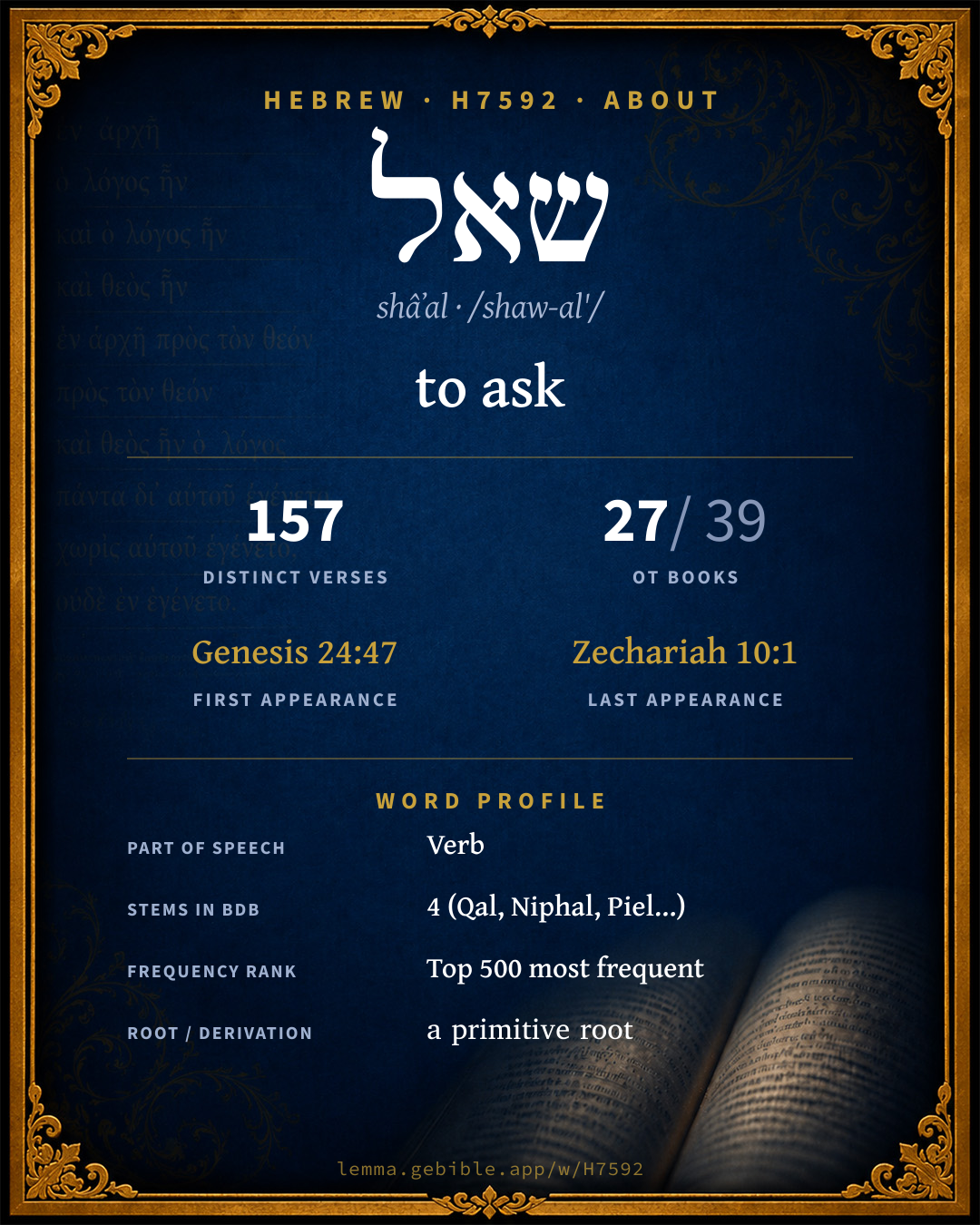
שָׁאַל
to ask
also: enquire, borrow, beg fuller range ↓
Full lexicon entry — Brown-Driver-Briggs (BDB)
From Brown-Driver-Briggs (BDB)
Where this word appears
Grammar key — what these labels mean
Part of speech
- Verb
- An action or state-of-being word.
- Preposition
- A relational word (e.g. “in,” “to,” “from”) governing a noun.
Stem
- Qal
- The basic, simple active stem — the plain form of the verb (“he wrote”). Here: ‘inquire of’
- Niphal
- Usually the simple passive or reflexive of the Qal (“he was written”). Here: ‘ask for oneself’
- Hiphil
- The causative active stem (“he caused / brought about”).
- Piel
- An intensive or resultative active stem. Here: ‘inquire carefully’
Form
- Sequential Imperfect
- An imperfect with prefixed waw — the standard past-narrative form (waw-consecutive imperfect).
- Infinitive Construct
- A bound verbal noun, frequently with prepositions (“to write / in writing”).
- Imperative
- A direct command (“write!”).
- Perfect
- A completed action or state — Hebrew marks aspect (completeness) more than strict tense (“he wrote”).
- Participle Active
- A verbal adjective expressing ongoing or characteristic action (“writing / one who writes”).
- Imperfect
- An incomplete, ongoing, or future action (“he will / would write”).
- Sequential Perfect
- A perfect with prefixed waw continuing a preceding imperfect or command (waw-consecutive perfect).
- Infinitive Absolute
- An unbound verbal noun, often intensifying or standing in for a finite verb.
- Participle Passive
- A verbal adjective expressing action received (“written”).
- Cohortative
- A first-person volitional form expressing wish or resolve (“let me / let us write”).
- Jussive
- A third- or second-person volitional form expressing wish or command (“let him write”).
State
- Absolute
- The independent form of a noun, not bound to a following word.
Person
- 3rd Person
- The one spoken about (“he / she / it / they”).
- 2nd Person
- The one addressed (“you”).
- 1st Person
- The speaker (“I / we”).
Gender
- Masculine
- Grammatically masculine.
- Common
- Either gender — not distinguished for this form.
- Feminine
- Grammatically feminine.
Number
- Singular
- One.
- Plural
- More than one (in Hebrew, generally three or more).
Every verse where H7592 appears in the Book of 1 Kings — 9 distinct verses. Click any verse to open its interlinear word-by-word view. Verse text shown in the World English Bible for context — . Each verse’s Hebrew form is shown with its reference; the English is not keyword-highlighted, since the data carries no word-level English alignment. Use “Compare translations” on any verse to read it across multiple English versions. This concordance covers the Hebrew Bible; Septuagint (Greek Old Testament) occurrences are not indexed here.
1 Kings
- 1 Kings 2:16 שֹׁאֵ֣ל Qal ptcp.act ms Now I ask one petition of you; don't deny me. She said to him, Say on.
- 1 Kings 2:20 שֹׁאֶ֣לֶת שַׁאֲלִ֣י Qal ptcp.act fs Qal impv 2fs Then she said, I ask one small petition of you; don't deny me. The king said to her, Ask on, my mother; for I will not deny you.
- 1 Kings 2:22 שֹׁאֶ֜לֶת וְ/שַֽׁאֲלִי Qal ptcp.act fs conj + Qal impv 2fs King Solomon answered his mother, Why do you ask Abishag the Shunammite for Adonijah? ask for him the kingdom also; for he is my elder brother; even for him, and for Abiathar the priest, and for Joab the son of Zeruiah.
- 1 Kings 3:5 שְׁאַ֖ל Qal impv 2ms In Gibeon Yahweh appeared to Solomon in a dream by night; and God said, Ask what I shall give you.
- 1 Kings 3:10 שָׁאַ֣ל Qal pf 3ms The speech pleased the Lord, that Solomon had asked this thing.
- 1 Kings 3:11 שָׁאַ֜לְתָּ שָׁאַ֨לְתָּ שָׁאַ֤לְתָּ שָׁאַ֖לְתָּ וְ/שָׁאַ֧לְתָּ Qal pf 2ms Qal pf 2ms Qal pf 2ms Qal pf 2ms conj + Qal pf 2ms God said to him, Because you have asked this thing, and have not asked for yourself long life, neither have asked riches for yourself, nor have asked the life of your enemies, but have asked for yourself understanding to discern justice;
- 1 Kings 3:13 שָׁאַ֨לְתָּ֙ Qal pf 2ms I have also given you that which you have not asked, both riches and honor, so that there shall not be any among the kings like you, all your days.
- 1 Kings 10:13 שָׁאָ֔לָה Qal pf 3fs King Solomon gave to the queen of Sheba all her desire, whatever she asked, besides that which Solomon gave her of his royal bounty. So she turned, and went to her own land, she and her servants.
- 1 Kings 19:4 וַ/יִּשְׁאַ֤ל conj + Qal wimpf 3ms But he himself went a day's journey into the wilderness, and came and sat down under a juniper tree: and he requested for himself that he might die, and said, It is enough; now, O Yahweh, take away my life; for I am not better than my fathers.
About this entry
At a glance — auto-summarized from this page’s data, not written by a person. Every figure links to its source below. This summary describes the numbers; it doesn’t interpret them.
“to ask” is the headline sense of the Hebrew verb שאל (shâʼal). “enquired” is the historic King James Version rendering; modern versions use “ask.” See the renderings breakdown. The Hebrew Bible uses it across 157 verses — common. First canonically at Genesis 24:47, it enters the text early. Across 4 stems, its meaning turns on the binyan (Qal, Niphal). The sections below give every sense, occurrence, and version rendering.
Gloss history
Strong's 1890 vs modern scholarship
About this word
Strong's H7592 catalogs a Hebrew word from the Hebrew Old Testament.
These counts are not copied from any lexicon or concordance. They are computed here, from the morphology-tagged Hebrew Old Testament. What Lemma adds →
- 157
- distinct verses
- The word appears in 157 distinct verses.
- 27 / 39
- OT books
- The word appears in 27 of 39 Old Testament books.
- #265
- by frequency
- Top 500 most frequent Hebrew words (rank 265 of 8,640 Hebrew words by occurrence).
View all 157 occurrences in the concordance →
By section of the Old Testament
By traditional corpus
Conventional, traditional groupings — biblical authorship is debated, so this is a traditional corpus grouping, not an authorship claim. Each share is this word’s portion of its verses in that division of the Hebrew canon. Each figure is a share of the word’s 157 distinct verses.
- Prophets (Nevi'im) 96 verses · 61%
- Writings (Ketuvim) 34 verses · 22%
- Torah (Pentateuch) 27 verses · 17%
How translations render this word
Counts come from each version’s own published word-to-Strong’s tagging or interlinear alignment — an approximate guide to how each version renders this word, not a word-level alignment the data otherwise carries. Because each total is that version’s own tagged count, the per-version totals vary from one another and need not match the appearance or distinct-verse counts above. These counts may also differ from a printed concordance because Lemma counts each distinctly tagged rendering and does not collapse phrase taggings into a single head-word total. This is a fixed set of word-tagged versions (KJV, ASV, BSB, ULT) and does not change with the reading translation you choose elsewhere. Each version’s license is shown beside its name below (and on Sources).
BDB lists this Strong’s number as 2 distinct words (homographs). Each count above pools all of them and is not split by sense — see the Senses section below. A low-frequency rendering may belong to a different one of those words, not the primary meaning.
- King James Version†: Ask 27×, Asked 16×, Enquired 11×
- American Standard Version†: Ask 23×, Asked 15×, Inquired 11×
- Berean Standard Bible†: Ask 21×, Inquired 13×, Asked 7×
- unfoldingWord Literal Text†: Ask 31×, Asked 14×, And 11×
King James Version Public Domain
Renders H7592 across 172† tagged occurrences — most commonly:
Plus other, less common renderings. Plus 65 renderings that appear only once — usually multi-word phrases or single function words the recovered tagging swept in, not distinct renderings. Not rendered by a distinct English word in 1 further occurrence.
American Standard Version Public Domain
Renders H7592 across 171† tagged occurrences — most commonly:
Plus other, less common renderings. Plus 73 renderings that appear only once — usually multi-word phrases or single function words the recovered tagging swept in, not distinct renderings.
Berean Standard Bible Public Domain
Renders H7592 across 165† tagged occurrences — most commonly:
Plus other, less common renderings. Plus 84 renderings that appear only once — usually multi-word phrases or single function words the recovered tagging swept in, not distinct renderings. Not rendered by a distinct English word in 8 further occurrences.
unfoldingWord Literal Text CC BY-SA 4.0
Renders H7592 across 204† tagged occurrences — most commonly:
Plus other, less common renderings. Plus 55 renderings that appear only once — usually multi-word phrases or single function words the recovered tagging swept in, not distinct renderings.
10 senses and sub-senses in the full BDB
Hebrew verbs can shift meaning by stem (binyan): Qal is the basic action, Niphal is often passive or reflexive, Piel often intensifies or makes it factitive, and Hiphil is typically causative. The senses below are grouped under the stem BDB assigns to each.
What do BDB’s symbols mean?
BDB uses these scholarly abbreviations:
| Symbol | Meaning |
|---|---|
| 𝔊 | the Septuagint (the ancient Greek translation, LXX) |
| 𝔙 | the Vulgate (the Latin translation) |
| 𝔖 | the Syriac version (the Peshitta) |
| 𝔗 | the Targum (the Aramaic translation) |
| ψ | the Psalms |
| √ | root (the underlying root or stem) |
| ‖ | parallel passage (a synonymous or contrasted parallel) |
| † | the dagger: every passage where the word occurs is cited |
The 10 senses and sub-senses the full Brown-Driver-Briggs lexicon distinguishes for this word, in lexicon order (not ranked by frequency), with BDB’s own verbatim wording and sub-sense lettering. Shown in Hebrew script with BDB’s own scholarly abbreviations. The condensed entry is in the Lexicon Entry tab. See also the Forms in the corpus table below.
Qal
- Pf. 3 ms. שׁ׳ Ju 5:25 +, שָׁאָ֑ל Ju 8:26 + 2 times; consec. וְשָׁ֫אַל לוֹ Nu 27:21; sf. וּשְׁאֵלְךָ consec. Gn 32:18 (Ges§ 64 f), וּשְׁאֵלֵךְ consec. Ju 4:20; 1 s. sf. שְׁאִלְתִּיו 1 S 1:20, שְׁאִלְתִּיהוּ Ju 13:16; 3 pl. sf. שְׁאֵלוּנוּ ψ 137:3; 2 mpl. שְׁאֶלְתֶּם 1 S 12:13 (del. 𝔊 Th We Dr and most), Jb 21:29, וּשְׁאֶלְתֶּס־ consec. 1 S 25:5, etc.; Impf. 3 ms. יִשְׁאַל Ex 22:13 +, etc.; Imv. שְׁאַל Is 7:11 +, שְׁאָלוּנִי Is 45:11 (תִּשְׁאָלוּנִי Weir Che al.), etc.; Inf. abs. שָׁאוֹל Gn 43:7 +; cstr. לִשְׁאֹל Ju 1:14 +, etc.; Pt. act. שֹׁאֵל 2 S 3:13 +, fs. שֹׁאֶלֶת 1 K 2:20, 22, mpl. הַשֹּׁאֲלִים 1 S 8:10; pass. שָׁאוּל 1:28; 2 K 6:5;— e.g. Judges 5:25
- 1.
- a. ask, ask for, acc. rei (vel pers.) Ju 5:25; 8:26; 1 K 3:10 ψ 122:6 (= pray for) +; שׁ׳ אֶת־נַפְשׁוֹ לָמוּת 1 K 19:4; Jon 4:8, i.e. pray for death, but Jb 31:30 demand the life of another בְּאָלָה by a curse; c. ל pers. 1 K 2:22(×2) + (ל pers. reflex.) 1 S 12:17, 19 +; c. מִן pers. Ju 8:24 (acc. cogn.), Ezr 8:22; Zc 10:1 +; sq. הָבִין 1 K 3:11; sq. cl. שׁ׳ מָה אֶתֶּן־לָֽךְ׃ 1 K 3:5 = 2 Ch 1:7, cf. 2 K 2:9; c. acc. + מֵאֵת pers. 1 S 8:10 ψ 27:4 (from י׳) +; + מֵעִם pers. Is 7:11 (from י׳) +; c. acc. pers. (from whom) + rei †ψ 137:3; acc. om. Is 7:12; 2 S 12:20; 1 K 2:20; c. מִן pers. ψ 2:8; abs. Mi 7:3 ψ 105:40 (of prayer); הִקְשִׁיתָ לִשְׁאוֹל 2 K 2:10, i.e. thou hast asked for a difficult thing.—1 S 2:20 v. Hiph. e.g. Judges 5:25
- b. specif. ask as a favour, for temporary use, i.e. borrow (cf. לָוָה, as matter of business, v. Bu 1 S 1:28), Ex 22:13 (E; acc. rei + מֵעִם pers.), 2 K 4:3 (acc. rei + מִן of source + ל pers. reflex.), 6:5 (pt. pass. abs.); so also (according to many), c. acc. rei Ex 3:22 (+ מִן pers.) 11:2; 12:35 (both + מֵאֵת pers.; all E),—it is, however, not clear that there was any pretext of mere temporary use; pt. pass. שָׁאוּל לי׳ 1 S 1:28 (lent, granted) made over to י׳ (in effect pass. of Hiph., q.v.). e.g. 1 Samuel 1:28
- c. in weakened sense, seek, desire (late), c. acc. 2 Ch 11:23 Ec 2:10 (subj. עֵינַי); Pr 20:4 in harvest he shall look [for a crop], וָאָ֑יִן and there shall be none. e.g. 2 Chronicles 11:23
- 2.
- a. inquire of, c. acc. pers. + לֵאמֹר before inquiry Gn 32:18 (E), 44:19 (J) +; c. וְאָמַר Ju 4:20, וַיֹּאמֶר, etc., Gn 24:47 (J), Je 37:13; sq. וְאָמַר without acc. pers. Gn 32:30 (J), cf. 1 S 19:22, sq. לֵאמֹר Jos 4:6 (JE); c. acc. pers. + עַל rei Ne 1:2; עַל rei alone, Ec 7:10 (+ מֵחָכְמָה, i.e. prompted by wisdom); c. acc. pers. + rei (about which) 2 S 14:18; Is 45:11 + 4 times; acc. pers. + indir.quest. Ju 13:6; c. acc. pers. only, Ju 8:14; 1 S 25:8 Dt 32:7 +, inquire of beasts (acc.) Jb 12:7; c. acc. rei only, Je 50:5; c. ל pers. = acc. 2 K 8:6 (KöSynt. § 289 h); c. ל rei about which Gn 26:7 (J), 32:30 (J), Ju 13:18; 2 S 11:7; Je 6:16; Jb 8:8, also (+ לאמר before the inquiry) Gn 43:7 (J), and (sq. direct question) Dt 4:32; c. ל pers. about whom, Gn 43:27 (J), cf. phr. of greeting, שׁ׳ אִישׁ לְרֵעֵהוּ לְשָׁלוֹם Ex 18:7 (E) ask each for (or about) his fellow as to welfare, cf. †Ju 18:15; 1 S 10:4; 17:22; 25:5; 30:21 [read וַיִּשְׁאֲלוּ לוֹ 𝔊 𝔖 We Dr HPS Bu] 2 S 8:10; Je 15:5; 1 Ch 18:10; sq. direct question only, 1 S 17:56; Je 18:13 (c. ב loc.), sq. indirect question only (c. אִם) Je 30:6; שׁ׳ אֶת־פִי פ׳ Gn 24:57 (J); abs. make inquiry Dt 13:15 (+ דָּרַשׁ, חָקַר). e.g. Genesis 32:18
- b. inquire of, consult, deity, oracle, etc. (JastrJBL xix (1900), 88 ff.), sq. acc. פִּי י׳ Jos 9:14 (JE), Is 30:2, י׳ 65:1 (‖ בִּקֵּשׁ); elsewhere in Hex only (acc. om.), Nu 27:21 (P; c. ל pers. for whom, + ב instr.), cf. Jos 19:50; also שׁ׳ אוֹב Dt 18:11 (pt. as subst.; JägerBAS ii. 292 cp. Assyrian maššaku ša šâ’ili, i.e. skin-vessel of the oracle-seeker, cf. JastrJBL xix (1900), 96 ff.); c. acc. of human agent 1 S 28:16; Je 38:14, 27; usually (ancient usage, chiefly Ju Sm) שׁ׳ בי׳ לֵאמֹר (בְּ perhaps orig. local, so GFM, or instr.), Ju 1:1; 20:23; 1 S 23:2; 30:8; 2 S 2:1; 5:19 = 1 Ch 14:10; לֵאמֹר om. 1 S 10:22 (sq. direct question), 22:10 (ל pers. for whom), 23:4; 28:6; 2 S 5:23 = 1 Ch 14:14; Ju 20:27; שׁ׳ בֵּאלֹהִים Ju 18:5; 20:18; 1 S 14:37 (sq. direct question), also (ל pers. for whom), 22:13, 15; שׁ׳ בִּדְבַר הָא׳ 2 S 16:23; likewise שׁ׳ בְּעֵצוֹ Ho 4:12 (i.e. his idol), בַּתְּרָפִים Ez 21:26, בָּאוֹב 1 Ch 10:13; perhaps = receive as oracle Dt 18:16 (מֵעִם י׳), Jastrl.c.. e.g. Joshua 9:14
Niphal
- ask for oneself (Ges§ 51 e), specif. ask leave of absence, c. מִן pers.: Pf. 3 ms. + Inf. abs. נִשְׁאֹל נִשְׁאַל 1 S 20:6 (sq. inf.), v 28 (sq. עַד;? ins. ל inf. HPS); Pf. 1 s. נִשְׁאַלְתִּי מִן־הַמֶּלֶךְ Ne 13:6 (abs.). e.g. 1 Samuel 20:6
Piel
- 1. inquire carefully: Impf. 3 mpl. + Qal Inf. abs. שָׁאוֹל יְשָֽׁאֲלוּ 2 S 20:18 (Bu proposes Qal Impf. יִשְׁאֲלוּ), c. ב loc.; on foll. context v. We Dr HPS Bu. e.g. 2 Samuel 20:18
- 2. beg, practise beggary, Pf. 3 pl. וְשִׁאֵ֑לוּ (consec.) ψ 109:10. e.g. Psalms 109:10
Hiphil
- (proposes let one ask [successfully], give, or lend, on request, then) grant, make over to (as a favour, with or without request): Pf. 1 s. sf. הִשְׁאִלְתִּהוּ לי׳ 1 S 1:28 I have made him over to י׳ (cf. Dr HPS Bu and Qal Pt. pass., ib.); perhaps also read 3 fs. הִשְׁאִילָה לי׳ 2:20 (whom) she hath made over to י׳ (for שָׁאַל לי׳) Bu HPS (after 𝔊 in part; other conj. in Dr); Impf. 3 mpl. sf. rei וַיַּשְׁאִלוּם Ex 12:36 (E) and they handed them over. e.g. 1 Samuel 1:28
Senses from the full Brown-Driver-Briggs lexicon (Brown, Driver, Briggs; Oxford 1906 — public domain), digitized via Sefaria, supplemented by the OpenScriptures HebrewLexicon (CC BY 4.0). Full attribution on Sources.
Word origin
vb. ask, inquire (NH id.; Assyrian šaʾâlu, Arabic سَأَلَ, Ethiopic ሰአለ: Sab. מסאל request, petition, HomChrest. 124 Levy-Os ZMG xix (1865), 165; Aramaic ܫܶܐܠ, שְׁאֵיל; O Aramaic Zinj. שאל Ldzb371, Nab. Hiph. lend id.ib.;—on שׁ׳ cf. Jastr JBL xix (1900), 82 ff.);—
— Brown-Driver-Briggs (Oxford 1906, public domain), digitized via Sefaria, supplemented by the OpenScriptures HebrewLexicon (CC BY 4.0). See Sources.
Origin: a primitive root
Jastrow Dictionary
A second Hebrew/Aramaic lexicon for comparison, covering Aramaic and post-biblical (Talmudic, Targumic, Midrashic) usage that the biblical-Hebrew BDB does not. Matched by lemma rather than by Strong’s number, so a lemma may carry more than one Jastrow headword (shown separately below), and the entries cover usage well beyond the Bible.
שָׁאַל
- (b. h.)
- 1. to ask, beg; to inquire, question. Yoma 75ᵃ bot. בשר ששָׁאֲלוּ שלא וכ׳ flesh for which they asked unreasonably was given them at an unreasonable time (in the evening) &c. Taan. 4ᵃ, v. הוֹגָן. Ber. V, 2 (33ᵃ) הגשמים וכ׳ (את) ושׁוֹאֲלִין (Bab. ed. ושְׁאֵלָה, v. Rabb. D. S. a. l.) and the prayer for rain is inserted in the Benediction of Years (the ninth section of the Prayer of Benedictions, v. שָׁנָה). Taan. I, 1 אף אני לא אמרתי לִשְׁאוֹל אלא להזכיר I also did not say, ‘to ask’ for rain, but to mention rain. Ib. 2. Y. Ber. V, 9ᵇ bot. שׁוֹאֵל צרכיו, v. צוֹרֶךְ. B. Bath. IX, 1 יִשְׁאֲלוּ וכ׳, v. פֶּתַח. Ab. IV, 18 ואל תִּשְׁאַל לו בשעת נדרו ask not thy neighbor (as to circumstances which may change the aspects of his vow) at the moment of his vow, v. infra Nif. Ib. V, 7 שואל כענין ומשיב וכ׳ he (the wise student) asks pertinent questions, and (when asked) replies in agreement with the adopted law. Bekh. 36ᵃ עמד השואל וש׳ יכ׳ the questioner (at college) arose and asked &c. Ned. 20ᵃ שָׁאֲלוּ את וכ׳ they asked Imma Shalom &c. Nidd. 68ᵇ בראשון לא שָׁאַלְתִּי … שלא שאלתי as to the first day I did not ask, and I made a mistake in not asking. Gen. R. s. 68 מטרונה שָׁאֲלָה וכ׳ a Roman matron asked R. José &c.; a. v. fr.—Yoma 73ᵃ כיצד שׁוֹאֲלִין השואל פניו כלפי נִשְׁאָל הנשאל וכ׳ how were the Urim and Tummim consulted? The inquirer had his face directed to him (the priest) who was consulted, and the latter directed himself to the Divine Presence (the Urim and Tummim). Ib. אין שואלין שני וכ׳ you must not ask two questions at a time; a. fr.—ש׳ בשלום (or sub. בשלום) to salute. M. Kat. 21ᵇ הוא שואל בשלום אחרים … אחרים אין שואלין בשלומו וכ׳ he (the mourner during the first thirty days) may inquire after the peace of others, for they dwell in peace, but others must not inquire after his peace, for he does not dwell in peace. Ib. משיב ואינו שואל, v. שׁוּב; a. fr.
- 2. (cmp. דָּרַשׁ) to discuss, lecture. Tosef. Meg. IV (III), 5 שואלין הילכות וכ׳ the laws of Passover are expounded on Passover &c., v. עִנְיָן; Meg. 29ᵇ שואלין בהלכות וכ׳; Y. Pes. I, 27ᵇ bot.; Bab. Pes. 6ᵃ שואלין בהלכות וכ׳ Ms. M. (ed. שואלין ודורשין, v. Rabb. D. S. a. l. note); Snh. 12ᵇ; a. fr.
- 3. (cmp. בְּעֵי I) to beg to remark, to submit. Y. Shek. I, beg. 45ᵈ ר׳ חזקיה ש׳ מעתה וכ׳ R. Ḥ. remarked, according to this &c. Ib. 46ᵇ. Y. Snh. IX, 27ᵃ bot.; a. fr.
- 4. to ask for a loan, to borrow. Sabb. XXIII, 1 שואל אדם מחבירו וכ׳ a man may borrow of his neighbor vessels of wine or oil (on the Sabbath), but must not say הַלְוֵינִי (v. infra Hif.); a. fr.—Esp. to borrow an object for use (with ref. to Ex. XXII, 13 sq.). B. Mets. 103ᵃ שואל אדם בטובו לעולם if a person borrows an object (saying, ‘lend it to me) for its usefulness’, it is a standing loan (he is permitted to take it whenever he desires to use it). Ib. VIII, 1 השואל את הפרה וש׳ בעליה עמה if a person borrows a cow for work, borrowing her owner with her (the owner lending his personal service). Ib. 95ᵇ שָׁאֲלָהּ ואחר כך ש׳ וכ׳ if he borrowed the cow only, and after a while borrowed her owner; a. fr.—שׁוֹאֵל the borrower of an object. Ib. 95ᵃ חיובא דש׳ the responsibility of the borrower. Ib. 96ᵇ top ש׳ הוי או שוכר הוי is he legally considered a borrower or a hirer? Ib. III, 2 והש׳ ישלם וכ׳ and the borrower must indemnify the hirer; a. fr.—Sabb. 96ᵇ אורגי … לשׁוֹאֲלֵיהֶן (Ar. לשווליהן, v. שְׁוַולְיָא) the curtain weavers were wont to throw the clue over to such as would borrow it from them.—Part. pass. שָׁאוּל; f. שְׁאוּלָה &c. Taan. 23ᵇ טלית ש׳ היתה וכ׳ it was a cloak that had been lent to me, I had borrowed it for such a purpose (for ordinary wear), but not for that purpose (to wear it when carrying a load). Ib. IV, 8 שבחן … בכלי לבן שְׁאוּלִין וכ׳ on those days the maidens of Zion went out (to the vineyards) in white garments borrowed for the purpose, in order not to put to shame those who had none; a. fr.— [Gen. R. s. 65 לא שאול … ולא שאולה, v. next w.—Gen. R. s. 19 שאולת חומץ, read: שׁוֹאֶלֶת, a woman asking for some vinegar.] e.g. Exodus 22:13
- 1. to cause inquiry, to inquire. Ber. 6ᵇ כל הרגיל … הקב"ה מַשְׁאִיל בו if one who comes regularly to synagogue fails to come one day, the Lord holds inquiry about him. Yeb. 76ᵇ עד שאתה משאיל עליו … שְׁאַל וכ׳ instead of inquiring about him whether or not he is fit for government, ask whether &c. Ib. (in Chald. dict.) אאבוה קא משאיל he (Saul) asked (Abner) to inquire who his (David’s) father was. B. Bath. 123ᵃ היתה יושבת … ומַשְׁאֶלֶת וכ׳ she sat at the cross-roads and made inquiries; a. e.
- 2. to lend. Sabb. 148ᵃ (ref. to Mish. ib. XIII, 1, v. supra) מאי שנא הַשְׁאִילֵינִי ומאי שנא הלויני what is the difference, whether you say hashileni (lend me) or halveni (loan me)? השאיליני לא אתי למיכתב וכ׳ when you say ‘lend me’, no document is expected to be written for it &c. Ned. IV, 6 חמודר … לא יַשְׁאִילֶנּוּ ולא יִשְׁאַל ממנו he who by his neighbor’s vow is forbidden any benefit at his hand, must neither lend him nor borrow from him &c. B. Mets. 116ᵃ דברים העשויין להַשְׁאִיל וכ׳ things which are frequently lent out or hired out; a. fr.—מַשְׁאִיל the lender, owner of the lent object. Ib. 96ᵃ; a. fr.—[Pesik. Vayhi, p. 63ᵃ שאילו השאיל, v. שָׁחַל II.]
- 1. to be asked, consulted. Yoma 73ᵃ בגדים … נ׳ בהן when the war chaplain is consulted, he wears the garments which the high priest wears when he officiates, v. supra. Ib. 85ᵃ נִשְׁאֲלָח שאלה וכ׳ the following question was asked in their presence; Kidd. 40ᵇ. Ned. 81ᵃ דבר זה נ׳ לחכמים וכ׳ this problem was placed before the scholars and the prophets, and they could not solve it &c.; a. fr.
- 2. נ׳ על to allow one’s self to be asked about the circumstances of a case, to appear before a scholar for a decision on a ritual case. Y. Ter. VIII, 46ᵃ bot. שדעתו להִישָּׁאֵל עליה a case (of T’rumah) which he had intended to have a scholar decide. Ib. הריני מניחה על מנת שאֶישָּׁאֵל עליה I put it (the doubtful T’rumah) aside with the intention of having it decided &c. Toh. III, 6 שאין בו דעת להִשָּׁאֵל (a child) whose mind is not sufficiently developed to be questioned. Ib. V, 5 אם נִשְׁאֲלוּ זה וכ׳ if they come for a decision, each of them separately; a. fr.—Esp. (על נדרו) נ׳ to come before a scholar for absolution from a vow. Ned. 90ᵃ קונם … ולמי שאֶשָּׁאֵל עליו if one vows, I will not be benefited by N. N., nor by any scholar to whom I may apply for absolution from this vow; נ׳ על הראשון וכ׳ he must first apply for absolution from the first part of the vow, and then from the second. Ib. נ׳ על נדרו … נזרו he must first apply for absolution from his vow of abstinence, and then from his nazaritic vow. Ib. 69ᵃ נִשְׁאָלִין על ההקם וכ׳ you may apply for absolution in order to revoke your confirmation (of your daughter’s vow), but you cannot do so in order to revoke your invalidation; a. fr.
- 3. to be borrowed, to do gratuitous service. B. Mets. 96ᵃ שותפין ששאלו ונ׳ לאחד מהן if partners borrow an animal for work, and its owner lends his services to one of them individually. Ib. האומר לשלוחו צא והִשָּׁאֵל לי וכ׳ (not והשאיל) if a person says to his deputy, go out and do work in my behalf together with my cow (lent to my neighbor). Ib. האומר לעבדו צא והשאל עם וכ׳ if he says to his slave, go out and do work &c.; a. e.
שְׁאַל
- 1. to ask, inquire, beg. Targ. II Kings III, 11. Targ. I Kings XIX, 4. Targ. Job XXXI, 30 למִשְׁאַל Ms. (ed. למִשְׁיַיל, למִשְׁיַל). Targ. Y. Deut. I, 1 שַׁיְילְתוּן (ed. Vien. שַׁיְילַתַּוּן, read: שַׁיַּילְתּוּן, Pa). Targ. Ps. CXXXVII, 3; a. fr.—ש׳ לשלם, ש׳ בשלם, v. שְׁלָם.—Sabb. 20ᵇ; 21ᵃ שְׁאִילְתִּינְהוּ לכל וכ׳, v. נָחוֹתָא. Ib. 30ᵃ שׁאוּל שאילה זו וכ׳ they asked the following question &c., v. עֵיל. Taan. 21ᵃ אי איכא דשָׁאֵיל לי וכ׳ if any one were to ask me a question from the Mishnah of &c. Y. Shebi. VII, 37ᶜ top הא גברא מִישְׁאֲלִינֵיה אתא שַׁאֲלוּנֵיה וכ׳ (not מישאלינית) here is a man whom you night ask; he came, and they asked; a. fr.—Part. pass. שְׁאִיל. Sabb. 30ᵇ ולענין שאילה דשְׁאִילְנָא קדמיכון and as to the question which I have been asked in your presence; [Rashi: דשָׁאֵילְנָא which I asked, a courteous phrase for ‘which you asked of me’]; a. e.
- 2. to borrow. Targ. Ex. XXII, 13; a. fr.—[Targ. O. ib. XII, 36, v. infra Af.]—B. Mets. 97ᵃ ההוא גברא דש׳ וכ׳ a man borrowed a cat from his neighbor &c. Ib. האי … למִישְׁאַל מידי וכ׳ if one wishes to borrow an object from his neighbor and be free from responsibility for an accident &c. Ib. נימא ליה שְׁאֵיל וכ׳ let him (the lender) say to him, first take what you want to borrow, and then &c. Yeb. 120ᵇ לא שָׁיְילֵי (not שיולי); B. Mets. 27ᵇ לא שְׁאִילֵי, v. סְקַב; a. fr.—Part. pass. as ab. Ib. 97ᵃ שאיל לן מר you (as teacher) are loaned to us, i.e. you are in our service, and if we borrow an object from you, we are not responsible, it being שאילה בבעלים, v. שְׁאִילָה. Ib. אתון שְׁאִילְתּוּן לי you are in my service. Ib. איהו ש׳ להו … אינהו שְׁאִילוּ ליה וכ׳ he (the teacher) is in their (the scholar’s) service on the Kallah day (v. כַּלָּה); they are in his on any other day; a. e.—Gen. R. s. 65 לא שאיל הוא לה ולא שְׁאִילָה היא ליה (some ed. שאול … שאולה) he is not loaned to her, nor she to him, i.e. the simile does not fit the application, nor the application the simile.
- 1. same, same, to ask, borrow &c. Targ. Y. Ex. XII, 35; a. e.—Bets. 19ᵃ אתא … לשַׁיּוּלֵי וכ׳ he came before the Rabbis to ask &c. Ḥull. 3ᵇ דליתיה קמן דלִישַׁיְּילֵיה when he is not before us so that we could ask him. Tam. 32ᵃ מְשַׁיַּילְנָא לכו I am asking you; a. fr.
- 2. to lend. Targ. Y. Ex. XII, 36.—Taan. 21ᵇ, v. זְבִילָא. Ib. דמחממת … ומְשַׁיְּילָא וכ׳ who heated her oven and let her neighbors use it; a. fr.
- to lend. Targ. O. Ex. XII, 36 ed. Berl. (ed. Vien. שאילינון, corr. acc.); a. e.—Yeb. l. c. ולא מוֹשְׁלֵי, v. נְחַשׁ I. B. Mets. 116ᵃ דעביד לאוֹשׁוּלֵי וכ׳ which it is customary to lend and hire out; a. e.
- 1. (with (with מ־) to take leave of absence. Targ. I Sam. XX, 6.
- 2. (with ב־) to allow one’s self to be inquired of; to answer, issue an oracle. Targ. Ez. XIV, 3. Targ. Y. II, Num. XXIV, 1. Targ. Is. LXV, 1.
- 3. (with ל־) to bring a case up for decision, to ask. Y. Maasr. II, beg. 49ᶜ אִשְׁתָּאֲלִית לאילין וכ׳ I asked those of the house of &c. Y. Sabb. XII, 13ᶜ bot., אִשְׁתַּאֲלַת לר׳ שמעון וכ׳ R. S. b. L. was asked. Ib. VI, 8ᵃ ואִיתְשְׁלַת לר׳ ומר וכ׳ when the case was brought before Rabbi, he said &c.; a. fr.—Esp. to come before a scholar for absolution from a vow. Ned. 90ᵃ אי בעי על נדרו איתשיל ברישא וכ׳ if he so desires, he may ask first for absolution from his vow of abstinence, or if he chooses, he may ask first for absolution from his nazaritic vow; ib. נִיתְּשִׁיל; a. fr.
A Dictionary of the Targumim, the Talmud Babli and Yerushalmi, and the Midrashic Literature (Marcus Jastrow; London, Luzac, 1903) — Public Domain. Digitized via Sefaria. Digitized via Sefaria. Full attribution on Sources.
Forms in the corpus
The 129 distinct written forms H7592 takes in the Hebrew Bible, most frequent first — each parse links to that stem’s occurrences in the concordance. Hebrew forms include their vowel points and cantillation, so a single lemma takes many written forms.
The 60 most common forms are shown; 69 rarer forms follow in the full concordance.
Same root — word family
Other BDB entries built from the same root as H7592, grouped by Strong’s listed origin. These share a root / origin per the lexicon — not necessarily a shared meaning. Each links to that word’s own entry.
Derived from this word
Proper names from this root
People and places named from this root — a name, not an additional meaning of the word.
- אשתאל ʼEshtâʼôl H847 Eshtaol
- משאל Mishʼâl H4861 Misheal
- שאול shᵉʼôwl H7585 Sheol
- שאול Shâʼûwl H7586 Saul
- שאל Shᵉʼâl H7594 Sheal
- שאלתיאל Shᵉʼaltîyʼêl H7597 Shealtiel
Compare all same-root words → Showing 4 of 10 — not the complete family. 6 of the same-root words are proper names (people or places). They share a root, not necessarily a meaning.
Septuagint verse parallels
This word appears in 150 verses that also exist in the Greek Old Testament (Septuagint), out of the 157 Hebrew verses it occurs in. You can read those verses in Greek by switching the Old Testament edition to the Septuagint.
Read these verses in the Septuagint
- Genesis 24:47
- Exodus 3:22
- Numbers 27:21
- Deuteronomy 4:32
- Joshua 4:6
- Judges 1:1
- 1 Samuel 1:17
- 2 Samuel 2:1
- 1 Kings 2:16
- 2 Kings 2:9
- 1 Chronicles 4:10
- 2 Chronicles 1:7
This is a verse-level parallel only — the same verses exist in both the Hebrew and Greek Old Testaments. No word-level Hebrew↔Greek correspondence is claimed: the data carries no such alignment, so no Greek word is shown as this Hebrew word’s translation. Coverage is not total — the Septuagint omits the deuterocanon and renumbers the Psalms, so some Hebrew verses have no direct Greek parallel.