
Joshua 9:14

Hebrew (Westminster Leningrad Codex) Joshua 9:14 appears in the Hebrew Old Testament. The text above is from the Westminster Leningrad Codex. Each word links to its Strong’s number, a concise gloss, and parsing drawn from the Open Scriptures Hebrew Bible morphology. Click any word for its full Brown-Driver-Briggs (BDB) entry.
Download image
Cite this verse

Joshua 9:14 (World English Bible). Public Domain. Lemma interlinear Bible study tool, https://lemma.gebible.app/v/joshua/9/14.

Show BibTeX & RIS
BibTeX
RIS
English Translation
The men took of their provision, and didn't ask counsel at the mouth of Yahweh.
World English Bible · Public Domain
Download a study sheet

One document with this verse’s original text, its word-by-word gloss line, the meaning frame, cross-references with their text, attributed commentary, and full source and license credits — printable, and it pastes into notes with its structure intact.

This verse Autodidact and up

Study sheet (.html) Plain text (.txt)

A passage Seminary Student

Up to 50 verses in one chapter. A passage sheet keeps up to 6 commentary sources and 12 cross-references per verse, in the order this page ranks them, and says so on the sheet whenever that leaves anything out. Ask for a single verse and you get the Autodidact verse sheet above.

Everything on this page stays free to read, with no account — the sheet is a download of what is already on screen, not access to it.

Want to remove ads? Support Godless Engineer
Compare translations 3

The same verse in 3 English versions, stacked beneath the original-language interlinear above. Click any original word for its lexicon entry.

Each is an independent rendering of the whole verse — the interlinear is not word-aligned to these translations.

Highlighted words mark where these versions differ — a whole-verse word diff, not a word-by-word alignment.

  • World English Bible Public Domain
    The men took of their provision, and didn't ask counsel at the mouth of Yahweh.
  • King James Version Public Domain
    And the men took of their victuals, and asked not counsel at the mouth of the LORD.
  • unfoldingWord Literal Text CC BY-SA 4.0
    And the men took from their provisions, but they did not ask the mouth of Yahweh.

unfoldingWord Literal Text — © unfoldingWord, licensed CC BY-SA 4.0. Word-aligned USFM3 via Door43 (git.door43.org/unfoldingWord/en_ult).

Versions to compare (up to 4)

3 of 4 selected

Show all 18 translations

Every available English version of this verse, each an independent rendering of the whole verse.

  • World English Bible Public Domain
    The men took of their provision, and didn't ask counsel at the mouth of Yahweh.
  • Berean Standard Bible Public Domain
    Then the men of Israel sampled their provisions, but did not seek the counsel of the LORD.
  • Majority Standard Bible Public Domain
    Then the men of Israel sampled their provisions but did not seek the counsel of the LORD.
  • King James Version Public Domain
    And the men took of their victuals, and asked not counsel at the mouth of the LORD.
  • American Standard Version (1901) Public Domain
    And the men took of their provision, and asked not counsel at the mouth of Jehovah.
  • Revised Version (1885) Public Domain
    And the men took of their provision, and asked not counsel at the mouth of the LORD.
  • Geneva Bible (1599) Public Domain
    And the men accepted their tale concerning their vittailes, and counselled not with the mouth of the Lord.
  • Douay-Rheims (1899) Public Domain
    They took therefore of their victuals, and consulted not the mouth of the Lord.
  • Young's Literal Translation Public Domain
    And the men take of their provision, and the mouth of Jehovah have not asked;
  • Literal Standard Version CC BY-SA 4.0
    And the men take of their provision, and have not asked the mouth of YHWH;
  • Unlocked Literal Bible CC BY-SA 4.0
    So the Israelites took some of their provisions, but they did not consult with Yahweh for guidance.
  • unfoldingWord Literal Text CC BY-SA 4.0
    And the men took from their provisions, but they did not ask the mouth of Yahweh.
  • Darby Bible Public Domain
    And the men took of their victuals, but they did not inquire at the mouth of Jehovah.
  • World Messianic Bible Public Domain
    The men sampled their provisions, and didn’t ask counsel from the LORD’s mouth.
  • Webster's Bible Public Domain
    And the men took of their provisions, and asked not counsel at the mouth of the LORD.
  • Free Bible Version CC BY-SA 4.0
    The Israelites tried some of the food. However, they did not consult the Lord.
  • Bible in Basic English Public Domain
    And the men took some of their food, without requesting directions from the Lord.
  • JPS Tanakh (1917) Public Domain
    And the men took of their provision, and asked not counsel at the mouth of the LORD.

Literal Standard Version (2020), Covenant Press — licensed CC BY-SA 4.0. Text via the HelloAO Bible API (eBible.org). Unlocked Literal Bible (unfoldingWord) — licensed CC BY-SA 4.0. Text via the HelloAO Bible API (eBible.org). unfoldingWord Literal Text — © unfoldingWord, licensed CC BY-SA 4.0. Word-aligned USFM3 via Door43 (git.door43.org/unfoldingWord/en_ult). Free Bible Version, Dr. Jonathan Gallagher — licensed CC BY-SA 4.0. Text via the HelloAO Bible API (eBible.org).

Word by word

More ways to search: Search by grammar → Find every occurrence → Compare this word →

Practice this passage: Drill this verse → Learn its vocabulary →

מִצֵּידָ֑ם
tsayid
H6718
“from · game · their”
Preposition + Noun, Common, Masculine, Singular, Construct + Suffix, Personal, 3rd Person, Masculine, Plural
Part of Speech
Preposition + Noun
Type
Common
Gender
Masculine
Number
Singular
State
Construct
Full BDB Definition

Origin: from a form of H6679 and meaning the same

TWOT: 1885a , 1886a

hunting, game - hunting - game hunted - provision, food - provision, food, food-supply
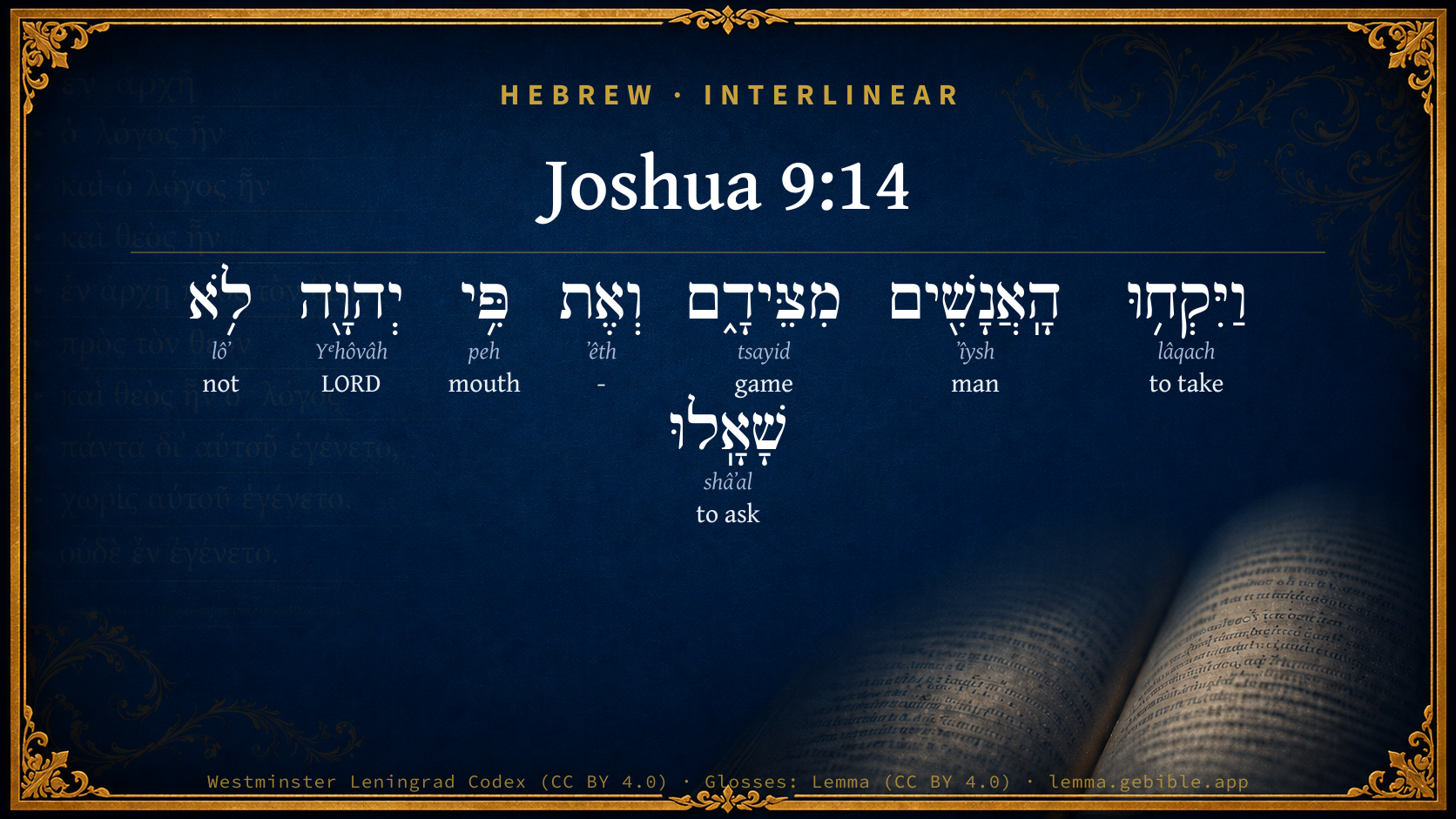
  1. וַיִּקְח֥וּ lâqach H3947 “and · to take” Conjunction + Verb, Qal, Sequential Imperfect, 3rd Person, Masculine, Plural
  2. הָֽאֲנָשִׁ֖ים ʼîysh H376 “the · men” Particle, Definite Article + Noun, Common, Masculine, Plural, Absolute
  3. וְאֶת ʼêth H853 “and · -” Conjunction + Particle, Direct Object
  4. פִּ֥י peh H6310 “mouth of” Noun, Common, Masculine, Singular, Construct
  5. יְהוָ֖ה Yᵉhôvâh H3068 “LORD” Noun, Proper
  6. לֹ֥א lôʼ H3808 “not” Particle, Negative
  7. שָׁאָֽלוּ shâʼal H7592 “to ask” Verb, Qal, Perfect, 3rd Person, Common, Plural

About this verse

These counts appear in no published source. They are computed here, from the morphology-tagged text and Lemma’s own curated glosses. What Lemma adds →

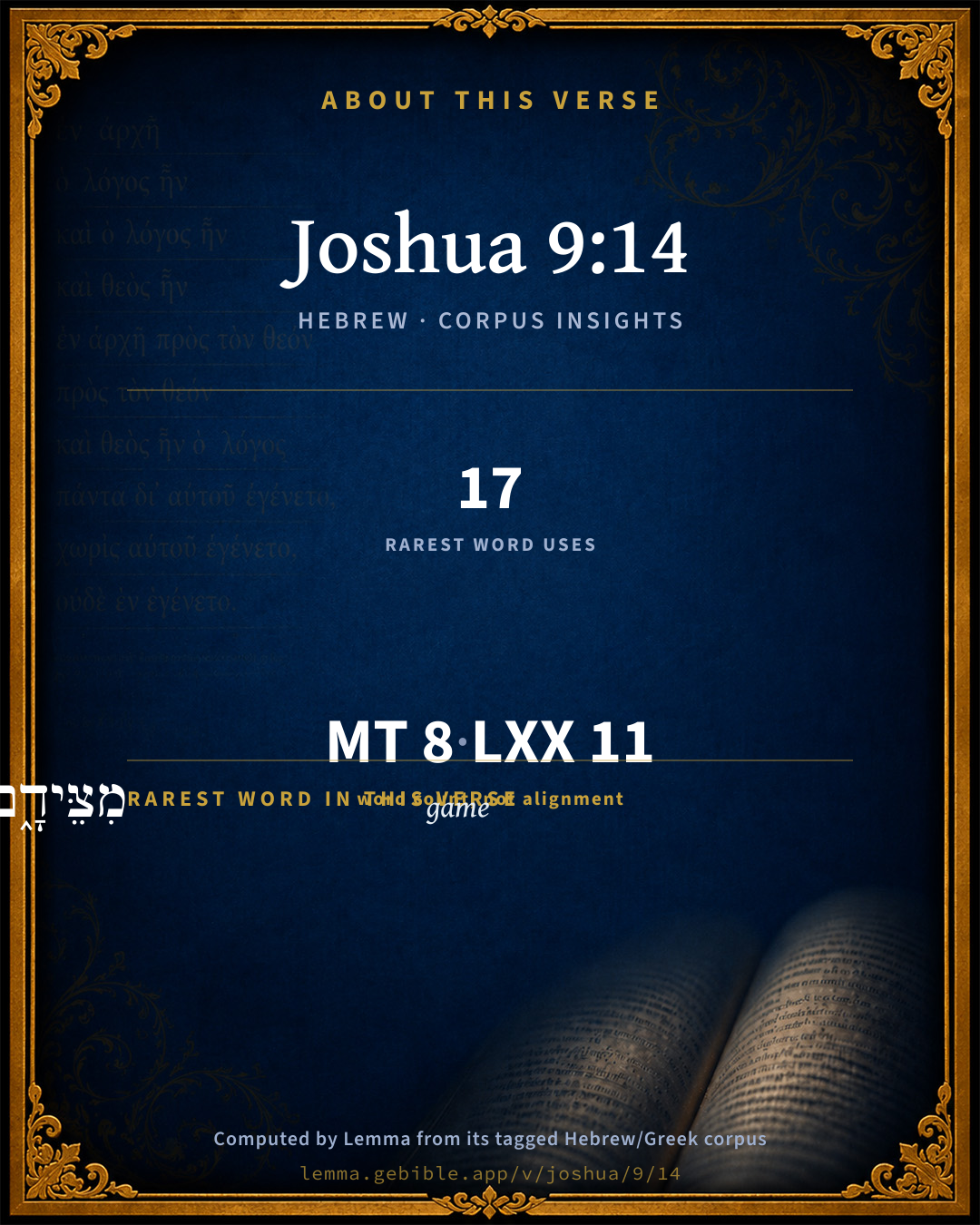
8
words
8
distinct lemmas
Historical
section

Notable vocabulary

The rarest word here is מִצֵּידָ֑ם game H6718 — appearing just 17 times in the whole Hebrew Bible.

Shared distinctive vocabulary

מִצֵּידָ֑ם game H6718 occurs in 16 verses of the Hebrew Bible. Also found in:

Grammatical profile

  • 2 verbs
  • 4 nouns
  • 2 particles

Verb forms

  • וַיִּקְח֥וּ Qal · Sequential Imperfect
  • שָׁאָֽלוּ Qal · Perfect

Hebrew & Septuagint length

In English translation the verse runs 15 words from the Hebrew and 14 from the Septuagint (LXX English) — closely comparable.

A rough comparison of the two English renderings, which tokenize alike — not a word-level alignment.

Word counts can differ between the Hebrew and the Greek without any difference in meaning — e.g. the Hebrew direct-object marker אֵת has no separate Greek word, and Greek often adds the article ὁ.

In the original languages it is 8 Hebrew tokens and 11 Greek tokens — but the two are counted differently (Hebrew bundles its prefixes and suffixes into one token; the Greek is in lemma form), so that isn’t a like-for-like length.

Cross-references

16

Topical passages linked to Joshua 9:14 in the Treasury of Scripture Knowledge — connected by theme and wording, ordered by reader-vote popularity; previews shown in the World English Bible.

  • Proverbs 3:5–6 Trust in Yahweh with all your heart, And don't lean on your own understanding.
  • Numbers 27:21 He shall stand before Eleazar the priest, who shall inquire for him by the judgment of the Urim before Yahweh: at his word shall they go out, and at his word they shall come in, both he, and all the children of Israel with him, even all the congregation.
  • 1 Chronicles 10:13–14 So Saul died for his trespass which he committed against Yahweh, because of the word of Yahweh, which he didn't keep; and also because he asked counsel of one who had a familiar spirit, to inquire [thereby],
  • 2 Samuel 5:19 David inquired of Yahweh, saying, Shall I go up against the Philistines? will you deliver them into my hand? Yahweh said to David, Go up; for I will certainly deliver the Philistines into your hand.
  • Judges 1:1 It happened after the death of Joshua, the children of Israel asked of Yahweh, saying, Who shall go up for us first against the Canaanites, to fight against them?
  • Judges 20:28 and Phinehas, the son of Eleazar, the son of Aaron, stood before it in those days), saying, Shall I yet again go out to battle against the children of Benjamin my brother, or shall I cease? Yahweh said, Go up; for tomorrow I will deliver him into your hand.
  • 1 Samuel 23:9–12 David knew that Saul was devising mischief against him; and he said to Abiathar the priest, Bring here the ephod.
  • 1 Samuel 30:7–8 David said to Abiathar the priest, the son of Ahimelech, Please bring me here the ephod. Abiathar brought there the ephod to David.
  • Ezra 8:21 Then I proclaimed a fast there, at the river Ahava, that we might humble ourselves before our God, to seek of him a straight way for us, and for our little ones, and for all our substance.
  • Isaiah 30:1–2 Woe to the rebellious children, says Yahweh, who take counsel, but not of me; and who make a league, but not of my Spirit, that they may add sin to sin,
  • Judges 20:18 The children of Israel arose, and went up to Bethel, and asked counsel of God; and they said, Who shall go up for us first to battle against the children of Benjamin? Yahweh said, Judah [shall go up] first.
  • 2 Samuel 2:1 It happened after this, that David inquired of Yahweh, saying, Shall I go up into any of the cities of Judah? Yahweh said to him, Go up. David said, Where shall I go up? He said, To Hebron.
  • James 1:5 But if any of you lacks wisdom, let him ask of God, who gives to all liberally and without reproach; and it will be given to him.
  • Exodus 28:30 You shall put in the breastplate of judgment the Urim and the Thummim; and they shall be on Aaron's heart, when he goes in before Yahweh: and Aaron shall bear the judgment of the children of Israel on his heart before Yahweh continually.
  • 1 Samuel 14:18–19 Saul said to Ahijah, Bring here the ark of God. For the ark of God was [there] at that time with the children of Israel.
  • 1 Samuel 22:10 He inquired of Yahweh for him, and gave him food, and gave him the sword of Goliath the Philistine.

Cross-references courtesy of OpenBible.info (CC BY 4.0).

Hebrew and Greek witnesses Masoretic Hebrew ↔ Greek Septuagint

The same verse in the two great witnesses to the Old Testament, shown verse-for-verse.

These are two independent witnesses, not word-aligned to each other, and the Septuagint is shown in lemma (dictionary) form.

Hebrew Joshua 9:14 Masoretic · Westminster Leningrad Codex

וַיִּקְח֥וּ הָֽאֲנָשִׁ֖ים מִצֵּידָ֑ם וְאֶת פִּ֥י יְהוָ֖ה לֹ֥א שָׁאָֽלוּ

The men took of their provision, and didn't ask counsel at the mouth of Yahweh.

World English Bible · Public Domain

Greek LXX Joshua 9:14 Septuagint · lemma form

καί λαμβάνω ὁ ἄρχων ὁ ἐπισιτισμός αὐτός καί κύριος οὐ ἐπιἐρωτάω

And the chiefs took of their provision, and asked not counsel of the Lord.

LXX2012 (modern English Septuagint) · Public Domain

Hebrew: Westminster Leningrad Codex (CC BY 4.0). Greek: Septuagint (public domain); English from LXX2012 (modern English Septuagint) (Public Domain). How the Septuagint differs from the Hebrew →

Targum (Aramaic paraphrase)

1

The Targum is the ancient Jewish Aramaic paraphrase of the Hebrew Scriptures — an interpretive translation, not the Hebrew text itself. Onkelos (literal) and Pseudo-Jonathan (expansive) render the Torah, and Jonathan the Prophets. Coverage is partial: where no permissively-licensed English translation exists for a verse, only the Aramaic is shown. This is verse-level text, not a word-by-word alignment to the Hebrew.

  1. Targum Jonathan Prophets (Joshua–Malachi)
    וְקַבִּילוּ גַבְרַיָא לְפִּתְגָמֵיהוֹן וְאוּלְפַן מִן קֳדָם יְיָ לָא תְּבָעוּ:

    (no public-domain English translation for this verse)

    Targum Jonathan — Aramaic: “Mikraot Gedolot” (public domain). English: “Sefaria Community Translation” (CC0 1.0 (public-domain dedication)); “London "Chaldee Paraphrase," 1871” (public domain). Text via Sefaria.

Commentary

Notes on Joshua 9:14 from classic Christian and Jewish commentators (each source and its license shown beneath its notes). The classic Christian expositions comment on the surrounding passage and are grouped to its opening verse, so a note may address several verses; the Jewish commentaries on the Tanakh (Rashi and others) are per-verse, so they appear only where the commentator wrote on this verse.

Lemma curates 59 commentaries, every one of them public domain or Creative Commons licensed, each selected and text-cleaned for this edition rather than reprinted as found. About our sources →

Trapp's Complete Commentary

John Trapp

Jos 9:14 And the men took of their victuals, and asked not [counsel] at the mouth of the LORD.

Ver. 14. And the men took of their victuals.] That is, they did eat of it in token of a league made with them, say some: others more probably, they took it and looked on it, to see whether it were hoary and mouldy, as they had said.

And asked not counsel at the mouth of the Lord.] This precipitancy and credulity is seldom successful. Good Josiah lost his life by it. Sometimes both grace and wit are asleep in the holiest and wariest breasts.

John Trapp, A Commentary or Exposition upon All the Books of the Old and New Testament (1647–1656) — public domain. Text from a community e-Sword module.

Joseph Benson's Commentary

Jos 9:14. The men — That is, the princes. Their victuals — That they might examine the truth of what they said. Asked not at the mouth of the Lord — As they ought to have done upon all such weighty occasions. So they are accused of rashness and neglect of their duty. For though it is probable, if God had been consulted, he would have consented to the sparing of the Gibeonites; yet it should have been done with more caution, and an obligation upon them to embrace the true religion. In every business of importance we should take God along with us, and by his word and prayer consult him. Many a time our affairs miscarry, because we ask not counsel at the mouth of the Lord. Did we acknowledge him in all our ways, they would be more safe, easy, and successful.

Joseph Benson's Commentary on the Old and New Testaments (1811–1818) — public domain. Text from a community e-Sword module.

Tyndale Open Study Notes

Tyndale Open Resources

9:14 Israel’s leaders examined the bread to verify the Gibeonites’ story, but Joshua neglected to consult the Lord. This same oversight had cost lives at Ai, whereas the victories at Jericho and Ai had both been won when Israel followed God’s instructions precisely.

Tyndale Open Study Notes — © Tyndale Open Resources, licensed CC BY-SA 4.0. Text via the HelloAO Bible API.

Geneva Bible (1599)

Geneva Bible translators

Some think that the Israelites ate of their victuals, and so made a league with them.

Geneva Bible (1599) marginal notes — public domain. Text via Bolls.life.

Jamieson, Fausset & Brown

Robert Jamieson, A. R. Fausset & David Brown

the men took of their victuals and asked not counsel at the mouth of the Lord--The mouldy appearance of their bread was, after examination, accepted as guaranteeing the truth of the story. In this precipitate conclusion the Israelites were guilty of excessive credulity and culpable negligence, in not asking by the high priest's Urim and Thummim the mind of God, before entering into the alliance. It is not clear, however, that had they applied for divine direction they would have been forbidden to spare and connect themselves with any of the Canaanite tribes who renounced idolatry and embraced and worshipped the true God. At least, no fault was found with them for making a covenant with the Gibeonites; while, on the other hand, the violation of it was severely punished (Sa2 21:1; and Jos 11:19-20).

Jamieson, Fausset & Brown — Commentary Critical and Explanatory on the Whole Bible (1871) — public domain (CC PDM 1.0). Text via the HelloAO Bible API.

Adam Clarke's Commentary

Verse 14. The men took of their victuals] This was done in all probability in the way of friendship; for, from time immemorial to the present day, eating together, in the Asiatic countries, is considered a token of unalterable friendship; and those who eat even salt together, feel themselves bound thereby in a perpetual covenant. But the marginal reading of this clause should not be hastily rejected.

And asked not counsel at the mouth of the Lord.] They made the covenant with the Gibeonites without consulting God by Urim and Thummim, which was highly reprehensible in them, as it was a state transaction in which the interests and honour of God their king were intimately concerned.

Adam Clarke's Commentary on the Bible (1810–1826) — public domain. Text from a community e-Sword/MySword module.

John Calvin's Commentaries

14. And the men took of their victuals, etc. Some commentators here have recourse to the insipid fictions that they ate the bread, to ascertain from the taste whether it were stale from age, or that they confirmed the covenant by a feast. The words rather, in my opinion, are an indirect censure of their excessive credulity in having, on slight grounds acquiesced in a fabulous narrative, and in having attended merely to the bread, without considering that the fiction was devoid of color. And, certainly, had not their senses been blunted, many things would have instantly occurred to refute the Gibeonites. But as it sometimes happens, that the most piercing eyes are dazzled by an empty spectacle, they are more severely condemned for not having ascertained the pleasure of God. The remedy was at hand, had they attempted nothing without consulting the oracle. It was a matter deserving of careful inquiry, and it was therefore a sign of gross carelessness, when a priest was ready to seek an answer from God, by means of Urim and Thummim, to decide rashly in an obscure case, as if they had no means of obtaining advice. Their rashness was the less excusable, from being combined with such supine neglect of the grace of God.

John Calvin's Commentaries (1540-1563) — public domain. Text from the Calvin Translation Society English edition (1840s-50s) via the Christian Classics Ethereal Library (ccel.org). Calvin's coverage is partial (roughly two-thirds of the Bible); uncommented books and verses are honest gaps, never fabricated. The 19th-century editor's footnotes and remarks are omitted so the notes are faithfully Calvin's own voice.

Ellicott's Commentary for English Readers

(14) And the men took of their victuals.—And they accepted the men from (the appearance of) their provisions. This, which is the view taken in our marginal reading, seems to be the more probable interpretation, and follows the Targum. “The men” can hardly refer to any one but the ambassadors of the Gibeonites.

A Bible Commentary for English Readers, edited by Charles John Ellicott (1878–1897) — public domain. Text from a community e-Sword module.

The Cambridge Bible for Schools and Colleges

gen. ed. J. J. S. Perowne

14. the men took of their victuals] “thei token thanne of the meetis of hem,” Wyclif. “The men” here denote the elders of Israel, the heads of the tribes. Comp. Jos_9:18-21. Some think it means they took and tasted of their provisions by way of test to see if their story was true, so Keil and Rosenmüller. Others interpret the words as denoting that the princes of the people took of the provisions, and by thus eating, according to the usages of Oriental nations, pledged themselves to friendship and amity. Compare the eating together as a sign of friendship of Jacob and Laban, Gen_31:46; and the expression “covenant of salt,” Lev_2:13; 2Ch_13:5.

and asked not counsel] This was a transgression of an explicit command that the priest should seek a revelation of the Divine will for Joshua by means of the Sacred Oracle, the Urim and Thummim; “at his word shall they go out, and at his word they shall come in, both he, and all the children of Israel with him” (Num_27:21). See also Exo_28:30. Against any league with the inhabitants of Canaan they had been specially warned (Exo_23:32; Exo_34:12; Num_33:55; Deu_7:2).

The Cambridge Bible for Schools and Colleges (gen. ed. J. J. S. Perowne; Cambridge University Press, 1878–1918) — public domain. Text from a community e-Sword module.

John Gill's Exposition

And the men took of their victuals,.... That is, the princes of Israel took thereof; not to eat of them, for it cannot be thought that such personages would eat of such dry and mouldy bread, and especially as they were now in a plentiful country, and possessed of the fruits of it; but to see whether it was in such a plight and condition as they said, whereby they might judge of the truth of what they said; and they learned and knew, as R. Jonah observes, from the dryness of their food, that it was truth they said; and so the Targum, the men hearkened to their words; and so Jarchi, they believed what they said on sight of their provisions; but, according to Kimchi and Ben Melech, they ate with them, to confirm the covenant they made with them; but had this been the case, as it sometimes was a custom to eat together at making covenants, see Gen 26:30; the princes would doubtless have provided a better entertainment for such a purpose: the "margin" of our Bibles leads to the other sense,"they received the men by reason of their victuals:"

and asked not counsel at the mouth of the Lord; as they might and should have done, by desiring the high priest to inquire of the Lord by Urim and Thummim; but this they neglected, which, had they attended to, the fraud would have been discovered; or however, they would have had the mind of God about making peace with the Gibeonites, which in all likelihood he would not have disapproved of, they becoming proselytes, and giving up their possessions to Israel; but this did not excuse their neglect.

John Gill's Exposition of the Whole Bible (1746–1763) — public domain (CC PDM 1.0). Text via the HelloAO Bible API.

Albert Barnes' Notes on the Bible

The elders of Israel Jos 9:18, tasting what was offered them by the Gibeonites, pledged themselves according to the usage of Eastern nations to peace and friendship with them. They credited the story at once, instead of seeking the direction of God in the matter. The rendering of the margin is not to be preferred to that of the text.

At the mouth of the Lord - i. e. by the Urim and Thummim Exo 28:30.

Albert Barnes' Notes on the Bible (1834–1885) — public domain. Text from a community e-Sword/MySword module.

Haydock's Catholic Bible Commentary

Victuals, to examine whether they were as old as they pretended; or they eat of them in sign of friendship. (Menochius) --- Thus we find a feast generally accompanied the making of a league, Genesis xxvi. 30., and xxxi. 54. To betray a guest was deemed a heinous injury, Psalm liv. 15. (Euripides) --- Lord. By the high priest, clothed with the Urim and Thummim. (Calmet) --- This remark shews that the Israelites had been guilty of some negligence. (Haydock) --- Hence they were so easily deceived, being perhaps overjoyed that their friendship should be courted by so distant a nation. (Menochius) --- The high priest was ordered to consult the Lord for Josue, at the door of the tabernacle, Exodus xxix. 42., and Numbers xxvii. 21. (Worthington)

Ver 15. Them. Were they bound to keep this promise? Some maintain the negative, as it was obtained by fraud, and therefore the Gabaonites leave themselves to the mercy of Josue, (ver. 25,) who condemns them to perpetual servitude in the house of the Lord. He could not, however, have taken away their lives after what had passed. The error was not essential, but the people might have obtained the same conditions, if they had frankly told the truth. If we make a contract with a person who pretends to be of a nation to which he does not belong, the contract will hold good. The deceit of the Gabaonites was punished as it deserved. But God required that the conditions which were granted to them, should be diligently observed; and the family of Saul was severely punished, because he had slain some of them, 3 Kings xxi. If the rest of the Chanaanites had changed their religion, and submitted to the Israelites, they might have been preserved, as Rahab, and so many others were, with whom the pious kings scrupled not to form alliances, chap. xi. 19., and Deuteronomy xx. 10, &c. (Masius; Bonfrere; Calmet) --- They were, however, obliged to yield possession of the land to the Israelites, and to renounce idolatry. The Gabaonites were willing to accede to these conditions, and therefore Josue might justly make a peace with them. (Menochius)

George Leo Haydock (1774–1849), Haydock's Catholic Family Bible and Commentary, 1859 edition — public domain. Excludes Psalms (Douay-Rheims chapter numbering differs from Protestant) and Deuterocanonical books (Catholic canon only).

Matthew Poole's English Annotations

The men, i.e. the princes, as before, Jos 9:6.

Took of their victuals; not from their want or any desire they could have to such unpleasant and unwholesome food; nor in a ceremony usual in making leagues, for that was not now done, but in the next verse; but that they might examine the truth of what they said.

Asked not counsel at the mouth of the Lord, as they ought to have done upon all such weighty and doubtful occasions. So they are accused of rashness, and neglect of their duty. For though it is probable, if God had been consulted, he would have consented to the sparing of the Gibeonites; yet it should have been done with more caution, and an obligation left upon them to embrace the true religion, which here was omitted.

Matthew Poole's English Annotations on the Holy Bible (1683–1685) — public domain. Text from a community e-Sword/MySword module.

Whedon's Commentary on the Bible

Daniel D. Whedon

14. The men — The chiefs in Joshua’s camp with whom the Gibeonites conferred.

Took of their victuals — But it is not said that the men of Israel ate of these victuals. Yet, as it is a custom among the Arabs to eat the victuals of a guest, as a sign of peace and friendship, this may have been the purpose of their taking the provision of these Gibeonites. This passage has puzzled all the interpreters. The marginal reading in our English Bible is ingenious, but it is not sustained by the Hebrew, “they received the men by reason of their victuals.” Nor did they make a treaty with them by eating their food, for this was not customary. More plausible is the theory that they took their bread into their hands to examine it. But we would suggest that the real meaning may be, they presumed the truth of the story from their victuals. The original word for took is sometimes used for mental acts.

And asked not counsel at the mouth of the Lord — A momentous question was settled with no reference to the Divine will, and that, too, on a point in regard to which Jehovah’s commands were very explicit — alliance with aliens. Compare note and references on Jos_9:7. Jehovah, who had made special arrangements for communicating with his people through the urim and thummim, was slighted and ignored. These Israelitish princes have had many imitators in the senates and cabinets of Christian lands. How rarely is God consulted by statesmen, even in affairs in which the destiny of a nation is involved!

Daniel D. Whedon (gen. ed.), Commentary on the Old and New Testaments (1874–1909) — public domain. Text from a community e-Sword module.

The Pulpit Commentary

And the men took of their victuals. Most commentators prefer this rendering to that of the margin, "and they received the men because of their victuals." The natural explanation though several others are given, for which see Keil in loc. would seem to be that the Israelites relied on the evidence of their senses, instead of upon the counsel of God. They could see the condition of the garments, sacks, and wine skins of the Gibeonites. They tasted of their victuals to convince themselves of the truth of those statements of which the sight was insufficient to take cognisance. And asked not counsel at the mouth of the Lord. Even in the most obvious matter it is well not to trust too implicitly to our own judgment. Nothing could seem more clear or satisfactory than the account given of themselves by the Gibeonites nothing more easy for the unassisted intellect to decide. And yet Joshua and the congregation were deceived. It is perhaps too much to say, with some commentators Maurer, for instance that Joshua disobeyed a plain command in acting thus. The passage in which Joshua is instructed to "stand up before Eleazar the priest, who shall ask counsel for him at the judgment of Urim before the Lord", (Num_27:18-23) does not require him to do so in all cases. But it was clearly "an act of gross carelessness" (Calvin). And the inference may safely be drawn that in no case whatever is it wise to trust to ourselves. However obvious our course may be, we shall do well to take counsel with God by prayer.

HOMILIES BY S.R. ALDRIDGE Ver. 14. The Israelites outwitted.

A story that bears on its face the evidences of authenticity. A wiliness displayed quite in keeping with our notions of Oriental duplicity. Has lessons appropriate to modern days. Whilst some incidents of this book enjoin courage, this induces discretion, and thus are we preserved from a one-sided development of our spiritual life. No study more instructive than that of history, and no history more suggestively written than that of the Israelites.

I THE STRATAGEM OF THE GIBEONITES shows us

1. The different courses adopted by different men in respect of the same dangers. The overthrow of Jericho and the destruction of Ai struck terror into the hearts of the neighbouring inhabitants of Palestine. Would not their turn come next? How should they deal with the difficulty that threatened them? The only safety seemed to lie in united opposition. So reasoned many of the kings, and they organised their forces for battle. But the Gibeonites determined to act otherwise. To contract a treaty with the foe would be a greater safeguard than to encounter him in war. This they accordingly endeavoured to secure in the subtle manner which this chapter records. This variety of sentiment is being constantly exhibited in the plans men pursue regarding the "terrors of the Lord" or the assaults of conscience. Conviction of sin and of the retribution to which it exposes the sinner does not always incline him to sue for mercy. Some brave the attack, and with incredible folly fight against God. Though others have been overcome, they hope to be successful. The fall of other cities does not deter them from vain enterprises. Some, like the Gibeonites, are teachable, and if we cannot commend the deception they practised, we can at least exhort that the impossibility of staying the spread of God"s kingdom be practically recognised. "Be ye reconciled unto God.

2. The pains taken to preserve life. Self-preservation is accounted one of the strongest instincts of our nature. These Gibeonites spared no trouble in order to gain their end. And yet how often are the things relative to eternal life utterly neglected!

3. The desire often entertained by the world to enter into an alliance with the Church. Simon Magus could desire the gift of the Holy Ghost for his own selfish purposes. It suits the plans of many to be considered religious; they assume the garb of piety to carry on their nefarious work unmolested. The Church of Christ is bound to exercise discipline, but prevention is better than excommunication. Guard against the intrusion of ungodly men. Seek the direction of God, who will keep His Church pure. The Gibeonites said nothing about adopting in heart the religion of the Israelites, about renouncing idolatry and serving the true God; they only wanted the advantages which would accrue from making a league with the Israelites. If we would share the advantages we must become God"s people in heart and life.

4. The success of craft. Mental is sometimes more powerful than physical force in overcoming a difficulty. The Midianites were able to seduce the Israelites into sin though they could not injure them in open battle. There is undoubtedly a legitimate use of craft; according to the Apostle"s declarations, "I have caught you with guile," "becoming all things to all men." There must be, however, nothing inherently wrong in our procedure, no tampering with truth, as in the case of the Gibeonites. For we proceed to remark

5. Deceit is certain of ultimate detection. Hypocrisy must ere long have its veil removed. Show will not always be taken for reality. God knows the actual state of the heart and often makes it manifest to others. Soon did Israel discover the trick which had been practised on them. Our subject contains a warning to mere professors of godliness. Privileges secured by appearance of conformity are only temporary.

II THE MISTAKE OF THE ISRAELITES teaches us

1. That the senses easily lead us astray. The mouldy bread, the damaged bottles, the clouted shoes seemed plain proof of the truth of the strangers" words. Many persons think all their doubts would vanish if they once saw an angel or heard the voice of the Almighty; but the irrefragable testimony might be a delusion just as much as the convincing sights beheld by the Israelites. The things touched and viewed are what they are; the error is in the conclusions drawn from them. The bread was mouldy, but it did not warrant the belief that it had become so by a long journey. We must be careful in our reasonings. Earthquakes and pestilences do not necessarily prove God"s anger, nor do they furnish testimony against the perfections of His character as a God of love. Prosperity is not conclusive evidence of God"s favour or man"s desert, nor adversity of man"s ill-desert and his Maker"s displeasure. In various directions the caution may be employed.

2. The weakness of human wisdom. All appeared so natural that the Israelites forbore to consult the Lord. Was not their path clearly indicated? They soon repented of their haste and simplicity. And has no similar error befallen us, the way seeming so evident that we have rushed into it without due deliberation and prayer? God expects us to use the sagacity He has bestowed upon us, but not to rely upon it wholly. It must form only one element in the judgment reached. "O Lord, I know that the way of man is not in himself; it is not in man that walketh to direct his steps." We are so biassed, so influenced by inclination, have such perverse feelings, that we are not fit to be guides to ourselves. Experience attests this fact, Scripture often asserts it, reason corroborates it, and history proves it. The pride of the Israelites was probably flattered by the notion of their fame having extended to such a distant nation.

3. The importance of seeking the counsel of the Almighty. There is the reflex influence of prayer, purifying the desires, calming the passions, revealing the mischievous nature of much that seemed desirable, and leading to a clearer perception of principles. It cleanses "the thoughts of the heart." There is the answer granted to prayer. The mind is divinely directed, the Spirit of God fastens the eyes on particular passages of Scripture, and upon certain indications of Providence in external circumstances. To God, nothing that concerns His children is of trivial import; we may submit to Him matters great or small. "Commit thy way unto the Lord. A.

The oracle neglected.

Between Joshua and Eleazer, the ruler and the high priest, a noble heritage was divided. The one has the obedience of Israel, the other the secrets of God. They have at their command respectively human power and Divine wisdom. According to Num_27:21, Joshua was taught to expect to find a heavenly oracle in the Urim and the Thummim of the priest; and constantly the promised oracle was given. In this case, however, it was not sought. Joshua and the rest were flattered with the story of their fame, and too readily assumed the insignificance of the occasion. Otherwise, had they asked they would have received counsel, and have been set on the track of discovering the fraud. It probably did not materially matter to Israel then. The chief loss to that generation was the booty they would in that ease have divided, and the private advantage of so many slaves divided amongst the families, instead of having a servile tribe allotted to the ministry of the tabernacle. Still the historian notes the neglected oracle as if Joshua had learned here a lesson of carrying even things that seemed little to his God. The occasion gives two or three lessons worth learning.

I THERE IS AN ORACLE WHICH WILL WISELY GUIDE ALL WHO FEAR GOD. God has never been at a loss to guide the willing steps of men; but to the heart that has sought He has always given guidance. In various ways He has led men. Abraham through a whispering of His great name; Jacob and Joseph through dreams; Moses through voice and vision and miracle alike; Joshua through some gleaming of the high priest"s breastplate; Gideon through the angel; Samuel through a raised state of every faculty; the prophets by the breathings of great thoughts and feelings; Jonah"s sailors by the lot; the wise men from the East by a star; the Ethiopian by a page of prophecy. He seems to accommodate all and give them their guidance where they expect to find it. God still "fulfils Himself" m many ways, The African rain maker rebuked Livingstone, by declaring his methods of getting rain were really prayers which the good God was in the habit of granting. The Moravians, who expect Divine guidance through the casting of the lot, doubtless find it there, though no one else would get it. Sometimes through the providential barring of dangerous paths; sometimes through a restraint like that which Paul described in the words "the spirit suffered us not;" sometimes through inward impulse of a cogent kind, a being "bound in the spirit to go" in a certain direction; sometimes by the mere commendation of certain courses to our taste, our judgment, or our conscience. God still gives guidance to all who ask it. "No symbol visible We of Thy presence find, But all who would obey Thy will Shall know their Father"s mind.

Pray for light, and in some way it will reach you. There is a living oracle for all who wish to walk according to the will of God.

II TRUE WISDOM COMMITS SMALL THINGS AS WELL AS GREAT TO GOD"S CARE. A child tells all to the parent that it trusts; the least discomfiture the greatest distress. And when we have the child-like heart we commit all to God, feeling that the least is not too little for His great love. The ability is developed of rising on every occasion in thought to Him, till the mood becomes so confiding, so expectant, that it forms a "prayer without ceasing." And this habit of committing all becomes fortified by the wisdom which observes how often the issues of things are to be in the inverse ratio of their seeming importance: vast consequences flowing from what seem most trivial events, and events that seem of a stupendous character leaving no trace of influence on after history. So, little things as well as great are lifted by the devout heart to the Divine ear. Joshua here thought recourse to the oracle needless because the matter seemed unimportant. But it had more importance than he knew. Strangely enough, this compact with Gibeon fixes the resting place of the ark for centuries, right down to the time of David. For Kirjath-jearim was one of the cities of Gibeon, and it was probably the residence there of the Gibeonites that determined the resting there of the ark. This, in its turn, threw the centre of the national life to the southward, helped the supremacy of Judah, the choice of Jerusalem as capital, the subordination of Ephraim and Samaria. If Joshua had seen all that hung on his decision, he would not because of the seeming insignificance of the matter have neglected the oracle. Take God into thy counsel in all matters, less and larger. Commit the little acts to His decision, surrender the little things which self will would decide. "Faithful in least, faithful in much;" and, even so, devout in least, devout in much. Christ raised the dead, and then said, "Give her something to eat;" the omnipotent miracle, the homely kindness, being equally characteristic of Him. Walk with God always. In least things consult His oracle.

III ALL MAKE MISTAKES, BUT GOD"S SAINTS PROFIT BY THEM. This is the second mistake of the same kind which Joshua has made since crossing Jordan. Not consulting the oracle, he sends too few men against At. Not consulting the oracle, he makes this covenant with Gibeon. But our text recording the mistake shows how it was discovered, and the repetition of it avoided. There is no mistake which is absolute mischief, it will always give us at least a lesson. Blessed are they who can turn all their faults into schoolmasters. For though such schoolmasters use the lash, they give good teaching, being skilled to teach humility, watchfulness, dependence on God. Turn your faults to good account, and every act of folly into a spring of wisdom. Lastly, observe, that not only did Joshua turn the fault to account, but

IV GOD MAKES THE BEST OF A GOOD MAN"S MISTAKES. After all, the alliance with Gibeon gave them entrance into a position of importance, became the occasion of the great victory of Beth-heron, and has no traceable results of mischief. Thus it ever is. God makes the best of us and of our work. When the heart is right our every failing is turned to good account. Be not too nervous about the results of our actions. For when the purpose is honest and devout "Our indiscretions ofttimes serve us well. There"s a Divinity that shapes our ends, Rough-hew them as we will. G.

The Pulpit Commentary (1880–1919), ed. H.D.M. Spence-Jones & Joseph S. Exell — public domain. Text from a community e-Sword module.

John Wesley's Explanatory Notes

The men - That is, the princes. Their victuals - That they might examine the truth of what they said. The mouth of the Lord - As they ought to have done upon all such weighty occasions. So they are accused of rashness and neglect of their duty. For though it is probable, if God had been consulted, he would have consented to the sparing of the Gibeonites; yet it should have been done with more caution, and an obligation upon them to embrace the true religion. In every business of importance, we should stay to take God along with us, and by the word and prayer consult him. Many a time our affairs miscarry, because we asked not counsel at the mouth of the Lord. Did we acknowledge him in all our ways, they would be more safe, easy and successful.

John Wesley, Explanatory Notes Upon the Whole Bible (1754–1765) — public domain. Text via the GEBible commentary corpus.

Keil & Delitzsch

C. F. Keil & F. Delitzsch

The Israelites suffered themselves to be taken in by this pretence. "The men (the elders of Israel) took of their provisions; but they did not ask the mouth of the Lord." Instead of inquiring the will of the Lord in this matter through the Urim and Thummim of the high priest (Num 27:21), they contented themselves with taking some of the bread that was shown them, and tasting it; as if the dry mouldy bread furnished a safe guarantee of the truth of the words of these foreign ambassadors. Some commentators regard their taking of their provisions as a sign of mutual friendship, or of the league which they made; but in that case their eating with them would at any rate have been mentioned. Among the Arabs, simply eating bread and salt with a guest is considered a sign of peace and friendship.

Jos 9:15

So Joshua made (granted) them peace (vid., Isa 27:5), and concluded a covenant with them (להם, in their favour), to let them live; and the princes of the congregation sware unto them. Letting them live is the only article of the league that is mentioned, both because this was the main point, and also with special reference to the fact that the Gibeonites, being Canaanites, ought properly to have been destroyed. It is true that Joshua and the princes of the congregation had not violated any express command of God by doing this; for the only thing prohibited in the law was making treaties with the Canaanites, which they did not suppose the Gibeonites to be, whilst in Deu 20:11, where wars with foreign nations (not Canaanites) are referred to, permission is given to make peace with them, so that all treaties with foreign nations are not forbidden. But they had failed in this respect, that, trusting to the crafty words of the Gibeonites, and to outward appearances only, they had forgotten their attitude to the Lord their God who had promised to His congregation, in all important matters, a direct revelation of His own will.

Keil & Delitzsch — Biblical Commentary on the Old Testament (1861–1891) — public domain (CC PDM 1.0). Text via the HelloAO Bible API. (Old Testament only.)

unfoldingWord translationNotes

Door43 World Missions Community

Joshua made peace with them and made a covenant with them, to let them live. The leaders of the people also made a vow to them.

These two sentences are saying that the same thing occurred. Joshua, the leader of the nation of Israel, promised not to kill the Gibeonites. The leaders of the nation of Israel, likewise, made the same covenant. (See: Parallelism)

the people

Here this refers to the people of Israel. (See: Metonymy)

translationWords

Israel

Yahweh

Joshua

peace

promise

people group

vow

unfoldingWord translationNotes — © Distant Shores Media and the Door43 World Missions Community, licensed CC BY-SA 4.0. Source: git.door43.org/Door43/en_tn.

Rashi

Rabbi Shlomo Yitzchaki (Rashi)

And the men took of their provisions. They accepted their words. They trapped them with their mouths, as it is said, “But if he did not set an ambush.”

Rashi on the Tanakh — English translations: “The Judaica Press complete Tanach with Rashi, translated by A. J. Rosenberg” (CC BY 4.0); “Pentateuch with Rashi's commentary by M. Rosenbaum and A.M. Silbermann, 1929-1934” (public domain); “The Metsudah Tanach series, Lakewood, N.J” (CC BY 4.0); and “The Book of Joshua, Metsudah Publications, 1997” (CC BY 4.0). Text via Sefaria.

Lesson kit

Teaching starters — assembled from the data on this page, not authored interpretation. Every prompt links to the verse data it draws on. Edit before teaching.

Joshua, in the Historical, opens this verse with 8 words (8 distinct Hebrew lemmas). Its most distinctive word is tsayid (“game”). A historical commentator’s framing appears above. Read the whole chapter for the surrounding context.

Discussion questions

  1. The word tsayid carries the sense “game.” How does it shape the verse?
  2. Genesis 10:9 shares the word «game» with this verse. How do the two illuminate each other?
  3. These translations render this verse differently. What is at stake in choosing one wording over another?
  4. The verb «וַיִּקְח֥וּ» is Qal Sequential Imperfect. How does its form color the action?
  5. Reading how Trapp's Complete Commentary and Joseph Benson's Commentary read this verse, where do the two commentators agree and where do they part?

Things to notice

Reading settings

Reading text

Shown beneath each verse's original-language words.

Old Testament
Old Testament edition

Read the OT as the Masoretic Hebrew (MT) or the Greek Septuagint (LXX).

English shown for the Greek Septuagint (in the Hebrew ↔ Greek comparison).

Comparing translations? Open the Compare panel on any verse page to stack up to four side by side.