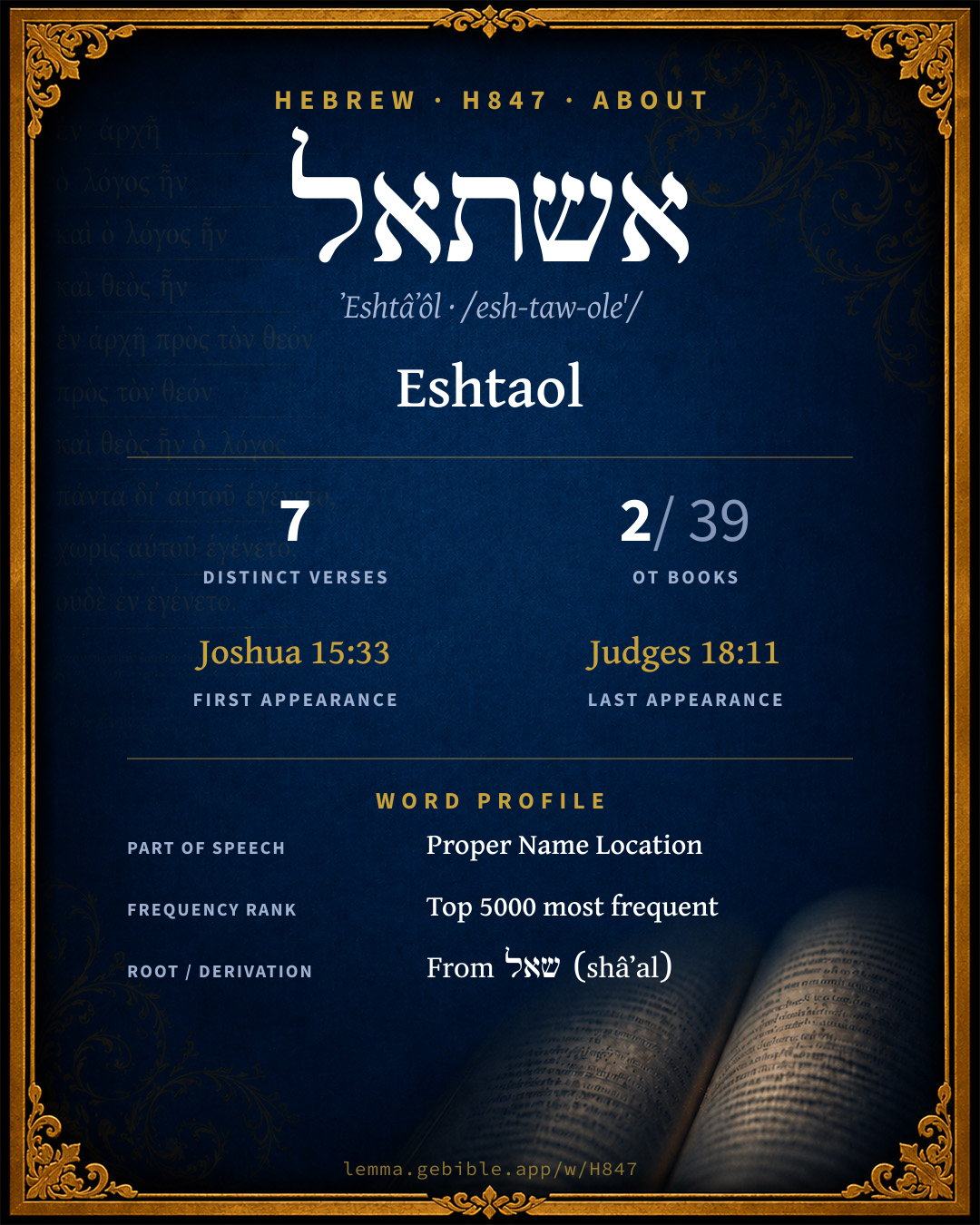
אֶשְׁתָּאוֹל
Eshtaol
BDB lists 2 entries for ‘Eshtaol’ fuller range ↓
Full lexicon entry — Brown-Driver-Briggs (BDB)
From Brown-Driver-Briggs (BDB)
Where this word appears
Grammar key — what these labels mean
Part of speech
- Noun
- A naming word — a person, place, thing, or idea.
Noun type
- Proper
- A name of a specific person, place, or people (e.g. Abraham, Zion, Israel).
Every verse where H847 appears — 7 distinct verses across 2 books. Click any verse to open its interlinear word-by-word view. Verse text shown in the World English Bible for context — . Each verse’s Hebrew form is shown with its reference; the English is not keyword-highlighted, since the data carries no word-level English alignment. Use “Compare translations” on any verse to read it across multiple English versions. This concordance covers the Hebrew Bible; Septuagint (Greek Old Testament) occurrences are not indexed here.
Joshua 2 verses
Judges 5 verses
- Judges 13:25 אֶשְׁתָּאֹֽל n Proper The Spirit of Yahweh began to move him in Mahaneh-dan, between Zorah and Eshtaol.
- Judges 16:31 אֶשְׁתָּאֹ֔ל n Proper Then his brothers and all the house of his father came down, and took him, and brought him up, and buried him between Zorah and Eshtaol in the burying-place of Manoah his father. He judged Israel twenty years.
- Judges 18:2 וּ/מֵֽ/אֶשְׁתָּאֹ֗ל conj + prep + n Proper The children of Dan sent of their family five men from their whole number, men of valor, from Zorah, and from Eshtaol, to spy out the land, and to search it; and they said to them, Go, search the land. They came to the hill-country of Ephraim, to the house of Micah, and lodged there.
- Judges 18:8 וְ/אֶשְׁתָּאֹ֑ל conj + n Proper They came to their brothers to Zorah and Eshtaol: and their brothers said to them, What [say] you?
- Judges 18:11 וּ/מֵ/אֶשְׁתָּאֹ֑ל conj + prep + n Proper There set forth from there of the family of the Danites, out of Zorah and out of Eshtaol, six hundred men girt with weapons of war.
About this entry
At a glance — auto-summarized from this page’s data, not written by a person. Every figure links to its source below. This summary describes the numbers; it doesn’t interpret them.
At its core, אשתאל (ʼEshtâʼôl) means “Eshtaol.” The word gravitates to Judges (71%), then Joshua. It appears 7 verses across 2 books of the Hebrew Bible, among its uncommon vocabulary. First canonically at Joshua 15:33, it enters the text early. Each statement above links to its evidence; the full detail follows below.
Gloss history
Strong's 1890 vs modern scholarship
About this word
Strong's H847 catalogs a Hebrew word from the Hebrew Old Testament.
These counts are not copied from any lexicon or concordance. They are computed here, from the morphology-tagged Hebrew Old Testament. What Lemma adds →
- 7
- distinct verses
- The word appears in 7 distinct verses.
- 2 / 39
- OT books
- The word appears in 2 of 39 Old Testament books.
- #2,835
- by frequency
- Top 5000 most frequent Hebrew words (rank 2,835 of 8,640 Hebrew words by occurrence).
View all 7 occurrences in the concordance →
By traditional corpus
Conventional, traditional groupings — biblical authorship is debated, so this is a traditional corpus grouping, not an authorship claim. Each share is this word’s portion of its verses in that division of the Hebrew canon. Each figure is a share of the word’s 7 distinct verses.
- Prophets (Nevi'im) 7 verses · 100%
How translations render this word
Counts come from each version’s own published word-to-Strong’s tagging or interlinear alignment — an approximate guide to how each version renders this word, not a word-level alignment the data otherwise carries. Because each total is that version’s own tagged count, the per-version totals vary from one another and need not match the appearance or distinct-verse counts above. These counts may also differ from a printed concordance because Lemma counts each distinctly tagged rendering and does not collapse phrase taggings into a single head-word total. This is a fixed set of word-tagged versions (KJV, ASV, BSB, ULT) and does not change with the reading translation you choose elsewhere. Each version’s license is shown beside its name below (and on Sources).
- King James Version: Eshtaol 7×
- American Standard Version: Eshtaol 7×
- Berean Standard Bible: Eshtaol 7×
- unfoldingWord Literal Text: Eshtaol 7×
King James Version Public Domain
Renders H847 across 7 tagged occurrences — most commonly:
American Standard Version Public Domain
Renders H847 across 7 tagged occurrences — most commonly:
Berean Standard Bible Public Domain
Renders H847 across 7 tagged occurrences — most commonly:
unfoldingWord Literal Text CC BY-SA 4.0
Renders H847 across 7 tagged occurrences — most commonly:
Senses in BDB
The 2 senses BDB distinguishes for this word, in lexicon order (not ranked by frequency or importance). The full entry — with sub-senses — is in the Lexicon Entry tab.
- Eshtaol = "entreaty"
- a Danite city located within Judah
Word origin
Jos 15:33 + 2 times, אֶשְׁתָּאֹל Ju 13:25 + 3 times n.pr.loc. (in form like the inf. of the Arabic viii. conj. from שָׁאַל: so אֶשְׁתְּמֹעַ from שָׁמַע. Perhaps Arabic-speaking tribes may have settled in parts of S. of Judah) city of Danites in the שְׁפֵלָה of Judah, named with צָרְעָה Jos 15:33; 19:41 Ju 13:25; 16:31; 18:2, 8, 11; perhaps mod. ’Eshûʿa Surveyiii. 25 GuerinPal. ii. 13 f. 382.
— Brown-Driver-Briggs (Oxford 1906, public domain), digitized via Sefaria, supplemented by the OpenScriptures HebrewLexicon (CC BY 4.0). See Sources.
Derived from שאל (shâʼal) (H7592) — to ask.
Jastrow Dictionary
A second Hebrew/Aramaic lexicon for comparison, covering Aramaic and post-biblical (Talmudic, Targumic, Midrashic) usage that the biblical-Hebrew BDB does not. Matched by lemma rather than by Strong’s number, so a lemma may carry more than one Jastrow headword (shown separately below), and the entries cover usage well beyond the Bible.
שְׁאַל
- 1. to ask, inquire, beg. Targ. II Kings III, 11. Targ. I Kings XIX, 4. Targ. Job XXXI, 30 למִשְׁאַל Ms. (ed. למִשְׁיַיל, למִשְׁיַל). Targ. Y. Deut. I, 1 שַׁיְילְתוּן (ed. Vien. שַׁיְילַתַּוּן, read: שַׁיַּילְתּוּן, Pa). Targ. Ps. CXXXVII, 3; a. fr.—ש׳ לשלם, ש׳ בשלם, v. שְׁלָם.—Sabb. 20ᵇ; 21ᵃ שְׁאִילְתִּינְהוּ לכל וכ׳, v. נָחוֹתָא. Ib. 30ᵃ שׁאוּל שאילה זו וכ׳ they asked the following question &c., v. עֵיל. Taan. 21ᵃ אי איכא דשָׁאֵיל לי וכ׳ if any one were to ask me a question from the Mishnah of &c. Y. Shebi. VII, 37ᶜ top הא גברא מִישְׁאֲלִינֵיה אתא שַׁאֲלוּנֵיה וכ׳ (not מישאלינית) here is a man whom you night ask; he came, and they asked; a. fr.—Part. pass. שְׁאִיל. Sabb. 30ᵇ ולענין שאילה דשְׁאִילְנָא קדמיכון and as to the question which I have been asked in your presence; [Rashi: דשָׁאֵילְנָא which I asked, a courteous phrase for ‘which you asked of me’]; a. e.
- 2. to borrow. Targ. Ex. XXII, 13; a. fr.—[Targ. O. ib. XII, 36, v. infra Af.]—B. Mets. 97ᵃ ההוא גברא דש׳ וכ׳ a man borrowed a cat from his neighbor &c. Ib. האי … למִישְׁאַל מידי וכ׳ if one wishes to borrow an object from his neighbor and be free from responsibility for an accident &c. Ib. נימא ליה שְׁאֵיל וכ׳ let him (the lender) say to him, first take what you want to borrow, and then &c. Yeb. 120ᵇ לא שָׁיְילֵי (not שיולי); B. Mets. 27ᵇ לא שְׁאִילֵי, v. סְקַב; a. fr.—Part. pass. as ab. Ib. 97ᵃ שאיל לן מר you (as teacher) are loaned to us, i.e. you are in our service, and if we borrow an object from you, we are not responsible, it being שאילה בבעלים, v. שְׁאִילָה. Ib. אתון שְׁאִילְתּוּן לי you are in my service. Ib. איהו ש׳ להו … אינהו שְׁאִילוּ ליה וכ׳ he (the teacher) is in their (the scholar’s) service on the Kallah day (v. כַּלָּה); they are in his on any other day; a. e.—Gen. R. s. 65 לא שאיל הוא לה ולא שְׁאִילָה היא ליה (some ed. שאול … שאולה) he is not loaned to her, nor she to him, i.e. the simile does not fit the application, nor the application the simile.
- 1. same, same, to ask, borrow &c. Targ. Y. Ex. XII, 35; a. e.—Bets. 19ᵃ אתא … לשַׁיּוּלֵי וכ׳ he came before the Rabbis to ask &c. Ḥull. 3ᵇ דליתיה קמן דלִישַׁיְּילֵיה when he is not before us so that we could ask him. Tam. 32ᵃ מְשַׁיַּילְנָא לכו I am asking you; a. fr.
- 2. to lend. Targ. Y. Ex. XII, 36.—Taan. 21ᵇ, v. זְבִילָא. Ib. דמחממת … ומְשַׁיְּילָא וכ׳ who heated her oven and let her neighbors use it; a. fr.
- to lend. Targ. O. Ex. XII, 36 ed. Berl. (ed. Vien. שאילינון, corr. acc.); a. e.—Yeb. l. c. ולא מוֹשְׁלֵי, v. נְחַשׁ I. B. Mets. 116ᵃ דעביד לאוֹשׁוּלֵי וכ׳ which it is customary to lend and hire out; a. e.
- 1. (with (with מ־) to take leave of absence. Targ. I Sam. XX, 6.
- 2. (with ב־) to allow one’s self to be inquired of; to answer, issue an oracle. Targ. Ez. XIV, 3. Targ. Y. II, Num. XXIV, 1. Targ. Is. LXV, 1.
- 3. (with ל־) to bring a case up for decision, to ask. Y. Maasr. II, beg. 49ᶜ אִשְׁתָּאֲלִית לאילין וכ׳ I asked those of the house of &c. Y. Sabb. XII, 13ᶜ bot., אִשְׁתַּאֲלַת לר׳ שמעון וכ׳ R. S. b. L. was asked. Ib. VI, 8ᵃ ואִיתְשְׁלַת לר׳ ומר וכ׳ when the case was brought before Rabbi, he said &c.; a. fr.—Esp. to come before a scholar for absolution from a vow. Ned. 90ᵃ אי בעי על נדרו איתשיל ברישא וכ׳ if he so desires, he may ask first for absolution from his vow of abstinence, or if he chooses, he may ask first for absolution from his nazaritic vow; ib. נִיתְּשִׁיל; a. fr.
A Dictionary of the Targumim, the Talmud Babli and Yerushalmi, and the Midrashic Literature (Marcus Jastrow; London, Luzac, 1903) — Public Domain. Digitized via Sefaria. Digitized via Sefaria. Full attribution on Sources.
Forms in the corpus
The 7 distinct written forms H847 takes in the Hebrew Bible, most frequent first — each parse links to that state’s occurrences in the concordance. Hebrew forms include their vowel points and cantillation, so a single lemma takes many written forms.
| Form | Parsing | Example | Uses |
|---|---|---|---|
| אֶשְׁתָּא֥וֹל | Noun, Proper | Joshua 15:33 | 1 |
| אֶשְׁתָּאֹ֔ל | Noun, Proper | Judges 16:31 | 1 |
| אֶשְׁתָּאֹֽל | Noun, Proper | Judges 13:25 | 1 |
| וְ/אֶשְׁתָּא֖וֹל | Noun, Proper | Joshua 19:41 | 1 |
| וְ/אֶשְׁתָּאֹ֑ל | Noun, Proper | Judges 18:8 | 1 |
| וּ/מֵ/אֶשְׁתָּאֹ֑ל | Noun, Proper | Judges 18:11 | 1 |
| וּ/מֵֽ/אֶשְׁתָּאֹ֗ל | Noun, Proper | Judges 18:2 | 1 |
Same root — word family
Other BDB entries built from the same root as H847, grouped by Strong’s listed origin. These share a root / origin per the lexicon — not necessarily a shared meaning. Each links to that word’s own entry.
Derives from
Shares the same root
Proper names from this root
People and places named from this root — a name, not an additional meaning of the word.
- משאל Mishʼâl H4861 Misheal
- שאול shᵉʼôwl H7585 Sheol
- שאול Shâʼûwl H7586 Saul
- שאל Shᵉʼâl H7594 Sheal
- שאלתיאל Shᵉʼaltîyʼêl H7597 Shealtiel
- אשתאלי ʼEshtâʼulîy H848 Eshtaulites
Compare all same-root words → Showing 4 of 11 — not the complete family. 6 of the same-root words are proper names (people or places). They share a root, not necessarily a meaning.
Bible dictionary
Public-domain dictionary articles matched to this entry by name (Eshtaol). A biblical name can be shared by more than one person or place, so an article may treat several.
Easton's Bible Dictionary · M. G. Easton, 1897
Narrow pass or recess, a town (Josh. 15:33) in the low country, the She-phelah of Judah. It was allotted to the tribe of Dan (Josh. 19:41), and was one of their strongholds. Here Samson spent his boyhood, and first began to show his mighty strength; and here he was buried in the burying-place of Manoah his father (Judg. 13:25; 16:31; 18:2, 8, 11, 12). It is identified with the modern Yeshua, on a hill 2 miles east of Zorah. Others, however, identify it with Kustul, east of Kirjath-jearim.
Smith's Bible Dictionary · William Smith, 1863
(a pass), a town in the low country--the Shefelah--of Judah, after wards allotted to Dan. (Joshua 15:33; 19:41) Here Samson spent his boyhood, and hither after his last exploit his body was brought. (Judges 13:25; 16:31; 18:2,8,11,12)
Hitchcock's Bible Names Dictionary · Roswell D. Hitchcock, 1869
a strong woman
Classic public-domain reference works; full attribution on Sources.
Septuagint verse parallels
This word appears in 7 verses that also exist in the Greek Old Testament (Septuagint), out of the 7 Hebrew verses it occurs in. You can read those verses in Greek by switching the Old Testament edition to the Septuagint.
Read these verses in the Septuagint
This is a verse-level parallel only — the same verses exist in both the Hebrew and Greek Old Testaments. No word-level Hebrew↔Greek correspondence is claimed: the data carries no such alignment, so no Greek word is shown as this Hebrew word’s translation. Coverage is not total — the Septuagint omits the deuterocanon and renumbers the Psalms, so some Hebrew verses have no direct Greek parallel.