
Proverbs 30:7

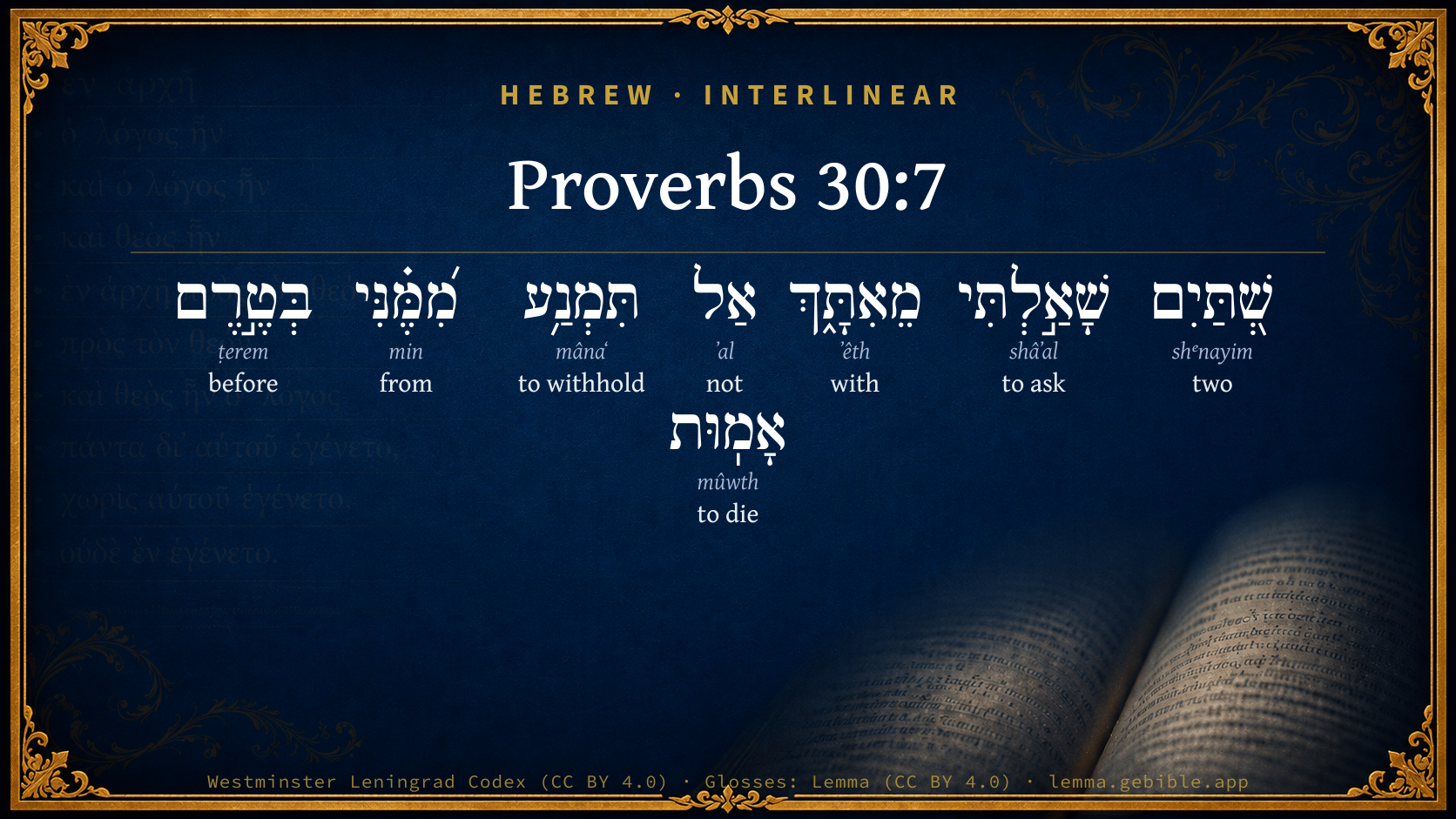
Hebrew (Westminster Leningrad Codex) Proverbs 30:7 appears in the Hebrew Old Testament. The text above is from the Westminster Leningrad Codex. Each word links to its Strong’s number, a concise gloss, and parsing drawn from the Open Scriptures Hebrew Bible morphology. Click any word for its full Brown-Driver-Briggs (BDB) entry.
Download image
Cite this verse

Proverbs 30:7 (World English Bible). Public Domain. Lemma interlinear Bible study tool, https://lemma.gebible.app/v/proverbs/30/7.

Show BibTeX & RIS
BibTeX
RIS
English Translation
"Two things I have asked of you; Don't deny me before I die:
World English Bible · Public Domain
Download a study sheet

One document with this verse’s original text, its word-by-word gloss line, the meaning frame, cross-references with their text, attributed commentary, and full source and license credits — printable, and it pastes into notes with its structure intact.

This verse Autodidact and up

Study sheet (.html) Plain text (.txt)

A passage Seminary Student

Up to 50 verses in one chapter. A passage sheet keeps up to 6 commentary sources and 12 cross-references per verse, in the order this page ranks them, and says so on the sheet whenever that leaves anything out. Ask for a single verse and you get the Autodidact verse sheet above.

Everything on this page stays free to read, with no account — the sheet is a download of what is already on screen, not access to it.

Want to remove ads? Support Godless Engineer
Compare translations 3

The same verse in 3 English versions, stacked beneath the original-language interlinear above. Click any original word for its lexicon entry.

Each is an independent rendering of the whole verse — the interlinear is not word-aligned to these translations.

Highlighted words mark where these versions differ — a whole-verse word diff, not a word-by-word alignment.

  • World English Bible Public Domain
    "Two things I have asked of you; Don't deny me before I die:
  • King James Version Public Domain
    Two things have I required of thee; deny me them not before I die:
  • unfoldingWord Literal Text CC BY-SA 4.0
    Two things I ask from with you, do not withhold from me before I die:

unfoldingWord Literal Text — © unfoldingWord, licensed CC BY-SA 4.0. Word-aligned USFM3 via Door43 (git.door43.org/unfoldingWord/en_ult).

Versions to compare (up to 4)

3 of 4 selected

Show all 18 translations

Every available English version of this verse, each an independent rendering of the whole verse.

  • World English Bible Public Domain
    "Two things I have asked of you; Don't deny me before I die:
  • Berean Standard Bible Public Domain
    Two things I ask of You—do not refuse me before I die:
  • Majority Standard Bible Public Domain
    Two things I ask of You—do not refuse me before I die:
  • King James Version Public Domain
    Two things have I required of thee; deny me them not before I die:
  • American Standard Version (1901) Public Domain
    Two things have I asked of thee; Deny me `them' not before I die:
  • Revised Version (1885) Public Domain
    Two things have I asked of thee; deny me them not before I die:
  • Geneva Bible (1599) Public Domain
    Two things haue I required of thee: denie me them not before I die.
  • Douay-Rheims (1899) Public Domain
    Two things I have asked of thee, deny them not to me before I die.
  • Young's Literal Translation Public Domain
    Two things I have asked from Thee, Withhold not from me before I die.
  • Literal Standard Version CC BY-SA 4.0
    Two things I have asked from You, || Do not withhold from me before I die.
  • Unlocked Literal Bible CC BY-SA 4.0
    Two things I ask of you, do not withhold them from me before I die:
  • unfoldingWord Literal Text CC BY-SA 4.0
    Two things I ask from with you, do not withhold from me before I die:
  • Darby Bible Public Domain
    Two things do I ask of thee; deny me [them] not before I die:
  • World Messianic Bible Public Domain
    “Two things I have asked of you. Don’t deny me before I die.
  • Webster's Bible Public Domain
    Two things have I required of thee; deny them not to me before I die:
  • Free Bible Version CC BY-SA 4.0
    God, I want to request two things from you. Please don't refuse to let me have them before I come to die.
  • Bible in Basic English Public Domain
    I have made request to you for two things; do not keep them from me before my death:
  • JPS Tanakh (1917) Public Domain
    Two things have I asked of Thee; deny me them not before I die:

Literal Standard Version (2020), Covenant Press — licensed CC BY-SA 4.0. Text via the HelloAO Bible API (eBible.org). Unlocked Literal Bible (unfoldingWord) — licensed CC BY-SA 4.0. Text via the HelloAO Bible API (eBible.org). unfoldingWord Literal Text — © unfoldingWord, licensed CC BY-SA 4.0. Word-aligned USFM3 via Door43 (git.door43.org/unfoldingWord/en_ult). Free Bible Version, Dr. Jonathan Gallagher — licensed CC BY-SA 4.0. Text via the HelloAO Bible API (eBible.org).

Word by word

More ways to search: Search by grammar → Find every occurrence → Compare this word →

Practice this passage: Drill this verse → Learn its vocabulary →

About this verse

These counts appear in no published source. They are computed here, from the morphology-tagged text and Lemma’s own curated glosses. What Lemma adds →

8
words
8
distinct lemmas
Wisdom
section

Shared distinctive vocabulary

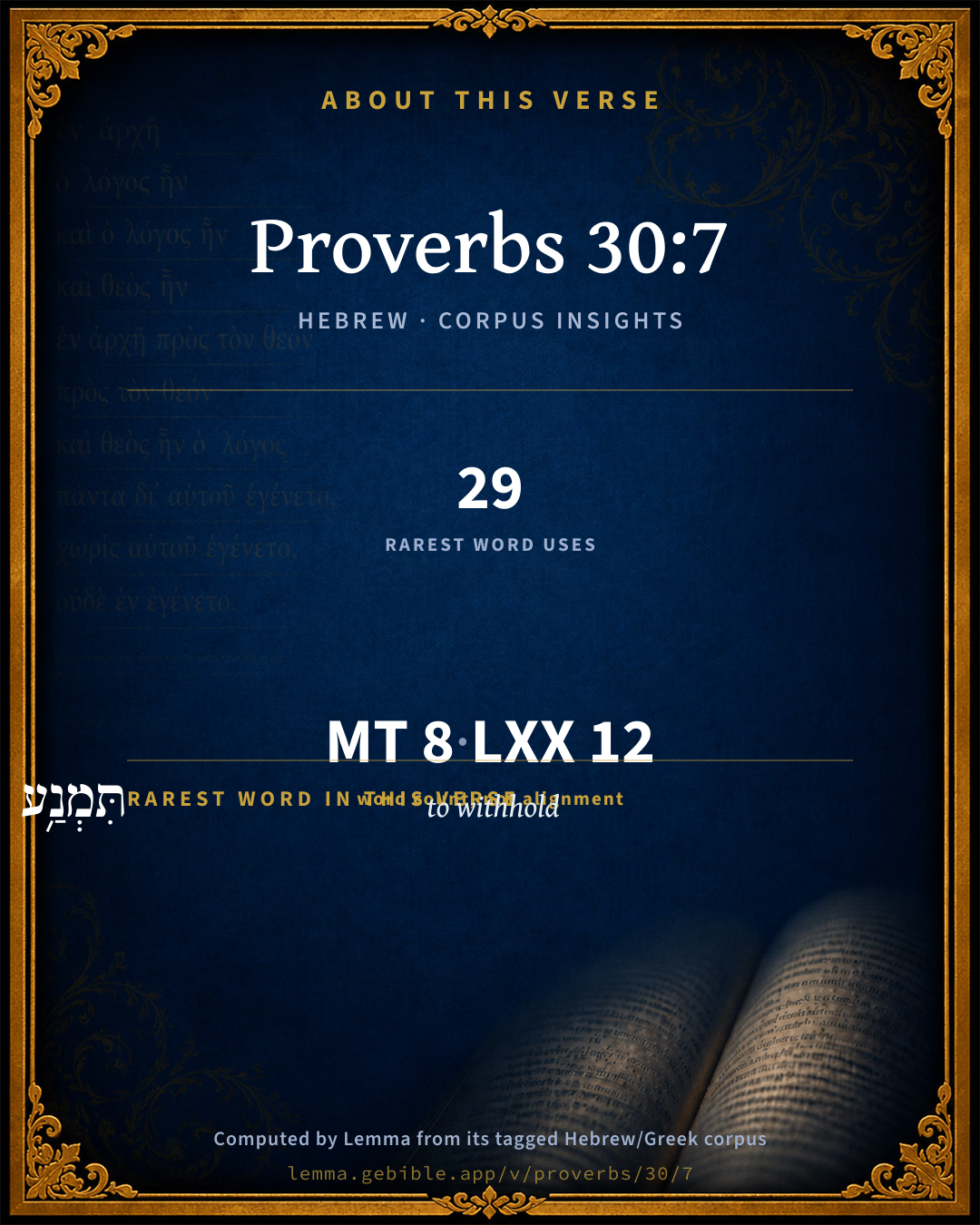
תִּמְנַ֥ע to withhold H4513 occurs in 29 verses of the Hebrew Bible. Also found in:

Grammatical profile

  • 3 verbs
  • 1 adjective
  • 2 prepositions
  • 1 adverb
  • 1 particle

Verb forms

  • שָׁאַ֣לְתִּי Qal · Perfect
  • תִּמְנַ֥ע Qal · Jussive
  • אָמֽוּת Qal · Imperfect

Hebrew & Septuagint length

In English translation the verse runs 13 words from the Hebrew and 14 from the Septuagint (LXX English) — closely comparable.

A rough comparison of the two English renderings, which tokenize alike — not a word-level alignment.

Word counts can differ between the Hebrew and the Greek without any difference in meaning — e.g. the Hebrew direct-object marker אֵת has no separate Greek word, and Greek often adds the article ὁ.

In the original languages it is 8 Hebrew tokens and 12 Greek tokens — but the two are counted differently (Hebrew bundles its prefixes and suffixes into one token; the Greek is in lemma form), so that isn’t a like-for-like length.

Cross-references

5

Topical passages linked to Proverbs 30:7 in the Treasury of Scripture Knowledge — connected by theme and wording, ordered by reader-vote popularity; previews shown in the World English Bible.

  • 2 Kings 2:9 It happened, when they had gone over, that Elijah said to Elisha, Ask what I shall do for you, before I am taken from you. Elisha said, please let a double portion of your spirit be on me.
  • Psalms 27:4 One thing I have asked of Yahweh, that I will seek after, That I may dwell in the house of Yahweh all the days of my life, To see Yahweh's beauty, And to inquire in his temple.
  • Luke 10:42 but one thing is needed. Mary has chosen the good part, which will not be taken away from her."
  • 1 Kings 3:5–9 In Gibeon Yahweh appeared to Solomon in a dream by night; and God said, Ask what I shall give you.
  • Psalms 21:2 You have given him his heart's desire, And have not withheld the request of his lips. Selah.

Cross-references courtesy of OpenBible.info (CC BY 4.0).

Hebrew and Greek witnesses Masoretic Hebrew ↔ Greek Septuagint

The same verse in the two great witnesses to the Old Testament, shown verse-for-verse.

These are two independent witnesses, not word-aligned to each other, and the Septuagint is shown in lemma (dictionary) form.

Hebrew Proverbs 30:7 Masoretic · Westminster Leningrad Codex

שְׁ֭תַּיִם שָׁאַ֣לְתִּי מֵאִתָּ֑ךְ אַל תִּמְנַ֥ע מִ֝מֶּ֗נִּי בְּטֶ֣רֶם אָמֽוּת

"Two things I have asked of you; Don't deny me before I die:

World English Bible · Public Domain

Greek LXX Proverbs 30:7 Septuagint · lemma form

δύο αἰτέω παρά σύ μή ἀποαἱρέω ἐγώ χάρις πρό ὁ ἀποθνήσκω ἐγώ

Two things I ask of you; take not favor from me before I die.

LXX2012 (modern English Septuagint) · Public Domain

On this verse, The Pulpit Commentary discusses the Septuagint’s reading. Read the note in Commentary ↓

Hebrew: Westminster Leningrad Codex (CC BY 4.0). Greek: Septuagint (public domain); English from LXX2012 (modern English Septuagint) (Public Domain). How the Septuagint differs from the Hebrew →

Commentary

Notes on Proverbs 30:7 from classic Christian and Jewish commentators (each source and its license shown beneath its notes). The classic Christian expositions comment on the surrounding passage and are grouped to its opening verse, so a note may address several verses; the Jewish commentaries on the Tanakh (Rashi and others) are per-verse, so they appear only where the commentator wrote on this verse.

Lemma curates 59 commentaries, every one of them public domain or Creative Commons licensed, each selected and text-cleaned for this edition rather than reprinted as found. About our sources →

Trapp's Complete Commentary

John Trapp

Pro 30:7 Two [things] have I required of thee; deny me [them] not before I die:

Ver. 7. Two things have I required of thee.] Two special requests he had among many, for our present condition is a condition of singular vanity and indigence. We get our living by begging, and are never without somewhat to be required of God; never without our wants and ailments and suits for supplies.

Deny me them not.] See here both his familiarity with God in prayer and his importunity; for a lazy suitor begs a denial. Agur therefore re-enforceth his request: it was honest, else he would never have begun it; but being so, he is resolved to follow it. So doth David with his "one thing" which he did desire, and he would desire, {Psa 27:4} he would never give it over. So Jacob would have a blessing, and therefore wrestles with might and slight; and this he doth in the night and alone, and when God was leaving him, and upon one leg. He had a hard pull of it, and yet he prevailed. "Let me go," saith God: no, thou shalt not go, saith Jacob, till I have my request. It is not unlawful for us to be unmannerly in prayer, to be importunate, and after a sort impudent. {Luk 18:8} {a} Was not the woman of Canaan so? {Mat 15:22} She came for a cure, and a cure she would have; and had it too, with a high commendation of her heroic faith. Christ was no penny father; he had more blessings than one, even the abundance of the Spirit for them that ask it. When poor men make requests to us, we usually answer them as the echo doth the voice, the answer cuts off half the petition: if they ask us two things, we think we deal well if we grant them one. Few Naamans, that when you beg one talent will force you to take two. But God heaps mercies upon his suppliants, and blames them for their modesty in asking. "Hitherto you have asked me nothing"; nothing to what you might have done, and should have had. "Ask, that your joy may be full." "Thou shouldst have smitten five or six times," said the prophet to the king of Israel, that smote thrice only - "then hadst thou smitten Syria till thou hadst consumed it." {2Ki 13:18-19}

Before I die,] q.d., I intend to be a daily suitor for them while I live; and when I die I shall have no more to do in this kind. Every one as he hath some special grace or gift above others, and as he is dogged with some special temptation or violent corruption, so he hath some great request. And God holds him haply in hand about it all his lifelong, that he may daily hear from him, and that a constant intercourse may be maintained. Thus it was with David, {Psa 27:4} and with Paul. {2Co 12:8-9} In this case we must resolve to give God no rest, never to stand before him but ply this petition; and yet take heed of prescribing to him, of "limiting the holy one of Israel." Say with Luther, Fiat voluntas mea: Let my will be done; but then he sweetly falls off with, mea voluntas, Domine, quia tua: My will, Lord, but because it is, and no further than it is, thy will too.

{a} δια γε την αναιδειαν, {Luk 11:8} Propter improbitatem.

John Trapp, A Commentary or Exposition upon All the Books of the Old and New Testament (1647–1656) — public domain. Text from a community e-Sword module.

Joseph Benson's Commentary

Pro 30:7-8. Two things have I required of thee — I do most earnestly and especially desire: deny me them not — Hebrew, אל תמנע ממני, withhold them not from me; before I die — That is, while I live, as being things of great and continual necessity, for thy honour and service, and my own good. Remove far from me — From my heart, and from the course of my life: vanity — That Isaiah , 1 st, All false and vain opinions, namely, concerning God and things divine; all unbelief, idolatry, and superstition: and, 2d, Vanity of heart and life; a vain conversation, or the love of the vain things of this world; and lies — All falsehood and deceit in my words and actions, and in my conduct toward God or men. This is the first of Agur’s petitions. Give me neither poverty nor riches — This is his second request, which may seem to have some reference to the former, poverty being commonly an occasion of, or temptation to, the sin of lying; and riches being the great occasions of, and enticements to, vanity. Thus, as his first petition was against the sins themselves, so this latter is against the occasions of them. Feed me with food convenient for me — Moderate and suitable, both to my natural necessities and to that condition of life in which thou hast placed me. And this mediocrity of condition is so amiable, that it has often been desired by wise heathen as more eligible than a state of the greatest plenty and glory.

Joseph Benson's Commentary on the Old and New Testaments (1811–1818) — public domain. Text from a community e-Sword module.

Tyndale Open Study Notes

Tyndale Open Resources

30:7-9 Agur requests two favors from God: that God will help him not to lie (cp. 6:16-19; 14:5, 25; 25:18; 26:18-19) and that he not be given too much or too little. It is not sinful to be rich (3:9-10, 15-16; 10:15, 22) or poor (3:27; 11:24; 28:27; 29:7, 14), but Agur wisely wanted to avoid the pitfalls of both.

Tyndale Open Study Notes — © Tyndale Open Resources, licensed CC BY-SA 4.0. Text via the HelloAO Bible API.

Geneva Bible (1599)

Geneva Bible translators

He maketh this request to God.

Geneva Bible (1599) marginal notes — public domain. Text via Bolls.life.

Matthew Henry's Commentary

After Agur's confession and creed, here follows his litany, where we may observe,

I. The preface to his prayer: Two things have I required (that is, requested) of thee, O God! Before we go to pray it is good to consider what we need, and what the things are which we have to ask of God. - What does our case require? What do our hearts desire? What would we that God should do for us? - that we may not have to seek for our petition and request when we should be presenting it. He begs, Deny me not before I die. In praying, we should think of dying, and pray accordingly. "Lord, give me pardon, and peace, and grace, before I die, before I go hence and be no more; for, if I be not renewed and sanctified before I die, the work will not be done after; if I do not prevail in prayer before I die, prayers afterwards will not prevail, no, not Lord, Lord. There is none of this wisdom or working in the grave. Deny me not thy grace, for, if thou do, I die, I perish; if thou be silent to me, I am like those that go down to the pit, Psa 28:1. Deny me not before I die; as long as I continue in the land of the living, let me continue under the conduct of thy grace and good providence."

II. The prayer itself. The two things he requires are grace sufficient and food convenient. 1. Grace sufficient for his soul: "Remove from me vanity and lies; deliver me from sin, from all corrupt principles, practices, and affections, from error and mistake, which are at the bottom of all sin, from the love of the world and the things of it, which are all vanity and a lie." Some understand it as a prayer for the pardon of sin, for, when God forgives sin, he removes it, he takes it away. Or, rather, it is a prayer of the same import with that, Lead us not into temptation. Nothing is more mischievous to us than sin, and therefore there is nothing which we should more earnestly pray against than that we may do no evil. 2. Food convenient for his body. Having prayed for the operations of divine grace, he here begs the favours of the divine Providence, but such as may tend to the good and not to the prejudice of the soul. (1.) He prays that of God's free gift he might receive a competent portion of the good things of this life: "Feed me with the bread of my allowance, such bread as thou thinkest fit to allow me." As to all the gifts of the divine Providence, we must refer ourselves to the divine wisdom. Or, "the bread that is fit for me, as a man, a master of a family, that which is agreeable to my rank and condition in the world." For as is the man so is his competency. Our Saviour seems to refer to this when he teaches us to pray, Give us this day our daily bread, as this seems to refer to Jacob's vow, in which he wished for no more than bread to eat and raiment to put on. Food convenient for us is what we ought to be content with, though we have not dainties, varieties, and superfluities - what is for necessity, though we have not for delight and ornament; and it is what we may in faith pray for and depend upon God for. (2.) He prays that he may be kept from every condition of life that would be a temptation to him. [1.] He prays against the extremes of abundance and want: Give me neither poverty nor riches. He does not hereby prescribe to God, nor pretend to teach him what condition he shall allot to him, nor does he pray against poverty or riches absolutely, as in themselves evil, for either of them, by the grace of God, may be sanctified and be a means of good to us; but, First, He hereby intends to express the value which wise and good men have for a middle state of life, and, with submission to the will of God, desires that that might be his state, neither great honour nor great contempt. We must learn how to manage both (as St. Paul, Phi 4:12), but rather wish to be always between both. Optimus pecuniae modus qui nec in paupertatem cedit nec procul paupertate discedit - The best condition is that which neither implies poverty nor yet recedes far from it. Seneca. Secondly, He hereby intimates a holy jealousy he had of himself, that he could not keep his ground against the temptations either of an afflicted or a prosperous condition. Others may preserve their integrity in either, but he is afraid of both, and therefore grace teaches him to pray against riches as much as nature against poverty; but the will of the Lord be done. [2.] He gives a pious reason for his prayer, Pro 30:9. He does not say, "Lest I be rich, and cumbered with care, and envied by my neighbours, and eaten up with a multitude of servants, or, lest I be poor and trampled on, and forced to work hard and fare hard;" but, "Lest I be rich and sin, or poor and sin." Sin is that which a good man is afraid of in every condition and under every event; witness Nehemiah (Neh 6:13), that I should be afraid, and do so, and sin. First, He dreads the temptations of a prosperous condition, and therefore even deprecates that: Lest I be full and deny thee (as Jeshurun, who waxed fat and kicked, and forsook God who made him, Deu 32:15), and say, as Pharaoh in his pride, Who is the Lord, that I should obey his voice? Prosperity makes people proud and forgetful of God, as if they had no need of him and were therefore under no obligation to him. What can the Almighty do for them? Job 22:17. And therefore they will do nothing for him. Even good men are afraid of the worst sins, so deceitful do they think their own hearts to be; and they know that the greatest gains of the world will not balance the least guilt. Secondly, He dreads the temptations of a poor condition, and for that reason, and no other, deprecates that: Lest I be poor and steal. Poverty is a strong temptation to dishonesty, and such as many are overcome by, and they are ready to think it will be their excuse; but it will not bear them out at God's bar any more than at men's to say, "I stole because I was poor;" yet, if a man steal for the satisfying of his soul when he is hungry, it is a case of compassion (Pro 6:30) and what even those that have some principles of honesty in them may be drawn to. But observe why Agur dreads this, not because he should endanger himself by it, "Lest I steal, and be hanged for it, whipped or put in the stocks, or sold for a bondman," as among the Jews poor thieves were, who had not wherewithal to make restitution; but lest he should dishonour God by it: "Lest I should steal, and take the name of my God in vain, that is, discredit my profession of religion by practices disagreeable to it." Or, "Lest I steal, and, when I am charged with it, forswear myself." He therefore dreads one sin, because it would draw on another, for the way of sin is downhill. Observe, He calls God his God, and therefore he is afraid of doing any thing to offend him because of the relation he stands in to him.

Matthew Henry's Commentary on the Whole Bible (1708–1710) — public domain (CC PDM 1.0). Text via the HelloAO Bible API.

Jamieson, Fausset & Brown

Robert Jamieson, A. R. Fausset & David Brown

A prayer for exemption from wickedness, and the extremes of poverty and riches, the two things mentioned. Contentment is implied as desired.

Jamieson, Fausset & Brown — Commentary Critical and Explanatory on the Whole Bible (1871) — public domain (CC PDM 1.0). Text via the HelloAO Bible API.

Adam Clarke's Commentary

Verse 7. Two things have I required of thee] These two petitions are mentioned in the next verse; and he wishes to have them answered before he should die. That is, he wishes the answer now, that he may live the rest of his life in the state he describes.

Adam Clarke's Commentary on the Bible (1810–1826) — public domain. Text from a community e-Sword/MySword module.

Ellicott's Commentary for English Readers

(7) Two things have I required of thee.—The commencement of a series of numerical proverbs. (See above on Pro_6:16.)

Before I die—i.e., while life lasts.

A Bible Commentary for English Readers, edited by Charles John Ellicott (1878–1897) — public domain. Text from a community e-Sword module.

John Gill's Exposition

Two things have I required of thee,.... Or, "have asked of thee (a), O God"; as may be supplied, for the words are addressed to him. The following is a prayer made unto him, which contains the two requests here referred to; his requests are not many, his words are few; he did not make long prayers, or expect to be heard for much speaking;

deny me them not before I die; not that he thought he was near his end; nor is it his sense that he desired some time or other, at least before he died, that he might have these two requests granted him after mentioned; for what are poverty and riches, or convenient food, to a man just dying? but his meaning is, that he might be thus favoured as long as he lived; that all the while he was in the world, he might be kept from sin, and be free from anxious worldly thoughts and cares, having a moderate competency of good things: faith in prayer will have no denial; a wrestling Jacob will not let the angel go without a blessing; importunity in prayer gets much from the hands of God; "the effectual fervent prayer of the righteous man availeth much", Jam 5:16.

(a) "postulavi a te", Pagninus, Montanus, Tigurine version, Mercerus, Gejerus; "peto ab te", Junius & Tremellius, Piscator; "petii a te", Cocceius, Michaelis, Schultens.

John Gill's Exposition of the Whole Bible (1746–1763) — public domain (CC PDM 1.0). Text via the HelloAO Bible API.

Albert Barnes' Notes on the Bible

Two things - The limitation of man’s desires follows naturally upon his consciousness of the limits of his knowledge.

Albert Barnes' Notes on the Bible (1834–1885) — public domain. Text from a community e-Sword/MySword module.

Matthew Poole's English Annotations

Have I required; I do earnestly and especially desire Deny me them not before I die, Heb.

withhold them not from me before I die, i.e. whilst I live, as things of great and continual necessity for thy honour and service, and my own good.

Matthew Poole's English Annotations on the Holy Bible (1683–1685) — public domain. Text from a community e-Sword/MySword module.

Whedon's Commentary on the Bible

Daniel D. Whedon

7, 8. These verses contain a direct address to God, although he is not named till towards the close of the prayer.

Two things — They might seem at first sight to be three, but the last two clauses are substantially one:

Let me be neither poor nor rich.

Vanity and lies — Deceptive and false things.

Food convenient for me — “Sufficient for me.” — Muenscher. “My allotted portion.” — Stuart. My rations, or daily bread. The conception is given as that of a child at the family table, waiting to receive from the hand of the parent his “piece,” or allotted part of the loaf or cake of bread. He asks submissively for just as much as the wise and benevolent parent judges to be good for him — necessary for his wants — nothing more. The unleavened bread of the Orientals, baked usually every day, or meal, was broken or torn to pieces. Hence the original is, “Tear or break off (for me) my allotted portion of bread.” Comp. Mat_6:11.

Daniel D. Whedon (gen. ed.), Commentary on the Old and New Testaments (1874–1909) — public domain. Text from a community e-Sword module.

The Pulpit Commentary

Vers. 7-9. A mashal ode, containing two requests, and a rationale of the latter. The matter of the two prayers connects it with ver. 6, whether we consider that the limitation of man"s desire follows naturally the limitation of his knowledge (Plumptre). or that the warning against being reproved as a liar is corroborated by the prayer against vanity and lies (but see below, on ver. 9). It is the first of Agur"s numerical proverbs.

Two things have I required of thee. The personal pronoun applies to God, who, according to our interpretation, has been invoked in ver. 1; otherwise it stands without reference to anything preceding. Deny me not before I die; i.e. grant me these two things for the rest of my life. Septuagint, "Take not grace (carin ) from me before I die.

Vers. 7-9. The golden mean.

I THE WAY OF LIFE: TRUTH IS THE MEAN BETWEEN TWO EXTREMES. (Ver. 8) Extremes exist in logic; life shows that extremes meet, and that the path of sense in opinion and of safety in conduct lies intermediate between them.

II GREAT INCHES ARE NOT IN THEMSELVES DESIRABLE. Not by the wise and religious man. They bring perils to the soul. Full of his gifts, it is tempted to deny the Giver. The deepest atheism springs from self-sufficiency. Prospering in the flesh, men are often impoverished in the spirit. "How deep a knowledge of the heart is implied in the petition of the Litany, "In all time of our wealth, good Lord deliver us"!" (Bridges).

III EXTREME POVERTY MAY BE EQUALLY INJURIOUS TO THE SPIRITUAL LIFE. It tempts to dishonesty, even to perjury. "Too poor to be honest" is a cynical saying which points out a real danger. The old proverb, "It is hard for an empty sack to stand on end," points the same way. More stinging still is the word, "Poor men have no souls.

IV THE GOLDEN MEAN IS THEREFORE TO BE DESIRED AND SOUGHT. (Comp. Php_4:11, 12 1Ti_6:6-10) Horace says, "Whoever loves the golden mediocrity is safe, free from the sordid misery of the tumble down dwelling, free from the envied hall in his sobriety" ("Carm.," 2:10). But let us be careful to note that the true state is to be found in the spirit itself the inward, not the outward sufficiency. "I have learned in whatsoever state I am, therewith to be content." Rich in estate, yet poor in spirit; poor in estate, yet rich in grace; this is the true solution of the problem, the true object of pious prayers. J.

Vers. 7-9. A new year"s prayer.

We have in these most instructive words a wise and good man

I CALMLY CONFRONTING THE FUTURE. Whether we read "before I die" or "until I die" (Wardlaw), we have a good man deliberately facing the future of his life. He realizes that before him stretches out a tract of time which he has to cross; he knows that he must keep steadily, incessantly, moving forward; that he will meet with difficulties and dangers on his way; that he will want all and more than all the power and the wisdom he has at his command; and he is sobered and solemnized by the thought. In view of this serious aspect of things, we find him

II EARNESTLY ADDRESSING HIMSELF TO GOD. "Two things have I required of thee." To whom, thus situated, should we go? Surely unto him who is:

1. The Lord of the future, who holds all time in his sovereign hand, who alone "can set new time upon our score.

2. The Father of our spirits, who is deeply interested in our highest welfare, and cares more about our well-being than does any human relative or friend.

3. The Lord of our life, who traces the path our feet will tread, who can and will hedge that path with his protecting care, who can and will lead us along the road we travel. And what better "requirement" or request could he prefer than that of

III ASKING FOR DELIVERANCE FROM DELUSION? From "vanity and lies." Whatever may have been the form which this evil took in the land and time of Agur, we know what withering and wasting delusions we need to be preserved from now.

1. From under-estimating the value of our life. There are many are there not many more than there once were? that say, "Who will show us any good?" Their name is legion who are discussing and even denying the worth of human life. Indifference, ennui, weariness and dreariness of spirit, disgust leading down to a pessimistic philosophy in theory, and to suicide in action this is the strain and spirit, and this is the current of our time. It is a delusion, both sorrowful and sinful. For it is a virtual abandonment of a noble heritage, and it is a rejection of a good and a great gift from the hand of God. A life of holy service, of unselfish devotion, of spiritual growth, of filial gratitude and joy, of Christian hopefulness, is a blessing of simply inestimable value.

2. From over-estimating the value of the sensuous and the material. Always and everywhere men have been in the gravest danger of supposing that "a man"s life does consist in the abundance of the things which he possesses," or the number and sweetness of his bodily gratifications. This also is vanity; it is a falsehood which sin sows freely and which quickly takes root in the minds of men. What we need to know, what we may well ask God to teach us so that we shall not only accept but realize it, is that all the rivers of earthly good and of sensuous satisfaction may run into the sea of an immortal spirit, made for God and for goodness, and they will not fill it.

IV PRAYING TO BE EXEMPT FROM THE EXTREMES OF CIRCUMSTANTIAL TRIAL. Give me neither poverty nor riches.

1. The trial of poverty. This we can all understand, and it takes but little wisdom or sanctity to pray for exemption from its evil.

2. The trial of wealth. We think we could endure this without, suffering. Nearly all those who have not experienced it are inclined to slight the danger of being rich. Those who have never walked on the ice imagine that they could do so without slipping; those who have never gambled indulge the idea that they could stop at the moment of prudential retirement. We do not know ourselves. He who "knew what was in man" knew how great is the peril of worldly wealth: (see Mar_10:23) We do well to strive and to toil for an honourable maintenance; but we do not well to sacrifice health or usefulness how much less our self-respect and the love of Christ! in order to be rich We do wisely to ask God to save us from the temptation the real, the strong, the frequently whelming temptation of great worldly success.

V ASKING FOR THE GOOD WHICH WILL PROVE TO BE A BLESSING. "Feed me with food convenient for me;" i.e. which thou knowest to be suited to my need. God only knows what we want what we want; what will be really and abidingly food for us, considered in all our relations. God knows what will nourish our spiritual nature, what will supply us as citizens of this life, what is our bodily need for those few years which he is about to give us here before he translates us to a heavenly sphere. Let us ask him to grant us what he knows is best, surely believing that what he gives in answer to our prayer is the best for us to receivethat, whatever the measure be, and not something sweeter, or finer, or more enduring. But let us, understanding what it is we ask as they who first used the words did not say continually, "Lord, evermore give us this bread. C.

The Pulpit Commentary (1880–1919), ed. H.D.M. Spence-Jones & Joseph S. Exell — public domain. Text from a community e-Sword module.

Keil & Delitzsch

C. F. Keil & F. Delitzsch

In what now follows, the key-note struck in Pro 30:1 is continued. There follows a prayer to be kept in the truth, and to be preserved in the middle state, between poverty and riches. It is a Mashal-ode, vid., vol. i. p. 12. By the first prayer, "vanity and lies keep far from me," it is connected with the warning of Pro 30:6.

7 Two things I entreat from Thee,

Refuse them not to me before I die.

8 Vanity and lies keep far away from me

Poverty and riches give me not:

Cause me to eat the bread which is allotted to me,

9 Lest in satiety I deny,

And say: Who is Jahve?

And lest, in becoming poor, I steal,

And profane the name of my God.

We begin with the settlement and explanation of the traditional punctuation. A monosyllable like שׁוא receives, if Legarmeh, always Mehuppach Legarmeh, while, on the contrary, the poly-syllable אשׂבּע has Asla Legarmeh. אל־תּתּן־לי, with double Makkeph and with Gaja in the third syllable before the tone (after the Metheg-Setzung, 28), is Ben-Asher's; whereas Ben-Naphtali prefers the punctuation אל־תּתּן לי (vid., Baer's Genesis, p. 79, note 3). Also פּן־אשׂבּע has (cf. פּן־ישׁתּה, Pro 31:5) Makkeph, and on the antepenultima Gaja (vid., Thorath Emeth, p. 32). The perf. consec. וכחשׁתּי has on the ult. the disjunctive Zinnor (Sarka), which always stands over the final letter; but that the ult. is also to be accented, is shown by the counter-tone Metheg, which is to be given to the first syllable. Also ואמרתּי has in correct Codd., e.g., Cod. 1294, the correct ultima toning of a perf. consec.; Kimchi in the Michlol 6b, as well as Aben Ezra in both of his Grammars, quotes only וגנבתּי ותפשׂתּי as toned on the penult. That וגנבתּי cannot be otherwise toned on account of the pausal accent, has been already remarked under 6b; the word, besides, belongs to the סף''פתתין בא, i.e., to those which preserve their Pathach unlengthened by one of the greater disjunctives; the Athnach has certainly in the three so-called metrical books only the disjunctive form of the Zakeph of the prose books. So much as to the form of the text.

As to its artistic form, this prayer presents itself to us as the first of the numerical proverbs, under the "Words" of Agur, who delighted in this form of proverb. The numerical proverb is a brief discourse, having a didactic end complete in itself, which by means of numerals gives prominence to that which it seeks to bring forward. There are two kinds of these. The more simple form places in the first place only one numeral, which is the sum of that which is to be brought forth separately: the numerical proverb of one cipher; to this class belong, keeping out of view the above prayer, which if it did not commence a series of numerical proverbs does not deserve this technical name on account of the low ciphers: Pro 30:24-28, with the cipher 4; Sir. 25:1 and 2, with the cipher 3. Similar to the above prayer are Job 13:20., Isa 51:19; but these are not numerical proverbs, for they are not proverbs. The more artistic kind of numerical proverb has two ciphers: the two-ciphered numerical proverb we call the sharpened (pointed) proverb. Of such two-ciphered numerical proverbs the "words" of Agur contain four, and the whole Book of Proverbs, reckoning Pro 6:16-19, five - this ascending numerical character belongs to the popular saying, Kg2 9:32; Job 33:29; Isa 16:6, and is found bearing the stamp of the artistic distich outside of the Book of Proverbs, Psa 62:12; Job 33:14; Job 40:5; Job 5:19, and particularly Amos 1:3-2:6. According to this scheme, the introduction of Agur's prayer should be:

אחת שׁאלתּי מאתּך

וּשׁתּים אל־תּמנע ממּנּי בּטרם אמוּת

and it could take this form, for the prayer expresses two requests, but dwells exclusively on the second. A twofold request he presents to God, these two things he wishes to be assured of on this side of death; for of these he stands in need, so as to be able when he dies to look back on the life he has spent, without the reproaches of an accusing conscience. The first thing he asks is that God would keep far from him vanity and lying words. שׁוא (= שׁוא, from שׁוא = שׁאה, to be waste, after the form מות) is either that which is confused, worthless, untrue, which comes to us from without (e.g., Job 31:5), or dissoluteness, hollowness, untruthfulness of disposition (e.g., Psa 26:4); it is not to be decided whether the suppliant is influenced by the conception thus from within or from without, since דבר־כּזב [a word of falsehood] may be said by himself as well as to him, a falsehood can intrude itself upon him. It is almost more probable that by שׁוא he thought of the misleading power of God-estranged, idolatrous thought and action; and by דבר־כזב, of lying words, with which he might be brought into sympathy, and by which he might ruin himself and others. The second petition is that God would give him neither poverty (ראשׁ, vid., Pro 10:4) nor riches, but grant him for his sustenance only the bread of the portion destined for him. The Hiph. הטריף (from טרף, to grind, viz., the bread with the teeth) means to give

(Note: The Venet. translates, according to Villoison, θέρψον με; but the MS has, according to Gebhardt, θρέψον.)

anything, as טרף, with which, 31:15, נתן חק is parallel: to present a fixed piece, a definite portion of sustenance. חק, Gen 47:22, the portion assigned as nourishment; cf. Job 23:14 חקּי, the decree determined regarding me. Accordingly, חקּי לחם does not mean the bread appropriately measured out for me (like ἄρτος ἐπιούσιος, that which is required for οὐσία, subsistence), but the bread appropriate for me, determined for me according to the divine plan. Fleischer compares (Arab.) ratab and marsaum, which both in a similar way designate a fixed sustentation portion. And why does he wish to be neither poor nor rich? Because in both extremes lie moral dangers: in riches, the temptation to deny God (which 'כּחשׁ בּה signifies, in the later Heb. כּפר בּעקּר, to deny the fundamental truth; cf. (Arab.) kafar, unbelieving), whom one flowing in superabundance forgets, and of whom one in his self-indulgence desires to know nothing (Job 21:14-16; Job 22:16.); in poverty, the temptation is to steal and to blaspheme the name of God, viz., by murmuring and disputing, or even by words of blasphemy; for one who is in despair directs the outbreaks of his anger against God (Isa 8:21), and curses Him as the cause of His misfortune (Rev 16:11, Rev 16:21). The question of godless haughtiness, מי יהוח, the lxx improperly change into מי יראה, τίς με ὁρᾶ. Regarding נורשׁ, to grow poor, or rather, since only the fut. Niph. occurs in this sense, regarding יוּרשׁ, vid., at Pro 20:13.

That the author here, by blaspheming (grasping at) the name of God, especially thinks on that which the Tôra calls "cursing (קלּל) God," and particularly "blaspheming the name of the Lord," Lev 24:15-16, is to be concluded from the two following proverbs, which begin with the catchword קלל:

Keil & Delitzsch — Biblical Commentary on the Old Testament (1861–1891) — public domain (CC PDM 1.0). Text via the HelloAO Bible API. (Old Testament only.)

Bridges on Proverbs

Charles Bridges

Though Agur had confessed his brutishness before his God; yet his prayers (the most accurate test of a man of God) prove him to have been possessed of deep spiritual understanding. "We ask, and receive not, because we ask amiss, that we may consume it upon our lusts." (Jas 4:3 .) How wisely gracious therefore is the teaching of the divine Comforter, "helping our infirmities" in prayer, and by molding our petitions, "according to the will of God," ensuring their acceptance. (Rom 8:26-27 .) Agur’s heart must have been under this heavenly teaching; dictating his prayers by a primary regard to his best interests, and by a spiritual discernment of what would probably be beneficial, and what injurious to them.

Two things he especially required — not as though he had nothing else to ask, but as being the pressing burden of the present moment. And these he asks — as if he would take no denial (Gen 32:26 ) — with all the intense earnestness of a dying sinner — Deny me them not before I die!

His prayers are short, but comprehensive. Though little is said, yet that little is fraught with matter; framed in its proper order. Spiritual blessings occupy the first place; temporal blessings are secondary, and in subserviencey to them.

Remove from me vanity and lies. Is not this the atmosphere of the world? vanity its character — lies its delusion; promising happiness, only to disappoint its weary and restless victims? How can the heaven-born soul breathe in such a world? Everything deadens the heart, and eclipses the glory of the Savior. "The soul cleaveth to the dust." "All that is in the world, the lust of the flesh, and the lust of the eyes, and the pride of life — is not of the Father, but is of the world." (1Jn 2:16 .) And therefore "they that observe lying vanities forsake their own mercy." (Jon 2:8 .) A soul that knows its dangers and its besetting temptations, will live in the spirit of this prayer of the godly Agur — remove from me — far from me — as far as possible, vanity and lies. "Turn away mine eyes" — prayed a saint of God in the same watchful jealousy — "from beholding vanity. Remove from me the way of lying." (Psa 119:37, Psa 119:29 .)

But how singular, yet how fraught with instruction, is Agur’s second prayer! All are ready to pray against poverty. But to deprecate riches — this is not nature’s desire, but an impulse of godly fear and trembling, that cometh from above. ’Give me not riches’ — is scarce the prayer of one in ten thousand. Agur, as a wise man, desired the safest and happiest lot; not, as Israel of old, "meat for his lust;"†1 but food convenient for him, measured out in daily allowance,†2 suitable to his need. This is obviously not a fixed measure. It implies, not a bare sufficiency for natural life, but a provision varying according to the calling, in which God has placed us. ’If Agur be the master of a family, then that is his competency, which is sufficient to maintain his wife, children, and household. If Agur be a public person, a prince or a ruler of the people; then that is Agur’s sufficiency, which will conveniently maintain him in that condition.’†3 Jacob when "he had become two bands," evidently required more than when in his earlier life "with his staff he had passed over Jordan." (Gen 32:10 .) What was sufficient for himself alone, would not have been sufficient for the many that were then dependent upon him. The immense provisions for Solomon’s table, considering the vast multitude of his dependents, might be only a competency for the demand. (1Ki 4:22 .) The distribution of the manna was food convenient — nothing too much, but no deficiency — "He that gathered much had nothing over; and he that gathered little had no lack." (Exo 16:18 .) And thus, in the daily dispensation of Providence, a little may be a sufficiency to one, while an overflowing plenty is no superfluity to another. Only let Christian self-denial, not depraved appetite, be the standard of competency. Proud nature never stoops so low.†4 The Apostle distinctly traces to the influence of Divine teaching his Christian moderation in his diversified conditions of abundance and of want.†5 Philosophy may have inculcated the lesson; but Almighty grace alone can command the practice of it.

’It is a question’ — says Dr. South — ’whether the piety or the prudence of this prayer be greater.’†6 Agur was well persuaded of the temptations incident to these two opposite conditions — the vanity and lies belonging to riches (Psa 62:9 ), the discontent and occasion of sin, which are the snares of poverty. Yet he does not pray absolutely against these states, only submissively. It is the prayer of his choice, the desire of his heart, that God would graciously exempt him from both, and bless him with a middle condition. Nor does he ask this for the indulgence of the flesh. He deprecates not the trouble, anxieties, and responsibilities of riches, which might betoken an indolent, self-pleasing spirit; nor the miseries and sufferings of poverty; but he cries for deliverance from the snares of each condition — Let me not be rich, lest I be full, and deny thee. Let me not be poor, lest I steal, and take the name of my God in vain.

And alas! the danger of these results is but too evident. Both extremes are the borders of fearful temptation. Strange and irrational as it may appear, such is the depravity of our nature, that mercies induce neglect, and often, casting off, of God.†7 Lust is too strong for conscience. Rarely does "the daughter of Tyre come with her gift, or the rich among the people entreat the favor" of their God. (Psa 45:12 .) Too often, the more we receive from God, the less he receives from us.†8 The twining thorns choke the heavenly plant. (Mat 13:22 .) And as we prosper in the flesh, we are impoverished in the spirit. But not less imminent are the dangers of pinching poverty; nor is it every Christian, that can honorably grapple with them. Dishonesty is a besetting temptation,†9 followed up by perjury to escape punishment.†10 Thus two commandments are broken, and the sinner is in "the snare of the devil, taken captive by him at his will." (2Ti 2:26 .)

The ’golden mean’ (for so even a heathen could describe it†11) is recommended by patriarchs,†12 prophets,†13 and apostles.†14 Nay, our Lord teaches us to pray for it in terms identical with this petition. For what else is our "daily bread" but food convenient for us?†15

We must however be careful, that we use Agur’s prayer in his spirit. Perhaps the Gospel rather teaches us to leave the matter entirely with God. Both riches and poverty are his appointment.†16 It may please him to place us in a high condition; to entrust us with much riches, or to exercise us with the trials of poverty. Many of his children are in both these conditions.†17 And shall they wish it otherwise? Let them rather seek for grace to glorify him in either state. Or if it seem lawful to pray for a change of condition, let us not forget to pray for a single eye to his glory, that his will, not ours, may be done in us. ’Whithersoever God gives’ — said the pious Bishop Hall — ’I am both thankful and indifferent; so as, while I am rich in estate, I may be poor in spirit; and while I am poor in estate, I may be rich in grace.’†18

Footnotes:

†1 Psa 78:18.

†2 Compare 1Ki 4:27 . 2Ki 25:30 .

†3 Mede’s Sermon on Agur’s Choice.

†4 Ecc 5:10. Hab 2:5 . 1Ti 6:9-10 .

†5 I have learned - I have been instructed - expressions taken from the instruction in the Heathen Mysteries. Php 4:11-12 .

†6 Sermon on Jas 3:16 .

†7 Job 21:13-14; Job 22:17-18 .

†8 Deu 6:11-12; Deu 8:10-13 ; Deu 32:15 . Hos 13:6 . What a deep knowledge of the heart is implied in that petition of our Litany for deliverance in all time of wealth! How hard to realize the time of wealth as the time of special need!

†9 Pro 6:30.

†10 Pro 29:24. Compare Lev 6:2-3 ; Lev 19:11-12 . Zec 5:3-4 .

†11 ’Auream quisquis mediocritatem

Diligit, tutus caret obsoleti

Sordibus tecti, caret invidendâ

Sobrius aulâ.’ - Horat. Carm. lib. 2. 10.

†12 Gen 28:20.

†13 Jer 45:5.

†14 Php 4:11-12. 1Ti 6:6-10 .

†15 The learned Mede insists upon this identity. Things fit and sufficient, precisely answers to arton eipiousion. (Mat 6:11 ) - ’a sufficiency as it were,’ - epi thn ousian, adequate to our being and support - bread sufficient - the bread we have need of. Thus periousia signifies abundance or superfluity - peri, ultra or super - as it were, an over-being.

†16 The learned Mede insists upon this identity. Things fit and sufficient, precisely answers to arton eipiousion. (Mat 6:11 ) - ’a sufficiency as it were,’ - epi thn ousian, adequate to our being and support - bread sufficient - the bread we have need of. Thus periousia signifies abundance or superfluity - peri, ultra or super - as it were, an over-being.

†17 Abraham - David - Solomon - with Lazarus and the heirs of his kingdom, Jas 2:5 .

†18 Works, viii. 195. ’Our Savior, in the prayer he taught, directs us to pray in general, that God would give us daily bread, and deliver us from evil; without specifying the external comfort we might desire, or the particular disagreeable occurrences we might wish to be secured against: but leaving it to the goodness of our heavenly Father to determine what is convenient for us, and what would prove upon the whole really evil. Let us therefore from hence learn to pray, that God would always put us into that condition, which he sees to be fittest for us, and that he would fit us more and more for that condition, in which he places us, whatever it be; granting us wisdom and grace to behave in it after a right manner, and both to discern and improve the advantages annexed to it. By this means, when there was no appearance but of a barren desert, we shall discover mines of gold.’ - Grove’s Sermons.

Charles Bridges, An Exposition of the Book of Proverbs (1846) — public domain. Text from a community e-Sword module.

unfoldingWord translationNotes

Door43 World Missions Community

Put vanity and lies far away from me

Possible meanings are 1) "Do not allow people to speak vanity and lies to me" or 2) "Do not allow me to speak vanity and lies" (See: Metaphor)

vanity

false, useless words

Give me neither poverty nor riches

The writer speaks as if "poverty" and "riches" were physical objects that someone could give to another. They are also abstract nouns that can be stated as "poor" and "rich." AT: "Do not allow me to be either very poor or very rich" (See: Metaphor and Abstract Nouns)

if I have too much, I might deny you and say

This describes a hypothetical situation that has not happened but is possible if the writer becomes rich. (See: Hypothetical Situations)

if I become poor, I might steal and profane

This describes a hypothetical situation that has not happened but is possible if the writer becomes poor. (See: Hypothetical Situations)

I might steal and profane the name of my God

"I might make people who know that I have stolen things think that there is no God" or "I might harm God's reputation by stealing"

translationWords

die

Yahweh

profane

name

God

unfoldingWord translationNotes — © Distant Shores Media and the Door43 World Missions Community, licensed CC BY-SA 4.0. Source: git.door43.org/Door43/en_tn.

Rashi

Rabbi Shlomo Yitzchaki (Rashi)

I ask two [things] of You Now he addresses the Holy One, blessed be He.

Rashi on the Tanakh — English translations: “The Judaica Press complete Tanach with Rashi, translated by A. J. Rosenberg” (CC BY 4.0); “Pentateuch with Rashi's commentary by M. Rosenbaum and A.M. Silbermann, 1929-1934” (public domain); “The Metsudah Tanach series, Lakewood, N.J” (CC BY 4.0); and “The Book of Joshua, Metsudah Publications, 1997” (CC BY 4.0). Text via Sefaria.

Lesson kit

Teaching starters — assembled from the data on this page, not authored interpretation. Every prompt links to the verse data it draws on. Edit before teaching.

Proverbs, in the Wisdom, opens this verse with 8 words (8 distinct Hebrew lemmas). Its most distinctive word is mânaʻ (“to withhold”). A historical commentator’s framing appears above. Read the whole chapter for the surrounding context.

Discussion questions

  1. The word mânaʻ carries the sense “to withhold.” How does it shape the verse?
  2. How does Genesis 30:2, which shares the word «to withhold», read alongside this verse?
  3. These translations render this verse differently; the difference is in the English rendering, not the original. What questions does that raise?
  4. «שָׁאַ֣לְתִּי» is a Qal Perfect verb. How does that grammatical form shape the action described?
  5. Compare how Trapp's Complete Commentary and Joseph Benson's Commentary read this verse. Where do they agree or differ?

Things to notice

Reading settings

Reading text

Shown beneath each verse's original-language words.

Old Testament
Old Testament edition

Read the OT as the Masoretic Hebrew (MT) or the Greek Septuagint (LXX).

English shown for the Greek Septuagint (in the Hebrew ↔ Greek comparison).

Comparing translations? Open the Compare panel on any verse page to stack up to four side by side.