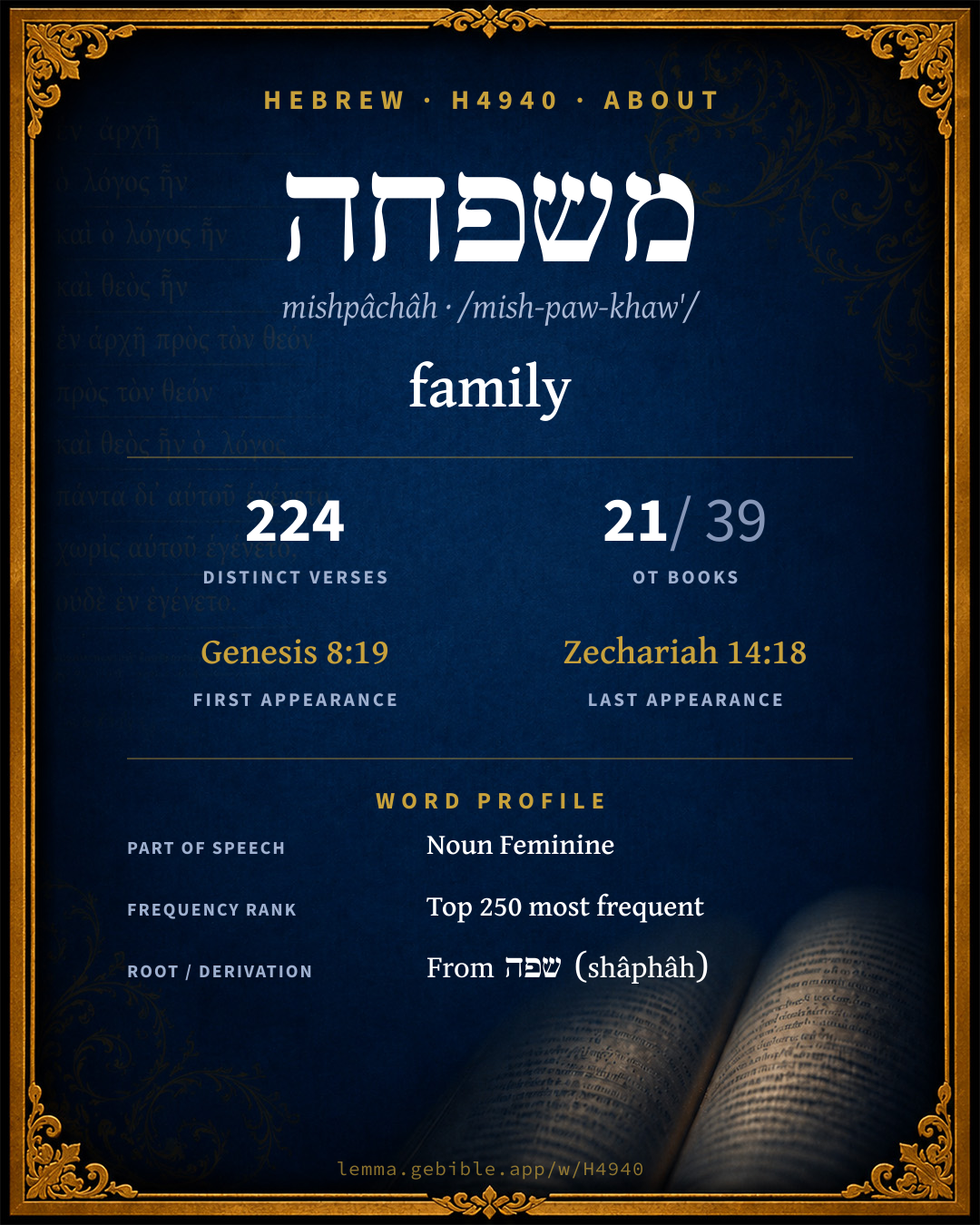
מִשְׁפָּחָה
family
‘family’ is one of 5 main senses fuller range ↓
Full lexicon entry — Brown-Driver-Briggs (BDB)
From Brown-Driver-Briggs (BDB)
Where this word appears
See every Construct-state word in the Hebrew Bible →
Grammar key — what these labels mean
Part of speech
- Noun
- A naming word — a person, place, thing, or idea.
Noun type
- Common
- A common noun — a general class of person, place, or thing (“king,” “city,” “water”), not a specific name.
State
- Construct
- A noun bound to a following noun in a possessive / “of” relationship (the construct chain).
- Absolute
- The independent form of a noun, not bound to a following word.
Gender
- Feminine
- Grammatically feminine.
Number
- Plural
- More than one (in Hebrew, generally three or more).
- Singular
- One.
3 verses where H4940 appears in the Construct state in the Book of 1 Samuel. Filtered view — show all forms. Click any verse to open its interlinear word-by-word view. Verse text shown in the World English Bible for context — . Each verse’s Hebrew form is shown with its reference; the English is not keyword-highlighted, since the data carries no word-level English alignment. Use “Compare translations” on any verse to read it across multiple English versions. This concordance covers the Hebrew Bible; Septuagint (Greek Old Testament) occurrences are not indexed here.
1 Samuel
- 1 Samuel 9:21 וּ/מִשְׁפַּחְתִּ/י֙ מִשְׁפְּח֖וֹת conj + n c fs cs + sfx pers 1cs n c fp cs Saul answered, Am I not a Benjamite, of the smallest of the tribes of Israel? and my family the least of all the families of the tribe of Benjamin? why then speak you to me after this manner?
- 1 Samuel 10:21 ל/משפחת/ו לְ/מִשְׁפְּחֹתָ֔י/ו מִשְׁפַּ֣חַת prep + n c fp cs + sfx pers 3ms prep + n c fp cs + sfx pers 3ms n c fs cs He brought the tribe of Benjamin near by their families; and the family of the Matrites was taken; and Saul the son of Kish was taken: but when they sought him, he could not be found.
- 1 Samuel 18:18 מִשְׁפַּ֥חַת n c fs cs David said to Saul, Who am I, and what is my life, [or] my father's family in Israel, that I should be son-in-law to the king?
About this entry
At a glance — auto-summarized from this page’s data, not written by a person. Every figure links to its source below. This summary describes the numbers; it doesn’t interpret them.
The Hebrew noun משפחה centers on the idea of “family.” The King James Version usually renders it “family,” while modern versions prefer “clans” (Berean Standard Bible) and “clan of” (unfoldingWord Literal Text) — see the renderings breakdown. Spanning 224 verses in 21 books, it ranks among the common words of the Hebrew Bible. Numbers dominates its distribution — 94 of 224 verses. The lexicon spreads it across several senses; see its full sense range. Dig into 224-verse concordance and the renderings breakdown below.
Gloss history
Strong's 1890 vs modern scholarship
About this word
Strong's H4940 catalogs a Hebrew word from the Hebrew Old Testament.
These counts are not copied from any lexicon or concordance. They are computed here, from the morphology-tagged Hebrew Old Testament. What Lemma adds →
- 224
- distinct verses
- The word appears in 224 distinct verses.
- 21 / 39
- OT books
- The word appears in 21 of 39 Old Testament books.
- #161
- by frequency
- Top 250 most frequent Hebrew words (rank 161 of 8,640 Hebrew words by occurrence).
View all 224 occurrences in the concordance →
Most concentrated in
- Numbers 94 verses 42%
- Joshua 42 verses 19%
- 1 Chronicles 19 verses 8%
By section of the Old Testament
By traditional corpus
Conventional, traditional groupings — biblical authorship is debated, so this is a traditional corpus grouping, not an authorship claim. Each share is this word’s portion of its verses in that division of the Hebrew canon. Each figure is a share of the word’s 224 distinct verses.
- Torah (Pentateuch) 120 verses · 54%
- Prophets (Nevi'im) 76 verses · 34%
- Writings (Ketuvim) 28 verses · 13%
How translations render this word
Counts come from each version’s own published word-to-Strong’s tagging or interlinear alignment — an approximate guide to how each version renders this word, not a word-level alignment the data otherwise carries. Because each total is that version’s own tagged count, the per-version totals vary from one another and need not match the appearance or distinct-verse counts above. These counts may also differ from a printed concordance because Lemma counts each distinctly tagged rendering and does not collapse phrase taggings into a single head-word total. This is a fixed set of word-tagged versions (KJV, ASV, BSB, ULT) and does not change with the reading translation you choose elsewhere. Each version’s license is shown beside its name below (and on Sources).
- King James Version: Family 95×, Families 53×, After their families 41×
- American Standard Version: Family 91×, Families 65×, According to their families 38×
- Berean Standard Bible: Clans 122×, Clan 98×, Families 15×
- unfoldingWord Literal Text: Clan of 88×, According to their clans 81×, Clans of 41×
King James Version Public Domain
Renders H4940 across 301 tagged occurrences — most commonly:
Plus other, less common renderings. Plus 34 renderings that appear only once — usually multi-word phrases or single function words the recovered tagging swept in, not distinct renderings.
American Standard Version Public Domain
Renders H4940 across 300 tagged occurrences — most commonly:
Plus other, less common renderings. Plus 34 renderings that appear only once — usually multi-word phrases or single function words the recovered tagging swept in, not distinct renderings.
Berean Standard Bible Public Domain
Renders H4940 across 285 tagged occurrences — most commonly:
Plus 22 renderings that appear only once — usually multi-word phrases or single function words the recovered tagging swept in, not distinct renderings. Not rendered by a distinct English word in 15 further occurrences.
unfoldingWord Literal Text CC BY-SA 4.0
Renders H4940 across 309 tagged occurrences — most commonly:
Plus other, less common renderings. Plus 18 renderings that appear only once — usually multi-word phrases or single function words the recovered tagging swept in, not distinct renderings.
12 senses and sub-senses in the full BDB
What do BDB’s symbols mean?
BDB uses these scholarly abbreviations:
| Symbol | Meaning |
|---|---|
| 𝔊 | the Septuagint (the ancient Greek translation, LXX) |
| 𝔙 | the Vulgate (the Latin translation) |
| 𝔖 | the Syriac version (the Peshitta) |
| 𝔗 | the Targum (the Aramaic translation) |
| ψ | the Psalms |
| √ | root (the underlying root or stem) |
| ‖ | parallel passage (a synonymous or contrasted parallel) |
| † | the dagger: every passage where the word occurs is cited |
The 12 senses and sub-senses the full Brown-Driver-Briggs lexicon distinguishes for this word, in lexicon order (not ranked by frequency), with BDB’s own verbatim wording and sub-sense lettering. Shown in Hebrew script with BDB’s own scholarly abbreviations. The condensed entry is in the Lexicon Entry tab. See also the Forms in the corpus table below.
- 1. clan:
- a. family connexion of individ. Gn 24:38 (+ בֵּית־אָבִי), v 40 (+ id.), v 41 (all J; = מוֹלַדְתִּי v 4), 2 S 14:7, united in sacrifice 1 S 20:6, 29, in passover Ex 12:21 (JE; cf. BenzEncy. Bib. Passover, §§ 9, 12); cf. Lv 20:5 (H), 25:10, 41 (P), v 49 (P; defined as כִשְּׁאֵר בְּשָׂרוֹ), non-Heb. v 47 (H), v 45 (P), Ju 1:25; מִשְׁפְּחוֹתֶיהָ Jos 6:23 (E or R) is unintelligible, probably del. (cf. Steuern Holz; בֵּית אָבִיהָ in v 25 [J]), cf. Nu 27:4, 11 (P); מ׳ בֵּית אֲבִי אִמּוֹ Ju 9:1 clan of his mother’s father-house; incl. individuals, and included by שֵׁבֶט 1 S 9:21(×2) 10:21; with specif. name, in series גֶבֶר, בַּיִת, מ׳, שֵׁבֶט Jos 7:14(×2), 17b, c (all J; v 17a read pl. Di Benn, or שֵׁבֶט GFM Ju 13:2; Steuern allows either); cf. Dt 29:17; Ju 21:24, מ׳ אָבִי בְּיִשׂ׳ 1 S 18:18 (+ חַיַּי, v. ii. [חַי]); אִישׁ … מִמּ׳ בֵּית־שָׁאוּל 2 S 16:5; with name also Ru 2:1, 3 and (non-Isr.) Jb 32:2. e.g. Genesis 24:38
- b. in loose, popular sense = tribe, Ju 13:2; 17:7; 18:19, cf. v 2 (‖ שֵׁבֶט v 1), v 11 (yet in these two read poss. pl., v. GFM). e.g. Judges 13:2
- c. techn. divisions of people of Isr. Nu 11:10 (J) Je 2:4; 31:1, cf. 3:14; Nu 1:2, 18; 2:34; 33:54 (all P), so (post-ex.) Ne 4:7: Est 9:28 (מְדִינָה, מ׳, דּוֹד). e.g. Numbers 11:10
- d. usually (P) techn. divisions of tribes of Israel, Ex 6:14, 15, 19, 25; Nu 3:15 + 112 times Nu (93 times Nu 26, incl. v 43 where הַשּׁוּחָמִי appar. = Dan), 34 times Jos 13–21; also 1 Ch 6:4, 45; 7:5; Zc 12:13; divisions of Gershom, etc. (in Levi) Nu 3:18, 19, 20 + 41 times Ex Nu Jos Ch; subdivisions of these divisions (in Levi) Nu 3:21(×2) + 6 times Nu 3 + 4:18; cf. (in other tribes) 1 Ch 2:53; 4:2, 8, 21, 27, 38; 5:7; also Zc 12:12b, c. 13 b, 14 a, and (distrib.) v 12a 14b, pleonast. מ׳ מַטֵּה אֲבִיהֶם Nu 36:6 cf. v 8, and (מַטֵּה מ׳ א׳) v 12. e.g. Exodus 6:14
- e. late, div. of other peoples 1 Ch 16:28 = ψ 96:7, ψ 22:28; in Edom Gn 36:40 (P). e.g. 1 Chronicles 16:28
- f. in wider sense = people, nation; כֹּל מִשְׁפְּחֹת הָאֲדָמָה Am 3:2; Gn 12:3; 28:14 (both J), cf. Je 10:25; Ez 20:32; Na 3:4 (all ‖ גּוֹיִם), Zc 14:17; Je 1:15; 25:9; as one’s posterity Gn 10:30, 31, 32 (all P), so prob. v 5 (P; Di Dr); = all Isr. Am 3:1, Judah Mi 2:3; Je 8:3 (הַמּ׳ הָרָעָה הַזֹּאת), Isr. + Judah, שְׁתֵּי הַמּ׳ 33:24; מִשְׁפַּחַת מִצְרַיִם Zc 14:18; cf. ψ 107:41. e.g. Amos 3:2
- 2. = guild 1 Ch 2:55 (of scribes; orig. hereditary in families). e.g. 1 Chronicles 2:55
- 3. = species, kind:
- a. of judgments Je 15:3. e.g. Jeremiah 15:3
- b. animals Gn 8:19 (P). e.g. Genesis 8:19
- 4. pl. = aristocrats Jb 31:34 (cf. Eng. ‘the classes’). e.g. Job 31:34
Senses from the full Brown-Driver-Briggs lexicon (Brown, Driver, Briggs; Oxford 1906 — public domain), digitized via Sefaria, supplemented by the OpenScriptures HebrewLexicon (CC BY 4.0). Full attribution on Sources.
Word origin
n.f.clan (RSSem i. 258, 2nd ed. 276; K149, 2nd ed. 175 BaNB § 161 a);—abs. מ׳ Am 3:1 +; cstr. מִשְׁפַּ֫חַת Ju 9:1 +; sf. מִשְׁפַּחְתִּי Gn 24:38 +, etc.; pl. מִשְׁפָּחוֹת Na 3:4 +; cstr. מִשְׁפְּחוֹת Am 3:2 +; sf. מִשְׁפְּחֹתֵיהֶם Gn 8:19 + 2 times, usually -תָם Nu 1:18 + 84 times, etc.;—
— Brown-Driver-Briggs (Oxford 1906, public domain), digitized via Sefaria, supplemented by the OpenScriptures HebrewLexicon (CC BY 4.0). See Sources.
Derived from שפה (shâphâh) (H8192) — to sweep.
Jastrow Dictionary
A second Hebrew/Aramaic lexicon for comparison, covering Aramaic and post-biblical (Talmudic, Targumic, Midrashic) usage that the biblical-Hebrew BDB does not. Matched by lemma rather than by Strong’s number, so a lemma may carry more than one Jastrow headword (shown separately below), and the entries cover usage well beyond the Bible.
מִשְׁפָּחָה
- family, kinship. Tanḥ. ed. Bub., Noah 24 (play on שפה, Gen. XI, 1) מ׳ אחת one kinship (all equally bad, cmp. preced. w.). B. Bath. 109ᵇ מִשְׁפַּחַת אב קרויה מ׳ the father’s kinship is called one’s family (not the mother’s). Eduy. VIII, 7; Kidd. 71ᵃ משפחת בית וכ׳ (not משפחות) a family named Beth &c.; a. fr.—Pl. מִשְׁפָּחוֹת. Tosef. Naz. I, 3, a. e., v. גָּלָה; a. fr. e.g. Genesis 11:1
A Dictionary of the Targumim, the Talmud Babli and Yerushalmi, and the Midrashic Literature (Marcus Jastrow; London, Luzac, 1903) — Public Domain. Digitized via Sefaria. Digitized via Sefaria. Full attribution on Sources.
Forms in the corpus
The 105 distinct written forms H4940 takes in the Hebrew Bible, most frequent first — each parse links to that state’s occurrences in the concordance. Hebrew forms include their vowel points and cantillation, so a single lemma takes many written forms.
The 60 most common forms are shown; 45 rarer forms follow in the full concordance.
Same root — word family
Other BDB entries built from the same root as H4940, grouped by Strong’s listed origin. These share a root / origin per the lexicon — not necessarily a shared meaning. Each links to that word’s own entry.
Derives from
Shares the same root
Proper names from this root
People and places named from this root — a name, not an additional meaning of the word.
Compare all same-root words → Showing 4 of 8 — not the complete family. 3 of the same-root words are proper names (people or places). They share a root, not necessarily a meaning.
Septuagint verse parallels
This word appears in 219 verses that also exist in the Greek Old Testament (Septuagint), out of the 224 Hebrew verses it occurs in. You can read those verses in Greek by switching the Old Testament edition to the Septuagint.
Read these verses in the Septuagint
- Genesis 8:19
- Exodus 6:14
- Leviticus 20:5
- Numbers 1:2
- Deuteronomy 29:18
- Joshua 6:23
- Judges 1:25
- Ruth 2:1
- 1 Samuel 9:21
- 2 Samuel 14:7
- 1 Chronicles 2:53
- Esther 9:28
This is a verse-level parallel only — the same verses exist in both the Hebrew and Greek Old Testaments. No word-level Hebrew↔Greek correspondence is claimed: the data carries no such alignment, so no Greek word is shown as this Hebrew word’s translation. Coverage is not total — the Septuagint omits the deuterocanon and renumbers the Psalms, so some Hebrew verses have no direct Greek parallel.