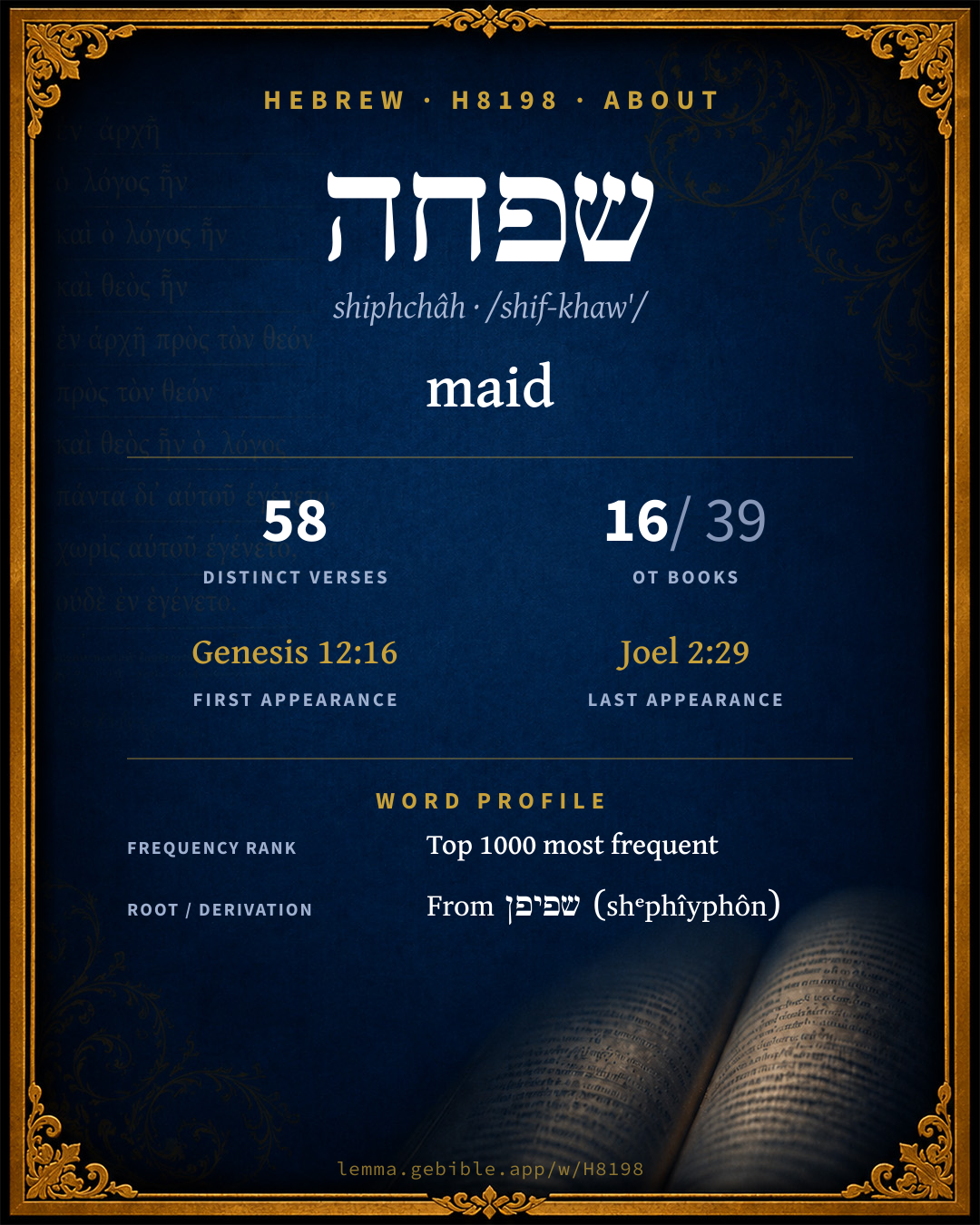
שִׁפְחָה
maid
also: maid-servant, slavegirl fuller range ↓
Full lexicon entry — Brown-Driver-Briggs (BDB)
From Brown-Driver-Briggs (BDB)
Where this word appears
See every Construct-state word in the Hebrew Bible →
Grammar key — what these labels mean
Part of speech
- Noun
- A naming word — a person, place, thing, or idea.
Noun type
- Common
- A common noun — a general class of person, place, or thing (“king,” “city,” “water”), not a specific name.
State
- Construct
- A noun bound to a following noun in a possessive / “of” relationship (the construct chain).
- Absolute
- The independent form of a noun, not bound to a following word.
Gender
- Feminine
- Grammatically feminine.
Number
- Singular
- One.
- Plural
- More than one (in Hebrew, generally three or more).
Grammatical forms
- Noun, Common, Feminine, Singular, Construct 32 times (51%)
- Noun, Common, Feminine, Plural, Absolute 17 times (27%)
- Noun, Common, Feminine, Singular, Absolute 11 times (17%)
- Noun, Common, Feminine, Plural, Construct 3 times (5%)
Parsed forms decoded from the imported morphology (morphhb / Westminster Leningrad Codex — WLC text public domain, morphhb tagging CC BY 4.0), counted across 63 parsed occurrences — not distinct verses.
Every verse where H8198 appears — 58 distinct verses across 16 books. Click any verse to open its interlinear word-by-word view. Verse text shown in the World English Bible for context — . Each verse’s Hebrew form is shown with its reference; the English is not keyword-highlighted, since the data carries no word-level English alignment. Use “Compare translations” on any verse to read it across multiple English versions. This concordance covers the Hebrew Bible; Septuagint (Greek Old Testament) occurrences are not indexed here.
Genesis 26 verses
- Genesis 12:16 וּ/שְׁפָחֹ֔ת conj + n c fp He dealt well with Abram for her sake. He had sheep, and oxen, and male donkeys, and men-servants, and maid-servants, and female donkeys, and camels.
- Genesis 16:1 שִׁפְחָ֥ה n c fs Now Sarai, Abram's wife, bore him no children. She had a handmaid, an Egyptian, whose name was Hagar.
- Genesis 16:2 שִׁפְחָתִ֔/י n c fs cs + sfx pers 1cs Sarai said to Abram," See now, Yahweh has restrained me from bearing. Please go in to my handmaid. It may be that I will obtain children by her." Abram listened to the voice of Sarai.
- Genesis 16:3 שִׁפְחָתָ֔/הּ n c fs cs + sfx pers 3fs Sarai, Abram's wife, took Hagar the Egyptian, her handmaid, after Abram had lived ten years in the land of Canaan, and gave her to Abram her husband to be his wife.
- Genesis 16:5 שִׁפְחָתִ/י֙ n c fs cs + sfx pers 1cs Sarai said to Abram, "This wrong is your fault. I gave my handmaid into your bosom, and when she saw that she had conceived, I was despised in her eyes. Yahweh judge between me and you."
- Genesis 16:6 שִׁפְחָתֵ/ךְ֙ n c fs cs + sfx pers 2fs But Abram said to Sarai, "Behold, your maid is in your hand. Do to her whatever is good in your eyes." Sarai dealt harshly with her, and she fled from her face.
- Genesis 16:8 שִׁפְחַ֥ת n c fs cs He said, "Hagar, Sarai's handmaid, where did you come from? Where are you going?" She said, "I am fleeing from the face of my mistress Sarai."
- Genesis 20:14 וּ/שְׁפָחֹ֔ת conj + n c fp Abimelech took sheep and oxen, men-servants and women-servants, and gave them to Abraham, and restored Sarah, his wife to him.
- Genesis 24:35 וּ/שְׁפָחֹ֔ת conj + n c fp Yahweh has blessed my master greatly. He has become great. He has given him flocks and herds, silver and gold, men-servants and maid-servants, and camels and donkeys.
- Genesis 25:12 שִׁפְחַ֥ת n c fs cs Now this is the history of the generations of Ishmael, Abraham's son, whom Hagar the Egyptian, Sarah's handmaid, bore to Abraham.
- Genesis 29:24 שִׁפְחָת֑/וֹ שִׁפְחָֽה n c fs cs + sfx pers 3ms n c fs Laban gave Zilpah his handmaid to his daughter Leah for a handmaid.
- Genesis 29:29 שִׁפְחָת֑/וֹ לְ/שִׁפְחָֽה n c fs cs + sfx pers 3ms prep + n c fs Laban gave to Rachel his daughter Bilhah, his handmaid, to be her handmaid.
- Genesis 30:4 שִׁפְחָתָ֖/הּ n c fs cs + sfx pers 3fs She gave him Bilhah her handmaid as wife, and Jacob went in to her.
- Genesis 30:7 שִׁפְחַ֣ת n c fs cs Bilhah, Rachel's handmaid, conceived again, and bore Jacob a second son.
- Genesis 30:9 שִׁפְחָתָ֔/הּ n c fs cs + sfx pers 3fs When Leah saw that she had finished bearing, she took Zilpah, her handmaid, and gave her to Jacob as a wife.
- Genesis 30:10 שִׁפְחַ֥ת n c fs cs Zilpah, Leah's handmaid, bore Jacob a son.
- Genesis 30:12 שִׁפְחַ֣ת n c fs cs Zilpah, Leah's handmaid, bore Jacob a second son.
- Genesis 30:18 שִׁפְחָתִ֖/י n c fs cs + sfx pers 1cs Leah said, "God has given me my hire, because I gave my handmaid to my husband." She named him Issachar.
- Genesis 30:43 וּ/שְׁפָחוֹת֙ conj + n c fp The man increased exceedingly, and had large flocks, maid-servants and men-servants, and camels and donkeys.
- Genesis 32:5 וְ/שִׁפְחָ֑ה conj + n c fs I have oxen, donkeys, flocks, men-servants, and maid-servants. I have sent to tell my lord, that I may find favor in your sight.'"
- Genesis 32:22 שִׁפְחֹתָ֔י/ו n c fp cs + sfx pers 3ms He rose up that night, and took his two wives, and his two handmaids, and his eleven sons, and passed over the ford of the Jabbok.
- Genesis 33:1 הַ/שְּׁפָחֽוֹת ptcl def.art + n c fp Jacob lifted up his eyes, and looked, and, behold, Esau was coming, and with him four hundred men. He divided the children between Leah, Rachel, and to the two handmaids.
- Genesis 33:2 הַ/שְּׁפָח֛וֹת ptcl def.art + n c fp He put the handmaids and their children in front, Leah and her children after, and Rachel and Joseph at the rear.
- Genesis 33:6 הַ/שְּׁפָח֛וֹת ptcl def.art + n c fp Then the handmaids came near with their children, and they bowed themselves.
- Genesis 35:25 שִׁפְחַ֣ת n c fs cs The sons of Bilhah (Rachel's handmaid): Dan and Naphtali.
- Genesis 35:26 שִׁפְחַ֥ת n c fs cs The sons of Zilpah (Leah's handmaid): Gad and Asher. These are the sons of Jacob, who were born to him in Paddan Aram.
Exodus 1 verse
Leviticus 1 verse
Deuteronomy 1 verse
Ruth 1 verse
1 Samuel 6 verses
- 1 Samuel 1:18 שִׁפְחָתְ/ךָ֛ n c fs cs + sfx pers 2ms She said, Let your handmaid find favor in your sight. So the woman went her way, and ate; and her facial expression wasn't sad any more.
- 1 Samuel 8:16 שִׁפְח֨וֹתֵי/כֶ֜ם n c fp cs + sfx pers 2mp He will take your men-servants, and your maid-servants, and your best young men, and your donkeys, and put them to his work.
- 1 Samuel 25:27 שִׁפְחָתְ/ךָ֖ n c fs cs + sfx pers 2ms Now this present which your servant has brought to my lord, let it be given to the young men who follow my lord.
- 1 Samuel 25:41 לְ/שִׁפְחָ֔ה prep + n c fs She arose, and bowed herself with her face to the earth, and said, Behold, your handmaid is a servant to wash the feet of the servants of my lord.
- 1 Samuel 28:21 שִׁפְחָֽתְ/ךָ֙ n c fs cs + sfx pers 2ms The woman came to Saul, and saw that he was sore troubled, and said to him, Behold, your handmaid has listened to your voice, and I have put my life in my hand, and have listened to your words which you spoke to me.
- 1 Samuel 28:22 שִׁפְחָתֶ֔/ךָ n c fs cs + sfx pers 2ms Now therefore, please listen also to the voice of your handmaid, and let me set a morsel of bread before you; and eat, that you may have strength, when you go on your way.
2 Samuel 7 verses
- 2 Samuel 14:6 וּ/לְ/שִׁפְחָֽתְ/ךָ֙ conj + prep + n c fs cs + sfx pers 2ms Your handmaid had two sons, and they two strove together in the field, and there was none to part them, but the one struck the other, and killed him.
- 2 Samuel 14:7 שִׁפְחָתֶ֗/ךָ n c fs cs + sfx pers 2ms Behold, the whole family is risen against your handmaid, and they say, Deliver him who struck his brother, that we may kill him for the life of his brother whom he killed, and so destroy the heir also. Thus will they quench my coal which is left, and will leave to my husband neither name nor remainder on the surface of the earth.
- 2 Samuel 14:12 שִׁפְחָתְ/ךָ֛ n c fs cs + sfx pers 2ms Then the woman said, Please let your handmaid speak a word to my lord the king. He said, Say on.
- 2 Samuel 14:15 שִׁפְחָֽתְ/ךָ֙ n c fs cs + sfx pers 2ms Now therefore seeing that I have come to speak this word to my lord the king, it is because the people have made me afraid: and your handmaid said, I will now speak to the king; it may be that the king will perform the request of his servant.
- 2 Samuel 14:17 שִׁפְחָ֣תְ/ךָ֔ n c fs cs + sfx pers 2ms Then your handmaid said, Please let the word of my lord the king be comfortable; for as an angel of God, so is my lord the king to discern good and bad: and Yahweh your God be with you.
- 2 Samuel 14:19 שִׁפְחָֽתְ/ךָ֔ n c fs cs + sfx pers 2ms The king said, Is the hand of Joab with you in all this? The woman answered, As your soul lives, my lord the king, none can turn to the right hand or to the left from anything that my lord the king has spoken; for your servant Joab, he bade me, and he put all these words in the mouth of your handmaid;
- 2 Samuel 17:17 הַ/שִּׁפְחָה֙ ptcl def.art + n c fs Now Jonathan and Ahimaaz were staying by En Rogel; and a maid-servant used to go and tell them; and they went and told king David: for they might not be seen to come into the city.
2 Kings 3 verses
- 2 Kings 4:2 לְ/שִׁפְחָתְ/ךָ֥ prep + n c fs cs + sfx pers 2ms Elisha said to her, What shall I do for you? tell me; what have you in the house? She said, Your handmaid has nothing in the house, except a pot of oil.
- 2 Kings 4:16 בְּ/שִׁפְחָתֶֽ/ךָ prep + n c fs cs + sfx pers 2ms He said, At this season, when the time comes round, you shall embrace a son. She said, No, my lord, you man of God, do not lie to your handmaid.
- 2 Kings 5:26 וּ/שְׁפָחֽוֹת conj + n c fp He said to him, Didn't my heart go with you, when the man turned from his chariot to meet you? Is it a time to receive money, and to receive garments, and olive groves and vineyards, and sheep and oxen, and men-servants and maid-servants?
2 Chronicles 1 verse
Esther 1 verse
Psalms 1 verse
Proverbs 1 verse
Ecclesiastes 1 verse
Isaiah 2 verses
- Isaiah 14:2 וְ/לִ/שְׁפָח֑וֹת conj + prep + n c fp The peoples shall take them, and bring them to their place; and the house of Israel shall possess them in the land of Yahweh for servants and for handmaids: and they shall take them captive whose captives they were; and they shall rule over their oppressors.
- Isaiah 24:2 כַּ/שִּׁפְחָ֖ה prep det + n c fs It shall be, as with the people, so with the priest; as with the servant, so with his master; as with the maid, so with her mistress; as with the buyer, so with the seller; as with the creditor, so with the debtor; as with the taker of interest, so with the giver of interest to him.
Jeremiah 4 verses
- Jeremiah 34:9 שִׁפְחָת֛/וֹ n c fs cs + sfx pers 3ms that every man should let his man-servant, and every man his maid-servant, who is a Hebrew or a Hebrewess, go free; that none should make bondservants of them, [to wit], of a Jew his brother.
- Jeremiah 34:10 שִׁפְחָת/וֹ֙ n c fs cs + sfx pers 3ms All the princes and all the people obeyed, who had entered into the covenant, that everyone should let his man-servant, and everyone his maid-servant, go free, that none should make bondservants of them any more; they obeyed, and let them go:
- Jeremiah 34:11 הַ/שְּׁפָח֔וֹת וְ/לִ/שְׁפָחֽוֹת ptcl def.art + n c fp conj + prep + n c fp but afterwards they turned, and caused the servants and the handmaids, whom they had let go free, to return, and brought them into subjection for servants and for handmaids.
- Jeremiah 34:16 שִׁפְחָת֔/וֹ וְ/לִ/שְׁפָחֽוֹת n c fs cs + sfx pers 3ms conj + prep + n c fp but you turned and profaned my name, and caused every man his servant, and every man his handmaid, whom you had let go free at their pleasure, to return; and you brought them into subjection, to be to you for servants and for handmaids.
Joel 1 verse
About this entry
At a glance — auto-summarized from this page’s data, not written by a person. Every figure links to its source below. This summary describes the numbers; it doesn’t interpret them.
שפחה (shiphchâh) is a Hebrew word most often rendered “maid.” Where the King James Version says “handmaid,” newer translations reach for “maidservant” (Berean Standard Bible); the renderings breakdown has the detail. The Hebrew Bible uses it across 58 verses — moderately common. Genesis dominates its distribution — 26 of 58 verses. It also covers “maid-servant” and “slavegirl”, alongside “maid” — see its full sense range. The sections below give every sense, occurrence, and version rendering.
Gloss history
Strong's 1890 vs modern scholarship
About this word
Strong's H8198 catalogs a Hebrew word from the Hebrew Old Testament.
These counts are not copied from any lexicon or concordance. They are computed here, from the morphology-tagged Hebrew Old Testament. What Lemma adds →
- 58
- distinct verses
- The word appears in 58 distinct verses.
- 16 / 39
- OT books
- The word appears in 16 of 39 Old Testament books.
- #611
- by frequency
- Top 1000 most frequent Hebrew words (rank 611 of 8,640 Hebrew words by occurrence).
View all 58 occurrences in the concordance →
By section of the Old Testament
By traditional corpus
Conventional, traditional groupings — biblical authorship is debated, so this is a traditional corpus grouping, not an authorship claim. Each share is this word’s portion of its verses in that division of the Hebrew canon. Each figure is a share of the word’s 58 distinct verses.
- Torah (Pentateuch) 29 verses · 50%
- Prophets (Nevi'im) 23 verses · 40%
- Writings (Ketuvim) 6 verses · 10%
How translations render this word
Counts come from each version’s own published word-to-Strong’s tagging or interlinear alignment — an approximate guide to how each version renders this word, not a word-level alignment the data otherwise carries. Because each total is that version’s own tagged count, the per-version totals vary from one another and need not match the appearance or distinct-verse counts above. These counts may also differ from a printed concordance because Lemma counts each distinctly tagged rendering and does not collapse phrase taggings into a single head-word total. This is a fixed set of word-tagged versions (KJV, ASV, BSB, ULT) and does not change with the reading translation you choose elsewhere. Each version’s license is shown beside its name below (and on Sources).
- King James Version: Handmaid 17×, Maid 10×, Handmaids 7×
- American Standard Version: Handmaid 17×, Handmaids 9×, 's handmaid 7×
- Berean Standard Bible: Maidservant 17×, Maidservants 17×, Servant 12×
- unfoldingWord Literal Text: Maidservant 26×, Maidservant of 7×, Maidservants 6×
King James Version Public Domain
Renders H8198 across 63 tagged occurrences — most commonly:
Plus 9 renderings that appear only once — usually multi-word phrases or single function words the recovered tagging swept in, not distinct renderings.
American Standard Version Public Domain
Renders H8198 across 64 tagged occurrences — most commonly:
Plus 13 renderings that appear only once — usually multi-word phrases or single function words the recovered tagging swept in, not distinct renderings.
Berean Standard Bible Public Domain
Renders H8198 across 60 tagged occurrences — most commonly:
Plus 10 renderings that appear only once — usually multi-word phrases or single function words the recovered tagging swept in, not distinct renderings. Not rendered by a distinct English word in 3 further occurrences.
unfoldingWord Literal Text CC BY-SA 4.0
Renders H8198 across 62 tagged occurrences — most commonly:
Plus 11 renderings that appear only once — usually multi-word phrases or single function words the recovered tagging swept in, not distinct renderings.
Senses in the full BDB
What do BDB’s symbols mean?
BDB uses these scholarly abbreviations:
| Symbol | Meaning |
|---|---|
| 𝔊 | the Septuagint (the ancient Greek translation, LXX) |
| 𝔙 | the Vulgate (the Latin translation) |
| 𝔖 | the Syriac version (the Peshitta) |
| 𝔗 | the Targum (the Aramaic translation) |
| ψ | the Psalms |
| √ | root (the underlying root or stem) |
| ‖ | parallel passage (a synonymous or contrasted parallel) |
| † | the dagger: every passage where the word occurs is cited |
The 2 senses and sub-senses the full Brown-Driver-Briggs lexicon distinguishes for this word, in lexicon order (not ranked by frequency), with BDB’s own verbatim wording and sub-sense lettering. Shown in Hebrew script with BDB’s own scholarly abbreviations. The condensed entry is in the Lexicon Entry tab. See also the Forms in the corpus table below.
- 1. lit., maid, maid-servant, as belonging to a mistress Gn 16:1, 3, 6, 8 (PJ) 29:24, 29 (P) ψ 123:2, Pr 30:23; Is 24:2; even where concubine of master (cf. אָמָה) Gn 16:2, 5 (PJ) 25:12; 35:25, 26 (P) 30:4, 7, 9, 10, 12, 18 (all JE); less often ref. to master 29:24, 29 (J), Ru 2:13, of concubine Gn 32:23, cf. 33:1, 2, 6 (all J); marriageable Lv 19:20 (H, cf. Ex 11:5; not elsewhere in legisl.); in gen., especially of menial service (never אָמָה) Ex 11:5 (J) 1 S 25:41 (opp. אָמָה) 2 S 17:17 (‖ עֶבֶד) Gn 12:16; 24:35 (J) 20:14 (E) 30:43 (P) 32:6 (J; coll.) Dt 28:68; 1 S 8:16; 2 K 5:26; Is 14:2; Je 34:9, 10, 11(×2), 16(×2) Jo 3:2; Ec 2:7; 2 Ch 28:10; Est 7:4. e.g. Genesis 16:1
- 2. fig. in address, שִׁפְתָֽתְךָ, etc., of speaker, in token of humility (v. אָמָה) Ru 2:13 (‖ אָמָה 3:9), 1 S 1:18 (‖ id. v 16), 25:27 (‖ v 24 f.), 28:21, 22; 2 S 14:6, 7, 12, 15, 17, 19 (‖ אָמָה v 15, 16); 2 K 4:2, 16; not toward God; but v. אָמָה. e.g. Ruth 2:13
Senses from the full Brown-Driver-Briggs lexicon (Brown, Driver, Briggs; Oxford 1906 — public domain), digitized via Sefaria, supplemented by the OpenScriptures HebrewLexicon (CC BY 4.0). Full attribution on Sources.
Word origin
n.f. maid, maid-servant (syn. אָמָה, q.v.; orig. = concubine? cf. √);—abs. שׁ׳ Gn 16:1 +; cstr. שִׁפְחַת v 2 +; sf. שִׁפְחָתִי v 2 +, שִׁפְחָתֶ֑ךָ Ru 2:13, etc.; pl. abs. שְׁפָחוֹת 12:16 +; etc.;—
— Brown-Driver-Briggs (Oxford 1906, public domain), digitized via Sefaria, supplemented by the OpenScriptures HebrewLexicon (CC BY 4.0). See Sources.
Derived from שפיפן (shᵉphîyphôn) (H8207) — horned snake.
Jastrow Dictionary
A second Hebrew/Aramaic lexicon for comparison, covering Aramaic and post-biblical (Talmudic, Targumic, Midrashic) usage that the biblical-Hebrew BDB does not. Matched by lemma rather than by Strong’s number, so a lemma may carry more than one Jastrow headword (shown separately below), and the entries cover usage well beyond the Bible.
שִׁפְחָה
- v. מִשְׁפָּחָה) [attached to the household,] handmaid, slave.—ש׳ חרופה, v. חֲרוּפָה.—Snh. 39ᵃ נטלו … לו ש׳ לשמשו they took a rib from him (Adam), and gave him a handmaid to wait on him. Ib. 99ᵇ מוטב תהא ש׳ לאומה זו וכ׳ better for her to be a handmaid to this nation than a mistress to any other nation. Kidd. III, 12 ולד ש׳ ונכרית the child of a slave or of a gentile woman. Ib. 13 ממזר שנשא ש׳ וכ׳ if a bastard married a slave, their child is a slave. Ib. 69ᵃ האומר לשִׁפְחָתוֹ וכ׳ if one says to his bondwoman, be thou free, but thy child (with which thou goest) shall be a slave, the child follows her status (is free). Ib. ש׳ כנענית a Canaanite slave. Keth. V, 5 הכניסה לו ש׳ אחת וכ׳ if the wife brought him one slave, she need not grind, or bake &c.; a. v. fr.—Pl. שְׁפָחוֹת. Ib. אפי׳ … מאה ש׳ וכ׳ even if she brought him a hundred slaves, he may force her (his wife) to work in wool &c. Ker. 9ᵃ ש׳ חרופות, v. חֲרוּפָה. Lev. R. s. 16, a. e. ש׳ מכודנות, v. כָּדַן. Tanḥ. Vayetsé 8 לא תהא … הש׳ should not my sister Rachel be at least like one of the handmaids (Bilhah and Zilpah)? Ab. II, 7; a. fr.
A Dictionary of the Targumim, the Talmud Babli and Yerushalmi, and the Midrashic Literature (Marcus Jastrow; London, Luzac, 1903) — Public Domain. Digitized via Sefaria. Digitized via Sefaria. Full attribution on Sources.
Forms in the corpus
The 49 distinct written forms H8198 takes in the Hebrew Bible, most frequent first — each parse links to that state’s occurrences in the concordance. Hebrew forms include their vowel points and cantillation, so a single lemma takes many written forms.
Same root — word family
Other BDB entries built from the same root as H8198, grouped by Strong’s listed origin. These share a root / origin per the lexicon — not necessarily a shared meaning. Each links to that word’s own entry.
Derives from
Proper names from this root
People and places named from this root — a name, not an additional meaning of the word.
Compare all same-root words → 2 of the same-root words are proper names (people or places). They share a root, not necessarily a meaning.
Septuagint verse parallels
This word appears in 57 verses that also exist in the Greek Old Testament (Septuagint), out of the 58 Hebrew verses it occurs in. You can read those verses in Greek by switching the Old Testament edition to the Septuagint.
Read these verses in the Septuagint
- Genesis 12:16
- Exodus 11:5
- Leviticus 19:20
- Deuteronomy 28:68
- Ruth 2:13
- 1 Samuel 1:18
- 2 Samuel 14:6
- 2 Kings 4:2
- 2 Chronicles 28:10
- Esther 7:4
- Psalms 123:2
- Proverbs 30:23
This is a verse-level parallel only — the same verses exist in both the Hebrew and Greek Old Testaments. No word-level Hebrew↔Greek correspondence is claimed: the data carries no such alignment, so no Greek word is shown as this Hebrew word’s translation. Coverage is not total — the Septuagint omits the deuterocanon and renumbers the Psalms, so some Hebrew verses have no direct Greek parallel.