
1 Chronicles 4:21

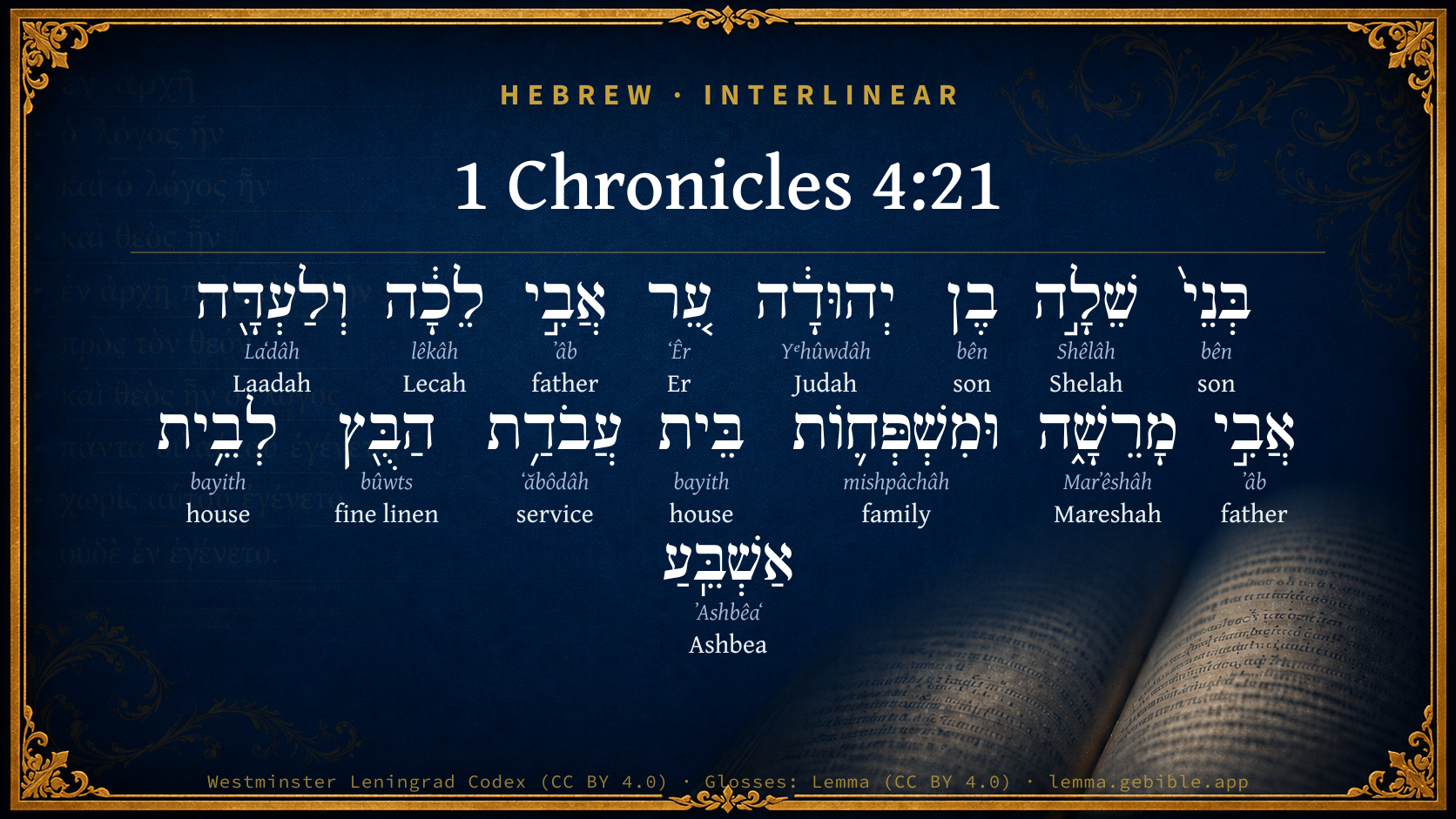
Hebrew (Westminster Leningrad Codex) 1 Chronicles 4:21 appears in the Hebrew Old Testament. The text above is from the Westminster Leningrad Codex. Each word links to its Strong’s number, a concise gloss, and parsing drawn from the Open Scriptures Hebrew Bible morphology. Click any word for its full Brown-Driver-Briggs (BDB) entry.
Download image
Cite this verse

1 Chronicles 4:21 (World English Bible). Public Domain. Lemma interlinear Bible study tool, https://lemma.gebible.app/v/1-chronicles/4/21.

Show BibTeX & RIS
BibTeX
RIS
English Translation
The sons of Shelah the son of Judah: Er the father of Lecah, and Laadah the father of Mareshah, and the families of the house of those who worked fine linen, of the house of Ashbea;
World English Bible · Public Domain
Highlights
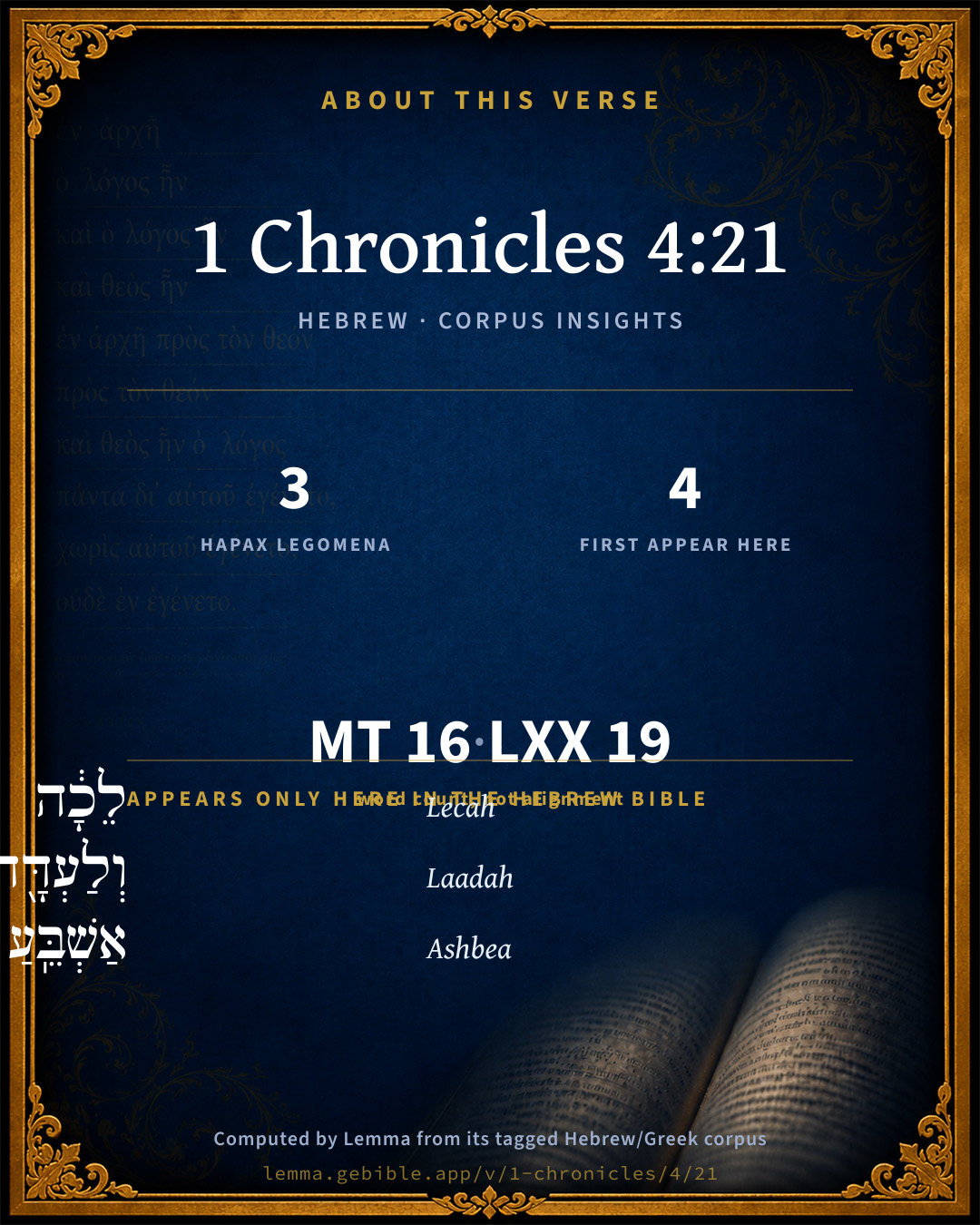
  • 3 hapax legomena — only here in the Hebrew Bible
  • 4 first appearances in the Hebrew Bible
Full analysis ↓
Download a study sheet

One document with this verse’s original text, its word-by-word gloss line, the meaning frame, cross-references with their text, attributed commentary, and full source and license credits — printable, and it pastes into notes with its structure intact.

This verse Autodidact and up

Study sheet (.html) Plain text (.txt)

A passage Seminary Student

Up to 50 verses in one chapter. A passage sheet keeps up to 6 commentary sources and 12 cross-references per verse, in the order this page ranks them, and says so on the sheet whenever that leaves anything out. Ask for a single verse and you get the Autodidact verse sheet above.

Everything on this page stays free to read, with no account — the sheet is a download of what is already on screen, not access to it.

Want to remove ads? Support Godless Engineer
Compare translations 3

The same verse in 3 English versions, stacked beneath the original-language interlinear above. Click any original word for its lexicon entry.

Each is an independent rendering of the whole verse — the interlinear is not word-aligned to these translations.

Highlighted words mark where these versions differ — a whole-verse word diff, not a word-by-word alignment.

  • World English Bible Public Domain
    The sons of Shelah the son of Judah: Er the father of Lecah, and Laadah the father of Mareshah, and the families of the house of those who worked fine linen, of the house of Ashbea;
  • King James Version Public Domain
    The sons of Shelah the son of Judah were, Er the father of Lecah, and Laadah the father of Mareshah, and the families of the house of them that wrought fine linen, of the house of Ashbea,
  • unfoldingWord Literal Text CC BY-SA 4.0
    The sons of Shelah the son of Judah: Er, the father of Lekah, and Laadah, the father of Mareshah, and the clans of the house of the service of linen at Beth Ashbea

unfoldingWord Literal Text — © unfoldingWord, licensed CC BY-SA 4.0. Word-aligned USFM3 via Door43 (git.door43.org/unfoldingWord/en_ult).

Versions to compare (up to 4)

3 of 4 selected

Show all 18 translations

Every available English version of this verse, each an independent rendering of the whole verse.

  • World English Bible Public Domain
    The sons of Shelah the son of Judah: Er the father of Lecah, and Laadah the father of Mareshah, and the families of the house of those who worked fine linen, of the house of Ashbea;
  • Berean Standard Bible Public Domain
    The sons of Shelah son of Judah: Er the father of Lecah, Laadah the father of Mareshah and the clans of the linen workers at Beth-ashbea,
  • Majority Standard Bible Public Domain
    The sons of Shelah son of Judah: Er the father of Lecah, Laadah the father of Mareshah and the clans of the linen workers at Beth-ashbea,
  • King James Version Public Domain
    The sons of Shelah the son of Judah were, Er the father of Lecah, and Laadah the father of Mareshah, and the families of the house of them that wrought fine linen, of the house of Ashbea,
  • American Standard Version (1901) Public Domain
    The sons of Shelah the son of Judah: Er the father of Lecah, and Laadah the father of Mareshah, and the families of the house of them that wrought fine linen, of the house of Ashbea;
  • Revised Version (1885) Public Domain
    The sons of Shelah the son of Judah; Er the father of Lecah, and Laadah the father of Mareshah, and the families of the house of them that wrought fine linen, of the house of Ashbea;
  • Geneva Bible (1599) Public Domain
    The sonnes of Shelah, the sonne of Iudah were Er the father of Lecah, and Laadah the father of Mareshah, and the families of the householdes of them that wrought fine linnen in the house of Ashbea.
  • Douay-Rheims (1899) Public Domain
    The sons of h Sela the son of Juda: Her the father of Lecha, and Laada the father of Maresa, and the families of the house of them that wrought fine linen in the House of oath.
  • Young's Literal Translation Public Domain
    Sons of Shelah son of Judah: Er father of Lecah, and Laadah father of Mareshah, and the families of the house of the service of fine linen, of the house of Ashbea;
  • Literal Standard Version CC BY-SA 4.0
    Sons of Shelah son of Judah: Er father of Lecah, and Laadah father of Mareshah, and the families of the house of the service of fine linen, of the house of Ashbea;
  • Unlocked Literal Bible CC BY-SA 4.0
    The descendants of Shelah son of Judah, were Er father of Lekah, Laadah father of Mareshah and the clans of the linen workers at Beth Ashbea,
  • unfoldingWord Literal Text CC BY-SA 4.0
    The sons of Shelah the son of Judah: Er, the father of Lekah, and Laadah, the father of Mareshah, and the clans of the house of the service of linen at Beth Ashbea
  • Darby Bible Public Domain
    The sons of Shelah the son of Judah: Er the father of Lechah, and Laadah the father of Mareshah, and the families of the house of byssus-workers, of the house of Ashbea,
  • World Messianic Bible Public Domain
    The sons of Shelah the son of Judah: Er the father of Lecah, Laadah the father of Mareshah, and the families of the house of those who worked fine linen, of the house of Ashbea;
  • Webster's Bible Public Domain
    The sons of Shelah the son of Judah were, Er the father of Lecah, and Laadah the father of Mareshah, and the families of the house of them that wrought fine linen, of the house of Ashbea,
  • Free Bible Version CC BY-SA 4.0
    The sons of Shelah son of Judah: Er, who was the father of Lecah, Laadah, who was the father of Mareshah, the families of the linen workers at Beth Ashbea,
  • Bible in Basic English Public Domain
    The sons of Shelah, the son of Judah: Er, the father of Lecah, and Laadah, the father of Mareshah, and the families of those who made delicate linen, of the family of Ashbea;
  • JPS Tanakh (1917) Public Domain
    The sons of Shelah the son of Judah: Er the father of Lecah, and Ladah the father of Mareshah, and the families of the house of them that wrought fine linen, of the house of Ashbea;

Literal Standard Version (2020), Covenant Press — licensed CC BY-SA 4.0. Text via the HelloAO Bible API (eBible.org). Unlocked Literal Bible (unfoldingWord) — licensed CC BY-SA 4.0. Text via the HelloAO Bible API (eBible.org). unfoldingWord Literal Text — © unfoldingWord, licensed CC BY-SA 4.0. Word-aligned USFM3 via Door43 (git.door43.org/unfoldingWord/en_ult). Free Bible Version, Dr. Jonathan Gallagher — licensed CC BY-SA 4.0. Text via the HelloAO Bible API (eBible.org).

Word by word

More ways to search: Search by grammar → Find every occurrence → Compare this word →

Practice this passage: Drill this verse → Learn its vocabulary →

לֵכָ֔ה
lêkâh
H3922
“Lecah”
Noun, Proper
Part of Speech
Noun
Type
Proper
Full BDB Definition

Origin: from H3212

TWOT: None

Lecah = "journey" - a town in Judah; site unknown
  1. בְּנֵי֙ bên H1121 “sons of” Noun, Common, Masculine, Plural, Construct
  2. שֵׁלָ֣ה Shêlâh H7956 “Shelah” Noun, Proper
  3. בֶן bên H1121 “son of” Noun, Common, Masculine, Singular, Construct
  4. יְהוּדָ֔ה Yᵉhûwdâh H3063 “Judah” Noun, Proper
  5. עֵ֚ר ʻÊr H6147 “Er” Noun, Proper
  6. אֲבִ֣י ʼâb H1 “father of” Noun, Common, Masculine, Singular, Construct
  7. וְלַעְדָּ֖ה Laʻdâh H3935 “and · Laadah” Conjunction + Noun, Proper
  8. אֲבִ֣י ʼâb H1 “father of” Noun, Common, Masculine, Singular, Construct
  9. מָרֵשָׁ֑ה Marʼêshâh H4762 “Mareshah” Noun, Proper
  10. וּמִשְׁפְּח֛וֹת mishpâchâh H4940 “and · families of” Conjunction + Noun, Common, Feminine, Plural, Construct
  11. בֵּית bayith H1004 “house of” Noun, Common, Masculine, Singular, Construct
  12. עֲבֹדַ֥ת ʻăbôdâh H5656 “service of” Noun, Common, Feminine, Singular, Construct
  13. הַבֻּ֖ץ bûwts H948 “the · fine linen” Particle, Definite Article + Noun, Common, Masculine, Singular, Absolute
  14. לְבֵ֥ית bayith H1004 “to/for · house of” Preposition + Noun, Common, Masculine, Singular, Construct
  15. אַשְׁבֵּֽעַ ʼAshbêaʻ H791 “Ashbea” Noun, Proper

About this verse

These counts appear in no published source. They are computed here, from the morphology-tagged text and Lemma’s own curated glosses. What Lemma adds →

16
words
13
distinct lemmas
Historical
section

Notable vocabulary

3 hapax legomena — words that appear only here in the entire Hebrew Bible:

  • לֵכָ֔ה Lecah H3922
  • וְלַעְדָּ֖ה Laadah H3935
  • אַשְׁבֵּֽעַ Ashbea H791

First appearance in Scripture

These words make their first canonical appearance in the Hebrew Bible here:

  • לֵכָ֔ה Lecah H3922
  • וְלַעְדָּ֖ה Laadah H3935
  • הַבֻּ֖ץ fine linen H948
  • אַשְׁבֵּֽעַ Ashbea H791

Shared distinctive vocabulary

שֵׁלָ֣ה Shelah H7956 occurs in 8 verses of the Hebrew Bible. Also found in:

Grammatical profile

  • 16 nouns

Repetition

Words recur within this verse — often emphatic in Hebrew:

  • בְּנֵי֙ son H1121 ×2
  • אֲבִ֣י father H1 ×2
  • בֵּית house H1004 ×2

Hebrew & Septuagint length

In English translation the verse runs 36 words from the Hebrew and 33 from the Septuagint (LXX English) — closely comparable.

A rough comparison of the two English renderings, which tokenize alike — not a word-level alignment.

Word counts can differ between the Hebrew and the Greek without any difference in meaning — e.g. the Hebrew direct-object marker אֵת has no separate Greek word, and Greek often adds the article ὁ.

In the original languages it is 16 Hebrew tokens and 19 Greek tokens — but the two are counted differently (Hebrew bundles its prefixes and suffixes into one token; the Greek is in lemma form), so that isn’t a like-for-like length.

Cross-references

6

Topical passages linked to 1 Chronicles 4:21 in the Treasury of Scripture Knowledge — connected by theme and wording, ordered by reader-vote popularity; previews shown in the World English Bible.

  • Genesis 38:5 She yet again bore a son, and named him Shelah: and he was at Chezib, when she bore him.
  • Genesis 46:12 The sons of Judah: Er, Onan, Shelah, Perez, and Zerah; but Er and Onan died in the land of Canaan. The sons of Perez were Hezron and Hamul.
  • Numbers 26:20 The sons of Judah after their families were: of Shelah, the family of the Shelanites; of Perez, the family of the Perezites; of Zerah, the family of the Zerahites.
  • 1 Chronicles 2:3 The sons of Judah: Er, and Onan, and Shelah; which three were born to him of Shua's daughter the Canaanitess. Er, Judah's firstborn, was wicked in the sight of Yahweh; and he killed him.
  • 1 Chronicles 9:5 Of the Shilonites: Asaiah the firstborn, and his sons.
  • Nehemiah 11:5 and Maaseiah the son of Baruch, the son of Colhozeh, the son of Hazaiah, the son of Adaiah, the son of Joiarib, the son of Zechariah, the son of the Shilonite.

Cross-references courtesy of OpenBible.info (CC BY 4.0).

Hebrew and Greek witnesses Masoretic Hebrew ↔ Greek Septuagint

The same verse in the two great witnesses to the Old Testament, shown verse-for-verse.

These are two independent witnesses, not word-aligned to each other, and the Septuagint is shown in lemma (dictionary) form.

Hebrew 1 Chronicles 4:21 Masoretic · Westminster Leningrad Codex

בְּנֵי֙ שֵׁלָ֣ה בֶן יְהוּדָ֔ה עֵ֚ר אֲבִ֣י לֵכָ֔ה וְלַעְדָּ֖ה אֲבִ֣י מָרֵשָׁ֑ה וּמִשְׁפְּח֛וֹת בֵּית עֲבֹדַ֥ת הַבֻּ֖ץ לְבֵ֥ית אַשְׁבֵּֽעַ

The sons of Shelah the son of Judah: Er the father of Lecah, and Laadah the father of Mareshah, and the families of the house of those who worked fine linen, of the house of Ashbea;

World English Bible · Public Domain

Greek LXX 1 Chronicles 4:21 Septuagint · lemma form

υἱός σηλωμ υἱός ἰουδά ηρ πατήρ ληχα καί λααδα πατήρ μαρησα καί γένεσις οἰκία εφραθ αβακ ὁ οἶκος εσοβα

The sons of Selom the son of Juda; Er the father of Lechab, and Laada the father of Marisa, and the offspring of the family of Ephrathabac belonging to the house of Esoba.

LXX2012 (modern English Septuagint) · Public Domain

On this verse, Ellicott's Commentary for English Readers discusses the Septuagint’s reading. Read the note in Commentary ↓

Hebrew: Westminster Leningrad Codex (CC BY 4.0). Greek: Septuagint (public domain); English from LXX2012 (modern English Septuagint) (Public Domain). How the Septuagint differs from the Hebrew →

Commentary

Notes on 1 Chronicles 4:21 from classic Christian and Jewish commentators (each source and its license shown beneath its notes). The classic Christian expositions comment on the surrounding passage and are grouped to its opening verse, so a note may address several verses; the Jewish commentaries on the Tanakh (Rashi and others) are per-verse, so they appear only where the commentator wrote on this verse.

Lemma curates 59 commentaries, every one of them public domain or Creative Commons licensed, each selected and text-cleaned for this edition rather than reprinted as found. About our sources →

Jamieson, Fausset & Brown

Robert Jamieson, A. R. Fausset & David Brown

POSTERITY OF SHELAH. (Ch1 4:21-23)

Laadah . . . the father . . . of the house of them that wrought fine linen--Here, again, is another incidental evidence that in very early times certain trades were followed by particular families among the Hebrews, apparently in hereditary succession. Their knowledge of the art of linen manufacture had been, most probably, acquired in Egypt, where the duty of bringing up families to the occupations of their forefathers was a compulsory obligation, whereas in Israel, as in many parts of Asia to this day, it was optional, though common.

Jamieson, Fausset & Brown — Commentary Critical and Explanatory on the Whole Bible (1871) — public domain (CC PDM 1.0). Text via the HelloAO Bible API.

Ellicott's Commentary for English Readers

II.—SONS OF SHELAH, THIRD SON OF JUDAH,

1Ch_4:21-23 (omitted by Syriac version).

The Shelanite clans were not noticed in 1 Chronicles 2 (See Gen_38:5 and 1Ch_2:3.)

(21) Er.—This Er who founded Lecah is, of course, distinct from Er “the firstborn of Judah.” Lecah is unknown. Mareshah, a town in the lowlands of Judah, is connected with Caleb (1Ch_2:42). Such statements are not contradictory. At different periods different tribal divisions might have been settled in the same city. The present statement need only mean that Mareshah was a Shelanite foundation.

The families of the house of them that wrought fine linen.—“The clans of the house of Byssus work at Beth-Ashbea.” Beth-Ashbea is an unknown place. It was the seat of some Shelanite houses engaged in growing flax and weaving linen. Such industries in ancient times were confined to hereditary guilds, which jealously guarded their methods and trade secrets.

(22) Jokim.—Comp. Jakim (1Ch_8:9). Both are probably equivalent to Joiakim (Jehoiakim).

Chozeba.—Perhaps Chezib (Gen_38:5), called Achzib (Jos_15:44), the birthplace of Shelah; now the ruins of Kesâba. It was a town of the Shephelah.

And Joash, and Saraph, who had the dominion in Moab.—The passage is obscure, because we know nothing further of Joash and Saraph. The LXX. render the whole verse: “And Joakim, and men of Chozeba, and Joas, and Saraph, who settled in Moab;” adding the meaningless words, καὶ ἀπέστρεψεν αὐτοὺς αβεδηριν αθουκιιν. The word rendered “had the dominion” occurs sixteen times, and in twelve cases at least means “to marry.” Probably Isa_26:13, Jer_3:14; Jer_31:32 are not exceptions. The right translation here, therefore, would seem to be “who married Moab,” a metaphor expressing settlement in that country (LXX., κατῴκησαν).

And Jashubi-lehem.—We have here a vestige of some form of the verb shûb (“to return”), as the LXX. (ἀπέστρεψεν) indicates; and “lehem” (Heb., lahem) may either signify “to them,” or represent the second half of the name Bethlehem. Reading (with one MS.) wayyâshûbû, we might translate, and they returned to themselves, i.e., to their Judæan home. (Comp. the story of the sojourn of Elimelech and his family in Moab, and the return of Naomi to Judah.) But Bêth might easily have fallen out before lahem, and if so, the statement is, and they returned to Bethlehem—another point of likeness to the story of the Book of Ruth. (2) Others render, “Reduced Moab and requited them” (way-yashîbû lahem); referring the notice to a supposed subjugation of Moab by two chieftains of Judah. (3) Others, again, have proposed: “Who married into Moab, and brought them home (wives).” (Comp. the story of Mahlon and Chilion in Ruth.) The Vulg. translates all the proper names, and continues: “Qui principes fuerunt in Moab, et qui reversi sunt in Lahem.” (Comp. also Ezr_2:6.)

And these are ancient things.—And the events are ancient, that is, those just recounted.

A Bible Commentary for English Readers, edited by Charles John Ellicott (1878–1897) — public domain. Text from a community e-Sword module.

Trapp's Complete Commentary

John Trapp

1Ch 4:21 The sons of Shelah the son of Judah [were], Er the father of Lecah, and Laadah the father of Mareshah, and the families of the house of them that wrought fine linen, of the house of Ashbea,

Ver. 21. Of them that wrought fine linen.] Gentis opificii byssini, silk-weavers. See on 1Ch 4:14.

John Trapp, A Commentary or Exposition upon All the Books of the Old and New Testament (1647–1656) — public domain. Text from a community e-Sword module.

Joseph Benson's Commentary

1Ch 4:21. The sons of Shelah — Having spoken of the posterity of Judah by Pharez, and by Zarah, he now comes to his progeny by Shelah. The families of them, that wrought fine linen — From him came all those families that were famous for weaving and working in fine linen; wherewith their kings and priests were clothed.

Joseph Benson's Commentary on the Old and New Testaments (1811–1818) — public domain. Text from a community e-Sword module.

Tyndale Open Study Notes

Tyndale Open Resources

4:21-23 Now that Judah’s descendants through his wife Tamar have been recorded (2:4–4:20), the descendants of Shelah, Judah’s third son through Bathshua, are listed (see 2:3; Gen 38:2, 5).

Tyndale Open Study Notes — © Tyndale Open Resources, licensed CC BY-SA 4.0. Text via the HelloAO Bible API.

Adam Clarke's Commentary

Verse 21. That wrought fine linen] "Of the family of those who worked in fine flax to make garments for kings and priests." - T.

Adam Clarke's Commentary on the Bible (1810–1826) — public domain. Text from a community e-Sword/MySword module.

The Cambridge Bible for Schools and Colleges

gen. ed. J. J. S. Perowne

21. Shelah] 1Ch_2:3.

Lecah] an unknown place.

Mareshah] 1Ch_2:42; 2Ch_11:8; Jos_15:44 (mentioned with Keilah). A town in the south of Judah.

the house of Ashbea] Nothing is known of such a family. We might render, Beth-Ashbea, but nothing is known of such a place.

The Cambridge Bible for Schools and Colleges (gen. ed. J. J. S. Perowne; Cambridge University Press, 1878–1918) — public domain. Text from a community e-Sword module.

John Gill's Exposition

The sons of Shelah, the son of Judah, were,.... The genealogy of the posterity of Judah, in the lines of Pharez and Zerah, being given, and very largely in that of the former, because of the honour of David, and his kingdom, which sprang from thence, as Jarchi observes, and also the King Messiah, the writer returns to give an account of his posterity by Shelah, a son he had by the daughter of Shuah, Gen 38:2 and the only one that had children: which were as follow:

Er the father of Lecah: prince of a city of this name in the tribe of Judah; Shelah gave him the name of Er, in memory of his brother, Gen 38:3,

and Laadah the father of Mareshah; prince of a city of this name in the same tribe, Jos 15:44.

and the families of the house of them that wrought fine linen, of the house of Ashbea; which last clause explains what house these families were of, which sprang from Shelah, and were employed in making fine linen; the Targum adds, for the garments of kings and priests, or for the curtains of the tabernacle, as Jarchi; for not with the Egyptians and Greeks only fine linen was made, but among the Hebrews, as Pausanias (f) testifies.

(f) Eliac. 1. sive, l. 5. p. 294.

John Gill's Exposition of the Whole Bible (1746–1763) — public domain (CC PDM 1.0). Text via the HelloAO Bible API.

Haydock's Catholic Bible Commentary

Her. Hitherto we have seem the possessions of the descendants of Phares. Those of Her inhabited the country rendered famous by the exploits of Samson with the jaw bone, Judges xv. 9. (Calmet) --- The first-born of Sela was called Her, after his unfortunate uncle, Genesis xxxviii. 7. (Haydock) --- That wrought. Septuagint take it for a proper name, "Ebdath." Hebrew, Beth-habodath habuts, "the house of the byssus, or fine linen manufacturers in Beth-Ashbaah," (Haydock) which is, perhaps, the same with Beersabee, "the well of swearing," Genesis xxi. 31. (Calmet) --- Oath. The Latin word juramenti, might be retained here, as well as Calor, chap. ii. 55. See 2 Kings xxi. 19. Septuagint read, "Esoba," as the proper name of a place. (Haydock)

George Leo Haydock (1774–1849), Haydock's Catholic Family Bible and Commentary, 1859 edition — public domain. Excludes Psalms (Douay-Rheims chapter numbering differs from Protestant) and Deuterocanonical books (Catholic canon only).

Matthew Poole's English Annotations

Having treated of the posterity of Judah by Pharez, and by Zerah, he now comes to his progeny by

Shelah, of whom see Ge 38.

Matthew Poole's English Annotations on the Holy Bible (1683–1685) — public domain. Text from a community e-Sword/MySword module.

Whedon's Commentary on the Bible

Daniel D. Whedon

21. The house of them that wrought fine linen — These descendants of Ashbea were noted for working in linen, or byssus, as the sons of Joab were famed artificers. The writer records the fact as a fragment of ancient tradition, and mentions in the next verse, its if to explain why nothing more is said or known about the matter, that “these are ancient things,” old fragments of tradition, whose more minute details are lost.

Daniel D. Whedon (gen. ed.), Commentary on the Old and New Testaments (1874–1909) — public domain. Text from a community e-Sword module.

The Pulpit Commentary

Vers. 21-23. The first of these verses takes us back to 1Ch_2:3, where the first three of the patriarch Judah"s sons are introduced in the genealogy, as Er, Onan, and Shelah; where of Er it is said," He was evil in the sight of the Lord; and he slew him;" and where nothing is added of Onan or Shelah. It would appear now that Shelah gave the name of the slain brother to his son. Respecting this Er of Lecah with little doubt the name of a place and Laadah, nothing else can be adduced; but Marebah (1Ch_2:42) is the name of a place in the Shefelah, given in the same passage with Kailah and Nezib. (Jos_15:44; see also 2Ch_11:8 2Ch_14:9) The fine linen (xWB) here spoken of is, according to Gesenius, equivalent in this passage and in the later Hebrew, to the byssus of the Egyptians (Exo_26:31; 2Ch_3:14) the vve, from which the Syrian byssus, (Eze_27:16) to which xWB does more strictly apply, is distinguished in some other places.

It was of fine texture, costly, and used as the clothing of kings, (1Ch_15:27) of priests, (2Ch_5:12) and of the very wealthy. (Est_1:6 Est_8:15) Gesenius says that, after long research and dispute, microscopic investigations in London have concluded that the threads of the cloth of byssus are linen, not cotton. Ashbea (Be is not yet recognized elsewhere. Jokim. Gesenius considers this name ( as a contracted form of wOy (Joiakim) ofa Neh_12:10. Chozeba. The meaning of this name is "lying;" not found elsewhere, it is probably the same as the byzika, town in the tribe of Judah, (Gen_38:5) and that is probably the same as the Byzika," of the "valley" list of Judah cities (Jos_15:44) and of Mic_1:14, where it is mentioned in near connection with the Mareshah, which also accompanies it in the above "valley" list. Joash. This name appears in three forms: va; wOy, as in the text, 2Ki_12:20; vawOjy as in 2Ki_12:1; and vwOy, as in 1Ch_7:8. Seraph. This is the word the plural of which gives us our seraphim, (Isa_6:2) and is from a root of somewhat uncertain meaning. The different significations to which the root seems to lend itself in the substantive, according as it is used in the singular or plural, are startling (see Gesenius, "Lexicon," sub voce). The apparent meaning of this verse is that there was a time of old, when the above, of whom we can ascertain nothing elsewhere, ruled over Moab. Jerome, in the Vulgate, has made a strange rendering of this verse by translating some of the proper names, and reading at least one of them, the first, as though it were a form in the Hebrew ( which it is not: Et qui stare fecit solem, virique Mendacii et Securus et Tircendens, qui principes fuerunt in Moab et qui reversi sunt in Lahem; haec autem verba vetera. Thus Jokim is turned into Elimelech, and the men of Chozeba into Mahlon and Chillon of the Book of Ruth, and Jashubi-lehem into Naomi and Ruth; and the last clause of the verse is equivalent to citing the Book of Ruth. Barrington ("Genealogies," 1:179) regards Jokim as Shelah"s third son in this enumeration; and ethers regard Jashubi-lehem as his fourth son. The preposition l prefixed to bawOm and following the verb, is to be noted Ver. 23 brings us to the last of Judah, and leaves us to part with the account of the tribe in the same obscurity which has lately involved it. The plants and hedges are probably an instance of inopportune translation of proper names, which should rather appear as Nelaira and Gedara, the former place or people not found elsewhere, but the latter possibly referred to. Jos_15:36. Again, who they were that were the potters, is not clear whether all of the preceding verse, or the last mentioned. From the last clause it may be probably safely concluded, that those designated, whoever they were, were employed habitually in the service, not indeed of one king necessarily, but of the succession of royalty. Passages that may be taken to throw interesting light upon this subject are 1Ch_27:25-31; 2Ch_26:10 2Ch_27:4 2Ch_32:27-29. Vers. 21, 23.

Weavers, husbandmen, and potters.

This portion of the book contains the record of the descendants of Shelah, one of the sons of Judah. The chronicler mentions incidentally the employments of several of these ancient families. Some were engaged in weaving byssus , or fine linen. Others were occupied in tilling the estates and tending the herds and flocks of the king. Others, again, pursued the calling of the potter. Now, there is no reason for surprise in meeting with such references in a book of the canonical Scriptures. There is a religious side to all such useful and respectable vocations. Those who follow them may not always be aware of the fact; but a fact it certainly is.

I HANDICRAFTSMEN AND HUSBANDMEN MAKE USE OF MATERIALS WHICH A KIND PROVIDENCE HAS SUPPLIED. The soil which is tilled, the vegetable substances which that soil produces, the minerals which are dug from it, are all of God. "The earth is the Lord"s, and the fulness thereof.

II THE FACULTIES OF BODY AND MIND WHICH SUCH PERSONS EXERCISE AND EMPLOY ARE ENTRUSTED BY THE CREATOR. The limbs of the body, the strength of the muscles, the skill of the intelligent and designing mind, are all needed for the production of the results. Every artificer is himself a miracle of creative power and wisdom; and he who framed the workman is glorified in the handiwork.

III THE WELFARE OF CIVILIZED HUMAN SOCIETY, WHICH IS THE CONSEQUENCE OF SUCH LABOURS, IS A PART OF THE DIVINE PLAN. The arts, useful and aesthetic, tend to the comfort and the development of humanity. All the conveniences of human life are instrumental in furthering the purposes of God.

IV AMONG SUCH ARTIFICERS RELIGION OFTEN FINDS WARM ADHERENTS, SUPPORTERS, AND PROMULGATORS. The busy and useful classes of society furnish the largest proportion of strength to our Churches. These have often been the salt of society, when the wealthy, luxurious, and dissolute on the one hand, and the idle and predatory on the other, would have introduced corruption and death into the body politic.

T.

Vers. 21-23.

The dignity of all work.

These verses set before us the interesting fact that God recognizes a man"s occupation, and knows precisely his sphere and his work. Another striking illustration of the precision of the Divine knowledge, and the observation even of a man"s handicraft, is found in Act_10:5, Act_10:6, where God gives these minute directions: "Send men to Joppa, and call for one Simon, whose surname is Peter; he lodgeth with one Simon, a tanner, whose house is by the seaside. " In these verses different occupations are honourably mentioned; some wrought fine linen; others were potters and gardeners and hedgers; and so is suggested to us the honourableness and usefulness of all kinds of work. There was no such sentiment among the Jews as unhappily prevails in all so-called highly civilized countries, that there is a kind of degradation in having to work for your own living. Every Jewish boy was required to learn a trade, and the greatest rabbis preserved their dignity and learning along with service to the community in some humble occupation. Consider

I WORK AS A CONDITION OF HUMAN LIFE ON THE EARTH. If there is one law more absolute for mankind than another, it is that they shall work. They are set in this earth-garden, as Adam was in Paradise, to win it, to use its forces, to dress it, to keep it. For "work" man is endowed. He has muscles with the needed physical strength, and hands with the needed physical skill, and brains with the needed guidance and control. And he is in the midst of conditions that demand work; the earth will only yield her stores and her increase in response to man"s work. If a man "will not work," then the law God has put into the very creation of the earth is, that, "he shall not eat." And this work-condition is designed by God to bear directly on man"s moral training. Only by and through work can character grow and unfold. Toil is testing and trial, out of which alone can virtue be born. So all work is noble and holy.

II WORK AS A CONDITION OF CIVILIZED LIFE. Here its simplicity is lost. It becomes a diversified and complicated thing. As men live together in cities a thousand fresh wants, real and fancied, become created, and trades are multiplied for the supply of the thousand wants. Work is divided and subdivided; sometimes it seems a higher kind, and sometimes a lower. While some must work by hand, others are called forth to work by voice, and pen, and brush, and chisel, and brain. Thousands must toil in various ways to supply the necessaries of life, and tens of thousands must toil to supply the ever-increasing demand for luxuries. And so, in civilized times, work seems too often to grow into man"s curse; and he toils at sweat of brain as well as of face; and spends strength and health and life in winning bread from those who "fare sumptuously every day, and are clothed in purple and fine linen;" and we cannot greatly wonder that men should grow hard, and lose the high and inspiring thought of the "dignity of work.

III THE ONE CONDITION THAT LIFTS ALL HUMAN TOIL INTO DIGNITY. Its usefulness to others. It must be done "not unto selL" And so God has "set the solitary in families," and put fathers and mothers under the pressure of family responsibility, that in toiling for others they may win the joy of work. Illustrate from the artist, the poet, etc., and see how the condition may apply to all workers.

IV THE YET HIGHER CONDITION WHICH SETS WORK IN ITS TRUE PLACE. It must be done as service to God. Then work bears upon the culture of religious character, and becomes a stepping-stone upward to the heavenly. Character is both exhibited and cultured by it; and no kind of occupation can be regarded as mean into which character can be put, and by which others may be served, and God may be glorified. Potters, gardeners, hedgers, and workers in fine linen may all win the "Well done, good and faithful. R.T.

The Pulpit Commentary (1880–1919), ed. H.D.M. Spence-Jones & Joseph S. Exell — public domain. Text from a community e-Sword module.

John Wesley's Explanatory Notes

Shelah - Having treated of the posterity of Judah by Pharez, and by Zara, he now comes to his progeny by Shelah.

John Wesley, Explanatory Notes Upon the Whole Bible (1754–1765) — public domain. Text via the GEBible commentary corpus.

Keil & Delitzsch

C. F. Keil & F. Delitzsch

The sons of Shelah, the son of Judah, were,.... The genealogy of the posterity of Judah, in the lines of Pharez and Zerah, being given, and very largely in that of the former, because of the honour of David, and his kingdom, which sprang from thence, as Jarchi observes, and also the King Messiah, the writer returns to give an account of his posterity by Shelah, a son he had by the daughter of Shuah, Gen 38:2 and the only one that had children: which were as follow:

Er the father of Lecah: prince of a city of this name in the tribe of Judah; Shelah gave him the name of Er, in memory of his brother, Gen 38:3,

and Laadah the father of Mareshah; prince of a city of this name in the same tribe, Jos 15:44.

and the families of the house of them that wrought fine linen, of the house of Ashbea; which last clause explains what house these families were of, which sprang from Shelah, and were employed in making fine linen; the Targum adds, for the garments of kings and priests, or for the curtains of the tabernacle, as Jarchi; for not with the Egyptians and Greeks only fine linen was made, but among the Hebrews, as Pausanias (f) testifies.

(f) Eliac. 1. sive, l. 5. p. 294.

Keil & Delitzsch — Biblical Commentary on the Old Testament (1861–1891) — public domain (CC PDM 1.0). Text via the HelloAO Bible API. (Old Testament only.)

unfoldingWord translationNotes

Door43 World Missions Community

Shelah ... Er ... Laadah ... Jokim ... Joash ... Saraph

These are the names of men. (See: How to Translate Names)

linen workers

people who made clothing out of a fabric made from crushed reeds (See: Translate Unknowns)

the potters

the people who make containers out of clay

Lekah ... Mareshah ... Beth Ashbea ... Kozeba ... Jashubi Lehem ... Netaim ... Gederah

These are the names of towns. (See: How to Translate Names)

translationWords

Judah

clan

Moab

Bethlehem

king

unfoldingWord translationNotes — © Distant Shores Media and the Door43 World Missions Community, licensed CC BY-SA 4.0. Source: git.door43.org/Door43/en_tn.

Rashi

Rabbi Shlomo Yitzchaki (Rashi)

The sons of Shelah the son of Judah Since he did not yet trace his geneology, he traces it now. Because of David’s honor, he first traced the genealogy of the sons of Tamar: Perez and Zerah, from whom he [David] was descended; now that he has traced the genealogy of the families of Perez and Zerah, he commences to trace the genealogy of all the families that were in that generation.

and the families of Beth Abodath Habbuz lit. the house of the linen work, for the curtains of the Sanctuary. They too were of the sons of Shelah.

Rashi on the Tanakh — English translations: “The Judaica Press complete Tanach with Rashi, translated by A. J. Rosenberg” (CC BY 4.0); “Pentateuch with Rashi's commentary by M. Rosenbaum and A.M. Silbermann, 1929-1934” (public domain); “The Metsudah Tanach series, Lakewood, N.J” (CC BY 4.0); and “The Book of Joshua, Metsudah Publications, 1997” (CC BY 4.0). Text via Sefaria.

Lesson kit

Teaching starters — assembled from the data on this page, not authored interpretation. Every prompt links to the verse data it draws on. Edit before teaching.

1 Chronicles, in the Historical, opens this verse with 16 words (13 distinct Hebrew lemmas). Its most distinctive word is lêkâh (“Lecah”). A historical commentator’s framing appears above. Read the whole chapter for the surrounding context.

Discussion questions

  1. What does “Lecah” (lêkâh) contribute to the verse as a whole?
  2. This verse holds 3 words here found nowhere else in the Hebrew Bible. What might the rare words draw attention to?
  3. 4 words here appear for the first time in Scripture. What is being introduced at this debut?
  4. Genesis 38:5 shares the word «Shelah» with this verse. How do the two illuminate each other?
  5. “son” occurs 2× in this one verse. What is the effect of the repetition?
  6. These translations render this verse differently. What is at stake in choosing one wording over another?
  7. Reading how Jamieson, Fausset & Brown and Ellicott's Commentary for English Readers read this verse, where do the two commentators agree and where do they part?

Things to notice

  • 3 words in this verse appear nowhere else in the Hebrew Bible.
  • 4 words make their first canonical appearance in Scripture here.
  • This verse counts 16 Hebrew ↔ 19 Greek words.
  • These translations choose different wording for 10 words in this verse.
  • “son” occurs 2× in this single verse.

Reading settings

Reading text

Shown beneath each verse's original-language words.

Old Testament
Old Testament edition

Read the OT as the Masoretic Hebrew (MT) or the Greek Septuagint (LXX).

English shown for the Greek Septuagint (in the Hebrew ↔ Greek comparison).

Comparing translations? Open the Compare panel on any verse page to stack up to four side by side.