1 Chronicles 5:7

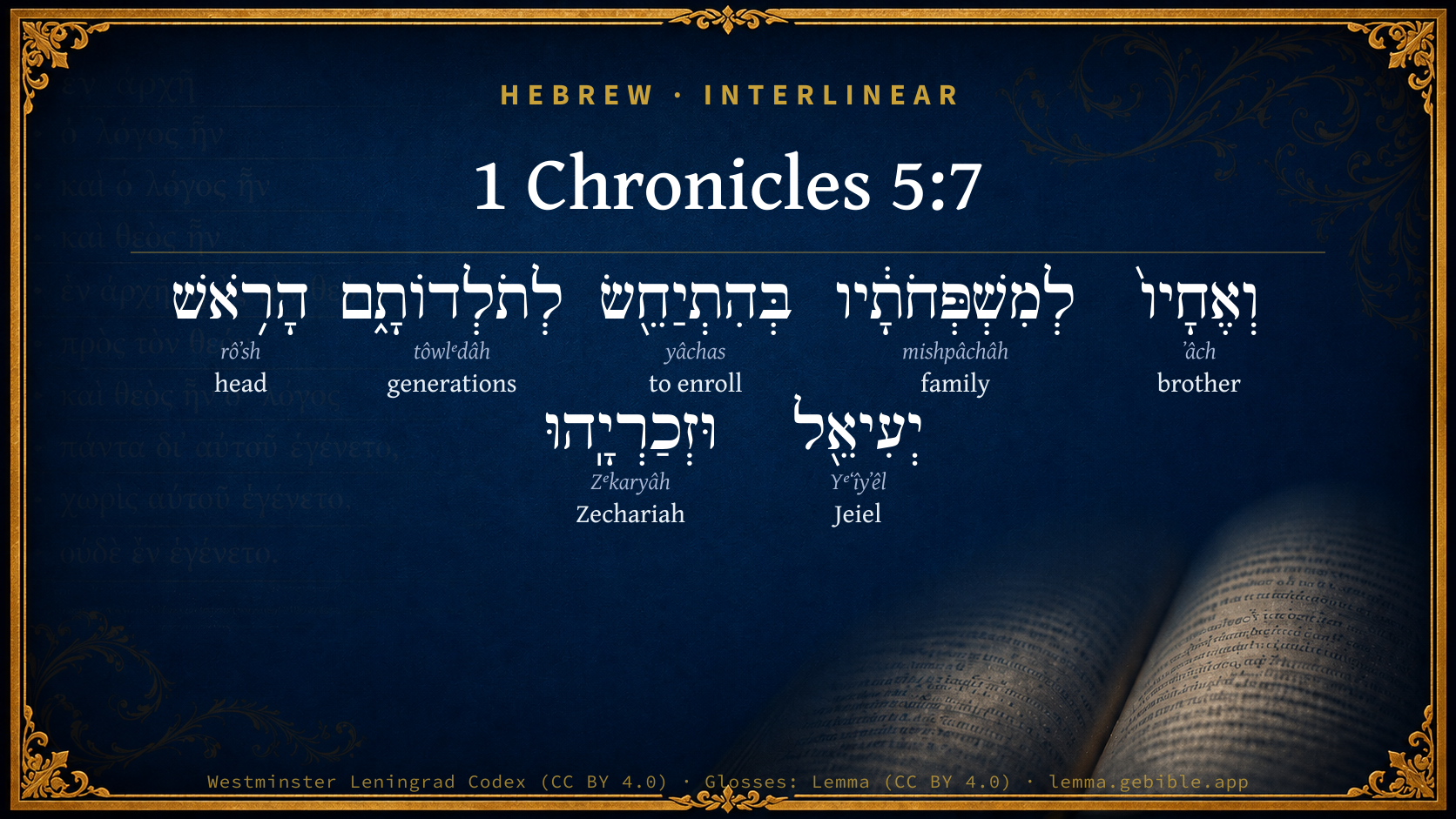
Hebrew (Westminster Leningrad Codex) 1 Chronicles 5:7 appears in the Hebrew Old Testament. The text above is from the Westminster Leningrad Codex. Each word links to its Strong’s number, a concise gloss, and parsing drawn from the Open Scriptures Hebrew Bible morphology. Click any word for its full Brown-Driver-Briggs (BDB) entry.
Download image
Cite this verse

1 Chronicles 5:7 (World English Bible). Public Domain. Lemma interlinear Bible study tool, https://lemma.gebible.app/v/1-chronicles/5/7.

Show BibTeX & RIS
BibTeX
RIS
English Translation
His brothers by their families, when the genealogy of their generations was reckoned: the chief, Jeiel, and Zechariah,
World English Bible · Public Domain
Highlights
  • 1 first appearance in the Hebrew Bible
Full analysis ↓
Download a study sheet

One document with this verse’s original text, its word-by-word gloss line, the meaning frame, cross-references with their text, attributed commentary, and full source and license credits — printable, and it pastes into notes with its structure intact.

This verse Autodidact and up

Study sheet (.html) Plain text (.txt)

A passage Seminary Student

Up to 50 verses in one chapter. A passage sheet keeps up to 6 commentary sources and 12 cross-references per verse, in the order this page ranks them, and says so on the sheet whenever that leaves anything out. Ask for a single verse and you get the Autodidact verse sheet above.

Everything on this page stays free to read, with no account — the sheet is a download of what is already on screen, not access to it.

Want to remove ads? Support Godless Engineer
Compare translations 3

The same verse in 3 English versions, stacked beneath the original-language interlinear above. Click any original word for its lexicon entry.

Each is an independent rendering of the whole verse — the interlinear is not word-aligned to these translations.

Highlighted words mark where these versions differ — a whole-verse word diff, not a word-by-word alignment.

  • World English Bible Public Domain
    His brothers by their families, when the genealogy of their generations was reckoned: the chief, Jeiel, and Zechariah,
  • King James Version Public Domain
    And his brethren by their families, when the genealogy of their generations was reckoned, were the chief, Jeiel, and Zechariah,
  • unfoldingWord Literal Text CC BY-SA 4.0
    And his brothers by his clans in the genealogy of their generations: Jeiel, the head, and Zechariah

unfoldingWord Literal Text — © unfoldingWord, licensed CC BY-SA 4.0. Word-aligned USFM3 via Door43 (git.door43.org/unfoldingWord/en_ult).

Versions to compare (up to 4)

3 of 4 selected

Show all 18 translations

Every available English version of this verse, each an independent rendering of the whole verse.

  • World English Bible Public Domain
    His brothers by their families, when the genealogy of their generations was reckoned: the chief, Jeiel, and Zechariah,
  • Berean Standard Bible Public Domain
    His relatives by their clans are recorded in their genealogy: Jeiel the chief, Zechariah,
  • Majority Standard Bible Public Domain
    His relatives by their clans are recorded in their genealogy: Jeiel the chief, Zechariah,
  • King James Version Public Domain
    And his brethren by their families, when the genealogy of their generations was reckoned, were the chief, Jeiel, and Zechariah,
  • American Standard Version (1901) Public Domain
    And his brethren by their families, when the genealogy of their generations was reckoned: the chief, Jeiel, and Zechariah,
  • Revised Version (1885) Public Domain
    And his brethren by their families, when the genealogy of their generations was reckoned; the chief, Jeiel, and Zechariah,
  • Geneva Bible (1599) Public Domain
    And when his brethren in their families rekoned the genealogie of their generations, Ieiel and Zechariah were the chiefe,
  • Douay-Rheims (1899) Public Domain
    And his brethren, and all his kindred, when they were numbered by their families, had for princes Jehiel, and Zacharias.
  • Young's Literal Translation Public Domain
    And his brethren, by their families, in the genealogy of their generations, `are' heads: Jeiel, and Zechariah,
  • Literal Standard Version CC BY-SA 4.0
    And his brothers, by their families, in the genealogy of their generations, [are] heads: Jeiel, and Zechariah,
  • Unlocked Literal Bible CC BY-SA 4.0
    Beerah's relatives according to their clans, listed according to their genealogical records: Jeiel the leader, Zechariah, and
  • unfoldingWord Literal Text CC BY-SA 4.0
    And his brothers by his clans in the genealogy of their generations: Jeiel, the head, and Zechariah
  • Darby Bible Public Domain
    And his brethren by their families, in the genealogical register of their generations, were: the chief, Jeiel, and Zechariah,
  • World Messianic Bible Public Domain
    His brothers by their families, when the genealogy of their generations was listed: the chief, Jeiel, and Zechariah,
  • Webster's Bible Public Domain
    And his brethren by their families, when the genealogy of their generations was reckoned, were the chief, Jeiel, and Zechariah,
  • Free Bible Version CC BY-SA 4.0
    Beerah's relatives are, listed in their genealogical records by family: Jeiel (chief), Zechariah,
  • Bible in Basic English Public Domain
    And his brothers by their families, when the list of their generations was made up: the chief, Jeiel, and Zechariah,
  • JPS Tanakh (1917) Public Domain
    And his brethren by their families, when the genealogy of their generations was reckoned: the chief Jeiel, and Zechariah,

Literal Standard Version (2020), Covenant Press — licensed CC BY-SA 4.0. Text via the HelloAO Bible API (eBible.org). Unlocked Literal Bible (unfoldingWord) — licensed CC BY-SA 4.0. Text via the HelloAO Bible API (eBible.org). unfoldingWord Literal Text — © unfoldingWord, licensed CC BY-SA 4.0. Word-aligned USFM3 via Door43 (git.door43.org/unfoldingWord/en_ult). Free Bible Version, Dr. Jonathan Gallagher — licensed CC BY-SA 4.0. Text via the HelloAO Bible API (eBible.org).

Word by word

More ways to search: Search by grammar → Find every occurrence → Compare this word →

Practice this passage: Drill this verse → Learn its vocabulary →

יְעִיאֵ֖ל
Yᵉʻîyʼêl
H3273
“Jeiel”
Noun, Proper
Part of Speech
Noun
Type
Proper
Full BDB Definition

Origin: from H3261 and H410

TWOT: None

Jeiel or Jehiel = "God sweeps away" - one of the sons of Adonikam who returned from exile with Ezra - a chief Reubenite of the house of Joel - a Merarite Levite and a gatekeeper to the tabernacle who also played the harp and psaltery in the service before the ark - one of the chiefs of the Levites in the time of king Josiah - one of the sons of Nebo who took a foreign wife in the time of Ezra - a man of Gibeon and ancestor of king Saul - one of the sons of Hotham the Aroerite and one of David's mighty warriors - the scribe of king Uzziah who kept the account of the king's irregular predatory warriors - a Gershonite Levite of the sons of Elizaphan - a Gershonite Levite of the sons of Asaph and forefather of Jahaziel in the time of king Jehoshaphat
  1. וְאֶחָיו֙ ʼâch H251 “and · brothers · his” Conjunction + Noun, Common, Masculine, Plural, Construct + Suffix, Personal, 3rd Person, Masculine, Singular
  2. לְמִשְׁפְּחֹתָ֔יו mishpâchâh H4940 “to/for · families · his” Preposition + Noun, Common, Feminine, Plural, Construct + Suffix, Personal, 3rd Person, Masculine, Singular
  3. בְּהִתְיַחֵ֖שׂ yâchas H3187 “in/at · to enroll” Preposition + Verb, Hithpael, Infinitive Construct
  4. לְתֹלְדוֹתָ֑ם tôwlᵉdâh H8435 “to/for · generations · their” Preposition + Noun, Common, Feminine, Plural, Construct + Suffix, Personal, 3rd Person, Masculine, Plural
  5. הָרֹ֥אשׁ rôʼsh H7218 “the · head” Particle, Definite Article + Noun, Common, Masculine, Singular, Absolute
  6. וּזְכַרְיָֽהוּ Zᵉkaryâh H2148 “and · Zechariah” Conjunction + Noun, Proper

About this verse

These counts appear in no published source. They are computed here, from the morphology-tagged text and Lemma’s own curated glosses. What Lemma adds →

7
words
7
distinct lemmas
Historical
section

Notable vocabulary

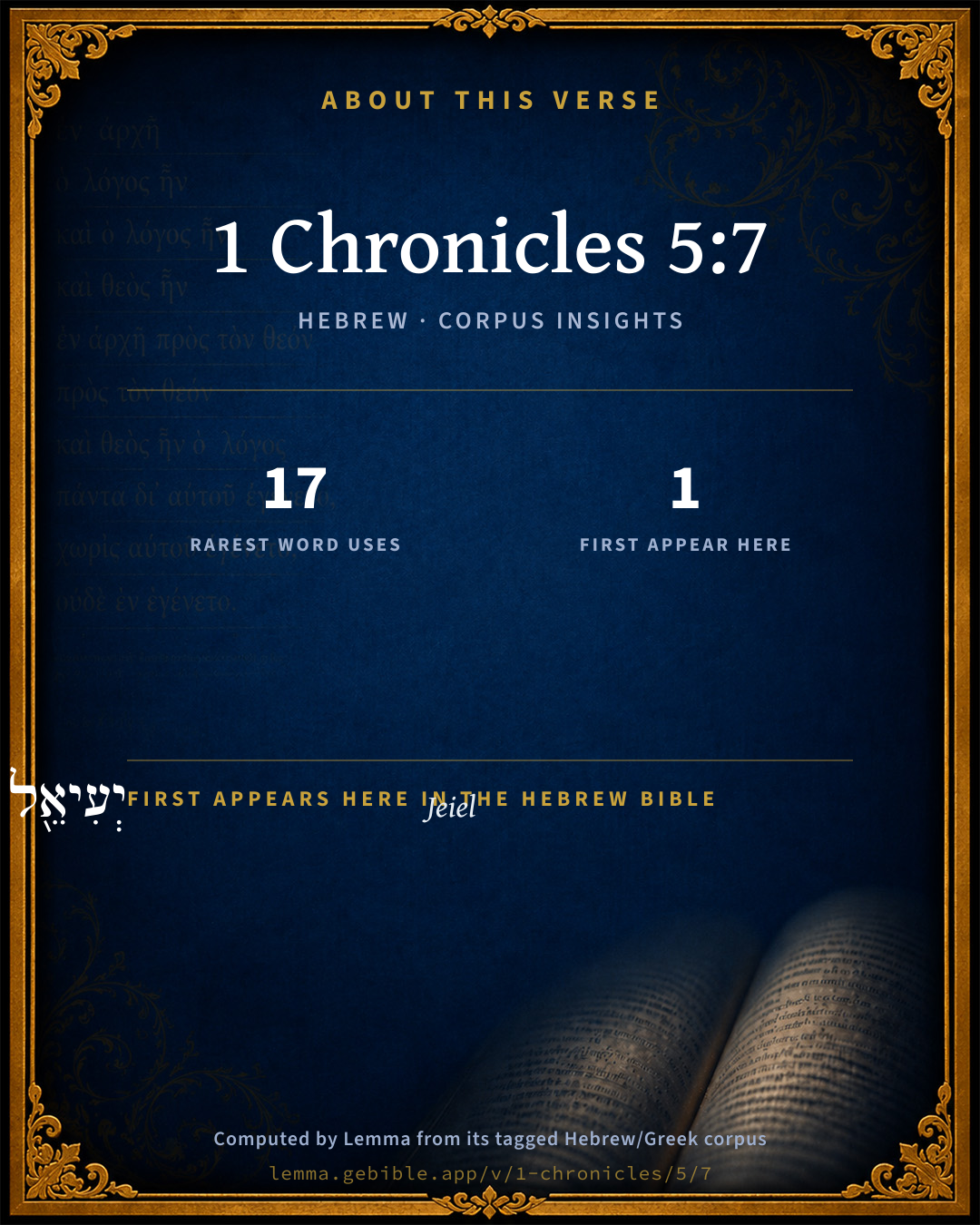
The rarest word here is יְעִיאֵ֖ל Jeiel H3273 — appearing just 17 times in the whole Hebrew Bible.

First appearance in Scripture

This word makes its first canonical appearance in the Hebrew Bible here:

  • יְעִיאֵ֖ל Jeiel H3273

Shared distinctive vocabulary

יְעִיאֵ֖ל Jeiel H3273 occurs in 12 verses of the Hebrew Bible. Also found in:

Grammatical profile

  • 1 verb
  • 6 nouns

Verb forms

  • בְּהִתְיַחֵ֖שׂ Hithpael · Infinitive Construct

Hebrew & Septuagint length

In English translation the verse runs 18 words from the Hebrew and 18 from the Septuagint (LXX English) — the same length.

A rough comparison of the two English renderings, which tokenize alike — not a word-level alignment.

Word counts can differ between the Hebrew and the Greek without any difference in meaning — e.g. the Hebrew direct-object marker אֵת has no separate Greek word, and Greek often adds the article ὁ.

Cross-references

1

Topical passages linked to 1 Chronicles 5:7 in the Treasury of Scripture Knowledge — connected by theme and wording, ordered by reader-vote popularity; previews shown in the World English Bible.

  • 1 Chronicles 5:17 All these were reckoned by genealogies in the days of Jotham king of Judah, and in the days of Jeroboam king of Israel.

Cross-references courtesy of OpenBible.info (CC BY 4.0).

Hebrew and Greek witnesses Masoretic Hebrew ↔ Greek Septuagint

The same verse in the two great witnesses to the Old Testament, shown verse-for-verse.

These are two independent witnesses, not word-aligned to each other, and the Septuagint is shown in lemma (dictionary) form.

Hebrew 1 Chronicles 5:7 Masoretic · Westminster Leningrad Codex

וְאֶחָיו֙ לְמִשְׁפְּחֹתָ֔יו בְּהִתְיַחֵ֖שׂ לְתֹלְדוֹתָ֑ם הָרֹ֥אשׁ יְעִיאֵ֖ל וּזְכַרְיָֽהוּ

His brothers by their families, when the genealogy of their generations was reckoned: the chief, Jeiel, and Zechariah,

World English Bible · Public Domain

Greek LXX 1 Chronicles 5:7 Septuagint · lemma form

καί ἀδελφός αὐτός ὁ πατριά αὐτός ἐν ὁ καταλοχισμός αὐτός κατά γένεσις αὐτός ὁ ἄρχω ιωηλ καί ζαχαρια

And his brethren in his family, in their distribution according to their generations; the chief, Joel, and Zacharia.

LXX2012 (modern English Septuagint) · Public Domain

On this verse, Ellicott's Commentary for English Readers discusses the Septuagint’s reading. Read the note in Commentary ↓

Hebrew: Westminster Leningrad Codex (CC BY 4.0). Greek: Septuagint (public domain); English from LXX2012 (modern English Septuagint) (Public Domain). How the Septuagint differs from the Hebrew →

Commentary

Notes on 1 Chronicles 5:7 from classic Christian and Jewish commentators (each source and its license shown beneath its notes). The classic Christian expositions comment on the surrounding passage and are grouped to its opening verse, so a note may address several verses; the Jewish commentaries on the Tanakh (Rashi and others) are per-verse, so they appear only where the commentator wrote on this verse.

Lemma curates 59 commentaries, every one of them public domain or Creative Commons licensed, each selected and text-cleaned for this edition rather than reprinted as found. About our sources →

Joseph Benson's Commentary

1Ch 5:7-8. And his brethren — The other sons of Reuben, and their posterity. Were the chief — Hebrew, the head: each was the head of his family. Who dwelt in Aroer, even, &c. — Namely, the Reubenites, all those here before mentioned, as appears, both by the following verses, which relate to the whole tribe, and by the agreement of this description of their inheritance with that Jos 13:15-16.

Joseph Benson's Commentary on the Old and New Testaments (1811–1818) — public domain. Text from a community e-Sword module.

Ellicott's Commentary for English Readers

(7) Tilgath - pilneser.—The Assyrian monarch known as Tiglath Pileser II. See 2Ki_15:29, for his deportation of the people of the northern and trans-Jordanic districts of Israel, in the reign of Pekah. Some MSS., with LXX. and Syriac, read Tiglath, which is more correct than Tilgath. Vat., LXX., ΘαγλαΦαλλασὰρ, Syr., Teglath-Palsar. The Assyrian name, of which these forms are transcripts, is Tu-kulti-pal-Esarra, “the servant of the son of Esarra.” (The “Son of Esarra” is a title of the god Ninip.) Tilgath-Pilneser (Vulg., Thelgath-Phalnasar) is the invariable spelling of Chronicles.

He was prince of the Reubenites.—Beerah was tribal prince of Reuben, and not merely chief of a Reubenite clan, as some will have it. The Hebrew construction is parallel to that of Num_7:24; Num_7:30 seq., with which comp. Num_7:18.

(7) And his brethren by their families.—“And his fellow-tribesmen, each after his clan (Num_2:34), in the registration after their pedigrees, were the chief, Jeiel, and Zechariah.” Jeiel was the chief of the second Reubenite clan, as Beerah of the first. Zechariah and Bela were heads of the other chief houses. It appears that these four chieftains correspond to the four divisions of Reuben mentioned in 1Ch_5:3. Num_26:7 says expressly that “the Hanochite, the Palluite, the Hezronite, and the Carmite” were “the clans of the Reubenite.”

A Bible Commentary for English Readers, edited by Charles John Ellicott (1878–1897) — public domain. Text from a community e-Sword module.

The Cambridge Bible for Schools and Colleges

gen. ed. J. J. S. Perowne

7. was reckoned, were the chief, Jeiel] R.V. was reckoned; the chief; Jeiel.

The Cambridge Bible for Schools and Colleges (gen. ed. J. J. S. Perowne; Cambridge University Press, 1878–1918) — public domain. Text from a community e-Sword module.

John Gill's Exposition

And Bela the son of Azaz, the son of Shema, the son of Joel,.... The pedigree of Bela, another principal man in the tribe of Reuben, is traced up to Joel the father of Shema; the same with Shemaiah, according to Kimchi and Ben Melech, Ch1 5:4

who dwelt in Aroer; which belonged to the tribe of Gad, and was rebuilt by them, Num 32:34 wherefore Kimchi observes, it may be interpreted, either from Aroer, or on the border of it, Bela dwelt:

even unto Nebo, and Baalmeon; of which See Gill on Num 32:38.

John Gill's Exposition of the Whole Bible (1746–1763) — public domain (CC PDM 1.0). Text via the HelloAO Bible API.

Haydock's Catholic Bible Commentary

Families, when they were led captive into Assyria; (Menochius) or before, when the tribe was in a most flourishing condition. --- Princes. Hebrew and Septuagint, "prince." --- Jehiel. Septuagint, "Joel," ver. 4.

George Leo Haydock (1774–1849), Haydock's Catholic Family Bible and Commentary, 1859 edition — public domain. Excludes Psalms (Douay-Rheims chapter numbering differs from Protestant) and Deuterocanonical books (Catholic canon only).

Matthew Poole's English Annotations

His brethren, i.e. the other sons of Reuben, and their posterity.

The chief, Heb. the head; each was the head of his family.

Matthew Poole's English Annotations on the Holy Bible (1683–1685) — public domain. Text from a community e-Sword/MySword module.

The Pulpit Commentary

Vers. 7, 8. Of Jeiel, Zechariah, Bela, and Asaz nothing further is known. Shema and Joel may be those of ver. 4, as above. The expression, his brethren, i.e. the brethren of Beerah, must be read generally. The intimation, when the genealogy of their generations was reckoned, is probably explained by the contents of ver. 17 (of which hereafter). Aroer (rero or rewOr); a place east of the Jordan, overhanging the torrent of Arnon, which was a boundary between Moab and the Amorites, and afterwards between Moab and Reuben. There is little doubt that Burckhardt has identified the ruins of Aroer (see Num_32:38; Deu_2:24, 36 3:8, 12, 16; Jos_12:1, 2 13:9, 16; Jud_1:11:13, 26, where note transposition of letters in the Hebrew; (2Ki_10:33) Moab seems to have regained it later. (Jer_48:1-47; see interesting arts. "Amen" and "Areer," Smith"s" Bible Dictionary Nebo and Baal-meon are also mentioned together in Num_32:38; and Baal-meon with Moab in Eze_25:9. This Nebo, the town, is distinct from Mount Nebo. It is remarkable that it is not mentioned, unless under one of the "changed" names, (Num_32:38) in the list of the towns of Reuben. (Jos_13:15-23) Nebo was the name of a heathen deity, known among the Chaldeans, (Babylonians, Isa_46:1) and Assyrians; and this constituted one reason, if not the reason, for changing its name when it had been affixed to the Moabite city.

The Pulpit Commentary (1880–1919), ed. H.D.M. Spence-Jones & Joseph S. Exell — public domain. Text from a community e-Sword module.

Keil & Delitzsch

C. F. Keil & F. Delitzsch

And Bela the son of Azaz, the son of Shema, the son of Joel,.... The pedigree of Bela, another principal man in the tribe of Reuben, is traced up to Joel the father of Shema; the same with Shemaiah, according to Kimchi and Ben Melech, Ch1 5:4

who dwelt in Aroer; which belonged to the tribe of Gad, and was rebuilt by them, Num 32:34 wherefore Kimchi observes, it may be interpreted, either from Aroer, or on the border of it, Bela dwelt:

even unto Nebo, and Baalmeon; of which See Gill on Num 32:38.

Keil & Delitzsch — Biblical Commentary on the Old Testament (1861–1891) — public domain (CC PDM 1.0). Text via the HelloAO Bible API. (Old Testament only.)

unfoldingWord translationNotes

Door43 World Missions Community

listed according to their genealogical records

This can start a new sentence: "Their genealogical records list them as" (See: Active or Passive)

genealogical records

records that show how people in a family are related to each other

Jeiel ... Zechariah ... Bela ... Azaz ... Shema

These are the names of men. (See: How to Translate Names)

Aroer ... Nebo ... Baal Meon

These are the names of cities. (See: How to Translate Names)

translationWords

clan

desert

Euphrates River

Gilead

unfoldingWord translationNotes — © Distant Shores Media and the Door43 World Missions Community, licensed CC BY-SA 4.0. Source: git.door43.org/Door43/en_tn.

Rashi

Rabbi Shlomo Yitzchaki (Rashi)

tracing their genealogy to their generations; the heads were Jeiel and Zechariah The meaning is: I traced only part of the genealogy of Reuben, but the main part of his genealogy is in the chronicles of the kings of Israel. Jeiel and Zechariah were the heads, through whom their genealogy was completed.

Rashi on the Tanakh — English translations: “The Judaica Press complete Tanach with Rashi, translated by A. J. Rosenberg” (CC BY 4.0); “Pentateuch with Rashi's commentary by M. Rosenbaum and A.M. Silbermann, 1929-1934” (public domain); “The Metsudah Tanach series, Lakewood, N.J” (CC BY 4.0); and “The Book of Joshua, Metsudah Publications, 1997” (CC BY 4.0). Text via Sefaria.

Lesson kit

Teaching starters — assembled from the data on this page, not authored interpretation. Every prompt links to the verse data it draws on. Edit before teaching.

1 Chronicles, in the Historical, opens this verse with 7 words (7 distinct Hebrew lemmas). Its most distinctive word is Yᵉʻîyʼêl (“Jeiel”). A historical commentator’s framing appears above. Read the whole chapter for the surrounding context.

Discussion questions

  1. How does “Jeiel” (Yᵉʻîyʼêl) shape what this verse is saying?
  2. This is the first place “Jeiel” appears in Scripture (first appears here). What does its debut here establish?
  3. How does 1 Chronicles 9:35, which shares the word «Jeiel», read alongside this verse?
  4. These translations render this verse differently. What is at stake in choosing one wording over another?
  5. «בְּהִתְיַחֵ֖שׂ» is a Hithpael Infinitive Construct verb. How does that grammatical form shape the action described?
  6. Compare how Joseph Benson's Commentary and Ellicott's Commentary for English Readers read this verse. Where do they agree or differ?

Things to notice

  • 1 word makes its first canonical appearance in Scripture here.
  • These translations choose different wording for 8 words in this verse.
  • 7 distinct Hebrew lemmas span 7 words in this verse.

Reading settings

Reading text

Shown beneath each verse's original-language words.

Old Testament
Old Testament edition

Read the OT as the Masoretic Hebrew (MT) or the Greek Septuagint (LXX).

English shown for the Greek Septuagint (in the Hebrew ↔ Greek comparison).

Comparing translations? Open the Compare panel on any verse page to stack up to four side by side.