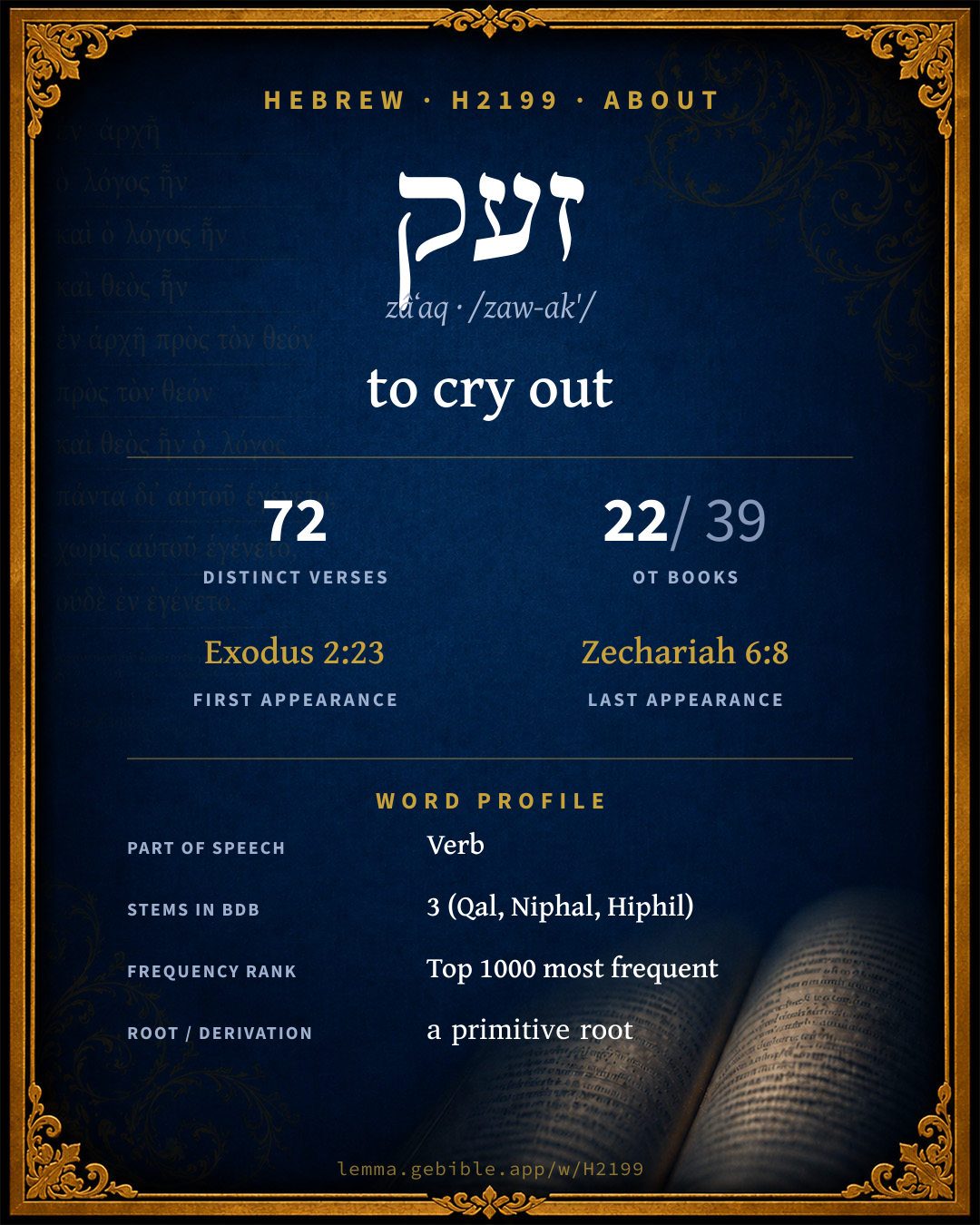
זָעַק
to cry out
‘to cry out’ is one of 2 main senses fuller range ↓
Full lexicon entry — Brown-Driver-Briggs (BDB)
From Brown-Driver-Briggs (BDB)
Where this word appears
See every Qal verb in the Hebrew Bible →
Grammar key — what these labels mean
Part of speech
- Verb
- An action or state-of-being word.
Stem
- Qal
- The basic, simple active stem — the plain form of the verb (“he wrote”). Here: ‘call’
- Hiphil
- The causative active stem (“he caused / brought about”). Here: ‘call’
- Niphal
- Usually the simple passive or reflexive of the Qal (“he was written”).
Form
- Sequential Imperfect
- An imperfect with prefixed waw — the standard past-narrative form (waw-consecutive imperfect).
- Imperfect
- An incomplete, ongoing, or future action (“he will / would write”).
- Imperative
- A direct command (“write!”).
- Perfect
- A completed action or state — Hebrew marks aspect (completeness) more than strict tense (“he wrote”).
- Sequential Perfect
- A perfect with prefixed waw continuing a preceding imperfect or command (waw-consecutive perfect).
- Infinitive Construct
- A bound verbal noun, frequently with prepositions (“to write / in writing”).
Person
- 3rd Person
- The one spoken about (“he / she / it / they”).
- 1st Person
- The speaker (“I / we”).
- 2nd Person
- The one addressed (“you”).
Gender
- Masculine
- Grammatically masculine.
- Common
- Either gender — not distinguished for this form.
- Feminine
- Grammatically feminine.
Number
- Plural
- More than one (in Hebrew, generally three or more).
- Singular
- One.
Grammatical forms 27 distinct
- Verb, Qal, Sequential Imperfect, 3rd Person, Masculine, Plural 14 times (19%)
- Verb, Qal, Sequential Imperfect, 3rd Person, Masculine, Singular 6 times (8%)
- Verb, Qal, Imperfect, 1st Person, Common, Singular 5 times (7%)
- Verb, Hiphil, Sequential Imperfect, 3rd Person, Masculine, Singular 4 times (5%)
- Verb, Qal, Imperative, 2nd Person, Masculine, Plural 4 times (5%)
- Verb, Qal, Perfect, 3rd Person, Common, Plural 4 times (5%)
- Verb, Niphal, Sequential Imperfect, 3rd Person, Masculine, Singular 3 times (4%)
- Verb, Qal, Sequential Perfect, 3rd Person, Common, Plural 3 times (4%)
+19 more forms (30 occurrences)
Parsed forms decoded from the imported morphology (morphhb / Westminster Leningrad Codex — WLC text public domain, morphhb tagging CC BY 4.0), counted across 73 parsed occurrences — not distinct verses.
Every verse where H2199 appears — 72 distinct verses across 22 books. Click any verse to open its interlinear word-by-word view. Verse text shown in the World English Bible for context — . Each verse’s Hebrew form is shown with its reference; the English is not keyword-highlighted, since the data carries no word-level English alignment. Use “Compare translations” on any verse to read it across multiple English versions. This concordance covers the Hebrew Bible; Septuagint (Greek Old Testament) occurrences are not indexed here.
Exodus 1 verse
Joshua 1 verse
Judges 13 verses
- Judges 3:9 וַ/יִּזְעֲק֤וּ conj + Qal wimpf 3mp When the children of Israel cried to Yahweh, Yahweh raised up a savior to the children of Israel, who saved them, even Othniel the son of Kenaz, Caleb's younger brother.
- Judges 3:15 וַ/יִּזְעֲק֣וּ conj + Qal wimpf 3mp But when the children of Israel cried to Yahweh, Yahweh raised them up a savior, Ehud the son of Gera, the Benjamite, a man left-handed. The children of Israel sent tribute by him to Eglon the king of Moab.
- Judges 4:10 וַ/יַּזְעֵ֨ק conj + Hiphil wimpf 3ms Barak called Zebulun and Naphtali together to Kedesh; and there went up ten thousand men at his feet: and Deborah went up with him.
- Judges 4:13 וַ/יַּזְעֵ֨ק conj + Hiphil wimpf 3ms Sisera gathered together all his chariots, even nine hundred chariots of iron, and all the people who were with him, from Harosheth of the Gentiles, to the river Kishon.
- Judges 6:6 וַ/יִּזְעֲק֥וּ conj + Qal wimpf 3mp Israel was brought very low because of Midian; and the children of Israel cried to Yahweh.
- Judges 6:7 זָעֲק֥וּ Qal pf 3cp It happened, when the children of Israel cried to Yahweh because of Midian,
- Judges 6:34 וַ/יִזָּעֵ֥ק conj + Niphal wimpf 3ms But the Spirit of Yahweh came on Gideon; and he blew a trumpet; and Abiezer was gathered together after him.
- Judges 6:35 וַ/יִזָּעֵ֥ק conj + Niphal wimpf 3ms He sent messengers throughout all Manasseh; and they also were gathered together after him: and he sent messengers to Asher, and to Zebulun, and to Naphtali; and they came up to meet them.
- Judges 10:10 וַֽ/יִּזְעֲקוּ֙ conj + Qal wimpf 3mp The children of Israel cried to Yahweh, saying, We have sinned against you, even because we have forsaken our God, and have served the Baals.
- Judges 10:14 וְ/זַֽעֲקוּ֙ conj + Qal impv 2mp Go and cry to the gods which you have chosen; let them save you in the time of your distress.
- Judges 12:2 וָ/אֶזְעַ֣ק conj + Qal wimpf 1cs Jephthah said to them, I and my people were at great strife with the children of Ammon; and when I called you, you didn't save me out of their hand.
- Judges 18:22 נִֽזְעֲק֔וּ Niphal pf 3cp When they were a good way from the house of Micah, the men who were in the houses near to Micah's house were gathered together, and overtook the children of Dan.
- Judges 18:23 נִזְעָֽקְתָּ Niphal pf 2ms They cried to the children of Dan. They turned their faces, and said to Micah, What ails you, that you come with such a company?
1 Samuel 10 verses
- 1 Samuel 4:13 וַ/תִּזְעַ֖ק conj + Qal wimpf 3fs When he came, behold, Eli was sitting on his seat by the road watching; for his heart trembled for the ark of God. When the man came into the city, and told it, all the city cried out.
- 1 Samuel 5:10 וַ/יִּזְעֲק֨וּ conj + Qal wimpf 3mp So they sent the ark of God to Ekron. It happened, as the ark of God came to Ekron, that the Ekronites cried out, saying, They have brought about the ark of the God of Israel to us, to kill us and our people.
- 1 Samuel 7:8 מִ/זְּעֹ֖ק prep + Qal inf.cs The children of Israel said to Samuel, "Don't cease to cry to Yahweh our God for us, that he will save us out of the hand of the Philistines."
- 1 Samuel 7:9 וַ/יִּזְעַ֨ק conj + Qal wimpf 3ms Samuel took a sucking lamb, and offered it for a whole burnt-offering to Yahweh: and Samuel cried to Yahweh for Israel; and Yahweh answered him.
- 1 Samuel 8:18 וּ/זְעַקְתֶּם֙ conj + Qal wpf 2mp You shall cry out in that day because of your king whom you shall have chosen you; and Yahweh will not answer you in that day.
- 1 Samuel 12:8 וַ/יִּזְעֲק֤וּ conj + Qal wimpf 3mp When Jacob was come into Egypt, and your fathers cried to Yahweh, then Yahweh sent Moses and Aaron, who brought forth your fathers out of Egypt, and made them to dwell in this place.
- 1 Samuel 12:10 וַ/יִּזְעֲק֤וּ conj + Qal wimpf 3mp They cried to Yahweh, and said, We have sinned, because we have forsaken Yahweh, and have served the Baals and the Ashtaroth: but now deliver us out of the hand of our enemies, and we will serve you.
- 1 Samuel 14:20 וַ/יִּזָּעֵ֣ק conj + Niphal wimpf 3ms Saul and all the people who were with him were gathered together, and came to the battle: and, behold, every man's sword was against his fellow, [and there was] a very great confusion.
- 1 Samuel 15:11 וַ/יִּזְעַ֥ק conj + Qal wimpf 3ms It repents me that I have set up Saul to be king; for he is turned back from following me, and has not performed my commandments. Samuel was angry; and he cried to Yahweh all night.
- 1 Samuel 28:12 וַ/תִּזְעַ֖ק conj + Qal wimpf 3fs When the woman saw Samuel, she cried with a loud voice; and the woman spoke to Saul, saying, Why have you deceived me? for you are Saul.
2 Samuel 5 verses
- 2 Samuel 13:19 וְ/זָעָֽקָה conj + Qal wpf 3fs Tamar put ashes on her head, and tore her garment of various colors that was on her; and she laid her hand on her head, and went her way, crying aloud as she went.
- 2 Samuel 19:4 וַ/יִּזְעַ֥ק conj + Qal wimpf 3ms The king covered his face, and the king cried with a loud voice, my son Absalom, Absalom, my son, my son!
- 2 Samuel 19:28 וְ/לִ/זְעֹ֥ק conj + prep + Qal inf.cs For all my father's house were but dead men before my lord the king; yet you set your servant among those who ate at your own table. What right therefore have I yet that I should cry any more to the king?
- 2 Samuel 20:4 הַזְעֶק Hiphil impv 2ms Then said the king to Amasa, Call me the men of Judah together within three days, and be here present.
- 2 Samuel 20:5 לְ/הַזְעִ֣יק prep + Hiphil inf.cs So Amasa went to call [the men of] Judah together; but he stayed longer than the set time which he had appointed him.
1 Kings 1 verse
1 Chronicles 1 verse
2 Chronicles 3 verses
- 2 Chronicles 18:31 וַ/יִּזְעַ֤ק conj + Qal wimpf 3ms It happened, when the captains of the chariots saw Jehoshaphat, that they said, It is the king of Israel. Therefore they turned about to fight against him: but Jehoshaphat cried out, and Yahweh helped him; and God moved them [to depart] from him.
- 2 Chronicles 20:9 וְ/נִזְעַ֥ק conj + Qal impf 1cp If evil come on us, the sword, judgment, or pestilence, or famine, we will stand before this house, and before you, (for your name is in this house), and cry to you in our affliction, and you will hear and save.
- 2 Chronicles 32:20 וַֽ/יִּזְעֲק֖וּ conj + Qal wimpf 3mp Hezekiah the king, and Isaiah the prophet the son of Amoz, prayed because of this, and cried to heaven.
Nehemiah 2 verses
- Nehemiah 9:4 וַֽ/יִּזְעֲקוּ֙ conj + Qal wimpf 3mp Then stood up on the stairs of the Levites, Jeshua, and Bani, Kadmiel, Shebaniah, Bunni, Sherebiah, Bani, [and] Chenani, and cried with a loud voice to Yahweh their God.
- Nehemiah 9:28 וַ/יִּזְעָק֔וּ/ךָ conj + Qal wimpf 3mp + sfx pers 2ms But after they had rest, they did evil again before you; therefore left you them in the hand of their enemies, so that they had the dominion over them: yet when they returned, and cried to you, you heard from heaven; and many times did you deliver them according to your mercies,
Esther 1 verse
Job 2 verses
Psalms 5 verses
- Psalms 22:5 זָעֲק֣וּ Qal pf 3cp They cried to you, and were delivered. They trusted in you, and were not disappointed.
- Psalms 107:13 וַ/יִּזְעֲק֣וּ conj + Qal wimpf 3mp Then they cried to Yahweh in their trouble, And he saved them out of their distresses.
- Psalms 107:19 וַ/יִּזְעֲק֣וּ conj + Qal wimpf 3mp Then they cry to Yahweh in their trouble, He saves them out of their distresses.
- Psalms 142:1 אֶזְעָ֑ק Qal impf 1cs I cry with my voice to Yahweh. With my voice, I ask Yahweh for mercy.
- Psalms 142:5 זָעַ֥קְתִּי Qal pf 1cs I cried to you, Yahweh. I said, "You are my refuge, My portion in the land of the living."
Isaiah 5 verses
- Isaiah 14:31 זַֽעֲקִי Qal impv 2fs Howl, gate; cry, city; you are melted away, Philistia, all of you; for there comes a smoke out of the north, and there is no straggler in his ranks.
- Isaiah 15:4 וַ/תִּזְעַ֤ק conj + Qal wimpf 3fs Heshbon cries out, and Elealeh; their voice is heard even to Jahaz: therefore the armed men of Moab cry aloud; his soul trembles within him.
- Isaiah 15:5 יִזְעָ֔ק Qal impf 3ms My heart cries out for Moab; her nobles [flee] to Zoar, to Eglath Shelishiyah: for by the ascent of Luhith with weeping they go up; for in the way of Horonaim they raise up a cry of destruction.
- Isaiah 26:17 תִּזְעַ֖ק Qal impf 3fs Like as a woman with child, who draws near the time of her delivery, is in pain and cries out in her pangs; so we have been before you, Yahweh.
- Isaiah 57:13 בְּ/זַֽעֲקֵ/ךְ֙ prep + Qal inf.cs + sfx pers 2fs When you cry, let those who you have gathered deliver you; but the wind shall take them, a breath shall carry them all away: but he who takes refuge in me shall possess the land, and shall inherit my holy mountain.
Jeremiah 8 verses
- Jeremiah 11:11 וְ/זָעֲק֣וּ conj + Qal wpf 3cp Therefore thus says Yahweh, Behold, I will bring evil on them, which they shall not be able to escape; and they shall cry to me, but I will not listen to them.
- Jeremiah 11:12 וְ/זָֽעֲקוּ֙ conj + Qal wpf 3cp Then shall the cities of Judah and the inhabitants of Jerusalem go and cry to the gods to which they offer incense: but they will not save them at all in the time of their trouble.
- Jeremiah 20:8 אֶזְעָ֔ק Qal impf 1cs For as often as I speak, I cry out; I cry, Violence and destruction! because the word of Yahweh is made a reproach to me, and a derision, all the day.
- Jeremiah 25:34 וְ/זַעֲק֗וּ conj + Qal impv 2mp Wail, you shepherds, and cry; and wallow [in ashes], you principal of the flock; for the days of your slaughter and of your dispersions are fully come, and you shall fall like a goodly vessel.
- Jeremiah 30:15 תִּזְעַק֙ Qal impf 2ms Why cry you for your hurt? your pain is incurable: for the greatness of your iniquity, because your sins were increased, I have done these things to you.
- Jeremiah 47:2 וְ/זָֽעֲקוּ֙ conj + Qal wpf 3cp Thus says Yahweh: Behold, waters rise up out of the north, and shall become an overflowing stream, and shall overflow the land and all that is therein, the city and those who dwell therein; and the men shall cry, and all the inhabitants of the land shall wail.
- Jeremiah 48:20 ו/זעקי וּֽ/זְעָ֑קוּ conj + Qal impv 2fs conj + Qal impv 2mp Moab is disappointed; for it is broken down: wail and cry; tell you it by the Arnon, that Moab is laid waste.
- Jeremiah 48:31 אֶזְעָ֑ק Qal impf 1cs Therefore will I wail for Moab; yes, I will cry out for all Moab: for the men of Kir Heres shall they mourn.
Lamentations 1 verse
Ezekiel 4 verses
- Ezekiel 9:8 וָ/אֶזְעַ֗ק conj + Qal wimpf 1cs It happened, while they were smiting, and I was left, that I fell on my face, and cried, and said, Ah Lord Yahweh! will you destroy all the residue of Israel in your pouring out of your wrath on Jerusalem?
- Ezekiel 11:13 וָ/אֶזְעַ֣ק conj + Qal wimpf 1cs It happened, when I prophesied, that Pelatiah the son of Benaiah died. Then fell I down on my face, and cried with a loud voice, and said, Ah Lord Yahweh! will you make a full end of the remnant of Israel?
- Ezekiel 21:12 זְעַ֤ק Qal impv 2ms Cry and wail, son of man; for it is on my people, it is on all the princes of Israel: they are delivered over to the sword with my people; strike therefore on your thigh.
- Ezekiel 27:30 וְ/יִזְעֲק֖וּ conj + Qal impf 3mp and shall cause their voice to be heard over you, and shall cry bitterly, and shall cast up dust on their heads, they shall wallow themselves in the ashes:
Hosea 2 verses
Joel 1 verse
Jonah 2 verses
- Jonah 1:5 וַֽ/יִּזְעֲקוּ֮ conj + Qal wimpf 3mp Then the mariners were afraid, and cried every man to his god. They threw the cargo that was in the ship into the sea, to lighten it. But Jonah had gone down into the innermost parts of the ship, and he was laying down, and was fast asleep.
- Jonah 3:7 וַ/יַּזְעֵ֗ק conj + Hiphil wimpf 3ms He made a proclamation and published through Nineveh by the decree of the king and his nobles, saying, "Let neither man nor animal, herd nor flock, taste anything; let them not feed, nor drink water;
Micah 1 verse
Habakkuk 2 verses
Zechariah 1 verse
About this entry
At a glance — auto-summarized from this page’s data, not written by a person. Every figure links to its source below. This summary describes the numbers; it doesn’t interpret them.
זעק — transliterated zâʻaq — is a Hebrew verb carrying the sense “to cry out.” The King James Version usually renders it “cried,” while modern versions prefer “cried out” (Berean Standard Bible) — see the renderings breakdown. With 72 verses in 22 books, it is a moderately common word in the Hebrew Bible. Debuting at Exodus 2:23, it then recurs through the corpus. Different stems carry different senses — BDB groups them under 3 stems, among them Qal and Niphal. See the sense tree, 72-verse concordance, and the renderings breakdown below.
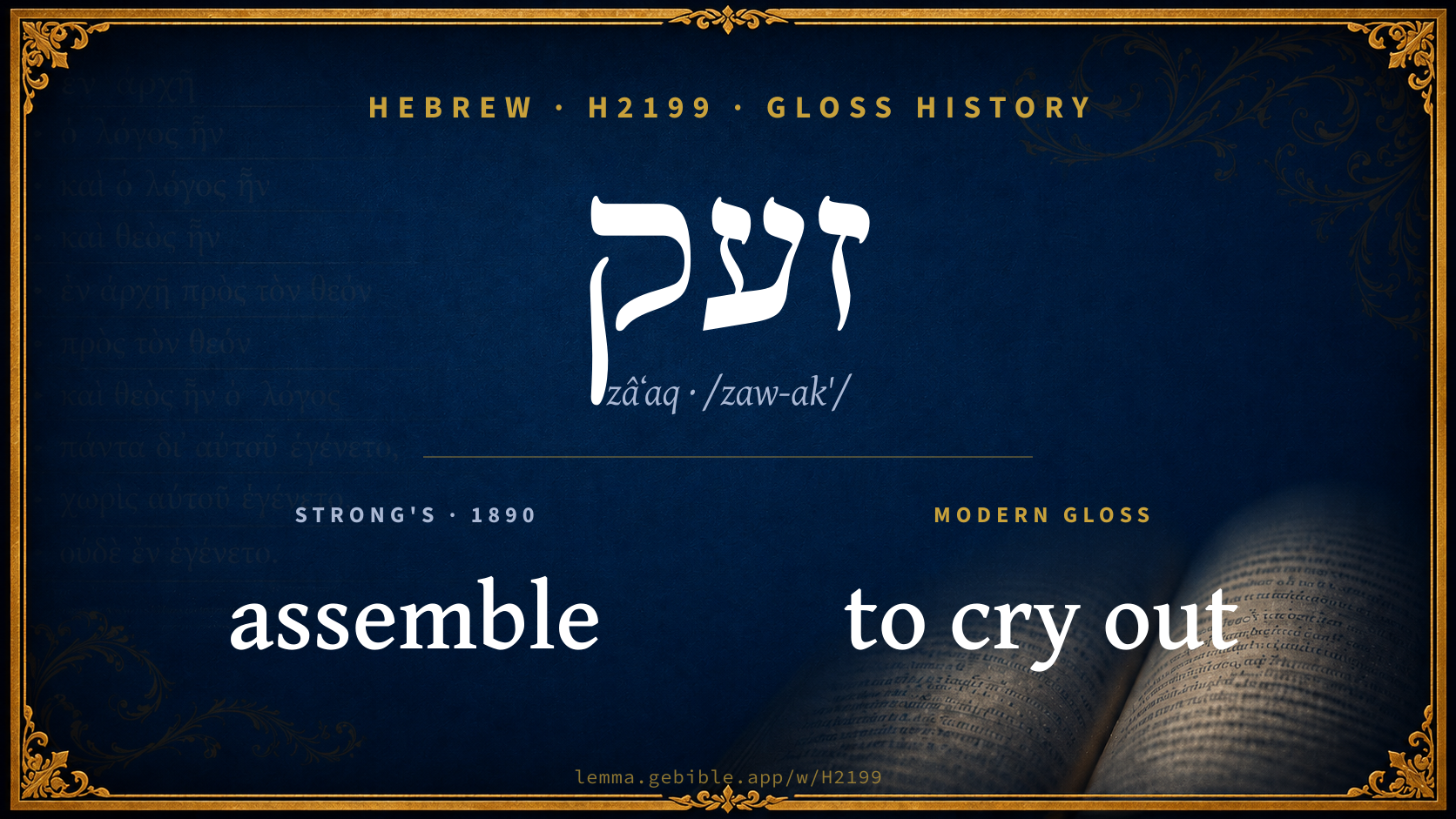
Gloss history
Strong's 1890 vs modern scholarship
About this word
Strong's H2199 catalogs a Hebrew word from the Hebrew Old Testament.
These counts are not copied from any lexicon or concordance. They are computed here, from the morphology-tagged Hebrew Old Testament. What Lemma adds →
- 72
- distinct verses
- The word appears in 72 distinct verses.
- 22 / 39
- OT books
- The word appears in 22 of 39 Old Testament books.
- #542
- by frequency
- Top 1000 most frequent Hebrew words (rank 542 of 8,640 Hebrew words by occurrence).
View all 72 occurrences in the concordance →
By section of the Old Testament
By traditional corpus
Conventional, traditional groupings — biblical authorship is debated, so this is a traditional corpus grouping, not an authorship claim. Each share is this word’s portion of its verses in that division of the Hebrew canon. Each figure is a share of the word’s 72 distinct verses.
- Prophets (Nevi'im) 56 verses · 78%
- Writings (Ketuvim) 15 verses · 21%
- Torah (Pentateuch) 1 verse · 1%
How translations render this word
Counts come from each version’s own published word-to-Strong’s tagging or interlinear alignment — an approximate guide to how each version renders this word, not a word-level alignment the data otherwise carries. Because each total is that version’s own tagged count, the per-version totals vary from one another and need not match the appearance or distinct-verse counts above. These counts may also differ from a printed concordance because Lemma counts each distinctly tagged rendering and does not collapse phrase taggings into a single head-word total. This is a fixed set of word-tagged versions (KJV, ASV, BSB, ULT) and does not change with the reading translation you choose elsewhere. Each version’s license is shown beside its name below (and on Sources).
- King James Version: Cried 16×, Cry 11×, Cried out 4×
- American Standard Version: Cried 14×, Cry 10×, They cried 4×
- Berean Standard Bible: Cried out 19×, Cry out 10×, They cried out 6×
- unfoldingWord Literal Text: Cried out 16×, And 9×, They cried out 8×
King James Version Public Domain
Renders H2199 across 73 tagged occurrences — most commonly:
Plus 27 renderings that appear only once — usually multi-word phrases or single function words the recovered tagging swept in, not distinct renderings.
American Standard Version Public Domain
Renders H2199 across 73 tagged occurrences — most commonly:
Plus 33 renderings that appear only once — usually multi-word phrases or single function words the recovered tagging swept in, not distinct renderings.
Berean Standard Bible Public Domain
Renders H2199 across 72 tagged occurrences — most commonly:
Plus 20 renderings that appear only once — usually multi-word phrases or single function words the recovered tagging swept in, not distinct renderings. Not rendered by a distinct English word in 1 further occurrence.
unfoldingWord Literal Text CC BY-SA 4.0
Renders H2199 across 85 tagged occurrences — most commonly:
Plus other, less common renderings. Plus 23 renderings that appear only once — usually multi-word phrases or single function words the recovered tagging swept in, not distinct renderings.
14 senses and sub-senses in the full BDB
Hebrew verbs can shift meaning by stem (binyan): Qal is the basic action, Niphal is often passive or reflexive, Piel often intensifies or makes it factitive, and Hiphil is typically causative. The senses below are grouped under the stem BDB assigns to each.
What do BDB’s symbols mean?
BDB uses these scholarly abbreviations:
| Symbol | Meaning |
|---|---|
| 𝔊 | the Septuagint (the ancient Greek translation, LXX) |
| 𝔙 | the Vulgate (the Latin translation) |
| 𝔖 | the Syriac version (the Peshitta) |
| 𝔗 | the Targum (the Aramaic translation) |
| ψ | the Psalms |
| √ | root (the underlying root or stem) |
| ‖ | parallel passage (a synonymous or contrasted parallel) |
| † | the dagger: every passage where the word occurs is cited |
The 14 senses and sub-senses the full Brown-Driver-Briggs lexicon distinguishes for this word, in lexicon order (not ranked by frequency), with BDB’s own verbatim wording and sub-sense lettering. Shown in Hebrew script with BDB’s own scholarly abbreviations. The condensed entry is in the Lexicon Entry tab. See also the Forms in the corpus table below.
Qal
- Pf. 3 fs. וְזָעָ֑קָה 2 S 13:19; 1 s. זָעַקְתִּי ψ 142:6; 3 pl. זָֽעֲקוּ Ju 6:7 + 3 times; וְזָעֲקוּ consec. Ju 11:11 + 2 times; 2 mpl. וּזְעַקְתֶּם consec. 1 S 8:18; Impf. 3 ms. יִזְעָ֑ק Is 15:5; וַיִּזְעַק 1 S 7:9 + 5 times, etc., Imv. זְעַק Ez 21:17; fs. זַעֲקִי־ Is 14:31, cf. Je 48:20 Kt; וְזַעֲקוּ Ju 10:14 + 2 times; וּזְעָ֑קוּ Je 48:20 Qr; Inf. cstr. מִזְּעֹק 1 S 7:8; וְלִזְעֹק 2 S 19:29; sf. זַעְקֶ֑ךָ Is 30:19; בְּזַעְקֵךְ Is 57:13 (Ol§ 245 b Ges§ 61. 1. R 1);— e.g. 2 Samuel 13:19
- 1. call, to one’s aid, sq. acc. pers. Ju 12:2. e.g. Judges 12:2
- 2. cry, cry out, in need:
- a. unto God (י׳), sq. אֶל־ Ju 3:9, 15; 6:6, 7; 10:10 1 S 7:8, 9 (+ בעד of intercession), 12:8, 10; 15:11 Mi 3:4 Je 11:11 Hb 1:2 (c. acc. חמס, cf. Ho 8:2 infr.), 2 Ch 20:9 ψ 22:6; 107:13, 19; 142:6 Jo 1:14; sq. אֶל־י׳ + בְּקוֹל גָּדוֹל Ne 9:4; + קוֹלִי ψ 142:2) (‖ התחנן); + בְּלִבָּם Ho 7:14 (opp. הֵילִיל); sq. לְ Ho 8:2 (+ obj. of words uttered), 1 Ch 5:20; sq. sf. Ne 9:28; sq. הַשָּׁמַיִם (without divine name) 2 Ch 32:20 (‖ התפלל); abs., but with implication of cry to י׳ 1 S 8:18 Is 30:19. e.g. Judges 3:9
- b. unto other gods, sq. אֶל־ Ju 10:14 Je 11:12 Jon 1:5. e.g. Judges 10:14
- c. unto king, sq. אֶל־ 2 S 19:29. e.g. 2 Samuel 19:29
- d. abs., utterance of horror, anxiety, alarm, distress, sorrow, etc. 1 S 4:13; 5:10; 28:12 (+ בקול גדול), 2 S 13:19; 19:5 (+ קול גדול), 1 K 22:32 = 2 Ch 18:31, Is 15:4; 26:17; 57:13 Je 20:8 (‖ קרא, cf. Hb 1:2 supr.), La 3:8 (‖ אֲשַׁוֵּעַ) Ez 9:8; 11:13; 27:30; also of cry heard by God Ex 2:23 (P); sq. לְ of that in behalf of, or for which one cries Is 15:5 Je 48:31; so sq. עַל־ Je 30:15; sq. acc. cogn. זְעָקָה Est 4:1; ‖ היליל Je 47:2; and especially Imv. Is 14:31 Je 25:34; 48:20 Ez 21:17. e.g. 1 Samuel 4:13
- e. cry out against one, sq. עַל־ Jb 31:38 if my land cry out against me (‖ יִבְכָּיוּן); cf. also (abs., and without prep.) Hb 2:11 the stone shall cry out of (מִן) the wall. e.g. Job 31:38
Niphal
- Pf. 2 ms. נִזְעָ֑קְתָּ Ju 18:23; 3 mpl. נִזְעֲקוּ Ju 18:22; Impf. וַיִּזָּעֵק Ju 6:34 + 2 times; וַיִּזָּעֲקוּ Jos 8:16;—be called together, assemble, join Jos 8:16 (JE), Ju 18:22, 23 1 S 14:20; sq. אַחֲרָיו Ju 6:34, 35 assembled after him, i.e. joined him as his followers. [= be called out for military service, pass. of Hiph. 1; cf. GFM Ju 18:23.] e.g. Judges 18:23
Hiphil
- Impf. וַיַּזְעֵק Ju 4:10 + 3 times; יַזְעִיקוּ Jb 35:9; Imv. הַזְעֶק־ 2 S 20:4; Inf. cstr. לְהַזְעִיק 2 S 20:5;— e.g. Judges 4:10
- 1. call, call out, or together, for military service, sq. acc. Ju 4:10, 13 2 S 20:4, 5. e.g. Judges 4:10
- 2. make a crying Jb 35:9 (יְשַׁוְּעוּ in ‖ cl.) e.g. Job 35:9
- 3. have proclamation made ויז׳ ויאמר Jon 3:7. e.g. Jonah 3:7
- 4. call out to, or at, sq. acc. וַיַּזְעֵק אֹתִי וַיְדַבֵּר Zc 6:8 (si vera l.; Gr queries וַיָּעַר?). e.g. Zechariah 6:8
Senses from the full Brown-Driver-Briggs lexicon (Brown, Driver, Briggs; Oxford 1906 — public domain), digitized via Sefaria, supplemented by the OpenScriptures HebrewLexicon (CC BY 4.0). Full attribution on Sources.
Word origin
vb. cry, cry out, call (‖ form of צעק q.v.; Arabic زَعَقَ, Aramaic ܙܥܰܩ )—
— Brown-Driver-Briggs (Oxford 1906, public domain), digitized via Sefaria, supplemented by the OpenScriptures HebrewLexicon (CC BY 4.0). See Sources.
Origin: a primitive root
Jastrow Dictionary
A second Hebrew/Aramaic lexicon for comparison, covering Aramaic and post-biblical (Talmudic, Targumic, Midrashic) usage that the biblical-Hebrew BDB does not. Matched by lemma rather than by Strong’s number, so a lemma may carry more than one Jastrow headword (shown separately below), and the entries cover usage well beyond the Bible.
זָעַק
- (b. h.) to cry. Ex. R. s. 1 (ref. to Ex. II, 23) אין וַיִזְעָקוּ אלא וכ׳ ‘they cried’ has the meaning of lamenting. e.g. Exodus 2:23
- to cause to cry. Gen. R. s. 67, v. זְעָקָה.
זְעַק
- Targ. Ex. II, 23; a. e.
A Dictionary of the Targumim, the Talmud Babli and Yerushalmi, and the Midrashic Literature (Marcus Jastrow; London, Luzac, 1903) — Public Domain. Digitized via Sefaria. Digitized via Sefaria. Full attribution on Sources.
Forms in the corpus
The 61 distinct written forms H2199 takes in the Hebrew Bible, most frequent first — each parse links to that stem’s occurrences in the concordance. Hebrew forms include their vowel points and cantillation, so a single lemma takes many written forms.
The 60 most common forms are shown; 1 rarer form follow in the full concordance.
Same root — word family
Other BDB entries built from the same root as H2199, grouped by Strong’s listed origin. These share a root / origin per the lexicon — not necessarily a shared meaning. Each links to that word’s own entry.
Derived from this word
Compare all same-root words → They share a root, not necessarily a meaning.
Septuagint verse parallels
This word appears in 66 verses that also exist in the Greek Old Testament (Septuagint), out of the 72 Hebrew verses it occurs in. You can read those verses in Greek by switching the Old Testament edition to the Septuagint.
Read these verses in the Septuagint
- Exodus 2:23
- Joshua 8:16
- Judges 3:9
- 1 Samuel 4:13
- 2 Samuel 13:19
- 1 Kings 22:32
- 1 Chronicles 5:20
- 2 Chronicles 18:31
- Esther 4:1
- Job 31:38
- Psalms 22:5
- Isaiah 14:31
This is a verse-level parallel only — the same verses exist in both the Hebrew and Greek Old Testaments. No word-level Hebrew↔Greek correspondence is claimed: the data carries no such alignment, so no Greek word is shown as this Hebrew word’s translation. Coverage is not total — the Septuagint omits the deuterocanon and renumbers the Psalms, so some Hebrew verses have no direct Greek parallel.