
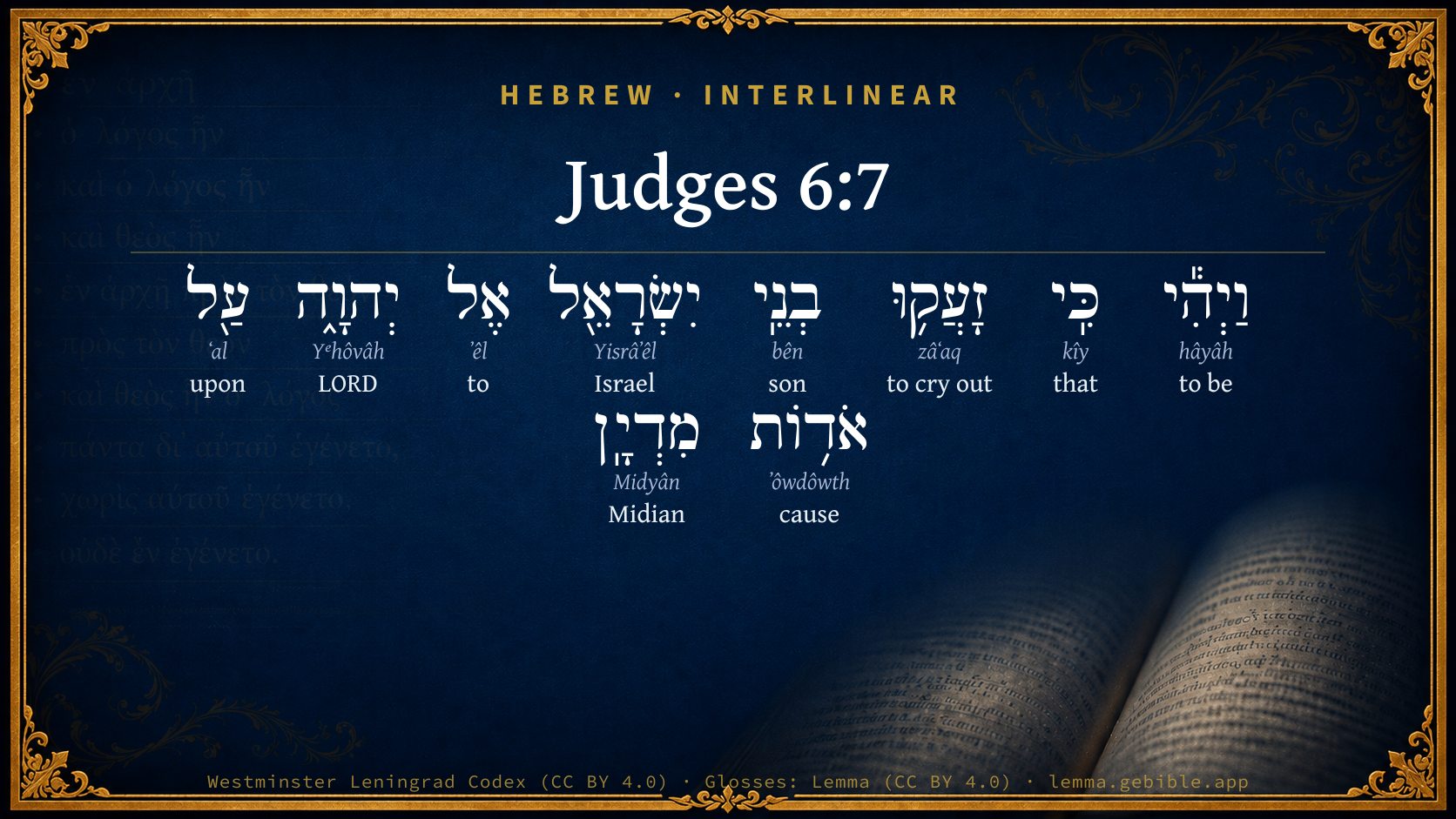
Judges 6:7

Hebrew (Westminster Leningrad Codex) Judges 6:7 appears in the Hebrew Old Testament. The text above is from the Westminster Leningrad Codex. Each word links to its Strong’s number, a concise gloss, and parsing drawn from the Open Scriptures Hebrew Bible morphology. Click any word for its full Brown-Driver-Briggs (BDB) entry.
Download image
Cite this verse

Judges 6:7 (World English Bible). Public Domain. Lemma interlinear Bible study tool, https://lemma.gebible.app/v/judges/6/7.

Show BibTeX & RIS
BibTeX
RIS
English Translation
It happened, when the children of Israel cried to Yahweh because of Midian,
World English Bible · Public Domain
Download a study sheet

One document with this verse’s original text, its word-by-word gloss line, the meaning frame, cross-references with their text, attributed commentary, and full source and license credits — printable, and it pastes into notes with its structure intact.

This verse Autodidact and up

Study sheet (.html) Plain text (.txt)

A passage Seminary Student

Up to 50 verses in one chapter. A passage sheet keeps up to 6 commentary sources and 12 cross-references per verse, in the order this page ranks them, and says so on the sheet whenever that leaves anything out. Ask for a single verse and you get the Autodidact verse sheet above.

Everything on this page stays free to read, with no account — the sheet is a download of what is already on screen, not access to it.

Want to remove ads? Support Godless Engineer
Compare translations 3

The same verse in 3 English versions, stacked beneath the original-language interlinear above. Click any original word for its lexicon entry.

Each is an independent rendering of the whole verse — the interlinear is not word-aligned to these translations.

Highlighted words mark where these versions differ — a whole-verse word diff, not a word-by-word alignment.

  • World English Bible Public Domain
    It happened, when the children of Israel cried to Yahweh because of Midian,
  • King James Version Public Domain
    And it came to pass, when the children of Israel cried unto the LORD because of the Midianites,
  • unfoldingWord Literal Text CC BY-SA 4.0
    Now it happened, when the sons of Israel cried out to Yahweh on account of Midian,

unfoldingWord Literal Text — © unfoldingWord, licensed CC BY-SA 4.0. Word-aligned USFM3 via Door43 (git.door43.org/unfoldingWord/en_ult).

Versions to compare (up to 4)

3 of 4 selected

Show all 18 translations

Every available English version of this verse, each an independent rendering of the whole verse.

  • World English Bible Public Domain
    It happened, when the children of Israel cried to Yahweh because of Midian,
  • Berean Standard Bible Public Domain
    Now when the Israelites cried out to the LORD because of Midian,
  • Majority Standard Bible Public Domain
    Now when the Israelites cried out to the LORD because of Midian,
  • King James Version Public Domain
    And it came to pass, when the children of Israel cried unto the LORD because of the Midianites,
  • American Standard Version (1901) Public Domain
    And it came to pass, when the children of Israel cried unto Jehovah because of Midian,
  • Revised Version (1885) Public Domain
    And it came to pass, when the children of Israel cried unto the LORD because of Midian,
  • Geneva Bible (1599) Public Domain
    And when the children of Israel cryed vnto the Lord because of the Midianites,
  • Douay-Rheims (1899) Public Domain
    And Israel was humbled exceedingly in the sight of Madian.
  • Young's Literal Translation Public Domain
    And it cometh to pass when the sons of Israel have cried unto Jehovah, concerning Midian,
  • Literal Standard Version CC BY-SA 4.0
    And it comes to pass, when the sons of Israel have cried to YHWH concerning Midian,
  • Unlocked Literal Bible CC BY-SA 4.0
    When the people of Israel called out to Yahweh because of Midian,
  • unfoldingWord Literal Text CC BY-SA 4.0
    Now it happened, when the sons of Israel cried out to Yahweh on account of Midian,
  • Darby Bible Public Domain
    When the people of Israel cried to the LORD on account of the Mid'ianites,
  • World Messianic Bible Public Domain
    When the children of Israel cried to the LORD because of Midian,
  • Webster's Bible Public Domain
    And it came to pass, when the children of Israel cried to the LORD because of the Midianites,
  • Free Bible Version CC BY-SA 4.0
    When the Israelites cried out to the Lord for help because of the Midianites,
  • Bible in Basic English Public Domain
    And when the cry of the children of Israel, because of Midian, came before the Lord,
  • JPS Tanakh (1917) Public Domain
    And it came to pass, when the children of Israel cried unto the LORD because of Midian,

Literal Standard Version (2020), Covenant Press — licensed CC BY-SA 4.0. Text via the HelloAO Bible API (eBible.org). Unlocked Literal Bible (unfoldingWord) — licensed CC BY-SA 4.0. Text via the HelloAO Bible API (eBible.org). unfoldingWord Literal Text — © unfoldingWord, licensed CC BY-SA 4.0. Word-aligned USFM3 via Door43 (git.door43.org/unfoldingWord/en_ult). Free Bible Version, Dr. Jonathan Gallagher — licensed CC BY-SA 4.0. Text via the HelloAO Bible API (eBible.org).

Word by word

More ways to search: Search by grammar → Find every occurrence → Compare this word →

Practice this passage: Drill this verse → Learn its vocabulary →

About this verse

These counts appear in no published source. They are computed here, from the morphology-tagged text and Lemma’s own curated glosses. What Lemma adds →

10
words
10
distinct lemmas
Historical
section

Notable vocabulary

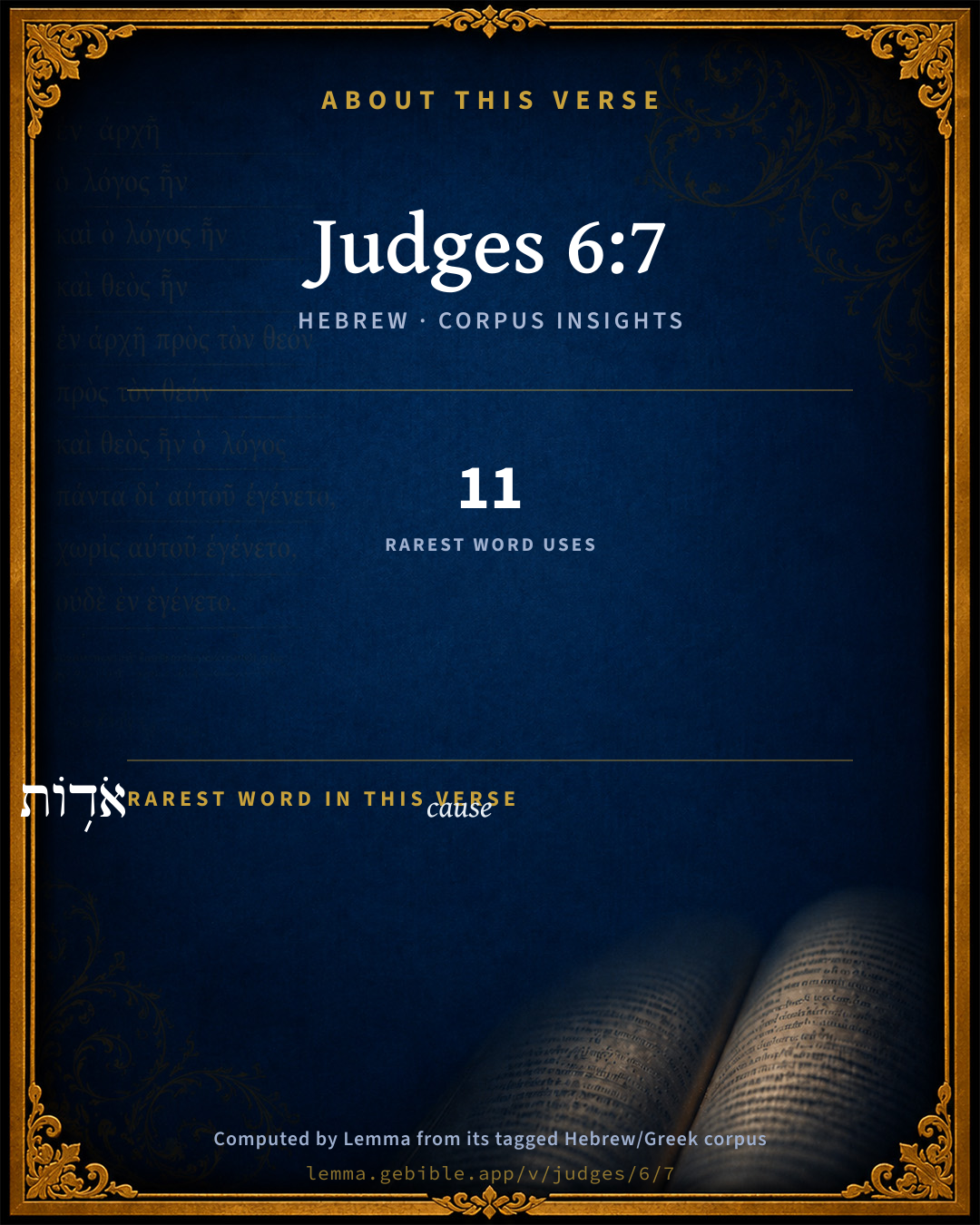
The rarest word here is אֹד֥וֹת cause H182 — appearing just 11 times in the whole Hebrew Bible.

Shared distinctive vocabulary

אֹד֥וֹת cause H182 occurs in 10 verses of the Hebrew Bible. Also found in:

Grammatical profile

  • 2 verbs
  • 5 nouns
  • 2 prepositions
  • 1 conjunction

Verb forms

  • וַיְהִ֕י Qal · Sequential Imperfect
  • זָעֲק֥וּ Qal · Perfect

Hebrew & Septuagint length

In English translation the verse runs 13 words from the Hebrew and 12 from the Septuagint (LXX English) — closely comparable.

A rough comparison of the two English renderings, which tokenize alike — not a word-level alignment.

Word counts can differ between the Hebrew and the Greek without any difference in meaning — e.g. the Hebrew direct-object marker אֵת has no separate Greek word, and Greek often adds the article ὁ.

Hebrew and Greek witnesses Masoretic Hebrew ↔ Greek Septuagint

The same verse in the two great witnesses to the Old Testament, shown verse-for-verse.

These are two independent witnesses, not word-aligned to each other, and the Septuagint is shown in lemma (dictionary) form.

Hebrew Judges 6:7 Masoretic · Westminster Leningrad Codex

וַיְהִ֕י כִּֽי זָעֲק֥וּ בְנֵֽי יִשְׂרָאֵ֖ל אֶל יְהוָ֑ה עַ֖ל אֹד֥וֹת מִדְיָֽן

It happened, when the children of Israel cried to Yahweh because of Midian,

World English Bible · Public Domain

Greek LXX Judges 6:7 Septuagint · lemma form

ἀπό πρόσωπον μαδιαμ

And the children of Israel cried to the Lord because of Madiam.

LXX2012 (modern English Septuagint) · Public Domain

Hebrew: Westminster Leningrad Codex (CC BY 4.0). Greek: Septuagint (public domain); English from LXX2012 (modern English Septuagint) (Public Domain). How the Septuagint differs from the Hebrew →

Targum (Aramaic paraphrase)

1

The Targum is the ancient Jewish Aramaic paraphrase of the Hebrew Scriptures — an interpretive translation, not the Hebrew text itself. Onkelos (literal) and Pseudo-Jonathan (expansive) render the Torah, and Jonathan the Prophets. Coverage is partial: where no permissively-licensed English translation exists for a verse, only the Aramaic is shown. This is verse-level text, not a word-by-word alignment to the Hebrew.

  1. Targum Jonathan Prophets (Joshua–Malachi)
    וַהֲוָה כַּד זְעִיקוּ בְּנֵי יִשְׂרָאֵל קֳדָם יְיָ עַל עֵסַק מִדְיָנָאֵי:

    (no public-domain English translation for this verse)

    Targum Jonathan — Aramaic: “Mikraot Gedolot” (public domain). English: “Sefaria Community Translation” (CC0 1.0 (public-domain dedication)); “London "Chaldee Paraphrase," 1871” (public domain). Text via Sefaria.

Commentary

Notes on Judges 6:7 from classic Christian and Jewish commentators (each source and its license shown beneath its notes). The classic Christian expositions comment on the surrounding passage and are grouped to its opening verse, so a note may address several verses; the Jewish commentaries on the Tanakh (Rashi and others) are per-verse, so they appear only where the commentator wrote on this verse.

Lemma curates 59 commentaries, every one of them public domain or Creative Commons licensed, each selected and text-cleaned for this edition rather than reprinted as found. About our sources →

Trapp's Complete Commentary

John Trapp

Jdg 6:7 And it came to pass, when the children of Israel cried unto the LORD because of the Midianites,

Ver. 7. When the children of Israel cried.] If men can find a praying heart, God will find a pitying heart.

John Trapp, A Commentary or Exposition upon All the Books of the Old and New Testament (1647–1656) — public domain. Text from a community e-Sword module.

Matthew Henry's Commentary

Observe here, I. The cognizance God took of the cries of Israel, when at length they were directed towards him. Though in their prosperity they had neglected him and made court to his rivals, and though they never looked towards him until they were driven to it by extremity, yet, upon their complain and prayer, he intended relief for them. Thus would he show how ready he is to forgive, how swift he is to show mercy, and how inclinable to hear prayer, that sinners may be encouraged to return and repent, Psa 130:4.

II. The method God took of working deliverance for them.

1. Before he sent an angel to raise them up a saviour he sent a prophet to reprove them for sin, and to bring them to repentance, Jdg 6:8. This prophet is not named, but he was a man, a prophet, not an angel, as Jdg 2:1. Whether this prophet took an opportunity of delivering his message to the children of Israel when they had met together in a general assembly, at some solemn feast or other great occasion, or whether he went from city to city and from tribe to tribe, preaching to this purport, is not certain; but his errand was to convince them of sin, that, in their crying to the Lord, they might confess that with sorrow and shame, and not spend their breath in only complaining of their trouble. They cried to God for a deliverer, and God sent them a prophet to instruct them, and to make them ready for deliverance. Note, (1.) We have reason to hope God is designing mercy for us if we find he is by his grace preparing us for it. If to those that are sick he sends a messenger, an interpreter, by whom he shows unto man his uprightness, then he is gracious, and grants a recovery, Job 33:23, Job 33:24. (2.) The sending of prophets to a people, and the furnishing of a land with faithful ministers, is a token for good, and an evidence that God has mercy in store for them. He thus turns us to him, and then causes his face to shine, Psa 80:19.

2. We have here the heads of the message which this prophet delivered in to Israel, in the name of the Lord.

(1.) He sets before them the great things God had done for them (Jdg 6:8, Jdg 6:9): Thus saith the Lord God of Israel; they had worshipped the gods of the nations, as if they had had no God of their own to worship and therefore might choose whom they pleased; but they are here reminded of one whom they had forgotten, who was known by the title of the God of Israel, and to him they must return. They had turned to other gods, as if their own had been either incapable or unwilling to protect them, and therefore they are told what he did for their fathers, in whose loins they were, the benefit of which descended and still remained to this their ungrateful seed. [1.] He brought them out of Egypt, where otherwise they would have continued in perpetual poverty and slavery. [2.] He delivered them out of the hands of all that oppressed them; this is mentioned to intimate that the reason why they were not now delivered out of the hands of the oppressing Midianites was not for want of any power or good-will in God, but because by their iniquity they had sold themselves, and God would not redeem them until they by repentance revoked the bargain. [3.] He put them in quiet possession of this good land; this not only aggravated their sin, and affixed the brand of base ingratitude to it, but it justified God, and cleared him from blame upon account of the trouble they were now in. They could not say he was unkind, for he had given all possible proofs of his designing well for them; if ill befel them notwithstanding, they must thank themselves.

(2.) He shows the easiness and equity of God's demands and expectations from them (Jdg 6:10): "I am the Lord your God, to whom you lie under the highest obligations, fear not the gods of the Amorites," that is, "do not worship them, nor show any respect to them; do not worship them for fear of their doing you any hurt, for what hurt can they do you while I am your God? Fear God, and you need not fear them."

(3.) He charges them with rebellion against God, who had laid this injunction upon them: But you have not obeyed my voice. The charge is short, but very comprehensive; this was the malignity of all their sin, it was disobedience to God; and therefore it was this that brought those calamities upon them under which they were now groaning, pursuant to the threatenings annexed to his commands. He intends hereby to bring them to repentance; and our repentance is then right and genuine when the sinfulness of sin, as disobedience to God, is that in it which we chiefly lament.

Matthew Henry's Commentary on the Whole Bible (1708–1710) — public domain (CC PDM 1.0). Text via the HelloAO Bible API.

The Cambridge Bible for Schools and Colleges

gen. ed. J. J. S. Perowne

7–10. A prophet is sent with a reproof

8. a prophet] This prophetic expostulation reminds us of the words of the Angel in Jdg_2:1 b – Jdg_2:5 a, of Jehovah in Jdg_10:11-16, of Samuel in 1Sa_7:3 f., Jdg_10:17-18, Jdg_12:6-15; cf. also 2Ki_17:35-40. The prophet here is anonymous. His appeal for loyalty is based upon (a) the deliverance from Egypt, which was regarded by the earliest prophets as the starting-point of Israel’s career as the people of Jehovah, Amo_2:10; Amo_3:1; Amo_9:7, Hos_11:1; Hos_12:9; Hos_12:13; Hos_13:4, and (b) the law in Exo_20:2 f. (= Deu_5:7) requiring the exclusive worship of Jehovah.

The Cambridge Bible for Schools and Colleges (gen. ed. J. J. S. Perowne; Cambridge University Press, 1878–1918) — public domain. Text from a community e-Sword module.

John Gill's Exposition

And it came to pass, when the children of Israel cried unto the Lord, because of the Midianites. Because of their oppressions and ill usage of them, and not because of their sins, which had brought those evils on them, of which, at present, they seemed not to be sensible; and yet such was the goodness and compassion of God to them, that having a mind to deliver them, he immediately, on their crying to him, sends them a messenger to bring them to a sense of their sins, and prepare them for the deliverance he designed to work for them, as follows.

And it came to pass, when the children of Israel cried unto the Lord, because of the Midianites. Because of their oppressions and ill usage of them, and not because of their sins, which had brought those evils on them, of which, at present, they seemed not to be sensible; and yet such was the goodness and compassion of God to them, that having a mind to deliver them, he immediately, on their crying to him, sends them a messenger to bring them to a sense of their sins, and prepare them for the deliverance he designed to work for them, as follows.

Judges 6:8

jdg 6:8

jdg 6:8

jdg 6:8And the Lord sent a prophet unto the children of Israel,.... "A man, a prophet" (f), as in the Hebrew text, not an angel, but a man; and this not Phinehas, as say some Jewish writers (g); for it is not probable he should live so long as more than two hundred years; and had he been living, it is very much he should not have been heard of in the times of the preceding judges, and that he was not made use of before now to reprove the people for their sins; but who the prophet was we have no account now nor hereafter, here or elsewhere. Abarbinel supposes he was raised up for a short time:

which said unto them, thus saith the Lord God of Israel; he came in the name of the Lord, and using the form and manner of speech the prophets of Israel did, putting them in mind of the true God they had forgot, and who yet was their Lord and God:

I brought you up from Egypt, and brought you forth out of the house of bondage; reminding them of the benefits they received from God, and the obligations they lay under to serve him, who, when they were bond slaves in Egypt, he appeared for them, and brought them out of their miserable condition.

(f) "virum prophetam", V. L. Pagninus, Montanus, Junius & Tremellius, Piscator. (g) Seder Olam Rabba, c. 20. p. 53.

John Gill's Exposition of the Whole Bible (1746–1763) — public domain (CC PDM 1.0). Text via the HelloAO Bible API.

The Pulpit Commentary

Vers. 7, 8, 11, 34. Divine mercy: its adaptation and sufficiency.

The cry of distress is heard instantly by Jehovah, and the answer begins to come at once. But only as is best for the sinning nation. As there was discipline in the misery to which Israel was reduced, so there is still discipline in the succession and several instalments of the mercy of God. The aim is not merely nor so much to deliver from the material evil to which they were subject, but to root out the unbelief and develop the spiritual life and moral heroism of the people.

I THE IMMEDIACY OF GOD"S MERCY. It came to pass, when the children of Israel cried... that the Lord sent a prophet. " There appears to be no interval. God begins to readjust his relations with Israel at once. But the material boon is not granted then. The sting must rankle until true repentance is forthcoming. Deliverance would have been a very questionable blessing under the circumstances. Freedom and independence are responsibilities as well as birthrights. So God hears the cry of the sinner always. "Not what we wish, but what we want," that in the end what we wish may be rendered spiritually advisable and blessed. The measure of comfort here was that God was not silent, prayer was not unavailing. There is hope in the opening of mercy"s door, even though it be in reproof.

II THE SUCCESSIONS OF GOD"S MERCY. First the cry of desperation and repentance, then the outward reproof, then the direction, encouragement, and training of a deliverer, then the recovery of national freedom, prosperity, and prestige. Flowerlike. So God adapts his blessings to the moral and spiritual capacity of his people. The Divine view of our misery and its requirements is the reverse of the human; we think of the material suffering, God of the moral defect and sin. These mercies as they come in train are manifestly education, that the work of grace may be effectual. "Grace for grace" is a law of his kingdom. And the dignity of God is never lost.

III MERCY IN ITS CULMINATION. God did not stop short of ultimate deliverance, although it was not achieved at once. So "he crowneth us with his loving-kindness and tender mercy." It is no mere secular and vulgar deliverance. It is national re-creation. The chivalry of Israel is called forth. It is even more a religious than a military triumph. So the salvation of the soul has its splendours and glories. It is absolute, complete, and magnificent, crowning the life of the faithful. "An abundant entrance will be ministered" into the kingdom of his Son. "We are more than conquerors" through him. M.

Vers. 7-10. Merciful reproof.

The answer to prayer begins in reproof. An anonymous messenger is sent, a prophet probably from amongst the Israelites themselves. In such a season of distress and seclusion they would become strangers even to themselves. No biography is given of the prophet. He is raised for the occasion. His message is simple. But it is the utterance of the people"s own national and individual conscience. He is a "voice crying in the wilderness," and saying, "Repent!

I THERE IS ENCOURAGEMENT EVEN IN GOD"S CHIDINGS. For

1. They are better than absolute and final silence.

2. They are meant to bring us back to him, and not to drive us away.

3. His severity is to prepare us for his gentleness.

II IT IS OFTEN AS NECESSARY AND PROFITABLE TO BE IMPRESSED WITH WHAT WE ALREADY KNOW AS TO RECEIVE NEW TRUTH. Revelation is not primarily intended to satisfy intellectual cravings, but to stimulate and enrich the moral nature. A sermon may be a mere exhortation, an impressive resume of acknowledged truth, and yet more valuable than if it were full of theological discoveries. Knowledge of God becomes religious and living when it is realized and acted upon. In this connection notice

1. How impressive the personality of the prophet.

2. The heightening of the conscience of sin by contrast with remembered and recited mercies.

3. The tone and style of the discourse. It was short, direct, spoken to the conscience. Its chief message and its sting is in the conclusion. No word of comfort is uttered. The people are left with their consciousness of sin. But this in itself is a gracious work, and preparatory for everything that is good. Thorough repentance is the condition of deep and lasting piety. M.

HOMILIES BY W.F. ADENEY Vers. 7-10. God sought and found in times of trouble.

I TROUBLE DRIVES MEN TO GOD. The people forsook God in their prosperity, and neglected his service so long as they enjoyed their comfortable homes in peace. But now they are miserable fugitives hiding in wild mountain caves, they remember his goodness and cry to him for help. This is a common experience. It is to our shame that it must be confessed. We ought to seek God for his own sake, to worship him in the beauty of holiness, not merely to obtain blessings for ourselves. In prosperity we should recognise tokens of his love, and so lift up our thoughts to him in grateful recognition of his goodness. To turn to God only in the hour of our need is a sign of base selfishness. Nevertheless it is better to seek him then than not at all. And if it is disgraceful in us that trouble should be needed to drive us to God, it is merciful in him to send the trouble for that object. The calamity which leads to this result is the greatest blessing. Herein we may see the end of many of the most severe forms of adversity. They are sent to us in our indifference to rouse us to our need of God, and lead us to seek him. Hence we may conclude that if we sought God aright in happy circumstances we might be spared some of the troubles which our spiritual negligence renders necessary to our soul"s welfare. (Hos_5:15)

II IF GOD IS TRULY SOUGHT IN TROUBLE HE WILL CERTAINLY BE FOUND. As soon as the people cried God heard them, and sent them first a prophet and then the deliverer Gideon. If we forsook God in our prosperity it would be reasonable that God should forsake us in our need. But he does not deal with us according to our sins. Our claim does not lie in our merit, in our obedience and fidelity, in anything of ours, but in his nature, and character, and conduct. Because God is our Father he hears us not out of consideration for our rights, but out of pity for our distresses. Therefore we need not fear that he will not respond to our call. To doubt is not to show our humility, but our distrust in the mercy of God and influence of Christ"s sacrifice and intercession. (Jer_29:11-13)

III WHEN GOD IS FOUND IN TROUBLE HE DOES NOT ALWAYS BRING IMMEDIATE DELIVERANCE. Israel called for help in need. God did not send the help at once. The people expected a deliverer, God sent a prophet. No word of promise is given by the prophet that relief will be accorded to the temporal distress of the nation. He speaks only of sin, and shows the ingratitude of the people, that they may feel how richly they deserve the calamities which have fallen upon them. They think most of their distresses, God of their sins. They cry for deliverance from the yoke of the Midianites, God wishes first to deliver them from the yoke of iniquity. Therefore the prophet of repentance comes before Gideon the deliverer. So we must expect that when God visits us in our sins he will deal with us so as to save us from spiritual evil before relieving us of physical distress. Christ bore the sicknesses and infirmities of his people, but his great work was to save them from their sins. (Mat_1:21)

IV THE CONSCIOUSNESS OF SIN WHICH MUST PRECEDE DELIVERANCE IS PRODUCED BY A PROPHET"S MESSAGE IN THE MIDST OF TROUBLE. The trouble is necessary to soften the hearts of the people, and make them willing to listen to the prophet. Yet the trouble does not produce repentance. For this a prophet is needed. The prophet does not make any prediction, nor does he give any revelation of God; he simply reveals his hearers to themselves. We need prophets to show to us our own true character. Much of the Bible is a revelation of human nature which would not have been possible without the aid of prophetic inspiration. The call to repentance consists

(1) in recounting the ancient mercy of God, for it is in the light of God"s goodness that we see most clearly our own wickedness; and

(2) in directly charging Israel with ingratitude and apostasy. All sin includes the sin of ingratitude. Till we feel this it is not well that God should show us more mercy. Therefore the stern John the Baptist must precede the saviour Christ; bat as Gideon followed the prophet, full salvation will follow repentance and submission. A.

The Pulpit Commentary (1880–1919), ed. H.D.M. Spence-Jones & Joseph S. Exell — public domain. Text from a community e-Sword module.

unfoldingWord translationNotes

Door43 World Missions Community

called out to Yahweh

This is an idiom. AT: "prayed to Yahweh for help" (See: Idiom)

because of Midian

Here "Midian" represents the people of Midian. AT: "because of the Midianites" (See: Metonymy)

I brought you up from Egypt

"I led you out of Egypt"

the house of slavery

Moses speaks of Egypt as if it were a house where people keep slaves. AT: "the place where you were slaves" (See: Metaphor)

translationWords

Israel

call

Yahweh

Midian

send

prophet

God

Egypt

house

servant

unfoldingWord translationNotes — © Distant Shores Media and the Door43 World Missions Community, licensed CC BY-SA 4.0. Source: git.door43.org/Door43/en_tn.

Lesson kit

Teaching starters — assembled from the data on this page, not authored interpretation. Every prompt links to the verse data it draws on. Edit before teaching.

Judges, in the Historical, opens this verse with 10 words (10 distinct Hebrew lemmas). Its most distinctive word is ʼôwdôwth (“cause”). A historical commentator’s framing appears above. Read the whole chapter for the surrounding context.

Discussion questions

  1. How does “cause” (ʼôwdôwth) shape what this verse is saying?
  2. How does Genesis 21:11, which shares the word «cause», read alongside this verse?
  3. The translations on this page render this verse differently — a whole-verse word diff, not a word-by-word alignment. What might account for the different wordings?
  4. «וַיְהִ֕י» is a Qal Sequential Imperfect verb. How does that grammatical form shape the action described?
  5. Compare how Trapp's Complete Commentary and Matthew Henry's Commentary read this verse. Where do they agree or differ?

Things to notice

Reading settings

Reading text

Shown beneath each verse's original-language words.

Old Testament
Old Testament edition

Read the OT as the Masoretic Hebrew (MT) or the Greek Septuagint (LXX).

English shown for the Greek Septuagint (in the Hebrew ↔ Greek comparison).

Comparing translations? Open the Compare panel on any verse page to stack up to four side by side.