
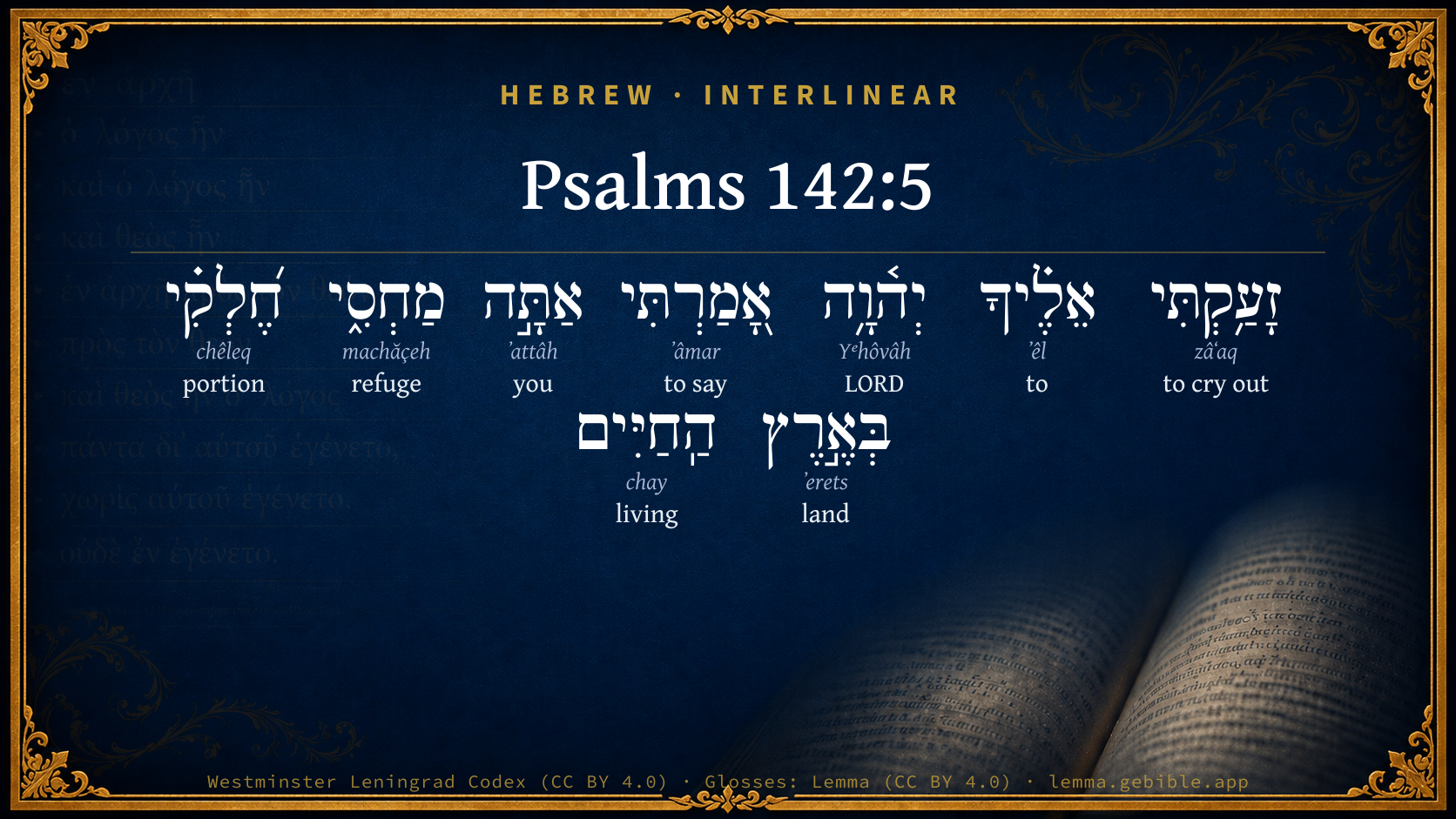
Psalms 142:5

Hebrew (Westminster Leningrad Codex) Psalms 142:5 appears in the Hebrew Old Testament. The text above is from the Westminster Leningrad Codex. Each word links to its Strong’s number, a concise gloss, and parsing drawn from the Open Scriptures Hebrew Bible morphology. Click any word for its full Brown-Driver-Briggs (BDB) entry.
Download image
Cite this verse

Psalms 142:5 (World English Bible). Public Domain. Lemma interlinear Bible study tool, https://lemma.gebible.app/v/psalms/142/5.

Show BibTeX & RIS
BibTeX
RIS
English Translation
I cried to you, Yahweh. I said, "You are my refuge, My portion in the land of the living."
World English Bible · Public Domain
Download a study sheet

One document with this verse’s original text, its word-by-word gloss line, the meaning frame, cross-references with their text, attributed commentary, and full source and license credits — printable, and it pastes into notes with its structure intact.

This verse Autodidact and up

Study sheet (.html) Plain text (.txt)

A passage Seminary Student

Up to 50 verses in one chapter. A passage sheet keeps up to 6 commentary sources and 12 cross-references per verse, in the order this page ranks them, and says so on the sheet whenever that leaves anything out. Ask for a single verse and you get the Autodidact verse sheet above.

Everything on this page stays free to read, with no account — the sheet is a download of what is already on screen, not access to it.

Want to remove ads? Support Godless Engineer
Compare translations 3

The same verse in 3 English versions, stacked beneath the original-language interlinear above. Click any original word for its lexicon entry.

Each is an independent rendering of the whole verse — the interlinear is not word-aligned to these translations.

Highlighted words mark where these versions differ — a whole-verse word diff, not a word-by-word alignment.

  • World English Bible Public Domain
    I cried to you, Yahweh. I said, "You are my refuge, My portion in the land of the living."
  • King James Version Public Domain
    I cried unto thee, O LORD: I said, Thou art my refuge and my portion in the land of the living.
  • unfoldingWord Literal Text CC BY-SA 4.0
    I cried out to you, Yahweh; I said, “You my shelter, my portion in the land of the living.”

unfoldingWord Literal Text — © unfoldingWord, licensed CC BY-SA 4.0. Word-aligned USFM3 via Door43 (git.door43.org/unfoldingWord/en_ult).

Versions to compare (up to 4)

3 of 4 selected

Show all 18 translations

Every available English version of this verse, each an independent rendering of the whole verse.

  • World English Bible Public Domain
    I cried to you, Yahweh. I said, "You are my refuge, My portion in the land of the living."
  • Berean Standard Bible Public Domain
    I cry to You, O LORD: “You are my refuge, my portion in the land of the living.”
  • Majority Standard Bible Public Domain
    I cry to You, O LORD: “You are my refuge, my portion in the land of the living.”
  • King James Version Public Domain
    I cried unto thee, O LORD: I said, Thou art my refuge and my portion in the land of the living.
  • American Standard Version (1901) Public Domain
    I cried unto thee, O Jehovah; I said, Thou art my refuge, My portion in the land of the living.
  • Revised Version (1885) Public Domain
    I cried unto thee, O LORD; I said, Thou art my refuge, my portion in the land of the living.
  • Geneva Bible (1599) Public Domain
    Then cryed I vnto thee, O Lord, and sayde, thou art mine hope, and my portion in the land of the liuing.
  • Douay-Rheims (1899) Public Domain
    The just shall correct me in mercy, and shall reprove me: but let not the oil of the sinner fatten my head. For my prayer also shall still be against the things with which they are well pleased:
  • Young's Literal Translation Public Domain
    I have cried unto thee, O Jehovah, I have said, `Thou `art' my refuge, My portion in the land of the living.'
  • Literal Standard Version CC BY-SA 4.0
    I have cried to you, O YHWH, || I have said, “You [are] my refuge, || My portion in the land of the living.”
  • Unlocked Literal Bible CC BY-SA 4.0
    I called out to you, Yahweh; I said, “You are my refuge, my portion in the land of the living.
  • unfoldingWord Literal Text CC BY-SA 4.0
    I cried out to you, Yahweh; I said, “You my shelter, my portion in the land of the living.”
  • Darby Bible Public Domain
    I cried unto thee, Jehovah; I said, Thou art my refuge, my portion in the land of the living.
  • World Messianic Bible Public Domain
    I cried to you, LORD. I said, “You are my refuge, my portion in the land of the living.”
  • Webster's Bible Public Domain
    \\142:4\\I looked on my right hand, and beheld, but there was no man that would know me: refuge failed me; no man cared for my soul.
  • Free Bible Version CC BY-SA 4.0
    I cry out to you, Lord, for help, saying, “You are the one who keeps me safe; you are all I need in life.
  • Bible in Basic English Public Domain
    I have made my cry to you, O Lord; I have said, You are my safe place, and my heritage in the land of the living.
  • JPS Tanakh (1917) Public Domain
    (142-6) I have cried unto Thee, O LORD; I have said: 'Thou art my refuge, my portion in the land of the living.'

Literal Standard Version (2020), Covenant Press — licensed CC BY-SA 4.0. Text via the HelloAO Bible API (eBible.org). Unlocked Literal Bible (unfoldingWord) — licensed CC BY-SA 4.0. Text via the HelloAO Bible API (eBible.org). unfoldingWord Literal Text — © unfoldingWord, licensed CC BY-SA 4.0. Word-aligned USFM3 via Door43 (git.door43.org/unfoldingWord/en_ult). Free Bible Version, Dr. Jonathan Gallagher — licensed CC BY-SA 4.0. Text via the HelloAO Bible API (eBible.org).

Word by word

More ways to search: Search by grammar → Find every occurrence → Compare this word →

Practice this passage: Drill this verse → Learn its vocabulary →

מַחְסִ֑י
machăçeh
H4268
“refuge · my”
Noun, Common, Masculine, Singular, Construct + Suffix, Personal, 1st Person, Common, Singular
Part of Speech
Noun
Type
Common
Gender
Masculine
Number
Singular
State
Construct
Full BDB Definition

Origin: from H2620

TWOT: 700b

refuge, shelter - from rain or storm, from danger - of falsehood
  1. זָעַ֥קְתִּי zâʻaq H2199 “to cry out” Verb, Qal, Perfect, 1st Person, Common, Singular
  2. אֵלֶ֗יךָ ʼêl H413 “to · you” Preposition + Suffix, Personal, 2nd Person, Masculine, Singular
  3. יְה֫וָ֥ה Yᵉhôvâh H3068 “LORD” Noun, Proper
  4. אָ֭מַרְתִּי ʼâmar H559 “to say” Verb, Qal, Perfect, 1st Person, Common, Singular
  5. אַתָּ֣ה ʼattâh H859 “you” Pronoun, Personal, 2nd Person, Masculine, Singular
  6. חֶ֝לְקִ֗י chêleq H2506 “portion · my” Noun, Common, Masculine, Singular, Construct + Suffix, Personal, 1st Person, Common, Singular
  7. בְּאֶ֣רֶץ ʼerets H776 “in/at · land of” Preposition + Noun, Common, Both, Singular, Construct
  8. הַֽחַיִּים chay H2416 “the · living” Particle, Definite Article + Adjective, Adjective, Masculine, Plural, Absolute

About this verse

These counts appear in no published source. They are computed here, from the morphology-tagged text and Lemma’s own curated glosses. What Lemma adds →

9
words
9
distinct lemmas
Wisdom
section

Notable vocabulary

The rarest word here is מַחְסִ֑י refuge H4268 — appearing just 20 times in the whole Hebrew Bible.

Shared distinctive vocabulary

מַחְסִ֑י refuge H4268 occurs in 20 verses of the Hebrew Bible. Also found in:

Grammatical profile

  • 2 verbs
  • 4 nouns
  • 1 adjective
  • 1 pronoun
  • 1 preposition

Verb forms

  • זָעַ֥קְתִּי Qal · Perfect
  • אָ֭מַרְתִּי Qal · Perfect

Hebrew & Septuagint length

In English translation the verse runs 19 words from the Hebrew and 20 from the Septuagint (LXX English) — closely comparable.

A rough comparison of the two English renderings, which tokenize alike — not a word-level alignment.

Word counts can differ between the Hebrew and the Greek without any difference in meaning — e.g. the Hebrew direct-object marker אֵת has no separate Greek word, and Greek often adds the article ὁ.

Cross-references

14

Topical passages linked to Psalms 142:5 in the Treasury of Scripture Knowledge — connected by theme and wording, ordered by reader-vote popularity; previews shown in the World English Bible.

  • 2 Timothy 4:17 But the Lord stood by me, and strengthened me, that through me the message might be fully proclaimed, and that all the Gentiles might hear; and I was delivered out of the mouth of the lion.
  • Psalms 16:5 Yahweh assigned my portion and my cup. You made my lot secure.
  • Psalms 27:13 I am still confident of this: I will see the goodness of Yahweh in the land of the living.
  • Psalms 73:26 My flesh and my heart fails, But God is the strength of my heart and my portion forever.
  • Psalms 91:2 I will say of Yahweh, "He is my refuge and my fortress; My God, in whom I trust."
  • Psalms 91:9–10 Because you have made Yahweh your refuge, And the Most High your dwelling place,
  • Lamentations 3:24 Yahweh is my portion, says my soul; therefore will I hope in him.
  • John 16:32 Behold, the time is coming, yes, and has now come, that you will be scattered, everyone to his own place, and you will leave me alone. Yet I am not alone, because the Father is with me.
  • Psalms 56:13 For you have delivered my soul from death, And prevented my feet from falling, That I may walk before God in the light of the living.
  • Psalms 119:57 Yahweh is my portion. I promised to obey your words.
  • Psalms 46:1 God is our refuge and strength, A very present help in trouble.
  • Psalms 62:6–7 He alone is my rock and my salvation, my fortress. I will not be shaken.
  • Psalms 46:7 Yahweh of Hosts is with us. The God of Jacob is our refuge. Selah.
  • Psalms 46:11 Yahweh of Hosts is with us. The God of Jacob is our refuge. Selah.

Cross-references courtesy of OpenBible.info (CC BY 4.0).

Hebrew and Greek witnesses Masoretic Hebrew ↔ Greek Septuagint

The same verse in the two great witnesses to the Old Testament, shown verse-for-verse.

You’re reading Greek Psalm 141 (Hebrew Psalm 142). The Septuagint counts the superscription, so verse numbers can differ from the Hebrew — chapter-level alignment, not verse-by-verse. Numbering follows Rahlfs.

These are two independent witnesses, not word-aligned to each other, and the Septuagint is shown in lemma (dictionary) form.

Hebrew Psalms 142:5 Masoretic · Westminster Leningrad Codex

זָעַ֥קְתִּי אֵלֶ֗יךָ יְה֫וָ֥ה אָ֭מַרְתִּי אַתָּ֣ה מַחְסִ֑י חֶ֝לְקִ֗י בְּאֶ֣רֶץ הַֽחַיִּים

I cried to you, Yahweh. I said, "You are my refuge, My portion in the land of the living."

World English Bible · Public Domain

Greek LXX Greek Psalm 141:5 Septuagint · lemma form

κατανοέω εἰς ὁ δεξιός καί ἐπιβλέπω ὅτι οὐ εἰμί ὁ ἐπιγιγνώσκω ἐγώ ἀποὀλλύω φυγή ἀπό ἐγώ καί οὐ εἰμί ὁ ἐκζητέω ὁ ψυχή ἐγώ

I cried to you, O Lord, and said, You are my hope, my portion in the land of the living.

LXX2012 (modern English Septuagint) · Public Domain

Hebrew: Westminster Leningrad Codex (CC BY 4.0). Greek: Septuagint (public domain); English from LXX2012 (modern English Septuagint) (Public Domain). How the Septuagint differs from the Hebrew →

Commentary

Notes on Psalms 142:5 from classic Christian and Jewish commentators (each source and its license shown beneath its notes). The classic Christian expositions comment on the surrounding passage and are grouped to its opening verse, so a note may address several verses; the Jewish commentaries on the Tanakh (Rashi and others) are per-verse, so they appear only where the commentator wrote on this verse.

Lemma curates 59 commentaries, every one of them public domain or Creative Commons licensed, each selected and text-cleaned for this edition rather than reprinted as found. About our sources →

Trapp's Complete Commentary

John Trapp

Psa 142:5 I cried unto thee, O LORD: I said, Thou [art] my refuge [and] my portion in the land of the living.

Ver. 5. I cried unto thee, O Lord] I ran to thee, as my last refuge, in the fail of all outward comforts. Zep 3:12, they are an "afflicted poor people"; and being so, "they trust in the name of the Lord."

John Trapp, A Commentary or Exposition upon All the Books of the Old and New Testament (1647–1656) — public domain. Text from a community e-Sword module.

The Biblical Illustrator

Joseph S. Exell

Psa_142:5

Thou art my refuge and my portion in the land of the living.

God in Christ, the believers refuge and portion

I. Concerning the refuge.

1. God in Christ is the refuge itself (Isa_4:6; Zec_3:8; Zec_6:12; Joh_1:14; Isa_32:2; Deu_33:27).

2. This refuge is by a legal destination a refuge for lost mankind (2Co_5:19; Joh_3:14-16; Tit_3:4).

(1) For the oppressed (Psa_9:9; Psa_72:4; Rom_16:20).

(2) For outcasts (Psa_142:4-5).

(3) For debtors (Isa_25:4).

(4) For criminals liable to death by the law (Heb_6:18).

3. The gate of this refuge through which sinners enter is the vail of the flesh of Christ, rent, torn, and opened to let in the guilty creature unto Jehovah as a refuge (Heb_10:19-20).

4. The covert in this refuge is the righteousness of Christ (Jer_23:6; Php_3:9).

(1) The satisfaction of Christs death and sufferings (1Jn_2:2).

(2) The righteousness of Christs life and conversation, who obeyed the commands of the law as a public person, as well as He suffered the penalty of it in that capacity (Rom_5:19).

(3) The holiness of His birth and nature (Heb_7:26).

5. The several apartments in this refuge for the various cases of the refugees are all the attributes and perfections of God the Lord Jehovah (Pro_18:10).

6. The boundaries of this refuge are the everlasting covenant (Psa_46:7).

7. The sinners entering into the refuge is by faith.

II. Concerning the portion.

1. The same God in Christ, who is the refuge for poor sinners, is also the portion for them to live by.

2. God in Christ is what one may live on (Psa_16:5-6). In Him man has a dwelling-place (Psa_90:1); raiment (Rev_3:18); meat and drink (Joh_6:55); and all in a word (Php_4:18; 2Co_6:10). And hereto belongs the sanctification of the soul in the beginning, progress, and consummation of it, as that which is for the perfecting of the soul (1Co_1:30). (T. Boston, D. D.)

The Biblical Illustrator, edited by Joseph S. Exell (c. 1880s–1900s) — public domain. Text from a community e-Sword module.

Joseph Benson's Commentary

Psa 142:5. I cried, rather I cry, unto thee, O Lord — Thou knowest me and carest for me, when no one else will, and wilt not fail me nor forsake me when men do. Thou art my refuge and my portion — Thou only art both my refuge to defend me from all evil, and my portion to supply me with all the good which I need and desire; in the land of the living — Even in this life, wherein I doubt not to see thy goodness, and more especially in the life to come. There is enough in God to answer all the necessities of this present time; we live in a world of dangers and wants, but what danger need we fear, if God is our refuge; and what wants, if he be our portion? Heaven, which alone deserves to be called the land of the living, will be to all believers both a refuge and a portion.

Joseph Benson's Commentary on the Old and New Testaments (1811–1818) — public domain. Text from a community e-Sword module.

J. A. Alexander on Psalms

Joseph Addison Alexander

6. (Psa 142:5) I have cried unto thee, Jehovah. I have said, Thou (art) my refuge, my portion in the land of life. I have cried and still cry; I have said and still say. With this last expression compare Psa 31:14; Psa 41:4. Thou (art) my refuge, as in Psa 62:7; Psa 71:7. My portion, as in Psa 16:5; Psa 73:26; Psa 119:57. Land of life (or of the living), as in Psa 27:13; Psa 52:5.

Joseph Addison Alexander, The Psalms Translated and Explained (1850) — public domain. Text from a community e-Sword module.

Tyndale Open Study Notes

Tyndale Open Resources

142:5 Though he is alone, the psalmist’s trust remains in the Lord, who is his life (see 9:9; 16:5; 27:13).

Tyndale Open Study Notes — © Tyndale Open Resources, licensed CC BY-SA 4.0. Text via the HelloAO Bible API.

Geneva Bible (1599)

Geneva Bible translators

Though all means failed him, yet he knew that God would never forsake him.

Geneva Bible (1599) marginal notes — public domain. Text via Bolls.life.

Adam Clarke's Commentary

Verse 5. Thou art my refuge] Even in these most disastrous circumstances, I will put my trust in thee.

Adam Clarke's Commentary on the Bible (1810–1826) — public domain. Text from a community e-Sword/MySword module.

John Calvin's Commentaries

5. I cried unto thee, O Jehovah! With a view to hasten God’s interposition, David complains of the low estate he was reduced to, and of his extremity; the term cry denoting vehemence, as I have elsewhere noticed. He speaks of deliverance as being plainly needed, since he was now held a prisoner. By prison some suppose he alludes to the cave where he was lodged, but this is too restricted a meaning. The subsequent clause, the righteous shall compass me, is translated differently by some, they shall wait me. I have retained the true and natural sense. I grant that it is taken figuratively for surrounding, intimating that he would be a spectacle to all, the eyes of men being attracted by such a singular case of deliverance. If any consider the words not to be figurative, the sense will be, That the righteous would not only congratulate him, but place a crown upon his head in token of victory. Some explain the passage, They will assemble to congratulate me, and will stand round me on every side like a crown. As the words literally read, they will crown upon me, some supply another pronoun, and give this sense, that the righteous would construe the mercy bestowed upon David as a glory conferred upon themselves; for when God delivers any of his children he holds out the prospect of deliverance to the rest, and, as it were, gifts them with a crown. The sense which I have adopted is the simplest, however, That the mercy vouchsafed would be shown conspicuously to all as in a theater, proving a signal example to the righteous for establishment of their faith. The verb גמל, gamal, in the Hebrew, is of a more general signification than to repay, and means to confer a benefit, as I have shown elsewhere.

John Calvin's Commentaries (1540-1563) — public domain. Text from the Calvin Translation Society English edition (1840s-50s) via the Christian Classics Ethereal Library (ccel.org). Calvin's coverage is partial (roughly two-thirds of the Bible); uncommented books and verses are honest gaps, never fabricated. The 19th-century editor's footnotes and remarks are omitted so the notes are faithfully Calvin's own voice.

Ellicott's Commentary for English Readers

(5) With this verse comp. Psa_31:3; Psa_22:8; Psa_16:5, &c.

A Bible Commentary for English Readers, edited by Charles John Ellicott (1878–1897) — public domain. Text from a community e-Sword module.

The Cambridge Bible for Schools and Colleges

gen. ed. J. J. S. Perowne

5. I cried … I said] I have cried … I have said. The perfect tense describes what he has done in the past and is still doing. For the form of expression I have said cp. Psa_140:6; for my refuge (a different word from that in Psa_142:4) see Psa_91:2; Jer_17:17; &c.; for my portion see Psa_16:5; Psa_73:26; Psa_119:57; Lam_3:24; for in the land of the living cp. Psa_27:13; Psa_116:9. He trusts that he “will not die but live and declare the works of the Lord.”

5–7. Reminding God of his devotion in past times, he prays for a speedy answer to his prayer.

The Cambridge Bible for Schools and Colleges (gen. ed. J. J. S. Perowne; Cambridge University Press, 1878–1918) — public domain. Text from a community e-Sword module.

John Gill's Exposition

I cried unto thee, O Lord,.... Finding no help from man, he turns to the Lord, and directs his prayer to him in his distress;

I said, thou art my refuge; as he was, from all his enemies that were in pursuit of him, and from the storm of calamities he apprehended was coming upon him: and a refuge the Lord is to all his people in time of trouble; and where they always meet with sustenance, protection, and safety; he being a strong habitation, a strong hold, a strong refuge, to which they may resort at all times; and such is Christ to all sensible sinners that flee unto him, Heb 6:18;

and my portion in the land of the living; and a most excellent one he is, a large, immense, and inconceivable portion; he and all his perfections, purposes, promises, and blessings, being included in it; a soul-satisfying one, and which will never be taken away nor consumed; it is a portion in the present life; it will last as long as life lasts, and continues unto death, and at death, and for evermore, Psa 73:26.

John Gill's Exposition of the Whole Bible (1746–1763) — public domain (CC PDM 1.0). Text via the HelloAO Bible API.

Albert Barnes' Notes on the Bible

I cried unto thee, O Lord - When there was no help; when I saw myself encompassed with dangers; when I looked on every hand and there was no “man” that would undertake for me.

I said, Thou art my refuge -

(a) My “only” refuge. I can go nowhere else.

(b) Thou art “in fact” my refuge. I can and do put my trust in thee. See the notes at Psa 46:1.

And my portion - See the notes at Psa 16:5.

In the land of the living - Among all those that live - all living beings. There is no one else among the living to whom I can come but to thee, the living God. My hope is not in human beings, for they are against me; not in angels, for they have not the power to rescue me. It is God only, the living God, whom I make my confidence and the ground of my hope.

Albert Barnes' Notes on the Bible (1834–1885) — public domain. Text from a community e-Sword/MySword module.

Matthew Poole's English Annotations

Thou only art both my refuge to defend me from all evil, and

my portion to supply me with all the good which I need and desire.

In the land of the living; even in this life, wherein I doubt not to see God’s goodness, as he said, Psa 27:13.

Matthew Poole's English Annotations on the Holy Bible (1683–1685) — public domain. Text from a community e-Sword/MySword module.

The Treasury of David

Charles H. Spurgeon

Ver. 5. I cried unto thee, O Lord. As man would not regard him, David was driven to Jehovah, his God. Was not this a gain made out of a loss? Wealth gained by a failure? Anything which leads us to cry unto God is a blessing to us. This is the second time that in this short psalm we find the same record, "I cried unto thee, O LORD": the saintly man is evidently glad to remember his cry and its results. We hear often of the bitter cry of outcast London, here is another bitter cry, and it comes from an outcast, in wretched lodgings, forgotten by those who should have helped him.

I said, Thou art my refuge and my portion in the land of the living. There is a sort of progressive repetition all through this sacred song; he cried first, but he said afterwards: his cry was bitter, but his saying was sweet; his cry was sharp and short, but his saying was fresh and full. It gives a believer great pleasure to remember his own believing speeches: he may well desire to bury his unbelieving murmurings in oblivion, but the triumphs of grace in working in him a living faith, he will not dream of forgetting. What a grand confession of faith was this! David spoke to God, and of God "Thou art my refuge." Not thou hast provided me a refuge, but thou, thyself, art my refuge. He fled to God alone; he hid himself beneath the wings of the Eternal. He not only believed this, but said it, and practised it. Nor was this all; for David, when banished from his portion in the promised land, and cut off from the portion of goods which he by right inherited, found his portion in God, yea, God was his portion. This was so not only in reference to a future state, but here among living men. It is sometimes easier to believe in a portion in heaven than in a portion upon earth: we could die more easily than live, at least we think so. But there is no living in the land of the living like living upon the living God. For the man of God to say these precious things in the hour of his dire distress was a grand attainment. It is easy to prate bravely when we dwell at ease, but to speak confidently in affliction is quite another matter.

Even in this one sentence we have two parts, the second rising far above the first. It is something to have Jehovah for our refuge, but it is everything to have him for our portion. If David had not cried he would not have said; and if the Lord had not been his refuge he would never have been his portion. The lower step is as needful as the higher; but it is not necessary always to stop on the first round of the ladder.

Ver. 5. I have cried unto thee, Jehovah, I have said, etc. I have cried and still cry; I have said and still say. Joseph Addison Alexander.

Ver. 5. I said. This imports,

1. A remembrance of the solemn transaction, Ps 103:18. This is a deed never to be forgotten, but always to be kept in remembrance. But, O ye who have said this, remember, a) What you said. You said that God in Christ should be your refuge, that under the shade of his wings you hid yourselves, and that, renouncing all other refuges, as refuges of lies, you did betake yourselves to the covert of Christ's righteousness, and that there ye would abide for your portion; which was a formal acceptance of and laying hold on the covenant. b) To whom you said it. To God in Christ speaking to you in the gospel offer, and inviting you into the refuge. What men say to their superiors, they think themselves specially concerned to mind. And surely what ye have said to God, ye ought in a peculiar manner to remember, and awe your hearts with the consideration of the majesty of the party to whom ye said it, Ps 16:2: "O my soul, thou hast said unto the Lord, Thou art my Lord"; for he is not one with whom we may deal falsely. c) How ye said it. Did ye not say it in your hearts, while God in Christ was held out as a refuge for you? And the language of the heart is plain language with a heart searching God. Did not some of you say it with your mouths? And did not all communicants say it solemnly before the world, angels, and men, by their receiving the elements of bread and wine? d) Upon what grounds you said it. Did you not see a necessity of a refuge for you, and a necessity of taking God in Christ for your refuge? Ye had rational grounds for it, and lasting grounds that can never fail; so that ye can never have ground to retract nor shift about for another refuge. Jer 2:31. e) Where ye said it. Remember the spot of ground where ye said it in prayer, where ye said it at the communion table. Ps 42:6. The stones of the place will be witnesses of your saying it. Jos 24:27.

2. A standing to it, without regretting that we said it, remembering what is said, Joh 6:66-69: "From that time many of his disciples went back, and walked no more with him. Then said Jesus unto the twelve, Will ye also go away? Then Simon Peter answered him, Lord, to whom shall we go? thou hast the words of eternal life. And we believe and are sure that thou art that Christ, the Son of the living God." Men often repent what they have said, and therefore will not own that they have said it. But gracious souls will not repent their saying this, but will abide by it. If they were to make their choice a thousand times, having chosen God in Christ for their refuge and portion, they would not alter; Jer 3:19: "I said, Thou shalt call me, My Father; and shalt not turn away from me." Many alterations may be in men's circumstances in the world, but there can never be one that will afford ground for retracting this saying.

3. An owning of the obligation of it: I said, and am obliged thereby to stand to it, "For I have opened my mouth unto the Lord and I cannot go back", Jud 11:35. God in Christ is yours, and ye are his by his own consent; ye are no more your own; ye have said the word, and must own that it is binding on you; and ye must beware that after vows ye make not enquiry. Whoever may pretend they have their choice yet to make of a refuge and portion to themselves, ye cannot: ye are engaged already, and ye are not at liberty to hearken to any other proposals, any more than a woman who has already signed her contract with one man.

4. A professing of it confidently without being ashamed of it; as though you should say, "I own it before all men, and am not ashamed of my choice." Antichrist allows some of his vassals to carry his mark in their right hand. Re 13:16. But all the followers of the Lamb have their mark on their foreheads, where it will not hide, Re 14:1. The world would put the people of God to shame on the head of their refuge and portion, as if they had made a foolish bargain of it, Ps 14:6: "Ye have shamed the counsel of the poor, because the LORD is his refuge." But sincerity will make men despise that shame, as David said, "And I will yet be more vile than thus, and will be base in mine own sight."

5. A satisfaction of heart in it: as though you should say, I said it", and, Oh, but I am well pleased that ever I said it; it was the best saying I could ever say. Ps 16:2, 5-7. And this is in effect to say it over again. And good reason there is for them who have sincerely said it to be well satisfied in their refuge, and to rejoice in their portion. The reflecting upon it may afford solid delight and content of heart. Ye who have taken the Lord for your refuge may with much satisfaction reflect upon what you have done. Thomas Boston.

Ver. 5. The soul choosing God.

1. Deliberately: "I cried unto thee, I said."

2. For all in all: "refuge", "portion."

3. Before every other "in the land of the living."

W.B.H.

Ver. 5. "How we may bring our Hearts to bear Reproofs." See John Owen's Sermon in "The Morning Exercises", vol. 2, page 600, etc.; and in his "Works", vol. 16, p. 23, etc.

Psalms 142:6*

Charles H. Spurgeon's The Treasury of David (1869–1885) — public domain. Psalms only. Text from a community e-Sword/MySword module.

Whedon's Commentary on the Bible

Daniel D. Whedon

5. I cried unto thee—Jehovah is now his only, but his sufficient refuge. The great straits of his condition cause his faith to settle more intensely in God, and his deliverance to appear more signally divine.

Daniel D. Whedon (gen. ed.), Commentary on the Old and New Testaments (1874–1909) — public domain. Text from a community e-Sword module.

The Pulpit Commentary

I cried unto thee, O Lord: I said, Thou art my Refuge. When men"s fathers and mothers forsake them, the Lord taketh them up. (Psa_27:10) David looked to God as a sure Refuge at all times. (Psa_9:9 Psa_18:1, 2 57:1 59:9, 16, 17) And my Portion in the land of the living; or, "my inheritance". (comp. Psa_16:5 Psa_73:26)

Pleading what we said to the Lord.

This is what the psalmist is here doing; he is putting the Lord in remembrance of his servant"s earnest vows.

I WHAT WAS SAID.

1. He reminds the Lord how he had cried unto" him. His coming was with all earnestness and sincerity of soul; and he tells the Lord this, as much as to say, "Lord, thou knowest that my prayer went not forth out of feigned lips, but it was with true heart that I turned to thee." Such is the prayer the Lord loves, and which alone has power and prevails.

2. He had said, Thou art my Refuge and my Portion." First, the Lord was his Refuge. Many were his distresses; some of them inward, others outward. But from them all he found refuge in God. And he was but an example of what all may do, for where he found refuge from the sense of guilt, the power of sin, the cares of life, the fear of death, the craft and cruelty of men, there also may we. Blessed is he who hath sincerely said to the Lord, "Thou art my Refuge." And, further, he had said, "Thou art my Portion in," etc. He had chosen the Lord before all else. Many there were who were saying, "Who will show us any good?" but his prayer was, "Lord, lift thou up the light of," etc. He could say, "Whom have I in heaven but thee? and there is none upon earth," etc. Thus had he taken the Lord for his Portion, for his chief good. Blessed are they who have done the same!

3. And he had said this. To the Lord himself. He had made this confession and profession to him repeatedly, deliberately, solemnly; he was even declaring it when speaking to the Lord. And he had said it to himself, had habitually kept before his mind that he was not his own, but the Lord"s. And he had said it before his fellow-men. He was openly and avowedly the Lord"s; he made his boast in God.

4. And here he pleads this fact before God. For he felt sure that God would not cast off such as he was, but would assuredly hearken to him when, as now, he was "brought very low." And he was right.

II HOW IT WAS SAID. Very earnestly. In no light mood, in no formal way, but he had "cried," etc. And he said it, in spite of opposition and persecution; and he means, by thus reminding the Lord of what he had said, to affirm his adherence thereto, and that he would by no means go back therefrom. And the obligation such avowal involved he was ready to meet and fulfill, God helping him. We are wont to make all manner of profession, but is it with this sincerity and resolve of heart?

III WHY IT WAS SAID.

1. Why did he make such profession at all? He bad felt his need of the Lord to be his Refuge and Portion. He had been brought to that conviction, as many are now. And he believed that God was both able and willing to be what he desired of him; hence he had sought the Lord on the matter, and he had actually found that the Lord was his Refuge and his Portion, his God and his exceeding Joy. Having found that, he could not do otherwise than avow it: "Come and hear, all ye that fear God, and I will declare," etc.

2. Why does he recall to his mind this that he had said? Doubtless it was, as such a thing ever is, a great delight to him. Thus to recall it, to have said such things sincerely, is one of the facts in one"s life that emphatically does bear recollection. It is not so with all life"s facts. Then, by such recall, he would tighten their hold upon his own heart, engrave them there yet more deeply. Such is ever the effect of so doing. Every way it helped him. The Lord became more precious. It held him off from other proffered refuges and portions, of which the world pretends to have large store; it quickened in him the resolve to fulfill the obligations of his vow such as abstaining from all sin, following after holiness, ever looking to the Lord. Anti he pleads what he had said, because he believed the Lord would allow its force, and let it be availing.

CONCLUSION.

1. Let us take the Lord for our Refuge and Portion.

2. Openly avow it. Say out before the Lord and before all men what you have done.

3. And then, as here, often recall to memory what you have said, and that the vows of the Lord are upon you. S.C.

The soul"s rights in God.

"Thou art my Refuge, my Portion in the land of the living." This apprehension of God"s relations belongs to a man who was placed in distressing circumstances, which were all the more distressing because he looked this way and that for human helpers, and found none. It is not that, disappointed in man, the psalmist turned to God. It is that, having linked together God"s help and man"s, he has had to learn that there are times in life when a man must turn from the help of brother man, and use for his entire help his soul"s rights in God. For the soul has rights in God which God will acknowledge.

I THE SOUL"S RIGHTS IN" GOD ARISING OUT OF ITS VERY BEING. We speak of man as a spark from God, the Eternal Fire; of man, the spiritual being, as made in God"s image. The relation is absolute. In God we "live, and move, and have our being." If in a sense, man is a soul put forth from God in some sort of separateness, that they know it or not.

II THE SOUL"S RIGHTS IN GOD ARE RECOGNIZED IN THE DIVINE COVENANT. This psalmist speaks within the covenant, and bases his confidence on covenant pledges. It may seem as if the formal Abrahamic covenant concerned only a particular people, and pledged, on either side, merely material things. But we must always regard the covenant as representative of the spiritual covenant into which God enters with all men. It is picture-teaching of spiritual things. God makes covenant with souls, pledging himself to be, what they feel him to be, their "Refuge" and "Portion." Our rights in God are secured by his covenant.

III THE SOUL"S RIGHTS IN GOD ARE RECOGNIZED IN THE DIVINE REDEMPTION. It should never be lost from view that, however formal and outward was its setting, the redemption wrought by Christ was a spiritual redemption a redemption of souls. It was really the response of Divine love to the soul"s rights in God as its Refuge, when that soul had come into conditions of disaster and distress. Souls never can lose their rights in God. R.T.

The Pulpit Commentary (1880–1919), ed. H.D.M. Spence-Jones & Joseph S. Exell — public domain. Text from a community e-Sword module.

John Wesley's Explanatory Notes

Portion - Even in this life.

John Wesley, Explanatory Notes Upon the Whole Bible (1754–1765) — public domain. Text via the GEBible commentary corpus.

Rashi

Rabbi Shlomo Yitzchaki (Rashi)

no one recognizes me Among all of Saul’s servants, there is no one who protests against him.

Rashi on the Tanakh — English translations: “The Judaica Press complete Tanach with Rashi, translated by A. J. Rosenberg” (CC BY 4.0); “Pentateuch with Rashi's commentary by M. Rosenbaum and A.M. Silbermann, 1929-1934” (public domain); “The Metsudah Tanach series, Lakewood, N.J” (CC BY 4.0); and “The Book of Joshua, Metsudah Publications, 1997” (CC BY 4.0). Text via Sefaria.

Lesson kit

Teaching starters — assembled from the data on this page, not authored interpretation. Every prompt links to the verse data it draws on. Edit before teaching.

Psalms, in the Wisdom, opens this verse with 9 words (9 distinct Hebrew lemmas). Its most distinctive word is machăçeh (“refuge”). A historical commentator’s framing appears above. Read the whole chapter for the surrounding context.

Discussion questions

  1. The word machăçeh carries the sense “refuge.” How does it shape the verse?
  2. Job 24:8 shares the word «refuge» with this verse. How do the two illuminate each other?
  3. These translations render this verse differently; the difference is in the English rendering, not the original. What questions does that raise?
  4. The verb «זָעַ֥קְתִּי» is Qal Perfect. How does its form color the action?
  5. Reading how Trapp's Complete Commentary and The Biblical Illustrator read this verse, where do the two commentators agree and where do they part?

Things to notice

Reading settings

Reading text

Shown beneath each verse's original-language words.

Old Testament
Old Testament edition

Read the OT as the Masoretic Hebrew (MT) or the Greek Septuagint (LXX).

English shown for the Greek Septuagint (in the Hebrew ↔ Greek comparison).

Comparing translations? Open the Compare panel on any verse page to stack up to four side by side.