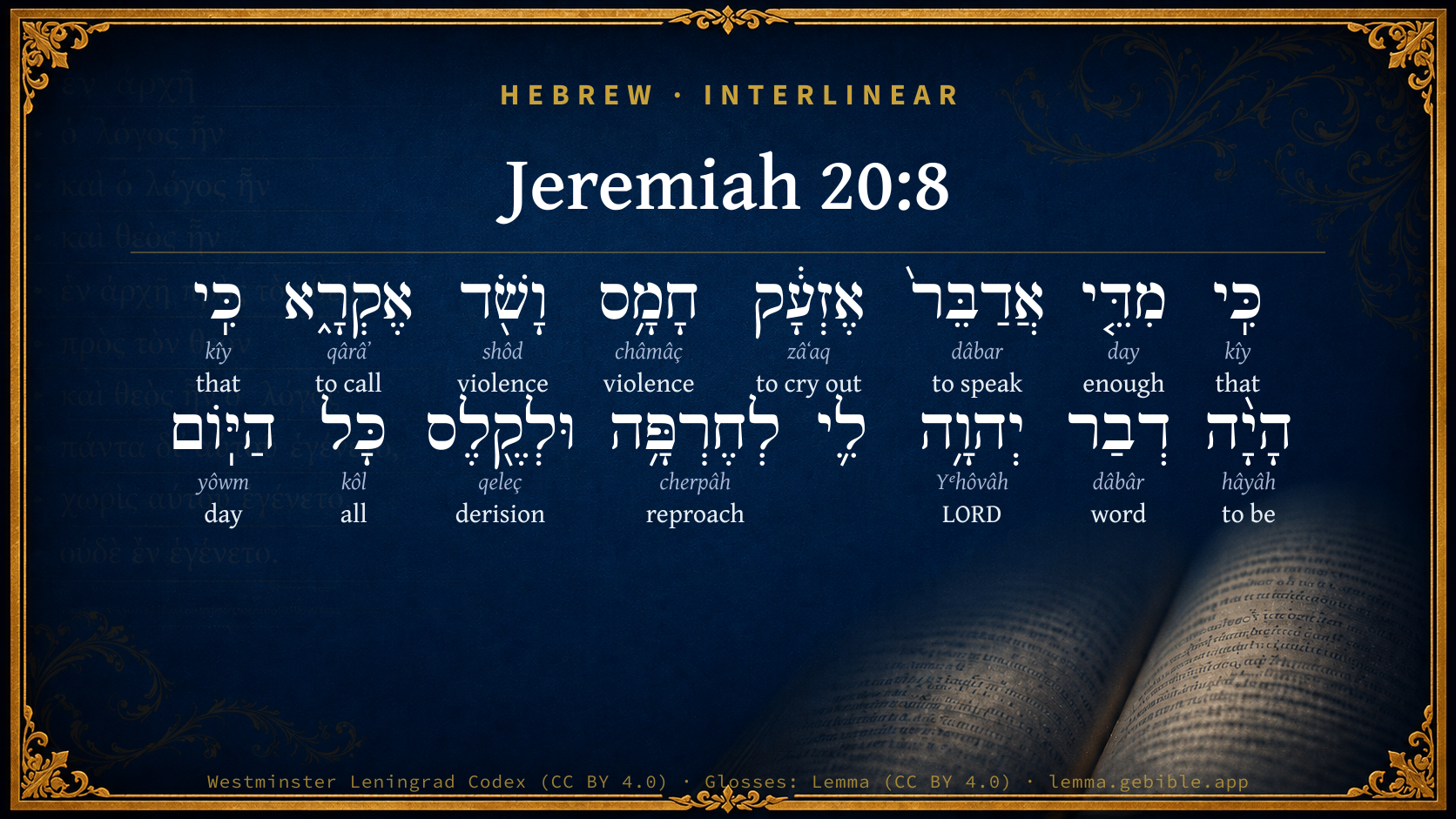
Jeremiah 20:8

Hebrew (Westminster Leningrad Codex) Jeremiah 20:8 appears in the Hebrew Old Testament. The text above is from the Westminster Leningrad Codex. Each word links to its Strong’s number, a concise gloss, and parsing drawn from the Open Scriptures Hebrew Bible morphology. Click any word for its full Brown-Driver-Briggs (BDB) entry.
Download image
Cite this verse

Jeremiah 20:8 (World English Bible). Public Domain. Lemma interlinear Bible study tool, https://lemma.gebible.app/v/jeremiah/20/8.

Show BibTeX & RIS
BibTeX
RIS
English Translation
For as often as I speak, I cry out; I cry, Violence and destruction! because the word of Yahweh is made a reproach to me, and a derision, all the day.
World English Bible · Public Domain
Download a study sheet

One document with this verse’s original text, its word-by-word gloss line, the meaning frame, cross-references with their text, attributed commentary, and full source and license credits — printable, and it pastes into notes with its structure intact.

This verse Autodidact and up

Study sheet (.html) Plain text (.txt)

A passage Seminary Student

Up to 50 verses in one chapter. A passage sheet keeps up to 6 commentary sources and 12 cross-references per verse, in the order this page ranks them, and says so on the sheet whenever that leaves anything out. Ask for a single verse and you get the Autodidact verse sheet above.

Everything on this page stays free to read, with no account — the sheet is a download of what is already on screen, not access to it.

Want to remove ads? Support Godless Engineer
Compare translations 3

The same verse in 3 English versions, stacked beneath the original-language interlinear above. Click any original word for its lexicon entry.

Each is an independent rendering of the whole verse — the interlinear is not word-aligned to these translations.

Highlighted words mark where these versions differ — a whole-verse word diff, not a word-by-word alignment.

  • World English Bible Public Domain
    For as often as I speak, I cry out; I cry, Violence and destruction! because the word of Yahweh is made a reproach to me, and a derision, all the day.
  • King James Version Public Domain
    For since I spake, I cried out, I cried violence and spoil; because the word of the LORD was made a reproach unto me, and a derision, daily.
  • unfoldingWord Literal Text CC BY-SA 4.0
    For as often as I speak, I cry out, I call out, “Violence and destruction!” For the word of Yahweh has become for me a reproach and a derision all the day.

unfoldingWord Literal Text — © unfoldingWord, licensed CC BY-SA 4.0. Word-aligned USFM3 via Door43 (git.door43.org/unfoldingWord/en_ult).

Versions to compare (up to 4)

3 of 4 selected

Show all 18 translations

Every available English version of this verse, each an independent rendering of the whole verse.

  • World English Bible Public Domain
    For as often as I speak, I cry out; I cry, Violence and destruction! because the word of Yahweh is made a reproach to me, and a derision, all the day.
  • Berean Standard Bible Public Domain
    For whenever I speak, I cry out; I proclaim violence and destruction. For the word of the LORD has become to me a reproach and derision all day long.
  • Majority Standard Bible Public Domain
    For whenever I speak, I cry out; I proclaim violence and destruction. For the word of the LORD has become to me a reproach and derision all day long.
  • King James Version Public Domain
    For since I spake, I cried out, I cried violence and spoil; because the word of the LORD was made a reproach unto me, and a derision, daily.
  • American Standard Version (1901) Public Domain
    For as often as I speak, I cry out; I cry, Violence and destruction! because the word of Jehovah is made a reproach unto me, and a derision, all the day.
  • Revised Version (1885) Public Domain
    For as often as I speak, I cry out; I cry, Violence and spoil: because the word of the LORD is made a reproach unto me, and a derision, all the day.
  • Geneva Bible (1599) Public Domain
    For since I spake, I cryed out of wrong, and proclaimed desolation: therefore the word of the Lord was made a reproche vnto me, and in derision daily.
  • Douay-Rheims (1899) Public Domain
    For I am speaking now this long time, crying out against iniquity, and I often proclaim devistation: and the word of the Lord is made a reproach to me, and a derision all the day.
  • Young's Literal Translation Public Domain
    Because from the time I speak I cry out, `Violence and destruction,' I cry, For the word of Jehovah hath been to me For reproach and for derision all the day.
  • Literal Standard Version CC BY-SA 4.0
    Because from the time I speak I cry out, I shout, “Violence and destruction!” || For the word of YHWH has been to me || For reproach and for derision all the day.
  • Unlocked Literal Bible CC BY-SA 4.0
    For whenever I have spoken, I have called out and proclaimed, 'Violence and destruction.' Then Yahweh's word has become for me reproach and mocking every day.
  • unfoldingWord Literal Text CC BY-SA 4.0
    For as often as I speak, I cry out, I call out, “Violence and destruction!” For the word of Yahweh has become for me a reproach and a derision all the day.
  • Darby Bible Public Domain
    For as oft as I speak, I cry out; I proclaim violence and spoil; for the word of Jehovah is become unto me a reproach and a derision all the day.
  • World Messianic Bible Public Domain
    For as often as I speak, I cry out; I cry, “Violence and destruction!” because the LORD’s word has been made a reproach to me, and a derision, all day.
  • Webster's Bible Public Domain
    For since I spoke, I cried out, I cried violence and spoil; because the word of the LORD was made a reproach to me, and a derision, daily.
  • Free Bible Version CC BY-SA 4.0
    This is because every time I open my mouth I have to shout out warnings of violence and destruction. The Lord's message has become the reason people criticize and ridicule me the whole time.
  • Bible in Basic English Public Domain
    For every word I say is a cry for help; I say with a loud voice, Violent behaviour and wasting: because the word of the Lord is made a shame to me and a cause of laughing all the day.
  • JPS Tanakh (1917) Public Domain
    For as often as I speak, I cry out, I cry: 'Violence and spoil'; because the word of the LORD is made a reproach unto me, and a derision, all the day.

Literal Standard Version (2020), Covenant Press — licensed CC BY-SA 4.0. Text via the HelloAO Bible API (eBible.org). Unlocked Literal Bible (unfoldingWord) — licensed CC BY-SA 4.0. Text via the HelloAO Bible API (eBible.org). unfoldingWord Literal Text — © unfoldingWord, licensed CC BY-SA 4.0. Word-aligned USFM3 via Door43 (git.door43.org/unfoldingWord/en_ult). Free Bible Version, Dr. Jonathan Gallagher — licensed CC BY-SA 4.0. Text via the HelloAO Bible API (eBible.org).

Word by word

More ways to search: Search by grammar → Find every occurrence → Compare this word →

Practice this passage: Drill this verse → Learn its vocabulary →

וּלְקֶ֖לֶס
qeleç
H7047
“and · to/for · derision”
Conjunction + Preposition + Noun, Common, Masculine, Singular, Absolute
Part of Speech
Conjunction + Preposition + Noun
Type
Common
Gender
Masculine
Number
Singular
State
Absolute
Full BDB Definition

Origin: from H7046

TWOT: 2029a

derision, ridicule
  1. כִּֽי kîy H3588 “that” Conjunction
  2. מִדֵּ֤י day H1767 “from · enough of” Preposition + Noun, Common, Masculine, Singular, Construct
  3. אֲדַבֵּר֙ dâbar H1696 “to speak” Verb, Piel, Imperfect, 1st Person, Common, Singular
  4. אֶזְעָ֔ק zâʻaq H2199 “to cry out” Verb, Qal, Imperfect, 1st Person, Common, Singular
  5. חָמָ֥ס châmâç H2555 “violence” Noun, Common, Masculine, Singular, Absolute
  6. וָשֹׁ֖ד shôd H7701 “and · violence” Conjunction + Noun, Common, Masculine, Singular, Absolute
  7. אֶקְרָ֑א qârâʼ H7121 “to call” Verb, Qal, Imperfect, 1st Person, Common, Singular
  8. כִּֽי kîy H3588 “that” Conjunction
  9. הָיָ֨ה hâyâh H1961 “to be” Verb, Qal, Perfect, 3rd Person, Masculine, Singular
  10. דְבַר dâbâr H1697 “word of” Noun, Common, Masculine, Singular, Construct
  11. יְהוָ֥ה Yᵉhôvâh H3068 “LORD” Noun, Proper
  12. לְחֶרְפָּ֥ה cherpâh H2781 “to/for · reproach” Preposition + Noun, Common, Feminine, Singular, Absolute
  13. כָּל kôl H3605 “all of” Noun, Common, Masculine, Singular, Construct
  14. הַיּֽוֹם yôwm H3117 “the · day” Particle, Definite Article + Noun, Common, Masculine, Singular, Absolute

About this verse

These counts appear in no published source. They are computed here, from the morphology-tagged text and Lemma’s own curated glosses. What Lemma adds →

16
words
14
distinct lemmas
Prophets
section

Notable vocabulary

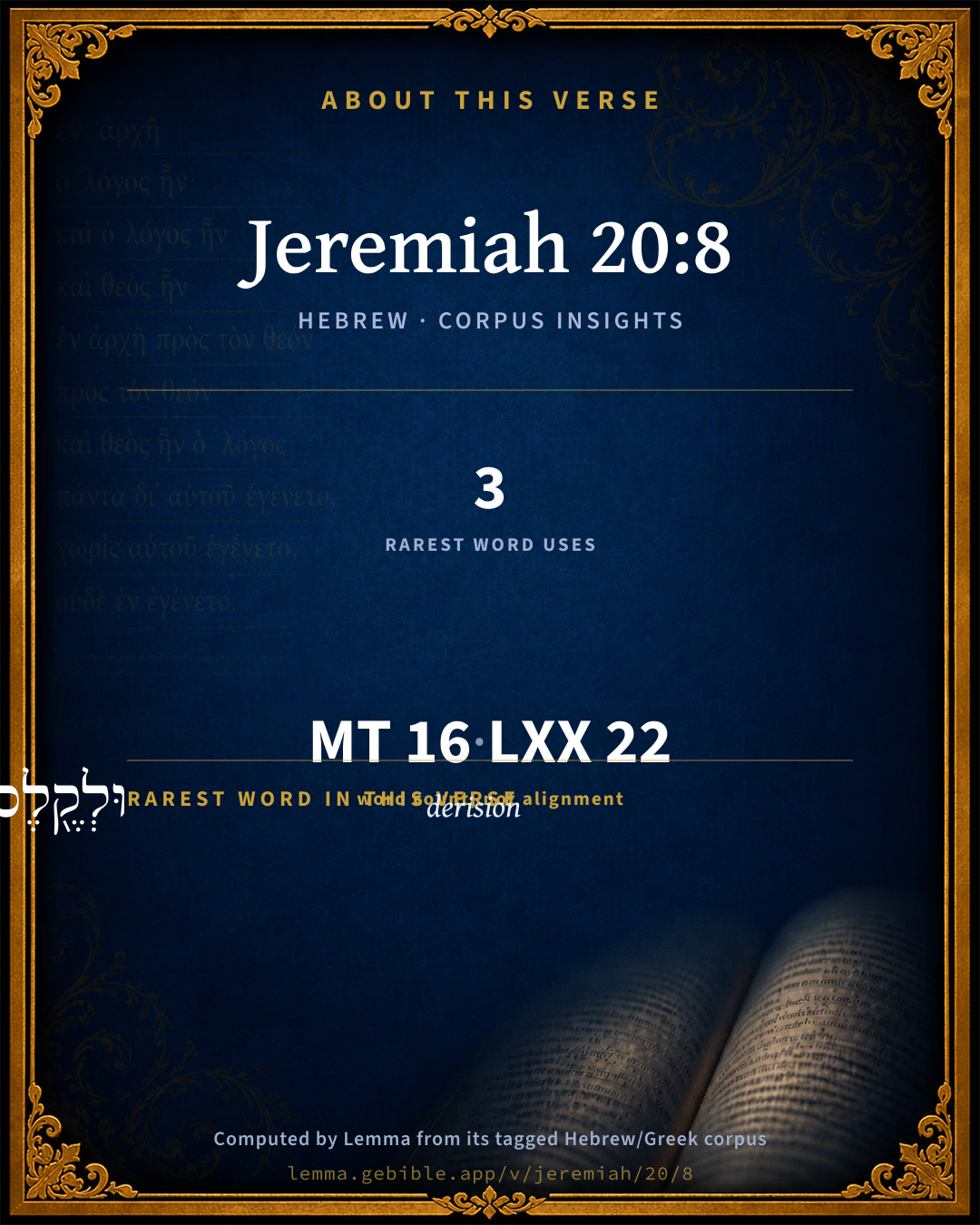
The rarest word here is וּלְקֶ֖לֶס derision H7047 — appearing just 3 times in the whole Hebrew Bible.

Shared distinctive vocabulary

וּלְקֶ֖לֶס derision H7047 occurs in 3 verses of the Hebrew Bible. Also found in:

Grammatical profile

  • 4 verbs
  • 9 nouns
  • 1 preposition
  • 2 conjunctions

Verb forms

  • אֲדַבֵּר֙ Piel · Imperfect
  • אֶזְעָ֔ק Qal · Imperfect
  • אֶקְרָ֑א Qal · Imperfect
  • הָיָ֨ה Qal · Perfect

Repetition

A word recurs within this verse — often emphatic in Hebrew:

  • כִּֽי that H3588 ×2

Hebrew & Septuagint length

In the original languages it is 16 Hebrew tokens and 22 Greek tokens — but the two are counted differently (Hebrew bundles its prefixes and suffixes into one token; the Greek is in lemma form), so that isn’t a like-for-like length.

Cross-references

21

Topical passages linked to Jeremiah 20:8 in the Treasury of Scripture Knowledge — connected by theme and wording, ordered by reader-vote popularity; previews shown in the World English Bible.

  • 2 Chronicles 36:16 but they mocked the messengers of God, and despised his words, and scoffed at his prophets, until the wrath of Yahweh arose against his people, until there was no remedy.
  • Jeremiah 6:10 To whom shall I speak and testify, that they may hear? behold, their ear is uncircumcised, and they can't listen: behold, the word of Yahweh is become to them a reproach; they have no delight in it.
  • Jeremiah 4:19–22 My anguish, my anguish! I am pained at my very heart; my heart is disquieted in me; I can't hold my peace; because you have heard, O my soul, the sound of the trumpet, the alarm of war.
  • Jeremiah 5:1 Run you back and forth through the streets of Jerusalem, and see now, and know, and seek in the broad places of it, if you can find a man, if there are any who does justly, who seeks truth; and I will pardon her.
  • Jeremiah 5:6 Therefore a lion out of the forest shall kill them, a wolf of the evenings shall destroy them, a leopard shall watch against their cities; everyone who goes out there shall be torn in pieces; because their transgressions are many, [and] their backsliding is increased.
  • Jeremiah 5:15–17 Behold, I will bring a nation on you from far, house of Israel, says Yahweh: it is a mighty nation, it is an ancient nation, a nation whose language you don't know, neither understand what they say.
  • Jeremiah 6:6–7 For thus has Yahweh of Hosts said, Hew you down trees, and cast up a mound against Jerusalem: this is the city to be visited; she is wholly oppression in the midst of her.
  • Jeremiah 7:9 Will you steal, murder, and commit adultery, and swear falsely, and burn incense to Baal, and walk after other gods that you have not known,
  • Jeremiah 13:13–14 Then shall you tell them, Thus says Yahweh, Behold, I will fill all the inhabitants of this land, even the kings who sit on David's throne, and the priests, and the prophets, and all the inhabitants of Jerusalem, with drunkenness.
  • Jeremiah 15:1–4 Then said Yahweh to me, Though Moses and Samuel stood before me, yet my mind would not be toward this people: cast them out of my sight, and let them go forth.
  • Jeremiah 15:13–14 Your substance and your treasures will I give for a spoil without price, and that for all your sins, even in all your borders.
  • Jeremiah 17:27 But if you will not listen to me to make the Sabbath day holy, and not to bear a burden and enter in at the gates of Jerusalem on the Sabbath day; then will I kindle a fire in the gates of it, and it shall devour the palaces of Jerusalem, and it shall not be quenched.
  • Jeremiah 18:16–17 to make their land an astonishment, and a perpetual hissing; everyone who passes thereby shall be astonished, and shake his head.
  • Jeremiah 19:7–11 I will make void the counsel of Judah and Jerusalem in this place; and I will cause them to fall by the sword before their enemies, and by the hand of those who seek their life: and their dead bodies will I give to be food for the birds of the sky, and for the animals of the earth.
  • Jeremiah 20:7 Yahweh, you have persuaded me, and I was persuaded; you are stronger than I, and have prevailed: I am become a laughing-stock all the day, every one mocks me.
  • Jeremiah 28:8 The prophets who have been before me and before you of old prophesied against many countries, and against great kingdoms, of war, and of evil, and of pestilence.
  • Lamentations 3:61–63 You have heard their reproach, Yahweh, and all their devices against me,
  • Luke 11:45 One of the lawyers answered him, "Teacher, in saying this you insult us also."
  • Hebrews 11:26 accounting the reproach of Christ greater riches than the treasures of Egypt; for he looked to the reward.
  • Hebrews 13:13 Let us therefore go forth to him outside of the camp, bearing his reproach.
  • 1 Peter 4:14 If you are insulted for the name of Christ, blessed are you; because the Spirit of glory and of God rests on you. On their part he is blasphemed, but on your part he is glorified.

Cross-references courtesy of OpenBible.info (CC BY 4.0).

Hebrew and Greek witnesses Masoretic Hebrew ↔ Greek Septuagint

The same verse in the two great witnesses to the Old Testament, shown verse-for-verse.

These are two independent witnesses, not word-aligned to each other, and the Septuagint is shown in lemma (dictionary) form.

Hebrew Jeremiah 20:8 Masoretic · Westminster Leningrad Codex

כִּֽי מִדֵּ֤י אֲדַבֵּר֙ אֶזְעָ֔ק חָמָ֥ס וָשֹׁ֖ד אֶקְרָ֑א כִּֽי הָיָ֨ה דְבַר יְהוָ֥ה לִ֛י לְחֶרְפָּ֥ה וּלְקֶ֖לֶס כָּל הַיּֽוֹם

For as often as I speak, I cry out; I cry, Violence and destruction! because the word of Yahweh is made a reproach to me, and a derision, all the day.

World English Bible · Public Domain

Greek LXX Structure differs

In the Septuagint, Jeremiah is about an eighth shorter than the Hebrew and arranges its material differently — the Oracles Against the Nations (Hebrew chapters 46–51) appear in the middle of the Greek book, after 25:13. Because the chapter and verse boundaries do not line up, a verse-for-verse comparison with the Hebrew is not shown.

A verse-for-verse comparison isn’t shown here because the chapters and verses don’t line up. Switch to the LXX edition with the MT / LXX toggle above to read the Greek directly.

Hebrew: Westminster Leningrad Codex (CC BY 4.0). Greek: Septuagint (public domain); English from a public-domain English Septuagint. How the Septuagint differs from the Hebrew →

Targum (Aramaic paraphrase)

1

The Targum is the ancient Jewish Aramaic paraphrase of the Hebrew Scriptures — an interpretive translation, not the Hebrew text itself. Onkelos (literal) and Pseudo-Jonathan (expansive) render the Torah, and Jonathan the Prophets. Coverage is partial: where no permissively-licensed English translation exists for a verse, only the Aramaic is shown. This is verse-level text, not a word-by-word alignment to the Hebrew.

  1. Targum Jonathan Prophets (Joshua–Malachi)
    אֲרֵי בִזְמַן דַאֲנָא מִתְנַבֵּי אֲנָא מֵרִים קָלִי בָּכֵי וּמְצַוַח וְעַל חָטוֹפִין וּבָזוֹזִין אֲנָא מִתְנַבֵּי אֲרֵי הֲוָה פִּתְגָמָא דַייָ לִי לְחִסוּדִין וּלְלַעַג כָּל יוֹמָא:

    (no public-domain English translation for this verse)

    Targum Jonathan — Aramaic: “Mikraot Gedolot” (public domain). English: “Sefaria Community Translation” (CC0 1.0 (public-domain dedication)); “London "Chaldee Paraphrase," 1871” (public domain). Text via Sefaria.

Commentary

Notes on Jeremiah 20:8 from classic Christian and Jewish commentators (each source and its license shown beneath its notes). The classic Christian expositions comment on the surrounding passage and are grouped to its opening verse, so a note may address several verses; the Jewish commentaries on the Tanakh (Rashi and others) are per-verse, so they appear only where the commentator wrote on this verse.

Lemma curates 59 commentaries, every one of them public domain or Creative Commons licensed, each selected and text-cleaned for this edition rather than reprinted as found. About our sources →

Trapp's Complete Commentary

John Trapp

Jer 20:8 For since I spake, I cried out, I cried violence and spoil; because the word of the LORD was made a reproach unto me, and a derision, daily.

Ver. 8. For since I spake, I cried out,] i.e., Ever since I took upon me the office of a prophet, I executed it vigorously, I cried with full mouth. {Jer 4:5 Isa 58:1}

I cried violence and spoil,] sc., Will surely befall you by the Chaldees. Or, I cried out of my misusages.

Because the word of the Lord was made a reproach unto me, and a derision daily.] This was all the recompense I reaped of my goodwill to this perverse people, and of my pains taken among them. Few sins are more dangerous than those of casting reproaches upon God’s Word, as here; of snuffing at it; {Mal 1:13} of enviously swelling at it; {Act 13:45} of chatting at it; {Rom 9:19-20} of stumbling at it; {1Pe 2:8} of gathering odious consequences from it. {Rom 3:8}

John Trapp, A Commentary or Exposition upon All the Books of the Old and New Testament (1647–1656) — public domain. Text from a community e-Sword module.

Joseph Benson's Commentary

Jer 20:8-9. For since I spake, I cried out, I cried violence and spoil — Or, rather, as Houbigant renders it, For since I spake, and cried against iniquity, and denounced desolation, the word of the Lord, &c. — Blaney’s translation is nearly to the same sense: For as often as I speak, whether I cry out against injustice or proclaim devastation, the word of Jehovah is turned against me into matter of reproach and derision continually. The prophet means that, upon account of declaring what God had revealed to him, he was reckoned an enemy to his country, and a false prophet. Then I said — Namely, within myself, for he did not speak this to any one; I will not make mention of him — Or, of it, namely, the word of God, or the message God had appointed him to deliver; nor speak any more in his name — I resolved no more to declare what God had revealed to me concerning the calamities which he was about to bring on Judah and Jerusalem. But his word was in my heart as a burning fire — It glowed inwardly, and must have vent: I found myself so pressed in spirit, felt such a burning ardour within my breast, such an immediate and powerful impulse of the prophetic spirit constraining me to speak, that I could no more be easy without executing God’s commands, than if a burning fire had been shut up in my bones. The conviction of his own mind that he ought to speak, his zeal for the glory of God, his indignation at the sins of the people, and his compassion for their souls, would not suffer him to rest, or allow him to forbear declaring God’s message.

Joseph Benson's Commentary on the Old and New Testaments (1811–1818) — public domain. Text from a community e-Sword module.

Tyndale Open Study Notes

Tyndale Open Resources

20:8-9 Jeremiah found it impossible not to speak the words of God’s judgment, even though his messages turned him into a household joke (cp. Job 32:18-20; Ps 39:1-3; Acts 4:18-20).

Tyndale Open Study Notes — © Tyndale Open Resources, licensed CC BY-SA 4.0. Text via the HelloAO Bible API.

Geneva Bible (1599)

Geneva Bible translators

He showeth that he did his office in that he reproved the people of their vices, and threatened them with God’s judgments: but because he was derided and persecuted for this, he was discouraged, and thought to have ceased to preach, save that God’s Spirit did force him thereunto.

Geneva Bible (1599) marginal notes — public domain. Text via Bolls.life.

Jamieson, Fausset & Brown

Robert Jamieson, A. R. Fausset & David Brown

Rather, "Whenever I speak, I cry out. Concerning violence and spoil, I (am compelled to) cry out," that is, complain [MAURER]. English Version in the last clause is more graphic, "I cried violence and spoil" (Jer 6:7)! I could not speak in a calm tone; their desperate wickedness compelled me to "cry out."

because--rather, "therefore," the apodosis of the previous sentence; because in discharging my prophetic functions, I not merely spake, but cried; and cried, violence . . . ; therefore the word of the Lord was made a reproach to me (Jer 20:7).

Jamieson, Fausset & Brown — Commentary Critical and Explanatory on the Whole Bible (1871) — public domain (CC PDM 1.0). Text via the HelloAO Bible API.

Adam Clarke's Commentary

Verse 8. I cried violence and spoil] This was the burden of the message thou didst give me.

Adam Clarke's Commentary on the Bible (1810–1826) — public domain. Text from a community e-Sword/MySword module.

John Calvin's Commentaries

The Prophet says here that he found no fruit from his labors, but on the contrary, he saw that all his efforts and endeavors had an opposite effect; for they exasperated all the Jews, inflamed their rage, and drove them into a greater licentiousness in sinning. Hence he says, that he purposed to give up the office assigned to him, but that by a secret impulse he was constrained to persevere, and that thus he was not at liberty to desist from the course which he had begun.

But the verse is variously explained; From the time I spoke, I cried violence aloud and proclaimed devastation Thus some take the words, as though Jeremiah said, that since he began to teach he uttered complaints; for he saw that he was violently assailed and was exposed to all kinds of wrongs: but this view appears to me too frigid. Others come nearer to the truth who consider him as saying, that he had not ceased to cry against outrages and plunders, when he saw that all kinds of wickedness prevailed among the people; as though he had said, “I could not mildly and peaceably teach them, for their disposition and temper prevented me, but their wickedness compelled me to treat them with severity, as all God’s servants ought wisely to consider what the state of the Church requires.” If indeed we should in tranquil times cry aloud, it would be mad affectation; and this is what is done by many, who without thought and without any reason always make a great cry; but when we see Satan reigning, we ought not then to withhold nor to act as in a truce; but as it is an open war it is necessary to cry aloud. They who take this view, then, understand that Jeremiah cried aloud, because he saw that the people were refractory, and also saw that things were so bad that they could not be restored to a right state without the greatest sharpness and vehemence.

But I rather think that the Prophet had another kind of trial, — that he brought down a greater vengeance of God by his cries, as though he had said, “To what purpose should I furnish God with weapons by my preaching? since I do nothing but increase his wrath, which will at length fulminate and consume the whole land together with the people.” He then says, that he cried violence and devastation aloud, for impiety itself is a sort of hostile violence by which God is provoked. The meaning is, that the Prophet saw no other fruit to his labor, but that men were rendered more insolent, and from being thieves became robbers, and from being disdainful became ruffians, so that they increasingly kindled God’s wrath, and more fully abandoned themselves. This was indeed a most severe and dangerous trial; it is therefore no wonder that the Prophet says, that it came to his mind to turn aside from his office as a teacher.

John Calvin's Commentaries (1540-1563) — public domain. Text from the Calvin Translation Society English edition (1840s-50s) via the Christian Classics Ethereal Library (ccel.org). Calvin's coverage is partial (roughly two-thirds of the Bible); uncommented books and verses are honest gaps, never fabricated. The 19th-century editor's footnotes and remarks are omitted so the notes are faithfully Calvin's own voice.

Ellicott's Commentary for English Readers

(8) I cried out, I cried.—The two Hebrew words are not, as in the English, alike, the first being the cry of complaint, the second of protest: When I speak (the tense implies from the beginning of his work till now), I complain; I call out (against) violence and spoil. They had formed the burden of his discourses, he had borne his witness against them, and yet “the word of Jehovah” so proclaimed by him had exposed him simply to derision. He had been the champion of the people’s rights, and yet they mocked and scorned him.

A Bible Commentary for English Readers, edited by Charles John Ellicott (1878–1897) — public domain. Text from a community e-Sword module.

The Cambridge Bible for Schools and Colleges

gen. ed. J. J. S. Perowne

8. Violence and spoil] directed generally against himself. Cp. Jer_5:26-28, Jer_9:4.

a reproach unto me, and a derision] Words applied to his own case by the great Florentine, Savonarola, “I have had nothing but tribulations, derision, and reproach.” Clark’s Savonarola, p. 169.

The Cambridge Bible for Schools and Colleges (gen. ed. J. J. S. Perowne; Cambridge University Press, 1878–1918) — public domain. Text from a community e-Sword module.

John Gill's Exposition

For since I spake, I cried out,.... Or, "when I speak, I cry" (a); whensoever I speak in the name of the Lord, and deliver message from him to the people, I lift up my voice and cry aloud, that all may hear and understand; and as showing zeal, fervour, and diligence: or, "I cry" with grief and trouble at the usage I meet with, and the contempt that is cast upon the word; or because of what I am obliged to declare to them, as follows. The Targum takes in both sense, of the word thus,

"for at the time that I prophesy, I lift up my voice, weeping, and crying.''

I cried violence and spoil: or, "proclaimed" it (b), for a different word is here used; that is, he publicly declared the rapine and oppression they were guilty of, inveighed against it, and reproved them for it; and foretold the violence of the enemy, and the spoil that he should make of them, when he should come upon them, even the king of Babylon; as well as cried out and complained of the injurious treatment he himself met with from them;

because the word of the Lord was made a reproach unto me, and a derision daily; which is a reason either why he cried with grief and sorrow; or why he cried violence and spoil, ruin and destruction: or, "though the word of the Lord was" (c), &c. yet he went on publishing and proclaiming it: or, "surely the word of the Lord was made a reproach" (d), &c. either because of the matter of it, it not being believed, or the manner in which it was delivered; or because it was not immediately fulfilled.

(a) "quum loquor exclamavi, i.e. loquor exclamans", Gataker. (b) "clamo", Pagninus, Junius & Tremellius; "proclamo", Piscator. (c) "quamvis". (d) "Verum, verbum Domini", so some in Vatablus; "utique", De Dieu, Gataker.

John Gill's Exposition of the Whole Bible (1746–1763) — public domain (CC PDM 1.0). Text via the HelloAO Bible API.

Haydock's Catholic Bible Commentary

Day. They keep asking where are these enemies from the north, the plagues? &c. (Calmet) --- He is sorry to see the word of God despised, (Theodoret) and is guilty of a venial pusillanimity, concluding that his words had no good effect. (Menochius)

George Leo Haydock (1774–1849), Haydock's Catholic Family Bible and Commentary, 1859 edition — public domain. Excludes Psalms (Douay-Rheims chapter numbering differs from Protestant) and Deuterocanonical books (Catholic canon only).

Matthew Poole's English Annotations

For since I spake, I cried out: if the particle be translated since, as we translate it, the meaning is, Since I first began to be a prophet, I have faithfully discharged my prophetical office, and that with some warmth and zeal.

I cried violence and spoil: some understand it of the violence which he himself experienced: others understand it of those acts of injustice and violence which were found amongst the people; he cried out against them: others understand it as a denunciation of judgment; he prophesied that violence and spoil was coming upon them.

Because the word of the Lord was made a reproach unto me, and a derision, daily; because of that scorn and derision with which they treated him. But others think that it were better translated surely than because, as it is in many texts, Isa 60:9; 63:16, &c. It is not much material which way we translate it, for it appeareth, from 2Ch 36:16, that this people’s mocking of God’s messengers, despising his words, and misusing his prophets, was one great cause of the wrath of God coming upon them; and it is certain that Jeremiah was made such a scorn and derision to them.

Matthew Poole's English Annotations on the Holy Bible (1683–1685) — public domain. Text from a community e-Sword/MySword module.

Whedon's Commentary on the Bible

Daniel D. Whedon

8. Since I spake, I cried out — Rather, when I speak, I cry out, as if in pain or protest. The first “cried out” means to make an outcry as in danger or pain; the second cried means to call out — proclaim. Such was the subversion of justice on every side — the violence and spoil — that he could not speak calmly, but only cry out.

Daniel D. Whedon (gen. ed.), Commentary on the Old and New Testaments (1874–1909) — public domain. Text from a community e-Sword module.

The Pulpit Commentary

For since I spake, I cried out, etc.; rather, For as often as I speak, I must shout; I must cry, Violence and spoil; I can take up no other tone but that of indignant denunciation, no other theme but that of the acts of injustice constantly committed (not merely, nor indeed chiefly, against the prophet himself). Was made; rather, is made.

The Pulpit Commentary (1880–1919), ed. H.D.M. Spence-Jones & Joseph S. Exell — public domain. Text from a community e-Sword module.

John Wesley's Explanatory Notes

Since - Since I first began to be a prophet, I have faithfully discharged my office, and that with warmth and zeal. Spoil - I have prophesied that violence and spoil was coming. Because - Because of that scorn and derision with which they treated him.

John Wesley, Explanatory Notes Upon the Whole Bible (1754–1765) — public domain. Text via the GEBible commentary corpus.

Rashi

Rabbi Shlomo Yitzchaki (Rashi)

Whenever I speak Every time I speak to them, I must cry out and raise my voice, and I do not proclaim good for them but prophecies of violence and spoil.

for the word of the Lord has been...for me Therefore, they spoke to me with scorn, for they scorn me.

and mockery for speech. Comp. (Ezekiel 22:4) “and mockery (וְקַלָּסָה).”

Rashi on the Tanakh — English translations: “The Judaica Press complete Tanach with Rashi, translated by A. J. Rosenberg” (CC BY 4.0); “Pentateuch with Rashi's commentary by M. Rosenbaum and A.M. Silbermann, 1929-1934” (public domain); “The Metsudah Tanach series, Lakewood, N.J” (CC BY 4.0); and “The Book of Joshua, Metsudah Publications, 1997” (CC BY 4.0). Text via Sefaria.

Lesson kit

Teaching starters — assembled from the data on this page, not authored interpretation. Every prompt links to the verse data it draws on. Edit before teaching.

Jeremiah, in the Prophets, opens this verse with 16 words (14 distinct Hebrew lemmas). Its most distinctive word is qeleç (“derision”). A historical commentator’s framing appears above. Read the whole chapter for the surrounding context.

Discussion questions

  1. How does “derision” (qeleç) shape what this verse is saying?
  2. How does Psalms 44:13, which shares the word «derision», read alongside this verse?
  3. What does the repetition of “that” (2× in this one verse) do in this verse?
  4. The translations on this page render this verse differently — a whole-verse word diff, not a word-by-word alignment. What might account for the different wordings?
  5. «אֲדַבֵּר֙» is a Piel Imperfect verb. How does that grammatical form shape the action described?
  6. Compare how Trapp's Complete Commentary and Joseph Benson's Commentary read this verse. Where do they agree or differ?

Things to notice

Reading settings

Reading text

Shown beneath each verse's original-language words.

Old Testament
Old Testament edition

Read the OT as the Masoretic Hebrew (MT) or the Greek Septuagint (LXX).

English shown for the Greek Septuagint (in the Hebrew ↔ Greek comparison).

Comparing translations? Open the Compare panel on any verse page to stack up to four side by side.