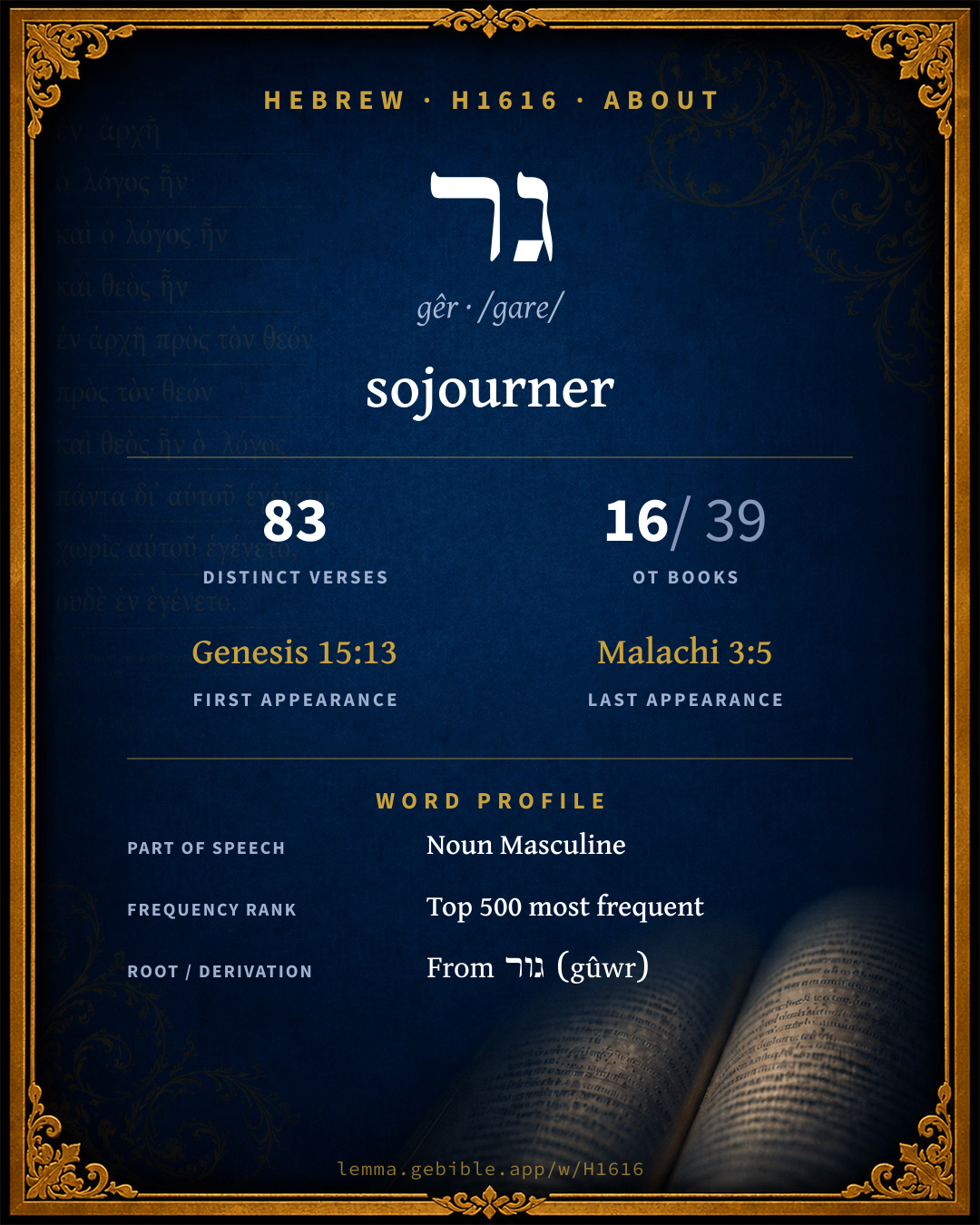
גֵּר
sojourner
‘sojourner’ is one of 3 main senses fuller range ↓
Full lexicon entry — Brown-Driver-Briggs (BDB)
From Brown-Driver-Briggs (BDB)
Where this word appears
See every Absolute-state word in the Hebrew Bible →
Grammar key — what these labels mean
Part of speech
- Noun
- A naming word — a person, place, thing, or idea.
Noun type
- Common
- A common noun — a general class of person, place, or thing (“king,” “city,” “water”), not a specific name.
State
- Absolute
- The independent form of a noun, not bound to a following word.
- Construct
- A noun bound to a following noun in a possessive / “of” relationship (the construct chain).
Gender
- Masculine
- Grammatically masculine.
Number
- Singular
- One.
- Plural
- More than one (in Hebrew, generally three or more).
Every verse where H1616 appears in the Book of Deuteronomy — 21 distinct verses. Click any verse to open its interlinear word-by-word view. Verse text shown in the World English Bible for context — . Each verse’s Hebrew form is shown with its reference; the English is not keyword-highlighted, since the data carries no word-level English alignment. Use “Compare translations” on any verse to read it across multiple English versions. This concordance covers the Hebrew Bible; Septuagint (Greek Old Testament) occurrences are not indexed here.
Deuteronomy
- Deuteronomy 1:16 גֵּרֽ/וֹ n c ms cs + sfx pers 3ms I charged your judges at that time, saying, Hear [the causes] between your brothers, and judge righteously between a man and his brother, and the foreigner who is living with him.
- Deuteronomy 5:14 וְ/גֵֽרְ/ךָ֙ conj + n c ms cs + sfx pers 2ms but the seventh day is a Sabbath to Yahweh your God: [in it] you shall not do any work, you, nor your son, nor your daughter, nor your man-servant, nor your maid-servant, nor your ox, nor your donkey, nor any of your cattle, nor your stranger who is within your gates; that your man-servant and your maid-servant may rest as well as you.
- Deuteronomy 10:18 גֵּ֔ר n c ms He does execute justice for the fatherless and widow, and loves the foreigner, in giving him food and clothing.
- Deuteronomy 10:19 הַ/גֵּ֑ר גֵרִ֥ים ptcl def.art + n c ms n c mp Therefore love the foreigner; for you were foreigners in the land of Egypt.
- Deuteronomy 14:21 לַ/גֵּ֨ר prep det + n c ms You shall not eat of anything that dies of itself: you may give it to the foreigner living among you who is within your gates, that he may eat it; or you may sell it to a foreigner: for you are a holy people to Yahweh your God. You shall not boil a kid in its mother's milk.
- Deuteronomy 14:29 וְ֠/הַ/גֵּר conj + ptcl def.art + n c ms and the Levite, because he has no portion nor inheritance with you, and the foreigner living among you, and the fatherless, and the widow, who are within your gates, shall come, and shall eat and be satisfied; that Yahweh your God may bless you in all the work of your hand which you do.
- Deuteronomy 16:11 וְ/הַ/גֵּ֛ר conj + ptcl def.art + n c ms and you shall rejoice before Yahweh your God, you, and your son, and your daughter, and your man-servant, and your maid-servant, and the Levite who is within your gates, and the foreigner, and the fatherless, and the widow, who are in the midst of you, in the place which Yahweh your God shall choose, to cause his name to dwell there.
- Deuteronomy 16:14 וְ/הַ/גֵּ֛ר conj + ptcl def.art + n c ms and you shall rejoice in your feast, you, and your son, and your daughter, and your man-servant, and your maid-servant, and the Levite, and the foreigner, and the fatherless, and the widow, who are within your gates.
- Deuteronomy 23:7 גֵ֖ר n c ms You shall not abhor an Edomite; for he is your brother: you shall not abhor an Egyptian, because you lived as a foreigner in his land.
- Deuteronomy 24:14 מִ/גֵּרְ/ךָ֛ prep + n c ms cs + sfx pers 2ms You shall not oppress a hired servant who is poor and needy, whether he be of your brothers, or of your foreigners who are in your land within your gates:
- Deuteronomy 24:17 גֵּ֣ר n c ms You shall not wrest the justice [due] to the foreigner, [or] to the fatherless, nor take the widow's clothing to pledge;
- Deuteronomy 24:19 לַ/גֵּ֛ר prep det + n c ms When you reap your harvest in your field, and have forgot a sheaf in the field, you shall not go again to get it: it shall be for the foreigner, for the fatherless, and for the widow; that Yahweh your God may bless you in all the work of your hands.
- Deuteronomy 24:20 לַ/גֵּ֛ר prep det + n c ms When you beat your olive tree, you shall not go over the boughs again: it shall be for the foreigner, for the fatherless, and for the widow.
- Deuteronomy 24:21 לַ/גֵּ֛ר prep det + n c ms When you gather [the grapes of] your vineyard, you shall not glean it after you: it shall be for the foreigner, for the fatherless, and for the widow.
- Deuteronomy 26:11 וְ/הַ/גֵּ֖ר conj + ptcl def.art + n c ms and you shall rejoice in all the good which Yahweh your God has given to you, and to your house, you, and the Levite, and the foreigner who is in the midst of you.
- Deuteronomy 26:12 לַ/גֵּר֙ prep det + n c ms When you have made an end of tithing all the tithe of your increase in the third year, which is the year of tithing, then you shall give it to the Levite, to the foreigner, to the fatherless, and to the widow, that they may eat within your gates, and be filled.
- Deuteronomy 26:13 וְ/לַ/גֵּר֙ conj + prep det + n c ms You shall say before Yahweh your God, I have put away the holy things out of my house, and also have given them to the Levite, and to the foreigner, to the fatherless, and to the widow, according to all your commandment which you have commanded me: I have not transgressed any of your commandments, neither have I forgotten them:
- Deuteronomy 27:19 גֵּר n c ms Cursed be he who wrests the justice [due] to the foreigner, fatherless, and widow. All the people shall say, Amen.
- Deuteronomy 28:43 הַ/גֵּר֙ ptcl def.art + n c ms The foreigner who is in the midst of you shall mount up above you higher and higher; and you shall come down lower and lower.
- Deuteronomy 29:11 וְ/גֵ֣רְ/ךָ֔ conj + n c ms cs + sfx pers 2ms your little ones, your wives, and your foreigner who is in the midst of your camps, from the one who cuts your wood to the one who draws your water;
- Deuteronomy 31:12 וְ/גֵרְ/ךָ֖ conj + n c ms cs + sfx pers 2ms Assemble the people, the men and the women and the little ones, and your foreigner who is within your gates, that they may hear, and that they may learn, and fear Yahweh your God, and observe to do all the words of this law;
About this entry
At a glance — auto-summarized from this page’s data, not written by a person. Every figure links to its source below. This summary describes the numbers; it doesn’t interpret them.
גר — transliterated gêr — is a Hebrew noun carrying the sense “sojourner.” The King James Version usually renders it “stranger,” while modern versions prefer “foreigner” (Berean Standard Bible) and “sojourner” (unfoldingWord Literal Text) — see the renderings breakdown. Spanning 83 verses in 16 books, it ranks among the moderately common words of the Hebrew Bible. Its uses concentrate in Deuteronomy (25% of all occurrences). It is not a single-sense word — see its full sense range. See the sense tree, 83-verse concordance, and the renderings breakdown below.
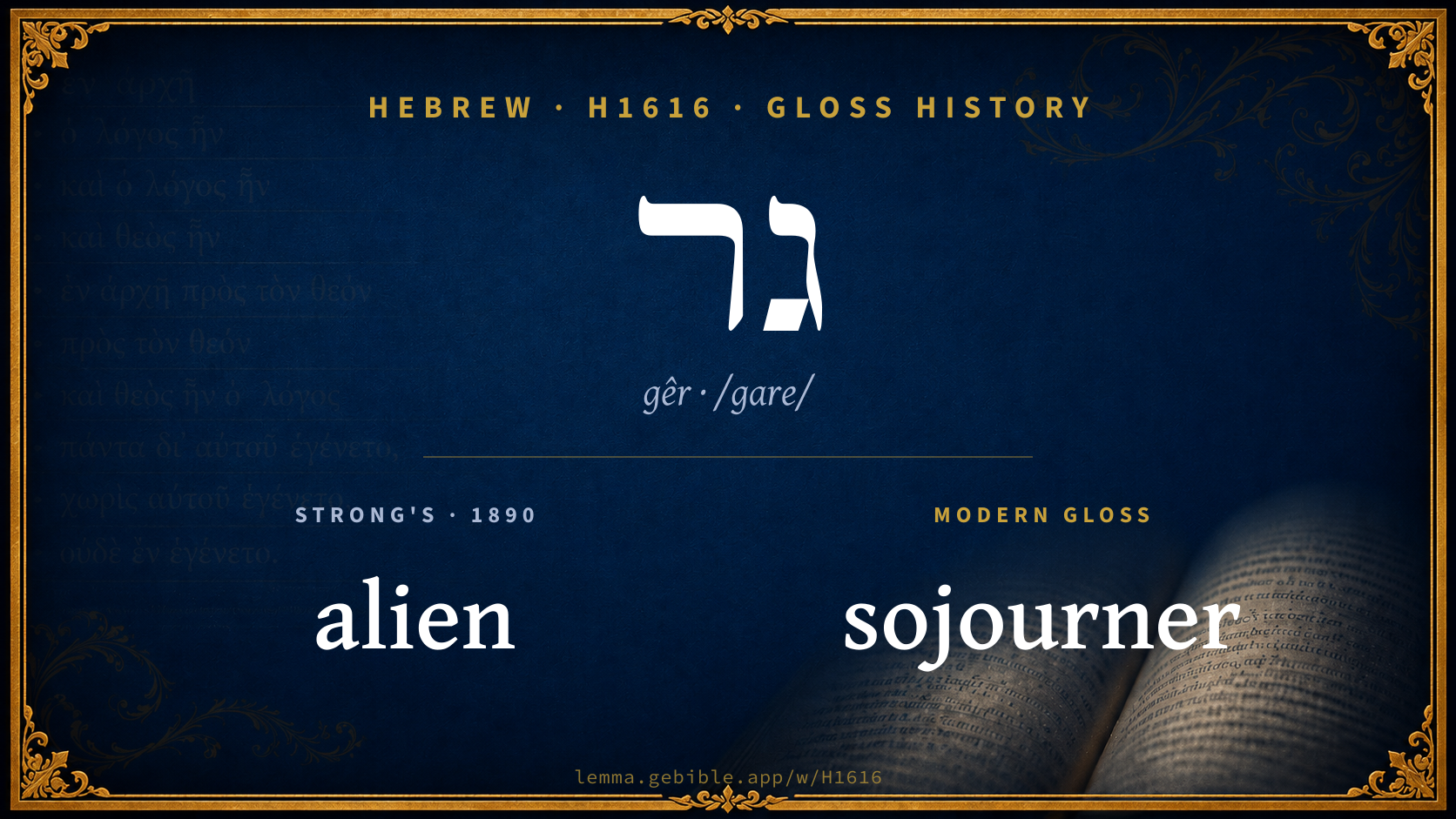
Gloss history
Strong's 1890 vs modern scholarship
About this word
Strong's H1616 catalogs a Hebrew word from the Hebrew Old Testament.
These counts are not copied from any lexicon or concordance. They are computed here, from the morphology-tagged Hebrew Old Testament. What Lemma adds →
- 83
- distinct verses
- The word appears in 83 distinct verses.
- 16 / 39
- OT books
- The word appears in 16 of 39 Old Testament books.
- #450
- by frequency
- Top 500 most frequent Hebrew words (rank 450 of 8,640 Hebrew words by occurrence).
View all 83 occurrences in the concordance →
Most concentrated in
- Deuteronomy 21 verses 25%
- Leviticus 18 verses 22%
- Exodus 9 verses 11%
By section of the Old Testament
By traditional corpus
Conventional, traditional groupings — biblical authorship is debated, so this is a traditional corpus grouping, not an authorship claim. Each share is this word’s portion of its verses in that division of the Hebrew canon. Each figure is a share of the word’s 83 distinct verses.
- Torah (Pentateuch) 59 verses · 71%
- Prophets (Nevi'im) 15 verses · 18%
- Writings (Ketuvim) 9 verses · 11%
How translations render this word
Counts come from each version’s own published word-to-Strong’s tagging or interlinear alignment — an approximate guide to how each version renders this word, not a word-level alignment the data otherwise carries. Because each total is that version’s own tagged count, the per-version totals vary from one another and need not match the appearance or distinct-verse counts above. These counts may also differ from a printed concordance because Lemma counts each distinctly tagged rendering and does not collapse phrase taggings into a single head-word total. This is a fixed set of word-tagged versions (KJV, ASV, BSB, ULT) and does not change with the reading translation you choose elsewhere. Each version’s license is shown beside its name below (and on Sources).
BDB lists this Strong’s number as 2 distinct words (homographs). Each count above pools all of them and is not split by sense — see the Senses section below. A low-frequency rendering may belong to a different one of those words, not the primary meaning.
- King James Version†: Stranger 42×, Or of the strangers 5×, Strangers 5×
- American Standard Version†: Sojourner 25×, Stranger 14×, Or of the strangers 5×
- Berean Standard Bible†: Foreigner 38×, Foreigners 14×, Foreign resident 7×
- unfoldingWord Literal Text†: Sojourner 40×, Foreigner 28×, Foreigners 9×
King James Version Public Domain
Renders H1616 across 89† tagged occurrences — most commonly:
Plus 24 renderings that appear only once — usually multi-word phrases or single function words the recovered tagging swept in, not distinct renderings. Not rendered by a distinct English word in 3 further occurrences.
American Standard Version Public Domain
Renders H1616 across 92† tagged occurrences — most commonly:
Plus 31 renderings that appear only once — usually multi-word phrases or single function words the recovered tagging swept in, not distinct renderings.
Berean Standard Bible Public Domain
Renders H1616 across 92† tagged occurrences — most commonly:
Plus 23 renderings that appear only once — usually multi-word phrases or single function words the recovered tagging swept in, not distinct renderings.
unfoldingWord Literal Text CC BY-SA 4.0
Renders H1616 across 96† tagged occurrences — most commonly:
Plus 10 renderings that appear only once — usually multi-word phrases or single function words the recovered tagging swept in, not distinct renderings.
Senses in the full BDB
What do BDB’s symbols mean?
BDB uses these scholarly abbreviations:
| Symbol | Meaning |
|---|---|
| 𝔊 | the Septuagint (the ancient Greek translation, LXX) |
| 𝔙 | the Vulgate (the Latin translation) |
| 𝔖 | the Syriac version (the Peshitta) |
| 𝔗 | the Targum (the Aramaic translation) |
| ψ | the Psalms |
| √ | root (the underlying root or stem) |
| ‖ | parallel passage (a synonymous or contrasted parallel) |
| † | the dagger: every passage where the word occurs is cited |
The 2 senses and sub-senses the full Brown-Driver-Briggs lexicon distinguishes for this word, in lexicon order (not ranked by frequency), with BDB’s own verbatim wording and sub-sense lettering. Shown in Hebrew script with BDB’s own scholarly abbreviations. The condensed entry is in the Lexicon Entry tab. See also the Forms in the corpus table below.
- 1. sojourner, temporary dweller, new-comer (no inherited rights), cf. Ex 12:19 Lv 24:16 Nu 15:30 Jos 8:33 (opp. homeborn); of Abraham at Hebron Gn 23:4 (P; ‖ תּוֹשָׁב); Moses in desert Ex 2:22 (J) 18:3 (E; here explan. of name Gershom, Moses’ son); as claiming hospitality Jb 31:32; perhaps in above cases, and certainly in general, with technical sense; fig. of Yahweh Je 14:8; of Israel in Egypt Gn 15:13 Ex 22:20; 23:9 (all JE) Lv 19:34 (H) Dt 10:19; 23:8; גֵּרִים with Yahweh Lv 25:23 (H) 1 Ch 29:15 ψ 39:13 (in all ‖ תּוֹשָׁב) cf. 119:19. e.g. Exodus 12:19
- 2. usually of גֵּרִים in Israel 2 S 1:13 (Amalekite) cf. Jos 8:33, 35 (E) 20:9 (P) Is 14:1; dwellers in Israel with certain conceded, not inherited rights (cf. RSOTJC 434; 2nd ed. 342. n.; K 42; Sem 75 f. StaGesch. i. 400). The גֵּר is to share in Sabbath rest Ex 20:10; 23:12 (both JE) Dt 5:14; otherwise he is to have like obligations with Israel Ex 12:19, 48, 49 Lv 16:29 (all P) Lv 17:8, 10, 12, 13, 15; 18:26; 20:2; 22:18; 24:16, 22 (all H) Nu 9:14(×2); 15:14, 15(×2), 16, 26, 29, 30; 19:10; 35:15 (all P) Ez 14:7; similar rights Dt 1:16 Ez 14:22, 23; and like privileges Dt 16:11, 14; 26:11; 29:10; 31:12 cf. 2 Ch 30:25; very rarely any distinction made, in obligation Lv 25:47(×3) (H), in permissible food Dt 14:21; in future success Dt 28:43; kindness to גֵּר frequently enjoined: Lv 19:10 (‖ עָנִי), 23:22 (‖ id.) 19:34 (all H); Dt 10:18, 19; 14:29; 24:19, 20, 21; 26:12, 13 (all ‖ יָתוֹם וְאַלְמָנָה); oppression prohibited Lv 19:33 (H) Dt 24:14; Ex 22:20; 23:9(×2) (JE) Dt 24:17; 27:19 Je 7:6; 22:3 Zc 7:10 (these eight ‖ יָתוֹם וְאַלְמָנָה); obj. of care to י׳ ψ 146:9 (‖ id.); charge that גֵּר has been oppressed Ez 22:7 Mal 3:5 (both ‖ id.); also Ez 22:29 (‖ עָנִי וְאֶבְיוֹן), ψ 94:6; cf. also command that a poor brother be treated like גֵּר, i.e. kindly, Lv 25:35 (H). Latest conception somewhat different: גֵּר 1 Ch 22:2 2 Ch 2:16 (הַגֵּירִים) gathered for hard service; yet cf. 2 Ch 30:25. (Often c. verb. cogn. Ex 12:48, 49 Lv 16:29; 17:8, 10, 12, 13; 18:26; 19:33; 20:2 Nu 9:14; 15:14, 15, 16, 26, 29; 19:10 Jos 20:9 Ez 14:22, 23; often ‖ תּוֹשָׁב Gn 23:4 Lv 25:23, 35, 47 1 Ch 29:15 ψ 39:13). e.g. 2 Samuel 1:13
Senses from the full Brown-Driver-Briggs lexicon (Brown, Driver, Briggs; Oxford 1906 — public domain), digitized via Sefaria, supplemented by the OpenScriptures HebrewLexicon (CC BY 4.0). Full attribution on Sources.
Word origin
n.m. Ex 12:48 sojourner (Arabic جَارٌ, Ethiopic ግዩር, ጎር Aramaic ܓܝܻܘܽܪ, גִּיּוֹר, proselyte, גַּיֵּר proselytize, Ph. גר in n.pr., & pl. גרם)—גֵּר Gn 15:13 + 74 times; sf. גֵּרְךָ Ex 20:10 + 4 times, גֵּרוֹ Dt 1:16; pl. גֵּרִים Ex 22:20 + 9 times, גֵּירִים 2 Ch 2:16;—
— Brown-Driver-Briggs (Oxford 1906, public domain), digitized via Sefaria, supplemented by the OpenScriptures HebrewLexicon (CC BY 4.0). See Sources.
Derived from גור (gûwr) (H1481) — to sojourn.
Jastrow Dictionary
A second Hebrew/Aramaic lexicon for comparison, covering Aramaic and post-biblical (Talmudic, Targumic, Midrashic) usage that the biblical-Hebrew BDB does not. Matched by lemma rather than by Strong’s number, so a lemma may carry more than one Jastrow headword (shown separately below), and the entries cover usage well beyond the Bible.
גֵּר
- 1. a dweller. Sabb. 104ᵃ, v. preced.
- 2. a stranger. Tanḥ. Vayigg. 4 גרא שנעשה ג׳ he is named Gera, because he (Joseph) became a stranger, v. גּוּר.—Esp. a proselyte, convert to Judaism. Yeb. 46ᵇ; Ber. 47ᵇ לעולם אינו ג׳ וכ׳ one is not a proselyte until he has been &c. Yeb. l. c.; Kidd. 62ᵇ ג׳ צריך שלשה a proselyte requires a court of three for making declaration and immersion. Kerith. II, 1 ג׳ מחוסר כפרה a proselyte who has not yet offered a sacrifice in the Temple; a. v. fr.—ג׳ צֶדֶק a full, true proselyte, ג׳ תֹּושָׁב one who, for the sake of acquiring limited citizenship in Palestine, renounces idolatry. Snh. 96ᵇ; Gitt. 57ᵇ; a. fr.—ג׳ שקר an insincere proselyte (from impure motives). Y. B. Mets. V, 10ᶜ.—Pl. גֵּרִים, constr. גֵּרֵי, גֵּירֵי.—ג׳ גרורים self-made converts, not formally admitted. Ab. Zar. 3ᵇ; 24ᵃ; a. e.—גרי אריות lion-proselytes, i.e. proselytes from mere fear (with ref. to II Kings XVII, 25 sq.). Ḥull. 3ᵇ, opp. גרי אמת. Kidd. 75ᵇ; Snh. 85ᵇ; a. fr.—גרי חלומות proselytes converted by the advice of a dreamer or an interpreter of dreams; גרי מרדכי ואסתר such as joined the Jewish ranks from motives like those prevalent in the days of Mordecai and Esther (Esth. VIII, 17). Yeb. 24ᵇ.—Nidd. VII, 3 (56ᵇ) גרים טועין Ar. (ed. וטועין) proselytes not living in accordance with the Jewish usages.—בן גרים a descendant of proselytes. B. Mets. IV, 10 (58ᵇ).—Sabb. 33ᵇ יהודה בן ג׳. [Mode of admission, v. Yeb. 47ᵃ.—Views about converts, v. Num. R. s. 8; Nidd. 13ᵇ; Pes. 87ᵇ; a. fr.]. Fem. גֵּרָה. Gen. R. s. 88, end.—Usu. גִּיֹּורֶת. Keth. IV, 3; a. fr. e.g. 2 Kings 17:25
A Dictionary of the Targumim, the Talmud Babli and Yerushalmi, and the Midrashic Literature (Marcus Jastrow; London, Luzac, 1903) — Public Domain. Digitized via Sefaria. Digitized via Sefaria. Full attribution on Sources.
Forms in the corpus
The 56 distinct written forms H1616 takes in the Hebrew Bible, most frequent first — each parse links to that state’s occurrences in the concordance. Hebrew forms include their vowel points and cantillation, so a single lemma takes many written forms.
Same root — word family
Other BDB entries built from the same root as H1616, grouped by Strong’s listed origin. These share a root / origin per the lexicon — not necessarily a shared meaning. Each links to that word’s own entry.
Derives from
Shares the same root
- גור gûwr H1482 cub
- גרות gêrûwth H1628 lodging place
- מגור mâgôwr H4032 fear
- מגור mâgûwr H4033 dwelling place
Proper names from this root
People and places named from this root — a name, not an additional meaning of the word.
Compare all same-root words → Showing 4 of 8 — not the complete family. 2 of the same-root words are proper names (people or places). They share a root, not necessarily a meaning.
Septuagint verse parallels
This word appears in 79 verses that also exist in the Greek Old Testament (Septuagint), out of the 83 Hebrew verses it occurs in. You can read those verses in Greek by switching the Old Testament edition to the Septuagint.
Read these verses in the Septuagint
- Genesis 15:13
- Exodus 2:22
- Leviticus 16:29
- Numbers 9:14
- Deuteronomy 1:16
- 2 Samuel 1:13
- 1 Chronicles 22:2
- 2 Chronicles 2:17
- Job 31:32
- Psalms 39:12
- Isaiah 14:1
- Jeremiah 7:6
This is a verse-level parallel only — the same verses exist in both the Hebrew and Greek Old Testaments. No word-level Hebrew↔Greek correspondence is claimed: the data carries no such alignment, so no Greek word is shown as this Hebrew word’s translation. Coverage is not total — the Septuagint omits the deuterocanon and renumbers the Psalms, so some Hebrew verses have no direct Greek parallel.