
Exodus 22:21

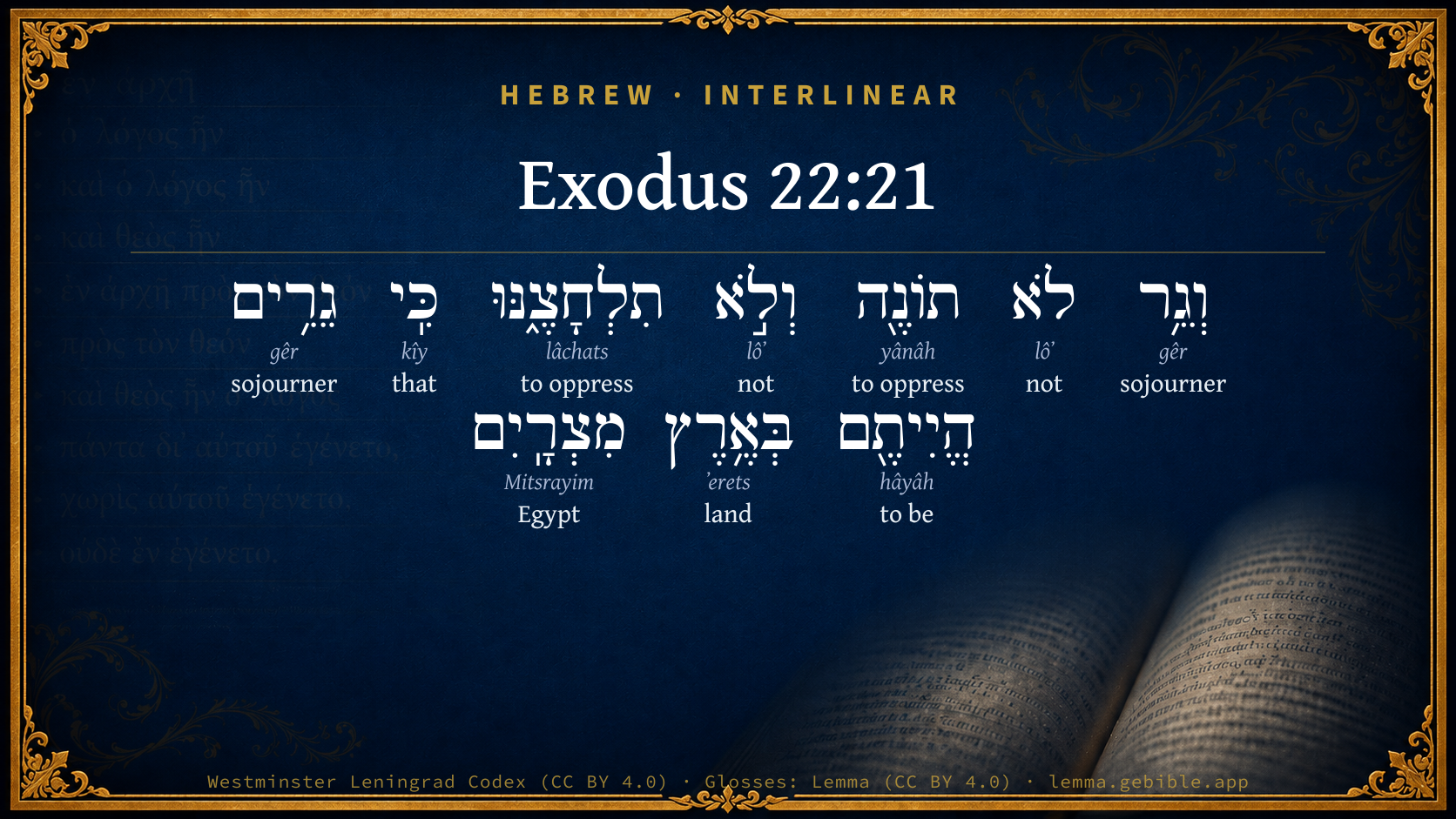
Hebrew (Westminster Leningrad Codex) Exodus 22:21 appears in the Hebrew Old Testament. The text above is from the Westminster Leningrad Codex. Each word links to its Strong’s number, a concise gloss, and parsing drawn from the Open Scriptures Hebrew Bible morphology. Click any word for its full Brown-Driver-Briggs (BDB) entry.
Download image
Cite this verse

Exodus 22:21 (World English Bible). Public Domain. Lemma interlinear Bible study tool, https://lemma.gebible.app/v/exodus/22/21.

Show BibTeX & RIS
BibTeX
RIS
English Translation
"You shall not wrong an alien, neither shall you oppress him, for you were aliens in the land of Egypt.
World English Bible · Public Domain
Highlights
  • 1 first appearance in the Hebrew Bible
Full analysis ↓
Download a study sheet

One document with this verse’s original text, its word-by-word gloss line, the meaning frame, cross-references with their text, attributed commentary, and full source and license credits — printable, and it pastes into notes with its structure intact.

This verse Autodidact and up

Study sheet (.html) Plain text (.txt)

A passage Seminary Student

Up to 50 verses in one chapter. A passage sheet keeps up to 6 commentary sources and 12 cross-references per verse, in the order this page ranks them, and says so on the sheet whenever that leaves anything out. Ask for a single verse and you get the Autodidact verse sheet above.

Everything on this page stays free to read, with no account — the sheet is a download of what is already on screen, not access to it.

Want to remove ads? Support Godless Engineer
Compare translations 3

The same verse in 3 English versions, stacked beneath the original-language interlinear above. Click any original word for its lexicon entry.

Each is an independent rendering of the whole verse — the interlinear is not word-aligned to these translations.

Highlighted words mark where these versions differ — a whole-verse word diff, not a word-by-word alignment.

  • World English Bible Public Domain
    "You shall not wrong an alien, neither shall you oppress him, for you were aliens in the land of Egypt.
  • King James Version Public Domain
    Thou shalt neither vex a stranger, nor oppress him: for ye were strangers in the land of Egypt.
  • unfoldingWord Literal Text CC BY-SA 4.0
    You shall not wrong a sojourner and you shall not oppress him, for you were sojourners in the land of Egypt.

unfoldingWord Literal Text — © unfoldingWord, licensed CC BY-SA 4.0. Word-aligned USFM3 via Door43 (git.door43.org/unfoldingWord/en_ult).

Versions to compare (up to 4)

3 of 4 selected

Show all 18 translations

Every available English version of this verse, each an independent rendering of the whole verse.

  • World English Bible Public Domain
    "You shall not wrong an alien, neither shall you oppress him, for you were aliens in the land of Egypt.
  • Berean Standard Bible Public Domain
    You must not exploit or oppress a foreign resident, for you yourselves were foreigners in the land of Egypt.
  • Majority Standard Bible Public Domain
    You must not exploit or oppress a foreign resident, for you yourselves were foreigners in the land of Egypt.
  • King James Version Public Domain
    Thou shalt neither vex a stranger, nor oppress him: for ye were strangers in the land of Egypt.
  • American Standard Version (1901) Public Domain
    And a sojourner shalt thou not wrong, neither shalt thou oppress him: for ye were sojourners in the land of Egypt.
  • Revised Version (1885) Public Domain
    And a stranger shalt thou not wrong, neither shalt thou oppress him: for ye were strangers in the land of Egypt.
  • Geneva Bible (1599) Public Domain
    Moreouer, thou shalt not do iniurie to a stranger, neither oppresse him: for ye were strangers in the land of Egypt.
  • Douay-Rheims (1899) Public Domain
    Thou shalt not molest a stranger, nor afflict him: for yourselves also were strangers in the land of Egypt.
  • Young's Literal Translation Public Domain
    `And a sojourner thou dost not oppress, nor crush him, for sojourners ye have been in the land of Egypt.
  • Literal Standard Version CC BY-SA 4.0
    And you do not oppress a sojourner, nor crush him, for you have been sojourners in the land of Egypt.
  • Unlocked Literal Bible CC BY-SA 4.0
    You must not wrong a foreigner or oppress him, for you were foreigners in the land of Egypt.
  • unfoldingWord Literal Text CC BY-SA 4.0
    You shall not wrong a sojourner and you shall not oppress him, for you were sojourners in the land of Egypt.
  • Darby Bible Public Domain
    Thou shalt neither vex a stranger, nor oppress him; for ye have been strangers in the land of Egypt.
  • World Messianic Bible Public Domain
    “You shall not wrong an alien or oppress him, for you were aliens in the land of Egypt.
  • Webster's Bible Public Domain
    Thou shalt neither vex a stranger, nor oppress him; for ye were strangers in the land of Egypt.
  • Free Bible Version CC BY-SA 4.0
    You must not exploit or mistreat a foreigner. Remember that you yourselves were once foreigners in Egypt.
  • Bible in Basic English Public Domain
    Do no wrong to a man from a strange country, and do not be hard on him; for you yourselves were living in a strange country, in the land of Egypt.
  • JPS Tanakh (1917) Public Domain
    (22-20) And a stranger shalt thou not wrong, neither shalt thou oppress him; for ye were strangers in the land of Egypt.

Literal Standard Version (2020), Covenant Press — licensed CC BY-SA 4.0. Text via the HelloAO Bible API (eBible.org). Unlocked Literal Bible (unfoldingWord) — licensed CC BY-SA 4.0. Text via the HelloAO Bible API (eBible.org). unfoldingWord Literal Text — © unfoldingWord, licensed CC BY-SA 4.0. Word-aligned USFM3 via Door43 (git.door43.org/unfoldingWord/en_ult). Free Bible Version, Dr. Jonathan Gallagher — licensed CC BY-SA 4.0. Text via the HelloAO Bible API (eBible.org).

Word by word

More ways to search: Search by grammar → Find every occurrence → Compare this word →

Practice this passage: Drill this verse → Learn its vocabulary →

About this verse

These counts appear in no published source. They are computed here, from the morphology-tagged text and Lemma’s own curated glosses. What Lemma adds →

10
words
8
distinct lemmas
Pentateuch
section

Notable vocabulary

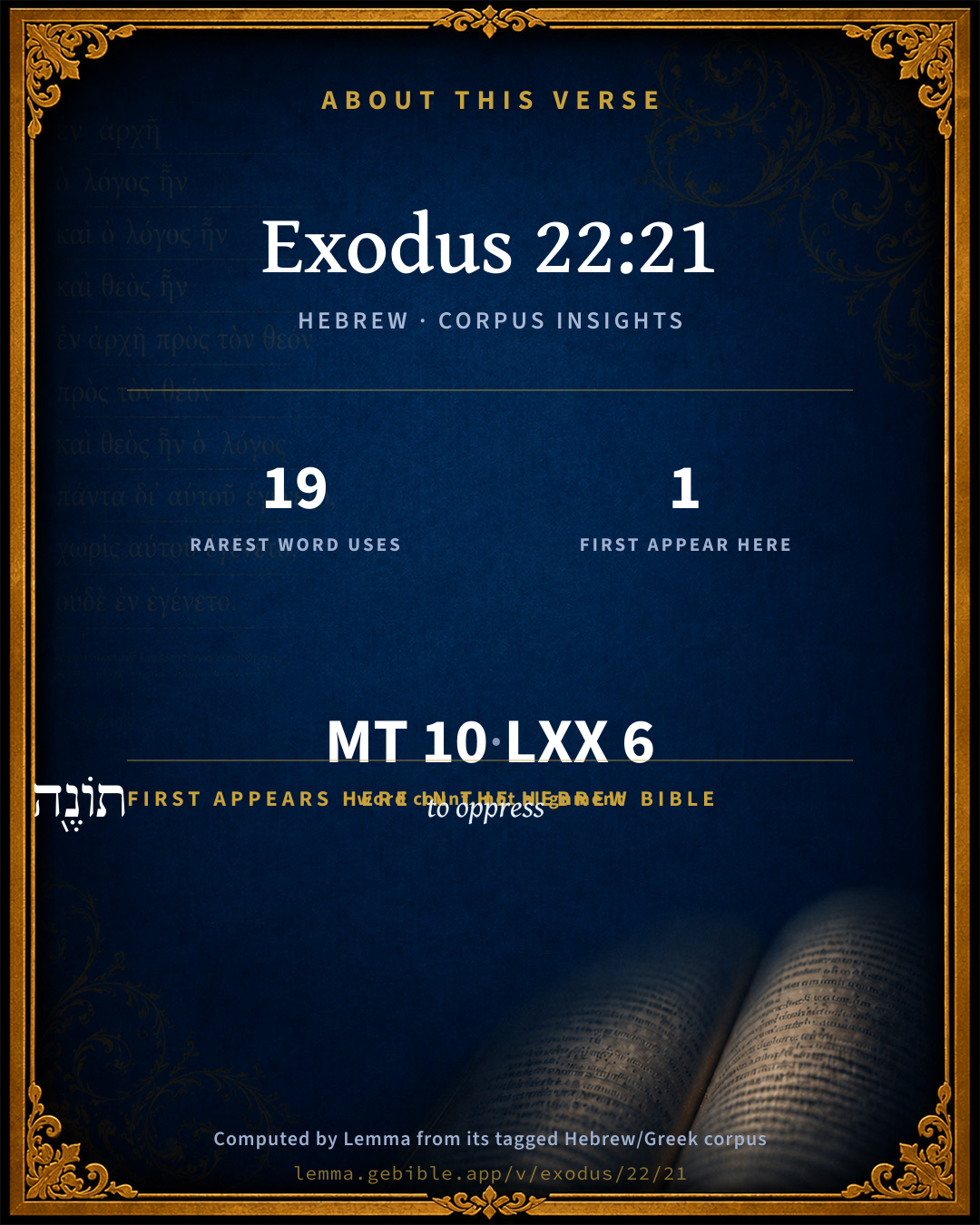
The rarest word here is תוֹנֶ֖ה to oppress H3238 — appearing just 19 times in the whole Hebrew Bible.

First appearance in Scripture

This word makes its first canonical appearance in the Hebrew Bible here:

  • תוֹנֶ֖ה to oppress H3238

Shared distinctive vocabulary

תוֹנֶ֖ה to oppress H3238 occurs in 19 verses of the Hebrew Bible. Also found in:

Grammatical profile

  • 3 verbs
  • 4 nouns
  • 1 conjunction
  • 2 particles

Verb forms

  • תוֹנֶ֖ה Hiphil · Imperfect
  • תִלְחָצֶ֑נּוּ Qal · Imperfect
  • הֱיִיתֶ֖ם Qal · Perfect

Repetition

Words recur within this verse — often emphatic in Hebrew:

  • וְגֵ֥ר sojourner H1616 ×2
  • לֹא not H3808 ×2

Hebrew & Septuagint length

In English translation the verse runs 20 words from the Hebrew and 19 from the Septuagint (LXX English) — closely comparable.

A rough comparison of the two English renderings, which tokenize alike — not a word-level alignment.

Word counts can differ between the Hebrew and the Greek without any difference in meaning — e.g. the Hebrew direct-object marker אֵת has no separate Greek word, and Greek often adds the article ὁ.

In the original languages it is 10 Hebrew tokens and 6 Greek tokens — but the two are counted differently (Hebrew bundles its prefixes and suffixes into one token; the Greek is in lemma form), so that isn’t a like-for-like length.

Cross-references

11

Topical passages linked to Exodus 22:21 in the Treasury of Scripture Knowledge — connected by theme and wording, ordered by reader-vote popularity; previews shown in the World English Bible.

  • Exodus 23:9 "You shall not oppress an alien, for you know the heart of an alien, seeing you were aliens in the land of Egypt.
  • Deuteronomy 10:19 Therefore love the foreigner; for you were foreigners in the land of Egypt.
  • Leviticus 19:33 "'If a stranger lives as a foreigner with you in your land, you shall not do him wrong.
  • Zechariah 7:10 Don't oppress the widow, nor the fatherless, the foreigner, nor the poor; and let none of you devise evil against his brother in your heart.'
  • Exodus 20:2 "I am Yahweh your God, who brought you out of the land of Egypt, out of the house of bondage.
  • Leviticus 25:35 "'If your brother has become poor, and his hand can't support him among you; then you shall uphold him. As a stranger and a sojourner he shall live with you.
  • Deuteronomy 23:7 You shall not abhor an Edomite; for he is your brother: you shall not abhor an Egyptian, because you lived as a foreigner in his land.
  • Jeremiah 7:6 if you don't oppress the foreigner, the fatherless, and the widow, and don't shed innocent blood in this place, neither walk after other gods to your own hurt:
  • Malachi 3:5 I will come near to you to judgment; and I will be a swift witness against the sorcerers, and against the adulterers, and against the perjurers, and against those who oppress the hireling in his wages, the widow, and the fatherless, and who deprive the foreigner of justice, and don't fear me," says Yahweh of Hosts.
  • Deuteronomy 15:15 You shall remember that you were a bondservant in the land of Egypt, and Yahweh your God redeemed you: therefore I command you this thing today.
  • Jeremiah 22:3 Thus says Yahweh: Execute you justice and righteousness, and deliver him who is robbed out of the hand of the oppressor: and do no wrong, do no violence, to the foreigner, the fatherless, nor the widow; neither shed innocent blood in this place.

Cross-references courtesy of OpenBible.info (CC BY 4.0).

Hebrew and Greek witnesses Masoretic Hebrew ↔ Greek Septuagint

The same verse in the two great witnesses to the Old Testament, shown verse-for-verse.

These are two independent witnesses, not word-aligned to each other, and the Septuagint is shown in lemma (dictionary) form.

Hebrew Exodus 22:21 Masoretic · Westminster Leningrad Codex

וְגֵ֥ר לֹא תוֹנֶ֖ה וְלֹ֣א תִלְחָצֶ֑נּוּ כִּֽי גֵרִ֥ים הֱיִיתֶ֖ם בְּאֶ֥רֶץ מִצְרָֽיִם

"You shall not wrong an alien, neither shall you oppress him, for you were aliens in the land of Egypt.

World English Bible · Public Domain

Greek LXX Exodus 22:21 Septuagint · lemma form

πᾶς χήρα καί ὀρφανός οὐ κακόω

And you⌃ shall not hurt a stranger, nor afflict him; for you⌃ were strangers in the land of Egypt.

LXX2012 (modern English Septuagint) · Public Domain

Hebrew: Westminster Leningrad Codex (CC BY 4.0). Greek: Septuagint (public domain); English from LXX2012 (modern English Septuagint) (Public Domain). How the Septuagint differs from the Hebrew →

Targum (Aramaic paraphrase)

2

The Targum is the ancient Jewish Aramaic paraphrase of the Hebrew Scriptures — an interpretive translation, not the Hebrew text itself. Onkelos (literal) and Pseudo-Jonathan (expansive) render the Torah, and Jonathan the Prophets. Coverage is partial: where no permissively-licensed English translation exists for a verse, only the Aramaic is shown. This is verse-level text, not a word-by-word alignment to the Hebrew.

  1. Targum Onkelos Torah (Genesis–Deuteronomy)
    כָּל אַרְמְלָא וְיִתָּם לָא תְעַנוּן:

    (no public-domain English translation for this verse)

    Targum Onkelos — Aramaic: “Onkelos Genesis” (public domain); “Onkelos Exodus” (public domain); “Onkelos Leviticus” (public domain); “Onkelos Numbers” (public domain); “Onkelos Deuteronomy” (public domain). English: “Sefaria Community Translation” (CC0 1.0 (public-domain dedication)); “J.W. Etheridge. The Targums of Onkelos and Jonathan Ben Uzziel on the Pentateuch. London: Longmans, Green, 1862” (public domain). Text via Sefaria.

  2. Targum Pseudo-Jonathan Torah (Genesis–Deuteronomy)
    כָּל אַרְמְלָא וְיָתוֹם לָא תְסַגְפוּן

    You shall not impoverish the widow or the orphan.

    Targum Pseudo-Jonathan — Aramaic: “Targum Jonathan on Genesis” (public domain); “Targum Jonathan on Exodus” (public domain); “Targum Jonathan on Leviticus” (public domain); “Targum Jonathan on Numbers” (public domain); “Targum Jonathan on Deuteronomy” (public domain). English: “The Targum of Jonathan ben Uzziel, trans. J. W. Etheridge, London, 1862” (public domain). Text via Sefaria.

Commentary

Notes on Exodus 22:21 from classic Christian and Jewish commentators (each source and its license shown beneath its notes). The classic Christian expositions comment on the surrounding passage and are grouped to its opening verse, so a note may address several verses; the Jewish commentaries on the Tanakh (Rashi and others) are per-verse, so they appear only where the commentator wrote on this verse.

Lemma curates 59 commentaries, every one of them public domain or Creative Commons licensed, each selected and text-cleaned for this edition rather than reprinted as found. About our sources →

Trapp's Complete Commentary

John Trapp

Exo 22:21 Thou shalt neither vex a stranger, nor oppress him: for ye were strangers in the land of Egypt.

Ver. 21. Theft shalt not vex a stranger.] The right of strangers is so holy, saith one, that there was never nation so barbarous that would violate the same. When Stephen Gardner had in his power the renowned divine Peter Martyr, then teaching at Oxford, he would not keep him to punish him; but when he should go his way, gave him wherewith to bear his charges. {a}

{a} Act. and Mon., fol. 1783.

John Trapp, A Commentary or Exposition upon All the Books of the Old and New Testament (1647–1656) — public domain. Text from a community e-Sword module.

The Biblical Illustrator

Joseph S. Exell

Exo_22:21

Neither vex a stranger.

The stranger

The spirit of the Hebrew law was broader than race, or country, or kindred. Among the ancients generally a foreigner had no rights in any country but his own. In some languages the very word stranger was synonymous with enemy. Against these race hatreds Moses set up this command. Not only were foreigners to be tolerated; they were to receive the fullest protection (see Lev_24:22). (H. M. Field, D. D.)

Sound policy

This was not only a humane law; but it was a sound policy. Do not wrong a stranger; remember ye were strangers. Do not oppress a stranger; remember ye were oppressed. Therefore do unto all men as you would they should do to you. Let strangers be well treated among you, and many will come among you, and the strength of your country will be increased. If refugees of this kind be treated well, they will become proselytes to your religion, and thus their souls may be saved. (A. Clarke, D. D.)

She was a stranger

A missionary was requested to go out to a new settlement to address a Sabbath-school. He had preached in the morning, and was wearied and felt quite unfitted for the task, but reluctantly consented to go. When he found himself at the spot, he looked round the assembly with great misgivings, not knowing what to say to them. He noticed a little girl, shabbily dressed and barefooted, shrinking in a corner, her little sunburnt face buried in her hands, the tears trickling between her small brown fingers, and sobbing as if her heart would break. Soon, however, another little girl, about eleven years old, got up and went to her, whispered kindly to her, and taking her by the hand, led her toward a brook, then seated her on a log, and kneeling beside her she took off her ragged sun bonnet, and dipping her hand in the water, bathed her hot eyes and tear-stained face, and smoothed her tangled hair, talking in a cheery manner all the while. The little one brightened up, the tears all went, and smiles came creeping around the rosy mouth. The missionary stepped forward and said: Is that your little sister, my dear? No, sir, answered the noble child, with tender, earnest eyes, I have no sister, sir. Oh, one of the neighbours children, replied the missionary; a little school-mate, perhaps? No, sir; she is a stranger. I do not know where she came from; I never saw her before. Then how came you to take her out and have such a care for her if you do not know her? Because she was a stranger, sir, and seemed all alone, and needed somebody to be kind to her. Ah, said the missionary to himself, here is a text for me to preach from--Because she was a stranger, and seemed all alone, and needed somebody to be kind to her. The words came to him, Inasmuch as ye have done it unto one of the least of these My brethren, ye have done it unto Me. So, taking the little girls by the hand, he went back to the school-room and told the people the simple story; then spoke of the great love that all should bear to one another, even as the dear Saviour sought out those who were humble and of low estate, making them His peculiar care. The missionary forgot his weariness, and felt that God had put good word in his mouth.

The Biblical Illustrator, edited by Joseph S. Exell (c. 1880s–1900s) — public domain. Text from a community e-Sword module.

Joseph Benson's Commentary

Exo 22:21. A stranger must not be abused, not wronged in judgment by the magistrates, not imposed upon in contracts, nor any advantage taken of his ignorance or necessity, no, nor must he be taunted, or upbraided with his being a stranger; for all these were vexatious. For ye were strangers in Egypt — And knew what it was to be vexed and oppressed there. Those that have themselves been in poverty and distress, if Providence enrich and enlarge them, ought to show a particular tenderness toward those that are now in such circumstances as they were in formerly, now doing to them as they then wished to be done to.

Joseph Benson's Commentary on the Old and New Testaments (1811–1818) — public domain. Text from a community e-Sword module.

Tyndale Open Study Notes

Tyndale Open Resources

22:21 The Hebrews were to treat foreigners kindly because they, too, had once been foreigners (see also 23:9; Deut 10:18-19). For further development of the principle, see Luke 6:31.

Tyndale Open Study Notes — © Tyndale Open Resources, licensed CC BY-SA 4.0. Text via the HelloAO Bible API.

Adam Clarke's Commentary

Verse 21. Thou shalt neither vex a stranger, nor oppress him] This was not only a very humane law, but it was also the offspring of a sound policy: "Do not vex a stranger; remember ye were strangers. Do not oppress a stranger; remember ye were oppressed. Therefore do unto all men as ye would they should do to you." It was the produce of a sound policy: "Let strangers be well treated among you, and many will come to take refuge among you, and thus the strength of your country will be increased. If refugees of this kind be treated well, they will become proselytes to your religion, and thus their souls may be saved." In every point of view, therefore, justice, humanity, sound policy, and religion, say. Neither vex nor oppress a stranger.

Adam Clarke's Commentary on the Bible (1810–1826) — public domain. Text from a community e-Sword/MySword module.

Ellicott's Commentary for English Readers

(21) For ye were strangers.—Ye should, therefore, sympathise with “strangers;” not “vex them,” not “oppress them,” but “love them as yourselves” (Lev_19:34). The condition of foreigners in Israel is shown to have been more than tolerable by the examples of the Kenites (Jdg_1:16; Jdg_4:11); of Araunah the Jebusite (2Sa_24:18-24); of Uriah the Hittite (2Sa_23:39), Zelek the Ammonite (2Sa_23:37), and others.

(21-24) The juxtaposition of laws against oppression with three crimes of the deepest dye seems intended to indicate that oppression is among the sins which are most hateful in God’s sight. The lawgiver, however, does not say that it is to be punished capitally, nor, indeed, does he affix to it any legal penalty. Instead of so doing, he declares that God Himself will punish it “with the sword” (Exo_22:24). Three classes of persons particularly liable to be oppressed are selected for mention—(1) Strangers, i.e., foreigners; (2) widows; and (3) orphans. Strangers have seldom been protected by any legislation, unless, indeed, they formed a class of permanent residents, like the Metœci at Athens. The law of civilised communities has generally afforded some protection to the orphan and the widow, particularly in respect of rights of property. The protection given is, however, very generally insufficient; and it is of the highest importance that it should be supplemented by an assured belief that, beyond all legal penalties there lies the Divine sentence of wrath and punishment, certain to fall upon every one who, careless of law and right, makes the stranger, the widow, or the orphan to suffer wrong at his hands.

A Bible Commentary for English Readers, edited by Charles John Ellicott (1878–1897) — public domain. Text from a community e-Sword module.

The Cambridge Bible for Schools and Colleges

gen. ed. J. J. S. Perowne

21. a sojourner shalt thou not wrong …; for ye were sojourners in the land of Egypt] The ‘sojourner’ (gêr), or resident foreigner (see on Exo_12:48; and cf. Exo_2:22, Exo_20:10), had at this time no legal status in Israel, and was thus liable in many ways to injustice and oppression. With this injunction comp. Lev_19:33-34, Deu_1:16; Deu_10:18 f., and the other passages from Dt. and Jer. cited on v. 22; for allusions to the oppression of the gêr, see Eze_22:7; Eze_22:29, Mal_3:5.

wrong] Heb. hônâh; cf. Lev_19:33 (‘oppress’), also of the gêr.

oppress] lit. crush (Num_22:25): fig. of external oppressors, Jdg_2:8 al.; as here, only Exo_23:9 besides.

for ye were sojourners, &c.] The same motive, in exactly the same words, in Exo_23:9, Lev_19:34 (H), Deu_10:19. For the cognate verb cased of the ‘sojourn’ in Egypt, see Gen_12:10 (of Abraham), Exo_6:4, Deu_26:5, Isa_52:4, Psa_105:12.

21–27. A group of humanitarian laws. The gêr, or resident foreigner, the widow, and the orphan not to be oppressed, vv. 21–24; interest not to be taken from the poor, v. 25; a garment taken in pledge to be returned before nightfall, vv. 26 f.

The Cambridge Bible for Schools and Colleges (gen. ed. J. J. S. Perowne; Cambridge University Press, 1878–1918) — public domain. Text from a community e-Sword module.

John Gill's Exposition

Ye shall not afflict any widow or fatherless child. Who have no friends, husband, or father to be on their side and protect them, and are weak and helpless to defend themselves, and therefore it must be barbarous to do them any injury, either to their persons or property; no one ought to be afflicted and distressed by another, either in body or mind, or substance, and especially such as have no helper, not any to assist them and sympathize with them; for this is a law for every man, as Jarchi observes, is binding upon all; only the Scripture speaks of these, because of their weakness, and because they are more frequently afflicted than others, cruel and unmerciful men taking the advantage of their inability to defend themselves.

Ye shall not afflict any widow or fatherless child. Who have no friends, husband, or father to be on their side and protect them, and are weak and helpless to defend themselves, and therefore it must be barbarous to do them any injury, either to their persons or property; no one ought to be afflicted and distressed by another, either in body or mind, or substance, and especially such as have no helper, not any to assist them and sympathize with them; for this is a law for every man, as Jarchi observes, is binding upon all; only the Scripture speaks of these, because of their weakness, and because they are more frequently afflicted than others, cruel and unmerciful men taking the advantage of their inability to defend themselves.

Exodus 22:23

exo 22:23

exo 22:23

exo 22:23If thou afflict them in any wise,..... In any way, or by any means whatever; their minds, by reproaches, censures, insults, and their bodies by stripes, false imprisonment, &c. and in their substance, by withholding from them what belongs to them, taking what they have, or cheating and defrauding them in any respect; or, "in afflicting afflict them" (e); afflict them much, and continue to do so:

and they cry at all unto me; in prayer, as the Targum of Jonathan; or, "in crying cry" (f); cry vehemently, or importunately, and with constancy, or rather, cry ever so little:

I will surely hear their cry; the voice of their prayer, as the same Targum; or, "in hearing I will hear" (g); will certainly take notice of their cries, and return an answer to them, by appearing on their side, and avenging their injuries; for God is the Father of the fatherless, and the husband of the widow, and the Judge of them both: the manner of speaking or form of expression is the same in all these clauses, the words being doubled.

(e) "affligendo afflixeris", Pagninus, Piscator, Ainsworth, Montanus, Junius & Tremellius. (f) "clamando clamaverit", Pagninus, Montanus, Piscator, Ainsworth. (g) "audiendo audiam", Pagninus, Montanus, Piscator, Ainsworth.

John Gill's Exposition of the Whole Bible (1746–1763) — public domain (CC PDM 1.0). Text via the HelloAO Bible API.

Albert Barnes' Notes on the Bible

A stranger - See Exo 20:10 note.

Albert Barnes' Notes on the Bible (1834–1885) — public domain. Text from a community e-Sword/MySword module.

Haydock's Catholic Bible Commentary

Were strangers. The Celtes punished with death the murderer of a stranger, which they only banished him who murdered a citizen. (Calmet)

George Leo Haydock (1774–1849), Haydock's Catholic Family Bible and Commentary, 1859 edition — public domain. Excludes Psalms (Douay-Rheims chapter numbering differs from Protestant) and Deuterocanonical books (Catholic canon only).

The Pulpit Commentary

Law against oppression of foreigners. It may be doubted whether such a law as this was ever made in any other country. Foreigners are generally looked upon as "fair game," whom the natives of a country may ridicule and annoy at their pleasure. Native politeness gives them an exceptional position in France; but elsewhere it is the general rule to "vex" them. The Mosaic legislation protested strongly against this practice (Exo_23:9; Lev_19:33) and even required the Israelites to "love the stranger who dwelt with them as themselves". (Lev_19:34) For ye were strangers. Compare Lev_19:34, and Deu_10:19 in Exo_23:9 the addition is made ye know the heart of a stranger ye know; i.e. , the feelings which strangers have when they are vexed and oppressed ye know this by your own sad experience, and should therefore have a tenderness for strangers.

Vers. 21-29. Jehovah"s proteges and representatives.

I JEHOVAH"S PROTEGES (vers. 21-28). These are the stranger, the fatherless, the widow, and the poor generally all of whom the Israelites are forbidden to "afflict." The ground of Jehovah"s interest in them is his own character I am gracious" (ver. 27). In him, however little they may sometimes think of it or feel it, they have a constant Friend, a great invisible Protector. They are (in the sense of Roman law) Jehovah"s "clients." He is their great Patron; he identifies himself with their interests; he will uphold their cause. Injuries done to them he will resent as if done to himself, and will call the wrong-doer to strict account. If earthly law fails, let them cry to him, and he will put the jus talionis in operation with his own hands (vers. 23, 24, 27). Vers. 25-28 specially forbid exacting treatment of the poor. Liberal help is to be afforded them. A neighbour is not to be harshly dealt with when driven to a strait. His garment, if given as a pledge, is not to be kept beyond nightfall, which is practically equivalent to saying that it is not to be taken from him at all (ver. 27). What kindness breathes in these precepts! How justly does the law which embodies them claim to be a law of love! And how far, even yet, is our Christian society from having risen to the height of the standard they set up! Let us seek ourselves to translate them more uniformly into practice. Learn also, from these precepts, inculcating love to the stronger, how little ground there is for accusing the religion of Moses of fanatical hatred of foreign peoples.

II JEHOVAH"S REPRESENTATIVES (ver. 28). Magistrates and rulers are to be treated with respect. They are invested with a portion of God"s authority. J.O. (Rom_14:1)

HOMILIES BY D. YOUNG Ver. 21. The treatment of the stranger.

I NOTE THE FACT THAT STRANGERS WOULD COME INTO SUCH CONTACT WITH ISRAEL AS TO PROVIDE OPPORTUNITY FOR THIS TREATMENT. Jehovah had done a great deal in Israel to make them a separated people separated in many ways as by the land of their dwelling, their national institutions, their worship, their personal rite of circumcision; but separation, with all its rigours and all the penalties for neglecting it, could never become isolation. Solemnly indeed were the people enjoined to drive out the Canaanites, and trample down all idolatry; but there still remained the fact, that by a certain Divine and glorious necessity, strangers were to come into considerable intercourse with them. That strangers should have been drawn to them when they settled in their fertile home was only likely; but this must nave happened to some extent even before. We may be perfectly certain, considering the analogies of after generations and what we read of proselytism in the New Testament, that from the very first there must have been some with the proselyte disposition in them. Few perhaps of this sort were to be found in the mixed multitude coming out of Egypt but still there were some. The Lord knoweth them that are his. If there are those of whom John might say, "They went out from us because they were not of us," so there are those of whom the Church may ever say, "They come to us because they are of us." For such God lovingly and amply provided from the first, even when they came with all the disadvantages and difficulties of strangers to contend against. There is in this very injunction, a foreshadowing of the power and attractiveness to which Israel in due time would rise, though as yet it was but a fugitive people without discipline and without coherence. Strangers in their need were even now drawn to Israel and would be drawn still more, just as years ago their needy ancestor and his children were drawn to Egypt because of the corn that was there.

II THE STRONG TEMPTATION TO TREAT THESE FOREIGNERS BADLY. There is a very melancholy picture of human inconsistency here presented. Liberated slaves, forgetting the horrors of their own servitude, treat with like cruelty those exposed to the opportunity of that cruelty. Men soon forget their past condition. Israel, we see, forgot the horror of their own Egyptian experiences in two ways.

1. They lusted after the flesh-pots of Egypt.

2. They failed in sympathy for the foreigners among themselves.

When we have possessions and power and thus get the chance of domination, we are only too ready to treat foreigners either as interlopers wishing to spoil us, or tools fitted to increase our possessions. The world, alas! is always abounding in a great number of the feeble and unfortunate, of whom it is only too easy to take advantage. More than one class of these are mentioned in this chapter, and among them we see that the foreigner occupies a conspicuous place. The stranger is the man without friends; he comes into a place where the very things that profit the knowing are traps and snares for the ignorant. Consider the difficulties of a foreigner planted down in the midst of a huge city like London, a place of dangers and difficulties even for an Englishman who is thrown into it for the first time, and how much more for one whom ignorance of the language makes doubly strange! Blanco White, who it will be remembered was an exile from his native land of Spain, gives as an instance of Shakespeare"s surprising knowledge of the human mind and heart "the passage in which he describes the magnitude of the loss which a man banished from his country has to endure by living among those who do not understand his native language." The words are those put into the mouth of Mowbray Duke of Norfolk, on his banishment by Richard II.

The language I have learn" d these forty years, My native English, now I must forego. And now my tongue"s use is to me no more Than an unstringed viol or a harp, Or like a cunning instrument cased up Or, being open, put into his hands That knows no touch to tune the harmony: Within my mouth you have engaoled my tongue, Doubly portcullis" d with my teeth and lips; And dull unfeeling barren ignorance Is made my gaoler to attend on me.

If this be so, the stranger"s feelings are some index to the temptations of those among whom he is cast. There may not be downright robbery, but there are tricks of trade, extortionate charges on pretence of making hay while the sun shines; in short there are all sorts of human foxes ever on the watch to catch the ignorant, the innocent, and the confiding. But are God"s people amenable to charges of this kind? It is evident that the Israelites were, from this warning to them. It was so easy to turn Jehovah"s denunciations of the idolater into excuses for maltreating the stranger because he had the look of an idolater. Nay more, how easy it was both to yield to the idolatry and maltreat the stranger!

III THE GREAT CONSIDERATION WHICH IS TO LEAD TO PROPER TREATMENT OF THE STRANGER. "Ye were strangers in the land of Egypt." Great as the temptation was to treat strangers badly, such treatment if only looked at in a certain light would be scarcely excusable at all This possible treatment of the stranger is to be looked at in the clear light of our Lord"s parable concerning the forgiven yet unforgiving debtor. Israel had been strangers in Egypt, not only foreigners among the Egyptians, but to some extent exiles from God, who had put on the appearance of having forgotten them. But now he had brought them to himself, they were to be his people, a holy nation; and it was want of loyalty to God, it was behaviour unworthy of a holy nation for them to treat strangers as the Egyptians had treated Israel. God hates the oppressor everywhere and pities the oppressed. The people of God never dishonour their name more than when they trample on the alien from the commonwealth of Israel and the stranger from the covenant of promise. The alien may become as the home-born. The stranger may become familiar with Divine covenants and promises as if he were an Israelite from the womb. Even already the Israelites were being warned against counting too much on outward signs and natural descent. We should ever be looking for the minimum of living faith rather than the maximum of formal orthodoxy. A tiny seed is more to be cherished than a huge log of timber; for the one has whole living forests in it, and the other is dead and dead it must remain. We must labour to get the insight whereby we may penetrate through strange outward aspects and discern the spiritual life and sympathies underneath. God will give us the eye to discover, the honest and good eye, whether the stranger who comes is a wandering sheep seeking the true flock or a wolf in sheep"s clothing. To mistake the sheep for the wolf is equally lamentable with mistaking the wolf for the sheep. The Pharisaic spirit so easily finds entrance, welcome and dominion in our breasts. It is so natural to play the censor towards those who sin the tins which we have no temptation to fall into. He without mercy for him that seems a stranger to God, may suspect that he is still a stranger himself. Many even of the Israelites at Mount Sinai had not been brought to God in the full sense of the term. Theirs was but a local contiguity to the awful demonstrations, not an attachment of the whole heart to the pure and glorious God who was behind the demonstrations. Y.

The Pulpit Commentary (1880–1919), ed. H.D.M. Spence-Jones & Joseph S. Exell — public domain. Text from a community e-Sword module.

John Wesley's Explanatory Notes

A stranger must not be abused, not wronged in judgment by the magistrates, not imposed upon in contracts, nor any advantage taken of his ignorance or necessity, no, nor must he be taunted, or upbraided with his being a stranger; for all these were vexations. For ye were strangers in Egypt - And knew what it was to be vexed and oppressed there. Those that have themselves been in poverty and distress, if Providence enrich and enlarge them, ought to shew a particular tenderness towards those that are now in such circumstances as they were in formerly, now doing to them as they then wished to be done by.

John Wesley, Explanatory Notes Upon the Whole Bible (1754–1765) — public domain. Text via the GEBible commentary corpus.

Keil & Delitzsch

C. F. Keil & F. Delitzsch

The Israelites were not to offer sacrifice to foreign deities; but a foreigner himself they were not only to tolerate, but were not to vex or oppress him, bearing in mind that they also had been foreigners in Egypt (cf. Exo 23:9, and Lev 19:33-34). - Whilst the foreigner, as having no rights, is thus commended to the kindness of the people through their remembrance of what they themselves had experienced in Egypt, those members of the nation itself who were most in need of protection (viz., widows and orphans) are secured from humiliation by an assurance of the special care and watchfulness of Jehovah, under which such forsaken ones stand, inasmuch as Jehovah Himself would take their troubles upon Himself, and punish their oppressors with just retribution. ענּה to humiliate, includes not only unjust oppression, but every kind of cold and contemptuous treatment. The suffix in אתו (Exo 22:23) refers to both אלמנה and יתום, according to the rule that when there are two or more subjects of different genders, the masculine is employed (Ges. 148, 2). The כּי before אם expresses a strong assurance: "yea, if he cries to Me, I will hearken to him" (see Ewald, 330b). "Killing with the sword" points to wars, in which men and fathers of families perish, and their wives and children are made widows and orphans.

Keil & Delitzsch — Biblical Commentary on the Old Testament (1861–1891) — public domain (CC PDM 1.0). Text via the HelloAO Bible API. (Old Testament only.)

Rashi

Rabbi Shlomo Yitzchaki (Rashi)

כל אלמנה ויתום לא תענון YOU SHALL NOT AFFLICT ANY WIDOW, OR FATHERLESS CHILD — That is also the law regarding any person, but Scripture is speaking of what usually happens and therefore mentions these in particular, for they are feeble in defensive power (i. e. they have no one to protect them) and it is a frequent occurrence for people to afflict them (Mekhilta).

Rashi on the Tanakh — English translations: “The Judaica Press complete Tanach with Rashi, translated by A. J. Rosenberg” (CC BY 4.0); “Pentateuch with Rashi's commentary by M. Rosenbaum and A.M. Silbermann, 1929-1934” (public domain); “The Metsudah Tanach series, Lakewood, N.J” (CC BY 4.0); and “The Book of Joshua, Metsudah Publications, 1997” (CC BY 4.0). Text via Sefaria.

Ramban (Nachmanides)

Rabbi Moshe ben Nachman (Ramban / Nachmanides)

ANY WIDOW — even a rich one of quite considerable wealth — YE SHALL NOT AFFLICT, for her tears are frequent and her soul is depressed. He states, If thou afflict ‘otho’ [“him” in the singular], meaning any one [who is a widow or a fatherless child]. Therefore it is written after that, and your wives shall be widows, in punishment for your causing the cry of the widow, and your children fatherless, in punishment for the cry of the orphan.This punishment [And My wrath shall glow, and I will kill you with the sword etc.] is not counted by our Rabbis amongst those brought upon people who are liable to death by the hand of Heaven, as listed in the Beraitha, Note 209. “These are the people who are liable to death by the hand of Heaven” taught in Tractate Sanhedrin. The reason for this is that the death mentioned here is unlike the usual death of people by the hand of Heaven, of whom it is said, and they die therein, if they profane it; and ye die not. But here the punishment is that they will die by the enemy’s sword, or he shall go down into battle, and be swept away without anyone knowing it, and their wives will thus have to remain forever widows, and their children always be fatherless.

Ramban (Nachmanides) on the Tanakh — English translation: “Commentary on the Torah by Ramban (Nachmanides). Translated and annotated by Charles B. Chavel. New York, Shilo Pub. House, 1971-1976” (CC BY 4.0). Text via Sefaria.

Lesson kit

Teaching starters — assembled from the data on this page, not authored interpretation. Every prompt links to the verse data it draws on. Edit before teaching.

Exodus, in the Pentateuch, opens this verse with 10 words (8 distinct Hebrew lemmas). Its most distinctive word is yânâh (“to oppress”). A historical commentator’s framing appears above. Read the whole chapter for the surrounding context.

Discussion questions

  1. The word yânâh carries the sense “to oppress.” How does it shape the verse?
  2. This is the first place “to oppress” appears in Scripture (first appears here). What does its debut here establish?
  3. How does Leviticus 19:33, which shares the word «to oppress», read alongside this verse?
  4. What does the repetition of “sojourner” (2× in this one verse) do in this verse?
  5. These translations render this verse differently. What is at stake in choosing one wording over another?
  6. «תוֹנֶ֖ה» is a Hiphil Imperfect verb. How does that grammatical form shape the action described?
  7. Compare how Trapp's Complete Commentary and The Biblical Illustrator read this verse. Where do they agree or differ?

Things to notice

Reading settings

Reading text

Shown beneath each verse's original-language words.

Old Testament
Old Testament edition

Read the OT as the Masoretic Hebrew (MT) or the Greek Septuagint (LXX).

English shown for the Greek Septuagint (in the Hebrew ↔ Greek comparison).

Comparing translations? Open the Compare panel on any verse page to stack up to four side by side.