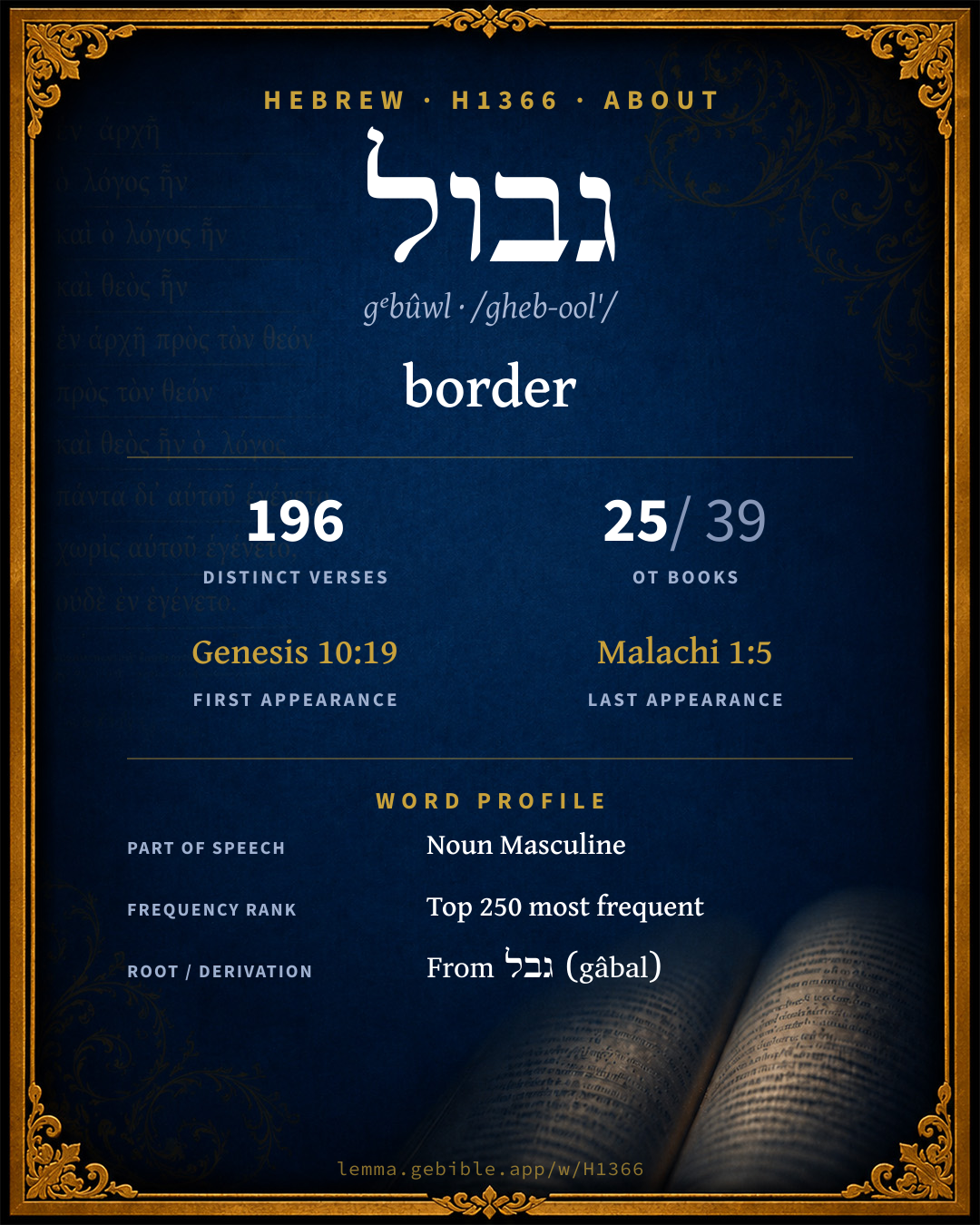
גְּבוּל
border
‘border’ is one of 4 main senses fuller range ↓
Full lexicon entry — Brown-Driver-Briggs (BDB)
From Brown-Driver-Briggs (BDB)
Where this word appears
See every Construct-state word in the Hebrew Bible →
Grammar key — what these labels mean
Part of speech
- Noun
- A naming word — a person, place, thing, or idea.
Noun type
- Common
- A common noun — a general class of person, place, or thing (“king,” “city,” “water”), not a specific name.
State
- Construct
- A noun bound to a following noun in a possessive / “of” relationship (the construct chain).
- Absolute
- The independent form of a noun, not bound to a following word.
Gender
- Masculine
- Grammatically masculine.
Number
- Singular
- One.
- Plural
- More than one (in Hebrew, generally three or more).
1 verse where H1366 appears in the Absolute state in the Book of Psalms. Filtered view — show all forms. Click any verse to open its interlinear word-by-word view. Verse text shown in the World English Bible for context — . Each verse’s Hebrew form is shown with its reference; the English is not keyword-highlighted, since the data carries no word-level English alignment. Use “Compare translations” on any verse to read it across multiple English versions. This concordance covers the Hebrew Bible; Septuagint (Greek Old Testament) occurrences are not indexed here.
Psalms
About this entry
At a glance — auto-summarized from this page’s data, not written by a person. Every figure links to its source below. This summary describes the numbers; it doesn’t interpret them.
At its core, גבול (gᵉbûwl) means “border.” One archaism survives in the King James Version — “coast” — where modern Bibles read “border”; see the renderings breakdown. It turns up in 196 verses across 25 books, a common footprint. The word gravitates to Joshua (30%), then Ezekiel and Numbers. Carrying more than one sense, it rewards its full sense range. Dig into 196-verse concordance and the renderings breakdown below.
Gloss history
Strong's 1890 vs modern scholarship
About this word
Strong's H1366 catalogs a Hebrew word from the Hebrew Old Testament.
These counts are not copied from any lexicon or concordance. They are computed here, from the morphology-tagged Hebrew Old Testament. What Lemma adds →
- 196
- distinct verses
- The word appears in 196 distinct verses.
- 25 / 39
- OT books
- The word appears in 25 of 39 Old Testament books.
- #196
- by frequency
- Top 250 most frequent Hebrew words (rank 196 of 8,640 Hebrew words by occurrence).
View all 196 occurrences in the concordance →
By section of the Old Testament
By traditional corpus
Conventional, traditional groupings — biblical authorship is debated, so this is a traditional corpus grouping, not an authorship claim. Each share is this word’s portion of its verses in that division of the Hebrew canon. Each figure is a share of the word’s 196 distinct verses.
- Prophets (Nevi'im) 135 verses · 69%
- Torah (Pentateuch) 46 verses · 23%
- Writings (Ketuvim) 15 verses · 8%
How translations render this word
Counts come from each version’s own published word-to-Strong’s tagging or interlinear alignment — an approximate guide to how each version renders this word, not a word-level alignment the data otherwise carries. Because each total is that version’s own tagged count, the per-version totals vary from one another and need not match the appearance or distinct-verse counts above. These counts may also differ from a printed concordance because Lemma counts each distinctly tagged rendering and does not collapse phrase taggings into a single head-word total. This is a fixed set of word-tagged versions (KJV, ASV, BSB, ULT) and does not change with the reading translation you choose elsewhere. Each version’s license is shown beside its name below (and on Sources).
- King James Version: Border 115×, Coast 36×, Borders 12×
- American Standard Version: Border 153×, Borders 7×, Throughout all the borders 4×
- Berean Standard Bible: Border 70×, Territory 49×, Borders 15×
- unfoldingWord Literal Text: Border 93×, Border of 64×, Borders 15×
King James Version Public Domain
Renders H1366 across 240 tagged occurrences — most commonly:
Plus other, less common renderings. Plus 38 renderings that appear only once — usually multi-word phrases or single function words the recovered tagging swept in, not distinct renderings. Not rendered by a distinct English word in 1 further occurrence.
American Standard Version Public Domain
Renders H1366 across 240 tagged occurrences — most commonly:
Plus other, less common renderings. Plus 42 renderings that appear only once — usually multi-word phrases or single function words the recovered tagging swept in, not distinct renderings.
Berean Standard Bible Public Domain
Renders H1366 across 208 tagged occurrences — most commonly:
Plus other, less common renderings. Plus 35 renderings that appear only once — usually multi-word phrases or single function words the recovered tagging swept in, not distinct renderings. Not rendered by a distinct English word in 33 further occurrences.
unfoldingWord Literal Text CC BY-SA 4.0
Renders H1366 across 247 tagged occurrences — most commonly:
Plus other, less common renderings. Plus 25 renderings that appear only once — usually multi-word phrases or single function words the recovered tagging swept in, not distinct renderings.
13 senses and sub-senses in the full BDB
What do BDB’s symbols mean?
BDB uses these scholarly abbreviations:
| Symbol | Meaning |
|---|---|
| 𝔊 | the Septuagint (the ancient Greek translation, LXX) |
| 𝔙 | the Vulgate (the Latin translation) |
| 𝔖 | the Syriac version (the Peshitta) |
| 𝔗 | the Targum (the Aramaic translation) |
| ψ | the Psalms |
| √ | root (the underlying root or stem) |
| ‖ | parallel passage (a synonymous or contrasted parallel) |
| † | the dagger: every passage where the word occurs is cited |
The 13 senses and sub-senses the full Brown-Driver-Briggs lexicon distinguishes for this word, in lexicon order (not ranked by frequency), with BDB’s own verbatim wording and sub-sense lettering. Shown in Hebrew script with BDB’s own scholarly abbreviations. The condensed entry is in the Lexicon Entry tab. See also the Forms in the corpus table below.
- 1. border, boundary,
- a. of a land or people: Canaanites Gn 10:19 (J), Edom Nu 20:23 Jos 15:1, 21 (all P) cf. Ob 7, Amorites Nu 21:13 (E) Jos 13:4 (D) cf. 12:5 (D) Ju 1:36, Moab Nu 21:13, 15; 22:36 (E) 33:44 (P) Dt 2:18 Ju 11:18(×2) 2 K 3:21 Is 15:8, Ammon Nu 21:24 (E) Dt 3:16 Jos 12:2; 13:10 (all D) Am 1:13, Bashan Jos 12:4 (D), Egypt 1 K 5:1 = 2 Ch 9:26, Is 19:19; especially of promised land Ex 23:31; 34:24 (JE) Nu 34:3 + 13 times Nu 34 (all P) Dt 11:24; 12:20; 16:4 Jos 1:4 (D), cf. Ez 45:1 + 10 times Ez 45–48; also of Israel 2 K 14:25 Am 6:2 Mal 1:5. e.g. Genesis 10:19
- b. boundary of smaller divisions, e.g. Geshurites Dt 3:14 Jos 12:5; 13:11 (all D), cf. Jos 16:2, 3 (J) 19:12 (P); especially of tribes of Israel Dt 3:16, 17 Jos 13:30 (all D) 13:16 + 60 times Jos 13–19 (P);—15:47 read גדול v. supr. Jos 22:25 (P) & 17:8; 18:11; 24:30 (JE), cf. 1 Ch 6:39, 51 2 Ch 11:13 Ez 48:1 + 15 times Ez 48 (incl. v 22(×2) q. del. Co);—in 1 S 13:18 read for גְּבוּל, הַגֶּבַע 𝔊 We Dr e.g. Deuteronomy 3:14
- c. boundary of territory belonging to an individual,—of field, piece of ground, etc. Gn 23:17 (P) Dt 19:14; 27:17, Jos 24:30 (E) = Ju 2:9 1 Ch 4:10 Pr 15:25; 22:28; 23:10 Ho 5:10. e.g. Genesis 23:17
- d. border of stream Nu 22:36. e.g. Numbers 22:36
- e. limit to waters of deep ψ 104:9 cf. Je 5:22. e.g. Psalms 104:9
- f. a concrete object marking limit, (α) barrier in Ezekiel’s temple Ez 40:12 (del. 𝔊 𝔖 Co) v 12; (β) border of altar Ez 43:13, 17, 20; (γ) surrounding wall of restored Zion Is 54:12 (so 𝔊 Ew Kn Che; De Brd territory, Di undecided). e.g. Ezekiel 40:12
- 2. territory (enclosed within boundary),
- a. of land or people Gn 47:21 (J) Ex 7:27 (P) 10:4, 14 (‖ ארץ) v 19; 13:7 (all J), Nu 20:16, 17, 21; 21:22 (E; ‖ ארץ) = Ju 11:20, Nu 21:23 (E) Dt 2:4; 19:3 (גּ׳ אַרְצְךָ) v 8; 28:40 Jos 18:5(×2) (E) Ju 11:22; 19:29 2 S 21:5 1 K 1:3 2 K 10:32 1 Ch 21:12 (‖ ארץ) ψ 105:31 (= ארץ in ‖ Ez 8:16, 17) v 33; 147:14 Je 31:17 Ez 11:10, 11 Jo 4:6 Zp 2:8. e.g. Genesis 47:21
- b. territory of a city (or limit of such territory) Nu 35:26, 27 Jos 13:26 Ju 1:18(×3) Ez 47:16(×2); 17(×2) (del. 𝔊 Co) 48:1 Am 6:2. e.g. Numbers 35:26
- c. territory about Ezekiel’s temple Ez 43:12. e.g. Ezekiel 43:12
- d. pl. in like sense (only use of pl.), of land Mi 5:5 Is 60:18 (‖ ארץ) Je 15:13; 17:3, cf. city 1 S 5:6 2 K 15:16; 18:8; so Ez 27:4 of Tyre. e.g. Micah 5:5
- e. fig. territory (region) of darkness Jb 38:20; territory of wickedness Mal 1:4 (of Edom); territory of his holiness ψ 78:54 (of Canaan). e.g. Job 38:20
Senses from the full Brown-Driver-Briggs lexicon (Brown, Driver, Briggs; Oxford 1906 — public domain), digitized via Sefaria, supplemented by the OpenScriptures HebrewLexicon (CC BY 4.0). Full attribution on Sources.
Word origin
n.m. Nu 34, 3 border, boundary, territory (NH id., Punic gubulim (pl., PlautPoen. i. 9)—גְּבוּל Gn 10:19 + 168 times + Jos 15:47 Kt (but read Qr גָּדוֹל); גְּבֻל Nu 21:13 + 9 times; (both, in abs. & cstr., e.g. abs. Nu 22:36; 34:8, cstr. Gn 10:19 2 S 21:5); sf. גְּבוּלִי 1 Ch 4:10, גְּבוּלְךָ Ex 7:27, גְבֻלְךָ Ex 23:31 + 3 times, etc.; pl. (8 times) only sf. גְּבוּלֶיךָ Je 15:13; 17:3, etc.;—
— Brown-Driver-Briggs (Oxford 1906, public domain), digitized via Sefaria, supplemented by the OpenScriptures HebrewLexicon (CC BY 4.0). See Sources.
Derived from גבל (gâbal) (H1379) — to border.
Jastrow Dictionary
A second Hebrew/Aramaic lexicon for comparison, covering Aramaic and post-biblical (Talmudic, Targumic, Midrashic) usage that the biblical-Hebrew BDB does not. Matched by lemma rather than by Strong’s number, so a lemma may carry more than one Jastrow headword (shown separately below), and the entries cover usage well beyond the Bible.
גְּבוּל I
- [heap, mound,]
- 1. landmark, boundary; limit; qualification. B. Bath. 69ᵇ (ref. to Gen. XXIII, 17) מי שצריך לג׳ סביב such trees as require boundaries (small trees, are included in the sale). Ab. Zar. 24ᵇ ג׳ יש לה this assertion (לוקחין מהן בהמה לקרבן, ib. 23ᵇ) must be qualified. Y. Ḥall. I, 57ᵇ top (ref. to Is. XXVIII, 25) ע"כ גְּבוּלוֹ של לחם so far goes the definition of bread, i.e. only these species can be called leḥem. e.g. Genesis 23:17
- 2. (in gen.) country, contrad. to the sanctuary (מקדש) and Jerusalem. Keth. 24ᵇ, a. fr. קדשי הג׳ the sacred gifts (T’rumah &c.) set apart and consumed outside of the Temple and Jerusalem.—Pl. גְּבוּלִים, גְּבוּלִין. B. Bath. 56ᵃ עיירות העומדות על הג׳ border-towns.—Shek. VII, 3 נמצא בג׳ if found outside of Jerusalem. R. Hash. 30ᵃ; a. fr.—V. גּוֹבֶל.
*גְּבוּל II
- G’bul (High-land), cmp. גַּבְלָא. Sot. IX, 15; Snh. 97ᵃ אנשי (ה)ג׳ (Ms. M. Snh., a. Cant. R. to II, 13 גָּלִיל).
A Dictionary of the Targumim, the Talmud Babli and Yerushalmi, and the Midrashic Literature (Marcus Jastrow; London, Luzac, 1903) — Public Domain. Digitized via Sefaria. Digitized via Sefaria. Full attribution on Sources.
Forms in the corpus
The 94 distinct written forms H1366 takes in the Hebrew Bible, most frequent first — each parse links to that state’s occurrences in the concordance. Hebrew forms include their vowel points and cantillation, so a single lemma takes many written forms.
The 60 most common forms are shown; 34 rarer forms follow in the full concordance.
Same root — word family
Other BDB entries built from the same root as H1366, grouped by Strong’s listed origin. These share a root / origin per the lexicon — not necessarily a shared meaning. Each links to that word’s own entry.
Derives from
Shares the same root
Derived from this word
Proper names from this root
People and places named from this root — a name, not an additional meaning of the word.
Compare all same-root words → Showing 4 of 6 — not the complete family. 1 of the same-root words is a proper name (a person or place). They share a root, not necessarily a meaning.
Septuagint verse parallels
This word appears in 191 verses that also exist in the Greek Old Testament (Septuagint), out of the 196 Hebrew verses it occurs in. You can read those verses in Greek by switching the Old Testament edition to the Septuagint.
Read these verses in the Septuagint
- Genesis 10:19
- Exodus 8:2
- Numbers 20:16
- Deuteronomy 2:4
- Joshua 1:4
- Judges 1:18
- 1 Samuel 5:6
- 2 Samuel 21:5
- 1 Kings 1:3
- 2 Kings 3:21
- 1 Chronicles 4:10
- 2 Chronicles 9:26
This is a verse-level parallel only — the same verses exist in both the Hebrew and Greek Old Testaments. No word-level Hebrew↔Greek correspondence is claimed: the data carries no such alignment, so no Greek word is shown as this Hebrew word’s translation. Coverage is not total — the Septuagint omits the deuterocanon and renumbers the Psalms, so some Hebrew verses have no direct Greek parallel.