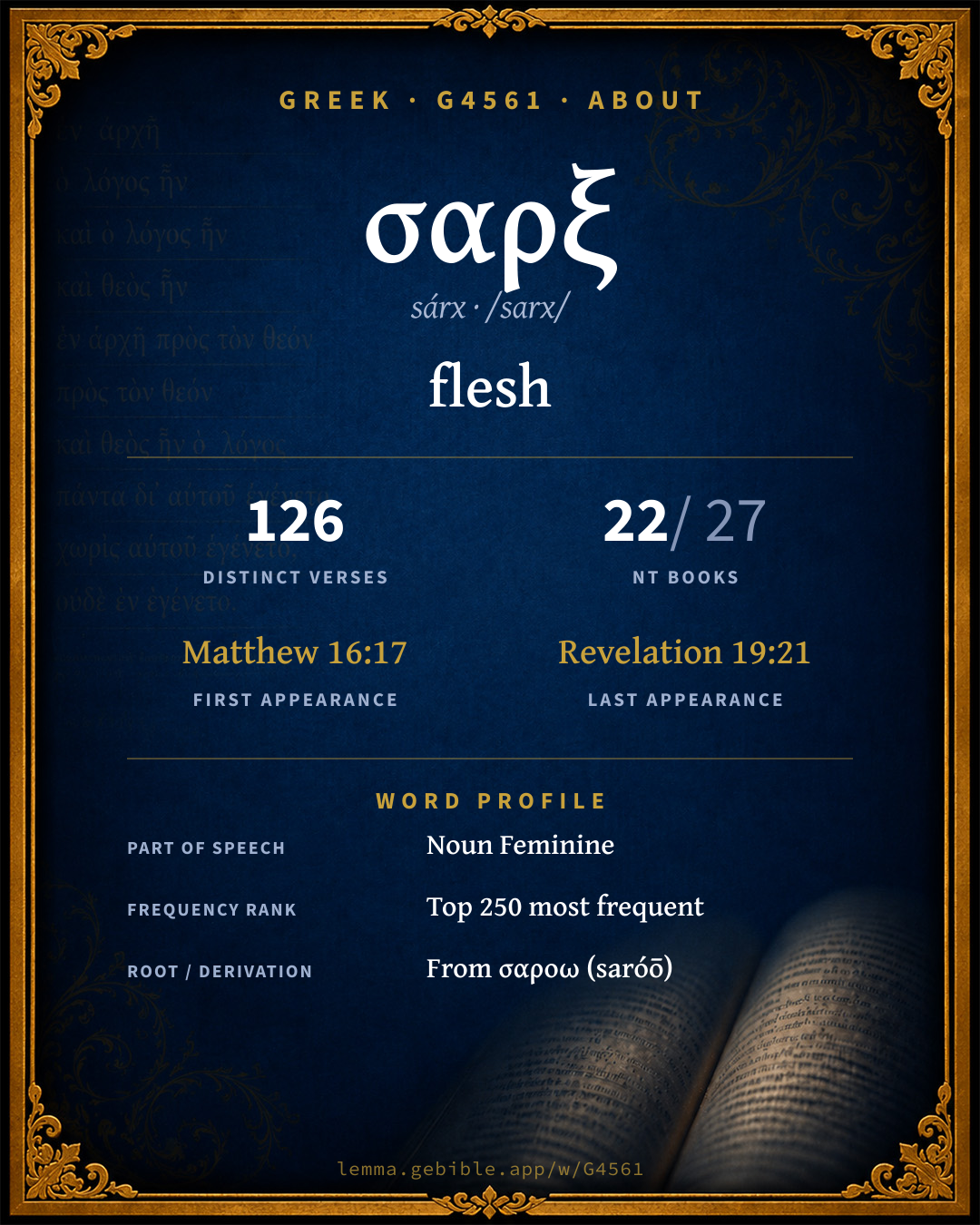
σάρξ
flesh
‘flesh’ is one of 6 main senses fuller range ↓
Full lexicon entry — Thayer's Greek Lexicon
From Thayer's Greek Lexicon
Where this word appears
See every Accusative-case word in the Greek New Testament →
Grammar key — what these labels mean
Part of speech
- Noun
- A naming word — a person, place, thing, or idea.
Case
- Dative
- The case of the indirect object, means, or location — “to / for / with / in.”
- Genitive
- The case of source, possession, or “of” — answers “whose / from what.”
- Accusative
- The case of the direct object and of extent.
- Nominative
- The case of the subject (and the predicate nominative).
Gender
- Feminine
- Grammatically feminine.
Number
- Singular
- One.
- Plural
- More than one.
7 verses where G4561 appears in the Genitive case in the Book of Romans. Filtered view — show all forms. Click any verse to open its interlinear word-by-word view. Verse text shown in the World English Bible for context — . Each verse’s Greek form is shown with its reference; the English is not keyword-highlighted, since the data carries no word-level English alignment. Use “Compare translations” on any verse to read it across multiple English versions. This concordance covers the Greek New Testament; Septuagint (Greek Old Testament) occurrences of this word are not indexed here.
Romans
- Romans 6:19 σαρκὸς n gen sg fem I speak in human terms because of the weakness of your flesh, for as you presented your members as servants to uncleanness and to wickedness upon wickedness, even so now present your members as servants to righteousness for sanctification.
- Romans 8:3 σαρκός σαρκὸς σαρκί n gen sg fem n gen sg fem n dat sg fem For what the law couldn't do, in that it was weak through the flesh, God did, sending his own Son in the likeness of sinful flesh and for sin, he condemned sin in the flesh;
- Romans 8:5 σάρκα σαρκὸς n acc sg fem n gen sg fem For those who live according to the flesh set their minds on the things of the flesh, but those who live according to the Spirit, the things of the Spirit.
- Romans 8:6 σαρκὸς n gen sg fem For the mind of the flesh is death, but the mind of the Spirit is life and peace;
- Romans 8:7 σαρκὸς n gen sg fem because the mind of the flesh is hostile towards God; for it is not subject to God's law, neither indeed can it be.
- Romans 9:8 σαρκὸς n gen sg fem That is, it is not the children of the flesh who are children of God, but the children of the promise are counted as a seed.
- Romans 13:14 σαρκὸς n gen sg fem But put on the Lord Jesus Christ, and make no provision for the flesh, for its lusts.
About this entry
At a glance — auto-summarized from this page’s data, not written by a person. Every figure links to its source below. This summary describes the numbers; it doesn’t interpret them.
σαρξ (sárx) is a Greek noun most often rendered “flesh.” Ranging over 6 senses, it is not a single-sense word. It turns up in 126 verses across 22 books, a common footprint. Scripture first uses it in Matthew 16:17. It clusters with σαροω, σαρκικος and σαρκινος under a shared root. For the data behind this summary, explore the sense tree and the renderings breakdown below.
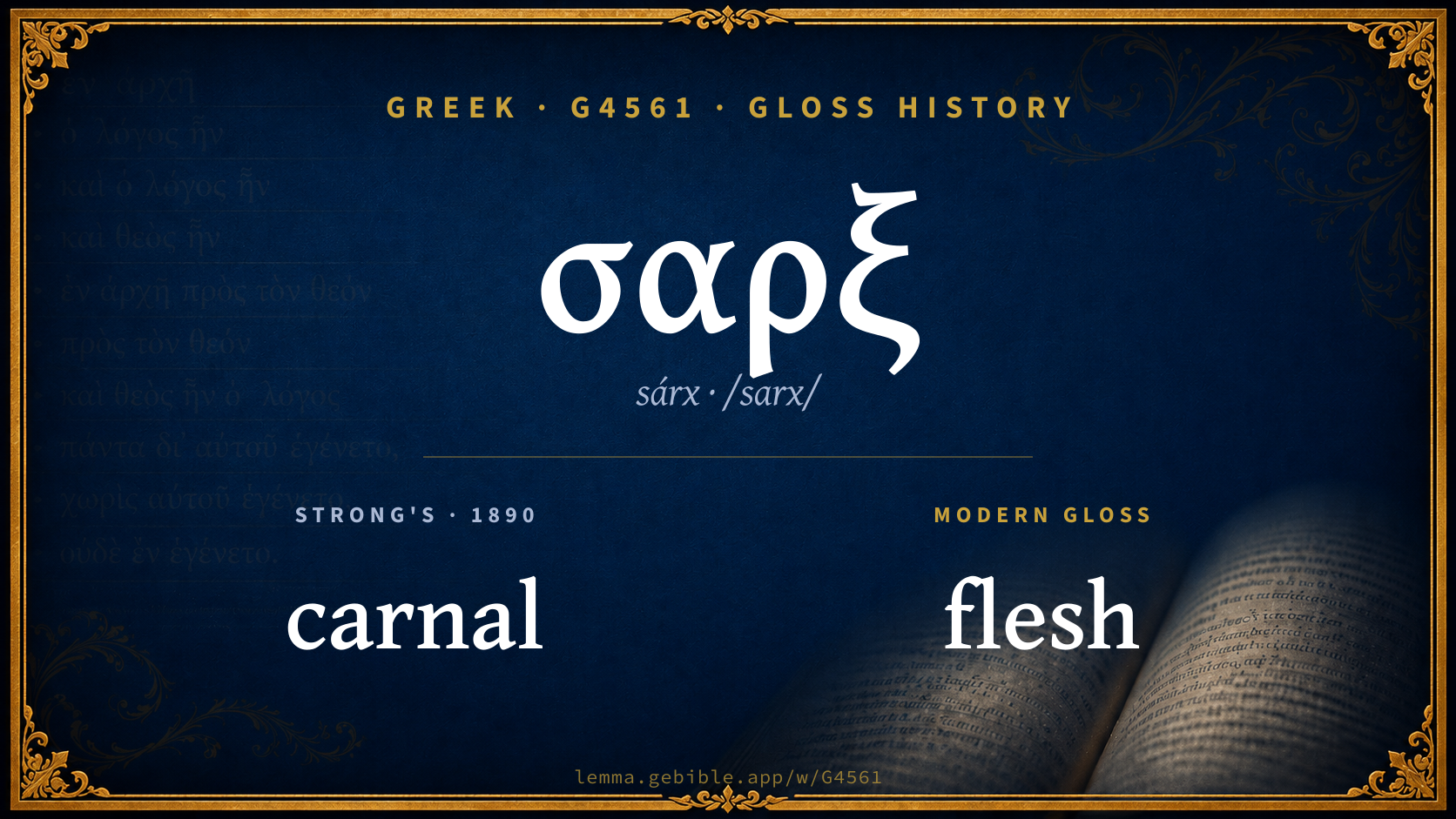
Gloss history
Strong's 1890 vs modern scholarship
About this word
Strong's G4561 catalogs a Greek word from the Greek New Testament.
These counts are not copied from any lexicon or concordance. They are computed here, from the morphology-tagged Greek New Testament. What Lemma adds →
- 126
- distinct verses
- The word appears in 126 distinct verses.
- 22 / 27
- NT books
- The word appears in 22 of 27 New Testament books.
- #110
- by frequency
- Top 250 most frequent Greek words (rank 110 of 5,347 Greek words by occurrence).
View all 126 occurrences in the concordance →
By section of the New Testament
By traditional corpus
Conventional, traditional groupings — biblical authorship is debated, so this is a traditional corpus grouping, not an authorship claim. Some books belong to more than one corpus (Luke is in both the Gospels and the Lukan corpus, and so on), so these shares overlap and need not total 100%. Each figure is a share of the word’s 126 distinct verses.
- Pauline corpus 77 verses · 61%
- Gospels 22 verses · 17%
- Johannine 18 verses · 14%
- General (Catholic) Epistles 15 verses · 12%
- Hebrews 6 verses · 5%
- Lukan (Luke–Acts) 5 verses · 4%
- Revelation 3 verses · 2%
How translations render this word
Counts come from each version’s own published word-to-Strong’s tagging or interlinear alignment — an approximate guide to how each version renders this word, not a word-level alignment the data otherwise carries. Because each total is that version’s own tagged count, the per-version totals vary from one another and need not match the appearance or distinct-verse counts above. These counts may also differ from a printed concordance because Lemma counts each distinctly tagged rendering and does not collapse phrase taggings into a single head-word total. This is a fixed set of word-tagged versions (KJV, ASV, BSB, ULT) and does not change with the reading translation you choose elsewhere. Each version’s license is shown beside its name below (and on Sources).
- King James Version: Flesh 145×, Carnal 2×
- American Standard Version: Flesh 140×, Of 2×
- Berean Standard Bible: Flesh 84×, Body 17×, Bodies 3×
- unfoldingWord Literal Text: Flesh 144×, Of 9×, Body 3×
King James Version Public Domain
Renders G4561 across 150 tagged occurrences — most commonly:
Plus 3 renderings that appear only once — usually multi-word phrases or single function words the recovered tagging swept in, not distinct renderings. Not rendered by a distinct English word in 1 further occurrence.
American Standard Version Public Domain
Renders G4561 across 149 tagged occurrences — most commonly:
Plus 7 renderings that appear only once — usually multi-word phrases or single function words the recovered tagging swept in, not distinct renderings.
Berean Standard Bible Public Domain
Renders G4561 across 124 tagged occurrences — most commonly:
Plus 11 renderings that appear only once — usually multi-word phrases or single function words the recovered tagging swept in, not distinct renderings. Not rendered by a distinct English word in 23 further occurrences.
unfoldingWord Literal Text CC BY-SA 4.0
Renders G4561 across 160 tagged occurrences — most commonly:
Plus 1 rendering that appears only once — usually multi-word phrases or single function words the recovered tagging swept in, not distinct renderings.
Senses in Thayer's
The 6 senses Thayer's distinguishes for this word, in lexicon order (not ranked by frequency or importance). The full entry — with sub-senses — is in the Lexicon Entry tab.
- flesh (the soft substance of the living body, which covers the bones and is permeated with blood) of both man and beasts
- the body of a man
- used of natural or physical origin, generation or relationship
- the sensuous nature of man, "the animal nature"
- a living creature (because possessed of a body of flesh) whether man or beast
- the flesh, denotes mere human nature, the earthly nature of man apart from divine influence, and therefore prone to sin…
Word origin
Derived from σαροω (saróō) (G4563) — to sweep.
Probably from the base of G4563 ; flesh (as stripped of the skin) that is (strictly) the meat of an animal (as food) or (by extension) the body (as opposed to the soul (or spirit) or as the symbol of what is external or as the means of kindred or (by implication) human nature (with its frailties (physically or morally) and passions) or (specifically) a human being (as such): - carnal (-ly + -ly minded) flesh ([-ly]).
— Strong’s Exhaustive Concordance (1890), public domain.
Forms in the corpus
The 9 distinct written forms G4561 takes in the Greek New Testament, most frequent first — each parse links to that case’s occurrences in the concordance.
| Form | Parsing | Example | Uses |
|---|---|---|---|
| σάρκα sárka | Noun, Accusative, Singular, Feminine | Matthew 19:5 | 36 |
| σαρκὸς sarkòs | Noun, Genitive, Singular, Feminine | John 1:13 | 29 |
| σαρκὶ sarkì | Noun, Dative, Singular, Feminine | Romans 2:28 | 23 |
| σὰρξ sàrx | Noun, Nominative, Singular, Feminine | Matthew 16:17 | 17 |
| σαρκί sarkí | Noun, Dative, Singular, Feminine | Romans 7:5 | 16 |
| σάρξ sárx | Noun, Nominative, Singular, Feminine | Matthew 24:22 | 9 |
| σάρκας sárkas | Noun, Accusative, Plural, Feminine | Luke 24:39 | 8 |
| σαρκός sarkós | Noun, Genitive, Singular, Feminine | John 17:2 | 8 |
| σαρκῶν sarkō̂n | Noun, Genitive, Plural, Feminine | Revelation 19:21 | 1 |
Same root — word family
Other Thayer's entries built from the same root as G4561, grouped by Strong’s listed origin. These share a root / origin per the lexicon — not necessarily a shared meaning. Each links to that word’s own entry.
Derives from
Derived from this word
Compare all same-root words → They share a root, not necessarily a meaning.
Septuagint usage
The same Greek word σαρξ appears 158 times in the Greek Old Testament (Septuagint), across 146 verses in 25 books.
- 158
- LXX occurrences
- Tagged occurrences of this Greek word in the Septuagint.
- 146
- verses
- Distinct Septuagint verses containing this word.
- 25 / 39
- OT books
- The word appears in 25 of the 39 Old Testament books.
Sample Septuagint occurrences
- Genesis 2:21 σάρξ
- Exodus 4:7 σάρξ
- Leviticus 4:11 σάρξ
- Numbers 12:12 σάρξ
- Deuteronomy 5:26 σάρξ
- Judges 8:7 σάρξ
- 1 Samuel 17:24 σάρξ
- 2 Samuel 5:1 σάρξ
- 2 Kings 4:34 σάρξ
- 1 Chronicles 11:1 σάρξ
- Ezra 15:5 σάρξ
- Job 2:5 σάρξ
Septuagint occurrences (same lexeme)
Every verse where the same Strong’s number (G4561) appears in the Greek Septuagint — showing the first 50 of 146. Verse text shown in the World English Bible for context; the Greek form is the matched word — the English is not keyword-highlighted.
- Genesis 2:21 σάρξ Yahweh God caused a deep sleep to fall on the man, and he slept; and he took one of his ribs, and closed up the flesh in its place.
- Genesis 2:23 σάρξ The man said, "This is now bone of my bones, and flesh of my flesh. She will be called Woman, because she was taken out of Man."
- Genesis 2:24 σάρξ Therefore a man will leave his father and his mother, and will join with his wife, and they will be one flesh.
- Genesis 6:3 σάρξ Yahweh said, "My Spirit will not strive with man forever, because he also is flesh; yet will his days be one hundred twenty years."
- Genesis 6:12 σάρξ God saw the earth, and saw that it was corrupt, for all flesh had corrupted their way on the earth.
- Genesis 6:17 σάρξ I, even, I do bring the flood of waters on this earth, to destroy all flesh having the breath of life from under the sky. Everything that is in the earth will die.
- Genesis 6:19 σάρξ Of every living thing of all flesh, you shall bring two of every sort into the ark, to keep them alive with you. They shall be male and female.
- Genesis 7:15 σάρξ They went to Noah into the ark, by pairs of all flesh with the breath of life in them.
- Genesis 7:16 σάρξ Those who went in, went in male and female of all flesh, as God commanded him; and Yahweh shut him in.
- Genesis 7:21 σάρξ All flesh died that moved on the earth, including birds, cattle, animals, every creeping thing that creeps on the earth, and every man.
- Genesis 8:17 σάρξ Bring forth with you every living thing that is with you of all flesh, including birds, cattle, and every creeping thing that creeps on the earth; that they may breed abundantly in the earth, and be fruitful, and multiply on the earth."
- Genesis 8:21 σάρξ Yahweh smelled the sweet savor. Yahweh said in his heart, "I will not again curse the ground any more for man's sake, because the imagination of man's heart is evil from his youth; neither will I ever again strike everything living, as I have done.
- Genesis 9:11 σάρξ I will establish my covenant with you; neither will all flesh be cut off any more by the waters of the flood; neither will there any more be a flood to destroy the earth."
- Genesis 9:15 σάρξ and I will remember my covenant, which is between me and you and every living creature of all flesh, and the waters will no more become a flood to destroy all flesh.
- Genesis 9:16 σάρξ The rainbow will be in the cloud. I will look at it, that I may remember the everlasting covenant between God and every living creature of all flesh that is on the earth."
- Genesis 9:17 σάρξ God said to Noah, "This is the token of the covenant which I have established between me and all flesh that is on the earth."
- Genesis 17:11 σάρξ You shall be circumcised in the flesh of your foreskin. It will be a token of a covenant between me and you.
- Genesis 17:13 σάρξ He who is born in your house, and he who is bought with your money, must be circumcised. My covenant will be in your flesh for an everlasting covenant.
- Genesis 17:14 σάρξ The uncircumcised male who is not circumcised in the flesh of his foreskin, that soul shall be cut off from his people. He has broken my covenant."
- Genesis 17:24 σάρξ Abraham was ninety-nine years old, when he was circumcised in the flesh of his foreskin.
- Genesis 17:25 σάρξ Ishmael, his son, was thirteen years old when he was circumcised in the flesh of his foreskin.
- Genesis 29:14 σάρξ Laban said to him, Surely you are my bone and my flesh. He lived with him for a month.
- Genesis 34:24 σάρξ All who went out of the gate of his city listened to Hamor, and to Shechem his son; and every male was circumcised, all who went out of the gate of his city.
- Genesis 37:27 σάρξ Come, and let's sell him to the Ishmaelites, and not let our hand be on him; for he is our brother, our flesh." His brothers listened to him.
- Genesis 40:19 σάρξ Within three more days, Pharaoh will lift up your head from off you, and will hang you on a tree; and the birds will eat your flesh from off you."
- Genesis 41:2 σάρξ Behold, there came up out of the river seven cattle, well-favored and fat-fleshed, and they fed in the reed-grass.
- Genesis 41:3 σάρξ Behold, seven other cattle came up after them out of the river, ill-favored and lean-fleshed, and stood by the other cattle on the brink of the river.
- Genesis 41:4 σάρξ The ill-favored and lean-fleshed cattle ate up the seven well-favored and fat cattle. So Pharaoh awoke.
- Genesis 41:18 σάρξ and, behold, there came up out of the river seven cattle, fat-fleshed and well-favored. They fed in the reed-grass,
- Genesis 41:19 σάρξ and, behold, seven other cattle came up after them, poor and very ill-favored and lean-fleshed, such as I never saw in all the land of Egypt for ugliness.
- Exodus 4:7 σάρξ He said, "Put your hand inside your cloak again." He put his hand inside his cloak again, and when he took it out of his cloak, behold, it had turned again as his other flesh.
- Exodus 30:32 σάρξ It shall not be poured on man's flesh, neither shall you make any like it, according to its composition: it is holy. It shall be holy to you.
- Leviticus 4:11 σάρξ The bull's skin, all its flesh, with its head, and with its legs, its innards, and its dung,
- Leviticus 12:3 σάρξ In the eighth day the flesh of his foreskin shall be circumcised.
- Leviticus 13:10 σάρξ and the priest shall examine him. Behold, if there is a white rising in the skin, and it has turned the hair white, and there is raw flesh in the rising,
- Leviticus 13:18 σάρξ "When the body has a boil on its skin, and it has healed,
- Leviticus 13:24 σάρξ "Or when the body has a burn from fire on its skin, and the raw flesh of the burn becomes a bright spot, reddish-white, or white,
- Leviticus 13:38 σάρξ "When a man or a woman has bright spots in the skin of the body, even white bright spots;
- Leviticus 13:39 σάρξ then the priest shall examine them; and, behold, if the bright spots on the skin of their body are a dull white, it is a harmless rash, it has broken out in the skin; he is clean.
- Leviticus 13:43 σάρξ Then the priest shall examine him; and, behold, if the rising of the plague is reddish-white in his bald head, or in his bald forehead, like the appearance of leprosy in the skin of the flesh,
- Leviticus 17:11 σάρξ For the life of the flesh is in the blood; and I have given it to you on the altar to make atonement for your souls: for it is the blood that makes atonement by reason of the life.
- Leviticus 17:14 σάρξ For as to the life of all flesh, its blood is with its life: therefore I said to the children of Israel, "You shall not eat the blood of any kind of flesh; for the life of all flesh is its blood. Whoever eats it shall be cut off."
- Leviticus 18:6 σάρξ "'None of you shall approach anyone who are his close relatives, to uncover their nakedness: I am Yahweh.
- Leviticus 21:5 σάρξ "'They shall not shave their heads, neither shall they shave off the corners of their beards, nor make any cuttings in their flesh.
- Leviticus 25:49 σάρξ or his uncle, or his uncle's son, may redeem him, or any who is a close relative to him of his family may redeem him; or if he has grown rich, he may redeem himself.
- Leviticus 26:29 σάρξ You will eat the flesh of your sons, and you will eat the flesh of your daughters.
- Numbers 12:12 σάρξ Let her not, I pray, be as one dead, of whom the flesh is half consumed when he comes out of his mother's womb.
- Numbers 16:22 σάρξ They fell on their faces, and said, God, the God of the spirits of all flesh, shall one man sin, and will you be angry with all the congregation?
- Numbers 18:15 σάρξ Everything that opens the womb, of all flesh which they offer to Yahweh, both of man and animal shall be yours: nevertheless the firstborn of man shall you surely redeem, and the firstborn of unclean animals shall you redeem.
- Numbers 27:16 σάρξ Let Yahweh, the God of the spirits of all flesh, appoint a man over the congregation,
These are occurrences of the same Greek lexeme (G4561) in the Septuagint — not a translation of any one Hebrew word. The store carries no word-level Hebrew↔Greek alignment, so no Hebrew original is asserted here. Counts come from the recovered LXX Strong's tagging — high-frequency vocabulary is well covered, while rare or late forms may be untagged — so they reflect tagged occurrences and may slightly undercount.