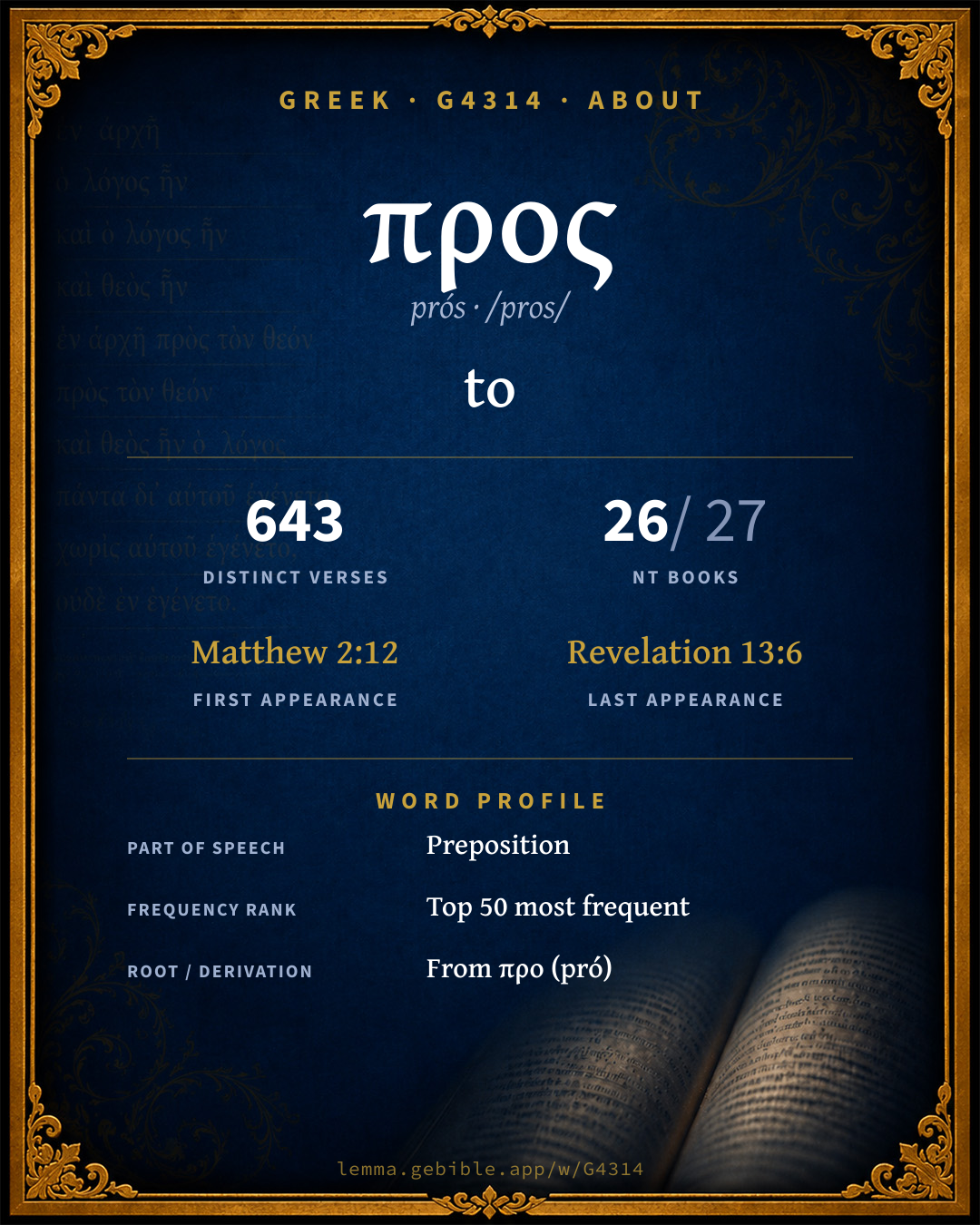
πρός
to
‘to’ is one of 3 main senses fuller range ↓
Full lexicon entry — Thayer's Greek Lexicon
From Thayer's Greek Lexicon
Where this word appears
Grammar key — what these labels mean
Part of speech
- Preposition
- A relational word governing a noun in a particular case.
Every verse where G4314 appears in the Book of Galatians — 7 distinct verses. Click any verse to open its interlinear word-by-word view. Verse text shown in the World English Bible for context — . Each verse’s Greek form is shown with its reference; the English is not keyword-highlighted, since the data carries no word-level English alignment. Use “Compare translations” on any verse to read it across multiple English versions. This concordance covers the Greek New Testament; Septuagint (Greek Old Testament) occurrences of this word are not indexed here.
Galatians
- Galatians 1:17 πρὸς prep nor did I go up to Jerusalem to those who were apostles before me, but I went away into Arabia. Then I returned to Damascus.
- Galatians 1:18 πρὸς prep Then after three years I went up to Jerusalem to visit Peter, and stayed with him fifteen days.
- Galatians 2:5 πρὸς πρὸς prep prep to whom we gave no place in the way of subjection, not for an hour, that the truth of the Gospel might continue with you.
- Galatians 2:14 πρὸς prep But when I saw that they didn't walk uprightly according to the truth of the Gospel, I said to Peter before them all, "If you, being a Jew, live as the Gentiles do, and not as the Jews do, why do you compel the Gentiles to live as the Jews do?
- Galatians 4:18 πρὸς prep But it is always good to be zealous in a good cause, and not only when I am present with you.
- Galatians 4:20 πρὸς prep but I could wish to be present with you now, and to change my tone, for I am perplexed about you.
- Galatians 6:10 πρὸς πρὸς prep prep So then, as we have opportunity, let's do what is good toward all men, and especially toward those who are of the household of the faith.
About this entry
At a glance — auto-summarized from this page’s data, not written by a person. Every figure links to its source below. This summary describes the numbers; it doesn’t interpret them.
“to” is the headline sense of the Greek preposition προς (prós). Its earliest occurrence is Matthew 2:12. It turns up in 643 verses across 26 books, one of the most common footprint. It concentrates in Luke, which alone accounts for 25% of its uses. Lexicons map it across 3 senses. See the sense tree, 643-verse concordance, and the renderings breakdown below.
Gloss history
Strong's 1890 vs modern scholarship

About this word
Strong's G4314 catalogs a Greek word from the Greek New Testament.
These counts are not copied from any lexicon or concordance. They are computed here, from the morphology-tagged Greek New Testament. What Lemma adds →
- 643
- distinct verses
- The word appears in 643 distinct verses.
- 26 / 27
- NT books
- The word appears in 26 of 27 New Testament books.
- #26
- by frequency
- Top 50 most frequent Greek words (rank 26 of 5,347 Greek words by occurrence).
View all 643 occurrences in the concordance →
By section of the New Testament
By traditional corpus
Conventional, traditional groupings — biblical authorship is debated, so this is a traditional corpus grouping, not an authorship claim. Some books belong to more than one corpus (Luke is in both the Gospels and the Lukan corpus, and so on), so these shares overlap and need not total 100%. Each figure is a share of the word’s 643 distinct verses.
- Gospels 348 verses · 54%
- Lukan (Luke–Acts) 282 verses · 44%
- Pauline corpus 129 verses · 20%
- Johannine 106 verses · 16%
- Hebrews 19 verses · 3%
- General (Catholic) Epistles 16 verses · 2%
- Revelation 7 verses · 1%
How translations render this word
Counts come from each version’s own published word-to-Strong’s tagging or interlinear alignment — an approximate guide to how each version renders this word, not a word-level alignment the data otherwise carries. Because each total is that version’s own tagged count, the per-version totals vary from one another and need not match the appearance or distinct-verse counts above. These counts may also differ from a printed concordance because Lemma counts each distinctly tagged rendering and does not collapse phrase taggings into a single head-word total. This is a fixed set of word-tagged versions (KJV, ASV, BSB, ULT) and does not change with the reading translation you choose elsewhere. Each version’s license is shown beside its name below (and on Sources).
- King James Version: Unto 331×, To 179×, With 40×
- American Standard Version: Unto 337×, To 143×, With 39×
- Berean Standard Bible: To 359×, With 43×, For 33×
- unfoldingWord Literal Text: To 491×, With 51×, For 50×
King James Version Public Domain
Renders G4314 across 709 tagged occurrences — most commonly:
Plus other, less common renderings. Plus 29 renderings that appear only once — usually multi-word phrases or single function words the recovered tagging swept in, not distinct renderings. Not rendered by a distinct English word in 2 further occurrences.
American Standard Version Public Domain
Renders G4314 across 696 tagged occurrences — most commonly:
Plus other, less common renderings. Plus 56 renderings that appear only once — usually multi-word phrases or single function words the recovered tagging swept in, not distinct renderings. Not rendered by a distinct English word in 1 further occurrence.
Berean Standard Bible Public Domain
Renders G4314 across 549 tagged occurrences — most commonly:
Plus other, less common renderings. Plus 21 renderings that appear only once — usually multi-word phrases or single function words the recovered tagging swept in, not distinct renderings. Not rendered by a distinct English word in 144 further occurrences.
unfoldingWord Literal Text CC BY-SA 4.0
Renders G4314 across 698 tagged occurrences — most commonly:
Plus other, less common renderings. Plus 18 renderings that appear only once — usually multi-word phrases or single function words the recovered tagging swept in, not distinct renderings.
Senses in Thayer's
The 3 senses Thayer's distinguishes for this word, in lexicon order (not ranked by frequency or importance). The full entry — with sub-senses — is in the Lexicon Entry tab.
- to the advantage of
- at, near, by
- to, towards, with, with regard to
Word origin
Derived from προ (pró) (G4253) — before.
A strengthened form of G4253 ; a preposition of direction; forward to that is toward (with the genitive case the side of that is pertaining to ; with the dative case by the side of that is near to ; usually with the accusative case the place time occasion or respect which is the destination of the relation that is whither or for which it is predicated): - about according to against among at because of before between ([where-]) by for X at thy house in for intent nigh unto of which pertain to that to (the end that) + together to ([you]) -ward unto with (-in). In compounds it denotes essentially the same applications namely motion towards accession to or nearness at.
— Strong’s Exhaustive Concordance (1890), public domain.
Forms in the corpus
The 2 distinct written forms G4314 takes in the Greek New Testament, most frequent first — each parse links to that case’s occurrences in the concordance.
| Form | Parsing | Example | Uses |
|---|---|---|---|
| πρὸς pròs | Preposition | Matthew 2:12 | 666 |
| πρός prós | Preposition | Matthew 3:14 | 30 |
Same root — word family
Other Thayer's entries built from the same root as G4314, grouped by Strong’s listed origin. These share a root / origin per the lexicon — not necessarily a shared meaning. Each links to that word’s own entry.
Derives from
Shares the same root
- πορρω pórrhō G4206 far
- πρηνης prēnḗs G4248 headlong
- πριν prín G4250 before
- προαγω proágō G4254 to lead forward
- προαιρεομαι proairéomai G4255 to choose before
- προαιτιαομαι proaitiáomai G4256 to charge previously
- προακουω proakoúō G4257 to hear before
- προαμαρτανω proamartánō G4258 to sin before
- προαυλιον proaúlion G4259 porch
- προβαινω probaínō G4260 to go forward
- προβαλλω probállō G4261 to throw forward
- προβιβαζω probibázō G4264 to drag forward
- προβλεπω problépō G4265 to foresee
- προγινομαι progínomai G4266 to come before
- προγινωσκω proginṓskō G4267 to foreknow
- προγραφω prográphō G4270 to write before
- προδηλος pródēlos G4271 manifest
- προδιδωμι prodídōmi G4272 to give before
- προειδω proeídō G4275 to foresee
- προελπιζω proelpízō G4276 to hope before
- προεπω proépō G4277 to say before
- προεναρχομαι proenárchomai G4278 to begin before
- προεπαγγελλομαι proepangéllomai G4279 to promise before
- προερεω proeréō G4280 to say before
+47 more words share this root (not shown).
Derived from this word
- προσαγορευω prosagoreúō G4316 to address
- προσαγω proságō G4317 to bring
- προσαιτεω prosaitéō G4319 to ask alms
- προσαναβαινω prosanabaínō G4320 to go up higher
- προσαναλισκω prosanalískō G4321 to spend additionally
- προσαναπληροω prosanaplēróō G4322 to fill up
- προσανατιθημι prosanatíthēmi G4323 to lay upon
- προσαπειλεω prosapeiléō G4324 to threaten further
- προσδαπαναω prosdapanáō G4325 to spend besides
- προσδεομαι prosdéomai G4326 to need additionally
- προσδεχομαι prosdéchomai G4327 to receive to oneself
- προσδοκαω prosdokáō G4328 to expect
- προσεαω proseáō G4330 to permit approach
- προσεγγιζω prosengízō G4331 to approach
- προσεδρευω prosedreúō G4332 to sit near
- προσεργαζομαι prosergázomai G4333 to work besides
- προσερχομαι prosérchomai G4334 to draw near
- προσευχομαι proseúchomai G4336 to pray
- προσεχω proséchō G4337 to attend to
- προσηλοω prosēlóō G4338 to nail to
- προσκαιρος próskairos G4340 temporary
- προσκαλεομαι proskaléomai G4341 to call to
- προσκαρτερεω proskarteréō G4342 to adhere to
- προσκεφαλαιον proskephálaion G4344 pillow
+28 more words derive from G4314 (not shown).
Proper names from this root
People and places named from this root — a name, not an additional meaning of the word.
Compare all same-root words → Showing 4 of 126 — not the complete family. 1 of the same-root words is a proper name (a person or place). They share a root, not necessarily a meaning.
Septuagint usage
The same Greek word προς appears 3,581 times in the Greek Old Testament (Septuagint), across 2,948 verses in 37 books.
- 3,581
- LXX occurrences
- Tagged occurrences of this Greek word in the Septuagint.
- 2,948
- verses
- Distinct Septuagint verses containing this word.
- 37 / 39
- OT books
- The word appears in 37 of the 39 Old Testament books.
Sample Septuagint occurrences
- Genesis 2:19 πρός
- Exodus 1:10 πρός
- Leviticus 1:2 πρός
- Numbers 1:1 πρός
- Deuteronomy 1:1 πρός
- Joshua 2:3 πρός
- Judges 1:1 πρός
- Ruth 1:15 πρός
- 1 Samuel 1:10 πρός
- 2 Samuel 1:2 πρός
- 1 Kings 1:3 πρός
- 2 Kings 1:2 πρός
Septuagint occurrences (same lexeme)
Every verse where the same Strong’s number (G4314) appears in the Greek Septuagint — showing the first 50 of 2,948. Verse text shown in the World English Bible for context; the Greek form is the matched word — the English is not keyword-highlighted.
- Genesis 2:19 πρός Out of the ground Yahweh God formed every animal of the field, and every bird of the sky, and brought them to the man to see what he would call them. Whatever the man called every living creature, that was its name.
- Genesis 2:22 πρός He made the rib, which Yahweh God had taken from the man, into a woman, and brought her to the man.
- Genesis 2:24 πρός Therefore a man will leave his father and his mother, and will join with his wife, and they will be one flesh.
- Genesis 3:16 πρός To the woman he said, "I will greatly multiply your pain in childbirth. In pain you will bring forth children. Your desire will be for your husband, and he will rule over you."
- Genesis 4:7 πρός If you do well, will it not be lifted up? If you don't do well, sin crouches at the door. Its desire is for you, but you are to rule over it."
- Genesis 4:8 πρός Cain said to Abel, his brother, "Let's go into the field." It happened, when they were in the field, that Cain rose up against Abel, his brother, and killed him.
- Genesis 4:9 πρός Yahweh said to Cain, "Where is Abel, your brother?" He said, "I don't know. Am I my brother's keeper?"
- Genesis 4:10 πρός Yahweh said, "What have you done? The voice of your brother's blood cries to me from the ground.
- Genesis 4:13 πρός Cain said to Yahweh, "My punishment is greater than I can bear.
- Genesis 6:4 πρός The Nephilim were in the earth in those days, and also after that, when God's sons came to men's daughters. They bore children to them: the same were the mighty men who were of old, men of renown.
- Genesis 6:13 πρός God said to Noah, "The end of all flesh has come before me, for the earth is filled with violence through them. Behold, I will destroy them with the earth.
- Genesis 6:18 πρός But I will establish my covenant with you. You shall come into the ark, you, your sons, your wife, and your sons' wives with you.
- Genesis 6:20 πρός Of the birds after their kind, of the cattle after their kind, of every creeping thing of the ground after its kind, two of every sort shall come to you, to keep them alive.
- Genesis 6:21 πρός Take with you of all food that is eaten, and gather it to you; and it will be for food for you, and for them."
- Genesis 7:1 πρός Yahweh said to Noah, "Come with all of your household into the ark, for I have seen your righteousness before me in this generation.
- Genesis 7:2 πρός You shall take seven pairs of every clean animal with you, the male and his female. Of the animals that are not clean, take two, the male and his female.
- Genesis 7:9 πρός went by pairs to Noah into the ark, male and female, as God commanded Noah.
- Genesis 7:15 πρός They went to Noah into the ark, by pairs of all flesh with the breath of life in them.
- Genesis 8:9 πρός but the dove found no place to rest her foot, and she returned to him into the ark; for the waters were on the surface of the whole earth. He put forth his hand, and took her, and brought her to him into the ark.
- Genesis 8:11 πρός The dove came back to him at evening, and, behold, in her mouth was an olive leaf plucked off. So Noah knew that the waters were abated from off the earth.
- Genesis 8:12 πρός He stayed yet another seven days, and sent forth the dove; and she didn't return to him any more.
- Genesis 9:11 πρός I will establish my covenant with you; neither will all flesh be cut off any more by the waters of the flood; neither will there any more be a flood to destroy the earth."
- Genesis 9:12 πρός God said, "This is the token of the covenant which I make between me and you and every living creature that is with you, for perpetual generations:
- Genesis 12:15 πρός The princes of Pharaoh saw her, and praised her to Pharaoh; and the woman was taken into Pharaoh's house.
- Genesis 13:14 πρός Yahweh said to Abram, after Lot was separated from him, "Now, lift up your eyes, and look from the place where you are, northward and southward and eastward and westward,
- Genesis 14:9 πρός against Chedorlaomer king of Elam, and Tidal king of Goiim, and Amraphel king of Shinar, and Arioch king of Ellasar; four kings against the five.
- Genesis 14:13 πρός One who had escaped came and told Abram, the Hebrew. Now he lived by the oaks of Mamre, the Amorite, brother of Eshcol, and brother of Aner; and these were allies of Abram.
- Genesis 14:21 πρός The king of Sodom said to Abram, "Give me the people, and take the goods to yourself."
- Genesis 14:22 πρός Abram said to the king of Sodom, "I have lifted up my hand to Yahweh, God Most High, possessor of heaven and earth,
- Genesis 15:1 πρός After these things the word of Yahweh came to Abram in a vision, saying, "Don't be afraid, Abram. I am your shield, your exceedingly great reward."
- Genesis 15:4 πρός Behold, the word of Yahweh came to him, saying, "This man will not be your heir, but he who will come forth out of your own body will be your heir."
- Genesis 15:7 πρός He said to him, "I am Yahweh who brought you out of Ur of the Chaldees, to give you this land to inherit it."
- Genesis 15:13 πρός He said to Abram, "Know for sure that your seed will live as foreigners in a land that is not theirs, and will serve them. They will afflict them four hundred years.
- Genesis 15:15 πρός But you will go to your fathers in peace. You will be buried in a good old age.
- Genesis 15:17 πρός It came to pass that, when the sun went down, and it was dark, behold, a smoking furnace, and a flaming torch passed between these pieces.
- Genesis 16:2 πρός Sarai said to Abram," See now, Yahweh has restrained me from bearing. Please go in to my handmaid. It may be that I will obtain children by her." Abram listened to the voice of Sarai.
- Genesis 16:4 πρός He went in to Hagar, and she conceived. When she saw that she had conceived, her mistress was despised in her eyes.
- Genesis 16:5 πρός Sarai said to Abram, "This wrong is your fault. I gave my handmaid into your bosom, and when she saw that she had conceived, I was despised in her eyes. Yahweh judge between me and you."
- Genesis 16:6 πρός But Abram said to Sarai, "Behold, your maid is in your hand. Do to her whatever is good in your eyes." Sarai dealt harshly with her, and she fled from her face.
- Genesis 16:9 πρός The angel of Yahweh said to her, "Return to your mistress, and submit yourself under her hands."
- Genesis 16:13 πρός She called the name of Yahweh who spoke to her, "You are a God who sees," for she said, "Have I even stayed alive after seeing him?"
- Genesis 17:9 πρός God said to Abraham, "As for you, you will keep my covenant, you and your seed after you throughout their generations.
- Genesis 17:18 πρός Abraham said to God, "Oh that Ishmael might live before you!"
- Genesis 17:19 πρός God said, "No, but Sarah, your wife, will bear you a son. You shall call his name Isaac. I will establish my covenant with him for an everlasting covenant for his seed after him.
- Genesis 17:21 πρός But my covenant I establish with Isaac, whom Sarah will bear to you at this set time in the next year."
- Genesis 17:22 πρός When he finished talking with him, God went up from Abraham.
- Genesis 18:1 πρός Yahweh appeared to him by the oaks of Mamre, as he sat in the tent door in the heat of the day.
- Genesis 18:5 πρός I will get a morsel of bread so you can refresh your heart. After that you may go your way, now that you have come to your servant." They said, "Very well, do as you have said."
- Genesis 18:6 πρός Abraham hurried into the tent to Sarah, and said, "Quickly make ready three measures of fine meal, knead it, and make cakes."
- Genesis 18:9 πρός They said to him, "Where is Sarah, your wife? He said, "See, in the tent."
These are occurrences of the same Greek lexeme (G4314) in the Septuagint — not a translation of any one Hebrew word. The store carries no word-level Hebrew↔Greek alignment, so no Hebrew original is asserted here. Counts come from the recovered LXX Strong's tagging — high-frequency vocabulary is well covered, while rare or late forms may be untagged — so they reflect tagged occurrences and may slightly undercount.