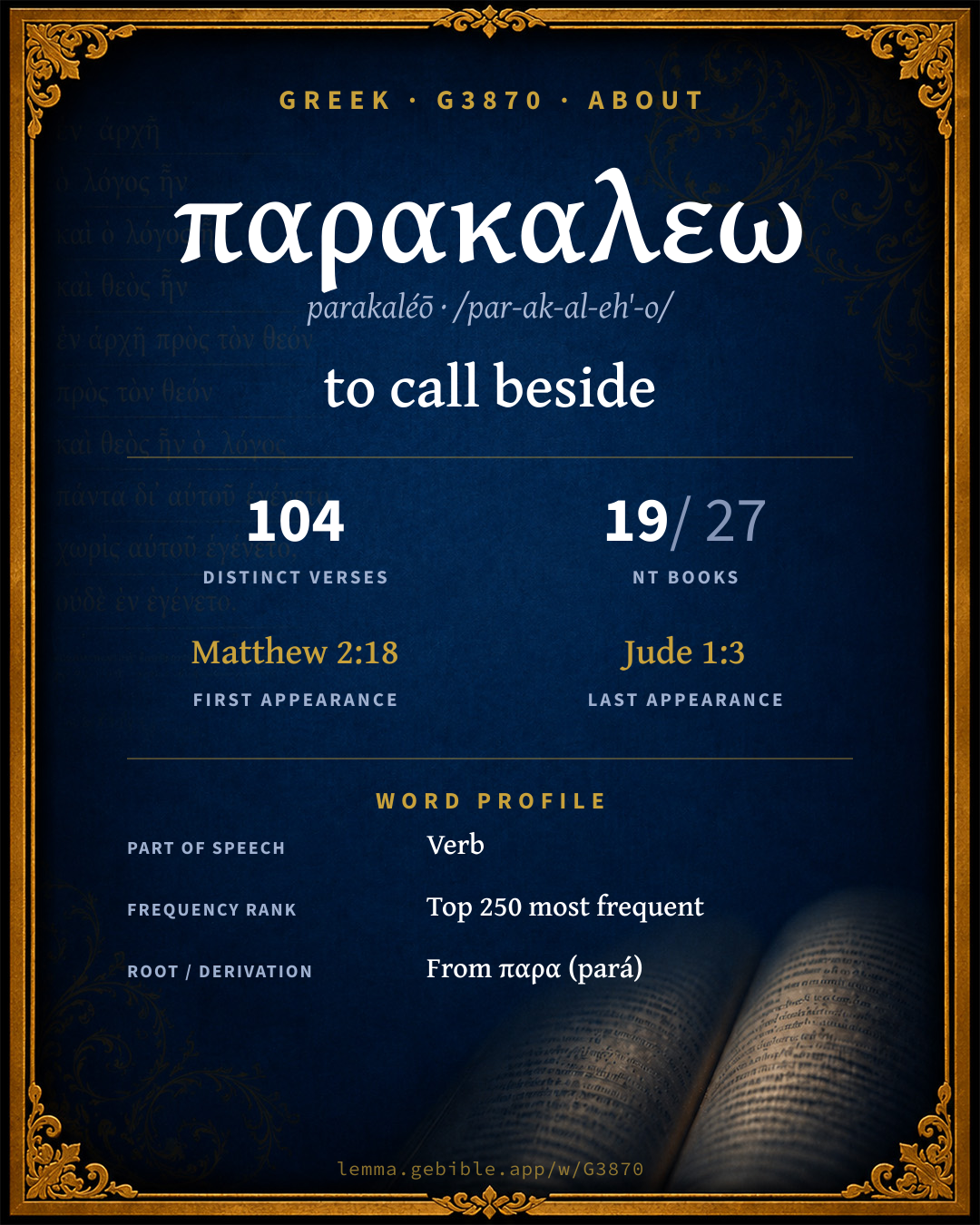
παρακαλέω
to call beside
‘to call beside’ is one of 2 main senses fuller range ↓
Full lexicon entry — Thayer's Greek Lexicon
From Thayer's Greek Lexicon
Where this word appears
See every Imperfect-tense verb in the Greek New Testament →
Grammar key — what these labels mean
Part of speech
- Verb
- An action or state-of-being word.
Tense
- Present
- Ongoing or general action in present time (imperfective aspect).
- Imperfect
- Continuous or repeated action in past time (“was writing”).
- Aorist
- Action viewed as a simple whole, without regard to duration — often past (perfective aspect).
- Future
- Action expected in future time.
- Perfect
- A completed past action with continuing present results.
Voice
- Active
- The subject performs the action.
- Passive
- The subject receives the action.
Mood
- Indicative
- States a fact or asks a factual question (the mood of reality).
- Participle
- A verbal adjective (“writing,” “having written”).
- Infinitive
- A verbal noun (“to write”), unmarked for person or number.
- Imperative
- Expresses a command or request.
- Subjunctive
- Expresses probability, purpose, or possibility (the mood of contingency).
- Optative
- Expresses a wish or a remote possibility.
Case
- Nominative
- The case of the subject (and the predicate nominative).
- Genitive
- The case of source, possession, or “of” — answers “whose / from what.”
Person
- 1st person
- The speaker (“I / we”).
- 3rd person
- The one spoken about (“he / she / it / they”).
- 2nd person
- The one addressed (“you”).
Gender
- Masculine
- Grammatically masculine.
Number
- Singular
- One.
- Plural
- More than one.
1 verse where G3870 appears in the Aorist tense in the Book of Luke. Filtered view — show all forms. Click any verse to open its interlinear word-by-word view. Verse text shown in the World English Bible for context — . Each verse’s Greek form is shown with its reference; the English is not keyword-highlighted, since the data carries no word-level English alignment. Use “Compare translations” on any verse to read it across multiple English versions. This concordance covers the Greek New Testament; Septuagint (Greek Old Testament) occurrences of this word are not indexed here.
Luke
About this entry
At a glance — auto-summarized from this page’s data, not written by a person. Every figure links to its source below. This summary describes the numbers; it doesn’t interpret them.
παρακαλεω — transliterated parakaléō — is a Greek verb carrying the sense “to call beside.” Translators differ — “besought” in the King James Version, then “encourage” (Berean Standard Bible) and “i urge” (unfoldingWord Literal Text), as the renderings breakdown shows. With 104 verses in 19 books, it is a common word in the Greek New Testament. First canonically at Matthew 2:18, it enters the text early. Catalogued under 2 senses, its meaning is not single-sense. See the sense tree, 104-verse concordance, and the renderings breakdown below.
Gloss history
Strong's 1890 vs modern scholarship

About this word
Strong's G3870 catalogs a Greek word from the Greek New Testament.
These counts are not copied from any lexicon or concordance. They are computed here, from the morphology-tagged Greek New Testament. What Lemma adds →
- 104
- distinct verses
- The word appears in 104 distinct verses.
- 19 / 27
- NT books
- The word appears in 19 of 27 New Testament books.
- #153
- by frequency
- Top 250 most frequent Greek words (rank 153 of 5,347 Greek words by occurrence).
View all 104 occurrences in the concordance →
Most concentrated in
- Acts 22 verses 21%
- 2 Corinthians 15 verses 14%
- Matthew 9 verses 9%
By section of the New Testament
By traditional corpus
Conventional, traditional groupings — biblical authorship is debated, so this is a traditional corpus grouping, not an authorship claim. Some books belong to more than one corpus (Luke is in both the Gospels and the Lukan corpus, and so on), so these shares overlap and need not total 100%. Each figure is a share of the word’s 104 distinct verses.
- Pauline corpus 50 verses · 48%
- Lukan (Luke–Acts) 28 verses · 27%
- Gospels 24 verses · 23%
- Hebrews 4 verses · 4%
- General (Catholic) Epistles 4 verses · 4%
How translations render this word
Counts come from each version’s own published word-to-Strong’s tagging or interlinear alignment — an approximate guide to how each version renders this word, not a word-level alignment the data otherwise carries. Because each total is that version’s own tagged count, the per-version totals vary from one another and need not match the appearance or distinct-verse counts above. These counts may also differ from a printed concordance because Lemma counts each distinctly tagged rendering and does not collapse phrase taggings into a single head-word total. This is a fixed set of word-tagged versions (KJV, ASV, BSB, ULT) and does not change with the reading translation you choose elsewhere. Each version’s license is shown beside its name below (and on Sources).
- King James Version: Besought 13×, I beseech 12×, Exhort 11×
- American Standard Version: Besought 10×, Exhort 10×, I beseech 9×
- Berean Standard Bible: Encourage 10×, I urge 10×, Begged 8×
- unfoldingWord Literal Text: I urge 11×, Exhort 6×, Exhorting 6×
King James Version Public Domain
Renders G3870 across 113 tagged occurrences — most commonly:
Plus other, less common renderings. Plus 31 renderings that appear only once — usually multi-word phrases or single function words the recovered tagging swept in, not distinct renderings. Not rendered by a distinct English word in 1 further occurrence.
American Standard Version Public Domain
Renders G3870 across 112 tagged occurrences — most commonly:
Plus other, less common renderings. Plus 32 renderings that appear only once — usually multi-word phrases or single function words the recovered tagging swept in, not distinct renderings.
Berean Standard Bible Public Domain
Renders G3870 across 106 tagged occurrences — most commonly:
Plus other, less common renderings. Plus 39 renderings that appear only once — usually multi-word phrases or single function words the recovered tagging swept in, not distinct renderings. Not rendered by a distinct English word in 3 further occurrences.
unfoldingWord Literal Text CC BY-SA 4.0
Renders G3870 across 119 tagged occurrences — most commonly:
Plus other, less common renderings. Plus 54 renderings that appear only once — usually multi-word phrases or single function words the recovered tagging swept in, not distinct renderings.
Senses in Thayer's
The 2 senses Thayer's distinguishes for this word, in lexicon order (not ranked by frequency or importance). The full entry — with sub-senses — is in the Lexicon Entry tab.
- to call to one's side, call for, summon
- to address, speak to, (call to, call upon), which may be done in the way of exhortation, entreaty, comfort, instruction,…
Word origin
Derived from παρα (pará) (G3844) — from.
Forms in the corpus
The 35 distinct written forms G3870 takes in the Greek New Testament, most frequent first — each parse links to that tense’s occurrences in the concordance.
Same root — word family
Other Thayer's entries built from the same root as G3870, grouped by Strong’s listed origin. These share a root / origin per the lexicon — not necessarily a shared meaning. Each links to that word’s own entry.
Derives from
Shares the same root
- παραβαινω parabaínō G3845 to neglect
- παραβαλλω parabállō G3846 to place beside
- παραβιαζομαι parabiázomai G3849 to compel
- παραβουλευομαι parabouleúomai G3851 to consult wrongly
- παραγγελλω parangéllō G3853 to announce
- παραγινομαι paragínomai G3854 to appear
- παραγω parágō G3855 to pass by
- παραδειγματιζω paradeigmatízō G3856 to make example
- παραδεχομαι paradéchomai G3858 to receive
- παραδιατριβη paradiatribḗ G3859 empty business
- παραδιδωμι paradídōmi G3860 to deliver
- παραδοξος parádoxos G3861 strange
- παραζηλοω parazēlóō G3863 to provoke
- παραθαλασσιος parathalássios G3864 by the sea
- παραθεωρεω paratheōréō G3865 to compare
- παραινεω parainéō G3867 to exhort
- παραιτεομαι paraitéomai G3868 to beg pardon
- παρακαθιζω parakathízō G3869 to sit beside
- παρακαλυπτω parakalýptō G3871 to cover up
- παρακαταθηκη parakatathḗkē G3872 deposit
- παρακειμαι parákeimai G3873 to lie beside
- παρακολουθεω parakolouthéō G3877 to follow after
- παρακουω parakoúō G3878 to disobey
- παρακυπτω parakýptō G3879 to look into
+51 more words share this root (not shown).
Derived from this word
Proper names from this root
People and places named from this root — a name, not an additional meaning of the word.
Compare all same-root words → Showing 4 of 79 — not the complete family. 1 of the same-root words is a proper name (a person or place). They share a root, not necessarily a meaning.
Septuagint usage
The same Greek word παρακαλεω appears 86 times in the Greek Old Testament (Septuagint), across 79 verses in 16 books.
- 86
- LXX occurrences
- Tagged occurrences of this Greek word in the Septuagint.
- 79
- verses
- Distinct Septuagint verses containing this word.
- 16 / 39
- OT books
- The word appears in 16 of the 39 Old Testament books.
Sample Septuagint occurrences
- Genesis 24:67 παρακαλέω
- Exodus 15:13 παρακαλέω
- Deuteronomy 3:28 παρακαλέω
- Judges 2:18 παρακαλέω
- Ruth 2:13 παρακαλέω
- 1 Samuel 22:4 παρακαλέω
- 2 Samuel 10:2 παρακαλέω
- 1 Chronicles 7:22 παρακαλέω
- Job 2:11 παρακαλέω
- Psalms 22:4 παρακαλέω
- Proverbs 1:10 παρακαλέω
- Ecclesiastes 4:1 παρακαλέω
Septuagint occurrences (same lexeme)
Every verse where the same Strong’s number (G3870) appears in the Greek Septuagint — showing the first 50 of 79. Verse text shown in the World English Bible for context; the Greek form is the matched word — the English is not keyword-highlighted.
- Genesis 24:67 παρακαλέω Isaac brought her into his mother Sarah's tent, and took Rebekah, and she became his wife. He loved her. Isaac was comforted after his mother's death.
- Genesis 37:35 παρακαλέω All his sons and all his daughters rose up to comfort him; but he refused to be comforted. He said, "For I will go down to Sheol to my son mourning." His father wept for him.
- Genesis 38:12 παρακαλέω After many days, Shua's daughter, the wife of Judah, died. Judah was comforted, and went up to his sheep-shearers to Timnah, he and his friend Hirah, the Adullamite.
- Genesis 50:21 παρακαλέω Now therefore don't be afraid. I will nourish you and your little ones." He comforted them, and spoke kindly to them.
- Exodus 15:13 παρακαλέω "You, in your loving kindness, have led the people that you have redeemed. You have guided them in your strength to your holy habitation.
- Deuteronomy 3:28 παρακαλέω But charge Joshua, and encourage him, and strengthen him; for he shall go over before this people, and he shall cause them to inherit the land which you shall see.
- Deuteronomy 13:7 παρακαλέω of the gods of the peoples who are round about you, near to you, or far off from you, from the one end of the earth even to the other end of the earth;
- Deuteronomy 32:36 παρακαλέω For Yahweh will judge his people, Repent himself for his servants; When he sees that [their] power is gone, There is none [remaining], shut up or left at large.
- Judges 2:18 παρακαλέω When Yahweh raised them up judges, then Yahweh was with the judge, and saved them out of the hand of their enemies all the days of the judge: for it repented Yahweh because of their groaning by reason of those who oppressed them and vexed them.
- Judges 21:6 παρακαλέω The children of Israel repented them for Benjamin their brother, and said, There is one tribe cut off from Israel this day.
- Judges 21:15 παρακαλέω The people repented them for Benjamin, because that Yahweh had made a breach in the tribes of Israel.
- Ruth 2:13 παρακαλέω Then she said, Let me find favor in your sight, my lord, because you have comforted me, and because you have spoken kindly to your handmaid, though I am not as one of your handmaidens.
- 1 Samuel 22:4 παρακαλέω He brought them before the king of Moab: and they lived with him all the while that David was in the stronghold.
- 2 Samuel 10:2 παρακαλέω David said, I will show kindness to Hanun the son of Nahash, as his father shown kindness to me. So David sent by his servants to comfort him concerning his father. David's servants came into the land of the children of Ammon.
- 2 Samuel 10:3 παρακαλέω But the princes of the children of Ammon said to Hanun their lord, Do you think that David honors your father, in that he has sent comforters to you? Hasn't David sent his servants to you to search the city, and to spy it out, and to overthrow it?
- 2 Samuel 12:24 παρακαλέω David comforted Bathsheba his wife, and went in to her, and lay with her: and she bore a son, and he called his name Solomon. Yahweh loved him;
- 2 Samuel 13:39 παρακαλέω [the soul of] king David longed to go forth to Absalom: for he was comforted concerning Amnon, seeing he was dead.
- 2 Samuel 24:16 παρακαλέω When the angel stretched out his hand toward Jerusalem to destroy it, Yahweh repented him of the evil, and said to the angel who destroyed the people, It is enough; now stay your hand. The angel of Yahweh was by the threshing floor of Araunah the Jebusite.
- 1 Chronicles 7:22 παρακαλέω Ephraim their father mourned many days, and his brothers came to comfort him.
- 1 Chronicles 19:2 παρακαλέω David said, I will show kindness to Hanun the son of Nahash, because his father shown kindness to me. So David sent messengers to comfort him concerning his father. David's servants came into the land of the children of Ammon to Hanun, to comfort him.
- 1 Chronicles 19:3 παρακαλέω But the princes of the children of Ammon said to Hanun, Think you that David does honor your father, in that he has sent comforters to you? Aren't his servants come to you to search, and to overthrow, and to spy out the land?
- Job 2:11 παρακαλέω Now when Job's three friends heard of all this evil that had come on him, they each came from his own place: Eliphaz the Temanite, Bildad the Shuhite, and Zophar the Naamathite, and they made an appointment together to come to sympathize with him and to comfort him.
- Job 4:3 παρακαλέω Behold, you have instructed many, You have strengthened the weak hands.
- Job 7:13 παρακαλέω When I say, 'My bed shall comfort me, My couch shall ease my complaint;'
- Job 21:34 παρακαλέω So how can you comfort me with nonsense, Seeing that in your answers there remains only falsehood?"
- Job 29:25 παρακαλέω I chose out their way, and sat as chief. I lived as a king in the army, As one who comforts the mourners.
- Job 42:11 παρακαλέω Then came there to him all his brothers, and all his sisters, and all those who had been of his acquaintance before, and ate bread with him in his house. They comforted him, and consoled him concerning all the evil that Yahweh had brought on him. Everyone also gave him a piece of money, and everyone a ring of gold.
- Psalms 22:4 παρακαλέω Our fathers trusted in you. They trusted, and you delivered them.
- Psalms 68:21 παρακαλέω But God will strike through the head of his enemies, The hairy scalp of such a one as still continues in his guiltiness.
- Psalms 70:21 παρακαλέω
- Psalms 76:3 παρακαλέω There he broke the flaming arrows of the bow, The shield, and the sword, and the weapons of war. Selah.
- Psalms 85:17 παρακαλέω
- Psalms 89:13 παρακαλέω You have a mighty arm. Your hand is strong, and your right hand is exalted.
- Psalms 118:50 παρακαλέω
- Psalms 118:52 παρακαλέω
- Psalms 118:76 παρακαλέω
- Psalms 118:82 παρακαλέω
- Psalms 125:1 παρακαλέω Those who trust in Yahweh are as Mount Zion, Which can't be moved, but remains forever.
- Psalms 134:14 παρακαλέω
- Proverbs 1:10 παρακαλέω My son, if sinners entice you, don't consent.
- Proverbs 8:4 παρακαλέω "To you men, I call! I send my voice to the sons of mankind.
- Ecclesiastes 4:1 παρακαλέω Then I returned and saw all the oppressions that are done under the sun: and, behold, the tears of those who were oppressed, and they had no comforter; and on the side of their oppressors there was power; but they had no comforter.
- Isaiah 10:31 παρακαλέω Madmenah is a fugitive; the inhabitants of Gebim flee for safety.
- Isaiah 10:32 παρακαλέω This very day shall he halt at Nob: he shakes his hand at the mountain of the daughter of Zion, the hill of Jerusalem.
- Isaiah 13:2 παρακαλέω Set up an ensign on the bare mountain, lift up the voice to them, wave the hand, that they may go into the gates of the nobles.
- Isaiah 21:2 παρακαλέω A grievous vision is declared to me; the treacherous man deals treacherously, and the destroyer destroys. Go up, Elam; besiege, Media; all the sighing of it have I made to cease.
- Isaiah 22:4 παρακαλέω Therefore said I, Look away from me, I will weep bitterly; don't labor to comfort me for the destruction of the daughter of my people.
- Isaiah 33:7 παρακαλέω Behold, their valiant ones cry outside; the ambassadors of peace weep bitterly.
- Isaiah 35:4 παρακαλέω Tell those who are of a fearful heart, Be strong, don't be afraid: behold, your God will come [with] vengeance, [with] the recompense of God; he will come and save you.
- Isaiah 38:16 παρακαλέω Lord, by these things men live; Wholly therein is the life of my spirit: You restore me, and cause me to live.
These are occurrences of the same Greek lexeme (G3870) in the Septuagint — not a translation of any one Hebrew word. The store carries no word-level Hebrew↔Greek alignment, so no Hebrew original is asserted here. Counts come from the recovered LXX Strong's tagging — high-frequency vocabulary is well covered, while rare or late forms may be untagged — so they reflect tagged occurrences and may slightly undercount.