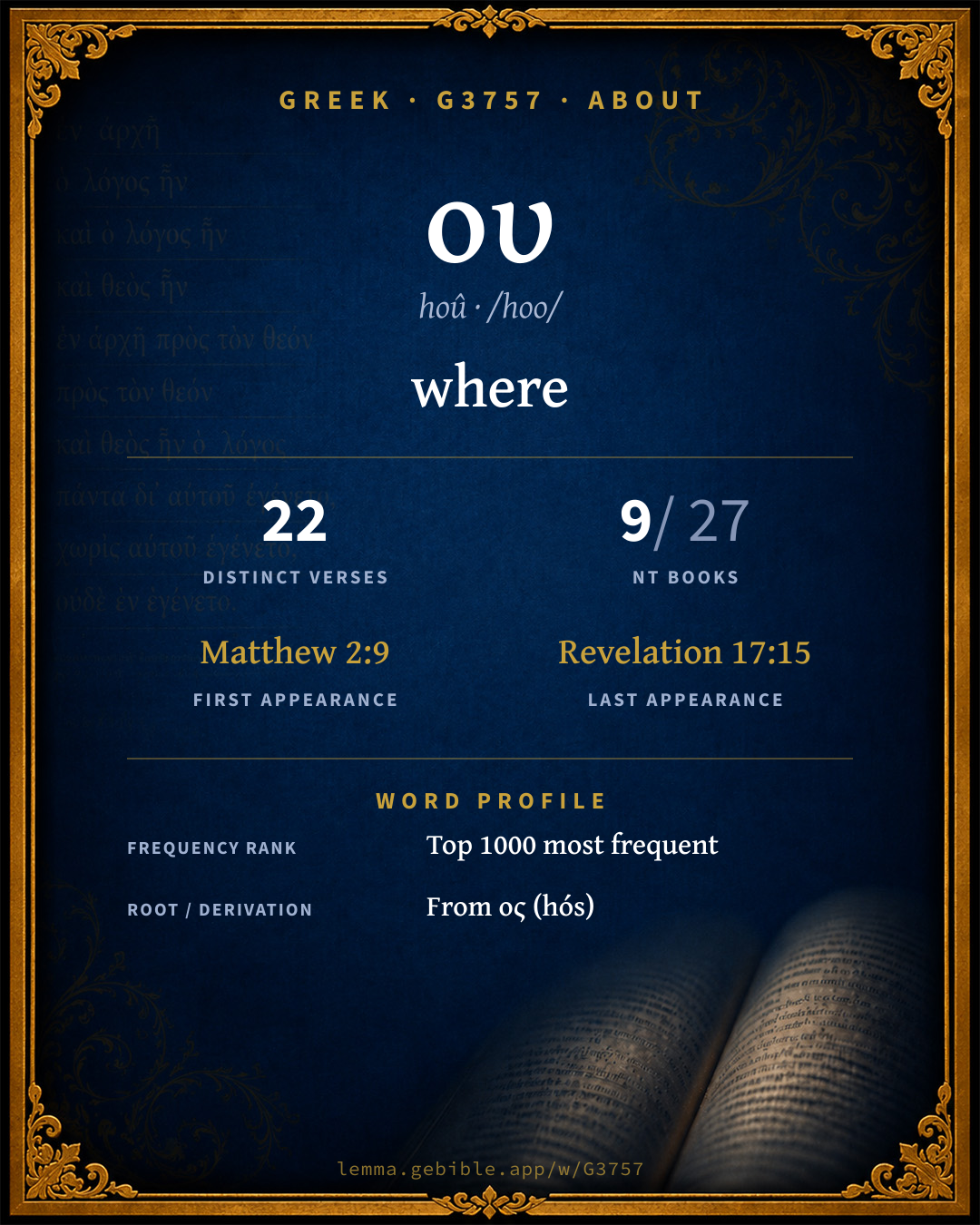
οὗ
where
Full lexicon entry — Thayer's Greek Lexicon
From Thayer's Greek Lexicon
Where this word appears
Grammar key — what these labels mean
Part of speech
- Adverb
- A word that modifies a verb, adjective, or other adverb.
Every verse where G3757 appears in the Book of Acts — 8 distinct verses. Click any verse to open its interlinear word-by-word view. Verse text shown in the World English Bible for context — . Each verse’s Greek form is shown with its reference; the English is not keyword-highlighted, since the data carries no word-level English alignment. Use “Compare translations” on any verse to read it across multiple English versions. This concordance covers the Greek New Testament; Septuagint (Greek Old Testament) occurrences of this word are not indexed here.
Acts
- Acts 1:13 οὗ adv When they had come in, they went up into the upper room, where they were staying; that is Peter, John, James, Andrew, Philip, Thomas, Bartholomew, Matthew, James the son of Alphaeus, Simon the Zealot, and Judas the son of James.
- Acts 2:2 οὗ adv Suddenly there came from the sky a sound like the rushing of a mighty wind, and it filled all the house where they were sitting.
- Acts 7:29 οὗ adv Moses fled at this saying, and became a stranger in the land of Midian, where he became the father of two sons.
- Acts 12:12 οὗ adv Thinking about that, he came to the house of Mary, the mother of John whose surname was Mark, where many were gathered together and were praying.
- Acts 16:13 οὗ adv On the Sabbath day we went forth outside of the city by a riverside, where we supposed there was a place of prayer, and we sat down, and spoke to the women who had come together.
- Acts 20:8 οὗ adv There were many lights in the upper chamber where we were gathered together.
- Acts 25:10 οὗ adv But Paul said, "I am standing before Caesar's judgment seat, where I ought to be tried. I have done no wrong to the Jews, as you also know very well.
- Acts 28:14 οὗ adv where we found brothers, and were entreated to stay with them for seven days. So we came to Rome.
About this entry
At a glance — auto-summarized from this page’s data, not written by a person. Every figure links to its source below. This summary describes the numbers; it doesn’t interpret them.
ου — transliterated hoû — is a Greek word carrying the sense “where.” Debuting at Matthew 2:9, it then recurs through the corpus. With 22 verses in 9 books, it is an uncommon word in the Greek New Testament. Its uses concentrate in Acts (36% of all occurrences). Sharing its root, it stands alongside ος, ο εστι and οθεν. See the sense tree, 22-verse concordance, and the renderings breakdown below.
Gloss history
Strong's 1890 vs modern scholarship
About this word
Strong's G3757 catalogs a Greek word from the Greek New Testament.
These counts are not copied from any lexicon or concordance. They are computed here, from the morphology-tagged Greek New Testament. What Lemma adds →
- 22
- distinct verses
- The word appears in 22 distinct verses.
- 9 / 27
- NT books
- The word appears in 9 of 27 New Testament books.
- #586
- by frequency
- Top 1000 most frequent Greek words (rank 586 of 5,347 Greek words by occurrence).
View all 22 occurrences in the concordance →
By section of the New Testament
By traditional corpus
Conventional, traditional groupings — biblical authorship is debated, so this is a traditional corpus grouping, not an authorship claim. Some books belong to more than one corpus (Luke is in both the Gospels and the Lukan corpus, and so on), so these shares overlap and need not total 100%. Each figure is a share of the word’s 22 distinct verses.
- Lukan (Luke–Acts) 12 verses · 55%
- Gospels 7 verses · 32%
- Pauline corpus 5 verses · 23%
- Johannine 1 verse · 5%
- Hebrews 1 verse · 5%
- Revelation 1 verse · 5%
How translations render this word
Counts come from each version’s own published word-to-Strong’s tagging or interlinear alignment — an approximate guide to how each version renders this word, not a word-level alignment the data otherwise carries. Because each total is that version’s own tagged count, the per-version totals vary from one another and need not match the appearance or distinct-verse counts above. These counts may also differ from a printed concordance because Lemma counts each distinctly tagged rendering and does not collapse phrase taggings into a single head-word total. This is a fixed set of word-tagged versions (KJV, ASV, BSB, ULT) and does not change with the reading translation you choose elsewhere. Each version’s license is shown beside its name below (and on Sources).
- King James Version: Where 21×, Whither 2×
- American Standard Version: Where 21×
- Berean Standard Bible: Where 16×
- unfoldingWord Literal Text: Where 24×
King James Version Public Domain
Renders G3757 across 27 tagged occurrences — most commonly:
Plus 4 renderings that appear only once — usually multi-word phrases or single function words the recovered tagging swept in, not distinct renderings.
American Standard Version Public Domain
Renders G3757 across 23 tagged occurrences — most commonly:
Plus 2 renderings that appear only once — usually multi-word phrases or single function words the recovered tagging swept in, not distinct renderings.
Berean Standard Bible Public Domain
Renders G3757 across 18 tagged occurrences — most commonly:
Plus 2 renderings that appear only once — usually multi-word phrases or single function words the recovered tagging swept in, not distinct renderings. Not rendered by a distinct English word in 2 further occurrences.
unfoldingWord Literal Text CC BY-SA 4.0
Renders G3757 across 25 tagged occurrences — most commonly:
Plus 1 rendering that appears only once — usually multi-word phrases or single function words the recovered tagging swept in, not distinct renderings.
Senses in Thayer's
The 1 sense Thayer's distinguishes for this word, in lexicon order (not ranked by frequency or importance). The full entry — with sub-senses — is in the Lexicon Entry tab.
- where
Word origin
Derived from ος (hós) (G3739) — who.
Genitive case of G3739 as adverb; at which place that is where : - where (-in) whither ([-soever]).
— Strong’s Exhaustive Concordance (1890), public domain.
Same root — word family
Other Thayer's entries built from the same root as G3757, grouped by Strong’s listed origin. These share a root / origin per the lexicon — not necessarily a shared meaning. Each links to that word’s own entry.
Derives from
Shares the same root
- ο εστι hó esti G3603 which is
- οθεν hóthen G3606 from which
- οποιος hopoîos G3697 what sort
- οποτε hopóte G3698 when
- οπου hópou G3699 where
- οπως hópōs G3704 how
- οσακις hosákis G3740 as often as
- οσος hósos G3745 how much
- οσπερ hósper G3746 whomever
- οστις hóstis G3748 whoever
- οτε hóte G3753 when
- ποσος pósos G4214 how much
- ως hōs G5613 as
Compare all same-root words → Showing 4 of 15 — not the complete family. They share a root, not necessarily a meaning.
Septuagint usage
The same Greek word ου appears 92 times in the Greek Old Testament (Septuagint), across 89 verses in 15 books.
- 92
- LXX occurrences
- Tagged occurrences of this Greek word in the Septuagint.
- 89
- verses
- Distinct Septuagint verses containing this word.
- 15 / 39
- OT books
- The word appears in 15 of the 39 Old Testament books.
Sample Septuagint occurrences
- Genesis 13:3 οὗ
- Exodus 9:26 οὗ
- Leviticus 4:12 οὗ
- Numbers 9:17 οὗ
- Deuteronomy 8:7 οὗ
- Joshua 1:9 οὗ
- Ruth 1:7 οὗ
- 1 Samuel 19:3 οὗ
- 1 Kings 5:23 οὗ
- Ezra 1:4 οὗ
- Esther 2:14 οὗ
- Isaiah 5:10 οὗ
Septuagint occurrences (same lexeme)
Every verse where the same Strong’s number (G3757) appears in the Greek Septuagint — showing the first 50 of 89. Verse text shown in the World English Bible for context; the Greek form is the matched word — the English is not keyword-highlighted.
- Genesis 13:3 οὗ He went on his journeys from the South even to Bethel, to the place where his tent had been at the beginning, between Bethel and Ai,
- Genesis 13:4 οὗ to the place of the altar, which he had made there at the first. There Abram called on the name of Yahweh.
- Genesis 13:14 οὗ Yahweh said to Abram, after Lot was separated from him, "Now, lift up your eyes, and look from the place where you are, northward and southward and eastward and westward,
- Genesis 19:27 οὗ Abraham got up early in the morning to the place where he had stood before Yahweh.
- Genesis 20:13 οὗ It happened, when God caused me to wander from my father's house, that I said to her, 'This is your kindness which you shall show to me. Everywhere that we go, say of me, "He is my brother."'"
- Genesis 20:15 οὗ Abimelech said, "Behold, my land is before you. Dwell where it pleases you."
- Genesis 21:17 οὗ God heard the voice of the boy. The angel of God called to Hagar out of the sky, and said to her, "What ails you, Hagar? Don't be afraid. For God has heard the voice of the boy where he is.
- Genesis 24:4 οὗ But you shall go to my country, and to my relatives, and take a wife for my son Isaac."
- Genesis 28:15 οὗ Behold, I am with you, and will keep you, wherever you go, and will bring you again into this land. For I will not leave you, until I have done that which I have spoken of to you."
- Genesis 31:4 οὗ Jacob sent and called Rachel and Leah to the field to his flock,
- Genesis 31:13 οὗ I am the God of Bethel, where you anointed a pillar, where you vowed a vow to me. Now arise, get out from this land, and return to the land of your birth."
- Genesis 33:19 οὗ He bought the parcel of ground, where he had spread his tent, at the hand of the children of Hamor, Shechem's father, for one hundred pieces of money.
- Genesis 35:13 οὗ God went up from him in the place where he spoke with him.
- Genesis 35:27 οὗ Jacob came to Isaac his father, to Mamre, to Kiriath Arba (the same is Hebron), where Abraham and Isaac lived as foreigners.
- Genesis 37:1 οὗ Jacob lived in the land of his father's travels, in the land of Canaan.
- Genesis 40:3 οὗ He put them in custody in the house of the captain of the guard, into the prison, the place where Joseph was bound.
- Genesis 42:27 οὗ As one of them opened his sack to give his donkey food in the lodging-place, he saw his money. Behold, it was in the mouth of his sack.
- Genesis 49:4 οὗ Boiling over as water, you shall not have the pre-eminence; Because you went up to your father's bed; Then defiled it. He went up to my couch.
- Exodus 9:26 οὗ Only in the land of Goshen, where the children of Israel were, there was no hail.
- Exodus 18:5 οὗ Jethro, Moses' father-in-law, came with his sons and his wife to Moses into the wilderness where he was encamped, at the Mountain of God.
- Exodus 20:21 οὗ The people stayed at a distance, and Moses drew near to the thick darkness where God was.
- Exodus 20:24 οὗ You shall make an altar of earth for me, and shall sacrifice on it your burnt offerings and your peace-offerings, your sheep and your oxen. In every place where I record my name I will come to you and I will bless you.
- Exodus 21:13 οὗ but not if it is unintentional, but God allows it to happen: then I will appoint you a place where he shall flee.
- Exodus 24:10 οὗ They saw the God of Israel. Under his feet was like a paved work of sapphire stone, like the skies for clearness.
- Leviticus 4:12 οὗ even the whole bull shall he carry forth outside the camp to a clean place, where the ashes are poured out, and burn it on wood with fire. Where the ashes are poured out it shall be burned.
- Leviticus 4:24 οὗ He shall lay his hand on the head of the goat, and kill it in the place where they kill the burnt offering before Yahweh. It is a sin offering.
- Leviticus 4:29 οὗ He shall lay his hand on the head of the sin offering, and kill the sin offering in the place of burnt offering.
- Leviticus 4:33 οὗ He shall lay his hand on the head of the sin offering, and kill it for a sin offering in the place where they kill the burnt offering.
- Leviticus 6:18 οὗ Every male among the children of Aaron shall eat of it, as their portion forever throughout your generations, from the offerings of Yahweh made by fire. Whoever touches them shall be holy.'"
- Leviticus 6:21 οὗ It shall be made with oil in a baking pan. When it is soaked, you shall bring it in. You shall offer the meal offering in baked pieces for a sweet savor to Yahweh.
- Leviticus 7:2 οὗ In the place where they kill the burnt offering, he shall kill the trespass offering; and its blood he shall sprinkle on the altar round about.
- Leviticus 14:13 οὗ He shall kill the male lamb in the place where they kill the sin offering and the burnt offering, in the place of the sanctuary; for as the sin offering is the priest's, so is the trespass offering. It is most holy.
- Leviticus 15:22 οὗ Whoever touches anything that she sits on shall wash his clothes, and bathe himself in water, and be unclean until the evening.
- Leviticus 15:23 οὗ If it is on the bed, or on anything whereon she sits, when he touches it, he shall be unclean until the evening.
- Numbers 9:17 οὗ Whenever the cloud was taken up from over the Tent, then after that the children of Israel traveled; and in the place where the cloud remained, there the children of Israel encamped.
- Numbers 20:5 οὗ Why have you made us to come up out of Egypt, to bring us in to this evil place? it is no place of seed, or of figs, or of vines, or of pomegranates; neither is there any water to drink.
- Numbers 35:25 οὗ and the congregation shall deliver the manslayer out of the hand of the avenger of blood, and the congregation shall restore him to his city of refuge, where he was fled: and he shall dwell therein until the death of the high priest, who was anointed with the holy oil.
- Numbers 36:6 οὗ This is the thing which Yahweh does command concerning the daughters of Zelophehad, saying, Let them be married to whom they think best; only into the family of the tribe of their father shall they be married.
- Deuteronomy 8:7 οὗ For Yahweh your God brings you into a good land, a land of brooks of water, of springs and springs, flowing forth in valleys and hills;
- Deuteronomy 8:15 οὗ who led you through the great and terrible wilderness, [in which were] fiery serpents and scorpions, and thirsty ground where was no water; who brought you forth water out of the rock of flint;
- Deuteronomy 11:24 οὗ Every place whereon the sole of your foot shall tread shall be yours: from the wilderness, and Lebanon, from the river, the river Euphrates, even to the hinder sea shall be your border.
- Deuteronomy 12:7 οὗ and there you shall eat before Yahweh your God, and you shall rejoice in all that you put your hand to, you and your households, in which Yahweh your God has blessed you.
- Deuteronomy 12:13 οὗ Take heed to yourself that you don't offer your burnt offerings in every place that you see;
- Deuteronomy 12:18 οὗ but you shall eat them before Yahweh your God in the place which Yahweh your God shall choose, you, and your son, and your daughter, and your man-servant, and your maid-servant, and the Levite who is within your gates: and you shall rejoice before Yahweh your God in all that you put your hand to.
- Deuteronomy 15:10 οὗ You shall surely give him, and your heart shall not be grieved when you give to him; because that for this thing Yahweh your God will bless you in all your work, and in all that you put your hand to.
- Deuteronomy 18:6 οὗ If a Levite comes from any of your gates out of all Israel, where he lives as a foreigner, and comes with all the desire of his soul to the place which Yahweh shall choose;
- Deuteronomy 23:17 οὗ There shall be no prostitute of the daughters of Israel, neither shall there be a sodomite of the sons of Israel.
- Deuteronomy 28:8 οὗ Yahweh will command the blessing on you in your barns, and in all that you put your hand to; and he will bless you in the land which Yahweh your God gives you.
- Deuteronomy 28:20 οὗ Yahweh will send on you cursing, confusion, and rebuke, in all that you put your hand to do, until you are destroyed, and until you perish quickly; because of the evil of your doings, by which you have forsaken me.
- Deuteronomy 30:1 οὗ It shall happen, when all these things are come on you, the blessing and the curse, which I have set before you, and you shall call them to mind among all the nations, where Yahweh your God has driven you,
These are occurrences of the same Greek lexeme (G3757) in the Septuagint — not a translation of any one Hebrew word. The store carries no word-level Hebrew↔Greek alignment, so no Hebrew original is asserted here. Counts come from the recovered LXX Strong's tagging — high-frequency vocabulary is well covered, while rare or late forms may be untagged — so they reflect tagged occurrences and may slightly undercount.