
Numbers 36:6

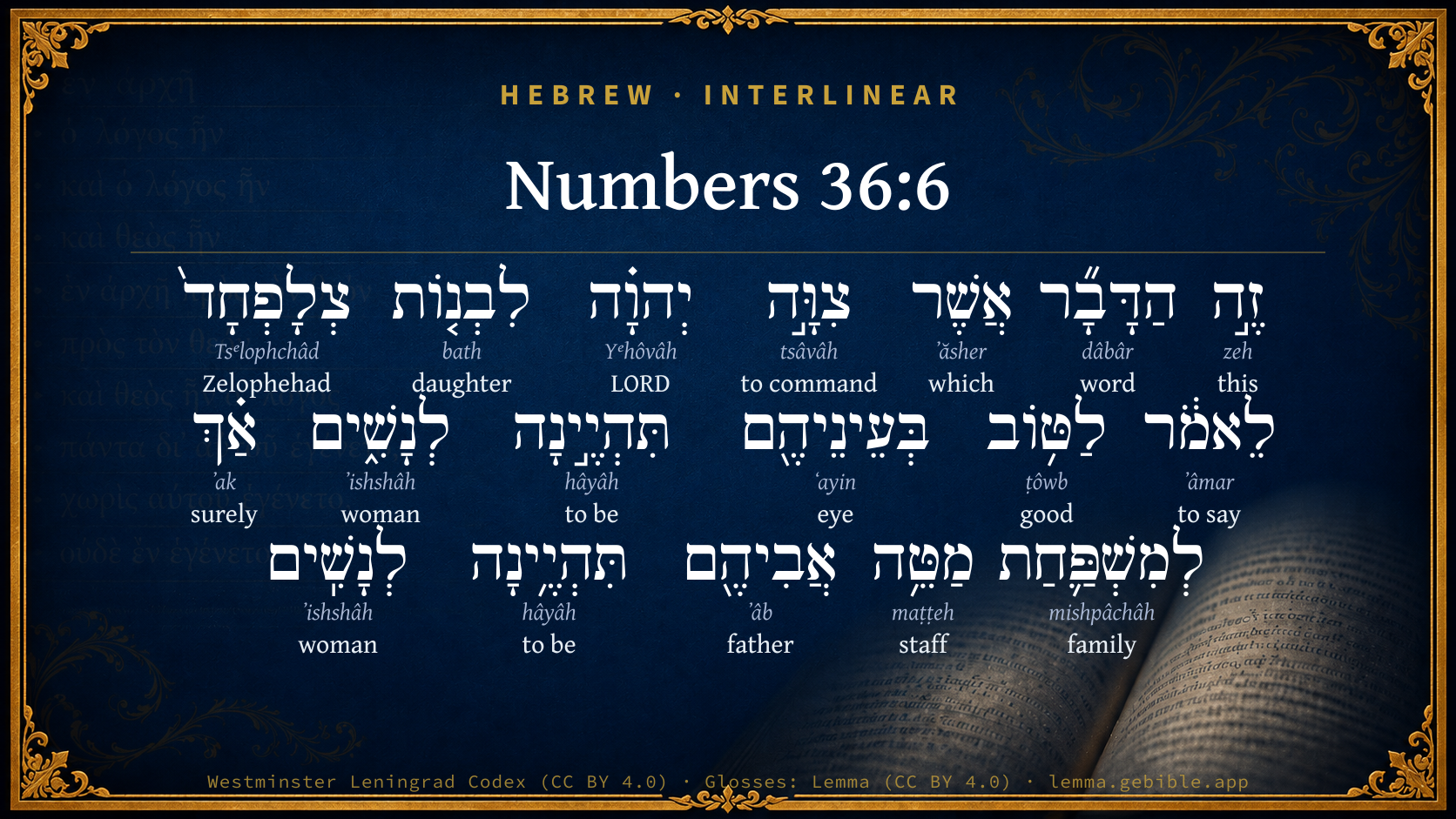
Hebrew (Westminster Leningrad Codex) Numbers 36:6 appears in the Hebrew Old Testament. The text above is from the Westminster Leningrad Codex. Each word links to its Strong’s number, a concise gloss, and parsing drawn from the Open Scriptures Hebrew Bible morphology. Click any word for its full Brown-Driver-Briggs (BDB) entry.
Download image
Cite this verse

Numbers 36:6 (World English Bible). Public Domain. Lemma interlinear Bible study tool, https://lemma.gebible.app/v/numbers/36/6.

Show BibTeX & RIS
BibTeX
RIS
English Translation
This is the thing which Yahweh does command concerning the daughters of Zelophehad, saying, Let them be married to whom they think best; only into the family of the tribe of their father shall they be married.
World English Bible · Public Domain
Download a study sheet

One document with this verse’s original text, its word-by-word gloss line, the meaning frame, cross-references with their text, attributed commentary, and full source and license credits — printable, and it pastes into notes with its structure intact.

This verse Autodidact and up

Study sheet (.html) Plain text (.txt)

A passage Seminary Student

Up to 50 verses in one chapter. A passage sheet keeps up to 6 commentary sources and 12 cross-references per verse, in the order this page ranks them, and says so on the sheet whenever that leaves anything out. Ask for a single verse and you get the Autodidact verse sheet above.

Everything on this page stays free to read, with no account — the sheet is a download of what is already on screen, not access to it.

Want to remove ads? Support Godless Engineer
Compare translations 3

The same verse in 3 English versions, stacked beneath the original-language interlinear above. Click any original word for its lexicon entry.

Each is an independent rendering of the whole verse — the interlinear is not word-aligned to these translations.

Highlighted words mark where these versions differ — a whole-verse word diff, not a word-by-word alignment.

  • World English Bible Public Domain
    This is the thing which Yahweh does command concerning the daughters of Zelophehad, saying, Let them be married to whom they think best; only into the family of the tribe of their father shall they be married.
  • King James Version Public Domain
    This is the thing which the LORD doth command concerning the daughters of Zelophehad, saying, Let them marry to whom they think best; only to the family of the tribe of their father shall they marry.
  • unfoldingWord Literal Text CC BY-SA 4.0
    This is the word that Yahweh commands to the daughters of Zelophehad, saying, ‘They may become wives of the good one in their eyes, only they shall become wives of the clan of the tribe of their father.

unfoldingWord Literal Text — © unfoldingWord, licensed CC BY-SA 4.0. Word-aligned USFM3 via Door43 (git.door43.org/unfoldingWord/en_ult).

Versions to compare (up to 4)

3 of 4 selected

Show all 18 translations

Every available English version of this verse, each an independent rendering of the whole verse.

  • World English Bible Public Domain
    This is the thing which Yahweh does command concerning the daughters of Zelophehad, saying, Let them be married to whom they think best; only into the family of the tribe of their father shall they be married.
  • Berean Standard Bible Public Domain
    This is what the LORD has commanded concerning the daughters of Zelophehad: They may marry anyone they please, provided they marry within a clan of the tribe of their father.
  • Majority Standard Bible Public Domain
    This is what the LORD has commanded concerning the daughters of Zelophehad: They may marry anyone they please, provided they marry within a clan of the tribe of their father.
  • King James Version Public Domain
    This is the thing which the LORD doth command concerning the daughters of Zelophehad, saying, Let them marry to whom they think best; only to the family of the tribe of their father shall they marry.
  • American Standard Version (1901) Public Domain
    This is the thing which Jehovah doth command concerning the daughters of Zelophehad, saying, Let them be married to whom they think best; only into the family of the tribe of their father shall they be married.
  • Revised Version (1885) Public Domain
    This is the thing which the LORD doth command concerning the daughters of Zelophehad, saying, Let them marry to whom they think best; only to the family of the tribe of their father shall they marry.
  • Geneva Bible (1599) Public Domain
    This is the thing that the Lord hath commanded, concerning the daughters of Zelophehad, saying, They shall be wiues, to whome they thinke best, onely to the familie of the tribe of their father shall they marry:
  • Douay-Rheims (1899) Public Domain
    And this is the law promulgated by the Lord touching the daughters of Salphaad: Let them marry to whom they will, only so that it be to men of their own tribe.
  • Young's Literal Translation Public Domain
    this `is' the thing which Jehovah hath commanded concerning the daughters of Zelophehad, saying, To those good in their eyes let them be for wives; only, to a family of the tribe of their fathers let them be for wives;
  • Literal Standard Version CC BY-SA 4.0
    this [is] the thing which YHWH has commanded concerning the daughters of Zelophehad, saying, To those good in their eyes let them be for wives; only, let them be for wives to a family of the tribe of their fathers;
  • Unlocked Literal Bible CC BY-SA 4.0
    This is what Yahweh commands concerning Zelophehad's daughters. He says, 'Let them be married to whom they think best, but they must marry only within the family of their father's tribe.'
  • unfoldingWord Literal Text CC BY-SA 4.0
    This is the word that Yahweh commands to the daughters of Zelophehad, saying, ‘They may become wives of the good one in their eyes, only they shall become wives of the clan of the tribe of their father.
  • Darby Bible Public Domain
    This is the thing which Jehovah hath commanded concerning the daughters of Zelophehad, saying, Let them marry whom they please; only they shall marry one of the tribe of their father,
  • World Messianic Bible Public Domain
    This is the thing which the LORD commands concerning the daughters of Zelophehad, saying, ‘Let them be married to whom they think best, only they shall marry into the family of the tribe of their father.
  • Webster's Bible Public Domain
    This is the thing which the LORD doth command concerning the daughters of Zelophehad, saying, Let them marry to whom they think best; only to the family of the tribe of their father shall they marry.
  • Free Bible Version CC BY-SA 4.0
    This is what the Lord has ordered in regard to Zelophehad's daughters: They can marry anyone they want as long as they marry within a family that belongs to their father's tribe.
  • Bible in Basic English Public Domain
    This is the order of the Lord about the daughters of Zelophehad: The Lord says, Let them take as their husbands whoever is most pleasing to them, but only among the family of their father's tribe.
  • JPS Tanakh (1917) Public Domain
    This is the thing which the LORD hath commanded concerning the daughters of Zelophehad, saying: Let them be married to whom they think best; only into the family of the tribe of their father shall they be married.

Literal Standard Version (2020), Covenant Press — licensed CC BY-SA 4.0. Text via the HelloAO Bible API (eBible.org). Unlocked Literal Bible (unfoldingWord) — licensed CC BY-SA 4.0. Text via the HelloAO Bible API (eBible.org). unfoldingWord Literal Text — © unfoldingWord, licensed CC BY-SA 4.0. Word-aligned USFM3 via Door43 (git.door43.org/unfoldingWord/en_ult). Free Bible Version, Dr. Jonathan Gallagher — licensed CC BY-SA 4.0. Text via the HelloAO Bible API (eBible.org).

Word by word

More ways to search: Search by grammar → Find every occurrence → Compare this word →

Practice this passage: Drill this verse → Learn its vocabulary →

צְלָפְחָד֙
Tsᵉlophchâd
H6765
“Zelophehad”
Noun, Proper
Part of Speech
Noun
Type
Proper
Full BDB Definition

Origin: from the same as H6764 and H259

TWOT: None

Zelophehad = "first-born" - a Manassite, son of Hepher and grandson of Gilead; came out of Egypt with Moses and died in the wilderness leaving only five daughters as heirs; their right to the inheritance was confirmed by divine direction
  1. זֶ֣ה zeh H2088 “this” Pronoun, Demonstrative, Masculine, Singular
  2. הַדָּבָ֞ר dâbâr H1697 “the · word” Particle, Definite Article + Noun, Common, Masculine, Singular, Absolute
  3. אֲשֶׁר ʼăsher H834 “which” Particle, Relative
  4. צִוָּ֣ה tsâvâh H6680 “to command” Verb, Piel, Perfect, 3rd Person, Masculine, Singular
  5. יְהוָ֗ה Yᵉhôvâh H3068 “LORD” Noun, Proper
  6. לִבְנ֤וֹת bath H1323 “to/for · daughters of” Preposition + Noun, Common, Feminine, Plural, Construct
  7. לֵאמֹ֔ר ʼâmar H559 “to say” Preposition + Verb, Qal, Infinitive Construct
  8. לַטּ֥וֹב ṭôwb H2896 “to/for the · good” Preposition, Determined + Adjective, Adjective, Masculine, Singular, Absolute
  9. בְּעֵינֵיהֶ֖ם ʻayin H5869 “in/at · eyes · their” Preposition + Noun, Common, Both, Dual, Construct + Suffix, Personal, 3rd Person, Masculine, Plural
  10. תִּהְיֶ֣ינָה hâyâh H1961 “to be” Verb, Qal, Imperfect, 3rd Person, Feminine, Plural
  11. לְנָשִׁ֑ים ʼishshâh H802 “to/for · women” Preposition + Noun, Common, Feminine, Plural, Absolute
  12. אַ֗ךְ ʼak H389 “surely” Particle, Accusative
  13. לְמִשְׁפַּ֛חַת mishpâchâh H4940 “to/for · family of” Preposition + Noun, Common, Feminine, Singular, Construct
  14. מַטֵּ֥ה maṭṭeh H4294 “staff of” Noun, Common, Masculine, Singular, Construct
  15. אֲבִיהֶ֖ם ʼâb H1 “father · their” Noun, Common, Masculine, Singular, Construct + Suffix, Personal, 3rd Person, Masculine, Plural
  16. תִּהְיֶ֥ינָה hâyâh H1961 “to be” Verb, Qal, Imperfect, 3rd Person, Feminine, Plural
  17. לְנָשִֽׁים ʼishshâh H802 “to/for · women” Preposition + Noun, Common, Feminine, Plural, Absolute

About this verse

These counts appear in no published source. They are computed here, from the morphology-tagged text and Lemma’s own curated glosses. What Lemma adds →

18
words
16
distinct lemmas
Pentateuch
section

Notable vocabulary

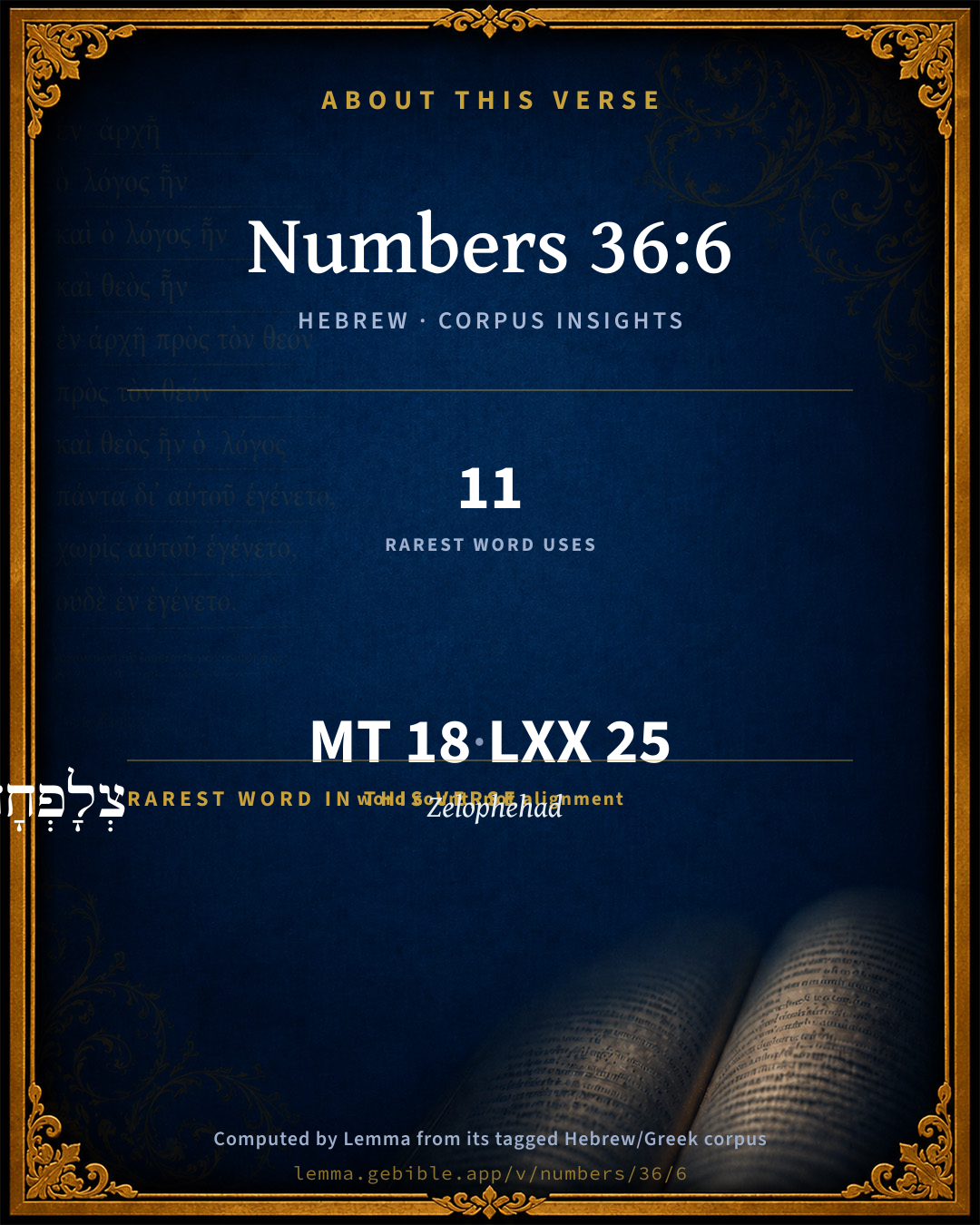
The rarest word here is צְלָפְחָד֙ Zelophehad H6765 — appearing just 11 times in the whole Hebrew Bible.

Shared distinctive vocabulary

צְלָפְחָד֙ Zelophehad H6765 occurs in 9 verses of the Hebrew Bible. Also found in:

Grammatical profile

  • 4 verbs
  • 10 nouns
  • 1 adjective
  • 1 pronoun
  • 2 particles

Verb forms

  • צִוָּ֣ה Piel · Perfect
  • לֵאמֹ֔ר Qal · Infinitive Construct
  • תִּהְיֶ֣ינָה Qal · Imperfect
  • תִּהְיֶ֥ינָה Qal · Imperfect

Repetition

Words recur within this verse — often emphatic in Hebrew:

  • תִּהְיֶ֣ינָה to be H1961 ×2
  • לְנָשִׁ֑ים woman H802 ×2

Hebrew & Septuagint length

In English translation the verse runs 37 words from the Hebrew and 29 from the Septuagint (LXX English) — closely comparable.

A rough comparison of the two English renderings, which tokenize alike — not a word-level alignment.

Word counts can differ between the Hebrew and the Greek without any difference in meaning — e.g. the Hebrew direct-object marker אֵת has no separate Greek word, and Greek often adds the article ὁ.

In the original languages it is 18 Hebrew tokens and 25 Greek tokens — but the two are counted differently (Hebrew bundles its prefixes and suffixes into one token; the Greek is in lemma form), so that isn’t a like-for-like length.

Cross-references

4

Topical passages linked to Numbers 36:6 in the Treasury of Scripture Knowledge — connected by theme and wording, ordered by reader-vote popularity; previews shown in the World English Bible.

  • Numbers 36:12 They were married into the families of the sons of Manasseh the son of Joseph; and their inheritance remained in the tribe of the family of their father.
  • 2 Corinthians 6:14 Don't be unequally yoked with unbelievers, for what fellowship have righteousness and iniquity? Or what communion has light with darkness?
  • Genesis 24:3 I will make you swear by Yahweh, the God of heaven and the God of the earth, that you shall not take a wife for my son of the daughters of the Canaanites, among whom I live.
  • Genesis 24:57–58 They said, "We will call the young lady, and ask her."

Cross-references courtesy of OpenBible.info (CC BY 4.0).

Hebrew and Greek witnesses Masoretic Hebrew ↔ Greek Septuagint

The same verse in the two great witnesses to the Old Testament, shown verse-for-verse.

These are two independent witnesses, not word-aligned to each other, and the Septuagint is shown in lemma (dictionary) form.

Hebrew Numbers 36:6 Masoretic · Westminster Leningrad Codex

זֶ֣ה הַדָּבָ֞ר אֲשֶׁר צִוָּ֣ה יְהוָ֗ה לִבְנ֤וֹת צְלָפְחָד֙ לֵאמֹ֔ר לַטּ֥וֹב בְּעֵינֵיהֶ֖ם תִּהְיֶ֣ינָה לְנָשִׁ֑ים אַ֗ךְ לְמִשְׁפַּ֛חַת מַטֵּ֥ה אֲבִיהֶ֖ם תִּהְיֶ֥ינָה לְנָשִֽׁים

This is the thing which Yahweh does command concerning the daughters of Zelophehad, saying, Let them be married to whom they think best; only into the family of the tribe of their father shall they be married.

World English Bible · Public Domain

Greek LXX Numbers 36:6 Septuagint · lemma form

οὗτος ὁ ῥῆμα ὅς συντάσσω κύριος ὁ θυγάτηρ σαλπααδ λέγω οὗ ἀρέσκω ἐναντίον αὐτός εἰμί γυνή πλήν ἐκ ὁ δῆμος ὁ πατήρ αὐτός εἰμί γυνή

This is the thing which the Lord has appointed the daughters of Salpaad, saying, Let them marry where they please, only let them marry men of their father's tribe.

LXX2012 (modern English Septuagint) · Public Domain

Hebrew: Westminster Leningrad Codex (CC BY 4.0). Greek: Septuagint (public domain); English from LXX2012 (modern English Septuagint) (Public Domain). How the Septuagint differs from the Hebrew →

Targum (Aramaic paraphrase)

2

The Targum is the ancient Jewish Aramaic paraphrase of the Hebrew Scriptures — an interpretive translation, not the Hebrew text itself. Onkelos (literal) and Pseudo-Jonathan (expansive) render the Torah, and Jonathan the Prophets. Coverage is partial: where no permissively-licensed English translation exists for a verse, only the Aramaic is shown. This is verse-level text, not a word-by-word alignment to the Hebrew.

  1. Targum Onkelos Torah (Genesis–Deuteronomy)
    דֵין פִּתְגָמָא דִי פַקִיד יְיָ לִבְנַת צְלָפְחָד לְמֵימַר לִדְתַקִין בְּעֵינֵיהוֹן תְּהֶוְיַן לִנְשִׁין בְּרַם לְזַרְעִית שִׁבְטָא דַאֲבוּהֶן תְּהֶוְיַן לִנְשִׁין

    (no public-domain English translation for this verse)

    Targum Onkelos — Aramaic: “Onkelos Genesis” (public domain); “Onkelos Exodus” (public domain); “Onkelos Leviticus” (public domain); “Onkelos Numbers” (public domain); “Onkelos Deuteronomy” (public domain). English: “Sefaria Community Translation” (CC0 1.0 (public-domain dedication)); “J.W. Etheridge. The Targums of Onkelos and Jonathan Ben Uzziel on the Pentateuch. London: Longmans, Green, 1862” (public domain). Text via Sefaria.

  2. Targum Pseudo-Jonathan Torah (Genesis–Deuteronomy)
    דֵין פִּתְגָמָא דְפַקֵיד יְיָ לָא לְדָרַיָא דַעֲתִידִין לְמֵיקוּם בָּתַר פִּילוּג אַרְעָא אֱלָהֵן לִבְנַת צְלָפְחָד לְמֵימָר לִדְתַקִין בְּעֵינֵיהוֹן תֶּהֱוְיָן לִנְשִׁין לְחוֹד לִגְנִיסַת שֵׁבֶט אֲבוּהֶן תֶּהֱוְיַן לִנְשִׁין

    This is the thing which the Lord hath commanded,-not for the generations that shall arise after the division of the land, but for the daughters of Zelophehad, saying: They may be the wives of them who are proper in their eyes, only such must be of the families of their father's tribe.

    Targum Pseudo-Jonathan — Aramaic: “Targum Jonathan on Genesis” (public domain); “Targum Jonathan on Exodus” (public domain); “Targum Jonathan on Leviticus” (public domain); “Targum Jonathan on Numbers” (public domain); “Targum Jonathan on Deuteronomy” (public domain). English: “The Targum of Jonathan ben Uzziel, trans. J. W. Etheridge, London, 1862” (public domain). Text via Sefaria.

Commentary

Notes on Numbers 36:6 from classic Christian and Jewish commentators (each source and its license shown beneath its notes). The classic Christian expositions comment on the surrounding passage and are grouped to its opening verse, so a note may address several verses; the Jewish commentaries on the Tanakh (Rashi and others) are per-verse, so they appear only where the commentator wrote on this verse.

Lemma curates 59 commentaries, every one of them public domain or Creative Commons licensed, each selected and text-cleaned for this edition rather than reprinted as found. About our sources →

Trapp's Complete Commentary

John Trapp

Num 36:6 This [is] the thing which the LORD doth command concerning the daughters of Zelophehad, saying, Let them marry to whom they think best; only to the family of the tribe of their father shall they marry.

Ver. 6. To whom they think best.] See Gen 24:57-58, {See Trapp on "Gen 24:57"} {See Trapp on "Gen 24:58"}

John Trapp, A Commentary or Exposition upon All the Books of the Old and New Testament (1647–1656) — public domain. Text from a community e-Sword module.

Joseph Benson's Commentary

Num 36:6. Only to the family — They were not confined to any particular person, but might have their choice among such as solicited their consent, who were descended from the same stock. But they were restrained from marrying men of another tribe or of another family of the same tribe; for God would have the inheritance of families, as well as of tribes, kept entire and distinct. And accordingly they actually did marry their cousin-germans, Num 36:11.

Joseph Benson's Commentary on the Old and New Testaments (1811–1818) — public domain. Text from a community e-Sword module.

Tyndale Open Study Notes

Tyndale Open Resources

36:6-9 These stipulations resolved the quandary, guaranteeing the stability and continuity of the tribal land allotments.

Tyndale Open Study Notes — © Tyndale Open Resources, licensed CC BY-SA 4.0. Text via the HelloAO Bible API.

Adam Clarke's Commentary

Verse 6. Let them marry to whom they think best] Here was latitude sufficient, and yet a salutary and reasonable restraint, which prevented a vexatious mixture of property and possession.

Adam Clarke's Commentary on the Bible (1810–1826) — public domain. Text from a community e-Sword/MySword module.

John Gill's Exposition

This is the thing which the Lord doth command concerning the daughters of Zelophehad,.... Concerning this affair relative to them; the Targum of Jonathan paraphrases the words,"not for the generations that rise up after the division of the land, but for the daughters of Zelophehad;''as if this order only respected them, or what might happen before the land was divided, but not after; and this is the general opinion of the Jewish writers; but it seems, that as the following law not only concerns them, but all heiresses, so all such after as well as before the division of the land, since the reason of it holds good after as before:

saying, let them marry to whom they think best; whom they like best, who are most acceptable to them; as it was reasonable they should, and not have such forced upon them, whose persons were disagreeable to them:

only into the family of the tribe of their father shall they marry; they were to marry not only such as were of the tribe of Manasseh, but of their father's family in that tribe; they could only marry into the family of the Hepherites; see Num 26:32.

John Gill's Exposition of the Whole Bible (1746–1763) — public domain (CC PDM 1.0). Text via the HelloAO Bible API.

Haydock's Catholic Bible Commentary

Tribe. Hebrew adds family also: for heiresses were obliged to marry in their own family, to prevent the confusion of the inheritances. If they had a mind to renounce their right, they were at liberty to marry where they pleased. (Calmet) --- The nearest relations, who chose to receive their land, were under an obligation of marrying them, Ruth iv. 6. (Haydock) --- A similar law prevailed at Athens.

George Leo Haydock (1774–1849), Haydock's Catholic Family Bible and Commentary, 1859 edition — public domain. Excludes Psalms (Douay-Rheims chapter numbering differs from Protestant) and Deuterocanonical books (Catholic canon only).

Matthew Poole's English Annotations

They seem hereby to be confined not only to the same tribe, trot also to the family of their tribe, as appears from the reason of the law, for God would have the inheritance of families as well as tribes kept entire and unmixed; and this was one reason of that law of marrying the brother’s wife, Deu 25. And although the next verse may seem to thwart this interpretation, the reason of this law being there given that inheritances might not go from tribe to tribe, Num 36:8 confirms it, where the very same phrase is repeated, and that more emphatically, that such shall marry one of the family of the tribe of her father; and this further reason and restriction is added, that they may enjoy every man the inheritance (not only of his tribe, but) of his fathers, to wit, belonging to his father’s family.

Matthew Poole's English Annotations on the Holy Bible (1683–1685) — public domain. Text from a community e-Sword/MySword module.

Whedon's Commentary on the Bible

Daniel D. Whedon

6. Only to the family — This is the only limitation of matrimony from expediency. The other restrictions relate to kindred, (Leviticus xviii,) and to the doomed Canaanites, intermarriage with whom was forbidden in the interest of loyalty to Jehovah. Exo_34:15.

Daniel D. Whedon (gen. ed.), Commentary on the Old and New Testaments (1874–1909) — public domain. Text from a community e-Sword module.

The Pulpit Commentary

Only to the family of the tribe of their father shall they marry. The direction is not altogether plain, since the tribe (matteh) contained several families (mishpachoth), and in this case one or more of the families were widely separated from the rest. Probably the words are to be read, "only to the tribe-family of their father," i.e., only into that mishpachah of Manasseh to which their father had belonged. Practically, therefore, they were restricted to the family of the Hepherites. (Num_26:32, Num_26:33) This is made almost certain when we remember that the territory of the "family" was to be apportioned within the tribe in the same way, and with the same regard to relationship, as the territory of the tribe within the nation. (see on Num_33:54)

The Pulpit Commentary (1880–1919), ed. H.D.M. Spence-Jones & Joseph S. Exell — public domain. Text from a community e-Sword module.

John Wesley's Explanatory Notes

To the family - They seem hereby to be confined not only to the same tribe, but also to the family of their tribe, as appears from the reason of the law, for God would have the inheritance of families as well as tribes kept entire and unmixed.

John Wesley, Explanatory Notes Upon the Whole Bible (1754–1765) — public domain. Text via the GEBible commentary corpus.

Lesson kit

Teaching starters — assembled from the data on this page, not authored interpretation. Every prompt links to the verse data it draws on. Edit before teaching.

Numbers, in the Pentateuch, opens this verse with 18 words (16 distinct Hebrew lemmas). Its most distinctive word is Tsᵉlophchâd (“Zelophehad”). A historical commentator’s framing appears above. Read the whole chapter for the surrounding context.

Discussion questions

  1. What does “Zelophehad” (Tsᵉlophchâd) contribute to the verse as a whole?
  2. How does Numbers 26:33, which shares the word «Zelophehad», read alongside this verse?
  3. What does the repetition of “to be” (2× in this one verse) do in this verse?
  4. These translations render this verse differently; the difference is in the English rendering, not the original. What questions does that raise?
  5. «צִוָּ֣ה» is a Piel Perfect verb. How does that grammatical form shape the action described?
  6. Compare how Trapp's Complete Commentary and Joseph Benson's Commentary read this verse. Where do they agree or differ?

Things to notice

Reading settings

Reading text

Shown beneath each verse's original-language words.

Old Testament
Old Testament edition

Read the OT as the Masoretic Hebrew (MT) or the Greek Septuagint (LXX).

English shown for the Greek Septuagint (in the Hebrew ↔ Greek comparison).

Comparing translations? Open the Compare panel on any verse page to stack up to four side by side.