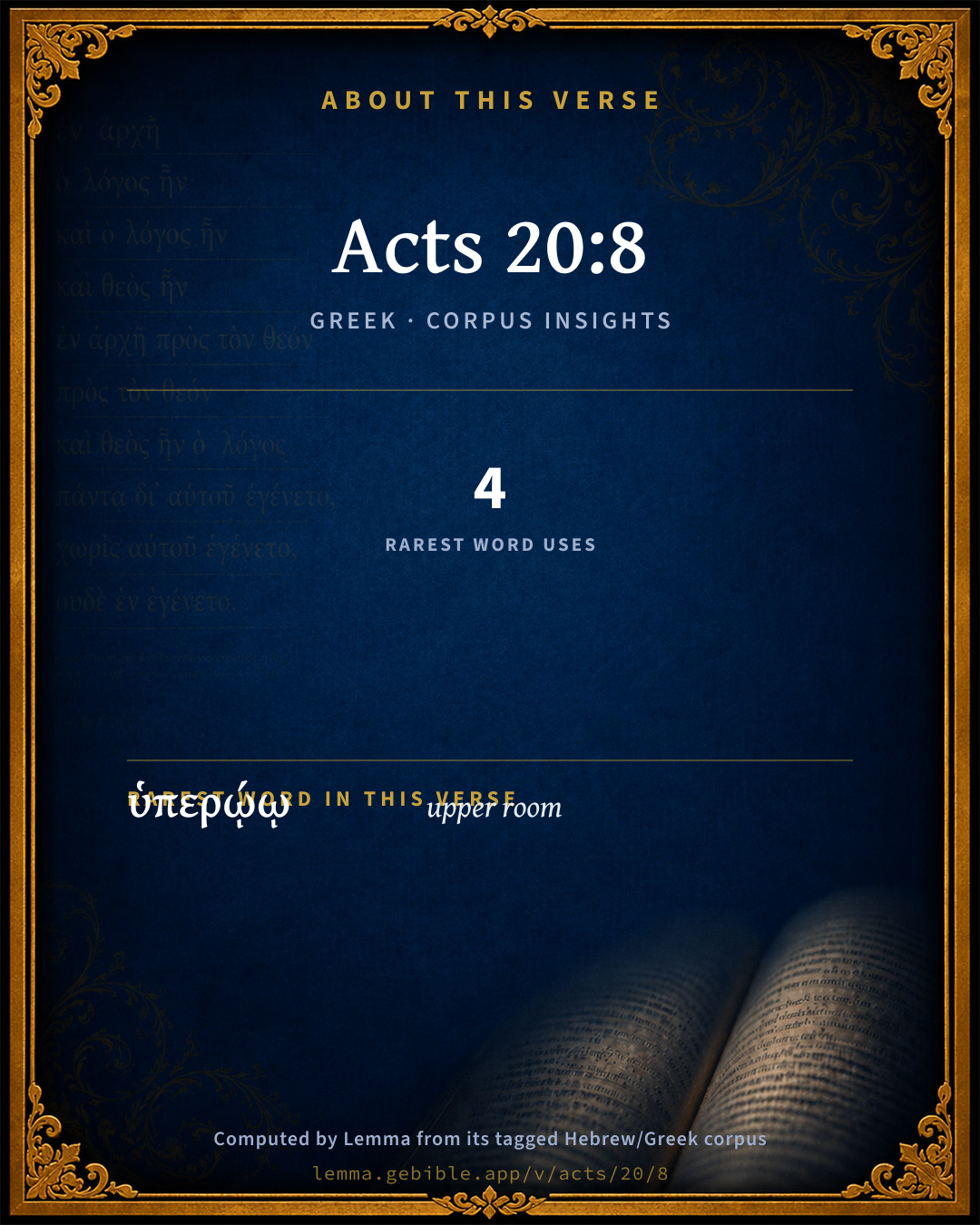
Acts 20:8

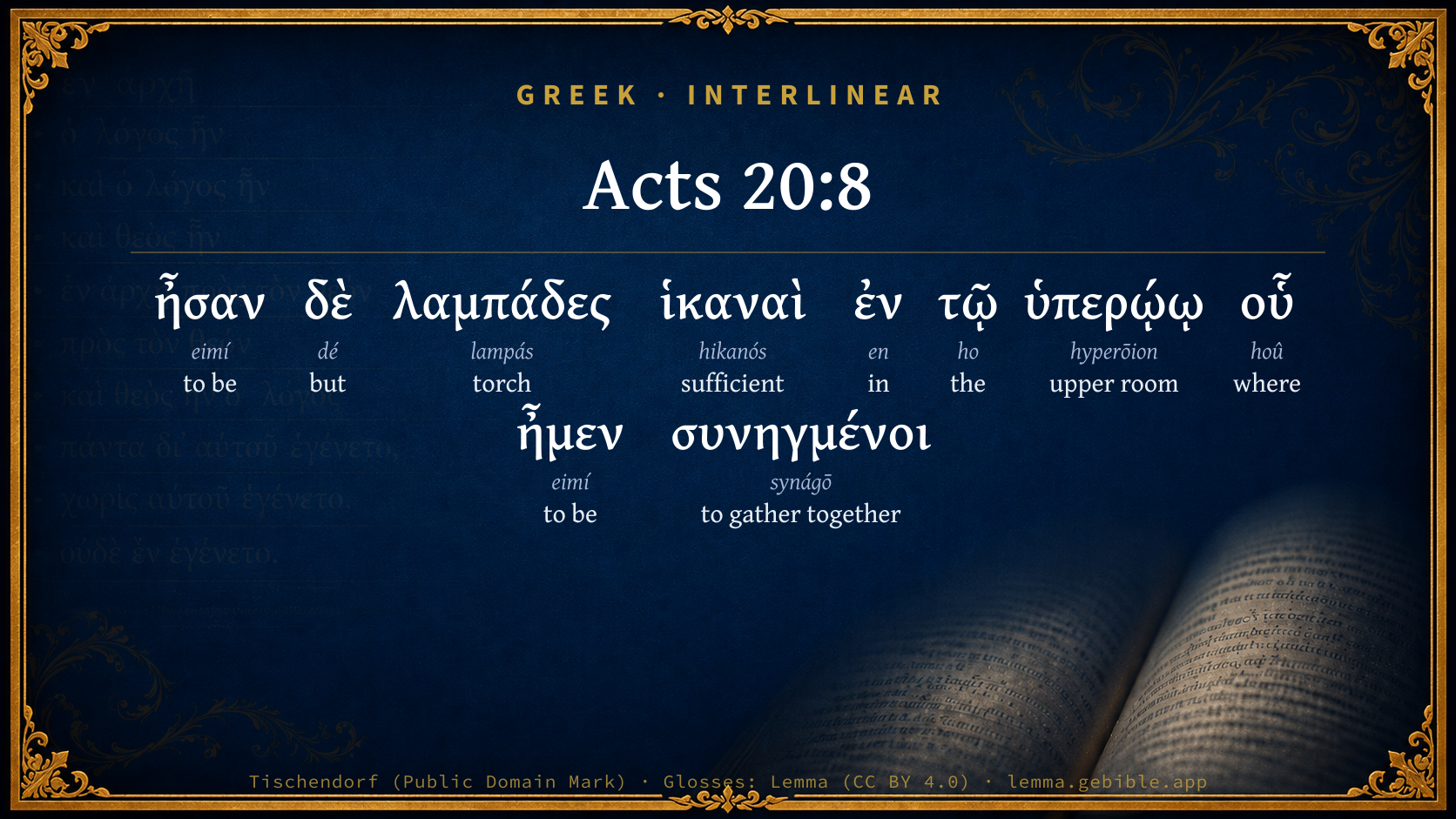
Greek (Tischendorf 8th ed.) Acts 20:8 appears in the Greek New Testament. The text above is from the Tischendorf 8th edition. Each word links to its Strong’s number and a concise gloss. Click any word for its full Thayer’s Greek Lexicon entry.
Download image
Cite this verse

Acts 20:8 (World English Bible). Public Domain. Lemma interlinear Bible study tool, https://lemma.gebible.app/v/acts/20/8.

Show BibTeX & RIS
BibTeX
RIS
English Translation
There were many lights in the upper chamber where we were gathered together.
World English Bible · Public Domain
Download a study sheet

One document with this verse’s original text, its word-by-word gloss line, the meaning frame, cross-references with their text, attributed commentary, and full source and license credits — printable, and it pastes into notes with its structure intact.

This verse Autodidact and up

Study sheet (.html) Plain text (.txt)

A passage Seminary Student

Up to 50 verses in one chapter. A passage sheet keeps up to 6 commentary sources and 12 cross-references per verse, in the order this page ranks them, and says so on the sheet whenever that leaves anything out. Ask for a single verse and you get the Autodidact verse sheet above.

Everything on this page stays free to read, with no account — the sheet is a download of what is already on screen, not access to it.

Want to remove ads? Support Godless Engineer
Compare translations 3

The same verse in 3 English versions, stacked beneath the original-language interlinear above. Click any original word for its lexicon entry.

Each is an independent rendering of the whole verse — the interlinear is not word-aligned to these translations.

Highlighted words mark where these versions differ — a whole-verse word diff, not a word-by-word alignment.

  • World English Bible Public Domain
    There were many lights in the upper chamber where we were gathered together.
  • King James Version Public Domain
    And there were many lights in the upper chamber, where they were gathered together.
  • unfoldingWord Literal Text CC BY-SA 4.0
    And many lamps were in the upper room where we were gathered together.

unfoldingWord Literal Text — © unfoldingWord, licensed CC BY-SA 4.0. Word-aligned USFM3 via Door43 (git.door43.org/unfoldingWord/en_ult).

Versions to compare (up to 4)

3 of 4 selected

Show all 19 translations

Every available English version of this verse, each an independent rendering of the whole verse.

  • World English Bible Public Domain
    There were many lights in the upper chamber where we were gathered together.
  • Berean Standard Bible Public Domain
    Now there were many lamps in the upper room where we were gathered.
  • Majority Standard Bible Public Domain
    Now there were many lamps in the upper room where we were gathered.
  • King James Version Public Domain
    And there were many lights in the upper chamber, where they were gathered together.
  • American Standard Version (1901) Public Domain
    And there were many lights in the upper chamber where we were gathered together.
  • Revised Version (1885) Public Domain
    And there were many lights in the upper chamber, where we were gathered together.
  • Geneva Bible (1599) Public Domain
    And there were many lightes in an vpper chamber, where they were gathered together.
  • Douay-Rheims (1899) Public Domain
    And there were a great number of lamps in the upper chamber where we were assembled.
  • Young's Literal Translation Public Domain
    and there were many lamps in the upper chamber where they were gathered together,
  • Literal Standard Version CC BY-SA 4.0
    and there were many lamps in the upper chamber where they were gathered together,
  • Unlocked Literal Bible CC BY-SA 4.0
    There were many lamps in the upper room where we had come together.
  • unfoldingWord Literal Text CC BY-SA 4.0
    And many lamps were in the upper room where we were gathered together.
  • Darby Bible Public Domain
    And there were many lights in the upper room where we were assembled.
  • World Messianic Bible Public Domain
    There were many lights in the upper room where we were gathered together.
  • Webster's Bible Public Domain
    And there were many lights in the upper chamber, where they were assembled.
  • Free Bible Version CC BY-SA 4.0
    (The upstairs room where we were meeting was lit by many lamps.)
  • Bible in Basic English Public Domain
    And there were a number of lights in the room where we had come together.
  • Text-Critical English NT CC BY 4.0
    Now there were many lamps in the upper room where we were gathered together,
  • Tyndale New Testament (1534) Public Domain
    And there were many lyghtes in the chamber where thy were gaddered to geder

Literal Standard Version (2020), Covenant Press — licensed CC BY-SA 4.0. Text via the HelloAO Bible API (eBible.org). Unlocked Literal Bible (unfoldingWord) — licensed CC BY-SA 4.0. Text via the HelloAO Bible API (eBible.org). unfoldingWord Literal Text — © unfoldingWord, licensed CC BY-SA 4.0. Word-aligned USFM3 via Door43 (git.door43.org/unfoldingWord/en_ult). Free Bible Version, Dr. Jonathan Gallagher — licensed CC BY-SA 4.0. Text via the HelloAO Bible API (eBible.org).

Word by word

More ways to search: Search by grammar → Find every occurrence → Compare this word →

Practice this passage: Drill this verse → Learn its vocabulary →

About this verse

These counts appear in no published source. They are computed here, from the morphology-tagged text and Lemma’s own curated glosses. What Lemma adds →

10
words
9
distinct lemmas
Acts
section

Notable vocabulary

The rarest word here is ὑπερῴῳ upper room G5253 — appearing just 4 times in the whole Greek New Testament.

Shared distinctive vocabulary

ὑπερῴῳ upper room G5253 occurs in 4 verses of the Greek New Testament. Also found in:

Repetition

A word recurs within this verse:

  • ἦσαν to be G1510 ×2

Cross-references

2

Topical passages linked to Acts 20:8 in the Treasury of Scripture Knowledge — connected by theme and wording, ordered by reader-vote popularity; previews shown in the World English Bible.

  • Acts 1:13 When they had come in, they went up into the upper room, where they were staying; that is Peter, John, James, Andrew, Philip, Thomas, Bartholomew, Matthew, James the son of Alphaeus, Simon the Zealot, and Judas the son of James.
  • Luke 22:12 He will show you a large, furnished upper room. Make preparations there."

Cross-references courtesy of OpenBible.info (CC BY 4.0).

Where the printed editions differ

1 variant

Places in this verse where the major printed Greek editions disagree on the wording in a way that affects the translation — a comparison of editions, not a manuscript-by-manuscript collation. The editions are the modern critical texts (Nestlé-Aland 28/27, SBL, Westcott-Hort, Tregelles, Tyndale House) and the traditional texts behind the KJV (the Textus Receptus and the Byzantine/Majority text). It is not a claim about which reading is original.

  1. Different wording
    ἦμεν

    “we were”

    In NA28NA27TynSBLWHTregByz Not in TR

    ἦσαν (ēsan) 'they were' occurs in traditional manuscripts (TR) instead of ἦμεν (ēmen) 'we were' in older manuscripts (NA28+NA27+Tyn+SBL+WH+Treg+Byz)

Textual data: Translators Amalgamated Greek New Testament (STEPBible TAGNT) · CC BY 4.0.

Commentary

Notes on Acts 20:8 from classic Christian and Jewish commentators (each source and its license shown beneath its notes). The classic Christian expositions comment on the surrounding passage and are grouped to its opening verse, so a note may address several verses; the Jewish commentaries on the Tanakh (Rashi and others) are per-verse, so they appear only where the commentator wrote on this verse.

Lemma curates 59 commentaries, every one of them public domain or Creative Commons licensed, each selected and text-cleaned for this edition rather than reprinted as found. About our sources →

Bengel's Gnomon

Johann Albrecht Bengel

Act 20:8. Λαμπάδες ἱκαναὶ, many lights) in order that all suspicion of scandal might be obviated.

Bengel's Gnomon of the New Testament — English translation (T&T Clark, Edinburgh, 1860) — public domain. Text from a community e-Sword module.

Meyer's Critical & Exegetical Commentary

Heinrich August Wilhelm Meyer

Act_20:8-10. Ἦσαν δὲ λαμπ. ἱκ.] therefore the fall of the young man could at once be perceived. The lamps served for the lighting up of the room, for it was night; but perhaps at the same time for heightening the solemnity of the occasion. According to Ewald, Luke wished to obviate the evil reports concerning the nocturnal meetings of the Christians (comp. Calvin and Bengel); but they remained withal nocturnal and thereby exposed to suspicion.

Whether Eutychus was a young man serving (Rosenmüller, Heinrichs), which at least is not to be inferred from the occurrence of the name among slaves and freedmen (Artem. iii. 38; Phaedr. 3, prol.), the text does not say.

ἐπὶ τῆς θυρίδ.] on the (open) window, i.e. on the window-seat. The openings of the windows in the East, having no glass, were sometimes with and sometimes without lattice-work (see Winer, Realw.). So they are still at the present day.

καταφερόμενος κ.τ.λ.] falling into a deep sleep. καταφέρεσθαι is the proper word for this among Greek writers (comp. also Aquila, Psa_75:6), usually with εἰς ὕπνον (Lucian, Dial. mer. ii. 4; Herodian, ii. 1. 3, ii. 9. 6). Comp. Hom. Od. vi. 2 : ὕπνῳ κ. καμάτῳ ἀρημένος. Observe the logical relation of the participles: But as there sat (καθεζόμ., see the critical remarks) a young man, falling (in his sitting there) into deep sleep during the prolonged discourse of Paul, he fell, overpowered by the sleep, from the third story, etc.

As to ἐπὶ πλεῖον, comp. on Act_4:17. The discourse continued for a longer time (Act_18:20) than the young man had expected.

ἀπὸ τοῦ ὑπνοῦ] ἀπό denotes the proceeding from, the power producing the effect (Bernhardy, p. 222; Buttmann, neut. Gr. p. 277 [E. T. 322]), and the article denotes the sleep already mentioned (Mat_1:24).

ἤρθη νεκρός] he was taken up dead. The words affirm nothing else than that the young man actually fell down dead and was taken up dead (Chrys.: διὰ τοῦτο ἀποθανὼν, ἵνα Παῦλον ἀκούσῃ, Calvin, Beza, and others; recently Schneckenburger, Schwegler, Zeller, and Baumgarten); and only so understood has the fall, as well as the conduct of the apostle in Act_20:10 and the result, the significance which can have induced its being narrated, namely, as a raising from the dead.[110] This we remark in opposition to the view which has become common, as if Ὡς ΝΕΚΡΌς were used (apparently dead, de Wette; comp. Ewald).

ἘΠΈΠΕΣΕΝ ΑὐΤῷ Κ.Τ.Λ.] not in order to examine him, but in order to revive him by his contact, in a way similar to the procedure of Elisha and Elijah, 2Ki_4:34; 1Ki_17:17 ff.

μὴ θορυβεῖσθε· ἡ γὰρ ψυχὴ κ.τ.λ.] Thus he speaks, obviating the consternation of those present (comp. on μὴ θορυβ., Dem. de cor. 35), when he had convinced himself of the successful intervention of his miraculous influence. His soul is in him, i.e. he is living! ἡ ψυχὴ αὐτοῦ (not ἘΝ ΑὐΤῷ) has the emphasis, not spoken without a lively feeling of victory. The young man had, in fact, been but now ἄψυχος. Accordingly there is no ambiguity of the words, in which Lekebusch asserts that we desiderate an added again, and would explain this ambiguity on the ground that the author himself was not quite convinced of the miraculous nature of the incident. See, on the other hand, Oertel, Paulus in d. Apostelgesch. p. 147.

[110] Baurs criticism in the case, however, converts an event which was in itself natural into a parallel in a miraculous form with the raising of the dead narrated of Peter in chap. 9.

Meyer — Critical and Exegetical Commentary on the New Testament — English translation by Peter Christie, edited by Frederick Crombie (T&T Clark, 1880) — public domain. Text from a community e-Sword module.

Expositor's Greek Testament

ed. W. Robertson Nicoll

Act 20:8 . λαμπάδες ἱκαναὶ , see critical note and reading in D. The words have been taken to indicate clearly that the accident was not due to darkness coming on through Paul’s lengthy discourse (so Weiss and Wendt), whilst Meyer regards them as introduced to show that the fall of the young man was not perceived at once. Others (so Felten) hold that the words mark the joy at the Sacramental Presence of the Lord and Bridegroom of the Church (Mat 25:1 ), and Nösgen sees in them a note of joy in the celebration of the Christian Sunday (see also Kuinoel). But it is also allowable to see in this notice the graphic and minute touch of one who was an eye-witness of the scene, and who described it, as he remembered it, in all its vividness (Hackett, Blass). We can scarcely see in the words with Ewald an intention on the part of the narrative to guard against any suspicion attaching to the night meetings of the Christians (so Calvin, Bengel, Lechler); the date, as Nösgen says, is too early (so too Overbeck). Lewin also takes Ewald’s view, but with the alternative that the lights may have been mentioned to exclude any suspicion in the reader’s mind of any deception with regard to the miracle.

The Expositor's Greek Testament, edited by W. Robertson Nicoll (1897–1910) — public domain. Text from a community e-Sword module.

Geneva Bible (1599)

Geneva Bible translators

The devil minding to trouble the Church with a great offense, giveth Paul a singular occasion to confirm the Gospel.

Geneva Bible (1599) marginal notes — public domain. Text via Bolls.life.

Jamieson, Fausset & Brown

Robert Jamieson, A. R. Fausset & David Brown

there were many lights in the upper chamber--not a mere piece of graphic detail by an eye-witness [HACKETT, HOWSON], but mentioned, probably, as increasing the heat and contributing to drowsiness [WEBSTER and WILKINSON], as the next clause seems to show.

Jamieson, Fausset & Brown — Commentary Critical and Explanatory on the Whole Bible (1871) — public domain (CC PDM 1.0). Text via the HelloAO Bible API.

Adam Clarke's Commentary

Verse 8. Upper chamber] It was in an upper chamber in the temple that the primitive disciples were accustomed to meet: on that account, they might have preferred an upper chamber whenever they could meet with it. The pious Quesnel supposes that the smoke, issuing from the many lamps in this upper chamber, was the cause of Eutychus falling asleep; and this, he says, the apostle mentions, in charity, to excuse the young man's appearing negligent.

Adam Clarke's Commentary on the Bible (1810–1826) — public domain. Text from a community e-Sword/MySword module.

Ellicott's Commentary for English Readers

(8) And there were many lights in the upper chamber.—We learn from Act_20:9 that it was on the third floor of the house. In the high narrow streets of Eastern towns the upper storey is often chosen for social or devotional purposes, partly as more removed from the noise of the street, partly as giving access to the roof of the house. Such a room in a good sized house might well hold two or three hundred people. It is a fair inference also that the vividness and minuteness of the account indicate that we have the narrative of an eye-witness. The lamps or torches (see Notes on Mat_5:15; Mat_25:3; Joh_5:35) are probably mentioned, partly as accounting for the sleep of Eutychus by the heat and closeness of the room, partly, perhaps, as an indirect answer to the calumny loudly asserted afterwards (Tertull. Apol. c. 8), and probably even then whispered, that at the meetings of the Christians the lamps were extinguished and free scope given for deeds of shameless licence. There is no ground for assuming that the lamps at this early period had any distinctive ritual or symbolic character, though it would be a natural expression of respect that two or more should be placed in front of the Apostle, or other presiding elder, at such a meeting, on either side of the loaf which was to be broken, and the cup which was to be blest. The position of the celebrant (to use a later, but convenient term) may have been, as in the original institution of the Supper, recumbent on the triclinium, or couch, which was at this time used by both Greeks and Romans. It is obvious, however, that this would be an inconvenient posture for distribution to a large assembly, and the special mention of “the Lord’s table” in 1Co_10:21, leads to the conclusion that there was a separate high table (to borrow the familiar language of a college or Inn of Court) at which the celebrant and other ministers sat, their backs to the wall, their faces to the people, and that from that table they distributed the bread and wine, either by taking them, or sending them by the deacons or other ministers, to those who sat in the body of the room, or by giving it to the congregation as they came up to the table in detachments. The later practice of the Church, and the absence of any indication in patristic writings that there was an abrupt change, makes the latter the more probable alternative. The table, so placed, served as a transition stage between the triclinium and the altar of the later basilica. The primitive arrangement in which the priest faces the congregation and stands behind the altar, it may be noted, was at first retained in most of the basilicas, and survives to the present day in some of the churches of that type in Rome—as, for example, in that of S. Clemente. This, therefore, and not any eastward or southward position, may claim to be, as has been well said, “at once the most primitive, the most Catholic, the most Protestant” of Eucharistic usages.

A Bible Commentary for English Readers, edited by Charles John Ellicott (1878–1897) — public domain. Text from a community e-Sword module.

The Cambridge Bible for Schools and Colleges

gen. ed. J. J. S. Perowne

8. And there were, &c.] Our thoughts go back to the upper room in Jerusalem where (Act_1:13) the first preachers of Christianity waited for the promised gift of the Holy Ghost.

The Cambridge Bible for Schools and Colleges (gen. ed. J. J. S. Perowne; Cambridge University Press, 1878–1918) — public domain. Text from a community e-Sword module.

John Gill's Exposition

And there were many lights in the upper chamber,.... Which were lighted up, both for necessary uses, to see by, to read the word, and to administer the ordinance of the supper, and for the comfort and pleasure of the whole company, both preacher and hearers; as well as to remove all ground of suspicion, or occasion of reproach, as if it was a midnight society met for wicked practices: but this no ways countenances the use of lamps and wax candies in the daytime at divine worship, since this was in the night; of the upper chamber, in which it was usual to meet for religious exercises, see Mar 2:4, where they were gathered together; the Alexandrian copy, Vulgate Latin, Syriac, and Arabic versions read, "where we were gathered together".

, where they were gathered together; the Alexandrian copy, Vulgate Latin, Syriac, and Arabic versions read, "where we were gathered together".

Acts 20:9

act 20:9

act 20:9

act 20:9And there sat in a window a certain young man,.... In the upper room, where he placed himself, either for air and refreshment, the chamber being suffocating, through the number of people, and of lights; or for want of room, the place being full:

named Eutychus; a Greek name, which signifies one of good fortune:

being fallen into a deep sleep; which may be accounted for without aggravating the case; as from his youth, he was a young man, and so more subject to sleep, and more easily overcome with it, than persons in years, by reason of the humours of the body which incline to it; and also from the length of service, and the lateness of the season of the night, all which contributed to bring on this deep sleep: it can hardly be thought that he purposely composed himself to sleep, for had he, he would never have chose so dangerous a place to sit in as a window, and that at so great an height from the ground; but this sleep seemed to come upon him at an unawares; what hand soever Satan might have in it, with a view to the young man's hurt, both as to soul and body, and to bring reproach and scandal upon the church, and the Gospel, it seems evident that the providence of God was in it, and which overruled it for a good end, even the greater confirmation of the Gospel, and very probably for the spiritual good of the young man.

And as Paul was long preaching he sunk down with sleep; being quite overcome, and bore down with it, not able to hold up his head, he either bowed down, or leaned backwards: and fell down from the third loft: or three story high, where the upper room was. It seems that he did not fall inward, for then he would have fallen no further than the floor of the upper room, but outward, out of the window into the street or yard; and this is the more evident from Paul's going down to him, mentioned in the next verse:

and was taken up dead; not only for dead, or as one dead, but he really was dead, as it is no wonder he should.

John Gill's Exposition of the Whole Bible (1746–1763) — public domain (CC PDM 1.0). Text via the HelloAO Bible API.

Trapp's Complete Commentary

John Trapp

8 And there were many lights in the upper chamber, where they were gathered together.

Ver. 8. And there were many lights] Night meetings are lawful, and, in some cases, needful; though carnal men will calumniate, and muse as they use. Caligula thought there was not a chaste man upon earth, because himself was most detestably unchaste.

John Trapp, A Commentary or Exposition upon All the Books of the Old and New Testament (1647–1656) — public domain. Text from a community e-Sword module.

Albert Barnes' Notes on the Bible

And there were many lights - Why this circumstance is mentioned is not apparent. It, however, meets one of the slanders of the early enemies of Christianity, that the Christians in their assemblies were accustomed to extinguish all the lights, and to commit every kind of abomination. Perhaps the mention of many lights here is designed to intimate that it was a place of public worship, as not only the Jews, but the Gentiles were accustomed to have many lights burning in such places.

In the upper chamber - See the notes on Act 1:13.

Albert Barnes' Notes on the Bible (1834–1885) — public domain. Text from a community e-Sword/MySword module.

Matthew Poole's English Annotations

There were many lights; there being many present; and it being in the night, because of the persecution that the Christians met with. Lest they should be reproached for doing any thing indecently, they by this means exposed themselves, and all that was done amongst them, to the common view and notice of all.

In the upper chamber; where it is supposed they did ordinarily meet; as Act 1:13.

Matthew Poole's English Annotations on the Holy Bible (1683–1685) — public domain. Text from a community e-Sword/MySword module.

Whedon's Commentary on the Bible

Daniel D. Whedon

8. Many lights—The whole scene, both of ministry and miracle, if not by daylight, took place under clear lamplight.

Upper chamber—(See note on Act_1:13.)

Daniel D. Whedon (gen. ed.), Commentary on the Old and New Testaments (1874–1909) — public domain. Text from a community e-Sword module.

The Pulpit Commentary

We for they, A.V. and T.R. It is not obvious why St. Luke mentions the many lights. Some say to mark the solemnity of the first day of the week (Kuinoel); some, to remove all possible occasion of scandal as regards such midnight meetings (Bengel); some, to explain how the young man"s fall was immediately perceived (Meyer); others, to account for the young man"s drowsiness, which would be increased by the many lights, possibly making the room hot (Alford); for ornament (Olshausen). But possibly it is the mere mention by an eye-witness of a fact which struck him. It is obvious that the room must have been lit for a night meeting only perhaps there were more lights than usual.

The Pulpit Commentary (1880–1919), ed. H.D.M. Spence-Jones & Joseph S. Exell — public domain. Text from a community e-Sword module.

John Wesley's Explanatory Notes

There were many lamps in the room where they were assembled - To prevent any possible scandal.

John Wesley, Explanatory Notes Upon the Whole Bible (1754–1765) — public domain. Text via the GEBible commentary corpus.

Godbey's Commentary on the New Testament

William B. Godbey

8, 9. Here we see the church at Troas, the capital of Mysia; occupying a room in the third story. Church houses were never built till the middle of the second century. Till that time the Lord’s army were constantly marching to the conquest of the world. When they built houses and went into winter quarters, they soon toned down the heroic spirit of Pentecostal blood and fire, and ceased to be aggressive. When the holiness people house up and settle down, you can write “Ichabod” on their bonnet. Paul preached till midnight, when the death of Eutychus did not stop the meeting. They did not send up for Doctor Luke to come down and medicate him, but for Paul to pray over him and raise him from the dead. After midnight they had the Agapee, i. e., the Love Feast peculiar to the Apostolic age, and revived by John Wesley, commemorative of the last supper of Jesus and his disciples, which was followed by the sacrament. After the agapee and eucharist, Paul resumes and preaches on till day without retiring to rest. Meanwhile his comrades sail round the coast to Assos. He enjoys a morning walk of thirty miles through the country, and embarks with them at Assos per arrangement.

William B. Godbey, Commentary on the New Testament (1896–1900) — public domain. Text from a community e-Sword module.

McGarvey & Pendleton's Commentaries

J. W. McGarvey

8-10. The long and solemn discourse was interrupted at midnight, by an incident which caused great alarm, and some confusion, in the audience. (8) " Now there were many lamps in the upper chamber where we were assembled; (9) and there sat in the window a certain young man named Eutychus, who was borne down by deep sleep: and as Paul was discoursing a very long time, borne down with sleep, he fell from the third story down, and was taken up dead. (10) But Paul went down, and fell upon him, and embraced him, and said, Be not troubled, for his life is in him. " It is assumed by some writers, that the young man was not really dead, and Paul's remark, "his life is in him," is adduced in proof of the assumption. If this remark had been made when Paul first saw him, it might, with propriety, be so understood, but as it was made after he had fallen upon him, and embraced him, action evidently designed to restore him, it should be understood as only a modest way of declaring that he had restored him to life.

J. W. McGarvey (with Philip Y. Pendleton), Commentaries on the New Testament (The Fourfold Gospel, 1914; Acts; and the epistles) — public domain. Text from a community e-Sword/MySword module.

Cambridge Greek Testament for Schools and Colleges

8. ἦμεν for ἦσαν with אABDEHLP. Vulg. ‘eramus.’

8. ἐν τῷ ὑπερῴῳ, in the upper room. Our thoughts go back to the upper room in Jerusalem where (Act 1:13) the first preachers of Christianity waited for the promised gift of the Holy Ghost.

οὗ ἦμεν συνηγμένοι, where we were gathered together. The first person as in the previous verse.

Cambridge Greek Testament for Schools and Colleges (Cambridge University Press, 1896; 21 vols, various authors incl. Carr, Maclear, Plummer, Farrar, Lumby, Moule, M. R. James, Simcox) — public domain. Text from a community e-Sword module.

Alford’s Greek Testament

Henry Alford

8. λαμπάδ. ἱκ.] This may be noticed, as Meyer observes, to shew that the fall of the young man could be well observed: or, perhaps, because many lights are apt to increase drowsiness at such times. Calvin and Bengel suppose,—in order that all suspicion might be removed from the assembly (‘ut omnis abesset suspicio scandali,’ Beng.); Kuin. and partly Meyer,—that the lights were used for solemnity’s sake,—for that both Jews and Gentiles celebrated their festal days by abundance of lights. But surely the adoption of either Jewish or Gentile practices of this kind in the Christian assemblies was very improbable.

Henry Alford, The Greek Testament (1849–1861) — public domain. Text from a community e-Sword module.

Vincent's Word Studies in the New Testament

Marvin R. Vincent

Many lights. A detail showing the vivid impression of the scene upon an eye - witness. It has been remarked that the abundance of lights shows how little of secrecy or disorder attached to these meetings.

The upper chamber. See on ch. Act 1:13.

Marvin R. Vincent, Word Studies in the New Testament (1887–1900) — public domain. Text from a community e-Sword/MySword module.

Lesson kit

Teaching starters — assembled from the data on this page, not authored interpretation. Every prompt links to the verse data it draws on. Edit before teaching.

Acts, in the Acts, opens this verse with 10 words (9 distinct Greek lemmas). Its most distinctive word is hyperōion (“upper room”). A historical commentator’s framing appears above. Read the whole chapter for the surrounding context.

Discussion questions

  1. What does “upper room” (hyperōion) contribute to the verse as a whole?
  2. How does Acts 1:13, which shares the word «upper room», read alongside this verse?
  3. What does the repetition of “to be” (2× in this one verse) do in this verse?
  4. These translations render this verse differently; the difference is in the English rendering, not the original. What questions does that raise?
  5. Compare how Bengel's Gnomon and Meyer's Critical & Exegetical Commentary read this verse. Where do they agree or differ?

Things to notice

  • These translations choose different wording for 6 words in this verse.
  • “to be” occurs 2× in this single verse.
  • 9 distinct Greek lemmas span 10 words in this verse.

Reading settings

Reading text

Shown beneath each verse's original-language words.

Old Testament
Old Testament edition

Read the OT as the Masoretic Hebrew (MT) or the Greek Septuagint (LXX).

English shown for the Greek Septuagint (in the Hebrew ↔ Greek comparison).

Comparing translations? Open the Compare panel on any verse page to stack up to four side by side.