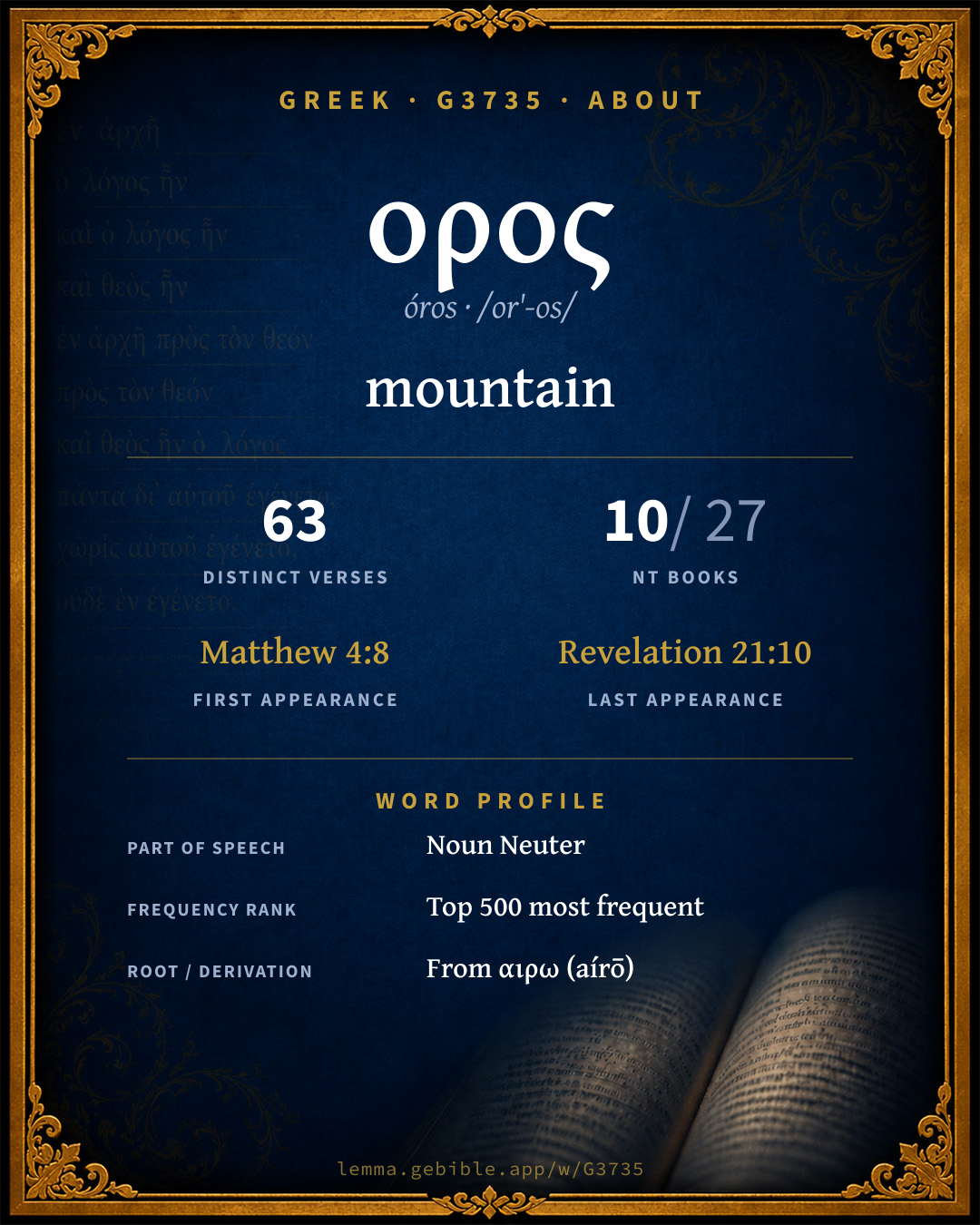
ὄρος
mountain
Full lexicon entry — Thayer's Greek Lexicon
From Thayer's Greek Lexicon
Where this word appears
See every Genitive-case word in the Greek New Testament →
Grammar key — what these labels mean
Part of speech
- Noun
- A naming word — a person, place, thing, or idea.
Case
- Accusative
- The case of the direct object and of extent.
- Genitive
- The case of source, possession, or “of” — answers “whose / from what.”
- Dative
- The case of the indirect object, means, or location — “to / for / with / in.”
- Nominative
- The case of the subject (and the predicate nominative).
Gender
- Neuter
- Grammatically neuter.
Number
- Singular
- One.
- Plural
- More than one.
2 verses where G3735 appears in the Genitive case in the Book of Acts. Filtered view — show all forms. Click any verse to open its interlinear word-by-word view. Verse text shown in the World English Bible for context — . Each verse’s Greek form is shown with its reference; the English is not keyword-highlighted, since the data carries no word-level English alignment. Use “Compare translations” on any verse to read it across multiple English versions. This concordance covers the Greek New Testament; Septuagint (Greek Old Testament) occurrences of this word are not indexed here.
Acts
- Acts 1:12 ὄρους n gen sg neut Then they returned to Jerusalem from the mountain called Olivet, which is near Jerusalem, a Sabbath day's journey away.
- Acts 7:30 ὄρους n gen sg neut "When forty years were fulfilled, an angel of the Lord appeared to him in the wilderness of Mount Sinai, in a flame of fire in a bush.
About this entry
At a glance — auto-summarized from this page’s data, not written by a person. Every figure links to its source below. This summary describes the numbers; it doesn’t interpret them.
ορος (óros) is a Greek noun most often rendered “mountain.” Scripture first uses it in Matthew 4:8. It turns up in 63 verses across 10 books, a moderately common footprint. It concentrates in Matthew, which alone accounts for 25% of its uses. It clusters with αιρω, αιρεομαι and αρα under a shared root. The sections below give every sense, occurrence, and version rendering.
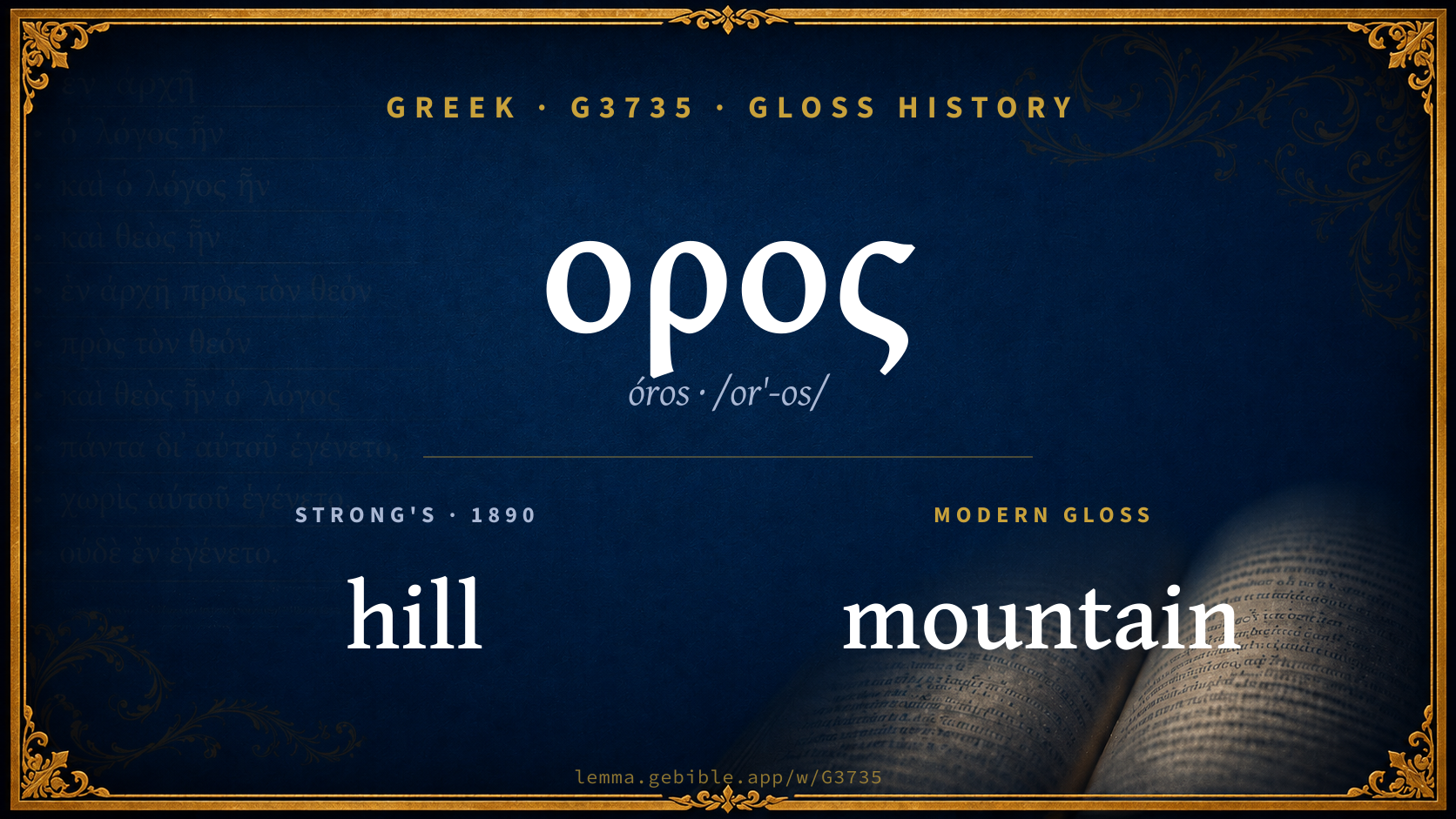
Gloss history
Strong's 1890 vs modern scholarship
About this word
Strong's G3735 catalogs a Greek word from the Greek New Testament.
These counts are not copied from any lexicon or concordance. They are computed here, from the morphology-tagged Greek New Testament. What Lemma adds →
- 63
- distinct verses
- The word appears in 63 distinct verses.
- 10 / 27
- NT books
- The word appears in 10 of 27 New Testament books.
- #259
- by frequency
- Top 500 most frequent Greek words (rank 259 of 5,347 Greek words by occurrence).
View all 63 occurrences in the concordance →
By section of the New Testament
By traditional corpus
Conventional, traditional groupings — biblical authorship is debated, so this is a traditional corpus grouping, not an authorship claim. Some books belong to more than one corpus (Luke is in both the Gospels and the Lukan corpus, and so on), so these shares overlap and need not total 100%. Each figure is a share of the word’s 63 distinct verses.
- Gospels 44 verses · 70%
- Lukan (Luke–Acts) 15 verses · 24%
- Johannine 13 verses · 21%
- Revelation 8 verses · 13%
- Hebrews 4 verses · 6%
- Pauline corpus 3 verses · 5%
- General (Catholic) Epistles 1 verse · 2%
How translations render this word
Counts come from each version’s own published word-to-Strong’s tagging or interlinear alignment — an approximate guide to how each version renders this word, not a word-level alignment the data otherwise carries. Because each total is that version’s own tagged count, the per-version totals vary from one another and need not match the appearance or distinct-verse counts above. These counts may also differ from a printed concordance because Lemma counts each distinctly tagged rendering and does not collapse phrase taggings into a single head-word total. This is a fixed set of word-tagged versions (KJV, ASV, BSB, ULT) and does not change with the reading translation you choose elsewhere. Each version’s license is shown beside its name below (and on Sources).
- King James Version: Mountain 28×, Mount 21×, Mountains 13×
- American Standard Version: Mountain 27×, Mount 21×, Mountains 11×
- Berean Standard Bible: Mountain 30×, Mount 18×, Mountains 10×
- unfoldingWord Literal Text: Mountain 29×, Mount 16×, Mountains 12×
King James Version Public Domain
Renders G3735 across 65 tagged occurrences — most commonly:
American Standard Version Public Domain
Renders G3735 across 67 tagged occurrences — most commonly:
Plus 4 renderings that appear only once — usually multi-word phrases or single function words the recovered tagging swept in, not distinct renderings.
Berean Standard Bible Public Domain
Renders G3735 across 63 tagged occurrences — most commonly:
Plus 1 rendering that appears only once — usually multi-word phrases or single function words the recovered tagging swept in, not distinct renderings.
unfoldingWord Literal Text CC BY-SA 4.0
Renders G3735 across 71 tagged occurrences — most commonly:
Plus 2 renderings that appear only once — usually multi-word phrases or single function words the recovered tagging swept in, not distinct renderings.
Senses in Thayer's
The 1 sense Thayer's distinguishes for this word, in lexicon order (not ranked by frequency or importance). The full entry — with sub-senses — is in the Lexicon Entry tab.
- a mountain
Word origin
Derived from αιρω (aírō) (G142) — to raise up.
Forms in the corpus
The 6 distinct written forms G3735 takes in the Greek New Testament, most frequent first — each parse links to that case’s occurrences in the concordance.
| Form | Parsing | Example | Uses |
|---|---|---|---|
| ὄρος óros | Noun, Accusative, Singular, Neuter | Matthew 4:8 | 28 |
| ὄρους órous | Noun, Genitive, Singular, Neuter | Matthew 5:14 | 12 |
| ὄρει órei | Noun, Dative, Singular, Neuter | Matthew 17:20 | 11 |
| ὄρη órē | Noun, Accusative, Plural, Neuter | Matthew 18:12 | 7 |
| ὄρεσιν óresin | Noun, Dative, Plural, Neuter | Mark 5:5 | 4 |
| ὀρέων oréōn | Noun, Genitive, Plural, Neuter | Revelation 6:15 | 1 |
Same root — word family
Other Thayer's entries built from the same root as G3735, grouped by Strong’s listed origin. These share a root / origin per the lexicon — not necessarily a shared meaning. Each links to that word’s own entry.
Derives from
Shares the same root
- αιρεομαι hairéomai G138 to choose
- αρα ará G685 curse
- αρα ára G686 therefore
- αρεσκω aréskō G700 to please
- αριθμος arithmós G706 number
- αρκεω arkéō G714 to ward off
- αρρην árrhēn G730 male
- αρτι árti G737 now
- αρτος ártos G740 bread
- αρτυω artýō G741 to season
- αρωμα árōma G759 spice
Derived from this word
- ορεγομαι orégomai G3713 to stretch out
- ορεινος oreinós G3714 mountainous
- ορθος orthós G3717 straight
- ορθρος órthros G3722 dawn
- ορνις órnis G3733 bird
- ουρανος ouranós G3772 heaven
Compare all same-root words → Showing 4 of 19 — not the complete family. They share a root, not necessarily a meaning.
Septuagint usage
The same Greek word ορος appears 573 times in the Greek Old Testament (Septuagint), across 500 verses in 34 books.
- 573
- LXX occurrences
- Tagged occurrences of this Greek word in the Septuagint.
- 500
- verses
- Distinct Septuagint verses containing this word.
- 34 / 39
- OT books
- The word appears in 34 of the 39 Old Testament books.
Sample Septuagint occurrences
- Genesis 7:19 ὄρος
- Exodus 3:1 ὄρος
- Leviticus 7:38 ὄρος
- Numbers 3:1 ὄρος
- Deuteronomy 1:2 ὄρος
- Joshua 2:23 ὄρος
- Judges 1:19 ὄρος
- 1 Samuel 1:1 ὄρος
- 2 Samuel 1:6 ὄρος
- 1 Kings 2:35 ὄρος
- 2 Kings 1:9 ὄρος
- 1 Chronicles 4:42 ὄρος
Septuagint occurrences (same lexeme)
Every verse where the same Strong’s number (G3735) appears in the Greek Septuagint — showing the first 50 of 500. Verse text shown in the World English Bible for context; the Greek form is the matched word — the English is not keyword-highlighted.
- Genesis 7:19 ὄρος The waters prevailed exceedingly on the earth. All the high mountains that were under the whole sky were covered.
- Genesis 7:20 ὄρος The waters prevailed fifteen cubits upward, and the mountains were covered.
- Genesis 8:4 ὄρος The ark rested in the seventh month, on the seventeenth day of the month, on Ararat's mountains.
- Genesis 8:5 ὄρος The waters receded continually until the tenth month. In the tenth month, on the first day of the month, the tops of the mountains were seen.
- Genesis 10:30 ὄρος Their dwelling was from Mesha, as you go toward Sephar, the mountain of the east.
- Genesis 12:8 ὄρος He left from there to the mountain on the east of Bethel, and pitched his tent, having Bethel on the west, and Ai on the east. There he built an altar to Yahweh, and called on the name of Yahweh.
- Genesis 14:6 ὄρος and the Horites in their Mount Seir, to Elparan, which is by the wilderness.
- Genesis 19:17 ὄρος It came to pass, when they had taken them out, that he said, "Escape for your life! Don't look behind you, neither stay anywhere in the plain. Escape to the mountain, lest you be consumed!"
- Genesis 19:19 ὄρος See now, your servant has found favor in your sight, and you have magnified your loving kindness, which you have shown to me in saving my life. I can't escape to the mountain, lest evil overtake me, and I die.
- Genesis 19:30 ὄρος Lot went up out of Zoar, and lived in the mountain, and his two daughters with him; for he was afraid to live in Zoar. He lived in a cave with his two daughters.
- Genesis 22:2 ὄρος He said, "Now take your son, your only son, whom you love, even Isaac, and go into the land of Moriah. Offer him there for a burnt offering on one of the mountains which I will tell you of."
- Genesis 22:14 ὄρος Abraham called the name of that place Yahweh-Jireh. As it is said to this day, "In Yahweh's mountain it will be provided.
- Genesis 31:21 ὄρος So he fled with all that he had. He rose up, passed over the River, and set his face toward the mountain of Gilead.
- Genesis 31:23 ὄρος He took his relatives with him, and pursued after him seven days' journey. He overtook him in the mountain of Gilead.
- Genesis 31:25 ὄρος Laban caught up with Jacob. Now Jacob had pitched his tent in the mountain, and Laban with his relatives encamped in the mountain of Gilead.
- Genesis 31:54 ὄρος Jacob offered a sacrifice in the mountain, and called his relatives to eat bread. They ate bread, and stayed all night in the mountain.
- Genesis 36:8 ὄρος Esau lived in the hill country of Seir. Esau is Edom.
- Genesis 36:9 ὄρος This is the history of the generations of Esau the father of the Edomites in the hill country of Seir:
- Genesis 49:26 ὄρος The blessings of your father Have prevailed above the blessings of the ancient mountains, Above the bounty of the age-old hills. They will be on the head of Joseph, On the crown of the head of him who is separated from his brothers.
- Exodus 3:1 ὄρος Now Moses was keeping the flock of Jethro, his father-in-law, the priest of Midian, and he led the flock to the back of the wilderness, and came to God's mountain, to Horeb.
- Exodus 3:12 ὄρος He said, "Certainly I will be with you. This will be the token to you, that I have sent you: when you have brought forth the people out of Egypt, you shall serve God on this mountain."
- Exodus 4:27 ὄρος Yahweh said to Aaron, "Go into the wilderness to meet Moses." He went, and met him on God's mountain, and kissed him.
- Exodus 9:5 ὅρος Yahweh appointed a set time, saying, "Tomorrow Yahweh shall do this thing in the land."
- Exodus 15:17 ὄρος You shall bring them in, and plant them in the mountain of your inheritance, The place, Yahweh, which you have made for yourself to dwell in; The sanctuary, Lord, which your hands have established.
- Exodus 18:5 ὄρος Jethro, Moses' father-in-law, came with his sons and his wife to Moses into the wilderness where he was encamped, at the Mountain of God.
- Exodus 19:2 ὄρος When they had departed from Rephidim, and had come to the wilderness of Sinai, they encamped in the wilderness; and there Israel encamped before the mountain.
- Exodus 19:3 ὄρος Moses went up to God, and Yahweh called to him out of the mountain, saying, "This is what you shall tell the house of Jacob, and tell the children of Israel:
- Exodus 19:11 ὄρος and be ready against the third day; for on the third day Yahweh will come down in the sight of all the people on Mount Sinai.
- Exodus 19:12 ὄρος You shall set bounds to the people round about, saying, 'Be careful that you don't go up onto the mountain, or touch its border. Whoever touches the mountain shall be surely put to death.
- Exodus 19:13 ὄρος No hand shall touch him, but he shall surely be stoned or shot through; whether it is animal or man, he shall not live.' When the trumpet sounds long, they shall come up to the mountain."
- Exodus 19:14 ὄρος Moses went down from the mountain to the people, and sanctified the people; and they washed their clothes.
- Exodus 19:16 ὄρος It happened on the third day, when it was morning, that there were thunders and lightnings, and a thick cloud on the mountain, and the sound of an exceedingly loud trumpet; and all the people who were in the camp trembled.
- Exodus 19:17 ὄρος Moses led the people out of the camp to meet God; and they stood at the lower part of the mountain.
- Exodus 19:18 ὄρος Mount Sinai, the whole of it, smoked, because Yahweh descended on it in fire; and its smoke ascended like the smoke of a furnace, and the whole mountain quaked greatly.
- Exodus 19:20 ὄρος Yahweh came down on Mount Sinai, to the top of the mountain. Yahweh called Moses to the top of the mountain, and Moses went up.
- Exodus 19:23 ὄρος Moses said to Yahweh, "The people can't come up to Mount Sinai, for you charged us, saying, 'Set bounds around the mountain, and sanctify it.'"
- Exodus 20:18 ὄρος All the people perceived the thunderings, the lightnings, the sound of the trumpet, and the mountain smoking. When the people saw it, they trembled, and stayed at a distance.
- Exodus 24:4 ὄρος Moses wrote all the words of Yahweh, and rose up early in the morning, and built an altar under the mountain, and twelve pillars for the twelve tribes of Israel.
- Exodus 24:12 ὄρος Yahweh said to Moses, "Come up to me on the mountain, and stay here, and I will give you the tables of stone with the law and the commands that I have written, that you may teach them."
- Exodus 24:13 ὄρος Moses rose up with Joshua, his servant, and Moses went up onto God's Mountain.
- Exodus 24:15 ὄρος Moses went up on the mountain, and the cloud covered the mountain.
- Exodus 24:16 ὄρος The glory of Yahweh settled on Mount Sinai, and the cloud covered it six days. The seventh day he called to Moses out of the midst of the cloud.
- Exodus 24:17 ὄρος The appearance of the glory of Yahweh was like devouring fire on the top of the mountain in the eyes of the children of Israel.
- Exodus 24:18 ὄρος Moses entered into the midst of the cloud, and went up on the mountain; and Moses was on the mountain forty days and forty nights.
- Exodus 25:9 ὄρος According to all that I show you, the pattern of the tent, and the pattern of all of its furniture, even so you shall make it.
- Exodus 25:40 ὄρος See that you make them after their pattern, which has been shown to you on the mountain.
- Exodus 26:30 ὄρος You shall set up the tent according to the way that it was shown to you on the mountain.
- Exodus 27:8 ὄρος Hollow with planks shall you make it: as it has been shown you on the mountain, so shall they make it.
- Exodus 31:18 ὄρος He gave to Moses, when he finished speaking with him on Mount Sinai, the two tablets of the testimony, stone tablets, written with God's finger.
- Exodus 32:1 ὄρος When the people saw that Moses delayed to come down from the mountain, the people gathered themselves together to Aaron, and said to him, "Come, make us gods, which shall go before us; for as for this Moses, the man who brought us up out of the land of Egypt, we don't know what has become of him."
These are occurrences of the same Greek lexeme (G3735) in the Septuagint — not a translation of any one Hebrew word. The store carries no word-level Hebrew↔Greek alignment, so no Hebrew original is asserted here. Counts come from the recovered LXX Strong's tagging — high-frequency vocabulary is well covered, while rare or late forms may be untagged — so they reflect tagged occurrences and may slightly undercount.