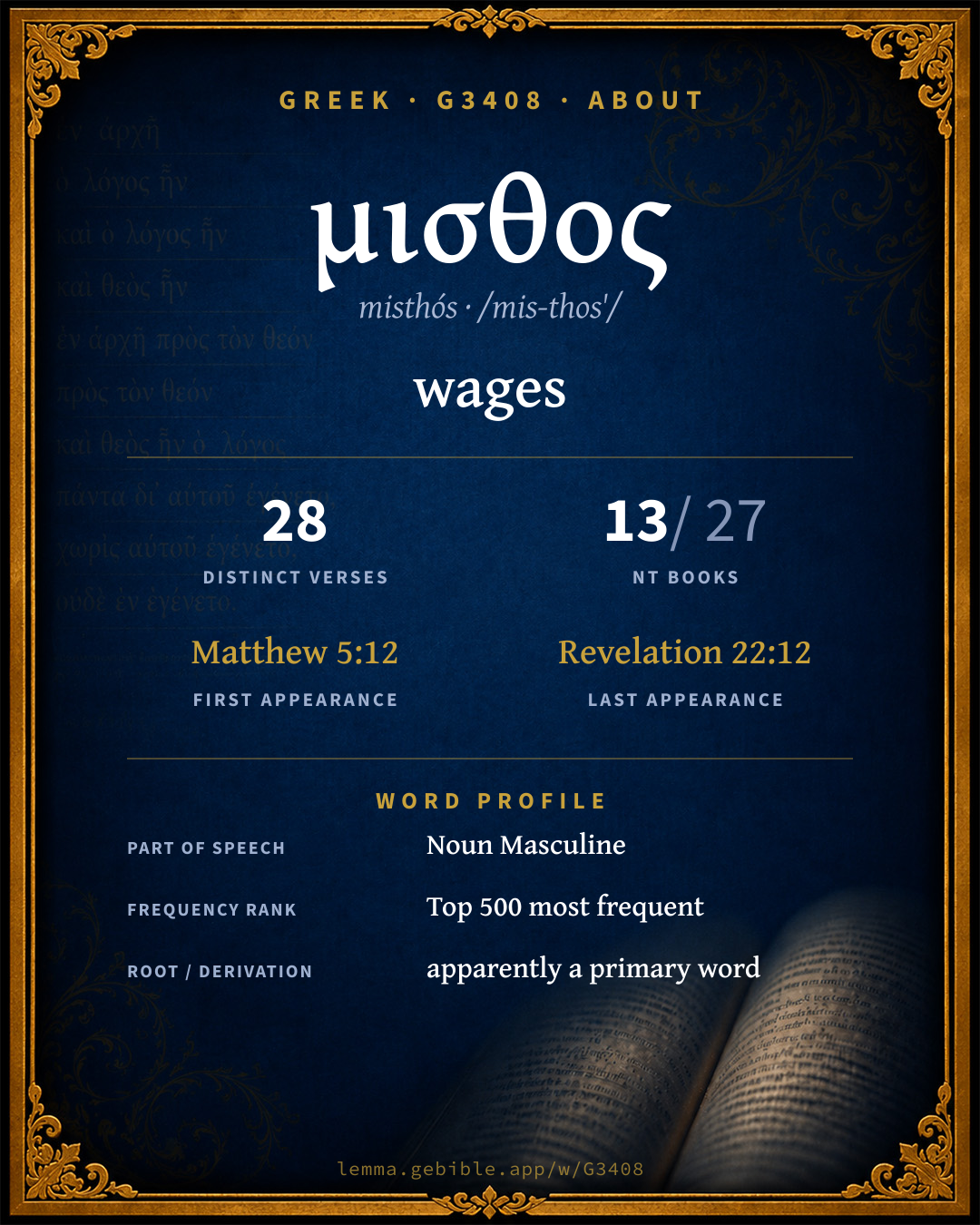
μισθός
wages
‘wages’ is one of 2 main senses fuller range ↓
Full lexicon entry — Thayer's Greek Lexicon
From Thayer's Greek Lexicon
Where this word appears
See every Accusative-case word in the Greek New Testament →
Grammar key — what these labels mean
Part of speech
- Noun
- A naming word — a person, place, thing, or idea.
Case
- Accusative
- The case of the direct object and of extent.
- Nominative
- The case of the subject (and the predicate nominative).
- Genitive
- The case of source, possession, or “of” — answers “whose / from what.”
Gender
- Masculine
- Grammatically masculine.
Number
- Singular
- One.
Grammatical forms
- Noun, Accusative, Singular, Masculine 18 times (62%)
- Noun, Nominative, Singular, Masculine 7 times (24%)
- Noun, Genitive, Singular, Masculine 4 times (14%)
Parsed forms decoded from the imported morphology (Robinson–Tischendorf, public domain), counted across 29 parsed occurrences — not distinct verses.
Every verse where G3408 appears — 28 distinct verses across 13 books. Click any verse to open its interlinear word-by-word view. Verse text shown in the World English Bible for context — . Each verse’s Greek form is shown with its reference; the English is not keyword-highlighted, since the data carries no word-level English alignment. Use “Compare translations” on any verse to read it across multiple English versions. This concordance covers the Greek New Testament; Septuagint (Greek Old Testament) occurrences of this word are not indexed here.
Matthew 9 verses
- Matthew 5:12 μισθὸς n nom sg masc Rejoice, and be exceedingly glad, for great is your reward in heaven. For that is how they persecuted the prophets who were before you.
- Matthew 5:46 μισθὸν n acc sg masc For if you love those who love you, what reward do you have? Don't even the tax collectors do the same?
- Matthew 6:1 μισθὸν n acc sg masc "Be careful that you don't do your charitable giving before men, to be seen by them, or else you have no reward from your Father who is in heaven.
- Matthew 6:2 μισθὸν n acc sg masc Therefore when you do merciful deeds, don't sound a trumpet before yourself, as the hypocrites do in the synagogues and in the streets, that they may get glory from men. Most assuredly I tell you, they have received their reward.
- Matthew 6:5 μισθὸν n acc sg masc "When you pray, you shall not be as the hypocrites, for they love to stand and pray in the synagogues and in the corners of the streets, that they may be seen by men. Most assuredly, I tell you, they have received their reward.
- Matthew 6:16 μισθὸν n acc sg masc "Moreover when you fast, don't be like the hypocrites, with sad faces. For they disfigure their faces, that they may be seen by men to be fasting. Most assuredly I tell you, they have received their reward.
- Matthew 10:41 μισθὸν μισθὸν n acc sg masc n acc sg masc He who receives a prophet in the name of a prophet will receive a prophet's reward: and he who receives a righteous man in the name of a righteous man will receive a righteous man's reward.
- Matthew 10:42 μισθὸν n acc sg masc Whoever gives one of these little ones just a cup of cold water to drink in the name of a disciple, most assuredly I tell you he will in no way lose his reward."
- Matthew 20:8 μισθὸν n acc sg masc When evening had come, the lord of the vineyard said to his steward, 'Call the laborers and pay them their wages, beginning from the last to the first.'
Mark 1 verse
Luke 3 verses
- Luke 6:23 μισθὸς n nom sg masc Rejoice in that day, and leap for joy, for behold, your reward is great in heaven, for their fathers did the same thing to the prophets.
- Luke 6:35 μισθὸς n nom sg masc But love your enemies, and do good, and lend, expecting nothing back; and your reward will be great, and you will be children of the Most High; for he is kind toward the unthankful and evil.
- Luke 10:7 μισθοῦ n gen sg masc Remain in that same house, eating and drinking the things they give, for the laborer is worthy of his wages. Don't go from house to house.
John 1 verse
Acts 1 verse
Romans 1 verse
1 Corinthians 4 verses
- 1 Corinthians 3:8 μισθὸν n acc sg masc Now he who plants and he who waters are the same, but each will receive his own reward according to his own labor.
- 1 Corinthians 3:14 μισθὸν n acc sg masc If any man's work remains which he built on it, he will receive a reward.
- 1 Corinthians 9:17 μισθὸν n acc sg masc For if I do this of my own will, I have a reward. But if not of my own will, I have a stewardship entrusted to me.
- 1 Corinthians 9:18 μισθός n nom sg masc What then is my reward? That, when I preach the Gospel, I may present the Gospel of Christ without charge, so as not to abuse my authority in the Gospel.
1 Timothy 1 verse
James 1 verse
2 Peter 2 verses
- 2 Peter 2:13 μισθὸν n acc sg masc receiving the wages of unrighteousness; people who count it pleasure to revel in the day-time, spots and blemishes, reveling in their deceit while they feast with you;
- 2 Peter 2:15 μισθὸν n acc sg masc forsaking the right way, they went astray, having followed the way of Balaam the son of Beor, who loved the wages of wrong-doing;
2 John 1 verse
Jude 1 verse
Revelation 2 verses
- Revelation 11:18 μισθὸν n acc sg masc The nations were angry, and your wrath came, as did the time for the dead to be judged, and to give your bondservants the prophets, their reward, as well as to the saints, and those who fear your name, to the small and the great; and to destroy those who destroy the earth."
- Revelation 22:12 μισθός n nom sg masc "Behold, I come quickly. My reward is with me, to repay to each man according to his work.
About this entry
At a glance — auto-summarized from this page’s data, not written by a person. Every figure links to its source below. This summary describes the numbers; it doesn’t interpret them.
At its core, μισθος (misthós) means “wages.” Scripture first uses it in Matthew 5:12. Spanning 28 verses in 13 books, it ranks among the moderately common words of the Greek New Testament. Its uses concentrate in Matthew (32% of all occurrences). Catalogued under 2 senses, its meaning is not single-sense. Dig into 28-verse concordance and the renderings breakdown below.
Gloss history
Strong's 1890 vs modern scholarship

About this word
Strong's G3408 catalogs a Greek word from the Greek New Testament.
These counts are not copied from any lexicon or concordance. They are computed here, from the morphology-tagged Greek New Testament. What Lemma adds →
- 28
- distinct verses
- The word appears in 28 distinct verses.
- 13 / 27
- NT books
- The word appears in 13 of 27 New Testament books.
- #471
- by frequency
- Top 500 most frequent Greek words (rank 471 of 5,347 Greek words by occurrence).
View all 28 occurrences in the concordance →
Most concentrated in
- Matthew 9 verses 32%
- 1 Corinthians 4 verses 14%
- Luke 3 verses 11%
By section of the New Testament
By traditional corpus
Conventional, traditional groupings — biblical authorship is debated, so this is a traditional corpus grouping, not an authorship claim. Some books belong to more than one corpus (Luke is in both the Gospels and the Lukan corpus, and so on), so these shares overlap and need not total 100%. Each figure is a share of the word’s 28 distinct verses.
- Gospels 14 verses · 50%
- Pauline corpus 6 verses · 21%
- General (Catholic) Epistles 5 verses · 18%
- Lukan (Luke–Acts) 4 verses · 14%
- Johannine 4 verses · 14%
- Revelation 2 verses · 7%
How translations render this word
Counts come from each version’s own published word-to-Strong’s tagging or interlinear alignment — an approximate guide to how each version renders this word, not a word-level alignment the data otherwise carries. Because each total is that version’s own tagged count, the per-version totals vary from one another and need not match the appearance or distinct-verse counts above. These counts may also differ from a printed concordance because Lemma counts each distinctly tagged rendering and does not collapse phrase taggings into a single head-word total. This is a fixed set of word-tagged versions (KJV, ASV, BSB, ULT) and does not change with the reading translation you choose elsewhere. Each version’s license is shown beside its name below (and on Sources).
- King James Version: Reward 24×, Hire 3×, Wages 2×
- American Standard Version: Reward 18×, Hire 6×, 's reward 2×
- Berean Standard Bible: Reward 15×, Wages 8×, Full reward 3×
- unfoldingWord Literal Text: Reward 18×, Wages 8×, Of 2×
King James Version Public Domain
Renders G3408 across 29 tagged occurrences — most commonly:
American Standard Version Public Domain
Renders G3408 across 30 tagged occurrences — most commonly:
Plus 4 renderings that appear only once — usually multi-word phrases or single function words the recovered tagging swept in, not distinct renderings.
Berean Standard Bible Public Domain
Renders G3408 across 27 tagged occurrences — most commonly:
Plus 1 rendering that appears only once — usually multi-word phrases or single function words the recovered tagging swept in, not distinct renderings. Not rendered by a distinct English word in 2 further occurrences.
unfoldingWord Literal Text CC BY-SA 4.0
Renders G3408 across 32 tagged occurrences — most commonly:
Plus 2 renderings that appear only once — usually multi-word phrases or single function words the recovered tagging swept in, not distinct renderings.
Senses in Thayer's
The 2 senses Thayer's distinguishes for this word, in lexicon order (not ranked by frequency or importance). The full entry — with sub-senses — is in the Lexicon Entry tab.
- dues paid for work
- reward: used of the fruit naturally resulting from toils and endeavours
Word origin
Origin: apparently a primary word
Apparently a primary word; pay for service (literally or figuratively) good or bad : - hire reward wages.
— Strong’s Exhaustive Concordance (1890), public domain.
Forms in the corpus
The 4 distinct written forms G3408 takes in the Greek New Testament, most frequent first — each parse links to that case’s occurrences in the concordance.
| Form | Parsing | Example | Uses |
|---|---|---|---|
| μισθὸν misthòn | Noun, Accusative, Singular, Masculine | Matthew 5:46 | 18 |
| μισθὸς misthòs | Noun, Nominative, Singular, Masculine | Matthew 5:12 | 5 |
| μισθοῦ misthoû | Noun, Genitive, Singular, Masculine | Luke 10:7 | 4 |
| μισθός misthós | Noun, Nominative, Singular, Masculine | 1 Corinthians 9:18 | 2 |
Same root — word family
Other Thayer's entries built from the same root as G3408, grouped by Strong’s listed origin. These share a root / origin per the lexicon — not necessarily a shared meaning. Each links to that word’s own entry.
Derived from this word
Compare all same-root words → They share a root, not necessarily a meaning.
Septuagint usage
The same Greek word μισθος appears 45 times in the Greek Old Testament (Septuagint), across 41 verses in 19 books.
- 45
- LXX occurrences
- Tagged occurrences of this Greek word in the Septuagint.
- 41
- verses
- Distinct Septuagint verses containing this word.
- 19 / 39
- OT books
- The word appears in 19 of the 39 Old Testament books.
Sample Septuagint occurrences
- Genesis 15:1 μισθός
- Exodus 2:9 μισθός
- Leviticus 19:13 μισθός
- Numbers 18:31 μισθός
- Deuteronomy 15:18 μισθός
- Ruth 2:12 μισθός
- 1 Kings 5:20 μισθός
- 2 Chronicles 15:7 μισθός
- Job 7:2 μισθός
- Psalms 126:3 μισθός
- Proverbs 11:18 μισθός
- Ecclesiastes 4:9 μισθός
Septuagint occurrences (same lexeme)
Every verse where the same Strong’s number (G3408) appears in the Greek Septuagint. Verse text shown in the World English Bible for context; the Greek form is the matched word — the English is not keyword-highlighted.
- Genesis 15:1 μισθός After these things the word of Yahweh came to Abram in a vision, saying, "Don't be afraid, Abram. I am your shield, your exceedingly great reward."
- Genesis 29:15 μισθός Laban said to Jacob, "Because you are my brother, should you therefore serve me for nothing? Tell me, what will your wages be?"
- Genesis 30:18 μισθός Leah said, "God has given me my hire, because I gave my handmaid to my husband." She named him Issachar.
- Genesis 30:28 μισθός He said, "Appoint me your wages, and I will give it."
- Genesis 30:32 μισθός I will pass through all your flock today, removing from there every speckled and spotted one, and every black one among the sheep, and the spotted and speckled among the goats. This will be my hire.
- Genesis 30:33 μισθός So my righteousness will answer for me hereafter, when you come concerning my hire that is before you. Everyone that is not speckled and spotted among the goats, and black among the sheep, that might be with me, will be counted stolen."
- Genesis 31:7 μισθός Your father has deceived me, and changed my wages ten times, but God didn't allow him to hurt me.
- Genesis 31:8 μισθός If he said this, 'The speckled will be your wages,' then all the flock bore speckled. If he said this, 'The streaked will be your wages,' then all the flock bore streaked.
- Genesis 31:41 μισθός These twenty years have I been in your house. I served you fourteen years for your two daughters, and six years for your flock, and you have changed my wages ten times.
- Exodus 2:9 μισθός Pharaoh's daughter said to her, "Take this child away, and nurse him for me, and I will give you your wages." The woman took the child, and nursed it.
- Exodus 22:14 μισθός "If a man borrows anything of his neighbor's, and it is injured, or dies, the owner of it not being with it, he shall surely make restitution.
- Leviticus 19:13 μισθός "'You shall not oppress your neighbor, nor rob him. The wages of a hired servant shall not remain with you all night until the morning.
- Numbers 18:31 μισθός You shall eat it in every place, you and your households: for it is your reward in return for your service in the tent of meeting.
- Deuteronomy 15:18 μισθός It shall not seem hard to you, when you let him go free from you; for to the double of the hire of a hireling has he served you six years: and Yahweh your God will bless you in all that you do.
- Deuteronomy 24:14 μισθός You shall not oppress a hired servant who is poor and needy, whether he be of your brothers, or of your foreigners who are in your land within your gates:
- Deuteronomy 24:15 μισθός in his day you shall give him his hire, neither shall the sun go down on it; for he is poor, and sets his heart on it: lest he cry against you to Yahweh, and it be sin to you.
- Ruth 2:12 μισθός Yahweh recompense your work, and a full reward be given you of Yahweh, the God of Israel, under whose wings you are come to take refuge.
- 1 Kings 5:20 μισθός
- 2 Chronicles 15:7 μισθός But be you strong, and don't let your hands be slack; for your work shall be rewarded.
- Job 7:2 μισθός As a servant who earnestly desires the shadow, As a hireling who looks for his wages,
- Psalms 126:3 μισθός Yahweh has done great things for us, And we are glad.
- Proverbs 11:18 μισθός Wicked people earn deceitful wages, But one who sows righteousness reaps a sure reward.
- Proverbs 11:21 μισθός Most assuredly, the evil man will not be unpunished, But the seed of the righteous will be delivered.
- Proverbs 17:8 μισθός A bribe is a precious stone in the eyes of him who gives it; Wherever he turns, he prospers.
- Ecclesiastes 4:9 μισθός Two are better than one, because they have a good reward for their labor.
- Ecclesiastes 9:5 μισθός For the living know that they will die, but the dead don't know anything, neither do they have any more a reward; for the memory of them is forgotten.
- Isaiah 23:18 μισθός Her merchandise and her hire shall be holiness to Yahweh: it shall not be treasured nor laid up; for her merchandise shall be for those who dwell before Yahweh, to eat sufficiently, and for durable clothing.
- Isaiah 40:10 μισθός Behold, the Lord Yahweh will come as a mighty one, and his arm will rule for him: Behold, his reward is with him, and his recompense before him.
- Isaiah 62:11 μισθός Behold, Yahweh has proclaimed to the end of the earth, Say you to the daughter of Zion, Behold, your salvation comes; behold, his reward is with him, and his recompense before him.
- Jeremiah 22:13 μισθός Woe to him who builds his house by unrighteousness, and his chambers by injustice; who uses his neighbor's service without wages, and doesn't give him his hire;
- Jeremiah 38:16 μισθός So Zedekiah the king swore secretly to Jeremiah, saying, As Yahweh lives, who made us this soul, I will not put you to death, neither will I give you into the hand of these men who seek your life.
- Ezekiel 27:15 μισθός The men of Dedan were your traffickers; many isles were the market of your hand: they brought you in exchange horns of ivory and ebony.
- Ezekiel 27:27 μισθός Your riches, and your wares, your merchandise, your mariners, and your pilots, your repairers of ship seams, and the dealers in your merchandise, and all your men of war, who are in you, with all your company which is in the midst of you, shall fall into the heart of the seas in the day of your ruin.
- Ezekiel 27:33 μισθός When your wares went forth out of the seas, you filled many peoples; you did enrich the kings of the earth with the multitude of your riches and of your merchandise.
- Ezekiel 29:18 μισθός Son of man, Nebuchadrezzar king of Babylon caused his army to serve a great service against Tyre: every head was made bald, and every shoulder was worn; yet had he no wages, nor his army, from Tyre, for the service that he had served against it.
- Ezekiel 29:19 μισθός Therefore thus says the Lord Yahweh: Behold, I will give the land of Egypt to Nebuchadrezzar king of Babylon; and he shall carry off her multitude, and take her spoil, and take her prey; and it shall be the wages for his army.
- Micah 3:11 μισθός Her leaders judge for bribes, And her priests teach for a price, And her prophets of it tell forturnes for money: Yet they lean on Yahweh, and say, Isn't Yahweh in the midst of us? No disaster will come on us.
- Haggai 1:6 μισθός You have sown much, and bring in little. You eat, but you don't have enough. You drink, but you aren't filled with drink. You clothe yourselves, but no one is warm, and he who earns wages earns wages to put them into a bag with holes in it."
- Zechariah 8:10 μισθός For before those days there was no wages for man, nor any wages for an animal; neither was there any peace to him who went out or came in, because of the adversary. For I set all men everyone against his neighbor.
- Zechariah 11:12 μισθός I said to them, "If you think it best, give me my wages; and if not, keep them." So they weighed for my wages thirty pieces of silver.
- Malachi 3:5 μισθός I will come near to you to judgment; and I will be a swift witness against the sorcerers, and against the adulterers, and against the perjurers, and against those who oppress the hireling in his wages, the widow, and the fatherless, and who deprive the foreigner of justice, and don't fear me," says Yahweh of Hosts.
These are occurrences of the same Greek lexeme (G3408) in the Septuagint — not a translation of any one Hebrew word. The store carries no word-level Hebrew↔Greek alignment, so no Hebrew original is asserted here. Counts come from the recovered LXX Strong's tagging — high-frequency vocabulary is well covered, while rare or late forms may be untagged — so they reflect tagged occurrences and may slightly undercount.