
Job 7:2

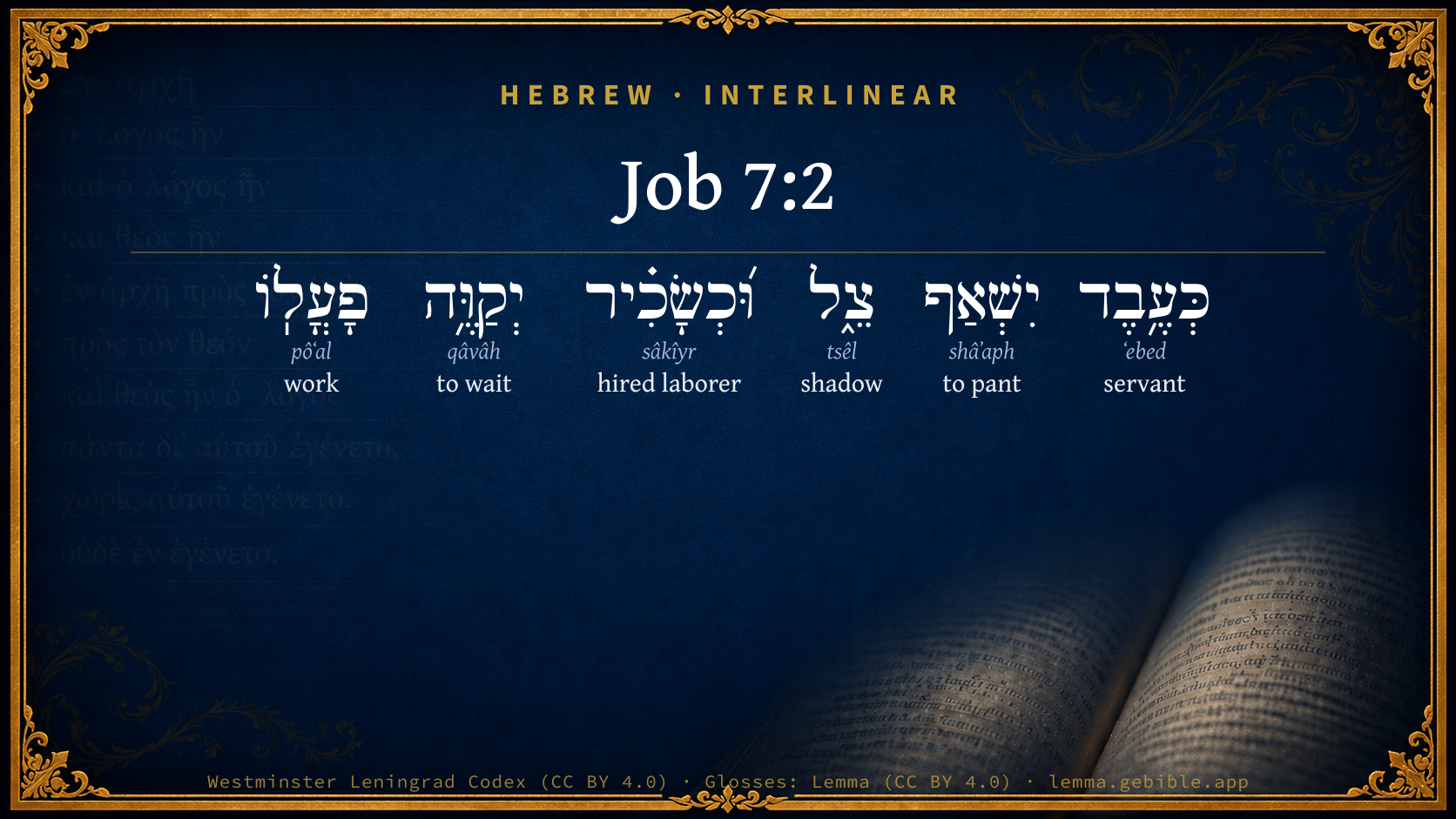
Hebrew (Westminster Leningrad Codex) Job 7:2 appears in the Hebrew Old Testament. The text above is from the Westminster Leningrad Codex. Each word links to its Strong’s number, a concise gloss, and parsing drawn from the Open Scriptures Hebrew Bible morphology. Click any word for its full Brown-Driver-Briggs (BDB) entry.
Download image
Cite this verse

Job 7:2 (World English Bible). Public Domain. Lemma interlinear Bible study tool, https://lemma.gebible.app/v/job/7/2.

Show BibTeX & RIS
BibTeX
RIS
English Translation
As a servant who earnestly desires the shadow, As a hireling who looks for his wages,
World English Bible · Public Domain
Download a study sheet

One document with this verse’s original text, its word-by-word gloss line, the meaning frame, cross-references with their text, attributed commentary, and full source and license credits — printable, and it pastes into notes with its structure intact.

This verse Autodidact and up

Study sheet (.html) Plain text (.txt)

A passage Seminary Student

Up to 50 verses in one chapter. A passage sheet keeps up to 6 commentary sources and 12 cross-references per verse, in the order this page ranks them, and says so on the sheet whenever that leaves anything out. Ask for a single verse and you get the Autodidact verse sheet above.

Everything on this page stays free to read, with no account — the sheet is a download of what is already on screen, not access to it.

Want to remove ads? Support Godless Engineer
Compare translations 3

The same verse in 3 English versions, stacked beneath the original-language interlinear above. Click any original word for its lexicon entry.

Each is an independent rendering of the whole verse — the interlinear is not word-aligned to these translations.

Highlighted words mark where these versions differ — a whole-verse word diff, not a word-by-word alignment.

  • World English Bible Public Domain
    As a servant who earnestly desires the shadow, As a hireling who looks for his wages,
  • King James Version Public Domain
    As a servant earnestly desireth the shadow, and as an hireling looketh for the reward of his work:
  • unfoldingWord Literal Text CC BY-SA 4.0
    As a slave longs for shade, and as a hireling awaits his wages,

unfoldingWord Literal Text — © unfoldingWord, licensed CC BY-SA 4.0. Word-aligned USFM3 via Door43 (git.door43.org/unfoldingWord/en_ult).

Versions to compare (up to 4)

3 of 4 selected

Show all 18 translations

Every available English version of this verse, each an independent rendering of the whole verse.

  • World English Bible Public Domain
    As a servant who earnestly desires the shadow, As a hireling who looks for his wages,
  • Berean Standard Bible Public Domain
    Like a slave he longs for shade; like a hireling he waits for his wages.
  • Majority Standard Bible Public Domain
    Like a slave he longs for shade; like a hireling he waits for his wages.
  • King James Version Public Domain
    As a servant earnestly desireth the shadow, and as an hireling looketh for the reward of his work:
  • American Standard Version (1901) Public Domain
    As a servant that earnestly desireth the shadow, And as a hireling that looketh for his wages:
  • Revised Version (1885) Public Domain
    As a servant that earnestly desireth the shadow, and as an hireling that looketh for his wages:
  • Geneva Bible (1599) Public Domain
    As a seruant longeth for the shadowe, and as an hyreling looketh for the ende of his worke,
  • Douay-Rheims (1899) Public Domain
    As a servant longeth for the shade, as the hireling looketh for the end of his work;
  • Young's Literal Translation Public Domain
    As a servant desireth the shadow, And as a hireling expecteth his wage,
  • Literal Standard Version CC BY-SA 4.0
    As a servant desires the shadow, || And as a hired worker expects his wage,
  • Unlocked Literal Bible CC BY-SA 4.0
    Like a slave earnestly desires the shadows of evening, like a hired man looks for his wages—
  • unfoldingWord Literal Text CC BY-SA 4.0
    As a slave longs for shade, and as a hireling awaits his wages,
  • Darby Bible Public Domain
    As a bondman earnestly desireth the shadow, and a hireling expecteth his wages,
  • World Messianic Bible Public Domain
    As a servant who earnestly desires the shadow, as a hireling who looks for his wages,
  • Webster's Bible Public Domain
    As a servant earnestly desireth the shadow, and as a hireling looketh for the reward of his work;
  • Free Bible Version CC BY-SA 4.0
    Like some slave longing for a bit of shade, like a hired hand anxiously waiting for pay day,
  • Bible in Basic English Public Domain
    As a servant desiring the shades of evening, and a workman looking for his payment:
  • JPS Tanakh (1917) Public Domain
    As a servant that eagerly longeth for the shadow, and as a hireling that looketh for his wages;

Literal Standard Version (2020), Covenant Press — licensed CC BY-SA 4.0. Text via the HelloAO Bible API (eBible.org). Unlocked Literal Bible (unfoldingWord) — licensed CC BY-SA 4.0. Text via the HelloAO Bible API (eBible.org). unfoldingWord Literal Text — © unfoldingWord, licensed CC BY-SA 4.0. Word-aligned USFM3 via Door43 (git.door43.org/unfoldingWord/en_ult). Free Bible Version, Dr. Jonathan Gallagher — licensed CC BY-SA 4.0. Text via the HelloAO Bible API (eBible.org).

Word by word

More ways to search: Search by grammar → Find every occurrence → Compare this word →

Practice this passage: Drill this verse → Learn its vocabulary →

About this verse

These counts appear in no published source. They are computed here, from the morphology-tagged text and Lemma’s own curated glosses. What Lemma adds →

6
words
6
distinct lemmas
Wisdom
section

Notable vocabulary

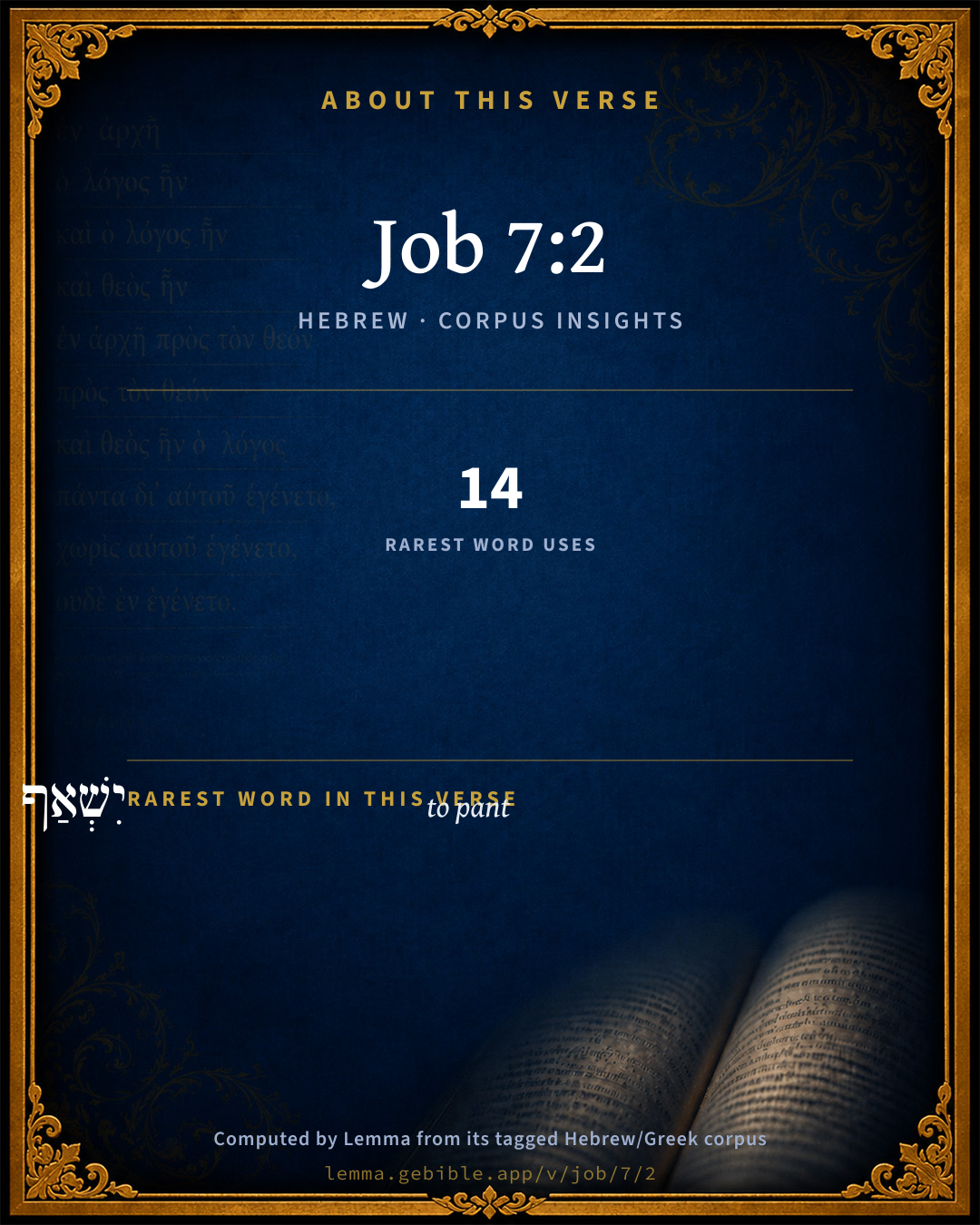
The rarest word here is יִשְׁאַף to pant H7602 — appearing just 14 times in the whole Hebrew Bible.

Shared distinctive vocabulary

יִשְׁאַף to pant H7602 occurs in 14 verses of the Hebrew Bible. Also found in:

Grammatical profile

  • 2 verbs
  • 4 nouns

Verb forms

  • יִשְׁאַף Qal · Imperfect
  • יְקַוֶּ֥ה Piel · Imperfect

Hebrew & Septuagint length

In English translation the verse runs 16 words from the Hebrew and 23 from the Septuagint (LXX English) — the Septuagint runs noticeably longer here. See the side-by-side →

A rough comparison of the two English renderings, which tokenize alike — not a word-level alignment.

Word counts can differ between the Hebrew and the Greek without any difference in meaning — e.g. the Hebrew direct-object marker אֵת has no separate Greek word, and Greek often adds the article ὁ.

Cross-references

7

Topical passages linked to Job 7:2 in the Treasury of Scripture Knowledge — connected by theme and wording, ordered by reader-vote popularity; previews shown in the World English Bible.

  • Leviticus 19:13 "'You shall not oppress your neighbor, nor rob him. The wages of a hired servant shall not remain with you all night until the morning.
  • Deuteronomy 24:15 in his day you shall give him his hire, neither shall the sun go down on it; for he is poor, and sets his heart on it: lest he cry against you to Yahweh, and it be sin to you.
  • Malachi 3:5 I will come near to you to judgment; and I will be a swift witness against the sorcerers, and against the adulterers, and against the perjurers, and against those who oppress the hireling in his wages, the widow, and the fatherless, and who deprive the foreigner of justice, and don't fear me," says Yahweh of Hosts.
  • James 5:4 Behold, the wages of the laborers who mowed your fields, which you have kept back by fraud, cry out, and the cries of those who reaped have entered into the ears of the Lord of Hosts.
  • Jeremiah 6:4 Prepare you war against her; arise, and let us go up at noon. Woe to us! for the day declines, for the shadows of the evening are stretched out.
  • Psalms 119:131 I opened my mouth wide and panted, For I longed for your commandments.
  • Psalms 143:6 I spread forth my hands to you. My soul thirsts for you, like a parched land. Selah.

Cross-references courtesy of OpenBible.info (CC BY 4.0).

Hebrew and Greek witnesses Masoretic Hebrew ↔ Greek Septuagint

The same verse in the two great witnesses to the Old Testament, shown verse-for-verse.

Here the Septuagint runs noticeably longer than the Hebrew — LXX2012 (modern English Septuagint) 23 words vs World English Bible 16. A rough length comparison of the two English translations, not a word-level alignment — read both below.

These are two independent witnesses, not word-aligned to each other, and the Septuagint is shown in lemma (dictionary) form.

Hebrew Job 7:2 Masoretic · Westminster Leningrad Codex

כְּעֶ֥בֶד יִשְׁאַף צֵ֑ל וּ֝כְשָׂכִ֗יר יְקַוֶּ֥ה פָעֳלֽוֹ

As a servant who earnestly desires the shadow, As a hireling who looks for his wages,

World English Bible · Public Domain

Greek LXX Job 7:2 Septuagint · lemma form

ἤ ὥσπερ θεράπων δείδω ὁ κύριος αὐτός καί τυγχάνω σκιά ἤ ὥσπερ μισθωτός ἀναμένω ὁ μισθός αὐτός

Or as a servant that fears his master, and one who has grasped a shadow? or as a hireling waiting for his pay?

LXX2012 (modern English Septuagint) · Public Domain

Hebrew: Westminster Leningrad Codex (CC BY 4.0). Greek: Septuagint (public domain); English from LXX2012 (modern English Septuagint) (Public Domain). How the Septuagint differs from the Hebrew →

Commentary

Notes on Job 7:2 from classic Christian and Jewish commentators (each source and its license shown beneath its notes). The classic Christian expositions comment on the surrounding passage and are grouped to its opening verse, so a note may address several verses; the Jewish commentaries on the Tanakh (Rashi and others) are per-verse, so they appear only where the commentator wrote on this verse.

Lemma curates 59 commentaries, every one of them public domain or Creative Commons licensed, each selected and text-cleaned for this edition rather than reprinted as found. About our sources →

Trapp's Complete Commentary

John Trapp

Job 7:2 As a servant earnestly desireth the shadow, and as an hireling looketh for [the reward of] his work:

Ver. 2. As a servant earnestly desireth the shadow, &c.] Heb. Gapeth after, or gaspeth for his shadow; that is, for some place of cool repose after his hard labour in the hot sunshine, as in harvest; or for the shadow, that is, for dark night, or for the evening.

Cum Sol crescentes discedens duplicet umbras (Virg. Eclog.).

And as an hireling looketh for the reward of his work] Heb. Expecteth his work, that is, his wages. God’s work is its own wages; and in doing thereof (not only for doing thereof) there is great reward, Psa 19:11. Righteousness is its own recompense; but a poor hireling looketh for his wages, he sets his heart upon it, Deu 24:15, and God provideth there that it be duly paid him; and those that detain it are sorely threatened. See Jas 5:5 : it is a crying sin. The whole verse may cohere with the former; and be thus rendered, Is not a man as a servant that earnestly desireth the shadow? and is he not as a hireling, that looketh for the reward of his work? but it is better to join it with that which followeth, according to our translation.

John Trapp, A Commentary or Exposition upon All the Books of the Old and New Testament (1647–1656) — public domain. Text from a community e-Sword module.

The Biblical Illustrator

Joseph S. Exell

Job_7:2-3

As a servant earnestly desireth the shadow.

Longing for sunset

The title of this sermon is the subject of a picture. The artist shows an overworked and weary slave, earnestly looking to the western sky, and longing for the evening shadow which will say his work is done.

I. The different forms of that experience in which the soul earnestly desireth the shadow, or the coming on of the night of death. The natural instinct of man is to desire to live. Yet there is a settled mood or habit of the soul in which there is longing for sunset.

1. One form of this experience arises out of painful and exhausting sickness. Months of bitterness and wearisome nights had, for Job, worn away the instinct of life. The grave seemed to him a desirable refuge from his distresses.

2. When the infirmities of old age creep on, and life continues after the loss of nearly all the friends among whom it was passed.

3. Those under the shadow of a mighty sorrow from God often long for sunset. Worldly disappointments sometimes almost craze the agonised spirit.

4. The baffled hero of the Church, after a long conflict with wickedness, often yearns for the end of his course. (Illustrate from Luther.)

5. The high, Christian experience which finds delight in working for God upon earth, yearns also for a full communion with Him in heaven.

II. Is such an experience healthy and desirable in any of its forms? When inspired by a clear realisation of the celestial glories, it certainly is both healthy and desirable. The real Christian often needs this longing for God as the solace and hope of his work. But every form of this experience which arises from disgust of life, is both unhealthy and undesirable. It is not a normal condition of the soul of man to wish to die, simply as a relief from the cares and toils of this world. Men love activity. It is a sure sign of unhealth when the manly vigour of the soul succumbs to its sorrows, and longs for the rest of the grave. The physical system is itself broken down. Such a state of mind is also undesirable. It oppresses the soul with a heavy load, so that it can bear no burden of duty. It envelops the life in a cloud of darkness, so that it cannot see the light. It is to be prayed against, laboured against, and lived against, with the utmost tenacity of will.

III. How far is it right or wrong to harbour this disgust of life? We cannot condemn this longing for death in the souls of those worn out by disease, but we cannot sanction the very common notion that it is to any extent the proof of grace in the heart. So far as the desire of the grave is concerned, it is simply the breaking down of nature, and not the incoming of grace. It is right too for the aged man to look joyfully towards the end. And if for the aged, why not for the oppressed? No one who is called to live has any right to wish to die. Every Christian is sinning against God, when he permits, himself to loathe, or to neglect the actual work to which he is clearly called. Observe, then, the supreme dignity of a joyful, earnest, working life in God. That is better far than a constant longing for sunset: God gives a higher importance to our living than to our dying. Yet, though a working life is to be desired in itself, it is not true that a Christian is always best trained in the sunshine. Some of the most precious of the graces grow best in the darkness, and the choicest disciples very often pass their lives under a cloud. But we must not forget that the shadow will be falling soon, nor neglect to prepare for death. And it is well to keep in mind the blessings which the sunset will bring to the weary saint. (W. H. Corning.)

The Biblical Illustrator, edited by Joseph S. Exell (c. 1880s–1900s) — public domain. Text from a community e-Sword module.

Joseph Benson's Commentary

Job 7:2. As a servant earnestly desireth the shadow — Of the evening, the sun-set, or the night, the time allotted for his rest and repose. For man goeth forth to his labour until the evening, Psa 104:23. So, why may not I also desire the time of my rest? The Hebrew, however, ישׁאŠ צל, jishap tzel, is more literally rendered, gapeth, or panteth after the shade. And the meaning probably is, As a servant, labouring in the heat of the sun, earnestly desires a cool, refreshing shade. And as a hireling — Hebrews שׂכיר, sacir, properly, a servant hired for a certain time, whereas, the preceding word, עבד, gnebed, signifies a servant, whose time of service is not fixed or limited: looketh for the reward of his work — As the Hebrews פעל, pognal, according to Buxtorf, signifies both work, and, by a metonymy, the wages of work, and is accordingly translated wages, (Lev 19:13,) the words in the Italic character (namely, the reward of) did not need to be added here in the text, but the version might properly have been, As a hireling looketh, or, as Heath renders it, earnestly longeth for his wages.

Joseph Benson's Commentary on the Old and New Testaments (1811–1818) — public domain. Text from a community e-Sword module.

Tyndale Open Study Notes

Tyndale Open Resources

7:2 A worker was to be paid at the end of each day (Lev 19:13; Deut 24:15), though this did not always happen (Jer 22:13; Mal 3:5; Jas 5:4).

Tyndale Open Study Notes — © Tyndale Open Resources, licensed CC BY-SA 4.0. Text via the HelloAO Bible API.

Jamieson, Fausset & Brown

Robert Jamieson, A. R. Fausset & David Brown

earnestly desireth--Hebrew, "pants for the [evening] shadow." Easterners measure time by the length of their shadow. If the servant longs for the evening when his wages are paid, why may not Job long for the close of his hard service, when he shall enter on his "reward?" This proves that Job did not, as many maintain, regard the grave as a mere sleep.

Jamieson, Fausset & Brown — Commentary Critical and Explanatory on the Whole Bible (1871) — public domain (CC PDM 1.0). Text via the HelloAO Bible API.

Adam Clarke's Commentary

Verse 2. Earnestly desireth the shadow] As a man who labours hard in the heat of the day earnestly desires to get under a shade, or wishes for the long evening shadows, that he may rest from his labour, get his day's wages, retire to his food, and then go to rest. Night is probably what is meant by the shadow; as in VIRGIL, AEn. iv., ver. 7:

Humentemque Aurora polo dimoverat UMBRAM.

"The morning had removed the humid shadow, i.e., night, from the world."

Where SERVIUS justly observes:

Nihil interest, utrum UMBRAM an NOCTEM dicat: NOX enim UMBRA terrae est,

"It makes no difference whether he says shadow or night; for night is the shadow of the earth."

Adam Clarke's Commentary on the Bible (1810–1826) — public domain. Text from a community e-Sword/MySword module.

The Cambridge Bible for Schools and Colleges

gen. ed. J. J. S. Perowne

2. With slight change the verse reads,

As a slave who panteth for the shadow,

And as an hireling who looketh, &c.

The slave in the heat and under his hard toil pants for the shadow of evening, the day’s end; and the hireling looks for his wages, that is, the close of the day; cf. Pro_21:6.

The Cambridge Bible for Schools and Colleges (gen. ed. J. J. S. Perowne; Cambridge University Press, 1878–1918) — public domain. Text from a community e-Sword module.

John Gill's Exposition

As a servant earnestly desireth the shadow,.... Either the shadow of some great rock, tree, or hedge, or any shady place to shelter him from the heat of the sun in the middle of the day, which in those eastern countries is hot and scorching; and very burdensome and fatiguing it is for servants and labourers to work in fields and vineyards, or in keeping herds and flocks in such countries, and at such a time of the day; to which the allusion is in Sol 1:7 Isa 25:4. Wherefore they "gape" for, or "pant" after some shady place for refreshment, as the word (n) used signifies; or for the shadow of the evening, or the sun setting, when the longest shadow is cast, Jer 6:4; and when the work of a servant is ended, and he retires to his house for refreshment and rest: and since now such a shadow in either sense is desirable, and not unlawful to wish for, Job suggests it ought not to be charged as a crime in him, that he should importunately desire to be in the shadow of death, or in the grave, where the weary are at rest; or to have the night come on him, when he should cease from all his toil and labour, sorrows and pains:

and as an hireling looketh for the reward of his work; or "for his work" (o); either for new work, what was set him being done, or rather for the finishing of it, that he might have rest from it; or for the reward, the hire due to him upon its being done; so Job intimates he desired death with the same view, that he might cease from his works, which should follow him, and when he should have the reward of the inheritance, not in a way of debt, but of grace: nor indeed is it sinful to look or have respect unto the recompence of reward, in order to engage to go through service more cheerfully, or to endure sufferings more patiently, see Heb 11:26; for though the hireling is an emblem of a self-righteous person, that works for life, and expects it as the reward of his work, and of false teachers and bad shepherds, that take the care of the flock for filthy lucre's sake, see Luk 15:19; yet hiring is sometimes used, in a good sense, of good men, that are hired and allured by gracious promises and divine encouragements to labour in the Lord's vineyard, and may expect their reward; see Mat 20:1.

(n) "anhelabit", Montanus, Bolducius; "anhelat", Beza, Tigurine version, Piscator, Cocceius, Schmidt, Schultens. (o) "opus suum", Beza Montanus, Bolducius, Schmidt, Schultens.

John Gill's Exposition of the Whole Bible (1746–1763) — public domain (CC PDM 1.0). Text via the HelloAO Bible API.

Albert Barnes' Notes on the Bible

As a servant earnestly desireth - Margin, gapeth after. The word here שׁאף shâ'aph means to breathe hard, to pant, to blow, and then to desire earnestly.

The shadow - This may refer either to a shade in the intense heat of the day, or to the night. Nothing is more grateful in oriental countries, when the sun pours down intensely on burning sands, than the shadow of a tree, or the shade of a projecting rock. The editor of the Pictorial Bible on this verse remarks, “We think we can say, that next to water, the greatest and deepest enjoyment we could ever realize in the hot climates of the East was, when on a journey, any circumstance of the road brought us for a few minutes under some shade. Its reviving influence upon the bodily frame, and consequently upon the spirits, is inconceivable by one who has not had some experience of the kind. Often also during the hall of a caravan in the open air, when the writer has been enabled to secure a station for repose under the shelter of a rock or of an old wall, has his own exultation and strong sense of luxurious enjoyment reminded him of this and other passages of Scripture, in which shade is mentioned as a thing punted for with intense desire.” Probably here, however, the reference is to the shades of night, the time when darkness falls upon the earth, and the servant is released from his toil. It is common in all languages to speak of night as enveloped with shadows. Thus, Virgil, En. iv. 7:

Humentemque aurora polo dimoverat urnbram.

The meaning of Job is, that as a servant looked impatiently for the shades of the evening when he would be dismissed from toil, so he longed for death.

And as an hireling looketh - That is, he anxiously desires his work to be finished, and expects the reward of his labors. So Job looked to the reward of a life of toil and piety. Is there not here an undoubted reference to a future state? Is it not manifest that Job looked to some recompense in the future world, as real and as sure, as a hired servant looks for the reward of his toils when his work is done?

Albert Barnes' Notes on the Bible (1834–1885) — public domain. Text from a community e-Sword/MySword module.

Matthew Poole's English Annotations

The shadow, i.e. the sun-set, or the night, the time allotted for his rest and repose, Psa 104:23. And why may not I also desire the time of my rest?

The reward of his work, Heb. his work; which is oft put for the reward of it, as Lev 19:13; Isa 40:10; 49:4. Or, the end of his work.

Matthew Poole's English Annotations on the Holy Bible (1683–1685) — public domain. Text from a community e-Sword/MySword module.

Whedon's Commentary on the Bible

Daniel D. Whedon

2. Earnestly desireth the shadow — Rather, longs for, שׁא, a word that in several oriental languages expresses strongest desire. See chap. Job_5:5. Kitto is rather disposed to think that the shadow means protection against the fierce rays of the sun to which the servant (עבד, slave) is exposed. Dr. A. Clarke more properly interprets it of the night, and cites Virgil: “The morning had removed the humid shadow from the world.” Servius observes, “It makes no difference whether he says shadow or night, for night is the shadow of the earth.” The most ancient artificial mode of marking the progress of the day was by the shadow caused by the sun, which, falling from a pillar upon some graduated surface, by its length served to denote the hour of the day. (2Ki_20:11.) The people of the East to the present day measure time by the length of their own shadow. “A person wishing to leave his toil says, How long my shadow is coming.” — Roberts.

His work — Wages. The word in the original פעל means both work and wages. As the two are closely identified in the Hebrew, so they seem to be in the thought before us. The hireling hopes for — “expects” — his wages; and shall man, the hireling of God, be of less consequence than the hireling of man? Shall he be “made to inherit” months of wretchedness and nights of trouble, and receive no compensation? Is there not here a reference to another life, where Job, too, should receive recompense? If not, the sense is incomplete — this second clause is superfluous; the first would have sufficed to introduce the comparison of Job_7:3.

Daniel D. Whedon (gen. ed.), Commentary on the Old and New Testaments (1874–1909) — public domain. Text from a community e-Sword module.

The Pulpit Commentary

As a servant (or, a slave) panteth for the shadow; i.e. longs for the shades of evening to descend and bring the day to a close. The slavery of Job"s time was probably not unlike that of captive races in Egypt, so graphically portrayed in the early chapters of Exodus. The captive, working from morning to night at exhausting labour, would long intensely for the night to arrive, when his toil would come to an end. The inference is not drawn, but clearly is so Job may be excused if he longs for death, now that he has reached old age, and that the work of his life is manifestly ended. And as a hireling looketh for the reward of his work; rather, for his wages. The word used (lp) has the two meanings of "work" and "the wages of work". (see Jer_22:13)

The Pulpit Commentary (1880–1919), ed. H.D.M. Spence-Jones & Joseph S. Exell — public domain. Text from a community e-Sword module.

John Wesley's Explanatory Notes

Shadow - That is, the sun-set, the time allotted for his rest.

John Wesley, Explanatory Notes Upon the Whole Bible (1754–1765) — public domain. Text via the GEBible commentary corpus.

Rashi

Rabbi Shlomo Yitzchaki (Rashi)

As a slave who longs for the shadow As a slave, who toils all day through and longs and yearns, “When will the shadow of evening come?” And as a hireling, who hopes for his wages at eventide, because the whole day was to him for toil, and he yearns for the sunset.

Rashi on the Tanakh — English translations: “The Judaica Press complete Tanach with Rashi, translated by A. J. Rosenberg” (CC BY 4.0); “Pentateuch with Rashi's commentary by M. Rosenbaum and A.M. Silbermann, 1929-1934” (public domain); “The Metsudah Tanach series, Lakewood, N.J” (CC BY 4.0); and “The Book of Joshua, Metsudah Publications, 1997” (CC BY 4.0). Text via Sefaria.

Lesson kit

Teaching starters — assembled from the data on this page, not authored interpretation. Every prompt links to the verse data it draws on. Edit before teaching.

Job, in the Wisdom, opens this verse with 6 words (6 distinct Hebrew lemmas). Its most distinctive word is shâʼaph (“to pant”). The Greek Septuagint runs longer here. A historical commentator’s framing appears above. Read the whole chapter for the surrounding context.

Discussion questions

  1. What does “to pant” (shâʼaph) contribute to the verse as a whole?
  2. Job 5:5 shares the word «to pant» with this verse. How do the two illuminate each other?
  3. Compared with the Hebrew, the Septuagint runs longer here. What questions does that raise?
  4. These translations render this verse differently. What is at stake in choosing one wording over another?
  5. The verb «יִשְׁאַף» is Qal Imperfect. How does its form color the action?
  6. Reading how Trapp's Complete Commentary and The Biblical Illustrator read this verse, where do the two commentators agree and where do they part?

Things to notice

Reading settings

Reading text

Shown beneath each verse's original-language words.

Old Testament
Old Testament edition

Read the OT as the Masoretic Hebrew (MT) or the Greek Septuagint (LXX).

English shown for the Greek Septuagint (in the Hebrew ↔ Greek comparison).

Comparing translations? Open the Compare panel on any verse page to stack up to four side by side.