
2 Peter 2:13

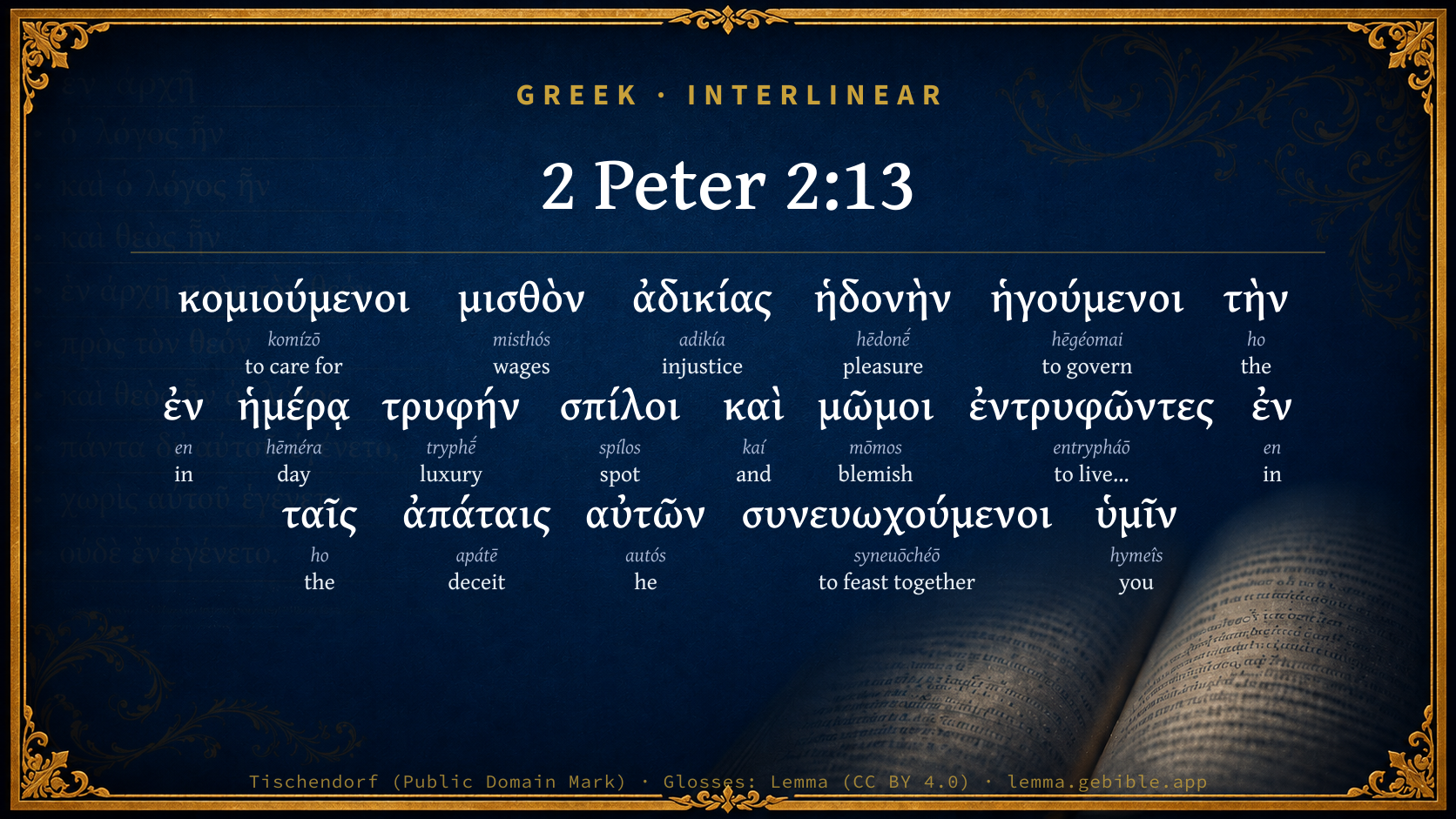
Greek (Tischendorf 8th ed.) 2 Peter 2:13 appears in the Greek New Testament. The text above is from the Tischendorf 8th edition. Each word links to its Strong’s number and a concise gloss. Click any word for its full Thayer’s Greek Lexicon entry.
Download image
Cite this verse

2 Peter 2:13 (World English Bible). Public Domain. Lemma interlinear Bible study tool, https://lemma.gebible.app/v/2-peter/2/13.

Show BibTeX & RIS
BibTeX
RIS
English Translation
receiving the wages of unrighteousness; people who count it pleasure to revel in the day-time, spots and blemishes, reveling in their deceit while they feast with you;
World English Bible · Public Domain
Highlights
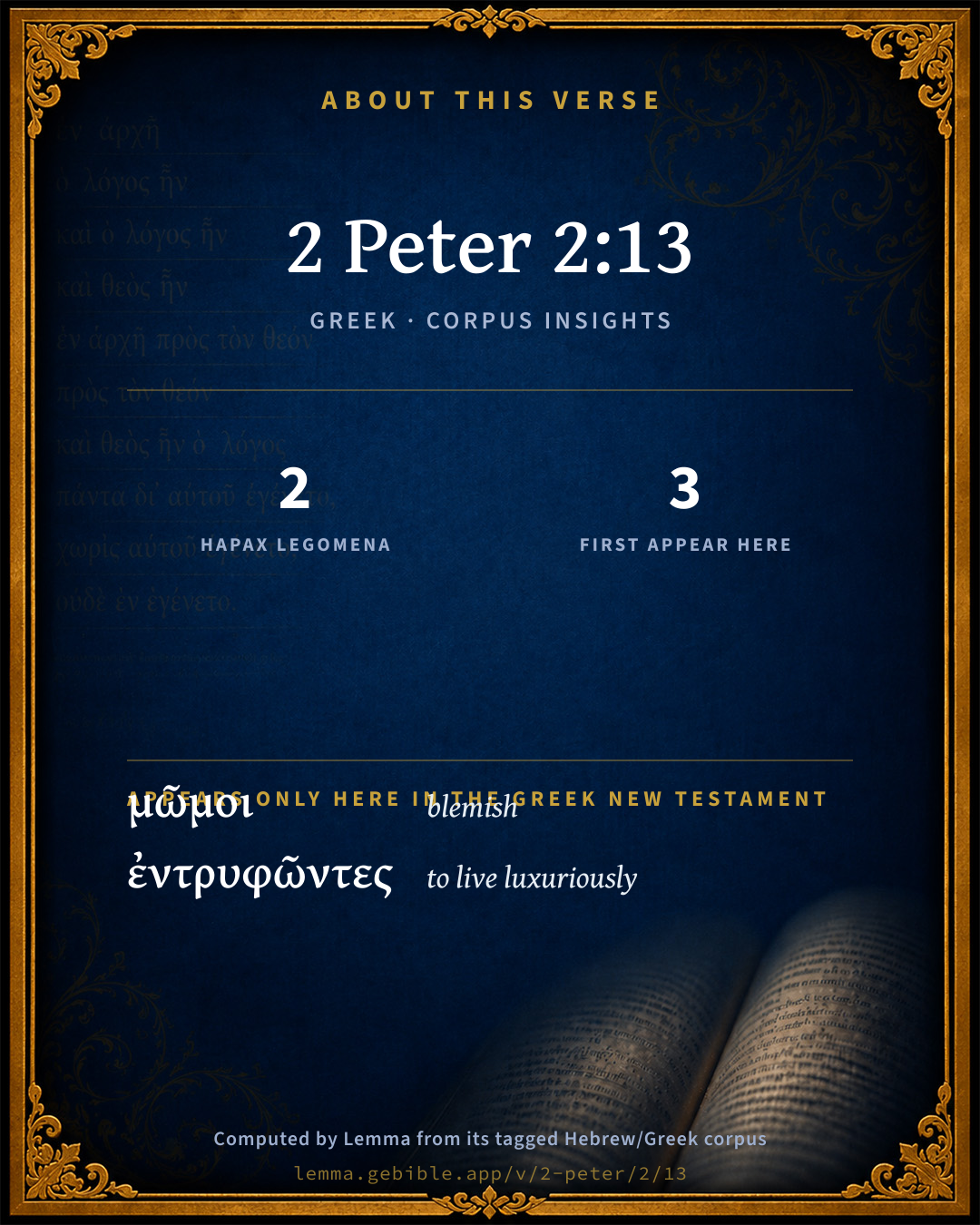
  • 2 hapax legomena — only here in the Greek New Testament
  • 3 first appearances in the Greek New Testament
Full analysis ↓
Download a study sheet

One document with this verse’s original text, its word-by-word gloss line, the meaning frame, cross-references with their text, attributed commentary, and full source and license credits — printable, and it pastes into notes with its structure intact.

This verse Autodidact and up

Study sheet (.html) Plain text (.txt)

A passage Seminary Student

Up to 50 verses in one chapter. A passage sheet keeps up to 6 commentary sources and 12 cross-references per verse, in the order this page ranks them, and says so on the sheet whenever that leaves anything out. Ask for a single verse and you get the Autodidact verse sheet above.

Everything on this page stays free to read, with no account — the sheet is a download of what is already on screen, not access to it.

Want to remove ads? Support Godless Engineer
Compare translations 3

The same verse in 3 English versions, stacked beneath the original-language interlinear above. Click any original word for its lexicon entry.

Each is an independent rendering of the whole verse — the interlinear is not word-aligned to these translations.

Highlighted words mark where these versions differ — a whole-verse word diff, not a word-by-word alignment.

  • World English Bible Public Domain
    receiving the wages of unrighteousness; people who count it pleasure to revel in the day-time, spots and blemishes, reveling in their deceit while they feast with you;
  • King James Version Public Domain
    And shall receive the reward of unrighteousness, as they that count it pleasure to riot in the day time. Spots they are and blemishes, sporting themselves with their own deceivings while they feast with you;
  • unfoldingWord Literal Text CC BY-SA 4.0
    being harmed wages of unrighteousness, considering pleasure the reveling in the day, stains and blemishes, reveling in their deceptions while feasting with you;

unfoldingWord Literal Text — © unfoldingWord, licensed CC BY-SA 4.0. Word-aligned USFM3 via Door43 (git.door43.org/unfoldingWord/en_ult).

Versions to compare (up to 4)

3 of 4 selected

Show all 19 translations

Every available English version of this verse, each an independent rendering of the whole verse.

  • World English Bible Public Domain
    receiving the wages of unrighteousness; people who count it pleasure to revel in the day-time, spots and blemishes, reveling in their deceit while they feast with you;
  • Berean Standard Bible Public Domain
    The harm they will suffer is the wages of their wickedness. They consider it a pleasure to carouse in broad daylight. They are blots and blemishes, reveling in their deception as they feast with you.
  • Majority Standard Bible Public Domain
    They will receive the wages of their wickedness. They consider it a pleasure to carouse in broad daylight. They are blots and blemishes, reveling in their deception as they feast with you.
  • King James Version Public Domain
    And shall receive the reward of unrighteousness, as they that count it pleasure to riot in the day time. Spots they are and blemishes, sporting themselves with their own deceivings while they feast with you;
  • American Standard Version (1901) Public Domain
    suffering wrong as the hire of wrong-doing; `men' that count it pleasure to revel in the day-time, spots and blemishes, revelling in their deceivings while they feast with you;
  • Revised Version (1885) Public Domain
    suffering wrong as the hire of wrong-doing; men that count it pleasure to revel in the day-time, spots and blemishes, revelling in their love-feasts while they feast with you;
  • Geneva Bible (1599) Public Domain
    And shall receiue the wages of vnrighteousnes, as they which count it pleasure dayly to liue deliciously. Spottes they are and blottes, deliting them selues in their deceiuings, in feasting with you,
  • Douay-Rheims (1899) Public Domain
    Receiving the reward of their injustice, counting for a pleasure the delights of a day: stains and spots, sporting themselves to excess, rioting in their feasts with you:
  • Young's Literal Translation Public Domain
    about to receive a reward of unrighteousness, pleasures counting the luxury in the day, spots and blemishes, luxuriating in their deceits, feasting with you,
  • Literal Standard Version CC BY-SA 4.0
    doing unjustly, [they will receive] a reward of unrighteousness, esteeming pleasure in the day, [and] luxury—[they are] spots and blemishes, reveling in their deceits, feasting with you,
  • Unlocked Literal Bible CC BY-SA 4.0
    They will receive the reward of their wrongdoing. They think that luxury during the day is a pleasure. They are stains and blemishes. They enjoy their deceitful actions while they are feasting with you.
  • unfoldingWord Literal Text CC BY-SA 4.0
    being harmed wages of unrighteousness, considering pleasure the reveling in the day, stains and blemishes, reveling in their deceptions while feasting with you;
  • Darby Bible Public Domain
    receiving [the] reward of unrighteousness; accounting ephemeral indulgence pleasure; spots and blemishes, rioting in their own deceits, feasting with you;
  • World Messianic Bible Public Domain
    receiving the wages of unrighteousness; people who count it pleasure to revel in the daytime, spots and defects, reveling in their deceit while they feast with you;
  • Webster's Bible Public Domain
    And shall receive the reward of unrighteousness, as they that count it pleasure to riot in the day-time. Spots they are and blemishes, sporting themselves with their own deceivings while they feast with you;
  • Free Bible Version CC BY-SA 4.0
    They will be paid back in harm for the harm they have done. Their idea of fun is to commit their evil lusts in broad daylight. They are stains and blemishes on your community. They enjoy their deceptive pleasures even while they eat together with you.
  • Bible in Basic English Public Domain
    For the evil which overtakes them is the reward of their evil-doing: such men take their pleasure in the delights of the flesh even in the daytime; they are like the marks of a disease, like poisoned wounds among you, feasting together with you in joy;
  • Text-Critical English NT CC BY 4.0
    receiving the wages of unrighteousness. Counting indulgence in the daytime as pleasure, they are stains and blemishes, openly indulging in their deceptions as they feast with you.
  • Tyndale New Testament (1534) Public Domain
    and receave the rewarde of vnrightewesnes. They count it pleasure to live deliciously for a season. Spottes they are and filthines livinge at pleasure and in disceaveable wayes feastynge with you:

Literal Standard Version (2020), Covenant Press — licensed CC BY-SA 4.0. Text via the HelloAO Bible API (eBible.org). Unlocked Literal Bible (unfoldingWord) — licensed CC BY-SA 4.0. Text via the HelloAO Bible API (eBible.org). unfoldingWord Literal Text — © unfoldingWord, licensed CC BY-SA 4.0. Word-aligned USFM3 via Door43 (git.door43.org/unfoldingWord/en_ult). Free Bible Version, Dr. Jonathan Gallagher — licensed CC BY-SA 4.0. Text via the HelloAO Bible API (eBible.org).

Word by word

More ways to search: Search by grammar → Find every occurrence → Compare this word →

Practice this passage: Drill this verse → Learn its vocabulary →

μῶμοι
mōmos
G3470
“blemish”
Noun, Nominative, Plural, Masculine
Part of Speech
Noun
Case
Nominative
Number
Plural
Gender
Masculine
Full Thayer's Definition

Origin: perhaps from G3201

TDNT: 17:49,6

1. blemish, blot, disgrace a. censure b. insult 1. of men who are a disgrace to society
  1. κομιούμενοι komízō G2865 “to care for” Verb, Future, Middle, Participle, Nominative, Plural, Masculine
  2. μισθὸν misthós G3408 “wages” Noun, Accusative, Singular, Masculine
  3. ἀδικίας adikía G93 “injustice” Noun, Genitive, Singular, Feminine
  4. ἡδονὴν hēdonḗ G2237 “pleasure” Noun, Accusative, Singular, Feminine
  5. ἡγούμενοι hēgéomai G2233 “to govern” Verb, Present, Middle or Passive deponent, Participle, Nominative, Plural, Masculine
  6. τὴν ho G3588 “the” Article, Accusative, Singular, Feminine
  7. ἐν en G1722 “in” Preposition
  8. ἡμέρᾳ hēméra G2250 “day” Noun, Dative, Singular, Feminine
  9. τρυφήν tryphḗ G5172 “luxury” Noun, Accusative, Singular, Feminine
  10. σπίλοι spílos G4696 “spot” Noun, Nominative, Plural, Masculine
  11. καὶ kaí G2532 “and” Conjunction
  12. ἐντρυφῶντες entrypháō G1792 “to live luxuriously” Verb, Present, Active, Participle, Nominative, Plural, Masculine
  13. ἐν en G1722 “in” Preposition
  14. ταῖς ho G3588 “the” Article, Dative, Plural, Feminine
  15. ἀπάταις apátē G539 “deceit” Noun, Dative, Plural, Feminine
  16. αὐτῶν autós G846 “he” Personal pronoun, Genitive, Plural, Masculine
  17. συνευωχούμενοι syneuōchéō G4910 “to feast together” Verb, Present, Middle or Passive deponent, Participle, Nominative, Plural, Masculine
  18. ὑμῖν hymeîs G5210 “you” Personal pronoun, 2nd person, Dative, Plural

About this verse

These counts appear in no published source. They are computed here, from the morphology-tagged text and Lemma’s own curated glosses. What Lemma adds →

19
words
17
distinct lemmas
General Epistles
section

Notable vocabulary

2 hapax legomena — words that appear only here in the entire Greek New Testament:

  • μῶμοι blemish G3470
  • ἐντρυφῶντες to live luxuriously G1792

First appearance in Scripture

These words make their first canonical appearance in the Greek New Testament here:

  • μῶμοι blemish G3470
  • ἐντρυφῶντες to live luxuriously G1792
  • συνευωχούμενοι to feast together G4910

Shared distinctive vocabulary

τρυφήν luxury G5172 occurs in 2 verses of the Greek New Testament. Also found in:
Repetition

Words recur within this verse:

Cross-references

14

Topical passages linked to 2 Peter 2:13 in the Treasury of Scripture Knowledge — connected by theme and wording, ordered by reader-vote popularity; previews shown in the World English Bible.

  • Romans 13:13 Let us walk properly, as in the day; not in reveling and drunkenness, not in sexual promiscuity and lustful acts, and not in strife and jealousy.
  • Romans 2:8–9 but to those who are self-seeking, and don't obey the truth, but obey unrighteousness, will be wrath and indignation,
  • Hebrews 2:2–3 For if the word spoken through angels proved steadfast, and every transgression and disobedience received a just recompense;
  • Philippians 3:19 whose end is destruction, whose god is the belly, and whose glory is in their shame, who think about earthly things.
  • Ephesians 5:27 that he might present the assembly to himself gloriously, not having spot or wrinkle or any such thing; but that it should be holy and without blemish.
  • 1 Peter 4:4 They think it is strange that you don't run with them into the same excess of riot, blaspheming:
  • Jude 1:12–16 These are hidden rocky reefs in your love feasts when they feast with you, shepherds who without fear feed themselves; clouds without water, carried along by winds; autumn leaves without fruit, twice dead, plucked up by the roots;
  • 1 Thessalonians 5:7–8 For those who sleep, sleep in the night, and those who are drunken are drunken in the night.
  • Isaiah 3:11 Woe to the wicked! Disaster is upon them; For the deeds of his hands will be paid back to him.
  • 1 Corinthians 11:20–22 When therefore you assemble yourselves together, it is not possible to eat the Lord's supper.
  • 2 Timothy 4:14 Alexander, the coppersmith, did much evil to me. The Lord will repay him according to his works,
  • 2 Peter 2:15 forsaking the right way, they went astray, having followed the way of Balaam the son of Beor, who loved the wages of wrong-doing;
  • Revelation 18:6 Return to her just as she returned, and repay her double as she did, and according to her works. In the cup which she mixed, mix to her double.
  • Song of Solomon 4:7 You are all beautiful, my love. There is no spot in you.

Cross-references courtesy of OpenBible.info (CC BY 4.0).

Where the printed editions differ

1 variant

Places in this verse where the major printed Greek editions disagree on the wording in a way that affects the translation — a comparison of editions, not a manuscript-by-manuscript collation. The editions are the modern critical texts (Nestlé-Aland 28/27, SBL, Westcott-Hort, Tregelles, Tyndale House) and the traditional texts behind the KJV (the Textus Receptus and the Byzantine/Majority text). It is not a claim about which reading is original.

  1. Different wording
    ἀδικούμενοι

    “suffering”

    In NA28NA27SBLWH Not in TynTregTRByz

    κομιούμενοι (komioumenoi) 'will receive' occurs in traditional manuscripts (Tyn+Treg+TR+Byz) instead of ἀδικούμενοι (adikoumenoi) 'suffering' in older manuscripts (NA28+NA27+SBL+WH)

Textual data: Translators Amalgamated Greek New Testament (STEPBible TAGNT) · CC BY 4.0.

Commentary

Notes on 2 Peter 2:13 from classic Christian and Jewish commentators (each source and its license shown beneath its notes). The classic Christian expositions comment on the surrounding passage and are grouped to its opening verse, so a note may address several verses; the Jewish commentaries on the Tanakh (Rashi and others) are per-verse, so they appear only where the commentator wrote on this verse.

Lemma curates 59 commentaries, every one of them public domain or Creative Commons licensed, each selected and text-cleaned for this edition rather than reprinted as found. About our sources →

The Biblical Illustrator

Joseph S. Exell

2Pe_2:13-14

Shall receive the reward of unrighteousness.

Sin punished

1. When we think of the sins of wicked men, we should likewise think of their punishments.

(1) Because these two are in Gods purpose, and their own nature knit together.

(2) Because the consideration of sin often does more hurt than God, if the consideration of the punishment be not joined unto it.

2. Profuse luxury is a sign of a man sinning securely.

3. Luxury, the more it is shown openly, the more it is to be condemned.

4. There is the greatest danger in those sins from which the greatest pleasure and delight ariseth.

(1) Because pleasure is a sign of a perfect habit.

(2) Because pleasure is very hardly left.

5. They that please themselves most in their sins, do most contaminate both themselves and others.

6. The outward members also of wicked men are full of wickedness. Because out of the abundance of the heart all our faculties, and all the instruments of operations receive impressions answerable unto the heart.

7. The uncleanness of the body is oftentimes joined with impurity of religion (2Pe_2:14).

8. In such men covetousness is oftentimes joined with their impiety.

9. The exercising of the heart unto such sins doth very much strengthen and increase them.

10. They that are after this manner accustomed unto their sins are hardened in them.

11. Such men are most to be detested. (Wm. Ames, D. D.)

Pleasure to riot.

Pleasure

1. Whether a man may take any pleasure in this world, or no? Yes, certainly; one special use of wisdom stands in tempering our pleasures: to be delighted is not evil, but to be delighted in evil. Why ,hath God given man such a choice of earthly commodities, but for his use? The wise man can distinguish between the love of pleasure and the use of pleasure; and while others serve delight, he teacheth delight to serve him.

2. How may a Christian take pleasure in the world? By having respect to three things: whether it be lawful, expedient, or becoming. The pleasure must be lawful, there can be no safety in a sinful delight. Poison may be qualified, and become medicinal; there is use to be made of an enemy; sickness may turn to our better health, and death itself to the faithful is but a door to life; but sin can never be made good. Pleasure therefore first must have the warrant, that it be without sin; then the measure, that it be without excess. If the cup be evil, we may not taste it; though good, yet not carouse it. We are not born to play or sport. Nor is the lawfulness only observable, but the conveniency; a man may wear good clothes unhandsomely. The stuff may be good, yet while the fashion of the garment does not become him, it appears ridiculous. The place, occasion, company, opportunity, all must be fit. (Thos. Adams.)

Spots they are, and blemishes.--

Spots and blemishes

In every sin there is not only guilt, that binds over to punishment, but defilement; which makes the sinner not less filthy than guilty; and even when the guilt is remitted, the filth remains still. The hurt is not so soon cured, as the fault is pardoned.

1. All men are spotted, originally from their parents; of actual spots themselves are the parents. If all our internal spots should break out, we could not endure one another. The whole world would be an hospital, and every man a lazar.

2. The whole world is spotted, that is another step: in the universal blemishes of nature let us read our own. To charge God with this degeneration is the highest blasphemy: coldness may sooner arise from fire, than any evil from the fountain of goodness.

3. But if every man be spotted, who shall then enter into heaven, seeing into that city no unclean thing shall come? (Rev_21:27.) This is true, yet many that have been unclean persons are since admitted (1Co_6:11; Rev_7:14; Jer_4:14). The grace of God may go a great way in our souls, and yet not leave us without spots. Not to have no spot here, but to have no spot imputed hereafter, is the happiness of a Christian.

4. We have all spots, but these are spots; for the apostle speaks not of their actions here, but their persons; not the blemishes of the men, but that the men themselves are blemishes. This is a high degree of sin, to be wholly turned into sin.

5. To whom do these appear spots and blemishes?

(1) To God, who hath pure eyes, and can abide no unclean thing.

(2) To the angels. Iniquities be sport for devils, but an eyesore to the angels; they that rejoice at a sinners conversion do rather grieve at his aberration.

(3) To good men, whom nothing pleaseth that displeaseth their Maker.

(4) To bad men; for howsoever sinners love to be evil themselves, yet they would have others good to them.

(5) To the creatures; they grieve that they are compelled to wait on a wrong master.

(6) And do they not offend themselves? No, the sick man may feel, the dead does not.

6. Sin is of a defiling quality; like a bemired dog, when it fawns upon us it fouls us. It may in this one thing be compared to fire, it converts matter into itself.

7. Open and notorious offenders ought to be denied these holy feasts; and instead of communicating with us, to pass under the censure of excommunication from us; till in penitent tears they have cleansed their pollutions.

8. We may not abstain from the sacrament, because there be spots and blemishes in the society.

9. As all sins are spots, so some have a more special resemblance, as carrying in them a natural poison and filthiness. Such particular instances we find in Scripture, wherein God discovered the spots in their consciences by sticking spots on their bodies (Exo_9:11; Num_12:10; 2Ki_5:27).

Application:

1. Learn to see thy spots. Many have unknown sins, as a man may have a mole on his back, and himself never know it (Psa_19:12). But many a one knows his fault, yet loves it.

2. Confess these spots. The spots that God hateth, are the spots that man hideth.

3. It is madness to confess ourselves foul, and not to wash, therefore let us endeavour our own cleansing. In our making there was work for God only; in our marring there was work for ourselves only; in our restoring there is work for God and ourselves together.

4. There is only one fountain to purge all these spots, the blood of the Lamb. For this purpose Christ was baptized, even to wash us. His first baptizing was with water, His last with blood; both of them wash the world from their sins. (Thos. Adams.)

Sporting themselves with their own deceivings.--

Sporting with sin

It is hard when the fool can find no bauble to play with but sin; casting firebrands, and arrows, and death; and then jeers (Pro_26:19). Custom brings sin to be so familiar, that the horror of it is turned into pleasure, and homicide is held but a sport. It is ill for a man to make himself merry with that which angers God. If sin were rightly considered, it were more worthy our tears than our sport; the fool laughs at it, but the saint weeps for it. (Thos. Adams.)

The Biblical Illustrator, edited by Joseph S. Exell (c. 1880s–1900s) — public domain. Text from a community e-Sword module.

Whedon's Commentary on the Bible

Daniel D. Whedon

3. Their viciousness of life, 2Pe_2:13-18.

13. And shall receive—Better, Receiving. This participial clause, ending with unrighteousness, is simply explanatory of perish. Perdition is their duly earned wages.

Count it—Rather, Counting it pleasure; commencing with these words a new sentence of pungent invective, which continues through 2Pe_2:16. In the East it was a shameful disgrace to be drunken in the daytime. So 1Th_5:7 describes the custom: “They that be drunken are drunken in the night;” but rioting by day would be a pleasure to these heretical profligates.

Spots—Stains upon the Christian name.

Blemishes—Disfigurements disgracing the Christian Church. Contrast with 1Pe_1:19.

Sporting—Revelling in the fruits of their deceit or fraud. Instead, however, of απαταις, deceits, Tregelles reads αγαπαις, love-feasts. This would mean that they make the love-feasts occasions for their baseness. But, in either case, feast undoubtedly refers to those festivals.

Daniel D. Whedon (gen. ed.), Commentary on the Old and New Testaments (1874–1909) — public domain. Text from a community e-Sword module.

Tyndale Open Study Notes

Tyndale Open Resources

2:13 They delight in deception even as they eat with you in your fellowship meals: Cp. Jude 1:12. Christians often ate fellowship meals together in celebration of the Lord (see Acts 2:46; 6:1). The false teachers were using these mealtimes as opportunities to deceive true believers. Some manuscripts read They delight (or revel, or carouse) in their fellowship meals as they eat with you. If this reading is correct, they were using the fellowship meals for self-indulgence (cp. 1 Cor 11:20-22).

Tyndale Open Study Notes — © Tyndale Open Resources, licensed CC BY-SA 4.0. Text via the HelloAO Bible API.

Bengel's Gnomon

Johann Albrecht Bengel

2Pe 2:13. Κομιούμενοι, bearing off [being about to “receive”]) willingly.—ἡδονὴν) that pleasure which man ought chiefly to aim at.[7]—ἩΓΟΎΜΕΝΟΙ, esteeming) A similar phrase occurs, ch. 2Pe 3:15.—ἐν ἡμέρᾳ) in the day of your love-feasts, whatever that day in each case may be, without any concern, whatever to-morrow may be about to bring with it.—σπῖλοι καὶ μῶμοι) They are spots in themselves; disgraces, which provoke others to blame the Church itself. As spots most shamefully disfigure the brightest objects, so do these men disgrace your love-feasts.—ἐντρυφῶντες) sporting themselves, so that they indulge themselves, and mock at others. The verb has a middle sense. It is used in the Septuagint, followed by ἐν, Isa 55:2; Isa 57:4.—ἈΠΆΤΑΙς[8]) deceivings. Jud 1:12, ἐν ταῖς ἀγάπαις ὑμῶν, in your feasts: Peter, making an important alteration in the letters, ἐν ταῖς ἀπάταις αὐτῶν, in their deceivings. An anonymous writer in MS. Catena, praised by Mill: οὐ διʼ ΑΓΑΠΗΝ καὶ τὸ μεταλαβεῖν ἁλῶν, φησὶ, συνευωχοῦνται ὑμῖν, ἀλλὰ διὰ τὸ καιρὸν εὑρίσκειν τῆς πρὸς γυναῖκας ΑΠΑΤΗΣ ἐπιτήδειον: It is not, he says, for the sake of LOVE, and of sharing your salt, that they feast with you, but that they may find a convenient opportunity of deceit with regard to your wives. At any rate, it is evident from this, that Peter alludes to the love-feasts; because each of them adds, feasting with you, and the one, sporting themselves, the other, feeding themselves.—συνευωχούμενοι ὑμῖν) feasting with you. Εὐωχία, a splendid feast, especially a sacred one; ἈΠῸ ΤΟῦ Εὖ ἜΧΕΙΝ ΤΟῪς ΣΥΝΙΌΝΤΑς ΕἸς ΕὐΦΡΟΣΎΝΗΝ ΤΙΜῇ ΤΟῦ ΘΕΊΟΥ, ΚΑῚ ΕἸς ἌΝΕΣΙΝ ἙΑΥΤΟῪς ΚΑΘΙΈΝΑΙ: from the fact, that those who assemble at a feast in honour of the god, have good cheer, and give themselves to indulgence. See Eust., fol. 281, ed. Rom.

[7] And which contains all things else in it.—V. g. (Counting luxury the summum bonum.—E.)

[8] Ἀπάταις is supported by A corrected, C, Memph. and later Syr., and so Rec. Text and Tisch.; but ἀγάπαις by A later corrected, B Vulg. Theb. Syr., and so Lachm.—E.

Bengel's Gnomon of the New Testament — English translation (T&T Clark, Edinburgh, 1860) — public domain. Text from a community e-Sword module.

Meyer's Critical & Exegetical Commentary

Heinrich August Wilhelm Meyer

2Pe_2:13. κομιούμενοι μισθόν ἀδικίας] is subjoined by way of explanation to what precedes.[73]

Cf. 1Pe_1:9.

μισθὸν ἀδικίας] not equivalent to μισθὸν ἄδικον (Wolf), but: the reward for unrighteousness.

ἡδονὴν ἡγούμενοι] This and the following participles, as far as the end of 2Pe_2:14, are connected with what precedes, as descriptive of the ἀδικία; it is less probable that, as Hofmann assumes, a new period begins with ἡδονὴν ἡγούμενοι and ends with 2Pe_2:16. The three kinds of ἀδικία here spoken of are: 1, luxurious living; 2, fornication; 3, covetousness. De Wette: they who count it pleasure.

τήν ἐν ἡμέρᾳ τρυφήν] ἐν ἡμέρᾳ is by Oecumenius interpreted as equal to καθʼ ἡμέραν, but this is not in accordance with the usage. Several interpreters (Benson, Morus, Fronmüller, Hofmann) take ἡμέρα, here as in contrast to the night. This, however, is inappropriate, for it is not easy to see why they should not regard the τρυφή in the night as a pleasure. Gerhard is better: per τὴν ἡμέραν intelligitur praesentis vitae tempus; Luther, temporal luxurious living (de Wette-Brückner, Wiesinger, Schott). It stands by way of contrast to the future, to which the fut. κομιούμενοι refers.

σπῖλοι καὶ μῶμοι] is either to be connected with what follows: who as σπ. καὶ μῶμοι riot (de Wette-Brückner, Wiesinger), or they are independent expressions of displeasure, like τολμηταὶ αὐθάδεις formerly in 2Pe_2:10, and κατάρας τέκνα afterwards (Schott, Fronmüller) subjoined to what precedes by way of apposition (Hofmann); the latter is most in harmony with the animated form of address. Instead of σπῖλοι, Jude has σπιλάδες; σπῖλοι (less commonly σπίλοι) is equivalent to spots of dirt, cf. Eph_5:27.

μῶμοι: ἅπ. λεγ., commonly: blame, shame; here: blemishes.[74]

ἐντρυφῶντες ἐν ταῖς ἀπάταις αὐτῶν] ἐντρυφῶντες points back to τρυφήν, and may not therefore be taken, with Hofmann, in the weakened meaning of, to take delight in anything, which it probably has in Isa_55:2, LXX.; it is not to be connected with the following ὑμῖν in the sense of: illudere, ludibrio habere, but means, as it commonly does: to riot; ὑμῖν belongs to συνευωχούμνοι.

ἐν ταῖς ἀπάταις αὐτῶν is explained from 2Pe_2:3; 2Pe_2:14; they practised deceit in this way, that they succeeded in procuring earthly advantage to themselves, by praising their vain wisdom (Wiesinger, Fronmüller); since ἐντρυφᾷυ denotes the actual rioting, ἐν ταῖς ἀπάταις αὐτῶν cannot state the object of their ἐντρυφᾷν, that is, the lies with which they practise deceit (Hofmann; or, according to Schott: their deceiving appearance of wisdom). The opinion of Wolf and others, that ἀπάται means the love-feasts, inasmuch as theyin opposition to their real natureare abused by these individuals to their own profit, requires no refutation.

συνευωχούμενοι ὑμῖν] is subordinate to what precedes. They rioted in their deceits, that is to say, by enjoying themselves at the feasts of those among whom they had obtained an entrance by deceit.

Luthers translation is mistaken: they make a show of your (ὑμῶν instead of αὐτῶν) alms (incorrect interpretation of ἀγάπαις), they revel with what is yours (instead of: with you).

[73] Hofmann considers the reading ἀδικούμενοιbut little attested, howeverinstead of κομιούμενοι to be the original, because the more difficult one. Tiseh. 8, on the other hand, says: ἀδικούμενοι, si aptum sensum praebere judicabitur, omnino praeferendum erit. Nescio an decepti circa μισθὸν ἀδικίας verti liceat. Hofmann interprets the accus. μισθόν as an accus. of apposition, cf. 2Co_6:13, and then translates: evil happens to them as the reward of evil; but though ἀδικεῖν occurs in this wider signification, as in Luk_10:19 and often in Revelation, still ἀδικία never does.Buttmann has accepted not ἀδικούμενοι, as in B, but κομιούμενοι.

[74] Hofmann arbitrarily defines these expressions more precisely as: spots which defile the purity of the church, blemishes which attach to her, to her shame; they are rather spoken of thus, because both defilement and shame cleave to them.

Meyer — Critical and Exegetical Commentary on the New Testament — English translation by Peter Christie, edited by Frederick Crombie (T&T Clark, 1880) — public domain. Text from a community e-Sword module.

Expositor's Greek Testament

ed. W. Robertson Nicoll

2Pe 2:13 . ἀδικούμενοι μισθὸν ἀδικίας ( cf. 2Pe 2:12 ). This playing upon words is characteristic of 2 Peter, ἀδικεῖν has usually the sense of “doing harm to” ( cf. Act 25:10 ; Gal 4:12 ). Here it would seem to mean “being defrauded of the wages of fraud,” or “being done out of the wages of wrong-doing”. It has been customary to see in this phrase an illustration of the irresponsible use of words in 2 Peter. “Another example of the author’s love of far-fetched and artificial expressions” (Mayor). In P. Eleph., however 27a 24 / (iii. B.C.), the writers ask for a receipt with reference to a certain business transaction. τούτου δὲ γενομένου ἐσόμεθα οὐκ ἠδικημένοι “this having been arranged, we shall not be defrauded”. To this may be added Mayor’s citation of Plut. Cato Mi. 17 (p. 766) εὑρὼν χρέα παλαιὰ τῷ δημοσίῳ πολλοὺς ὀφείλοντας καὶ πολλοῖς τὸ δημόσιον , ἅμα τὴν πόλιν ἔπαυσεν ἀδικουμένην καὶ ἀδικοῦσαν . The accusative rei after ἀδικ . is very unusual. In classical writers it is found only with ἀδίκημα . μισθὸν ἀδικίας suggests the experience of Balaam, of whom the same expression is used in 2Pe 2:15 , who never received his promised hire from Balak (Num 24:11 ). Death deprives the false teachers of all their reward. For significance of the name “Balaam,” in connexion with the false teachers, see Introduction, p. 118. ἡδονὴν in N.T. only in a bad sense, cf. Luk 8:14 , Tit 3:3 , Jas 4:1-3 . τρυφή only in N.T. in Luk 7:25 where it is used of “delicate living,” a luxurious life, but with no special blame attached. The word is also used of gifts of wisdom in Pro 4:9 , cf. Psa 36:8 , “the river of thy pleasures”. Eden is called παράδεισος τῆς τρυφῆς , Gen 2:15 ; Gen 3:13 ; Gen 3:24 . ἐν ἡμέρᾳ , “in the day-time”, ‘in broad day-light”. σπίλοι καὶ μῶμοι , cf. Eph 5:27 , 2Pe 3:14 , 1Pe 1:19 , Jud 1:12 . μῶμος “reproach,” “disgrace”. Cf. Hort. on 1Pe 1:19 , where he traces the way in which μῶμος and ἄμωμος , came to be used with superficial meaning of “blemish,” cf. Eph 1:4 ; Eph 5:27 , Heb 9:14 . ἐντρυφῶντες : “to be luxurious,” cf. Xen. Hell. 4:1, 30. ἐν ταῖς ἀπάταις αὐτῶν : to be taken with ἐντρυφ . ἀπάτη is a favourite word of Hermas ( Mand. viii. 5) and is frequently joined by him with τρυφή ( Mand. xi. 12 and throughout Parable 6). According to Deissmann, ἀπάτη in popular Hellenistic has the meaning “pleasure”. Cf. Mat 13:22 = Mar 4:19 (Luk 8:14 ), (see his Hellenisierung des semitischen Monothesismus , ( Neue Fahrb. f. d. Klass. Altertum , 1903), p. 165, n. 5).

The Expositor's Greek Testament, edited by W. Robertson Nicoll (1897–1910) — public domain. Text from a community e-Sword module.

Geneva Bible (1599)

Geneva Bible translators

When as by being amongst the Christians in the holy banquets which the Church keepeth, they would seem by that means to be true members of the Church, yet they are indeed but blots on the Church.

Or, little rocks.

Geneva Bible (1599) marginal notes — public domain. Text via Bolls.life.

Jamieson, Fausset & Brown

Robert Jamieson, A. R. Fausset & David Brown

receive--"shall carry off as their due."

reward of--that is, for their "unrighteousness" [ALFORD]. Perhaps it is implied, unrighteousness shall be its own reward or punishment. "Wages of unrighteousness" (Pe2 2:15) has a different sense, namely, the earthly gain to be gotten by "unrighteousness."

in the daytime--Translate as Greek, "counting the luxury which is in the daytime (not restricted to night, as ordinary revelling. Or as Vulgate and CALVIN, "the luxury which is but for a day": so Heb 11:25, "the pleasures of sin for a season"; and Heb 12:16, Esau) to be pleasure," that is, to be their chief good and highest enjoyment.

Spots--in themselves.

blemishes--disgraces: bringing blame (so the Greek) on the Church and on Christianity itself.

sporting themselves--Greek, "luxuriating."

with--Greek, "in."

deceivings--or else passively, "deceits": luxuries gotten by deceit. Compare Mat 13:22, "Deceitfulness of riches"; Eph 4:22, "Deceitful lusts." While deceiving others, they are deceived themselves. Compare with English Version, Phi 3:19, "Whose glory is in their shame." "Their own" stands in opposition to "you": "While partaking of the love-feast (compare Jde 1:12) with you," they are at the same time "luxuriating in their own deceivings," or "deceits" (to which latter clause answers Jde 1:12, end: Peter presents the positive side, "they luxuriate in their own deceivings"; Jude, the negative, "feeding themselves without fear"). But several of the oldest manuscripts, Vulgate, Syriac, and Sahidic Versions read (as Jude), "In their own love-feasts": "their own" will then imply that they pervert the love-feasts so as to make them subserve their own self-indulgent purposes.

Jamieson, Fausset & Brown — Commentary Critical and Explanatory on the Whole Bible (1871) — public domain (CC PDM 1.0). Text via the HelloAO Bible API.

Adam Clarke's Commentary

Verse 13. They that count it pleasure to riot in the day time.] Most sinners, in order to practise their abominable pleasures, seek the secrecy of the night; but these, bidding defiance to all decorum, decency, and shame, take the open day, and thus proclaim their impurities to the sun.

Spots - and blemishes] They are a disgrace to the Christian name.

Sporting themselves] Forming opinions which give license to sin, and then acting on those opinions; and thus rioting in their own deceits.

With their own deceivings] εν ταις απαταις. But instead of this, AB, and almost all the versions and several of the fathers, have εν ταις αγαπαις, in your love feasts, which is probably the true reading.

While they feast with you] It appears they held a kind of communion with the Church, and attended sacred festivals, which they desecrated with their own unhallowed opinions and conduct.

Adam Clarke's Commentary on the Bible (1810–1826) — public domain. Text from a community e-Sword/MySword module.

John Calvin's Commentaries

13. Count it pleasure As though he had said, “They place their happiness in their present enjoyments.” We know that men excel brute animals in this, that they extend their thoughts much farther. It is, then, a base thing in man to be occupied only with present things. Here he reminds us that our minds ought to be freed from the gratifications of the flesh, except we wish to be reduced to the state of beasts.

The meaning of what follows is this, “These are filthy spots to you and your assembly; for while they feast with you, they at the same time luxuriate in their errors, and shew by their eyes and gestures their lascivious lusts and detestable incontinency.” Erasmus has rendered the words thus, “Feasting in their errors, they deride you.” But this is too forced. It may not unaptly be thus explained, “Feasting with you, they insolently deride you by their errors.” I, however, have given the version which seems the most probable, “luxuriating in their errors, feasting with you.” He calls the libidinous such as had eyes full of adultery, and who were incessantly led to sin without restraint, as it appears from what is afterwards said.

John Calvin's Commentaries (1540-1563) — public domain. Text from the Calvin Translation Society English edition (1840s-50s) via the Christian Classics Ethereal Library (ccel.org). Calvin's coverage is partial (roughly two-thirds of the Bible); uncommented books and verses are honest gaps, never fabricated. The 19th-century editor's footnotes and remarks are omitted so the notes are faithfully Calvin's own voice.

Ellicott's Commentary for English Readers

(13) And shall receive.—Literally, about to receive (as they are). (Comp. 1Pe_1:9; 1Pe_5:4; see also Epistle of Barnabas, iv. 12.)

As they that count.—We must begin a fresh sentence, and somewhat modify the translation. “To riot” is too strong; the word means “delicate fare, dainty living, luxury,” and if the exact meaning be retained, this will necessitate a change of “in the day time.” For though “rioting in the day time” makes good sense—revelry even among professed pleasure seekers being usually confined to the night (1Th_5:7)—“dainty fare in the day time” does not seem to have much point. The meaning is, perhaps, “for the day,” without thought for the morrow, counting luxury for the moment a pleasure—the doctrine of the Cyrenaics and the instinct of “brute beasts.” In the Shepherd of Hermas (Sim. VI. iv. 4) there is a passage which may possibly be an echo of this: “The time of luxury and deceit is one hour, but the hours of torment have the power of thirty days; if, then, a man luxuriates for one day,” &c. &c. (See below on 2Pe_2:15; 2Pe_2:20; 2Pe_3:5.)

Sporting themselves.—The word is a compound of the one just translated “luxury”; hence luxuriating. It is worth noting that the words for “spots and blemishes” exactly correspond to the words translated “without blemish and without spot” in 1Pe_1:19. (See below on 2Pe_3:14.)

With their own deceivings.—Better, in their deceits, if this is the right reading. But both here and in Jud_1:12, the reading is uncertain, authorities being divided between agapai, “love-feasts,” and apatai, “deceits.” In Jude the balance on purely critical grounds is decidedly in favour of “love-feasts;” here (though much less decidedly) in favour of “deceits.” In Jude the context confirms the reading “love-feasts;” here the context is neutral, or slightly inclines to “love-feasts,” to which “while they feast with you” must in any case refer. But if “love-feasts” be right in Jude (and this is so probable that we may almost assume it), this in itself is strong support to the same reading here. Whichever writer is prior, so strange a change from “deceits” to “love-feasts” would hardly have been made deliberately; whereas, in copying mechanically, the interchange might easily be made, the words being so similar. The change from “spots” to “rocks,” if such a change has been deliberately made by either writer (see on Jud_1:12), would not be parallel to a change between “deceits” and “love-feasts.” The one is a mere variation of the metaphor, the other an alteration of the meaning. In 2Th_2:10 there is possibly an intentional play upon the similarity of these two words.

A Bible Commentary for English Readers, edited by Charles John Ellicott (1878–1897) — public domain. Text from a community e-Sword module.

The Cambridge Bible for Schools and Colleges

gen. ed. J. J. S. Perowne

13. and shall receive the reward of unrighteousness …] The words, which stand in the Greek as one of a series of participial clauses, are, perhaps, better joined with the last clause of the preceding verse, They shall perish … receiving the reward.…

as they that count it pleasure to riot in the day time] The latter words have been variously rendered; (1) as in the English version, (2) counting delicate living for a day (i.e. but for a little while, laying stress on the transitoriness of all such indulgence) as pleasure: (1) seems, on the whole, preferable, all the more so as it supplies a point of contact at once with St Peter’s own language as to the shamelessness of revel “at the third hour of the day” (Act_2:15), and with St Paul’s contrast between the works of the day and those of night (Rom_13:13-14; 1Th_5:7). It has been urged against this that the Greek word for “riot” means rather the delicate and luxurious living (Luk_7:25) that might be practised both by day and night rather than actual riot, but it is obvious that luxury shews itself chiefly in banquets which belong to night, and to carry the same luxury into the morning meal might well be noted as indicating excess. In the Greek version by Symmachus a cognate noun is applied to the banqueters of Amo_6:7.

Spots they are and blemishes] The former word is found in Eph_5:27; the latter is not found elsewhere in the New Testament.

sporting themselves with their own deceivings while they feast with you] The MSS. both here and in the parallel passage of Jude (2Pe_2:12) vary between ἀπάταις (= deceits) and ἀγάπαις (= feasts of love). The latter gives, on the whole, a preferable meaning, and, even if we adopt the former reading, we are compelled by the context to look on the love-feasts as the scene of the sin referred to. The Agapae were a kind of social club feast, at first, perhaps, connected in time and place with the Lord’s Supper, but afterwards first distinguished and then divided from it. They were a witness of the new brotherhood in which the conventional distinctions of society were suspended, and rich and poor met together. Their existence is recognised in early ecclesiastical writers, in the first century by Ignatius (ad Smyrn. c. 2), in the second by Tertullian (Apol. c. 39), and they survived for three or four hundred years, till the disorders connected with them led to their discontinuance. In 1Co_11:21 we have traces of such disorders at a very early period, and St Peter’s language here shews that they had found their way into the Asiatic Churches as well as into that of Corinth. The “false teachers” and their followers took their place in the company of the faithful, and instead of being content with their simple food, consisting probably of bread, fish, and vegetables (the fish are always prominent in the representations of the Agapae in the Catacombs of Rome), brought with them, it would seem, the materials for a more luxurious meal (comp. 1Co_11:21), and, as the context shews, abused the opportunities thus given them for wanton glances and impure dalliance. Taking the first reading (“deceits”), the Apostle lays stress on the fact that in doing so they were in fact practising a fraud on the Christian society into which they thus intruded themselves.

The Cambridge Bible for Schools and Colleges (gen. ed. J. J. S. Perowne; Cambridge University Press, 1878–1918) — public domain. Text from a community e-Sword module.

John Gill's Exposition

And shall receive the reward of unrighteousness,.... Due punishment, both in body and soul, for all their injustice to God and men; which will be a just recompense of reward they shall receive at the righteous judgment of God, who will render to every man according to his works: the justice of which appears by what follows,

as they that count it pleasure to riot in the daytime; who place all their satisfaction and happiness in sensual delight, in rioting and drunkenness, in chambering and wantonness, day after day; putting away the evil day far from them, supposing that tomorrow will be as this day, and that there will be no future judgment nor state; and therefore do not take the night for their revels, as other sinners do, but being without all shame, declare their sin as Sodom, and hide it not:

spots they are, and blemishes; which defile themselves, their minds and consciences, their souls and bodies, with sin, and defile others by their evil communications, and bring dishonour and disgrace upon the ways, doctrines, and interest of Christ:

sporting themselves with their own deceivings; with their sins and lusts, by which they deceive themselves and others, it being a sport to them to commit sin; and in which they take great pleasure and pastime, and not only delight in their own sins, but in those of others, and in them that do them. Some versions, as the Vulgate Latin and Arabic, instead of "deceivings", read love feasts, as in Jde 1:12, and so the Alexandrian copy; in which they behaved in a very scandalous manner, indulging themselves in luxury and intemperance: to which agrees what follows,

while they feast with you; at the above feasts, or at the Lord's table, or at their own houses, which shows that they were of them, and among them, as in Pe2 2:1; and carries in it a tacit reproof for the continuance of them, when they were become so bad in their principles, and so scandalous in their lives.

John Gill's Exposition of the Whole Bible (1746–1763) — public domain (CC PDM 1.0). Text via the HelloAO Bible API.

Trapp's Complete Commentary

John Trapp

13 And shall receive the reward of unrighteousness, as they that count it pleasure to riot in the day time. Spots they are and blemishes, sporting themselves with their own deceivings while they feast with you;

Ver. 13. To riot in the day time] {See Trapp on "1Th 5:7"} The word here rendered riot, comes of a root that signifies to break, for there is nothing that doth so break and emasculate the minds of men as rioting and revelling; luxury draws out a man’s spirits, and dissolves him. (τρυφη, a θρυπτω, frango.) Hence Venus is called λυσιμελης by the ancients, and harlots are called cruces, crosses, by the young man in Terence. Solomon’s prodigal found them no better, Pro 5:11, after he had paid for his learning.

Spots they are] σπιλοι, blots of goodness, botches of Christian society. Such are the Jesuits, who tell us they can daily be with the fairest women and yet not lust after them. Such was that profligate priest, who persuaded many maids and matrons to lie with him under a pretence of religion; asserens impietatis et hypocriseos plenam esse fiduciam, qua castitate et pudicitia sua potius quam Christi gratia niterentur, telling them that that faith of theirs was naught and counterfeit, whereby they were drawn to rest more upon their chastity and modesty than upon Christ’s grace and merits. (Theatr. Histor. Horndorf.) I much doubt we have many such merchants, such marcidi bibauldi, rascal ribalds {a} (as Math. Paris calls them), now abroad among us, in these last and loosest times.

{a} One of an irregular class of retainers who performed the lowest offices in royal or baronial households, especially in France during the 14th and 15th centuries, and were employed in warfare as irregular troops; hence, a menial or dependent of low birth. Obs. ŒD

John Trapp, A Commentary or Exposition upon All the Books of the Old and New Testament (1647–1656) — public domain. Text from a community e-Sword module.

Albert Barnes' Notes on the Bible

And shall receive the reward of unrighteousness - The appropriate recompense of their wickedness in the future world. Such people do not always receive the due recompense of their deeds in the present life; and as it is a great and immutable principle that all will be treated, under the government of God, as they deserve, or that justice will be rendered to every rational being, it follows that there must be punishment in the future state.

As they that count it pleasure to riot in the day-time - As especially wicked, shameless, and abandoned men; for only such revel in open day. Compare the Act 2:15 note; 1Th 5:7 note.

Spots they are and blemishes - That is, they are like a dark spot on a pure garment, or like a deformity on an otherwise beautiful person. They are a scandal and disgrace to the Christian profession.

Sporting themselves - The Greek word here means to live delicately or luxuriously; to revel. The idea is not exactly that of sporting, or playing, or amusing themselves; but it is that they take advantage of their views to live in riot and luxury. Under the garb of the Christian profession, they give indulgence to the most corrupt passions.

With their own deceivings - Jude, in the parallel place, Jud 1:12, has, “These are spots in your feasts of charity, when they feast with you.” Several versions, and a few manuscripts also, here read “feasts” instead of “deceivings,” (ἀγάπαῖς agapais for ἀπάταις apatais.) The common reading, however, is undoubtedly the correct one, (see Wetstein, in loc.); and the meaning is, that they took advantage of their false views to turn even the sacred feasts of charity, or perhaps the Lord’s Supper itself, into an occasion of sensual indulgence. Compare the notes at 1Co 11:20-22. The difference between these persons, and those in the church at Corinth, seems to have been that these did it at design, and for the purpose of leading others into sin; those who were in the church at Corinth erred through ignorance.

While they feast with you - συνευωχούμενοι suneuōchoumenoi. This word means to feast several together; to feast with anyone; and the reference seems to be to some festival which was celebrated by Christians, where men and women were assembled together, 2Pe 2:14, and where they could convert the festival into a scene of riot and disorder. If the Lord’s Supper was celebrated by them as it was at Corinth, that would furnish such an occasion; or if it was preceded by a “feast of charity” (notes, Jud 1:12), that would furnish such an occasion. It would seem to be probable that a festival of some kind was connected with the observance of the Lord’s Supper (notes, 1Co 11:21), and that this was converted by these persons into a scene of riot and disorder.

Albert Barnes' Notes on the Bible (1834–1885) — public domain. Text from a community e-Sword/MySword module.

Haydock's Catholic Bible Commentary

Counting the delights of the day to be pleasure; such is their impiety and their folly, that they have no regard to all the punishments they make themselves liable to, if they can but pass their days in this short life, or even one day, in shameful pleasures and delights. They may be called the stains and blemishes, the shame and disgrace of mankind, on account of the abominations they practise in their rioting and banquetings.[3] See what St. Epiphanius relates of Gnostics. (Witham) --- Delights; that is, the short delights of this world, in which they place all their happiness. (Challoner)

===============================

[BIBLIOGRAPHY]

In conviviis, Greek agapais, which reading Dr. Wells prefers before Greek: apatais, the common reading: in the Protestant translation, with their own deceivings.

====================

George Leo Haydock (1774–1849), Haydock's Catholic Family Bible and Commentary, 1859 edition — public domain. Excludes Psalms (Douay-Rheims chapter numbering differs from Protestant) and Deuterocanonical books (Catholic canon only).

Matthew Poole's English Annotations

And shall receive the reward of unrighteousness: under this general term, all the several sins they are charged with are comprehended.

As they that count it pleasure to riot in the day time; this is said to aggravate their sin, and signifies either their impudence in it, that they had cast off all shame, and practised their luxury by day light, whereas ordinary sinners are wont to choose the night for such works of darkness, Rom 13:12,13; 1Th 5:7; or their security, that they spent the day of their life in their pleasures, placing their happiness in present enjoyments, unmindful of a future reckoning and an eternal state.

Spots they are and blemishes; not only altogether polluted themselves, but such as defile others, and are blemishes to the church whereof they profess themselves members.

Sporting themselves with their own deceivings: some read αγαπαις instead of απαταις, leaving out the pronoun, rendered their own; and understand this of the love feasts, in which they luxuriously gorged themselves. This might well agree with Jud 1:12, but that the generality of Greek copies read απαταις, which we turn deceivings, i.e. either errors, taking the word passively; q.d. They do but make a sport of sin, and please themselves with it; and this agrees too with Jud 1:12, feeding themselves without fear: or cheatings, or imposings upon others, taking

deceivings actively; q.d. They sport themselves while they so finely deceive you, pretending love in their feasting with you, when they do it only to gratify their appetites; or sporting themselves, and making merry, with what they have cheated you of.

While they feast with you; viz. in your feasts of charity, with the specious pretence of which they covered their naughtiness.

Matthew Poole's English Annotations on the Holy Bible (1683–1685) — public domain. Text from a community e-Sword/MySword module.

The Pulpit Commentary

And shall receive the reward of unrighteousness. The two most ancient manuscripts read here, instead of komioumenoi ajdikoumenoi. This reading is adopted by the Revised Version in the translation, "suffering wrong as the hire of wrongdoing." But the other reading is well supported, and gives a better sense, "receiving, as they shall, the reward of unrighteousness." Balaam loved the reward of unrighteousness in this world (verse 15); the false teachers shall receive its final reward in the world to come. Whichever reading is preferred, this clause is best taken with the preceding verse. As they that count it pleasure to riot in the daytime; literally, counting the revel in daytime a pleasure. St. Peter has hitherto spoken of the insubordination and irreverence of the false teachers; he now goes on to condemn their sensuality. The words ejn hjmera cannot, with some ancient interpreters, be taken as equivalent to maq hJmeran, daily. (Luk_16:19) Many commentators, as Huther and Alford, translate "delicate living for a day enjoyment which is temporal and short-lived. But when we compare 1Th_5:7, "They that are drunken are drunken in the night," and St. Peter"s own words in Act_2:15, it seems more probable that the apostle means to describe these false teachers as worse than ordinary men of pleasure. They reserve the night for their feasting; these men spend the day in luxury. The word trufh) means "luxurious or delicate living" rather than "riot." Spots they are and blemishes. (For spiloi, spots, St. Jude has spiladev, sunken rocks.) The word for "blemishes (mwmoi) occurs nowhere else in the New Testament. But comp.mou 1Pe_1:19, where the Lord Jesus is described as "a Lamb without blemish and without spot (ajmw) kailou)." The Church should be like her Lord, "not having spot, or wrinkle, or any such thing"; (Eph_5:27) but these men are spots and blemishes on her beauty. Sporting themselves with their own deceivings; literally, reveling in their deceivings. The word for "reveling" (ejntrufwntev) corresponds with trufh, used just above. The manuscripts vary between ajpataiv, deceivings, and ajgapaiv, loves, love-feasts. The former reading seems the best-supported here, and the latter in the parallel passage of St. Jude (verse 12). It is possible that the paronomasia may be intentional (compare the spiloi of St. Peter and the spiladev of St. Jude). St. Peter will not use the honourable name for the banquets which these men disgrace by their excesses. He calls them ajpatav, not ajgapav deceits, not love-feasts. There is no love in the hearts of these men. Their love-feasts are hypocrisies, deceits; they try to deceive men, but they deceive not God. While they feast with you. The Greek word suneuwcoumenoi occurs elsewhere only in Jud_1:12. The false teachers joined in the love-feasts, but made them the occasion of self-indulgence. Compare the similar conduct of the Corinthians. (1Co_11:20-22)

The Pulpit Commentary (1880–1919), ed. H.D.M. Spence-Jones & Joseph S. Exell — public domain. Text from a community e-Sword module.

John Wesley's Explanatory Notes

They count it pleasure to riot in the day time - They glory in doing it in the face of the sun. They are spots in themselves, blemishes to any church. Sporting themselves with their own deceivings - Making a jest of those whom they deceive and even jesting while they are deceiving their own souls.

John Wesley, Explanatory Notes Upon the Whole Bible (1754–1765) — public domain. Text via the GEBible commentary corpus.

Burkitt's Expository Notes on the New Testament

William Burkitt

Here we have many sad and dreadful instances given of the height of sensuality and brutishness which these seducers were arrived at, and had attained unto. Lord! how do fleshly lusts, and sensual affections, obscure the light of conscience, and corrupt its judgment? There is such an intimate communion between the soul and the body, that they interchangeably corrupt one another. To what a desperate degree of hardness and insensibility, had the flames of lust seared the consciences of these men? They had lost all the ingenuous bashfulness of human nature, and pleased themselves in their licentious principles and practices, not declining to do that at noon-day which Heathens would have blushed to be found doing at mid-night.

Observe particularly, how luxury and uncleanness accompany each other; they took pleasure in rioting and sporting themselves in their feasts, and their eyes were full of adultery. They feasted and fed immeasurably, impurely, and lustfully, making their plenty fodder and fuel for their lusts: for having fed to the full, every one neighed after his neighbour’s wife, and, putting out the candles after supper, they gave way promiscuously to the ravings of unbridled lust, turning the temple of the Holy Ghost into an hog-sty: But know, O unclean sinner! that God will return flames for flames, and revenge this fire in thy heart with the fire of hell. How nearly does it concern thee, who has burnt in these impute flames of uncleanness, and kindled the flames of God’s wrath, to labour to cool and quench them with the blood of Christ, and the tears of repentance, which alone can allay the heats of sin in thee, and of wrath in God? Let unclean sinners improve examples, lest they be made examples.

William Burkitt's Expository Notes on the New Testament (1700–1703) — public domain. Text from a community e-Sword module.

The People's New Testament

B. W. Johnson

13. Shall receive the reward of unrighteousness. Their destruction is the legitimate reward of their own wrong doing. Count it pleasure to riot in the day time. Literally “in the day.” I believe that the idea is that, like dumb brutes forgetful of coming destruction, they take pleasure in carousal for a day, regardless of the morrow. Spots and blemishes. Marring the brightness and beauty of the church. Revelling in their love feasts (Revision). Converting even these into scenes of revel.

B. W. Johnson's The People's New Testament with Notes (1889–1891) — public domain. Electronic text from the Christian Classics Ethereal Library (CCEL) ThML edition.

Cambridge Greek Testament for Schools and Colleges

13. ἀδικούμενοι μισθὸν ἀδικίας. This is the reading of א (first hand) BP, one Syriac version and the Armenian; whereas a corrector of א, ACKL, the Latin, Egyptian, and another Syriac version give the undoubtedly easier κομιούμενοι “destined to receive.” It has rather a close parallel in Col 3:25, ὁ γὰρ ἀδικῶν κομίσεται ὃ ἠδίκησεν. But the future (κομιούμενοι) is against the reading: all the other participles near by (and there are many) are in the present.

ἀδικούμενοι is quite hard to translate. I prefer the rendering of Tischendorf, “being defrauded in respect of the wages of iniquity.” μισθὸς ἀδικίας is used just below of Balaam: and like Balaam the false teachers will not receive the gain they hoped for, but destruction.

If it were permissible to take ἀδικεῖν in the sense which it often has in Rev. (e.g. Rev 7:2-3, etc.) of “hurting,” we might render “being hurt as the reward for harming.” But this is not in the manner of our author, and besides would seem to require ἀδικήσεως, not ἀδικίας.

ἡδονὴν ἡγούμενοι τὴν ἐν ἡμέρᾳ τρυφήν. This hard clause finds an explanation in the Psalms of Solomon (1st century B.C.) 14:4. “Not so are the sinners and transgressors οἳ ἠγάπησαν ἡμέραν ἐν μετοχῇ ἁμαρτίας αὐτῶν, ἐν μικρότητι σαπρίας ἡ ἐπιθυμία (or ἐν ἐπιθυμίᾳ) αὐτῶν. They were contented with a day while they were partners together in sin: their desire was in (was satisfied with) a short space of corruption.” So these false teachers reckoned the shortlived enjoyment of a day to be true pleasure.

Another good interpretation depends on a passage in the Assumption of Moses (iv. 4). Those who are denounced are described as “omni hora diei amantes conuiuia.” This is in favour of the R.V. rendering, “men that count it pleasure to revel in the day-time.” Compare Rom 13:13 “let us walk honestly as in the day: not in revellings and drunkenness” etc.

σπίλοι καὶ μῶμοι, ἐντρυφῶντες ἐν ταῖς ἀπάταις αὐτῶν συνευωχούμενοι ὑμῖν. Jud 1:12 οὗτοί εἰσιν οἱ ἐν ταῖς ἀγάπαις ὑμῶν σπιλάδες συνευωχούμενοι.

ἀπάταις is read by א, the first hand of A and C, KLP and others; for it B, the second hand of A and C, and the Latin have ἀγάπαις (agreeing with Jude). The addition of αὐτῶν here is “in favour of ἀπάταις.” So Mayor, who also points out that ἀπάταις and σπίλοι are characteristic modifications of the similar ἀγάπαις and σπιλάδες in Jude.

σπίλος occurs in Eph 5:27 μὴ ἔχουσαν σπίλον: and ἄσπιλος in our Epistle (2Pe 3:14): the verb σπιλόω in Jud 1:23 and also in Jas 3:6.

μῶμος, which in classical Greek means reproach or disgrace, is used to mean blemish (as it does here) in the LXX. of Leviticus. ἄμωμος is in Jud 1:24. See also 1Pe 1:19.

If we adopt the strongly supported reading ἀπάταις it is not easy to get a clear notion of the meaning of the clause. Two ways of taking it are suggested: (a) revelling when they join in your feasts, to which by their deceitful conduct they have gained admission; (b) revelling in their deceitfulness, when they feast with you. In any case the writer has in his mind the love-feast of the Christians which these men perverted and profaned.

Cambridge Greek Testament for Schools and Colleges (Cambridge University Press, 1896; 21 vols, various authors incl. Carr, Maclear, Plummer, Farrar, Lumby, Moule, M. R. James, Simcox) — public domain. Text from a community e-Sword module.

Vincent's Word Studies in the New Testament

Marvin R. Vincent

And shall receive [κομιουμενοι] . Lit., being about or destined to receive. See on 1Pe 1:9, and compare 1Pe 5:4. Some good texts read ajdikoumenoi, suffering wrong. So Rev., suffering wrong as the hire of wrong - doing.

Reward of unrighteousness [μισθον αδικιας] . Misqov is hire, and so is rendered in Rev. Compare Mt 20:8; Luk 10:7; Joh 4:36. It also has in classical Greek the general sense of reward, and so very often in the New Testament, in passages where hire or wages would be inappropriate. Thus Mt 5:12; Mt 6:1; Mt 10:41. Hire would seem to be better here, because of the reference to Balaam in ver. 15, where the word occurs again and requires that rendering. The phrase misqov, reward or wages of iniquity, occurs only here and in Peter's speech concerning Judas (Act 1:18), where the Rev. retains the rendering of the A. V., reward of iniquity. It would have been better to render wages of iniquity in both places. Iniquity and unrighteousness are used in English almost synonymously; though, etymologically, iniquity emphasizes the idea of injustice (inaequus), while unrighteousness (non - rightness) is more general, implying all deviation from right, whether involving another's interests or not. This distinction is not, however, observed in the Rev., where the rendering of adikia, and of the kindred adjective adikov, varies unaccountably, if not capriciously, between unrighteous and unjust. As they that count it pleasure to riot [ηδονην ηγουμενοι τρυφην] . The as of the A. V. is needless. The discourse proceeds from ver. 13 by a series of participles, as far as following (ver. 15). Literally the passage runs, counting riot a pleasure.

Riot [τρυφην] . Meaning rather daintiness, delicacy, luxuriousness. Even the Rev. revel is almost too strong. Compare Luk 7:25, the only other passage where the word occurs, and where the Rev. retains the A. V., live delicately. So, also, Rev. substitutes, in Jas 5:5, lived delicately for lived in pleasure.

In the daytime. Compare Peter's words Act 2:15; also, 1Th 5:7.

Spots [σπιλοι] . Only here and Eph 5:27. Compare the kindred participle spotted (Jude 1:23), and defileth (James 3; 6).

Blemishes [μωμοι] . Only here in New Testament. The negatives of the two terms spots and blemishes occur at 1Pe 1:19.

Sporting themselves [εντρυφωντες] . From trufh, luxuriousness. See on riot. Rev., revelling.

With their own deceivings [εν ταις απαταις αυτων] . The Rev., however, follows another reading, which occurs in the parallel passage Jude 1:12 ajgapaiv, love - feasts, the public banquets instituted by the early Christians, and connected with the celebration of the Lord 's Supper. Rev. renders revelling in their love - feasts, though the American Committee insist on deceivings. On the abuses at these feasts, see 1Co 11:20 - 22. For auJtwn, their own, the best texts read aujtwn, their. While they feast with you [συνευωχουμενοι] . The word originally conveys the idea of sumptuous feasting, and is appropriate in view of the fact to which Peter alludes, that these sensualists converted the love - feast into a revel. Compare Paul 's words, 1Co 11:21, "one is hungry and another drunken." This seems to favor the reading ajgapaiv. The word occurs only here and Jude 1:12.

Marvin R. Vincent, Word Studies in the New Testament (1887–1900) — public domain. Text from a community e-Sword/MySword module.

Lesson kit

Teaching starters — assembled from the data on this page, not authored interpretation. Every prompt links to the verse data it draws on. Edit before teaching.

2 Peter, in the General Epistles, opens this verse with 19 words (17 distinct Greek lemmas). Its most distinctive word is mōmos (“blemish”). A historical commentator’s framing appears above. Read the whole chapter for the surrounding context.

Discussion questions

  1. The word mōmos carries the sense “blemish.” How does it shape the verse?
  2. This verse holds 2 words here found nowhere else in the Greek New Testament. What might the rare words draw attention to?
  3. 3 words here appear for the first time in Scripture. What is being introduced at this debut?
  4. Luke 7:25 shares the word «luxury» with this verse. How do the two illuminate each other?
  5. “the” occurs 2× in this one verse. What is the effect of the repetition?
  6. The translations on this page render this verse differently — a whole-verse word diff, not a word-by-word alignment. What might account for the different wordings?
  7. Reading how The Biblical Illustrator and Whedon's Commentary on the Bible read this verse, where do the two commentators agree and where do they part?

Things to notice

  • 2 words in this verse appear nowhere else in the Greek New Testament.
  • 3 words make their first canonical appearance in Scripture here.
  • These translations choose different wording for 27 words in this verse.
  • “the” occurs 2× in this single verse.
  • 17 distinct Greek lemmas span 19 words in this verse.

Reading settings

Reading text

Shown beneath each verse's original-language words.

Old Testament
Old Testament edition

Read the OT as the Masoretic Hebrew (MT) or the Greek Septuagint (LXX).

English shown for the Greek Septuagint (in the Hebrew ↔ Greek comparison).

Comparing translations? Open the Compare panel on any verse page to stack up to four side by side.