Zechariah 11:12

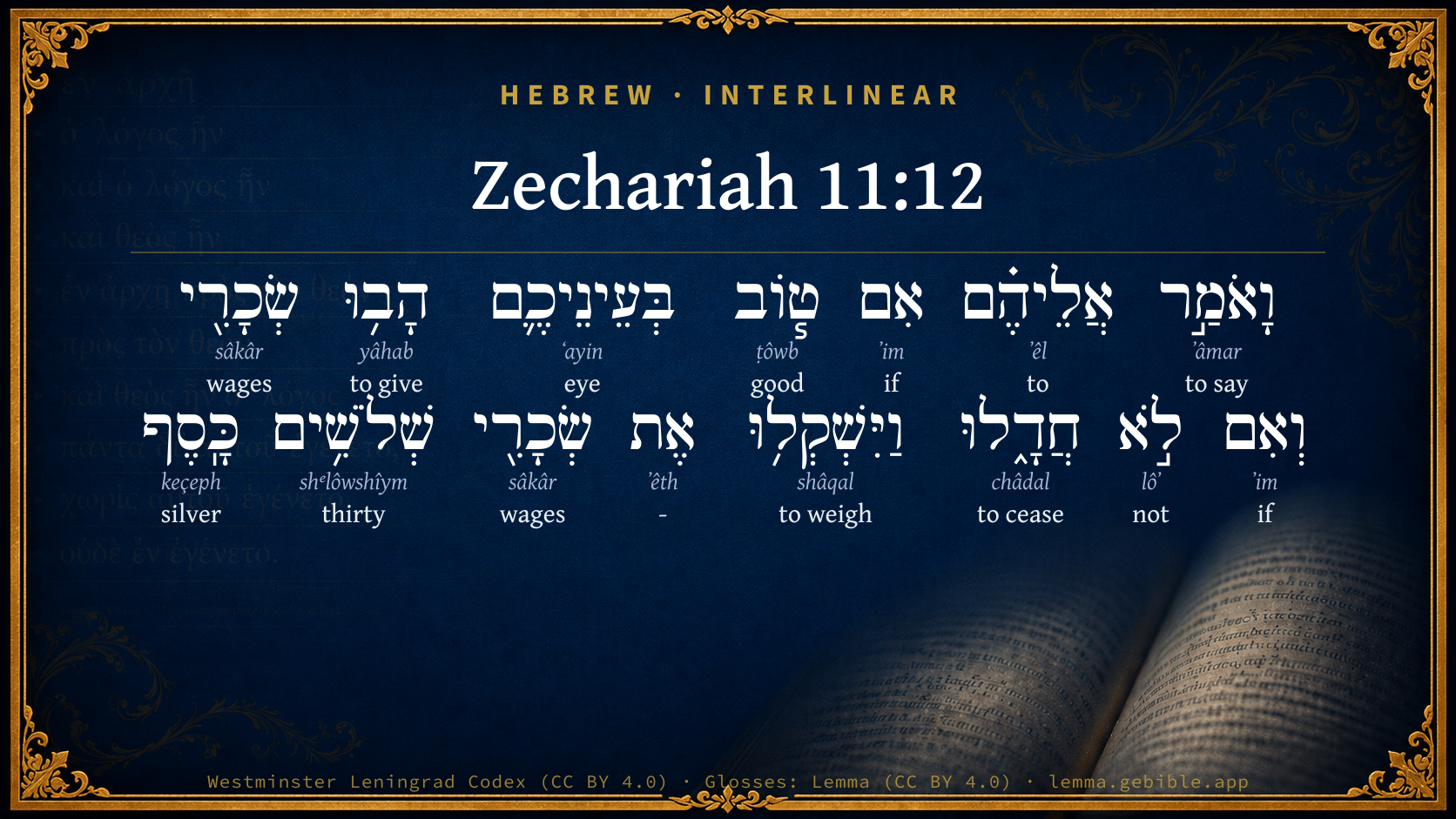
Hebrew (Westminster Leningrad Codex) Zechariah 11:12 appears in the Hebrew Old Testament. The text above is from the Westminster Leningrad Codex. Each word links to its Strong’s number, a concise gloss, and parsing drawn from the Open Scriptures Hebrew Bible morphology. Click any word for its full Brown-Driver-Briggs (BDB) entry.
Download image
Cite this verse

Zechariah 11:12 (World English Bible). Public Domain. Lemma interlinear Bible study tool, https://lemma.gebible.app/v/zechariah/11/12.

Show BibTeX & RIS
BibTeX
RIS
English Translation
I said to them, "If you think it best, give me my wages; and if not, keep them." So they weighed for my wages thirty pieces of silver.
World English Bible · Public Domain
Download a study sheet

One document with this verse’s original text, its word-by-word gloss line, the meaning frame, cross-references with their text, attributed commentary, and full source and license credits — printable, and it pastes into notes with its structure intact.

This verse Autodidact and up

Study sheet (.html) Plain text (.txt)

A passage Seminary Student

Up to 50 verses in one chapter. A passage sheet keeps up to 6 commentary sources and 12 cross-references per verse, in the order this page ranks them, and says so on the sheet whenever that leaves anything out. Ask for a single verse and you get the Autodidact verse sheet above.

Everything on this page stays free to read, with no account — the sheet is a download of what is already on screen, not access to it.

Want to remove ads? Support Godless Engineer
Compare translations 3

The same verse in 3 English versions, stacked beneath the original-language interlinear above. Click any original word for its lexicon entry.

Each is an independent rendering of the whole verse — the interlinear is not word-aligned to these translations.

Highlighted words mark where these versions differ — a whole-verse word diff, not a word-by-word alignment.

  • World English Bible Public Domain
    I said to them, "If you think it best, give me my wages; and if not, keep them." So they weighed for my wages thirty pieces of silver.
  • King James Version Public Domain
    And I said unto them, If ye think good, give me my price; and if not, forbear. So they weighed for my price thirty pieces of silver.
  • unfoldingWord Literal Text CC BY-SA 4.0
    I said to them, “If it seems good to you, pay me my wages. But if not, do not do it.” So they weighed out my wages—thirty of silver.

unfoldingWord Literal Text — © unfoldingWord, licensed CC BY-SA 4.0. Word-aligned USFM3 via Door43 (git.door43.org/unfoldingWord/en_ult).

Versions to compare (up to 4)

3 of 4 selected

Show all 18 translations

Every available English version of this verse, each an independent rendering of the whole verse.

  • World English Bible Public Domain
    I said to them, "If you think it best, give me my wages; and if not, keep them." So they weighed for my wages thirty pieces of silver.
  • Berean Standard Bible Public Domain
    Then I told them, “If it seems right to you, give me my wages; but if not, keep them.” So they weighed out my wages, thirty pieces of silver.
  • Majority Standard Bible Public Domain
    Then I told them, “If it seems right to you, give me my wages; but if not, keep them.” So they weighed out my wages, thirty pieces of silver.
  • King James Version Public Domain
    And I said unto them, If ye think good, give me my price; and if not, forbear. So they weighed for my price thirty pieces of silver.
  • American Standard Version (1901) Public Domain
    And I said unto them, If ye think good, give me my hire; and if not, forbear. So they weighed for my hire thirty `pieces' of silver.
  • Revised Version (1885) Public Domain
    And I said unto them, If ye think good, give me my hire; and if not, forbear. So they weighed for my hire thirty pieces of silver.
  • Geneva Bible (1599) Public Domain
    And I said vnto them, If ye thinke it good, giue me my wages: and if no, leaue off: so they weighed for my wages thirtie pieces of siluer.
  • Douay-Rheims (1899) Public Domain
    And I said to them: If it be good in your eyes, bring hither my wages: and if not, be quiet. And they weighed for my wages thirty pieces of silver.
  • Young's Literal Translation Public Domain
    And I say unto them: `If good in your eyes, give my hire, and if not, forbear;' and they weigh out my hire -- thirty silverlings.
  • Literal Standard Version CC BY-SA 4.0
    And I say to them: “If good in your eyes, give my hire, and if not, refrain”; and they weigh out my hire—thirty pieces of silver.
  • Unlocked Literal Bible CC BY-SA 4.0
    I said to them, “If it seems good to you, pay me my wages. But if not, do not do it.” So they weighed out my wages—thirty pieces of silver.
  • unfoldingWord Literal Text CC BY-SA 4.0
    I said to them, “If it seems good to you, pay me my wages. But if not, do not do it.” So they weighed out my wages—thirty of silver.
  • Darby Bible Public Domain
    And I said unto them, If ye think good, give [me] my hire; and if not, forbear. And they weighed for my hire thirty silver-pieces.
  • World Messianic Bible Public Domain
    I said to them, “If you think it best, give me my wages; and if not, keep them.” So they weighed for my wages thirty pieces of silver.
  • Webster's Bible Public Domain
    And I said to them, If ye think good, give me my price; and if not, forbear. So they weighed for my price thirty pieces of silver.
  • Free Bible Version CC BY-SA 4.0
    I told them, “If you want to pay me my wages, then do so. If not, then don't.” So they paid me my wages—thirty pieces of silver.
  • Bible in Basic English Public Domain
    And I said to them, If it seems good to you, give me my payment; and if not, do not give it. So they gave me my payment by weight, thirty shekels of silver.
  • JPS Tanakh (1917) Public Domain
    And I said unto them: 'If ye think good, give me my hire; and if not, forbear.' So they weighed for my hire thirty pieces of silver.

Literal Standard Version (2020), Covenant Press — licensed CC BY-SA 4.0. Text via the HelloAO Bible API (eBible.org). Unlocked Literal Bible (unfoldingWord) — licensed CC BY-SA 4.0. Text via the HelloAO Bible API (eBible.org). unfoldingWord Literal Text — © unfoldingWord, licensed CC BY-SA 4.0. Word-aligned USFM3 via Door43 (git.door43.org/unfoldingWord/en_ult). Free Bible Version, Dr. Jonathan Gallagher — licensed CC BY-SA 4.0. Text via the HelloAO Bible API (eBible.org).

Word by word

More ways to search: Search by grammar → Find every occurrence → Compare this word →

Practice this passage: Drill this verse → Learn its vocabulary →

וַיִּשְׁקְל֥וּ
shâqal
H8254
“and · to weigh”
Conjunction + Verb, Qal, Sequential Imperfect, 3rd Person, Masculine, Plural
Part of Speech
Conjunction + Verb
Stem
Qal
Form
Sequential Imperfect
Person
3rd Person
Gender
Masculine
Number
Plural
Full BDB Definition

Origin: a primitive root

TWOT: 2454

to weigh, weigh out, pay out - (Qal) - to weigh - to weigh out (a price) - of grief (figuratively) - (Niphal) - to be weighed - to be weighed out
  1. וָאֹמַ֣ר ʼâmar H559 “and · to say” Conjunction + Verb, Qal, Sequential Imperfect, 1st Person, Common, Singular
  2. אֲלֵיהֶ֗ם ʼêl H413 “to · them” Preposition + Suffix, Personal, 3rd Person, Masculine, Plural
  3. אִם ʼim H518 “if” Conjunction
  4. ט֧וֹב ṭôwb H2896 “good” Adjective, Adjective, Masculine, Singular, Absolute
  5. בְּעֵינֵיכֶ֛ם ʻayin H5869 “in/at · eyes · your” Preposition + Noun, Common, Both, Dual, Construct + Suffix, Personal, 2nd Person, Masculine, Plural
  6. הָב֥וּ yâhab H3051 “give” Verb, Qal, Imperative, 2nd Person, Masculine, Plural
  7. שְׂכָרִ֖י sâkâr H7939 “wages · my” Noun, Common, Masculine, Singular, Construct + Suffix, Personal, 1st Person, Common, Singular
  8. וְאִם ʼim H518 “and · if” Conjunction + Conjunction
  9. לֹ֣א lôʼ H3808 “not” Particle, Negative
  10. חֲדָ֑לוּ châdal H2308 “cease” Verb, Qal, Imperative, 2nd Person, Masculine, Plural
  11. אֶת ʼêth H853 “-” Particle, Direct Object
  12. שְׂכָרִ֖י sâkâr H7939 “wages · my” Noun, Common, Masculine, Singular, Construct + Suffix, Personal, 1st Person, Common, Singular
  13. שְׁלֹשִׁ֥ים shᵉlôwshîym H7970 “thirty” Adjective, Cardinal number, Both, Plural, Absolute
  14. כָּֽסֶף keçeph H3701 “silver” Noun, Common, Masculine, Singular, Absolute

About this verse

These counts appear in no published source. They are computed here, from the morphology-tagged text and Lemma’s own curated glosses. What Lemma adds →

15
words
13
distinct lemmas
Prophets
section

Notable vocabulary

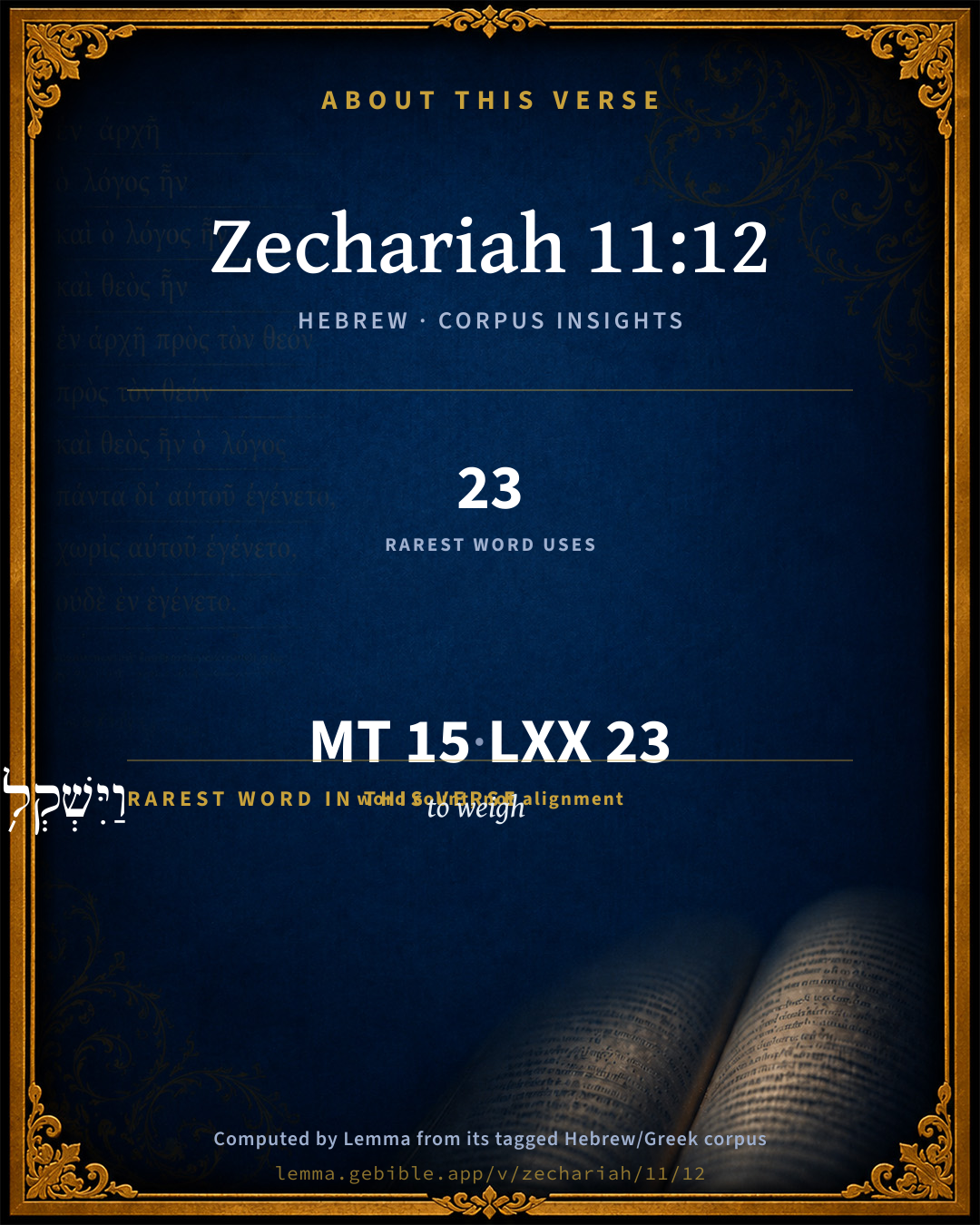
The rarest word here is וַיִּשְׁקְל֥וּ to weigh H8254 — appearing just 23 times in the whole Hebrew Bible.

Shared distinctive vocabulary

וַיִּשְׁקְל֥וּ to weigh H8254 occurs in 21 verses of the Hebrew Bible. Also found in:

Grammatical profile

  • 4 verbs
  • 4 nouns
  • 2 adjectives
  • 1 preposition
  • 2 conjunctions
  • 2 particles

Verb forms

  • וָאֹמַ֣ר Qal · Sequential Imperfect
  • הָב֥וּ Qal · Imperative
  • חֲדָ֑לוּ Qal · Imperative
  • וַיִּשְׁקְל֥וּ Qal · Sequential Imperfect

Repetition

Words recur within this verse — often emphatic in Hebrew:

  • שְׂכָרִ֖י wages H7939 ×2
  • אִם if H518 ×2

Hebrew & Septuagint length

In English translation the verse runs 28 words from the Hebrew and 30 from the Septuagint (LXX English) — closely comparable.

A rough comparison of the two English renderings, which tokenize alike — not a word-level alignment.

Word counts can differ between the Hebrew and the Greek without any difference in meaning — e.g. the Hebrew direct-object marker אֵת has no separate Greek word, and Greek often adds the article ὁ.

In the original languages it is 15 Hebrew tokens and 23 Greek tokens — but the two are counted differently (Hebrew bundles its prefixes and suffixes into one token; the Greek is in lemma form), so that isn’t a like-for-like length.

Cross-references

8

Topical passages linked to Zechariah 11:12 in the Treasury of Scripture Knowledge — connected by theme and wording, ordered by reader-vote popularity; previews shown in the World English Bible.

  • Matthew 26:15 and said, "What are you willing to give me, that I should deliver him to you?" They weighed out for him thirty pieces of silver.
  • Exodus 21:32 If the bull gores a man-servant or a maid-servant, thirty shekels of silver shall be given to their master, and the ox shall be stoned.
  • Mark 14:10–11 Judas Iscariot, who was one of the twelve, went away to the chief priests, that he might deliver him to them.
  • Luke 22:3–6 Satan entered into Judas, who was surnamed Iscariot, who was numbered with the twelve.
  • John 13:27–30 After the piece of bread, then Satan entered into him. Then Jesus said to him, "What you do, do quickly."
  • Genesis 37:28 Midianites who were merchants passed by, and they drew and lifted up Joseph out of the pit, and sold Joseph to the Ishmaelites for twenty pieces of silver. They brought Joseph into Egypt.
  • 1 Kings 21:2 Ahab spoke to Naboth, saying, Give me your vineyard, that I may have it for a garden of herbs, because it is near to my house; and I will give you for it a better vineyard than it: or, if it seem good to you, I will give you the worth of it in money.
  • John 13:2 After supper, the devil having already put into the heart of Judas Iscariot, Simon's son, to betray him,

Cross-references courtesy of OpenBible.info (CC BY 4.0).

Hebrew and Greek witnesses Masoretic Hebrew ↔ Greek Septuagint

The same verse in the two great witnesses to the Old Testament, shown verse-for-verse.

These are two independent witnesses, not word-aligned to each other, and the Septuagint is shown in lemma (dictionary) form.

Hebrew Zechariah 11:12 Masoretic · Westminster Leningrad Codex

וָאֹמַ֣ר אֲלֵיהֶ֗ם אִם ט֧וֹב בְּעֵינֵיכֶ֛ם הָב֥וּ שְׂכָרִ֖י וְאִם לֹ֣א חֲדָ֑לוּ וַיִּשְׁקְל֥וּ אֶת שְׂכָרִ֖י שְׁלֹשִׁ֥ים כָּֽסֶף

I said to them, "If you think it best, give me my wages; and if not, keep them." So they weighed for my wages thirty pieces of silver.

World English Bible · Public Domain

Greek LXX Zechariah 11:12 Septuagint · lemma form

καί εἶπον πρός αὐτός εἰ καλός ἐνώπιον σύ εἰμί δίδωμι ἵστημι ὁ μισθός ἐγώ ἤ ἀποεἶπον καί ἵστημι ὁ μισθός ἐγώ τριάκοντα ἀργυροῦς

And I will say to them, If it be good in your eyes, give me my price, or refuse it. And they weighed for my price thirty pieces of silver.

LXX2012 (modern English Septuagint) · Public Domain

Hebrew: Westminster Leningrad Codex (CC BY 4.0). Greek: Septuagint (public domain); English from LXX2012 (modern English Septuagint) (Public Domain). How the Septuagint differs from the Hebrew →

Targum (Aramaic paraphrase)

1

The Targum is the ancient Jewish Aramaic paraphrase of the Hebrew Scriptures — an interpretive translation, not the Hebrew text itself. Onkelos (literal) and Pseudo-Jonathan (expansive) render the Torah, and Jonathan the Prophets. Coverage is partial: where no permissively-licensed English translation exists for a verse, only the Aramaic is shown. This is verse-level text, not a word-by-word alignment to the Hebrew.

  1. Targum Jonathan Prophets (Joshua–Malachi)
    וַאֲמָרֵית לְהוֹן אִם תַקִין בְעֵינֵיכוֹן עֲבִידוּ רְעוּתִי וְאִם לָא אִתְמְנָעוּ וַעֲבָדוּ יַת רְעוּתִי גַבְרִין מִקְצַת:

    (no public-domain English translation for this verse)

    Targum Jonathan — Aramaic: “Mikraot Gedolot” (public domain). English: “Sefaria Community Translation” (CC0 1.0 (public-domain dedication)); “London "Chaldee Paraphrase," 1871” (public domain). Text via Sefaria.

Commentary

Notes on Zechariah 11:12 from classic Christian and Jewish commentators (each source and its license shown beneath its notes). The classic Christian expositions comment on the surrounding passage and are grouped to its opening verse, so a note may address several verses; the Jewish commentaries on the Tanakh (Rashi and others) are per-verse, so they appear only where the commentator wrote on this verse.

Lemma curates 59 commentaries, every one of them public domain or Creative Commons licensed, each selected and text-cleaned for this edition rather than reprinted as found. About our sources →

Trapp's Complete Commentary

John Trapp

Zec 11:12 And I said unto them, If ye think good, give [me] my price; and if not, forbear. So they weighed for my price thirty [pieces] of silver.

Ver. 12. If ye think good, give me my price] Pay me for my pains, lay me down my shepherd’s wages. Is not the labourer worthy of his hire? Shall I be forced to say of you, as my servant David of Nabal, that unthankful churl, "Surely in vain have I kept all that this fellow had in the wilderness, so that nothing was missed of all that pertained unto him: and he hath requited me evil for good," 1Sa 25:21. If God will be David’s shepherd, David will dwell in God’s house to all perpetuity, Psa 23:1; Psa 23:6. If the Lord deal bountifully with him, he will sit down and bethink himself what to render unto the Lord for all his benefits, Psa 116:7; Psa 116:12. A Christian counts all that he can do for God, by way of retribution, but a little of that much he could beteem him; and thinks nothing more unbeseeming himself than to receive the grace of God in vain. His two mites of thankfulness and obedience he daily presents; and then cries out, as the poor Grecian did to the emperor, If I had a better present thou shouldst be sure of it (Eι πλεον ειχον πλεον εδιδουν). But ingratitude is a grave, which receives all the bodies (the benefits) that are put into it; but will render none up again without a miracle. Hence that passionate expostulation, Deu 32:6 "Do ye thus requite the Lord, O ye foolish people and unwise?" Sic etiam stomachose loquitur Deus hoe loeo, saith Calvin upon this text: i.e. So likewise doth the Lord here in high displeasure and with great animosity or stomach, bespeak his people, Give me my wages howsoever; or, if not, forbear till I fetch it, till I recover it; you shall be sure to pay then, not the debt only, but the charges likewise; I will be paid both for my pains and patience too. In the mean space I need you not, nor care for your wages; for I am no hireling, &c.

So they weighed for my price thirty pieces of silver] That is, thirty shekels, or shillings. The price of a slain servant’s life, Exo 21:32. This they weighed, as the manner of paying money then was, Gen 23:16 Jer 32:9. But they heaved their hands very high, it seems, when they valued the Lord Christ at so vile a rate. See Mat 26:15. {See Trapp on "Mat 26:15"}

John Trapp, A Commentary or Exposition upon All the Books of the Old and New Testament (1647–1656) — public domain. Text from a community e-Sword module.

Joseph Benson's Commentary

Zec 11:12-13. And I said unto them — Namely, upon parting. The prophet, still personating Christ, or acting as a type of him, reminds the Jews of his concern for their welfare, the care he had taken of them, and the labour he had bestowed on instructing them; and refers it to them whether his services had not deserved some reward, and, if they had, what that reward ought to be; saying, If ye think good, give me my price — Or rather, my wages or hire of service, as the word שׂכרundoubtedly signifies; and if not, forbear — If you dismiss me without wages I shall be content. So they weighed for my price thirty pieces of silver — That is, as is supposed, thirty shekels, of the value of about 2 Samuel 4 d. each, which was the price of a slave. This showed how little they regarded him, or his labours; that is, how little value the Jews would put on the ministry of Christ; or on his labours and sufferings for their salvation. For, according to St. Mat 26:15; Mat 27:9, this symbolical action was fulfilled when the chief priests and elders of the Jews paid that sum to Judas for betraying Christ to them, and putting his life in their power. And the Lord said unto me — Unto the prophet, personating Christ; Cast it unto the potter — Hereby intimating that it was a reward only suitable to a potter’s labour, and a price only adequate for such wares as he sold, which were of the meanest value. A goodly price that I was prized at of them — Thus the prophet ironically remarks on the high estimation in which he and his services were holden: or rather, God here upbraids the shepherds of his people, who prized the great Shepherd no higher. And I cast them to the potter, &c. — Or, cast them into the house of the Lord for the potter: I cast them back into the treasury in the temple, whence afterward they were taken, and laid out in purchasing the potter’s field. This whole transaction, performed by Zechariah in a vision, as Lowth, Doddridge, and many other interpreters suppose, or, as others think, in reality; “was designed to be an exact representation of the several circumstances that should attend the betraying of Christ by Judas, the price the chief priests would put upon him, (to whom, as the governors of the temple, the money was returned,) and the use to which the money would be applied. And this whole prophetic scene was transacted in the single person of Zechariah, just as Ezekiel sustained the type or figure both of the Chaldean army that should besiege Jerusalem, and of the Jews themselves that should be besieged, Eze 4:1-12.” So Lowth, who adds, “This is one of those prophecies whose literal sense is fulfilled in our blessed Saviour, and cannot be applied to any other person but in a very remote or improper sense.” The like instances may be seen Psa 22:16-18; Psa 69:21; Hos 11:1. The Jews themselves have expounded this prophecy of the Messiah. “There can be no doubt,” says Blayney, “that this is the passage referred to Mat 27:9, though under the name of Jeremiah, (put by mistake of some transcriber of St. Matthew’s gospel,) instead of Zechariah. But a question arises, how the transaction related by the evangelist can be said to be a fulfilling of that which was spoken by the prophet, considering the striking difference in some of the circumstances. In the one case, thirty pieces of silver were given as wages for service; in the other, they were paid as the price of a man’s blood: in the one they were thrown with contempt to the potter; in the other, they were cast down in the temple in a fit of remorse, and taken up by others, who employed them in the purchase of the potter’s field. But notwithstanding these differences, considering that all passed under the special direction of Divine Providence, it is impossible not to conclude, from a review of both transactions, that there was a designed allusion of the one to the other, and not a mere accidental resemblance between them. But the quotation, it is said, is not just: for no such words are to be found in the prophet, which the evangelist hath pretended to cite from him. To this it may be answered, that though not the precise words, the substance of them is given, so that the passages are at least equivalent,” as a collation of them in the original will show: see the note on Mat 27:9.

Joseph Benson's Commentary on the Old and New Testaments (1811–1818) — public domain. Text from a community e-Sword module.

The Preacher's Complete Homiletical Commentary

Joseph S. Exell (gen. ed.)

CRITICAL NOTES.

Zec_11:12. Good] “He served them, not for wages, but in obedience to the Divine will.” Wages, however, were due; the price of a slave offered.

Zec_11:13.] It was contemptuously rejected. Jehovah regards the wages offered to himself. Goodly] Noble price, ironical. Potter] As worthless.

Zec_11:14.] Worse evil threatened than the former. Second, utter breaking up of the nation, and loss of fraternal unity.

THE SHEPHERD’S PRICE.—Zec_11:12-14

The prophet, representing Jehovah, demands the price for his services. The Jews were God’s peculiar people, blessed above all others, and should have made grateful return. But they offered forms for sincerity, added injury to insult, and sold the Messiah for thirty pieces of silver.

I. A price of their own rating. “If ye think good, give me my price; and if not, forbear.” As their servant, he sought their love and obedience. He will not force, but leave it to free-will. If men withhold what is due, God will not constrain them to give. His goodness should bind us to love him. “Love sought is good, but given unsought is better” [Shakespeare].

II. A price most contemptible. “They weighed, for my price, thirty pieces of silver.” They gave him the price of a bond-servant, half the value of a free-man—the compensation for a slave that had been killed (Exo_21:32; Mat_26:15). “A goodly price”—a splendid value that has been set upon me! Good men are not half valued in the world. What wonder when Christ, the Son of God, was sold so cheaply!

III. A price rejected by the Shepherd. “Cast it unto the potter.” The most suitable person to whom to cast the despicable sum, who plies his trade in the valley of polluted clay (2Ki_23:10). An action significant of the mind of God, and the doom of the people. God values our smallest service if offered in sincerity, but contempt of his Son will meet with death.

IV. A price which brought Jehovah’s displeasure upon them. “Then I cut asunder mine other Staff” (Zec_11:14). The shameful payment by the people leads to the abandonment to their fate. Fraternal unity is dissolved, and the nation is broken up into self-destroying parties. When schisms rend the Church, and factions break the peace of a people, we may see the withdrawal of the Shepherd’s care, and the presage of the nation’s doom. “When the staff of Beauty is broken the staff of Bands will not hold long. An unchurched people will soon be an undone people.”

HOMILETIC HINTS AND SUGGESTIONS

Zec_11:12. If ye think good. The demand an appeal to men, to give them opportunity of reasoning, explaining their conduct, and appreciating God’s kindness.

1. God lays men under great obligation by his love; makes them indebted to him.

2. Men should make some return to God. Not because they enrich God, but as proof of their affection.

3. God seeks return. “Give me my price.” He will not enforce it, but leave the consequences with men.

“Thus saith the Lord God, He that heareth let him hear, and he that forbeareth let him forbear.”

Zec_11:13 (cf. Mat_27:3-10). There are points of diversity between the two transactions—that in the Prophet, and that in the Evangelist. There are points, too, of similarity; and in these the allusive type is to be considered as lying. The “price”—reward or hire—given to the prophet, in the vision, represented the slight value set upon his person and official services. So did the same price, put upon the head of a greater than Zechariah or any of the prophets, testify the low value they set upon him and his Divinely-attested ministrations and work. The identity of “the price;” the principle, or want of principle, shown in its pitiful diminutiveness; and the giving of each to “the potter,” are the chief points of resemblance, in which the treatment of the prophet was a prophetic prefiguration of the treatment of him “of whom Moses in the law and the prophets did write.” However indirect and obscure the prefiguration might be, we are not to regard the reference by Matthew as a mere accommodation. There was in what befell the prophet a designed foreshadowing of what in the future should befall the prophet’s Lord [Wardlaw].

House. They are his most guilty adversaries who, like the Jews in Jesus’ days on earth, and like apostate Christians in our days, are so “in the house of the Lord” [Fausset].

Zec_11:14. Cut. God seems to say that he will now no more govern this people in mildness and clemency, nor yet exercise his shepherdly severity in saving corrections and visitations, as formerly he had done; but utterly reject and disject them [Trapp].

ILLUSTRATIONS TO CHAPTER 11

Zec_11:12-13. Price. The influence of money on a man will be according to the man’s state of mind; according to the condition of his heart and affections, his estimate and plan of life [Binney].

Zec_11:14. Brotherhood. Let us keep the unity of the Spirit in the bond of peace. Let this soft and silken knot of love tie our hearts together: though our heads and apprehensions cannot meet, as indeed they never will, but always stand at some distance off from one another [Cadworth].

The Preacher's Complete Homiletical Commentary (gen. ed. Joseph S. Exell; Funk & Wagnalls, c. 1892) — public domain (pre-1929). A full-Bible homiletical/sermon-outline anthology covering 65 of 66 books (2 John is absent from the source module). Text from a community e-Sword module.

Keil & Delitzsch

C. F. Keil & F. Delitzsch

With the breaking of the staff Favour, the shepherd of the Lord has indeed withdrawn one side of his pastoral care from the flock that he had to feed, but his connection with it is not yet entirely dissolved. This takes place first of all in Zac 11:12-14, when the flock rewards him for his service with base ingratitude. Zac 11:12. "And I said to them, If it seem good to you, give me my wages; but if not, let it alone: and they weighed me as wages thirty silverlings. Zac 11:13. Then Jehovah said to me, Throw it to the potter, the splendid price at which I am valued by them; and so I took the thirty silverlings, and threw it into the house of Jehovah to the potter. Zac 11:14. And I broke my second staff Bands, to destroy the brotherhood between Judah and Israel." אליהם (to them), so far as the grammatical construction is concerned, might be addressed to the wretched among the sheep, inasmuch as they were mentioned last. But when we bear in mind that the shepherd began to feed not only the wretched of the sheep, but the whole flock, and that he did not give up any one portion of the flock by breaking the staff Favour, we are forced to the conclusion that the words are addressed to the whole flock, and that the demand for wages is only intended to give the flock an opportunity for explaining whether it is willing to acknowledge his feeding, and appreciate it rightly. The fact that the prophet asks for wages from the sheep may be explained very simply from the fact that the sheep represent men. The demand for wages is not to be understood as implying that the shepherd intended to lay down his office as soon as he had been paid for his service; for in that case he would have asked for the wages before breaking the first staff. But as he does not ask for it till afterwards, and leaves it to the sheep to say whether they are willing to give it or not ("if it seem good to you"), this demand cannot have any other object than to call upon the sheep to declare whether they acknowledge his service, and desire it to be continued. By the wages the commentators have very properly understood repentance and faith, or piety of heart, humble obedience, and heartfelt, grateful love. These are the only wages with which man can discharge his debt to God. They weighed him now as wages thirty shekels of silver (on the omission of sheqel or keseph, see Ges. 120, 4, Anm. 2). "Thirty," - not to reward him for the one month, or for thirty days - that is to say, to give him a shekel a day for his service (Hofm., Klief.): for, in the first place, it is not stated in Zac 11:8 that he did not feed them longer than a month; and secondly, a shekel was not such very small wages for a day's work, as the wages actually paid are represented as being in Zac 11:13. They rather pay him thirty shekels, with an allusion to the fact that this sum was the compensation for a slave that had been killed (Exo 21:32), so that it was the price at which a bond-slave could be purchased (see at Hos 3:2). By paying thirty shekels, they therefore give him to understand that they did not estimate his service higher than the labour of a purchased slave. To offer such wages was in fact "more offensive than a direct refusal" (Hengstenberg). Jehovah therefore describes the wages ironically as "a splendid value that has been set upon me."

As the prophet fed the flock in the name of Jehovah, Jehovah regards the wages paid to His shepherd as paid to Himself, as the value set upon His personal work on behalf of the nation, and commands the prophet to throw this miserable sum to the potter. But the verb hishlı̄kh (throw) and the contemptuous expression used in relation to the sum paid down, prove unmistakeably that the words "throw to the potter" denote the actual casting away of the money. And this alone is sufficient to show that the view founded upon the last clause of the verse, "I threw it into the house of Jehovah to the potter," viz., that hayyōtsēr signifies the temple treasury, and that yōtsēr is a secondary form or a copyist's error for אוצר, is simply a mistaken attempt to solve the real difficulty. God could not possibly say to the prophet, They wages paid for my service are indeed a miserable amount, yet put it in the temple treasury, for it is at any rate better than nothing. The phrase "throw to the potter" (for the use of hishlı̄kh with 'el pers. compare Kg1 19:19) is apparently a proverbial expression for contemptuous treatment (= to the knacker), although we have no means of tracing the origin of the phrase satisfactorily. Hengstenberg's assumption, that "to the potter" is the same as to an unclean place, is founded upon the assumption that the potter who worked for the temple had his workshop in the valley of Ben-hinnom, which, having been formerly the scene of the abominable worship of Moloch, was regarded with abhorrence as an unclean place after its defilement by Josiah (Kg2 23:10), and served as the slaughter-house for the city. But it by no means follows from Jer 18:2 and Jer 19:2, that this potter dwelt in the valley of Ben-hinnom; whereas Jer 19:1, Jer 19:2 lead rather to the opposite conclusion. If, for example, God there says to Jeremiah, "Go and buy a pitcher of the potter (Jer 19:1), and go out into the valley of Ben-hinnom, which lies in front of the potter's gate" (Jer 19:2), it follows pretty clearly from these words that the pottery itself stood within the city gate. But even if the potter had had his workshop in the valley of Ben-hinnom, which was regarded as unclean, he would not have become unclean himself in consequence, so that men could say "to the potter," just as we should say "zum Schinder" (to the knacker); and if he had been looked upon as unclean in this way, he could not possibly have worked for the temple, or supplied the cooking utensils for use in the service of God - namely, for boiling the holy sacrificial flesh. The attempts at an explanation made by Grotius and Hofmann are equally unsatisfactory. The former supposes that throwing anything before the potter was equivalent to throwing it upon the heap of potsherds; the latter, that it was equivalent to throwing it into the dirt. But the potter had not to do with potsherds only, and potter's clay is not street mire. The explanation given by Koehler is more satisfactory; namely, that the meaning is, "The amount is just large enough to pay a potter for the pitchers and pots that have been received from him, and which are thought of so little value, that men easily comfort themselves when one or the other is broken." But this does not do justice to hishlı̄kh involves the idea of contempt, and earthen pots were things of insignificant worth. The execution of the command, "I threw it ('ōthō, the wages paid me) into the house of Jehovah to the potter," cannot be understood as signifying "into the house of Jehovah, that it might be taken thence to the potter" (Hengstenberg). If this were the meaning, it should have been expressed more clearly. As the words read, they can only be understood as signifying that the potter was in the house of Jehovah when the money was thrown to him; that he had either some work to do there, or that he had come there to bring some earthenware for the temple kitchens (cf. Zac 14:20). This circumstance is not doubt a significant one; but the meaning is not merely to show that it was as the servant of the Lord, or in the name and by the command of Jehovah, that the prophet did this, instead of keeping the money (Koehler); for Zechariah could have expressed this in two or three words in a much simpler and clearer manner. The house of Jehovah came into consideration here rather as the place where the people appeared in the presence of their God, either to receive or to solicit the blessings of the covenant from Him. What took place in the temple, was done before the face of God, that God might call His people to account for it.

Keil & Delitzsch — Biblical Commentary on the Old Testament (1861–1891) — public domain (CC PDM 1.0). Text via the HelloAO Bible API. (Old Testament only.)

Tyndale Open Study Notes

Tyndale Open Resources

11:12 Thirty pieces of silver was the price of a slave (see Exod 21:32). In the allegory, the silver was severance pay for the shepherd (Zech 11:9). The Gospel writers find the fulfillment of this passage in the betrayal of Jesus for thirty silver coins by Judas (see Matt 26:15; 27:9-10).

Tyndale Open Study Notes — © Tyndale Open Resources, licensed CC BY-SA 4.0. Text via the HelloAO Bible API.

Geneva Bible (1599)

Geneva Bible translators

Besides their ingratitude God accuseth them of malice and wickedness, which did not only forget his benefits, but esteemed them as things of naught.

Geneva Bible (1599) marginal notes — public domain. Text via Bolls.life.

Jamieson, Fausset & Brown

Robert Jamieson, A. R. Fausset & David Brown

I said--The prophet here represents the person of Jehovah-Messiah.

If ye think good--literally, "If it be good in your eyes." Glancing at their self-sufficient pride in not deigning to give Him that return which His great love in coming down to them from heaven merited, namely, their love and obedience. "My price"; my reward for pastoral care, both during the whole of Israel's history from the Exodus, and especially the three and a half years of Messiah's ministry. He speaks as their "servant," which He was to them in order to fulfil the Father's will (Phi 2:7).

if not, forbear--They withheld that which He sought as His only reward, their love; yet He will not force them, but leave His cause with God (Isa 49:4-5). Compare the type Jacob cheated of his wages by Laban, but leaving his cause in the hands of God (Gen 31:41-42).

So . . . thirty pieces of silver--thirty shekels. They not only refused Him His due, but added insult to injury by giving for Him the price of a gored bond-servant (Exo 21:32; Mat 26:15). A freeman was rated at twice that sum.

Jamieson, Fausset & Brown — Commentary Critical and Explanatory on the Whole Bible (1871) — public domain (CC PDM 1.0). Text via the HelloAO Bible API.

Adam Clarke's Commentary

Verse 12. If ye think good, give me my price] "Give me my hire." And we find they rated it contemptuously; thirty pieces of silver being the price of a slave, Ex 21:32.

Adam Clarke's Commentary on the Bible (1810–1826) — public domain. Text from a community e-Sword/MySword module.

John Calvin's Commentaries

God now adds another crime, by which he discovers the wickedness of the people; for they estimated all the labor he had bestowed at a cry insignificant price. He had before complained of ingratitude; but more fully detected was the iniquity and baseness of the people, when they thus regarded as of no value the inestimable favor of God towards them. What the Prophet then says now is — that God at last tried them so as to know whether his benefits were of any account among the Jews, and that it had been fully found out, that all the labor and toil employed in their behalf, had been ill-spent and wholly lost. That Zechariah now speaks in his own person, and then introduces God as the speaker, makes no difference, as we said yesterday, as to the main subject; for his object is to set forth how shamefully the Jews had abused the favor of God, and how unjustly they had despised it. And yet he speaks as God’s minister; for God not only governed that people himself, but also endued with the power of his Spirit many ministers, who undertook the office of shepherds.

He then says, that he came (and what is said properly belongs to God) to the people and demanded a reward, Give me, he says, a reward; if not, forbear He expresses here the highest indignation, as though one upbraided the wickedness and ingratitude of his neighbor and said, “Own my kindness, if you please; if not, let it perish: I care not; I see that you are wholly worthless and altogether unworthy of being so liberally treated: I therefore make no account of thy compensations; but at the same time it behaves thee to consider how much thou art indebted to me.” So now does God in high displeasure speak here: “Give me at least a reward, that I may not have served you for nothing: you have misused my labor, I have borne with many wrongs and annoyances in ruling you; what is to be the compensation for my solicitude and care? I indeed make no account of a reward, for I am not a mercenary.” He then adds, that they gave him thirty silverings He mentions this no doubt as a mean price, intimating, that they wished by such a small sum to compensate for the many and inestimable favors of God; as when one hires a swineherd or a clown, he gives a paltry sum as his wages; so the Jews, as the Prophet says, acted towards God. At the same time by the mean price, a suitable reward only to a clown, he means those frivolous things by which the Jews thought to satisfy God: for we know how diligent they were in performing their ceremonies, as though indeed these were a compensation that was of any value with God! He requires integrity of heart, and he gives himself to us, that he may in return have us as his own. This then was the price of labor which the Lord had deserved. It would have been a suitable reward had the Jews devoted themselves wholly to him in obedience to his word. But what did they do? They sedulously performed ceremonies and other frivolous things. This then was a sordid reward, as though they sought to put him off with the reward of a swineherd.

John Calvin's Commentaries (1540-1563) — public domain. Text from the Calvin Translation Society English edition (1840s-50s) via the Christian Classics Ethereal Library (ccel.org). Calvin's coverage is partial (roughly two-thirds of the Bible); uncommented books and verses are honest gaps, never fabricated. The 19th-century editor's footnotes and remarks are omitted so the notes are faithfully Calvin's own voice.

Ellicott's Commentary for English Readers

(12) My price.—The shepherd demands a requital for his toil, as a test of the gratitude of the sheep.

And if not, forbear.—Comp. Eze_3:27, &c. God does not force our will, which is free. He places life and death before us; by His grace alone we can choose Him, but we can refuse His grace and Himself.

Thirty pieces of silver.—The price set on a foreign slave (Exo_21:32).

A Bible Commentary for English Readers, edited by Charles John Ellicott (1878–1897) — public domain. Text from a community e-Sword module.

The Cambridge Bible for Schools and Colleges

gen. ed. J. J. S. Perowne

12. price] Rather, wages, or hire, R. V. This demand is made by the prophet not “in order to try whether the people would submit themselves further to his guidance” (Wright), but to signify the complete abandonment of his office of shepherd. It is as much as to say, “I will be no more your shepherd: give me therefore my wages, that I may go my way.” It is further designed to bring out in bold relief the mutual aversion and contempt, that had sprung up between the shepherd and the flock (Zec_11:8). He asks as one who cares not whether his request be granted: “Give, or forbear.” They reply by a gift more insulting than refusal.

forbear] “ne date; q.d. non sum de mercede admodum sollicitus, licet jure mihi debeatur. Exprimit summam indignationem, ut si quis alicui suam ingratitudinem exprobrat.” Rosenm.

thirty pieces of silver] The value of a slave. Exo_21:32. Comp. Hos_3:2.

The Cambridge Bible for Schools and Colleges (gen. ed. J. J. S. Perowne; Cambridge University Press, 1878–1918) — public domain. Text from a community e-Sword module.

John Gill's Exposition

And I said unto them, If ye think good,.... Not to the poor of the flock that waited on him, and knew the word of the Lord, and valued it; but to the other Jews that despised Christ and his Gospel:

give me my price; or, "give my price" (i); what I am valued at by you, to Judas the betrayer: or the price due unto him for feeding the flock, such as faith in him, love to him, reverence and worship of him. So the Targum paraphrases it, "do my will". Kimchi says the price is repentance, and good works:

and if not, forbear; unless all is done freely, willingly, and cheerfully; see Eze 2:5 or, if worth nothing, give nothing:

So they weighed for my price thirty pieces of silver; the price a servant was valued at, Exo 21:32 see the fulfilment of this prophecy in Mat 26:15. The Jews own (k) that this prophecy belongs to the Messiah; but wrongly interpret it of thirty precepts given by him: in just retaliation and righteous judgment, thirty Jews were sold by the Romans for a penny, by way of contempt of them (l).

(i) "date mercedem meam", Vatablus, Calvin, Junius & Tremellius, Piscator, Cocceius. (k) Bereshit Rabba, sect. 98. fol. 85. 3. (l) Egesippus de Urb. excidio Anacep. p. 680.

John Gill's Exposition of the Whole Bible (1746–1763) — public domain (CC PDM 1.0). Text via the HelloAO Bible API.

Albert Barnes' Notes on the Bible

And I said unto them, If ye think good, give Me My price - God asks of us a return, not having any proportion to His gifts of nature or of grace, but such as we can render. He took the Jews out of the whole human race, made them His own, “a peculiar people,” freed them from “the bondage and the iron furnace of Egypt,” gave them “the land flowing with milk and honey,” fed and guarded them by His Providence, taught them by His prophets. He, the Lord and Creator of all, was willing to have them alone for His inheritance, and, in return, asked them to love Him with their whole heart, and to do what He commanded them. “He sent His servants to the husbandmen, that they might receive the fruits of the vineyard; and the husbandmen took His servants, and beat one, and killed another, and stoned another. Last of all, He sent unto them His Son” Mat 21:34-37, to ask for those fruits, the return for all His bounteous care and His unwearied acts of power and love. o “Give Me,” He would say, “some fruits of piety, and tokens of faith.”

Osorius: “What? Does He speak of a price? Did the Lord of all let out His toil? Did He bargain with those, for whom he expended it for a certain price? He did. He condescended to serve day and night for our salvation and dignity; and as one hired, in view of the reward which He set before Him, to give all His care to adorn and sustain our condition. So He complains by Isaiah, that He had undergone great toil to do away our sins. But what reward did He require? Faith and the will of a faithful heart, that thereby we might attain the gift of righteousness, and might in holy works pant after everlasting glory. For He needeth not our goods; but He so bestoweth on us all things, as to esteem His labor amply paid, if He see us enjoy His gifts. But tie so asketh for this as a reward, as to leave us free, either by faith and the love due, to embrace His benefits, or faithlessly to reject it. This is His meaning, when He saith,”

And if not, forbear - God does not force our free-will, or constrain our service. He places life and death before us, and bids us choose life. By His grace alone we can choose Him; but we can refuse His grace and Himself. “Thou shalt say unto them,” He says to Ezekiel, “Thus saith the Lord God, He that heareth, let him hear, and he that forbeareth, let him forbear” (Eze 3:27; add Eze 2:5, Eze 2:7; Eze 3:11). This was said to them, as a people, the last offer of grace. It gathered into one all the past. As Elijah had said, “If the Lord be God, follow Him; but if Baal, then follow him” 1Ki 18:21; so He bids them, at last to choose openly, whose they would be, to whom they would give their service; and if they would refuse in heart, to refuse in act also. “Forbear,” cease, leave off, abandon; and that forever.

So they weighed for My price thirty pieces of silver - The price of a slave, gored to death by an ox Exo 21:32. Whence one of themselves says, o, “you will find that a freeman is valued, more or less, at 60 shekels, but a slave at thirty.” He then, whom the prophet represented, was to be valued at “thirty pieces of silver.” It was but an increase of the contumely, that this contemptuous price was given, not to Him, but for Him, the Price of His Blood. It was matter of bargain. “Judas said, What will ye give me, and I will deliver Him unto you?” Mat 26:15. The high priest, knowingly or unknowingly, fixed on the price, named by Zechariah. As they took into their mouths willingly the blasphemy mentioned in the Psalm; “they shoot out the lip, they shake the head, saying, He trusted in the Lord, that He would deliver Him; let Him deliver Him, seeing that He delighted in Him” Psa 22:7-8; so perhaps they fixed on the “thirty pieces of silver,” because Zechariah had named them as a sum offered in contumely to him, who offered to be a shepherd and asked for his reward.

Albert Barnes' Notes on the Bible (1834–1885) — public domain. Text from a community e-Sword/MySword module.

Haydock's Catholic Bible Commentary

Pieces. Sicles are usually understood. About fifty-one livres. The Jews bought the life of Christ for this sum; (Calmet) thirty pieces. (Worthington)

George Leo Haydock (1774–1849), Haydock's Catholic Family Bible and Commentary, 1859 edition — public domain. Excludes Psalms (Douay-Rheims chapter numbering differs from Protestant) and Deuterocanonical books (Catholic canon only).

Matthew Poole's English Annotations

And I said unto them; upon parting, Christ seems after the manner of men to mind them of his pains and care for them, and would have them reckon with him.

If ye think good: he puts it to them whether they thought he deserved aught at their hands, and what it was.

Give me my price; though I need not your money or pay, I deserve more than you will give, and therefore do in this as liketh you.

So they, the rulers of the Jews, the high priest, chief priests, and Pharisees,

weighed, which was the manner of paying money in those days,

thirty pieces of silver; which amounts to thirty-seven shillings and sixpence, the value of the life of a slave, Exo 21:32; this was fulfilled when they paid Judas Iscariot so much to betray Christ, Mat 26:15; 27:9.

Matthew Poole's English Annotations on the Holy Bible (1683–1685) — public domain. Text from a community e-Sword/MySword module.

The Pulpit Commentary

I said. The prophet is speaking in the person of the great Shepherd. Unto them. Unto the whole flock. Give me my price; my wages. He asks his hire of the flock, because the flock represents men. Acting far differently from the wicked shepherds, he used no violence or threats. He gives them this last opportunity of showing their gratitude for all the care bestowed upon them, and their appreciation of his tenderness and love. The wages God looked for were repentance, faith, obedience, or, in another view, themselves, their life and soul. It was for their sake he required these, not for his own. If not, forbear. He speaks with indignation, as conscious of their ungrateful contempt. Pay me what is due, or pay me not. I leave it to you to decide. I put no constraint upon you. So God has given us free will; and we can receive or reject his offers, as we are minded. So they weighed for my price thirty pieces of silver. This paltry remuneration displayed the people"s ingratitude and contempt. It was the compensation offered by the Law to a master for the loss of a slave that had been killed. (Exo_21:32) It was, perhaps, double the pries of a female slave; (Hos_3:2) and the very offer of such a sum was an insult, and, says Dr. Alexander, "suggested an intention to compass his death. They despised his goodness; they would have none of his service; they sought to cut him off; and they were ready to pay the penalty which the Law prescribed for the murder of one of so mean a condition." The word "weigh" was used in money transactions even after the use of coined money rendered weighing unnecessary.

Vers. 12-14. A model spiritual teacher.

"And I said unto them, If ye think good, give me my price; and if not, forbear. So they weighed for my price thirty pieces of silver. And the Lord said unto me, Cast it unto the potter: a goodly price that I was prised at of them. And I took the thirty pieces of silver, and cast them to the potter in the house of the Lord." Why these words should have been referred to by the Evangelist Matthew, (Mat_27:9, Mat_27:10) and applied to Christ and Judas, I cannot explain. Nor can any one else, judging from the conflicting interpretations of biblical critics. Matthew not only misquotes the words, but ascribes them to Jeremiah, and not to Zechariah. The probability is that the "thirty pieces of silver" and the "potter"s field," in connection with Judas, reminded the evangelist of these words, brought them to his memory, and from his memory he quotes them; for he gives them very incorrectly, neither according to the Greek version nor the original Hebrew. As the words, as they stand here, have a historical meaning entirely independent of St. Matthew"s application of them, they may be fairly employed to illustrate a model spiritual teacher in relation to secular acknowledgments of his teachings. Three things are suggested concerning the shepherd in this capacity.

I HE LEAVES THE SECULAR ACKNOWLEDGMENT TO THE FREE CHOICE OF THOSE TO WHOM HIS SERVICES HAVE BEEN RENDERED. "And I said unto them, If ye think good, give me my price; and if not, forbear." He does not exact anything, nor does he even suggest any amount. He leaves the matter entirely to themselves, give or not give, give this amount or that. This is as it should be. Ministers, whilst they have a Divine claim to a secular remuneration of their services, are neither authorized nor are they disposed, if they are true teachers, to enforce their claims upon the reluctant. "We have not used this power," says Paul. (see 1Co_9:9-17) It may be asked Why should the temporal support of the spiritual teacher be left entirely to the choice of the people?

1. Because contributions that are entirely free are the only proofs to the minister that his services are really valued. What proof is there in the amounts raised by tithes or rates, or, as in some Nonconformist Churches, by diaconate guarantees, that the service of the existing minister has been really valued?

2. Because the contributions that are entirely free arc the only contributions that are of any moral worth. Those who give from custom or law, or in any way reluctantly, without a "willing mind," have no claim to moral credit; their contributions, however large, are counted worthless in the empire of virtue.

II HIS SPIRITUAL SERVICES ARE SOMETIMES SHAMEFULLY UNDERRATED, "So they weighed for my price thirty pieces of silver." Thirty shekels. An amount in our money of about 3s. 9d. This was the price they put on his services, just the price paid for a bond-servant. (Exo_21:32)

1. Do not determine the real worth of a spiritual teacher by the amount of his stipend. This is often done: all fools do this. Yet who does not know ministers who get for their labours a year who are of far higher character, and render nobler services than many who get their and even The fact is, the minister who wants a large income, as a rule, must get a large congregation; and he who would get a large congregation must pander to popular prejudices and tastes.

2. Deplore the backwardness of the world in appreciating the highest services. The highest service one man can render another is the impartation of those Divine ideas that will most quicken, invigorate, and ennoble his mind. But such services are, alas! the least valued. Men will pay their scullery maid or their groom a larger sum every year than they pay their minister. "Thirty shekels," for a minister; for a horse! Curates are starving, whilst cooks, dressmakers, and tailors are getting fat.

III HIS INDEPENDENT SOUL REPUDIATES INADEQUATE SECULAR ACKNOWLEDGMENTS. "And the Lord said unto me, Cast it unto the potter: a goodly price that I was prized at of them. And I took the thirty pieces of silver, and cast them to the potter in the house of the Lord." He felt the insult of being offered such a miserable sum. "Cast it unto the potter perhaps a proverbial expression, meaning, "Throw it to the temple potter." "The most suitable person to whom to cast the despicable sum, plying the trade, as he did, in the polluted valley (2Ki_23:10) of Hinnom, because it furnished him with the most suitable clay." A true teacher would rather starve than accept such a miserable acknowledgment for his services. Your money perish with you!

CONCLUSION. Oh for ministers of this lofty type! ministers who feel as Paul did when he said, "I seek not yours, but you". D.T. (2Co_12:14)

The Pulpit Commentary (1880–1919), ed. H.D.M. Spence-Jones & Joseph S. Exell — public domain. Text from a community e-Sword module.

John Wesley's Explanatory Notes

And I said - Upon parting, Christ seems after the manner of men, to mind them of his claims for them, and desire them to reckon with him. If ye think good - He puts it to them, whether they thought he deserved ought at their hands? So they - The rulers of the Jews, the high priest, chief priests, and pharisees. Weighed - Which was the manner of paying money in those days. Thirty pieces - Which amounts to thirty-seven shillings and six- pence, the value of the life of a slave, Exod. xxi, 32. This was fulfilled when they paid Judas Iscariot so much to betray Christ.

John Wesley, Explanatory Notes Upon the Whole Bible (1754–1765) — public domain. Text via the GEBible commentary corpus.

Rashi

Rabbi Shlomo Yitzchaki (Rashi)

And I said to the remaining kings of Judah.

“If it pleases you, give [Me] My hire...” Fulfill My commandments, and that will be My payment for all the good that I have given you; as they give hire to a shepherd, I will return and tend you.

and if not, forbear And I, too, will not do good for you. We find that the Holy One, blessed be He, said similarly to Ezekiel (3:27): “He that hears, let him hear, and he that forbears, let him forbear.”

And they weighed out My hire, thirty pieces of silver Jonathan paraphrases: And they performed My will with a few men. There were a few good men among them, such as the craftsmen and the sentries, Daniel, Hananiah, Mishael, Azariah, and Ezekiel. But I do not know how to explain the expression here of thirty pieces of silver exactly, except that כֶּסֶף is an expression of desire. Our Sages, too, explained it this way in Chullin (92a). They brought proof from (Prov. 7:20), “The bundle of the desirable ones He took in His hand.” The thirty they explained in the following manner: There are forty-five righteous men in every generation. They brought proof from (Hosea 3:2), “a חֹמֶר of barley and a לֶתֶךְ of barley” - fifteen righteous in Babylon and thirty in Eretz Israel. It is said: “And I took the thirty pieces of silver, and I cast them into the house of the Lord in Eretz Israel.” The number thirty is explained by the Midrash Aggadah (Cf. Gen. Rabbah 49:3, Pesikta d’Rav Kahana 88a), that our father Abraham was promised that no generation would have fewer than thirty righteous in men, the number of (Gen. 15:8): “So shall your seed be.” The word יִהְיֶה has the numerical value of thirty.

Rashi on the Tanakh — English translations: “The Judaica Press complete Tanach with Rashi, translated by A. J. Rosenberg” (CC BY 4.0); “Pentateuch with Rashi's commentary by M. Rosenbaum and A.M. Silbermann, 1929-1934” (public domain); “The Metsudah Tanach series, Lakewood, N.J” (CC BY 4.0); and “The Book of Joshua, Metsudah Publications, 1997” (CC BY 4.0). Text via Sefaria.

Lesson kit

Teaching starters — assembled from the data on this page, not authored interpretation. Every prompt links to the verse data it draws on. Edit before teaching.

Zechariah, in the Prophets, opens this verse with 15 words (13 distinct Hebrew lemmas). Its most distinctive word is shâqal (“to weigh”). A historical commentator’s framing appears above. Read the whole chapter for the surrounding context.

Discussion questions

  1. How does “to weigh” (shâqal) shape what this verse is saying?
  2. Genesis 23:16 shares the word «to weigh» with this verse. How do the two illuminate each other?
  3. “wages” occurs 2× in this one verse. What is the effect of the repetition?
  4. These translations render this verse differently; the difference is in the English rendering, not the original. What questions does that raise?
  5. The verb «וָאֹמַ֣ר» is Qal Sequential Imperfect. How does its form color the action?
  6. Reading how Trapp's Complete Commentary and Joseph Benson's Commentary read this verse, where do the two commentators agree and where do they part?

Things to notice

Reading settings

Reading text

Shown beneath each verse's original-language words.

Old Testament
Old Testament edition

Read the OT as the Masoretic Hebrew (MT) or the Greek Septuagint (LXX).

English shown for the Greek Septuagint (in the Hebrew ↔ Greek comparison).

Comparing translations? Open the Compare panel on any verse page to stack up to four side by side.