Zechariah 12:2

Hebrew (Westminster Leningrad Codex) Zechariah 12:2 appears in the Hebrew Old Testament. The text above is from the Westminster Leningrad Codex. Each word links to its Strong’s number, a concise gloss, and parsing drawn from the Open Scriptures Hebrew Bible morphology. Click any word for its full Brown-Driver-Briggs (BDB) entry.
Download image
Cite this verse

Zechariah 12:2 (World English Bible). Public Domain. Lemma interlinear Bible study tool, https://lemma.gebible.app/v/zechariah/12/2.

Show BibTeX & RIS
BibTeX
RIS
English Translation
"Behold, I will make Jerusalem a cup of reeling to all the surrounding peoples, and on Judah also will it be in the siege against Jerusalem.
World English Bible · Public Domain
Highlights
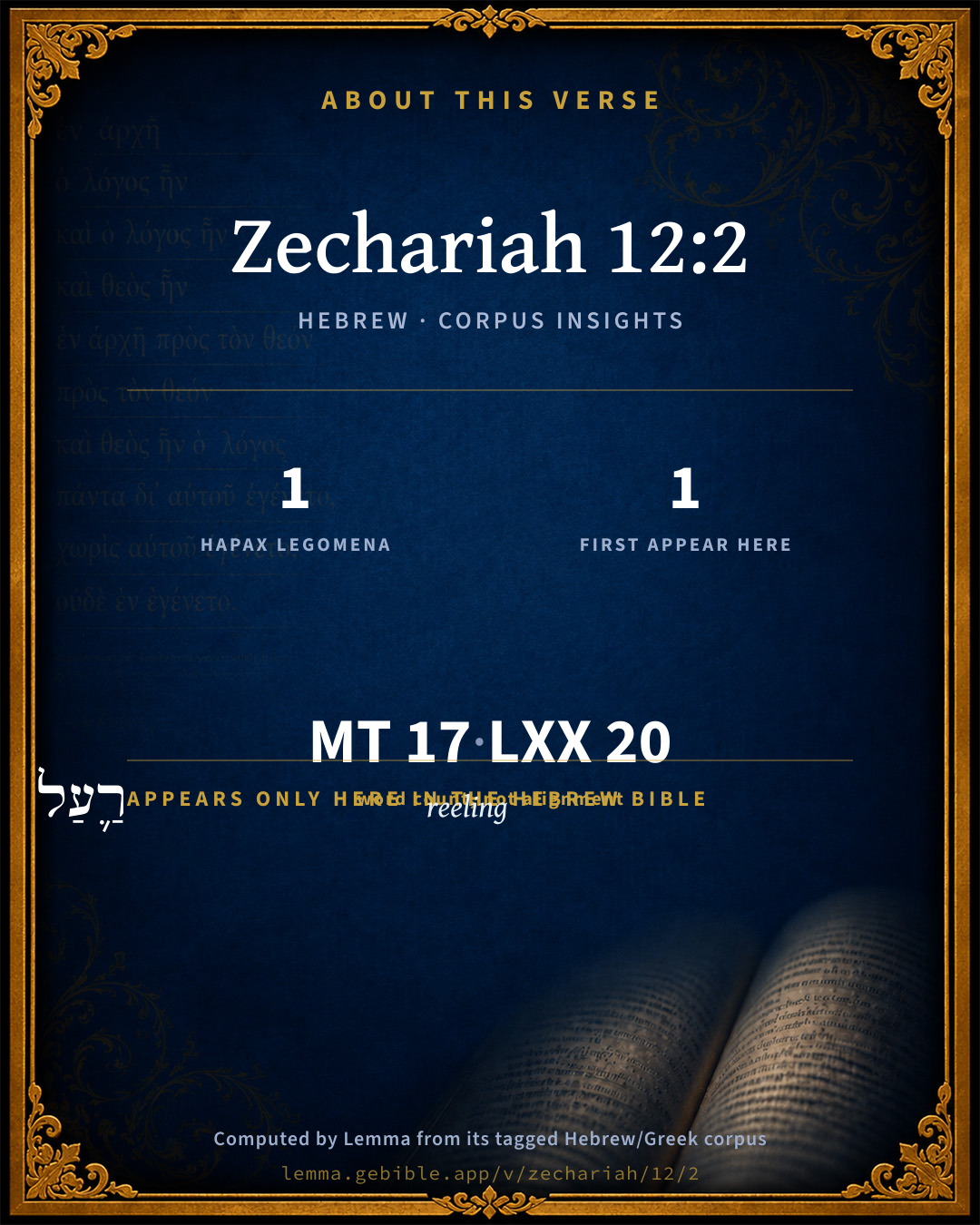
  • 1 hapax legomenon — only here in the Hebrew Bible
  • 1 first appearance in the Hebrew Bible
Full analysis ↓
Download a study sheet

One document with this verse’s original text, its word-by-word gloss line, the meaning frame, cross-references with their text, attributed commentary, and full source and license credits — printable, and it pastes into notes with its structure intact.

This verse Autodidact and up

Study sheet (.html) Plain text (.txt)

A passage Seminary Student

Up to 50 verses in one chapter. A passage sheet keeps up to 6 commentary sources and 12 cross-references per verse, in the order this page ranks them, and says so on the sheet whenever that leaves anything out. Ask for a single verse and you get the Autodidact verse sheet above.

Everything on this page stays free to read, with no account — the sheet is a download of what is already on screen, not access to it.

Want to remove ads? Support Godless Engineer
Compare translations 3

The same verse in 3 English versions, stacked beneath the original-language interlinear above. Click any original word for its lexicon entry.

Each is an independent rendering of the whole verse — the interlinear is not word-aligned to these translations.

Highlighted words mark where these versions differ — a whole-verse word diff, not a word-by-word alignment.

  • World English Bible Public Domain
    "Behold, I will make Jerusalem a cup of reeling to all the surrounding peoples, and on Judah also will it be in the siege against Jerusalem.
  • King James Version Public Domain
    Behold, I will make Jerusalem a cup of trembling unto all the people round about, when they shall be in the siege both against Judah and against Jerusalem.
  • unfoldingWord Literal Text CC BY-SA 4.0
    “See, I am about to make Jerusalem into a cup causing all the peoples surrounding her to stagger about. It will also be like that for Judah during the siege against Jerusalem.

unfoldingWord Literal Text — © unfoldingWord, licensed CC BY-SA 4.0. Word-aligned USFM3 via Door43 (git.door43.org/unfoldingWord/en_ult).

Versions to compare (up to 4)

3 of 4 selected

Show all 18 translations

Every available English version of this verse, each an independent rendering of the whole verse.

  • World English Bible Public Domain
    "Behold, I will make Jerusalem a cup of reeling to all the surrounding peoples, and on Judah also will it be in the siege against Jerusalem.
  • Berean Standard Bible Public Domain
    “Behold, I will make Jerusalem a cup of drunkenness to all the surrounding peoples. Judah will be besieged, as well as Jerusalem.
  • Majority Standard Bible Public Domain
    “Behold, I will make Jerusalem a cup of drunkenness to all the surrounding peoples. Judah will be besieged, as well as Jerusalem.
  • King James Version Public Domain
    Behold, I will make Jerusalem a cup of trembling unto all the people round about, when they shall be in the siege both against Judah and against Jerusalem.
  • American Standard Version (1901) Public Domain
    behold, I will make Jerusalem a cup of reeling unto all the peoples round about, and upon Judah also shall it be in the siege against Jerusalem.
  • Revised Version (1885) Public Domain
    behold, I will make Jerusalem a cup of reeling unto all the peoples round about, and upon Judah also shall it be in the siege against Jerusalem.
  • Geneva Bible (1599) Public Domain
    Beholde, I will make Ierusalem a cuppe of poyson vnto all the people round about: and also with Iudah will he be, in ye siege against Ierusalem.
  • Douay-Rheims (1899) Public Domain
    Behold I will make Jerusalem a lintel of surfeiting to all the people round about: and Juda also shall be in the siege against Jerusalem.
  • Young's Literal Translation Public Domain
    Lo, I am making Jerusalem a cup of reeling To all the peoples round about, And also against Judah it is, In the siege against Jerusalem.
  • Literal Standard Version CC BY-SA 4.0
    “Behold, I am making Jerusalem a cup of reeling || To all the surrounding peoples, || And it is also against Judah, || In the siege against Jerusalem.
  • Unlocked Literal Bible CC BY-SA 4.0
    “See, I am about to make Jerusalem into a cup causing all the peoples surrounding her to stagger about. It will also be like that for Judah during the siege against Jerusalem.
  • unfoldingWord Literal Text CC BY-SA 4.0
    “See, I am about to make Jerusalem into a cup causing all the peoples surrounding her to stagger about. It will also be like that for Judah during the siege against Jerusalem.
  • Darby Bible Public Domain
    Behold, I will make Jerusalem a cup of bewilderment unto all the peoples round about, and also against Judah shall it be in the siege against Jerusalem.
  • World Messianic Bible Public Domain
    “Behold, I will make Jerusalem a cup of reeling to all the surrounding peoples, and it will also be on Judah in the siege against Jerusalem.
  • Webster's Bible Public Domain
    Behold, I will make Jerusalem a cup of trembling to all the people around, when they shall be in the siege both against Judah and against Jerusalem.
  • Free Bible Version CC BY-SA 4.0
    Look! I am going to make Jerusalem like a cup containing alcoholic drink that will make all the surrounding nations stagger like drunks when they come to attack Judah and Jerusalem.
  • Bible in Basic English Public Domain
    See, I will make Jerusalem a cup of shaking fear to all the peoples round about, when Jerusalem is shut in.
  • JPS Tanakh (1917) Public Domain
    Behold, I will make Jerusalem a cup of staggering unto all the peoples round about, and upon Judah also shall it fall to be in the siege against Jerusalem.

Literal Standard Version (2020), Covenant Press — licensed CC BY-SA 4.0. Text via the HelloAO Bible API (eBible.org). Unlocked Literal Bible (unfoldingWord) — licensed CC BY-SA 4.0. Text via the HelloAO Bible API (eBible.org). unfoldingWord Literal Text — © unfoldingWord, licensed CC BY-SA 4.0. Word-aligned USFM3 via Door43 (git.door43.org/unfoldingWord/en_ult). Free Bible Version, Dr. Jonathan Gallagher — licensed CC BY-SA 4.0. Text via the HelloAO Bible API (eBible.org).

Word by word

More ways to search: Search by grammar → Find every occurrence → Compare this word →

Practice this passage: Drill this verse → Learn its vocabulary →

רַ֛עַל
raʻal
H7478
“reeling”
Noun, Common, Masculine, Singular, Absolute
Part of Speech
Noun
Type
Common
Gender
Masculine
Number
Singular
State
Absolute
Full BDB Definition

Origin: from H7477

TWOT: 2188a

reeling
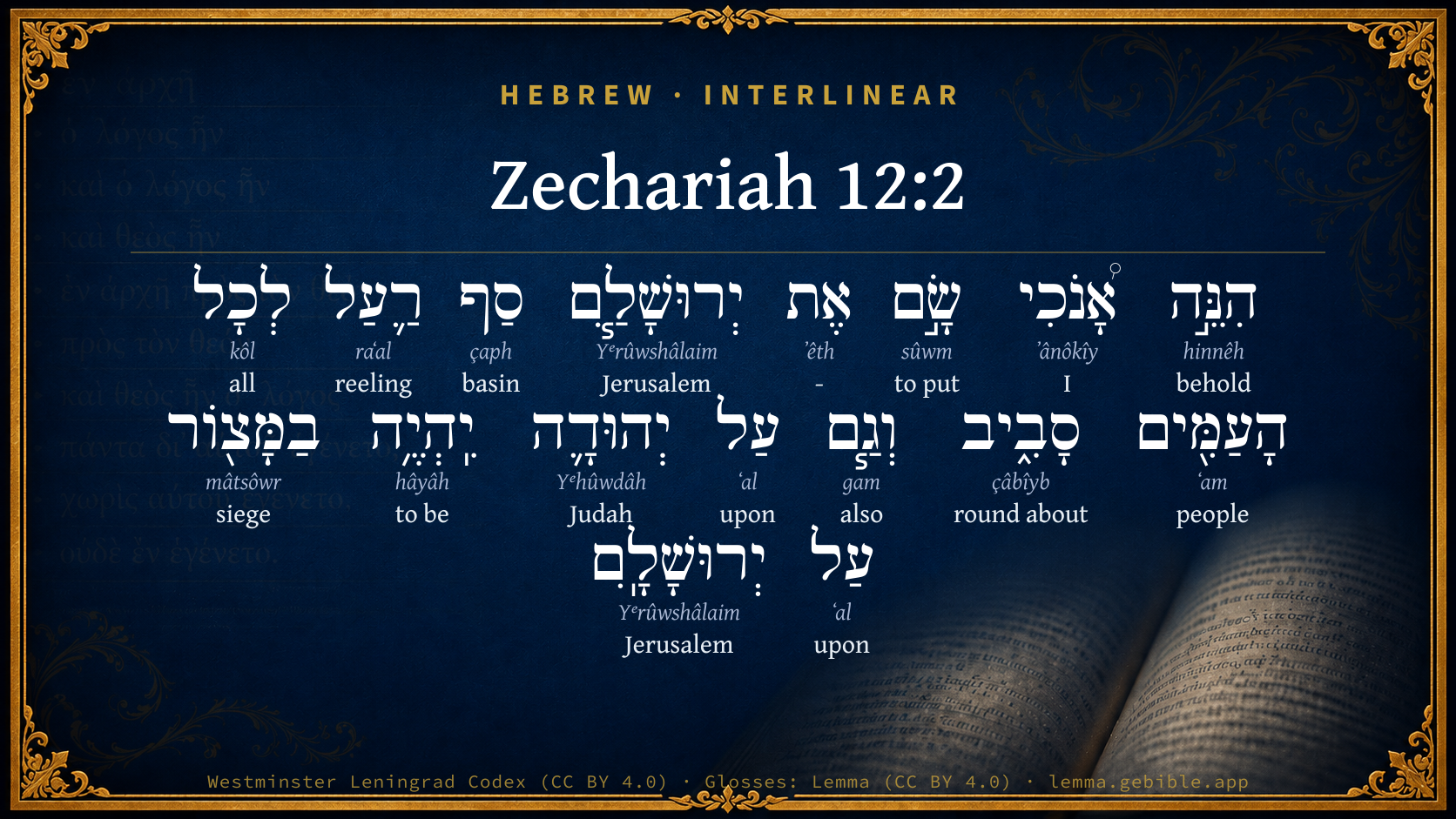
  1. הִנֵּ֣ה hinnêh H2009 “behold” Particle, Demonstrative
  2. אָ֠נֹכִי ʼânôkîy H595 “I” Pronoun, Personal, 1st Person, Common, Singular
  3. שָׂ֣ם sûwm H7760 “putting” Verb, Qal, Participle Active, Masculine, Singular, Absolute
  4. אֶת ʼêth H853 “-” Particle, Direct Object
  5. יְרוּשָׁלִַ֧ם Yᵉrûwshâlaim H3389 “Jerusalem” Noun, Proper
  6. סַף çaph H5592 “basin of” Noun, Common, Masculine, Singular, Construct
  7. לְכָל kôl H3605 “to/for · all of” Preposition + Noun, Common, Masculine, Singular, Construct
  8. הָעַמִּ֖ים ʻam H5971 “the · peoples” Particle, Definite Article + Noun, Common, Masculine, Plural, Absolute
  9. סָבִ֑יב çâbîyb H5439 “round about” Noun, Common, Both, Singular, Absolute
  10. וְגַ֧ם gam H1571 “and · also” Conjunction + Particle, Accusative
  11. עַל ʻal H5921 “upon” Preposition
  12. יְהוּדָ֛ה Yᵉhûwdâh H3063 “Judah” Noun, Proper
  13. יִֽהְיֶ֥ה hâyâh H1961 “to be” Verb, Qal, Imperfect, 3rd Person, Masculine, Singular
  14. בַמָּצ֖וֹר mâtsôwr H4692 “in/at the · siege” Preposition, Determined + Noun, Common, Masculine, Singular, Absolute
  15. עַל ʻal H5921 “upon” Preposition
  16. יְרוּשָׁלִָֽם Yᵉrûwshâlaim H3389 “Jerusalem” Noun, Proper

About this verse

These counts appear in no published source. They are computed here, from the morphology-tagged text and Lemma’s own curated glosses. What Lemma adds →

17
words
15
distinct lemmas
Prophets
section

Notable vocabulary

1 hapax legomenon — a word that appears only here in the entire Hebrew Bible:

  • רַ֛עַל reeling H7478

First appearance in Scripture

This word makes its first canonical appearance in the Hebrew Bible here:

  • רַ֛עַל reeling H7478

Shared distinctive vocabulary

בַמָּצ֖וֹר siege H4692 occurs in 26 verses of the Hebrew Bible. Also found in:

Grammatical profile

  • 2 verbs
  • 9 nouns
  • 1 pronoun
  • 2 prepositions
  • 3 particles

Verb forms

  • שָׂ֣ם Qal · Participle Active
  • יִֽהְיֶ֥ה Qal · Imperfect

Repetition

Words recur within this verse — often emphatic in Hebrew:

  • יְרוּשָׁלִַ֧ם Jerusalem H3389 ×2
  • עַל upon H5921 ×2

Hebrew & Septuagint length

In English translation the verse runs 26 words from the Hebrew and 24 from the Septuagint (LXX English) — closely comparable.

A rough comparison of the two English renderings, which tokenize alike — not a word-level alignment.

Word counts can differ between the Hebrew and the Greek without any difference in meaning — e.g. the Hebrew direct-object marker אֵת has no separate Greek word, and Greek often adds the article ὁ.

In the original languages it is 17 Hebrew tokens and 20 Greek tokens — but the two are counted differently (Hebrew bundles its prefixes and suffixes into one token; the Greek is in lemma form), so that isn’t a like-for-like length.

Cross-references

14

Topical passages linked to Zechariah 12:2 in the Treasury of Scripture Knowledge — connected by theme and wording, ordered by reader-vote popularity; previews shown in the World English Bible.

  • Psalms 75:8 For in the hand of Yahweh there is a cup, Full of foaming wine mixed with spices. He pours it out. Indeed the wicked of the earth drink and drink it to its very dregs.
  • Zechariah 14:14 Judah also will fight at Jerusalem; and the wealth of all the surrounding nations will be gathered together: gold, and silver, and clothing, in great abundance.
  • Isaiah 51:22–23 Thus says your Lord Yahweh, and your God who pleads the cause of his people, Behold, I have taken out of your hand the cup of staggering, even the bowl of the cup of my wrath; you shall no more drink it again:
  • Isaiah 51:17 Awake, awake, stand up, Jerusalem, that have drunk at the hand of Yahweh the cup of his wrath; you have drunken the bowl of the cup of staggering, and drained it.
  • Jeremiah 8:14 Why do we sit still? assemble yourselves, and let us enter into the fortified cities, and let us be silent there; for Yahweh our God has put us to silence, and given us water of gall to drink, because we have sinned against Yahweh.
  • Jeremiah 25:15 For thus says Yahweh, the God of Israel, to me: take this cup of the wine of wrath at my hand, and cause all the nations, to whom I send you, to drink it.
  • Jeremiah 25:17 Then took I the cup at Yahweh's hand, and made all the nations to drink, to whom Yahweh had sent me:
  • Jeremiah 49:12 For thus says Yahweh: Behold, they to whom it didn't pertain to drink of the cup shall assuredly drink; and are you he who shall altogether go unpunished? you shall not go unpunished, but you shall surely drink.
  • Jeremiah 51:7 Babylon has been a golden cup in Yahweh's hand, who made all the earth drunken: the nations have drunk of her wine; therefore the nations are mad.
  • Jeremiah 51:57 I will make drunk her princes and her wise men, her governors and her deputies, and her mighty men; and they shall sleep a perpetual sleep, and not wake up, says the King, whose name is Yahweh of Hosts.
  • Habakkuk 2:16 You are filled with shame, and not glory. You will also drink, and be exposed! The cup of Yahweh's right hand will come around to you, and disgrace will cover your glory.
  • Revelation 14:10 he also will drink of the wine of the wrath of God, which is prepared unmixed in the cup of his anger. He will be tormented with fire and sulfur in the presence of the holy angels, and in the presence of the Lamb.
  • Revelation 16:19 The great city was divided into three parts, and the cities of the nations fell. Babylon the great was remembered in the sight of God, to give to her the cup of the wine of the fierceness of his wrath.
  • Revelation 18:6 Return to her just as she returned, and repay her double as she did, and according to her works. In the cup which she mixed, mix to her double.

Cross-references courtesy of OpenBible.info (CC BY 4.0).

Hebrew and Greek witnesses Masoretic Hebrew ↔ Greek Septuagint

The same verse in the two great witnesses to the Old Testament, shown verse-for-verse.

These are two independent witnesses, not word-aligned to each other, and the Septuagint is shown in lemma (dictionary) form.

Hebrew Zechariah 12:2 Masoretic · Westminster Leningrad Codex

הִנֵּ֣ה אָ֠נֹכִי שָׂ֣ם אֶת יְרוּשָׁלִַ֧ם סַף רַ֛עַל לְכָל הָעַמִּ֖ים סָבִ֑יב וְגַ֧ם עַל יְהוּדָ֛ה יִֽהְיֶ֥ה בַמָּצ֖וֹר עַל יְרוּשָׁלִָֽם

"Behold, I will make Jerusalem a cup of reeling to all the surrounding peoples, and on Judah also will it be in the siege against Jerusalem.

World English Bible · Public Domain

Greek LXX Zechariah 12:2 Septuagint · lemma form

ἰδού ἐγώ τίθημι ὁ ἰερουσαλήμ ὡς πρόθυρον σαλεύω πᾶς ὁ λαός κύκλος καί ἐν ὁ ἰουδαία εἰμί περιοχή ἐπί ἰερουσαλήμ

Behold, I will make Jerusalem as trembling door-posts to all the nations round about, and in Judea there shall be a siege against Jerusalem.

LXX2012 (modern English Septuagint) · Public Domain

On this verse, Jamieson, Fausset & Brown discusses the Septuagint’s reading. Read the note in Commentary ↓

Hebrew: Westminster Leningrad Codex (CC BY 4.0). Greek: Septuagint (public domain); English from LXX2012 (modern English Septuagint) (Public Domain). How the Septuagint differs from the Hebrew →

Targum (Aramaic paraphrase)

1

The Targum is the ancient Jewish Aramaic paraphrase of the Hebrew Scriptures — an interpretive translation, not the Hebrew text itself. Onkelos (literal) and Pseudo-Jonathan (expansive) render the Torah, and Jonathan the Prophets. Coverage is partial: where no permissively-licensed English translation exists for a verse, only the Aramaic is shown. This is verse-level text, not a word-by-word alignment to the Hebrew.

  1. Targum Jonathan Prophets (Joshua–Malachi)
    הָא אֲנָא מְשַׁוֵי יַת יְרוּשְׁלֵם מָן מְלֵי מַרְוֵי לְכָל עַמְמַיָא סְחוֹר סְחוֹר וְאַף דְבֵית יְהוּדָה יֵיתוּנוּן עַמְמַיָא בְּיַד אֲנִיסִין בְּצַיְרָא לִירוּשְׁלֵם:

    (no public-domain English translation for this verse)

    Targum Jonathan — Aramaic: “Mikraot Gedolot” (public domain). English: “Sefaria Community Translation” (CC0 1.0 (public-domain dedication)); “London "Chaldee Paraphrase," 1871” (public domain). Text via Sefaria.

Commentary

Notes on Zechariah 12:2 from classic Christian and Jewish commentators (each source and its license shown beneath its notes). The classic Christian expositions comment on the surrounding passage and are grouped to its opening verse, so a note may address several verses; the Jewish commentaries on the Tanakh (Rashi and others) are per-verse, so they appear only where the commentator wrote on this verse.

Lemma curates 59 commentaries, every one of them public domain or Creative Commons licensed, each selected and text-cleaned for this edition rather than reprinted as found. About our sources →

Trapp's Complete Commentary

John Trapp

Zec 12:2 Behold, I will make Jerusalem a cup of trembling unto all the people round about, when they shall be in the siege both against Judah [and] against Jerusalem.

Ver. 2. Behold, I will make Jerusalem a cup of trembling] Or, slumber, or poison. A metaphor taken from a cup of generous wine, but empoisoned; so that those that drink of it do presently tremble, grow giddy, sleepy, sick as hear can hold. Poison in wine works more furiously. Thou hast made us to drink the wine of giddiness, saith the Church, Psa 60:3. In the hand of the Lord is a cup, and the wine is red, it is full mixed, &c. The prophet here seems to allude to Jer 25:15 Isa 29:8 Jer 51:7. Ovid saith of the river Gallus, that whoso drinketh of it runneth mad immediately. Jerome telleth of a lake, near Naples, whereinto, if a dog be thrown, he presently dieth. The like is reported, by Josephus, of the Lake Asphaltites. Jerusalem shall be a murdering morsel to those that swallow it. His meat in his bowels is turned, it is the gall of asps within him. He hath swallowed down her spoil, and he shall vomit it up again: God shall rake it out of his belly, Job 20:14-15 : he shall have as little joy of his tid bits, of his sweet draughts, as Jonathan had of his honey; whereof he had no sooner tasted but his head was forfeited. Pliny speaketh of a kind of honey that poisoneth; because it is sucked out of poisonous flowers. Our chronicler telleth us that at Alvelana, three miles from Lisbon, many of our English soldiers, under the Earl of Essex, perished by eating of honey, purposely left in the houses, and spiced with poison. The enemies of the Church make a dangerous adventure, they are even ambitious of destruction; they run to meet their bane, as did those Philistines at Mizpeh, 1Sa 7:7. And had they but so much wit as Pilate’s wife, in a dream, they would take heed of having anything to do with those just men, of eating up God’s people as they eat bread, Psa 14:4, of boozing in the bowls of the sanctuary with Belshazzar, who fell thereupon into a trembling, so that his loins were loosed, and his knees knocked one against another, Dan 5:6.

When they shall be in the siege] And so about to do their last and worst against the Church. The people of Rome was saepe praelio victus, nunquam bello, saith Florus; they lost many battles, but were never overcome in a set war; at the last, at the long run, as they say, they crushed all their enemies; so doth the Church. See Psa 129:1-8, throughout; and the story of the Maccabees.

John Trapp, A Commentary or Exposition upon All the Books of the Old and New Testament (1647–1656) — public domain. Text from a community e-Sword module.

The Biblical Illustrator

Joseph S. Exell

Zec_12:2-3

All that burden themselves with it shall be cut in pieces

Sin self-punishment

There is in this passage a principle by which the governor of the world punishes malicious men.

That principle is this, in the reaction of their efforts to injure others to injury of themselves. Jerusalem would become confusion and destruction to the men who sought its ruin.

1. Jerusalem would become a cup of trembling, or intoxication.

2. Jerusalem would become to them a burdensome stone.

The idea is, that in their endeavours to injure Jerusalem they would crush themselves.

I. It is well attested. It is attested by every mans consciousness. Every man who attempts to injure another feels sooner or later that he has injured himself. There is a recoil and a regret. In truth, the malign passion itself is its own punishment. In every malign emotion there is misery.

2. It is attested by universal history. The conduct of Josephs brethren, and of Haman, may be cited as illustrations; but the conduct of the Jews towards the Messiah is an example for all times, most mighty and impressive.

II. It is manifestly just. What man thus punished can complain of the righteousness of his sufferings? He must feel, and feel deeply, that he has deserved all, and even more than he endures.

III. It is essentially beneficent. It serves--

1. To guard men from the injuries of others.

2. To restrain the angry passions of men. (Homilist.)

The Biblical Illustrator, edited by Joseph S. Exell (c. 1880s–1900s) — public domain. Text from a community e-Sword module.

Joseph Benson's Commentary

Zec 12:2. Behold, I will make Jerusalem a cup of trembling — “An inebriating and stupifying potion of the strongest liquor and drugs. Jerusalem shall strike the nations with dread and astonishment.” When they shall be in the siege — “A future siege, after the final restoration of the Jews.” — Newcome. See on Zec 14:3; Rev 20:9. “It is not difficult to perceive,” says Blayney, “that the prophecies in this and the two following chapters relate to future times, and most probably to those predicted by Ezekiel in the 38th and 39th chapters; where it is said that Israel, after their restoration and return to their own country, would be assailed by a combination of many nations. Such an invasion is also here foretold; but it is not to be expected that all the particulars of a distant prophecy should be clearly understood, before the time of its accomplishment. It is at least likely that when the time shall come for the re-establishment of the Jews, (of which sufficient intimation is given in the prophecies both of the Old and New Testaments,) and they shall begin to collect themselves, and attempt a settlement in their ancient possessions, such a measure will create jealousy and uneasiness, in those powers more especially who are interested in the dominion over those countries. The Turks, we know, are at present, and long have been, in possession of the country of Palestine; and in the opinion of many, who have brought specious arguments to justify it, particularly of the learned Joseph Mede, (p. 674 and 816,) their prince is intended by Gog, prince of Meshech and Tubal, Eze 38:2, &c.; and by the king of the north, Dan 11:40, &c.; concerning whom the like things are prophesied in those chapters respectively. Now should that power subsist at the time, it may fairly be presumed, that he, and any other power in the like circumstances, would oppose with all their might an attempt to set up an independent sovereignty in those parts. But, without pretending to determine precisely concerning the invaders, the substance of the prophecy in this, and on to the seventh verse of the next chapter, will be found to amount to this; that Jerusalem will be besieged by a multitude of hostile nations, to the great terror of the people in its vicinity, as well as of Judah itself; but that the attempts of those nations will be frustrated through the special interposition of the Deity, and will terminate in their total discomfiture and ruin, and in the permanent peace and prosperity of the victorious Jews. After which, the Jews will be brought at length to see and lament the sin of their forefathers in putting their Messiah to death, and thereupon will have the means of purification and atonement afforded them; and, being thus cleansed from past guilt, will renounce all their former offensive practices, and carefully abstain from a future repetition of them.” To these views of Dr. Blayney, on the important subject of the restoration of the Jews to their own land, however probable upon the whole, there seems to be one great objection. Inasmuch as God cast the Jews out of their land for rejecting and crucifying the Messiah, it seems highly improbable that he should restore them to it while they remain in impenitence and unbelief, and in a state of enmity to that Messiah. It appears much more likely that, previous to their restoration, they must be made sensible of the great guilt which their nation contracted by the commission of that sin, and of the various other sins which accompanied it; and that they must be truly humbled and brought to a thorough repentance as a people, before God will open the way in any degree for their restoration. It is certain that, as they were carried captive into Babylon chiefly to punish them for the sin of idolatry, so no way was made for their restoration from that captivity, till they were generally humbled and made truly penitent for that sin.

Joseph Benson's Commentary on the Old and New Testaments (1811–1818) — public domain. Text from a community e-Sword module.

Whedon's Commentary on the Bible

Daniel D. Whedon

In Zec_12:2, Jehovah himself is introduced as the speaker.

Behold, I will — Better, Behold, I am about to; the act is imminent (G.-K., 116p).

Make Jerusalem a cup of trembling — R.V., “of reeling”; a cup or bowl (Exo_12:22; 1Ki_7:4-5) that produces trembling or reeling. Jerusalem is pictured as a bowl filled with a tempting drink; eagerly the nations grasp it; but the draught results in their undoing; confused and discomfited they reel and stagger back (compare Hab_2:16; Oba_1:16). 2b is translated in R.V., “and upon Judah also shall it be in the siege against Jerusalem.” A.V. is readily understood. The cup is handed to the nations when they attack Judah and Jerusalem. But what is the meaning of R.V., which is undoubtedly a more literal translation of the Hebrew? The troublesome clause is, “and upon Judah also shall it be.” What shall be upon, or against (margin), Judah also? Some say that Jerusalem will become a cup of reeling to Judah as well as to the other nations; which would imply that Judah was expected to make common cause with the nations against Jerusalem. One would hardly look for such an idea, and there is nothing in the rest of the prophecy that would support the idea that Judah was expected to turn against Jerusalem. It is worthy of notice also that the preposition before all the peoples is not the same as before Judah. Margin R.V. suggests a slightly different translation, “and upon Judah also shall it fall to be,” which has been interpreted as meaning that it shall be incumbent upon Judah to be in the siege; that is, Judah will be compelled to join in the siege. Some co-ordinate “upon Judah” with “concerning Israel” (the same preposition in Hebrew) in the title; that is, the word of Jehovah shall be concerning Judah also. Still others supply the subject from the preceding, that which falls upon Jerusalem shall fall upon Judah also; that is, Judah also will be besieged, and Judah also will be made a cup of reeling to the nations. All these translations and interpretations are more or less fanciful and do more or less violence to the text. It is quite certain that the text has suffered in transmission. Geiger, who is followed by others, omits the preposition before Judah and reads, “Judah also shall be in the siege of Jerusalem,” which might mean that Judah will join in the siege, or that Judah also will suffer when the city is surrounded. The latter is perhaps the thought of the author, but the emendation of Geiger does not remove all difficulties. Marti follows his usual method and omits the troublesome words, and with another change in the last clause he reads Zec_12:2, “Behold, I am about to make Jerusalem a cup of reeling unto all the peoples round about, and there will be a siege of Jerusalem.”

Daniel D. Whedon (gen. ed.), Commentary on the Old and New Testaments (1874–1909) — public domain. Text from a community e-Sword module.

Keil & Delitzsch

C. F. Keil & F. Delitzsch

"Behold, I make Jerusalem a reeling-basin for all the nations round about, and upon Judah also will it be at the siege against Jerusalem. Zac 12:3. And it will come to pass on that day, I will make Jerusalem a burden-stone to all nations: all who lift it up will tear rents for themselves; and all the nations of the earth will gather together against it. Zac 12:4. In that day, is the saying of Jehovah, will I smite every horse with shyness, and its rider with madness, and over the house of Judah will I open my eyes, and every horse of the nations will I smite with blindness." These verses allude to an attack on the part of the nations upon Jerusalem and Judah, which will result in injury and destruction to those who attack it. The Lord will make Jerusalem a reeling-basin to all nations round about. Saph does not mean threshold here, but basin, or a large bowl, as in Exo 12:22. רעל is equivalent to תּרעלה in Isa 51:17 and Psa 60:5, viz., reeling. Instead of the goblet, the prophet speaks of a basin, because many persons can put their mouths to this at the same time, and drink out of it (Schmieder). The "cup of reeling," i.e., a goblet filled with intoxicating drink, is a figure very frequently employed to denote the divine judgment, which intoxicates the nations, so that they are unable to stand any longer, and therefore fall to the ground and perish (see at Isa 51:17).

Psa 60:2 has been explained in very different ways. It is an old and widespread view, that the words "also upon Judah will it be," etc., express the participation of Judah in the siege of Jerusalem. The Chaldee and Jerome both adopt this explanation, that in the siege of Jerusalem Judah will be constrained by the nations to besiege the capital of its own land. The grammatical reason assigned for this view is, that we must either take היה with על in the sense of obligation (it will also be the duty of Judah: Mich., Ros., Ewald), or supply סף־רעל as the subject to יהיה: the reeling-basin will also come upon Judah. But there is great harshness in both explanations. With the former, להלּחם, or some other infinitive, would hardly have been omitted; and with the latter, the preposition ל would stand before יהוּדה, instead of על. Moreover, in what follows there is no indication whatever of Judah's having made common cause with the enemy against Jerusalem; on the contrary, Judah and Jerusalem stand together in opposition to the nations, and the princes of Judah have strength in the inhabitants of Jerusalem (Psa 60:5), and destroy the enemy to save Jerusalem (Psa 60:6). Moreover, it is only by a false interpretation that any one can find a conflict between Judah and Jerusalem indicated in Zac 14:14. And throughout it is incorrect to designate the attitude of Judah towards Jerusalem in these verses as "opposition," - a notion upon which Ebrard (Offenb. Joh.) and Kliefoth have founded the marvellous view, that by Jerusalem with its inhabitants and the house of David we are to understand the unbelieving portion of Israel; and by Judah with its princes, Christendom, or the true people of God, formed of believing Israelites, and increased by believing Gentiles. Judah is not opposed to Jerusalem, but simply distinguished from it, just as the Jewish kingdom or people is frequently designated by the prophets as Jerusalem and Judah. The גם, which does not separate, but adds, is of itself inapplicable to the idea of opposition. Consequently we should expect the words וגם על יה to express the thought, that Judah will be visited with the same fate as Jerusalem, as Luther, Calvin, and many others follow the Peshito in supposing that they do. היה על has then the meaning to happen, to come over a person; and the only question is, What are we to supply in thought as the subject? The best course is probably to take it from the previous clause, "that which passes over Jerusalem;" for the proposal of Koehler to supply mâtsōr as the subject is precluded by the circumstance that mâtsōr, a siege, can only affect a city or fortress (cf. Deu 20:20), and not a land. The thought is strengthened in Zac 12:3. Jerusalem is to become a burden-stone for all nations, which inflicts contusions and wounds upon those who try to lift it up or carry it away ("experiencing no hurt itself, it causes great damage to them:" Marck). The figure is founded upon the idea of the labour connected with building, and not upon the custom, which Jerome speaks of as a very common one in his time among the youth of Palestine, of testing and exercising their strength by lifting heavy stones. There is a gradation in the thought, both in the figure of the burdensome stone, which wounds whoever tries to lift it, whilst intoxicating wine only makes one powerless and incapable of any undertaking, and also in the description given of the object, viz., in Zac 12:2 all nations round about Jerusalem, and in Zac 12:3 all peoples and all nations of the earth. It is only in the last clause of Zac 12:3 that the oppression of Jerusalem indicated in the two figures is more minutely described, and in Zac 12:4 that its overthrow by the help of God is depicted. The Lord will throw the mind and spirit of the military force of the enemy into such confusion, that instead of injuring Jerusalem and Judah, it will rush forward to its own destruction. Horses and riders individualize the warlike forces of the enemy. The rider, smitten with madness, turns his sword against his own comrades in battle (cf. Zac 14:3; Jdg 7:22; Sa1 14:20). On the other hand, Jehovah will open His eyes upon Judah for its protection (Kg1 8:29; Neh 1:6; Psa 32:8). This promise is strengthened by the repetition of the punishment to be inflicted upon the enemy. Not only with alarm, but with blindness, will the Lord smite their horses. We have an example of this in Kg2 6:18, where the Lord smote the enemy with blindness in answer to Elisha's prayer, i.e., with mental blindness, so that, instead of seizing the prophet, they fell into the hands of Israel. The three plagues, timmâhōn, shiggâ‛ōn, and ‛ivvârōn, are those with which rebellious Israelites are threatened in Deu 28:28. The "house of Judah" is the covenant nation, the population of Judah including the inhabitants of Jerusalem, as we may see from what follows.

Keil & Delitzsch — Biblical Commentary on the Old Testament (1861–1891) — public domain (CC PDM 1.0). Text via the HelloAO Bible API. (Old Testament only.)

Tyndale Open Study Notes

Tyndale Open Resources

12:2 intoxicating drink (literally bowl of reeling or cup of staggering): The cup of alcoholic drink is a metaphor for God’s judgment (Isa 51:17; Jer 25:15; Hab 2:16; Matt 26:39, 42; Rev 14:10; 16:1). Jerusalem would be instrumental in God’s judgment on the nearby nations.

Tyndale Open Study Notes — © Tyndale Open Resources, licensed CC BY-SA 4.0. Text via the HelloAO Bible API.

Geneva Bible (1599)

Geneva Bible translators

Jerusalem shall be defended against all her enemies: so shall God defend all Judah also, and shall destroy the enemies.

Geneva Bible (1599) marginal notes — public domain. Text via Bolls.life.

Jamieson, Fausset & Brown

Robert Jamieson, A. R. Fausset & David Brown

cup of trembling--a cup causing those who drink it to reel (from a Hebrew root "to reel"). Jerusalem, who drank the "cup of trembling" herself, shall be so to her foes (Isa 51:17, Isa 51:22; Jer 13:13). CALVIN with the Septuagint translates, "threshold of destruction," on which they shall stumble and be crushed when they attempt to cross it. English Version is better.

both against Judah--The Hebrew order of words is literally, "And also against Judah shall he (the foe) be in the siege against Jerusalem"; implying virtually that Judah, as it shares the invasion along with Jerusalem, so it shall, like the metropolis, prove a cup of trembling to the invaders. MAURER with JEROME translates, "Also upon Judah shall be (the cup of trembling); that is, some Jews forced by the foe shall join in the assault on Jerusalem, and shall share the overthrow with the besiegers. But Zac 12:6-7 show that Judah escapes and proves the scourge of the foe.

Jamieson, Fausset & Brown — Commentary Critical and Explanatory on the Whole Bible (1871) — public domain (CC PDM 1.0). Text via the HelloAO Bible API.

Adam Clarke's Commentary

Verse 2. Jerusalem a cup of trembling] The Babylonians, who captivated and ruined the Jews, shall in their turn be ruined.

I incline to think that what is spoken in this chapter about the Jews and Jerusalem, belongs to the "glory of the latter times."

Shall be in the siege] This may refer to some war against the Church of Christ, such as that mentioned Re 20:9.

Adam Clarke's Commentary on the Bible (1810–1826) — public domain. Text from a community e-Sword/MySword module.

John Calvin's Commentaries

Zechariah begins here to teach us what I have briefly explained, that Jerusalem would be under the protection of God, who would render it safe and secure against all enemies. But he uses here figurative terms, which make the point more evident. He says, that Jerusalem would be a threshold of bruising, or breaking. The word סף, saph, means a threshold almost everywhere in Scripture. But some think that it means here a cup, and then they translate רעל, rol, drunkenness, or fury. But as this word also means breaking, it is not unsuitable to say that Jerusalem is here called a threshold at which people stumble, so that he who comes against this threshold either breaks a bone or receives some other injury. At the same time the Prophet seems to express something more, that whosoever ascended to attack Jerusalem would meet with a stumbling block, by which he might have his legs broken or bruised. The meaning then is, that access to Jerusalem would be closed up, so that enemies would not overcome it, though they reached the walls and the gates, for they would stumble, as it is said, at the threshold.

If the other rendering be approved, the sense would be suitable, — that all the ungodly, while devising schemes against God’s Church, would be inebriated by their own counsels; yea, that their drink would be deadly to them: for the passions of men produce effects like drunkenness. When therefore the ungodly gather their forces against the Church, it is the same as though they were greedily swallowing down wine; for the drunken meet together to indulge in excesses. The meaning then would be, — that this immoderate drinking would be fatal to the nations. But I prefer the former view, — that though the gates of the holy city were open, or even an easy access were made through the walls, yet God would on every side be a defense, so that enemies would stumble, as we have said, at the very threshold and bruise themselves. And this promise was very necessary then, for Jerusalem was exposed to the assaults of all, as it could not have defended itself by moats or walls or mounds: but the Lord here promises that it would be a threshold of bruising

He then adds, Also against Judah, or over Judah, it shall be during the siege against Jerusalem. The Prophet, as I think, extends the promise to the whole land, as though he had said, “Though the compass of Jerusalem should not contain all the inhabitants, yet they shall be everywhere safe; for God will take them under his protection.” I wonder why some interpreters have omitted the preposition על, ol, and have translated thus, “Judah also shall be in the siege against Jerusalem:” and they elicit a meaning wholly different, even that some of the Jews themselves would become perfidious, who would not spare their brethren and friends, but become hostile to them, and unite their forces to those of heathen nations. But I consider the meaning to be the reverse of this, — that when Jerusalem shall be besieged, the Lord will put impediments everywhere, which will hinder and prevent the assaults of enemies. When God, he says, shall defend the holy city, even this very thing, (for I apply this phrase to God’s protection,) even this very thing shall be through the whole land; as though he had said, “God will not only be the guardian of the city alone, but also of the whole of the holy land.” Now this must have sharply goaded the Israelites, seeing that they were excluded from having God’s aid, inasmuch asthey had not thought proper to return to their own country when liberty was freely given them. It follows —

John Calvin's Commentaries (1540-1563) — public domain. Text from the Calvin Translation Society English edition (1840s-50s) via the Christian Classics Ethereal Library (ccel.org). Calvin's coverage is partial (roughly two-thirds of the Bible); uncommented books and verses are honest gaps, never fabricated. The 19th-century editor's footnotes and remarks are omitted so the notes are faithfully Calvin's own voice.

Ellicott's Commentary for English Readers

(2) The first part of this verse seems to imply that all who should attack Jerusalem would do so to their injury. The second part should perhaps be translated, And also over Judah shall be (the trembling, or reeling) in the siege against Jerusalem: i.e., Judah should suffer as well as Jerusalem, though, as is promised before and after, they should both come out victorious. This rendering seems, on the whole, the best. The rendering of the E.V. cannot be supported; while that of the margin requires too much to be supplied. Some would refer back to the opening words of the chapter, and render: “and also concerning Judah (is this burden of the word of the Lord).” The explanation of Ewald, “And also upon Judah shall it be [incumbent to be occupied] in the siege against Jerusalem,” is grammatically correct, as he shows from the expression (1Ch_9:33) “upon them [it was incumbent to be occupied] in the work.” And, if we could understand by it that Judah was to be co-operating with (not against) Jerusalem in the siege (see Zec_12:5), this translation would have much to recommend it.

A Bible Commentary for English Readers, edited by Charles John Ellicott (1878–1897) — public domain. Text from a community e-Sword module.

The Cambridge Bible for Schools and Colleges

gen. ed. J. J. S. Perowne

2. cup of trembling] Rather, bowl of reeling. The word is used of the bowl or bason in which the blood of the Paschal lamb was caught, Exo_12:22, of the bowls used in the Temple service, 1Ki_7:50, and more generally, 2Sa_17:28. Jerusalem stands forth like some vast bowl or bason, round which all nations gather, eager to swallow down its inviting contents. But the draft proves to be far other than they anticipated, and they reel and stagger back from it, confused and discomfited. A similar figure, though of a “cup” (a different Hebrew word), occurs frequently elsewhere, e.g. Psa_75:8; Isa_51:17; Isa_51:22; Jer_51:7.

people] peoples, R. V., and so in Zec_12:3-4; Zec_12:6.

when they shall be in the siege, &c.] This is a clause of considerable difficulty. The rendering in the text of A. V. cannot be maintained. That in the margin is, as Pusey remarks, “too elliptical.” The same may, with him, be said of the rendering which has found supporters both in ancient and modern times, and also upon Judah shall it be (to be, or to fight) in the siege against Jerusalem; i.e. either “it shall happen to Judah” voluntarily, through civil war, or (since that idea is absolutely contradicted by the full alliance and agreement between Judah and Jerusalem described in Zec_12:5-6), “it shall be incumbent upon Judah,” because he shall be compelled against his will by the invading nations to join them, to take part in the siege. Pusey’s own rendering, which is that adopted in R. V., is, “And also upon Judah will it be in the siege against Jerusalem, i.e. the burden of the word of the Lord, which was upon Israel, should be upon Judah.” The objection to this is that the reference to the beginning of Zec_12:1 for a subject to the verb “it shall be” is remote and confusing. On the whole it is perhaps best to render, “And also on (or over) Judah it (i.e. the protection and deliverance implied in the first clause of the verse) shall be, in the siege,” &c. Signal as was the deliverance of Jerusalem in the time of Hezekiah, it did not extend beyond the city itself (2Ki_18:13; Isa_36:1). Now the country at large should share in the deliverance of the capital.

The Cambridge Bible for Schools and Colleges (gen. ed. J. J. S. Perowne; Cambridge University Press, 1878–1918) — public domain. Text from a community e-Sword module.

John Gill's Exposition

Behold, I will make Jerusalem a cup of trembling unto all the people round about,.... The Targum renders it,

"a vessel full of inebriating liquor;''

which intoxicates and makes giddy, and causes to tremble, stagger, and fall like a drunken man. The phrase denotes the punishment inflicted by the Lord upon the enemies of his church and people; see Isa 51:22,

when they shall be in the siege both against Judah and against Jerusalem; not by Antiochus Epiphanes; nor by Titus Vespasian; nor by Gog and Magog, as Kimchi; but by the antichristian powers, especially the Mahometan nations, the Turks, which shall come against Jerusalem, when the Jews are returned thither, and resettled in their own land; see Eze 38:5. The words should be rendered, "and upon Judah shall it be" (y), i.e. the cup of trembling, "in the siege against Jerusalem"; according to the Targum, and the Jewish commentators, the nations of the earth shall bring the men of Judah by force to join with them in the siege of Jerusalem; as, in the times of Antiochus, many of the Jews were drawn in to fight against their brethren; but the meaning is, that not only the wrath of God will come upon the Mahometan nations that shall besiege Jerusalem; but also on those who bear the Christian name, who are Jews outwardly, but not inwardly; and shall join with the Turks in distressing the people of the Jews upon their return to their own land: to besiege Judah, or a country, is not proper and pertinent: Jerusalem, when again in the hands of the Jews, according to this prophecy, only is to be besieged, as it will, by the Turks; and it should be observed, that it never was besieged by Antiochus, and therefore the prophecy can not be applied to his times, as it is by many.

(y) "et etiam super Jehudah erit", Pagninus, Montanus, Burkius.

John Gill's Exposition of the Whole Bible (1746–1763) — public domain (CC PDM 1.0). Text via the HelloAO Bible API.

Albert Barnes' Notes on the Bible

I will make Jerusalem a cup of trembling - For encouragement, He promises the victory, and at first mentions the attack incidentally. Jerusalem is as a cup or basin, which its enemies take into their hands; a stone, which they put forth their strength to lift; but they themselves reel with the draught of God’s judgments which they would give to others, they are torn by the stone which they would lift to fling. The image of the “cup” is mostly of God’s displeasure, which is given to His own people, and then, His judgment of chastisement being exceeded, given in turn to those who had been the instruments of giving it . Thus, Isaiah speaks of “the cup of trembling.” Thou, “Jerusalem, hast drunk the dregs of the cup of trembling, hast wrung them out. Therefore hear thou this, thou afflicted and drunken but not with wine. Thus saith thy Lord, the Lord, and thy God that pleadeth the cause of His people, Behold, I have taken out of thine hand the cup of trembling, the dregs of the cup of My fury; thou shalt no more drink it again: but I will put it into the hand of them that afflict thee” Isa 51:17, Isa 51:21-23. Jeremiah speaks of “the cup of God’s anger,” as given by God first to Jerusalem, then to all whom Nebuchadnezzar should subdue, then to Babylon itself Jer 25:15-26; and as “passing through” to Edom also Lam 4:21; Jer 49:12; Ezekiel, of “Aholibah” Eze 23:31-33 (Jerusalem) “drinking the cup of Samaria.” In Jeremiah alone, Babylon is herself the cup. “Babylon” is “a golden cup in the Lord’s hand, that made all the nations drunken; the nations have drunken of the wine; therefore the nations are mad” Jer 51:7. Now Jerusalem is to be, not an ordinary cup, but a large “basin” or vessel, from which all nations may drink what will make them reel.

“And also upon Judah will it be in the siege against Jerusalem, that is, the burden of the word of the Lord which was on Israel” should be “upon Judah,” that is, upon all, great and small.

Albert Barnes' Notes on the Bible (1834–1885) — public domain. Text from a community e-Sword/MySword module.

Haydock's Catholic Bible Commentary

A lintel of surfeiting. That is, a door into which they shall seek to enter, to glut themselves with blood: but they shall stumble, and fall like men stupified with wine. It seems to allude to the times of Antiochus, and to the victories of the Machabees. (Challoner) --- Yet it indirectly relates to the last siege of Jerusalem, and to Jesus Christ establishing his Church. Hebrew, "a cup of drowsiness," or trembling. (Calmet) --- Septuagint, "as courts (or thresholds; Greek: prothura) shaken." (Haydock) --- Jerusalem first drank the cup herself; and then under the Machabees, made others suffer. --- Juda. Never before Epiphanes had the Jews fought against their brethren. Then the apostates became most terrible, 1 Machabees i. 55., and ii. 7, 19. (Calmet) --- Thus none persecute the Catholic faith more than those who have perfidiously abandoned it. (Haydock) --- When the gospel began to be preached, the obstinate Jews opposed it, Acts iv., &c. (Worthington)

George Leo Haydock (1774–1849), Haydock's Catholic Family Bible and Commentary, 1859 edition — public domain. Excludes Psalms (Douay-Rheims chapter numbering differs from Protestant) and Deuterocanonical books (Catholic canon only).

Matthew Poole's English Annotations

I will make Jerusalem; that weak, unwalled, poor, and thinly inhabited city, type of the church; and much more the church, which is antitype to Jerusalem.

A cup of trembling; they shall drink their own bane whose swords be drinking the blood of the inhabitants of this Jerusalem; there is poison mixed in the cup of the wrath of God, which he will put into the hands of such wicked ones, and they must drink it off.

Unto all the people round about; to the heathen round about, to all of them; all have more or less at one time or other molested Jerusalem, and God remembers it, and hath provided for them a cup of astonishment against the day in which they besiege her, thinking then to finish all their attempts against Jerusalem.

When they shall be in the siege: strange siege laid against a whole country, and mighty powers will be little enough to do this, it requires a most extraordinary provision; now when all this is in readiness and no visible means of escape, then will God make them drink the wine of astonishment and cast them into a dead sleep.

Against Judah; the land of Judah.

Against Jerusalem; typical and mystical, the church of Christ.

Matthew Poole's English Annotations on the Holy Bible (1683–1685) — public domain. Text from a community e-Sword/MySword module.

The Pulpit Commentary

A cup of trembling; a bowl of reeling a bowl whose contents cause staggering and reeling, wv proyura saleuomena , "as tottering porticoes" (Septuagint); superliminare crapulae (Vulgate). This Jerome explains to mean that any one who crosses the threshold of Jerusalem in hostile guise shall totter and fall. Jerusalem is the capital and type of the Messianic theocracy; the hostile powers of the world crowd round her, like thirsting men round a bowl of wine; but they find the drought is fatal to them; they stagger back discomfited and destroyed. The figure of the cup and drunkenness is often employed to denote the judgment of God upon transgressors, which makes them incapable of defence or escape. (comp. Isa_51:17 Jer_25:15, Jer_25:27; etc.; Jer_51:39 Hab_2:16) The people; the peoples (so vers. 3, 4, 6). The heathen nations who war against God"s people. When they shall be in the siege, etc. This gives a good sense, but the Hebrew will not allow it. Septuagint, En th Ioudaia estai perioch epi Ierousalhm , "In Judaea there shall be a blockade against Jerusalem;" Vulgate, Sed et Juda erit in obsidione contra Jerusalem, which may mean that Judah shall be among those that besiege Jerusalem, or when Jerusalem is beset Judah shall suffer the same calamity. Pusey and Revised Version render, "And upon Judah also shall it i.e. "the burden" be in the siege against Jerusalem." Cheyne, "And also on or, "over Judah it i.e. the protection and deliverance implied in the first clause of the verse shall be, in the siege," etc. Any interpretation of the passage which makes Judah join with the enemy in attacking Jerusalem is precluded by the very intimate union between Judah and Jerusalem denoted in vers. 4-7, and by the hostility of the nations against Judah. Cheyne"s explanation is hardly a natural one, however suitable. Lowe ("Hebr. Stud. Comm.") renders, "And also on Judah shall fall this reeling during the siege which is to take place against Jerusalem." It seems best to render, with Alexander, "Also against Judah shall it be in the siege against Jerusalem," i.e. not only the mother city, but all the country, shall be exposed to hostile invasion. This suits ver. 5, where the chieftains of Judah are represented as trusting in the valour of the inhabitants of Jerusalem when they are incurring the same danger.

Vers. 2, 3. Sin self-punishment.

"Behold, I will make Jerusalem a cup of trembling unto all the people round about, when they shall be in the siege both against Judah and against Jerusalem. And in that day will I make Jerusalem a burdensome stone for all people: all that burden themselves with it shall be cut in pieces, though all the people of the earth be gathered together against it." There is in this passage a principle by which the Governor of the world punishes malicious men. That principle is this the reaction of their efforts to injure others causing injury of themselves. It is here said that Jerusalem would become confusion and destruction to the men who sought it, ruin. It is here said that:

1. Jerusalem would become to them "a cup of trembling," or, as some render it, "a cup of intoxication." It does not say that Jerusalem will put forth any active efforts to wreak vengeance on its enemies, but that its effect upon the enemies would be as an intoxicating cup; it will make them reel and stagger in confusion. The thought of their own malicious conduct towards it would produce an effect upon their own minds that would make them tremble and become confused.

2. Jerusalem would become to them "a burdensome stone." The idea is that, in their endeavours to injure Jerusalem, they would crush themselves. I make three remarks in relation to this punishment by reaction.

I IT IS WELL ATTESTED.

1. It is attested by every mans consciousness. Every man who attempts to injure another feels sooner or later that he has injured himself. There is a recoil and a regret. In truth, the malign passion itself is its own punishment. A man who cherishes anger towards another injures himself more than he can by any effort injure the object of his displeasure. In every malign emotion there is misery.

2. It is attested by universal history. It is a law that runs through all history, that the "mischief" of a man "shall return upon his own head, and his violent dealing shall come down upon his own pate". (Psa_7:16) The conduct of Joseph"s brethren and of Haman may be cited as illustrations; but the conduct of the Jews towards the Messiah is an example for all times, most mighty and impressive. The blows which the old Jewish nation struck on him rebounded on their own heads and ruined them. "Whoso diggeth the pit," says Solomon, "shall fall therein; and whoso rolleth the stone, it will return on him". (Pro_26:27)

II IT IS MANIFESTLY JUST. What man thus punished can complain of the righteousness of his sufferings? He must feel, and feel deeply, that he has deserved all and even more than he endures. Indeed, it is true that the punishment of the sinner is self-punishment; it is the fruit of his own doings. Witness Cain, Belshazzar, Judas, etc.

III IT IS ESSENTIALLY BENEFICENT. It serves:

1. To guard men from the injuries of others.

2. To restrain the angry passions of men.

CONCLUSION. Let us in all our conduct to our fellow men practically recognize the principle that with what measure we mete it shall be measured to us again. "He that rolleth the stone, it shall return upon him." The stone of revenge and malice which you have rolled at another shall come back upon the head of you that rolled it come back with a terrible momentum, come back to crush you. D.T.

The Pulpit Commentary (1880–1919), ed. H.D.M. Spence-Jones & Joseph S. Exell — public domain. Text from a community e-Sword module.

John Wesley's Explanatory Notes

Jerusalem - That weak, unwalled city, and much more the church which is the antitype of Jerusalem. In the siege - Now when all this is in readiness, and no visible means of escape, then will God make them drink the wine of astonishment.

John Wesley, Explanatory Notes Upon the Whole Bible (1754–1765) — public domain. Text via the GEBible commentary corpus.

Rashi

Rabbi Shlomo Yitzchaki (Rashi)

a cup of weakness a vessel of weakness, as in (Exod. 12:22), “in the blood that is in the cup.” weakness an expression of bewilderment, [it means] the clogging of the heart and the limbs, for, like man enwrapped in a garment, they have no strength, as in (Nahum 2:4), “And the cypress trees were enwrapped”; and (Isa. 3:19) “And the bracelets and the veils.” In the language of the Mishnah (Shabbath 6:6) we find, “Arabian women may go out veiled.” It is involopiment in O.F.

and also on Judah the nations that will be in siege against Jerusalem will impose upon Judah, for the house of David will be inside and the gentiles will besiege them. And also, the children of Judah will come, against their will, to besiege Jerusalem. So did Jonathan render it.

Rashi on the Tanakh — English translations: “The Judaica Press complete Tanach with Rashi, translated by A. J. Rosenberg” (CC BY 4.0); “Pentateuch with Rashi's commentary by M. Rosenbaum and A.M. Silbermann, 1929-1934” (public domain); “The Metsudah Tanach series, Lakewood, N.J” (CC BY 4.0); and “The Book of Joshua, Metsudah Publications, 1997” (CC BY 4.0). Text via Sefaria.

Lesson kit

Teaching starters — assembled from the data on this page, not authored interpretation. Every prompt links to the verse data it draws on. Edit before teaching.

Zechariah, in the Prophets, opens this verse with 17 words (15 distinct Hebrew lemmas). Its most distinctive word is raʻal (“reeling”). A historical commentator’s framing appears above. Read the whole chapter for the surrounding context.

Discussion questions

  1. The word raʻal carries the sense “reeling.” How does it shape the verse?
  2. This verse holds 1 word here found nowhere else in the Hebrew Bible. What might the rare word draw attention to?
  3. The word “reeling” first appears here in Scripture. What is being introduced at this debut?
  4. Deuteronomy 20:19 shares the word «siege» with this verse. How do the two illuminate each other?
  5. “Jerusalem” occurs 2× in this one verse. What is the effect of the repetition?
  6. The translations on this page render this verse differently — a whole-verse word diff, not a word-by-word alignment. What might account for the different wordings?
  7. The verb «שָׂ֣ם» is Qal Participle Active. How does its form color the action?
  8. Reading how Trapp's Complete Commentary and The Biblical Illustrator read this verse, where do the two commentators agree and where do they part?

Things to notice

  • 1 word in this verse appears nowhere else in the Hebrew Bible.
  • 1 word makes its first canonical appearance in Scripture here.
  • This verse counts 17 Hebrew ↔ 20 Greek words.
  • These translations choose different wording for 19 words in this verse.
  • “Jerusalem” occurs 2× in this single verse.

Reading settings

Reading text

Shown beneath each verse's original-language words.

Old Testament
Old Testament edition

Read the OT as the Masoretic Hebrew (MT) or the Greek Septuagint (LXX).

English shown for the Greek Septuagint (in the Hebrew ↔ Greek comparison).

Comparing translations? Open the Compare panel on any verse page to stack up to four side by side.