1 Samuel 27:6

Hebrew (Westminster Leningrad Codex) 1 Samuel 27:6 appears in the Hebrew Old Testament. The text above is from the Westminster Leningrad Codex. Each word links to its Strong’s number, a concise gloss, and parsing drawn from the Open Scriptures Hebrew Bible morphology. Click any word for its full Brown-Driver-Briggs (BDB) entry.
Download image
Cite this verse

1 Samuel 27:6 (World English Bible). Public Domain. Lemma interlinear Bible study tool, https://lemma.gebible.app/v/1-samuel/27/6.

Show BibTeX & RIS
BibTeX
RIS
English Translation
Then Achish gave him Ziklag that day: why Ziklag pertains to the kings of Judah to this day.
World English Bible · Public Domain
Download a study sheet

One document with this verse’s original text, its word-by-word gloss line, the meaning frame, cross-references with their text, attributed commentary, and full source and license credits — printable, and it pastes into notes with its structure intact.

This verse Autodidact and up

Study sheet (.html) Plain text (.txt)

A passage Seminary Student

Up to 50 verses in one chapter. A passage sheet keeps up to 6 commentary sources and 12 cross-references per verse, in the order this page ranks them, and says so on the sheet whenever that leaves anything out. Ask for a single verse and you get the Autodidact verse sheet above.

Everything on this page stays free to read, with no account — the sheet is a download of what is already on screen, not access to it.

Want to remove ads? Support Godless Engineer
Compare translations 3

The same verse in 3 English versions, stacked beneath the original-language interlinear above. Click any original word for its lexicon entry.

Each is an independent rendering of the whole verse — the interlinear is not word-aligned to these translations.

Highlighted words mark where these versions differ — a whole-verse word diff, not a word-by-word alignment.

  • World English Bible Public Domain
    Then Achish gave him Ziklag that day: why Ziklag pertains to the kings of Judah to this day.
  • King James Version Public Domain
    Then Achish gave him Ziklag that day: wherefore Ziklag pertaineth unto the kings of Judah unto this day.
  • unfoldingWord Literal Text CC BY-SA 4.0
    So on that day Achish gave to him Ziklag. (Therefore Ziklag is to the kings of Judah to this day.)

unfoldingWord Literal Text — © unfoldingWord, licensed CC BY-SA 4.0. Word-aligned USFM3 via Door43 (git.door43.org/unfoldingWord/en_ult).

Versions to compare (up to 4)

3 of 4 selected

Show all 18 translations

Every available English version of this verse, each an independent rendering of the whole verse.

  • World English Bible Public Domain
    Then Achish gave him Ziklag that day: why Ziklag pertains to the kings of Judah to this day.
  • Berean Standard Bible Public Domain
    That day Achish gave him Ziklag, and to this day it still belongs to the kings of Judah.
  • Majority Standard Bible Public Domain
    That day Achish gave him Ziklag, and to this day it still belongs to the kings of Judah.
  • King James Version Public Domain
    Then Achish gave him Ziklag that day: wherefore Ziklag pertaineth unto the kings of Judah unto this day.
  • American Standard Version (1901) Public Domain
    Then Achish gave him Ziklag that day: wherefore Ziklag pertaineth unto the kings of Judah unto this day.
  • Revised Version (1885) Public Domain
    Then Achish gave him Ziklag that day: wherefore Ziklag pertaineth unto the kings of Judah unto this day.
  • Geneva Bible (1599) Public Domain
    Then Achish gaue him Ziklag that same day: therefore Ziklag pertaineth vnto the kings of Iudah vnto this day.
  • Douay-Rheims (1899) Public Domain
    Then Achis gave him Siceleg that day: for which reason Siceleg belongeth to the kings of Juda unto this day.
  • Young's Literal Translation Public Domain
    And Achish giveth to him in that day Ziklag, therefore hath Ziklag been to the kings of Judah till this day.
  • Literal Standard Version CC BY-SA 4.0
    And Achish gives Ziklag to him in that day, therefore Ziklag has been for the kings of Judah until this day.
  • Unlocked Literal Bible CC BY-SA 4.0
    So that day Achish gave him Ziklag; that is why Ziklag belongs to the kings of Judah to this very day.
  • unfoldingWord Literal Text CC BY-SA 4.0
    So on that day Achish gave to him Ziklag. (Therefore Ziklag is to the kings of Judah to this day.)
  • Darby Bible Public Domain
    And Achish gave him Ziklag that day; therefore Ziklag belongs to the kings of Judah to this day.
  • World Messianic Bible Public Domain
    Then Achish gave him Ziklag that day: therefore Ziklag belongs to the kings of Judah to this day.
  • Webster's Bible Public Domain
    Then Achish gave him Ziklag that day: wherefore Ziklag pertaineth to the kings of Judah to this day.
  • Free Bible Version CC BY-SA 4.0
    Achish gave him Ziklag right away, and the town still belongs to the kings of Judah to this day.
  • Bible in Basic English Public Domain
    So Achish straight away gave him Ziklag: and for that reason Ziklag has been the property of the kings of Judah to this day.
  • JPS Tanakh (1917) Public Domain
    Then Achish gave him Ziklag that day; wherefore Ziklag belongeth unto the kings of Judah unto this day.

Literal Standard Version (2020), Covenant Press — licensed CC BY-SA 4.0. Text via the HelloAO Bible API (eBible.org). Unlocked Literal Bible (unfoldingWord) — licensed CC BY-SA 4.0. Text via the HelloAO Bible API (eBible.org). unfoldingWord Literal Text — © unfoldingWord, licensed CC BY-SA 4.0. Word-aligned USFM3 via Door43 (git.door43.org/unfoldingWord/en_ult). Free Bible Version, Dr. Jonathan Gallagher — licensed CC BY-SA 4.0. Text via the HelloAO Bible API (eBible.org).

Word by word

More ways to search: Search by grammar → Find every occurrence → Compare this word →

Practice this passage: Drill this verse → Learn its vocabulary →

צִֽקְלָ֑ג
Tsiqlag
H6860
“Ziklag”
Noun, Proper
Part of Speech
Noun
Type
Proper
Full BDB Definition

Origin: of uncertain derivation

TWOT: None

Ziklag = "winding" - a town in the south of Judah, later allotted to Simeon; noted for its having been the city of David given to him by king Achish of Gath and his residence when he was joined by many of his mighty warriors and when he received word of the death of Saul
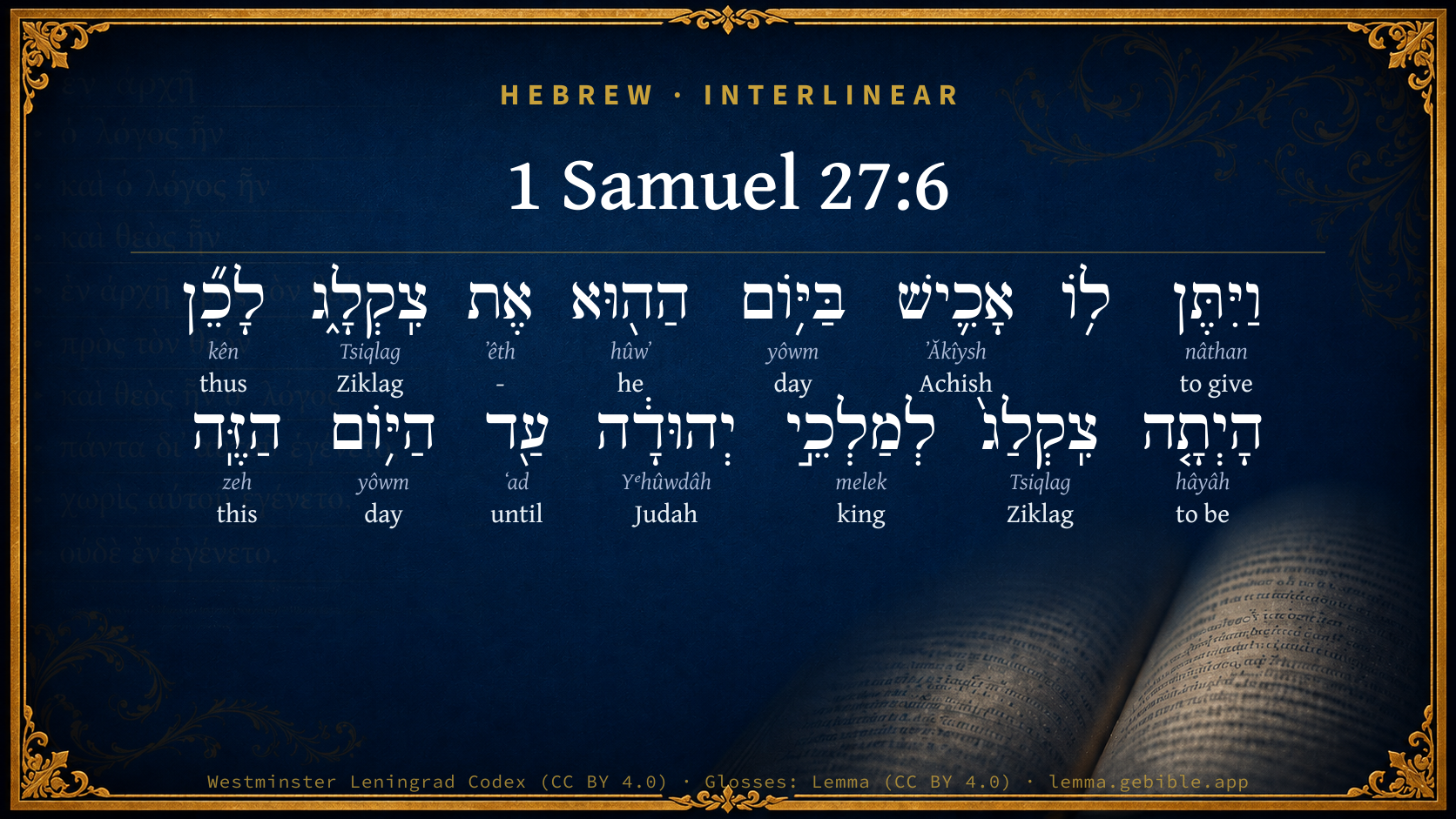
  1. וַיִּתֶּן nâthan H5414 “and · to give” Conjunction + Verb, Qal, Sequential Imperfect, 3rd Person, Masculine, Singular
  2. אָכִ֛ישׁ ʼĂkîysh H397 “Achish” Noun, Proper
  3. בַּיּ֥וֹם yôwm H3117 “in/at the · day” Preposition, Determined + Noun, Common, Masculine, Singular, Absolute
  4. הַה֖וּא hûwʼ H1931 “the · he” Particle, Definite Article + Pronoun, Personal, 3rd Person, Masculine, Singular
  5. אֶת ʼêth H853 “-” Particle, Direct Object
  6. לָכֵ֞ן kên H3651 “to/for · thus” Preposition + Adverb
  7. הָיְתָ֤ה hâyâh H1961 “to be” Verb, Qal, Perfect, 3rd Person, Feminine, Singular
  8. צִֽקְלַג֙ Tsiqlag H6860 “Ziklag” Noun, Proper
  9. לְמַלְכֵ֣י melek H4428 “to/for · kings of” Preposition + Noun, Common, Masculine, Plural, Construct
  10. יְהוּדָ֔ה Yᵉhûwdâh H3063 “Judah” Noun, Proper
  11. עַ֖ד ʻad H5704 “until” Preposition
  12. הַיּ֥וֹם yôwm H3117 “the · day” Particle, Definite Article + Noun, Common, Masculine, Singular, Absolute
  13. הַזֶּֽה zeh H2088 “the · this” Particle, Definite Article + Pronoun, Demonstrative, Masculine, Singular

About this verse

These counts appear in no published source. They are computed here, from the morphology-tagged text and Lemma’s own curated glosses. What Lemma adds →

15
words
12
distinct lemmas
Historical
section

Notable vocabulary

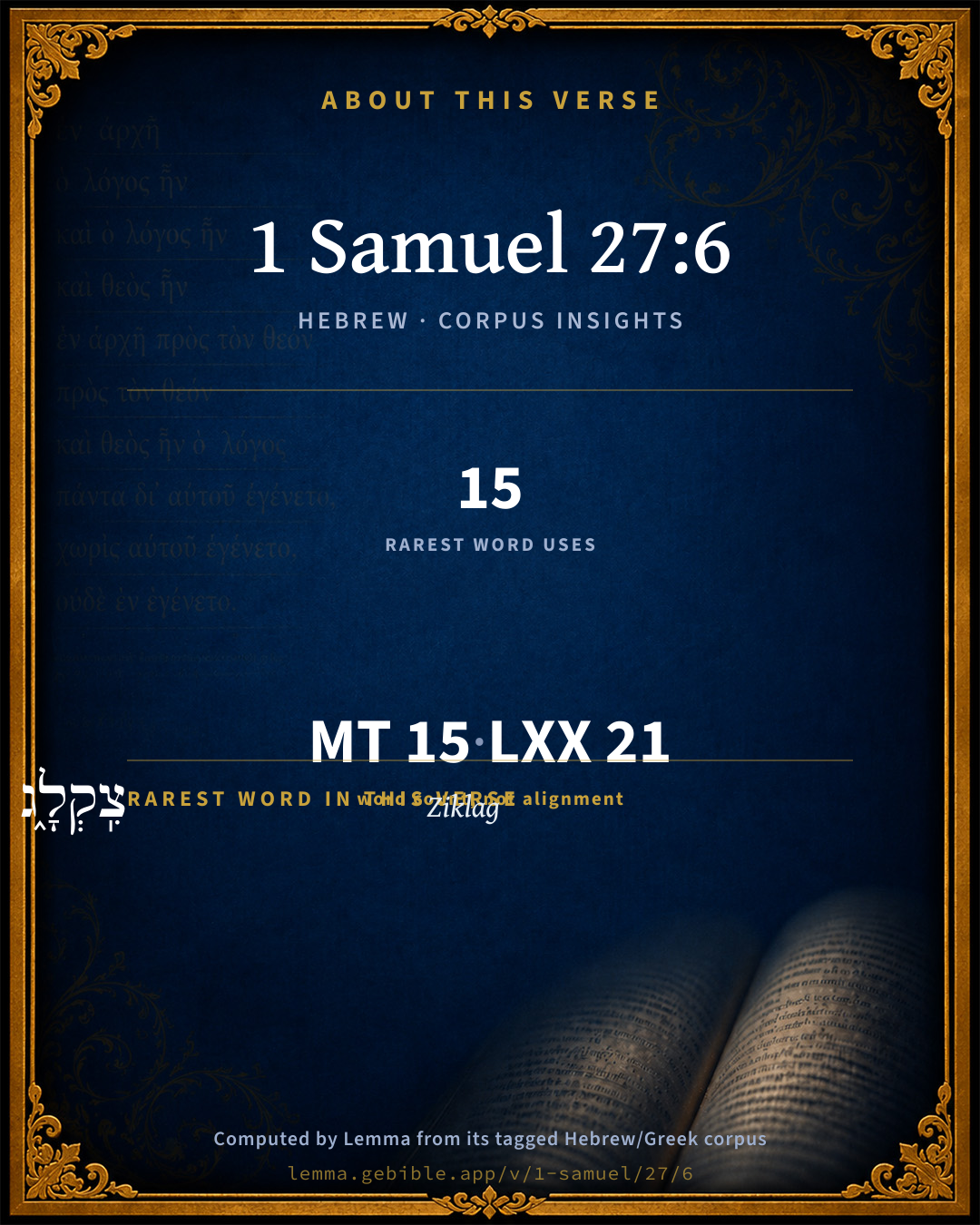
The rarest word here is צִֽקְלָ֑ג Ziklag H6860 — appearing just 15 times in the whole Hebrew Bible.

Shared distinctive vocabulary

צִֽקְלָ֑ג Ziklag H6860 occurs in 12 verses of the Hebrew Bible. Also found in:

Grammatical profile

  • 2 verbs
  • 7 nouns
  • 2 pronouns
  • 2 prepositions
  • 1 adverb
  • 1 particle

Verb forms

  • וַיִּתֶּן Qal · Sequential Imperfect
  • הָיְתָ֤ה Qal · Perfect

Repetition

Words recur within this verse — often emphatic in Hebrew:

  • בַּיּ֥וֹם day H3117 ×2
  • צִֽקְלָ֑ג Ziklag H6860 ×2

Hebrew & Septuagint length

In English translation the verse runs 18 words from the Hebrew and 21 from the Septuagint (LXX English) — closely comparable.

A rough comparison of the two English renderings, which tokenize alike — not a word-level alignment.

Word counts can differ between the Hebrew and the Greek without any difference in meaning — e.g. the Hebrew direct-object marker אֵת has no separate Greek word, and Greek often adds the article ὁ.

In the original languages it is 15 Hebrew tokens and 21 Greek tokens — but the two are counted differently (Hebrew bundles its prefixes and suffixes into one token; the Greek is in lemma form), so that isn’t a like-for-like length.

Cross-references

10

Topical passages linked to 1 Samuel 27:6 in the Treasury of Scripture Knowledge — connected by theme and wording, ordered by reader-vote popularity; previews shown in the World English Bible.

  • Nehemiah 11:28 and in Ziklag, and in Meconah and in the towns of it,
  • Joshua 15:31 and Ziklag, and Madmannah, and Sansannah,
  • Joshua 19:5 and Ziklag, and Beth Marcaboth, and Hazar Susah,
  • 1 Samuel 19:5 for he put his life in his hand, and struck the Philistine, and Yahweh worked a great victory for all Israel: you saw it, and did rejoice; why then will you sin against innocent blood, to kill David without a cause?
  • 1 Samuel 30:1 It happened, when David and his men were come to Ziklag on the third day, that the Amalekites had made a raid on the South, and on Ziklag, and had struck Ziklag, and burned it with fire,
  • 1 Samuel 30:14 We made a raid on the South of the Cherethites, and on that which belongs to Judah, and on the South of Caleb; and we burned Ziklag with fire.
  • 2 Samuel 1:1 It happened after the death of Saul, when David was returned from the slaughter of the Amalekites, and David had abode two days in Ziklag;
  • 1 Chronicles 4:30 and at Bethuel, and at Hormah, and at Ziklag,
  • 1 Chronicles 12:1 Now these are those who came to David to Ziklag, while he yet kept himself close because of Saul the son of Kish; and they were among the mighty men, his helpers in war.
  • 1 Chronicles 12:20 As he went to Ziklag, there fell to him of Manasseh, Adnah, and Jozabad, and Jediael, and Michael, and Jozabad, and Elihu, and Zillethai, captains of thousands who were of Manasseh.

Cross-references courtesy of OpenBible.info (CC BY 4.0).

Hebrew and Greek witnesses Masoretic Hebrew ↔ Greek Septuagint

The same verse in the two great witnesses to the Old Testament, shown verse-for-verse.

These are two independent witnesses, not word-aligned to each other, and the Septuagint is shown in lemma (dictionary) form.

Hebrew 1 Samuel 27:6 Masoretic · Westminster Leningrad Codex

וַיִּתֶּן ל֥וֹ אָכִ֛ישׁ בַּיּ֥וֹם הַה֖וּא אֶת צִֽקְלָ֑ג לָכֵ֞ן הָיְתָ֤ה צִֽקְלַג֙ לְמַלְכֵ֣י יְהוּדָ֔ה עַ֖ד הַיּ֥וֹם הַזֶּֽה

Then Achish gave him Ziklag that day: why Ziklag pertains to the kings of Judah to this day.

World English Bible · Public Domain

Greek LXX 1 Samuel 27:6 Septuagint · lemma form

καί δίδωμι αὐτός ἐν ὁ ἡμέρα ἐκεῖνος ὁ σεκελακ διά οὗτος γίγνομαι σεκελακ ὁ βασιλεύς ὁ ἰουδαία ἕως ὁ ἡμέρα οὗτος

And he gave him Sekelac in that day: therefore Sekelac came into possession of the king of Judea to this day.

LXX2012 (modern English Septuagint) · Public Domain

Hebrew: Westminster Leningrad Codex (CC BY 4.0). Greek: Septuagint (public domain); English from LXX2012 (modern English Septuagint) (Public Domain). How the Septuagint differs from the Hebrew →

Targum (Aramaic paraphrase)

1

The Targum is the ancient Jewish Aramaic paraphrase of the Hebrew Scriptures — an interpretive translation, not the Hebrew text itself. Onkelos (literal) and Pseudo-Jonathan (expansive) render the Torah, and Jonathan the Prophets. Coverage is partial: where no permissively-licensed English translation exists for a verse, only the Aramaic is shown. This is verse-level text, not a word-by-word alignment to the Hebrew.

  1. Targum Jonathan Prophets (Joshua–Malachi)
    וִיהַב לֵיה אָכִישׁ בְּיוֹמָא הַהוּא יַת צִקְלָג בְּכֵן הֲוָת צִקְלָג לְמַלְכַיָא דְבֵית יְהוּדָה עַד יוֹמָא הָדֵין:

    (no public-domain English translation for this verse)

    Targum Jonathan — Aramaic: “Mikraot Gedolot” (public domain). English: “Sefaria Community Translation” (CC0 1.0 (public-domain dedication)); “London "Chaldee Paraphrase," 1871” (public domain). Text via Sefaria.

Commentary

Notes on 1 Samuel 27:6 from classic Christian and Jewish commentators (each source and its license shown beneath its notes). The classic Christian expositions comment on the surrounding passage and are grouped to its opening verse, so a note may address several verses; the Jewish commentaries on the Tanakh (Rashi and others) are per-verse, so they appear only where the commentator wrote on this verse.

Lemma curates 59 commentaries, every one of them public domain or Creative Commons licensed, each selected and text-cleaned for this edition rather than reprinted as found. About our sources →

Trapp's Complete Commentary

John Trapp

1Sa 27:6 Then Achish gave him Ziklag that day: wherefore Ziklag pertaineth unto the kings of Judah unto this day.

Ver. 6. Then Achish gave him Ziklag that day.] Hungry Ziklag - augustia sextarii, so it signifieth, saith Pagnine - where David and his men were hard put to it for a poor subsistence; but it was fittest for his purpose, being an outter town, that he might forrage, and fetch in spoil undiscovered. And besides, it became a rendezvous for his friends out of Judea to resort unto him, as they did for his better advancement to the kingdom. {1Ch 12:1; 1Ch 12:22} But it was impoliticly done of Achish to assign him to such a city as belonged to Judea, {Jos 15:31} and bordered thereon.

John Trapp, A Commentary or Exposition upon All the Books of the Old and New Testament (1647–1656) — public domain. Text from a community e-Sword module.

The Biblical Illustrator

Joseph S. Exell

1Sa_27:6

Then Achish gave him Ziklag that day.

Gods restoring mercy

Throughout that season of declension and relapse (1Sa_27:1-12, Psa_10:1-18) the loving mercy of God hovered tenderly over Davids life. Gods restoring mercy was evident.

I. In inclining strong and noble men to identify themselves with Davids cause. Now these are they, says the chronicler, that came to David to Ziklag, while he yet kept himself close, because of Saul, the son of Kish; and they were among the mighty men, helpers in war (1Ch_12:1). And he proceeds to enumerate them. Some came from Sauls own tribe, experienced marksmen. Some came from the eastern bank of the Jordan, swimming it at the flood, mighty men of valour, men trained for war. Thine are we, David, etc. Evidently the spirit of discontent was abroad in the land. The people, weary of Sauls oppression and misgovernment, were beginning to realize that the true hope of Israel lay in the son of Jesse. They therefore went out to him without the camp, bearing his reproach. Thus, in silence and secrecy, loyal and true hearts are gathering around our blessed Lord, the centre of whose kingdom is not earthly but heavenly. Who then are willing to leave the tottering realm of the prince of this world, soon to be shattered on the last great battlefield of time, and identify themselves with the kingdom of the Son of David, which is destined to endure as long as the sun?

II. In extricating his servant from the false position into which he had drifted. The Philistines suddenly resolved on a forward policy. They were aware of the disintegration which was slowly dividing Sauls kingdom. When this campaign was being meditated, the guileless king assured David that he should accompany him. This was perhaps said as a mark of special confidence. It was, however, a very critical juncture with David. He had no alternative but to follow his liege lord into the battle; but every mile of those fifty or sixty which had to be traversed must have been trodden with lowering face and troubled heart. There was no hope for him in man. If by your mistakes and sins you have reduced yourself to a false position like this, do not despair; hope still in God. Confess and put away your sin, and humble yourself before Him, and He will arise to deliver you. You may have destroyed yourself; but in Him will be your help. An unexpected door of hope was suddenly opened in this valley of Anchor. When Achish reviewed his troops in Aphek, after the lords of the Philistines had passed on by hundreds and by thousands, David and his men passed on in the rearward with the king. This aroused the jealousy and suspicion of the imperious Philistine princes, and they came to Achish with fierce words and threats. What do these Hebrews here? etc. They pointed out how virulent a foe he had been, and how tempting the opportunity for him to purchase reconciliation with Saul by turning traitor in the fight. In the end, therefore, the king had to yield. It cost him much to inform David of the inevitable decision to which he was driven; but he little realized with what a burst of relief his announcement was received. He made a show of injured innocence: What have I done, and what has thou found in thy servant so long as I have been before thee unto this day, that I may not go and fight against the enemies of my lord the king? But his heart was not with his words; and it was with unfeigned satisfaction that he received the stringent command to depart from the camp with the morning light.

III. By the Divine dealings with him in respect to the burning of Ziklag. It was by Gods great mercy that the Philistine lords were so set against the continuance of David in their camp. They thought that they were executing a piece of ordinary policy, dictated by prudence and foresight; little realizing that they were the shears by which God was cutting the meshes of Davids net. As David was leaving the battlefield, a number of the men of Manasseh, who appear to have deserted to Achish, were assigned to him by the Philistines, lest they also should turn traitors on the field. Thus he left the camp with a greatly increased following. Here, too, was a proof of Gods tender thought, fulness, because at no time of his life was he in greater need of reinforcements than now. God anticipates coming trial, and reinforces us against its certain imminence and pressure. On reaching the spot which they accounted home, after three days exhausting march, the soldiers found it a heap of smouldering ruins; and instead of the welcome of wives and children, silence and desolation reigned supreme. The loyalty and devotion which he had never failed to receive from his followers were suddenly changed to vinegar and gall. But this was the moment of his return to God. In that dread hour, with the charred embers smoking at his feet; with this threat of stoning in his ears; his heart suddenly sprang back into its old resting place in the bosom of God. From this moment David is himself again, his old strong, glad, noble self. For the first time, after months of disuse, he bids Abiathar bring him the ephod, and he enquires of the Lord. With marvellous vigour he arises to pursue the marauding troop and he overtakes it. He withholds the impetuosity of his men till daylight wanes, loosing them from the leash in the twilight, and leading them to the work of rescue and vengeance with such irresistible impetuosity that not a man of them escaped. He was sweet as well as strong, as courteous as he was brave. (1Sa_30:26). The sunshine of Gods favour rested afresh upon his soul. (F. B. Meyer, B. A.)

Disaster and deliverance

To what fluctuations, what ebbs and flows of spiritual power, the same man is subject! Moral victories are often succeeded by terrible weaknesses. Days differ not so much as the men who live through them. Elijah flung himself beneath the juniper in unbelieving despondency directly after the fire from heaven had honoured his faith in God.

I. David nursing doubt. The pendulum of his faith has swung right back. His heroism, patience, and fortitude are gone. He turns his face and feet toward the enemies of Israel. Tides are not the sport of chance, nor is Davids declension. No man retreats before a conquered enemy unless there be reason and cause.

1. God is not consulted. David said in his heart (verse 1). He omitted to lay the case before God, and turned to commune with his own heart. He is simply a man moved by his fears and inclinations. How they shut us out from prayer! To the busy no time, to the perplexed no need, to the anxious no use. How hurriedly we move to obey these promptings when once admitted! If Davids inclinations tended towards Gath, he would not wish to ask God. Do not affect surprise; plunge the test right into your life. Are you afraid lest the answer from God should be against your inclinations?

2. Indifference to past mercies, I shall now perish one day by the hand of Saul. Unbelief finds voice here--open, blank, base, ungrateful unbelief! What reason had David to doubt Gods care for and over him?

3. Doubt thus led David to draw false conclusions. There is nothing better for me than that I should speedily escape into the land of the Philistines. The Seventh Psalm shows us how he suffered at this period of his life.

II. Distrust of God prepares the way for deceit. Doubt brought, forth deceit. Deceit led to cruelty (verse 11). He slew the Amalekites, so that none should tell the king.

1. Deceit producing difficulty. Achish tells David be must join with his people and fight against Israel (1Sa_27:1), and, moreover, appoints him captain of his bodyguard (verse 2). Deceit weaves difficulties which bind as chains. How could David go forward? Christian, you went with the multitude to do evil, and since then you have found the way of transgressors is hard.

III. Disaster following and yet producing deliverance. While David was away, the Amalekites, seizing their opportunity, pillaged and destroyed Ziklag. Home destroyed, wives and children gone, wounded where most susceptible in his affections, it was no wonder David was greatly distressed. If this was an hour of bitterness, it was also a blessed hour. Repentance does not always follow sorrow for sin--never, only in a gracious heart. Davids faith, chained down during these last sixteen months, sprang up through the gloom, and in the day of sorrow made itself heard. (H. E. Stone.)

.

The Biblical Illustrator, edited by Joseph S. Exell (c. 1880s–1900s) — public domain. Text from a community e-Sword module.

Joseph Benson's Commentary

1Sa 27:6. Achish gave him Ziklag — Not only that he might inhabit it for the present, but possess it as his own in future. This Achish did, either out of his royal bounty, or on condition of some service which David was to perform. Or perhaps he thought hereby to lay the greater obligations on David, whom he knew to be so able to serve him. In the division of the country it was first given to the tribe of Judah, Jos 15:31; and afterward to that of Simeon, who had a portion out of the land given to Judah, Jos 19:5. But the Philistines kept possession of it, so that neither of them enjoyed it, till now, by the gift of Achish, it became the peculiar inheritance of David and his successors. Ziklag pertaineth unto the kings of Judah unto this day — This and such clauses were evidently added after the substance of the books in which they are contained was written.

Joseph Benson's Commentary on the Old and New Testaments (1811–1818) — public domain. Text from a community e-Sword module.

Tyndale Open Study Notes

Tyndale Open Resources

27:6 Ziklag was about twenty-two miles southwest of Gath. • still belongs to the kings of Judah: This note was written between Solomon’s death (931 BC) and the start of the Babylonian exile (586 BC).

Tyndale Open Study Notes — © Tyndale Open Resources, licensed CC BY-SA 4.0. Text via the HelloAO Bible API.

Jamieson, Fausset & Brown

Robert Jamieson, A. R. Fausset & David Brown

Ziklag--Though originally assigned to Judah (Jos 15:31), and subsequently to Simeon (Jos 19:5), this town had never been possessed by the Israelites. It belonged to the Philistines, who gave it to David.

Jamieson, Fausset & Brown — Commentary Critical and Explanatory on the Whole Bible (1871) — public domain (CC PDM 1.0). Text via the HelloAO Bible API.

Adam Clarke's Commentary

Verse 6. Achish gave him Ziklag] Ziklag was at first given to the tribe of Judah, but afterwards it was ceded to that of Simeon, Jos 15:31; Jos 19:5. The Philistines had, however, made themselves masters of it, and held it to the time here mentioned; it then fell into the tribe of Judah again, and continued to be the property of the kings of Judah. This verse is a proof that this book was written long after the days of Samuel, and that it was formed by a later hand, out of materials which had been collected by a contemporary author. See the preface.

Adam Clarke's Commentary on the Bible (1810–1826) — public domain. Text from a community e-Sword/MySword module.

Ellicott's Commentary for English Readers

(6) Ziklag.—In the days of Joshua this place fell to the lot of Simeon (Jos_19:5). It was afterwards captured by the Philistines, not long before the time of David, and Keil thinks was left without inhabitants in consequence of this conquest. Its exact situation has never been clearly ascertained; it certainly lay far south, near the Amalekite borders.

Wherefore Ziklag pertaineth unto the kings of Judah unto this day.—These words supply us with a double note of time in the question of the date of this First Book of Samuel. They tell us that it was cast in its present shape after the revolt of Jeroboam, and certainly before the days of the carrying away of Israel to Babylon.

A Bible Commentary for English Readers, edited by Charles John Ellicott (1878–1897) — public domain. Text from a community e-Sword module.

The Cambridge Bible for Schools and Colleges

gen. ed. J. J. S. Perowne

6. Ziklag] One of the cities In the Negeb or “South Country,” originally assigned to Judah (Jos_15:31), but transferred to Simeon (Jos_19:5), and either never occupied by them or reconquered by the Philistines. Its site has not been identified, but was probably somewhere W. or N. W. of Beersheba, next to which it is mentioned in Neh_11:28.

Ziklag pertaineth unto the kings of Judah unto this day] This note from the hand of the compiler indicates that the book was composed after the separation of the kingdom of Judah from the kingdom of Israel, and before the Captivity. Ziklag was, so to speak, one of the crown estates of the royal house.

The Cambridge Bible for Schools and Colleges (gen. ed. J. J. S. Perowne; Cambridge University Press, 1878–1918) — public domain. Text from a community e-Sword module.

John Gill's Exposition

Then Achish gave him Ziklag that day,.... A city which in the division of the land was given to the tribe of Judah, and after that to the tribe of Simeon, Jos 15:31; though it seems not to have been possessed by either of them, at least not long, but soon came into the hands of the Philistines, who kept it till this time, and now it returned to its right owners; according to Bunting (g) it was twelve miles from Gath:

wherefore Ziklag pertaineth unto the kings of Judah unto this day; not to the tribe of Judah, though it originally belonged to it, but to the kings of it, it, being granted to David, who quickly after this became king of Judah; and this was annexed to the crown lands, and ever after enjoyed by the kings, of the house of Judah; for this was not given for a temporary habitation, but for perpetual possession. This clause seems to be added by the continuator of this history, after the death of Samuel; who might be Gad or Nathan; some say Ezra, and Abarbinel that Jeremiah was the writer of it.

(g) Travels, &c. p. 136.

John Gill's Exposition of the Whole Bible (1746–1763) — public domain (CC PDM 1.0). Text via the HelloAO Bible API.

Albert Barnes' Notes on the Bible

Ziklag - This was properly one of the cities of Simeon within the tribe of Judah (marginal references), but it had been taken possession of by the Philistines. The exact situation of it is uncertain.

Unto this day - This phrase, coupled with the title the kings of Judah, implies that this was written after the revolt of Jeroboam, and before the Babylonian captivity.

Albert Barnes' Notes on the Bible (1834–1885) — public domain. Text from a community e-Sword/MySword module.

Haydock's Catholic Bible Commentary

Day. This was written some time after the death of Samuel. --- Siceleg belonged at first to Juda, and was afterwards given to the tribe of Simeon, till it fell into the hands of the Philistines, and being restored by them to David, was considered afterwards as the property of the kings of Juda. It lay not far from Horma, Josue xix. 4.

George Leo Haydock (1774–1849), Haydock's Catholic Family Bible and Commentary, 1859 edition — public domain. Excludes Psalms (Douay-Rheims chapter numbering differs from Protestant) and Deuterocanonical books (Catholic canon only).

Matthew Poole's English Annotations

Gave him Ziklag; not only to inhabit, but to possess it as his own; which he did, to lay the greater obligations upon David, whom he knew so able to serve him.

Pertaineth unto the kings of Judah: it was given to the tribe of Judah before, Jos 15:31, and afterwards to the tribe of Simeon, Jos 19:5, whose inheritance was given them within the inheritance of the children of Judah, Jos 19.

1. But the Philistines kept the possession of it till this time, and were hitherto permitted to do so. And being now given by them to David, it now belonged not to the people of the tribe of Judah, to whom it was allotted before; but to the king of Judah, David and his heirs for ever.

Unto this day: this and some such clauses seem to have been added by some sacred writers after the main substance of the several books was written.

Matthew Poole's English Annotations on the Holy Bible (1683–1685) — public domain. Text from a community e-Sword/MySword module.

Whedon's Commentary on the Bible

Daniel D. Whedon

6. Gave him Ziklag — This town was situated in the extreme south of Palestine, (Jos_15:31; Jos_19:5.) but its exact location is unknown. A trace of the name may linger in the Wady Asluj, a day’s journey southwest of Beersheba. Near here are found the extensive ruins of Khalasah, identified by Robinson and Palmer with the Elusa of the Peutinger tables and of Jerome; but the ruins, says Palmer, are “so utterly destroyed that it is impossible to make out what the original ground plan might have been, though the course of one broad street can still be traced. The inhabitants of Gaza are in the habit of removing the stones for building purposes, and have thus nearly cleared the site, in many cases actually digging out the foundations of the houses.” May not this be the site of the ancient Ziklag?

Ziklag… unto this day — A remark inserted, probably, by a transcriber after the Book of Samuel was otherwise complete. See Introduction.

Daniel D. Whedon (gen. ed.), Commentary on the Old and New Testaments (1874–1909) — public domain. Text from a community e-Sword module.

John Wesley's Explanatory Notes

Gave Ziklag - Not only to inhabit, but to possess it as his own. Which he did, to lay the greater obligations upon David, whom he knew so able to serve him. It was given to the tribe of Judah before, Josh. xv, 31, but the Philistines kept the possession of it 'till this time. And being given by them to David, it now belonged not to the tribe of Judah; but to the king of Judah, David and his heirs forever. To this day - This, and some such clauses seem to have been added, after the main substance of the several books was written.

John Wesley, Explanatory Notes Upon the Whole Bible (1754–1765) — public domain. Text via the GEBible commentary corpus.

Lesson kit

Teaching starters — assembled from the data on this page, not authored interpretation. Every prompt links to the verse data it draws on. Edit before teaching.

1 Samuel, in the Historical, opens this verse with 15 words (12 distinct Hebrew lemmas). Its most distinctive word is Tsiqlag (“Ziklag”). A historical commentator’s framing appears above. Read the whole chapter for the surrounding context.

Discussion questions

  1. What does “Ziklag” (Tsiqlag) contribute to the verse as a whole?
  2. How does Joshua 15:31, which shares the word «Ziklag», read alongside this verse?
  3. What does the repetition of “day” (2× in this one verse) do in this verse?
  4. The translations on this page render this verse differently — a whole-verse word diff, not a word-by-word alignment. What might account for the different wordings?
  5. «וַיִּתֶּן» is a Qal Sequential Imperfect verb. How does that grammatical form shape the action described?
  6. Compare how Trapp's Complete Commentary and The Biblical Illustrator read this verse. Where do they agree or differ?

Things to notice

Reading settings

Reading text

Shown beneath each verse's original-language words.

Old Testament
Old Testament edition

Read the OT as the Masoretic Hebrew (MT) or the Greek Septuagint (LXX).

English shown for the Greek Septuagint (in the Hebrew ↔ Greek comparison).

Comparing translations? Open the Compare panel on any verse page to stack up to four side by side.