

Acts 2:9
Greek (Tischendorf 8th ed.) Acts 2:9 appears in the Greek New Testament. The text above is from the Tischendorf 8th edition. Each word links to its Strong’s number and a concise gloss. Click any word for its full Thayer’s Greek Lexicon entry.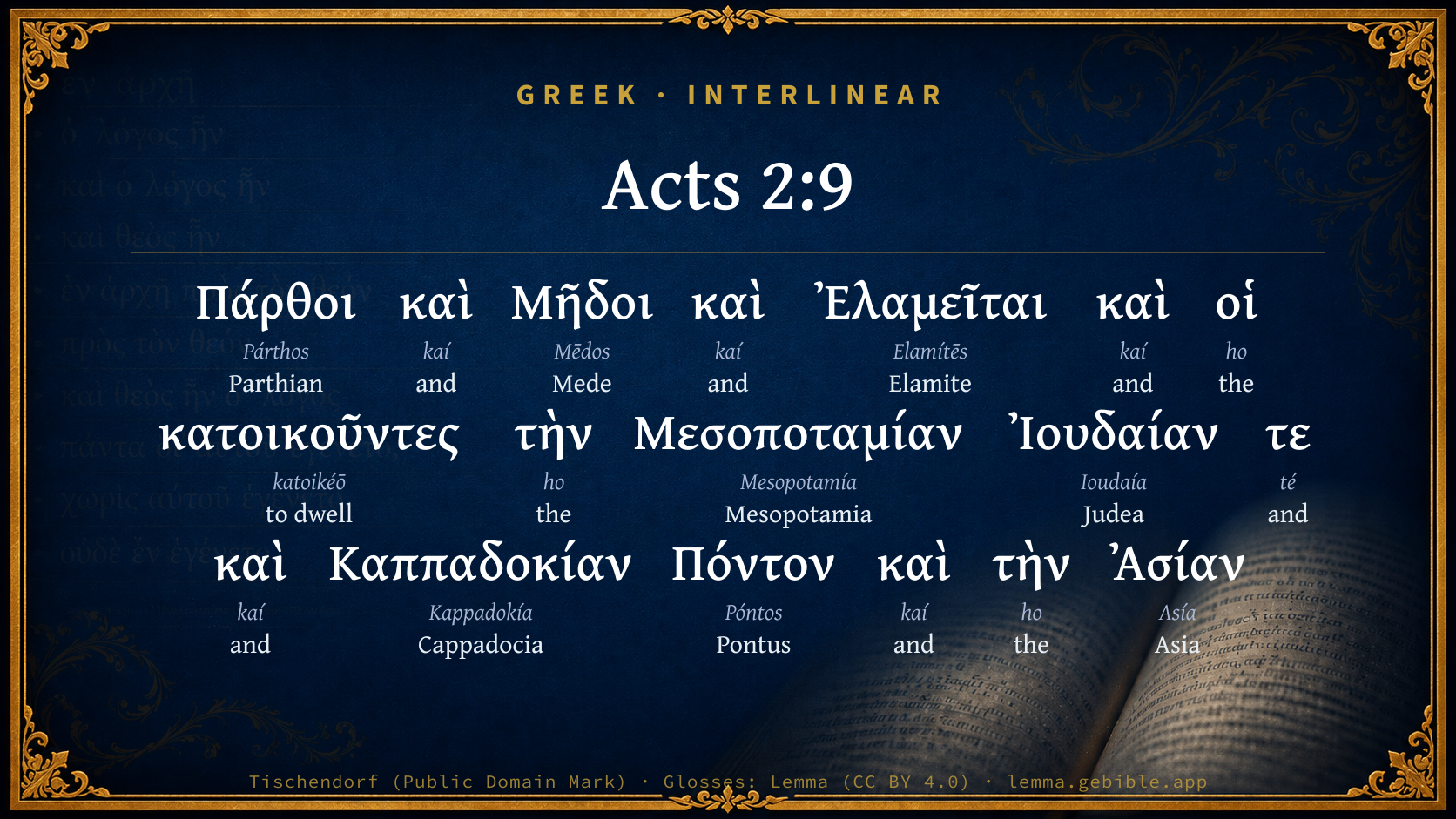
Parthians, Medes, Elamites, and people from Mesopotamia, Judea, Cappadocia, Pontus, Asia,
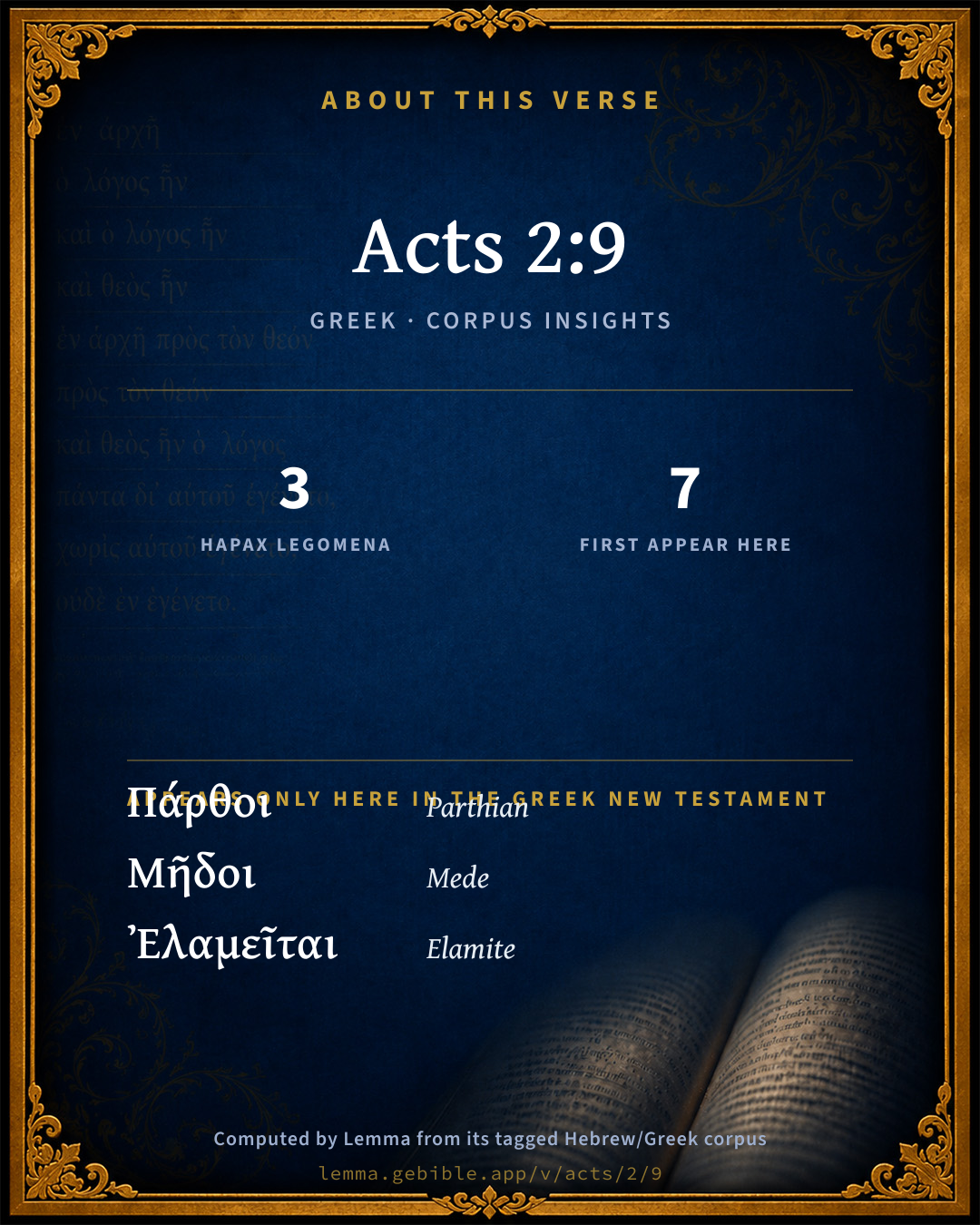
- 3 hapax legomena — only here in the Greek New Testament
- 7 first appearances in the Greek New Testament
Download a study sheet
One document with this verse’s original text, its word-by-word gloss line, the meaning frame, cross-references with their text, attributed commentary, and full source and license credits — printable, and it pastes into notes with its structure intact.
This verse Autodidact and up
A passage Seminary Student
Up to 50 verses in one chapter. A passage sheet keeps up to 6 commentary sources and 12 cross-references per verse, in the order this page ranks them, and says so on the sheet whenever that leaves anything out. Ask for a single verse and you get the Autodidact verse sheet above.
Everything on this page stays free to read, with no account — the sheet is a download of what is already on screen, not access to it.
Compare translations 3
The same verse in 3 English versions, stacked beneath the original-language interlinear above. Click any original word for its lexicon entry.
Each is an independent rendering of the whole verse — the interlinear is not word-aligned to these translations.
Highlighted words mark where these versions differ — a whole-verse word diff, not a word-by-word alignment.
-
World English Bible Public Domain
Parthians, Medes, Elamites, and people from Mesopotamia, Judea, Cappadocia, Pontus, Asia,
-
King James Version Public Domain
Parthians, and Medes, and Elamites, and the dwellers in Mesopotamia, and in Judaea, and Cappadocia, in Pontus, and Asia,
-
unfoldingWord Literal Text CC BY-SA 4.0
Parthians and Medes and Elamites, and those inhabiting Mesopotamia, Judea and also Cappadocia, Pontus and Asia,
unfoldingWord Literal Text — © unfoldingWord, licensed CC BY-SA 4.0. Word-aligned USFM3 via Door43 (git.door43.org/unfoldingWord/en_ult).
Show all 19 translations
Every available English version of this verse, each an independent rendering of the whole verse.
-
World English Bible Public Domain
Parthians, Medes, Elamites, and people from Mesopotamia, Judea, Cappadocia, Pontus, Asia,
-
Berean Standard Bible Public Domain
Parthians, Medes, and Elamites; residents of Mesopotamia, Judea and Cappadocia, Pontus and Asia,
-
Majority Standard Bible Public Domain
Parthians, Medes, and Elamites; residents of Mesopotamia, Judea and Cappadocia, Pontus and Asia,
-
King James Version Public Domain
Parthians, and Medes, and Elamites, and the dwellers in Mesopotamia, and in Judaea, and Cappadocia, in Pontus, and Asia,
-
American Standard Version (1901) Public Domain
Parthians and Medes and Elamites, and the dwellers in Mesopotamia, in Judaea and Cappadocia, in Pontus and Asia,
-
Revised Version (1885) Public Domain
Parthians and Medes and Elamites, and the dwellers in Mesopotamia, in Judaea and Cappadocia, in Pontus and Asia,
-
Geneva Bible (1599) Public Domain
Parthians, and Medes, and Elamites, and the inhabitants of Mesopotamia, and of Iudea, and of Cappadocia, of Pontus, and Asia,
-
Douay-Rheims (1899) Public Domain
Parthians, and Medes, and Elamites, and inhabitants of Mesopotamia, Judea, and Cappadocia, Pontus and Asia,
-
Young's Literal Translation Public Domain
Parthians, and Medes, and Elamites, and those dwelling in Mesopotamia, in Judea also, and Cappadocia, Pontus, and Asia,
-
Literal Standard Version CC BY-SA 4.0
Parthians, and Medes, and Elamites, and those dwelling in Mesopotamia, in Judea also, and Cappadocia, Pontus, and Asia,
-
Unlocked Literal Bible CC BY-SA 4.0
Parthians and Medes and Elamites, and those who live in Mesopotamia, in Judea and Cappadocia, in Pontus and Asia,
-
unfoldingWord Literal Text CC BY-SA 4.0
Parthians and Medes and Elamites, and those inhabiting Mesopotamia, Judea and also Cappadocia, Pontus and Asia,
-
Darby Bible Public Domain
Parthians, and Medes, and Elamites, and those who inhabit Mesopotamia, and Judaea, and Cappadocia, Pontus and Asia,
-
World Messianic Bible Public Domain
Parthians, Medes, Elamites, and people from Mesopotamia, Judea, Cappadocia, Pontus, Asia,
-
Webster's Bible Public Domain
Parthians, and Medes, and Elamites, and the dwellers in Mesopotamia, and in Judea, and Cappadocia, in Pontus, and Asia,
-
Free Bible Version CC BY-SA 4.0
Parthians, Medes and Elamites; people from Mesopotamia, Judaea and Cappadocia, Pontus and Asia,
-
Bible in Basic English Public Domain
Men of Parthia, Media, and Elam, and those living in Mesopotamia, in Judaea and Cappadocia, in Pontus and Asia,
-
Text-Critical English NT CC BY 4.0
Parthians, Medes, Elamites; those who dwell in Mesopotamia, Judea and Cappadocia, Pontus and Asia,
-
Tyndale New Testament (1534) Public Domain
Parthians Medes and Elamytes and the inhabiters of Mesopotamia of Iury and of Capadocia of Ponthus and Asia
Literal Standard Version (2020), Covenant Press — licensed CC BY-SA 4.0. Text via the HelloAO Bible API (eBible.org). Unlocked Literal Bible (unfoldingWord) — licensed CC BY-SA 4.0. Text via the HelloAO Bible API (eBible.org). unfoldingWord Literal Text — © unfoldingWord, licensed CC BY-SA 4.0. Word-aligned USFM3 via Door43 (git.door43.org/unfoldingWord/en_ult). Free Bible Version, Dr. Jonathan Gallagher — licensed CC BY-SA 4.0. Text via the HelloAO Bible API (eBible.org).
Word by word
More ways to search: Search by grammar → Find every occurrence → Compare this word →
Practice this passage: Drill this verse → Learn its vocabulary →
- Appears 1× in the Greek New Testament
- First appears here
- Part of Speech
- Noun
- Case
- Nominative
- Number
- Plural
- Gender
- Masculine
Full Thayer's Definition
- Πάρθοι Párthos G3934 “Parthian” Noun, Nominative, Plural, Masculine
- καὶ kaí G2532 “and” Conjunction
- Μῆδοι Mēdos G3370 “Mede” Noun, Nominative, Plural, Masculine
- καὶ kaí G2532 “and” Conjunction
- Ἐλαμεῖται Elamítēs G1639 “Elamite” Noun, Nominative, Plural, Masculine
- καὶ kaí G2532 “and” Conjunction
- οἱ ho G3588 “the” Article, Nominative, Plural, Masculine
- κατοικοῦντες katoikéō G2730 “to dwell” Verb, Present, Active, Participle, Nominative, Plural, Masculine
- τὴν ho G3588 “the” Article, Accusative, Singular, Feminine
- Μεσοποταμίαν Mesopotamía G3318 “Mesopotamia” Noun, Accusative, Singular, Feminine
- Ἰουδαίαν Ioudaía G2449 “Judea” Noun, Accusative, Singular, Feminine
- τε té G5037 “and” Particle
- καὶ kaí G2532 “and” Conjunction
- Καππαδοκίαν Kappadokía G2587 “Cappadocia” Noun, Accusative, Singular, Feminine
- Πόντον Póntos G4195 “Pontus” Noun, Accusative, Singular, Masculine
- καὶ kaí G2532 “and” Conjunction
- τὴν ho G3588 “the” Article, Accusative, Singular, Feminine
- Ἀσίαν Asía G773 “Asia” Noun, Accusative, Singular, Feminine
About this verse
These counts appear in no published source. They are computed here, from the morphology-tagged text and Lemma’s own curated glosses. What Lemma adds →
- 18
- words
- 12
- distinct lemmas
- Acts
- section
Notable vocabulary
3 hapax legomena — words that appear only here in the entire Greek New Testament:
First appearance in Scripture
These words make their first canonical appearance in the Greek New Testament here:
Shared distinctive vocabulary
Μεσοποταμίαν Mesopotamia G3318 occurs in 2 verses of the Greek New Testament. Also found in:
Cross-references
28Topical passages linked to Acts 2:9 in the Treasury of Scripture Knowledge — connected by theme and wording, ordered by reader-vote popularity; previews shown in the World English Bible.
- 1 Peter 1:1 Peter, an apostle of Jesus Christ, to the chosen ones who are living as strangers in the Dispersion in Pontus, Galatia, Cappadocia, Asia, and Bithynia,
- Acts 16:6 When they had gone through the region of Phrygia and Galatia, they were forbidden by the Holy Spirit to speak the word in Asia.
- Acts 18:2 He found a certain Jew named Aquila, a man of Pontus by race, who had recently come from Italy, with his wife Priscilla, because Claudius had commanded all the Jews to depart from Rome. He came to them,
- 2 Timothy 1:15 This you know, that all who are in Asia turned away from me; of whom are Phygelus and Hermogenes.
- Revelation 1:4 John, to the seven assemblies that are in Asia: Grace to you and peace, from God, who is and who was and who is to come; and from the seven Spirits who are before his throne;
- Genesis 14:1 It happened in the days of Amraphel, king of Shinar, Arioch, king of Ellasar, Chedorlaomer, king of Elam, and Tidal, king of Goiim,
- Genesis 24:10 The servant took ten camels, of his master's camels, and departed, having all goodly things of his master's in his hand. He arose, and went to Mesopotamia, to the city of Nahor.
- 2 Kings 17:6 In the ninth year of Hoshea the king of Assyria took Samaria, and carried Israel away to Assyria, and placed them in Halah, and on the Habor, the river of Gozan, and in the cities of the Medes.
- Isaiah 11:11 It shall happen in that day, that the Lord will set his hand again the second time to recover the remnant of his people, who shall remain, from Assyria, and from Egypt, and from Pathros, and from Cush, and from Elam, and from Shinar, and from Hamath, and from the islands of the sea.
- Daniel 8:2 I saw in the vision; now it was so, that when I saw, I was in Shushan the palace, which is in the province of Elam; and I saw in the vision, and I was by the river Ulai.
- Acts 6:9 But some of those who were of the synagogue called "The Libertines," and of the Cyrenians, of the Alexandrians, and of those of Cilicia and Asia arose, disputing with Stephen.
- Acts 19:10 This continued for two years, so that all those who lived in Asia heard the word of the Lord Jesus, both Jews and Greeks.
- Acts 19:31 Certain also of the Asiarchs, being his friends, sent to him and begged him not to venture into the theater.
- Genesis 10:22 The sons of Shem: Elam, Asshur, Arpachshad, Lud, and Aram.
- Deuteronomy 23:4 because they didn't meet you with bread and with water in the way, when you came forth out of Egypt, and because they hired against you Balaam the son of Beor from Pethor of Mesopotamia, to curse you.
- Judges 3:8 Therefore the anger of Yahweh was kindled against Israel, and he sold them into the hand of Cushan Rishathaim king of Mesopotamia: and the children of Israel served Cushan Rishathaim eight years.
- 1 Chronicles 19:6 When the children of Ammon saw that they had made themselves odious to David, Hanun and the children of Ammon sent one thousand talents of silver to hire them chariots and horsemen out of Mesopotamia, and out of Arammaacah, and out of Zobah.
- Ezra 6:2 There was found at Achmetha, in the palace that is in the province of Media, a scroll, and therein was thus written for a record:
- Isaiah 21:2 A grievous vision is declared to me; the treacherous man deals treacherously, and the destroyer destroys. Go up, Elam; besiege, Media; all the sighing of it have I made to cease.
- Daniel 8:20 The ram which you saw, that had the two horns, they are the kings of Media and Persia.
- Acts 7:2 He said, "Brothers and fathers, listen. The God of glory appeared to our father Abraham, when he was in Mesopotamia, before he lived in Haran,
- Acts 19:27 Not only is there danger that this our trade come into disrepute, but also that the temple of the great goddess Artemis will be counted as nothing, and her majesty destroyed, whom all Asia and the world worships."
- Acts 20:16 For Paul had determined to sail past Ephesus, that he might not have to spend time in Asia; for he was hastening, if it were possible for him, to be in Jerusalem on the day of Pentecost.
- Acts 20:18 When they had come to him, he said to them, "You yourselves know, from the first day that I set foot in Asia, how I was with you all the time,
- Romans 16:5 Greet the assembly that is in their house. Greet Epaenetus, my beloved, who is the first fruits of Achaia to Christ.
- 1 Corinthians 16:19 The assemblies of Asia greet you. Aquila and Priscilla greet you much in the Lord, together with the assembly that is in their house.
- 2 Corinthians 1:8 For we don't desire to have you uninformed, brothers, concerning our affliction which happened to us in Asia, that we were weighed down exceedingly, beyond our power, so much that we despaired even of life.
- Revelation 1:11 saying, "What you see, write in a book and send to the seven assemblies: to Ephesus, Smyrna, Pergamum, Thyatira, Sardis, Philadelphia, and to Laodicea."
Cross-references courtesy of OpenBible.info (CC BY 4.0).
Lesson kit
Teaching starters — assembled from the data on this page, not authored interpretation. Every prompt links to the verse data it draws on. Edit before teaching.
Acts, in the Acts, opens this verse with 18 words (12 distinct Greek lemmas). Its most distinctive word is Párthos (“Parthian”). A historical commentator’s framing appears above. Read the whole chapter for the surrounding context.
Discussion questions
- The word Párthos carries the sense “Parthian.” How does it shape the verse?
- This verse holds 3 words here found nowhere else in the Greek New Testament. What might the rare words draw attention to?
- 7 words here appear for the first time in Scripture. What is being introduced at this debut?
- Acts 7:2 shares the word «Mesopotamia» with this verse. How do the two illuminate each other?
- “and” occurs 5× in this one verse. What is the effect of the repetition?
- These translations render this verse differently; the difference is in the English rendering, not the original. What questions does that raise?
- Reading how Tyndale Open Study Notes and Bengel's Gnomon read this verse, where do the two commentators agree and where do they part?
Things to notice
- 3 words in this verse appear nowhere else in the Greek New Testament.
- 7 words make their first canonical appearance in Scripture here.
- These translations choose different wording for 6 words in this verse.
- “and” occurs 5× in this single verse.
- 12 distinct Greek lemmas span 18 words in this verse.
Commentary
Notes on Acts 2:9 from classic Christian and Jewish commentators (each source and its license shown beneath its notes). The classic Christian expositions comment on the surrounding passage and are grouped to its opening verse, so a note may address several verses; the Jewish commentaries on the Tanakh (Rashi and others) are per-verse, so they appear only where the commentator wrote on this verse.
Lemma curates 59 commentaries, every one of them public domain or Creative Commons licensed, each selected and text-cleaned for this edition rather than reprinted as found. About our sources →
Tyndale Open Study Notes
Tyndale Open Resources
Tyndale Open Study Notes — © Tyndale Open Resources, licensed CC BY-SA 4.0. Text via the HelloAO Bible API.
Bengel's Gnomon
Johann Albrecht Bengel
Bengel's Gnomon of the New Testament — English translation (T&T Clark, Edinburgh, 1860) — public domain. Text from a community e-Sword module.
Meyer's Critical & Exegetical Commentary
Heinrich August Wilhelm Meyer
Meyer — Critical and Exegetical Commentary on the New Testament — English translation by Peter Christie, edited by Frederick Crombie (T&T Clark, 1880) — public domain. Text from a community e-Sword module.
Expositor's Greek Testament
ed. W. Robertson Nicoll
The Expositor's Greek Testament, edited by W. Robertson Nicoll (1897–1910) — public domain. Text from a community e-Sword module.
Jamieson, Fausset & Brown
Robert Jamieson, A. R. Fausset & David Brown
Jamieson, Fausset & Brown — Commentary Critical and Explanatory on the Whole Bible (1871) — public domain (CC PDM 1.0). Text via the HelloAO Bible API.
Adam Clarke's Commentary
Adam Clarke's Commentary on the Bible (1810–1826) — public domain. Text from a community e-Sword/MySword module.
Ellicott's Commentary for English Readers
A Bible Commentary for English Readers, edited by Charles John Ellicott (1878–1897) — public domain. Text from a community e-Sword module.
The Cambridge Bible for Schools and Colleges
gen. ed. J. J. S. Perowne
The Cambridge Bible for Schools and Colleges (gen. ed. J. J. S. Perowne; Cambridge University Press, 1878–1918) — public domain. Text from a community e-Sword module.
John Gill's Exposition
John Gill's Exposition of the Whole Bible (1746–1763) — public domain (CC PDM 1.0). Text via the HelloAO Bible API.
Trapp's Complete Commentary
John Trapp
John Trapp, A Commentary or Exposition upon All the Books of the Old and New Testament (1647–1656) — public domain. Text from a community e-Sword module.
Albert Barnes' Notes on the Bible
Albert Barnes' Notes on the Bible (1834–1885) — public domain. Text from a community e-Sword/MySword module.
Matthew Poole's English Annotations
Matthew Poole's English Annotations on the Holy Bible (1683–1685) — public domain. Text from a community e-Sword/MySword module.
Whedon's Commentary on the Bible
Daniel D. Whedon
Daniel D. Whedon (gen. ed.), Commentary on the Old and New Testaments (1874–1909) — public domain. Text from a community e-Sword module.
The Pulpit Commentary
The Pulpit Commentary (1880–1919), ed. H.D.M. Spence-Jones & Joseph S. Exell — public domain. Text from a community e-Sword module.
John Wesley's Explanatory Notes
John Wesley, Explanatory Notes Upon the Whole Bible (1754–1765) — public domain. Text via the GEBible commentary corpus.
Godbey's Commentary on the New Testament
William B. Godbey
William B. Godbey, Commentary on the New Testament (1896–1900) — public domain. Text from a community e-Sword module.
McGarvey & Pendleton's Commentaries
J. W. McGarvey
J. W. McGarvey (with Philip Y. Pendleton), Commentaries on the New Testament (The Fourfold Gospel, 1914; Acts; and the epistles) — public domain. Text from a community e-Sword/MySword module.
The People's New Testament
B. W. Johnson
B. W. Johnson's The People's New Testament with Notes (1889–1891) — public domain. Electronic text from the Christian Classics Ethereal Library (CCEL) ThML edition.
Cambridge Greek Testament for Schools and Colleges
Cambridge Greek Testament for Schools and Colleges (Cambridge University Press, 1896; 21 vols, various authors incl. Carr, Maclear, Plummer, Farrar, Lumby, Moule, M. R. James, Simcox) — public domain. Text from a community e-Sword module.
Alford’s Greek Testament
Henry Alford
Henry Alford, The Greek Testament (1849–1861) — public domain. Text from a community e-Sword module.
Vincent's Word Studies in the New Testament
Marvin R. Vincent
Marvin R. Vincent, Word Studies in the New Testament (1887–1900) — public domain. Text from a community e-Sword/MySword module.